B2B Sales Pipeline: Stages, Metrics & Strategy for 2026
A practical 2026 guide to building a B2B sales pipeline that actually predicts revenue: the 7 stages, the metrics that matter, and the data hygiene that keeps it clean.
A B2B sales pipeline is the operating system of your revenue team. When it is accurate, forecasting feels like reading a weather report. When it is messy, every quarter ends in a scramble. This guide breaks down what a modern pipeline looks like in 2026, the stages and metrics that matter, where deals leak, and how clean contact data keeps the whole machine honest.
TL;DR#
- A B2B sales pipeline is the visual, stage-by-stage map of every deal from first touch to closed-won (or closed-lost).
- Most healthy B2B pipelines run 5–7 stages; the exact number matters less than consistent exit criteria for each stage.
- The metrics that actually predict revenue are stage conversion rate, average deal size, sales cycle length, and pipeline coverage — not raw deal count.
- Pipelines rot from the top: bad contact data inflates early stages and destroys forecast accuracy. Verified emails and enriched contacts are the cheapest fix.
- Tools like a bulk email finder and an email verifier keep the top of funnel clean so the rest of the pipeline can be trusted.
What is a B2B sales pipeline?#
A B2B sales pipeline is a structured view of where every active deal sits in your sales process. Think of it like an airport control tower: each plane (deal) is at a known altitude (stage), moving on a known heading (next step), and the tower can tell you which ones are about to land and which are circling with no fuel.
Technically, a pipeline is a series of defined stages — each with entry and exit criteria — that a deal moves through. A deal only advances when it meets the objective requirement for the next stage, not when a rep "feels good" about it. That discipline is what separates a pipeline you can forecast from a wish list.
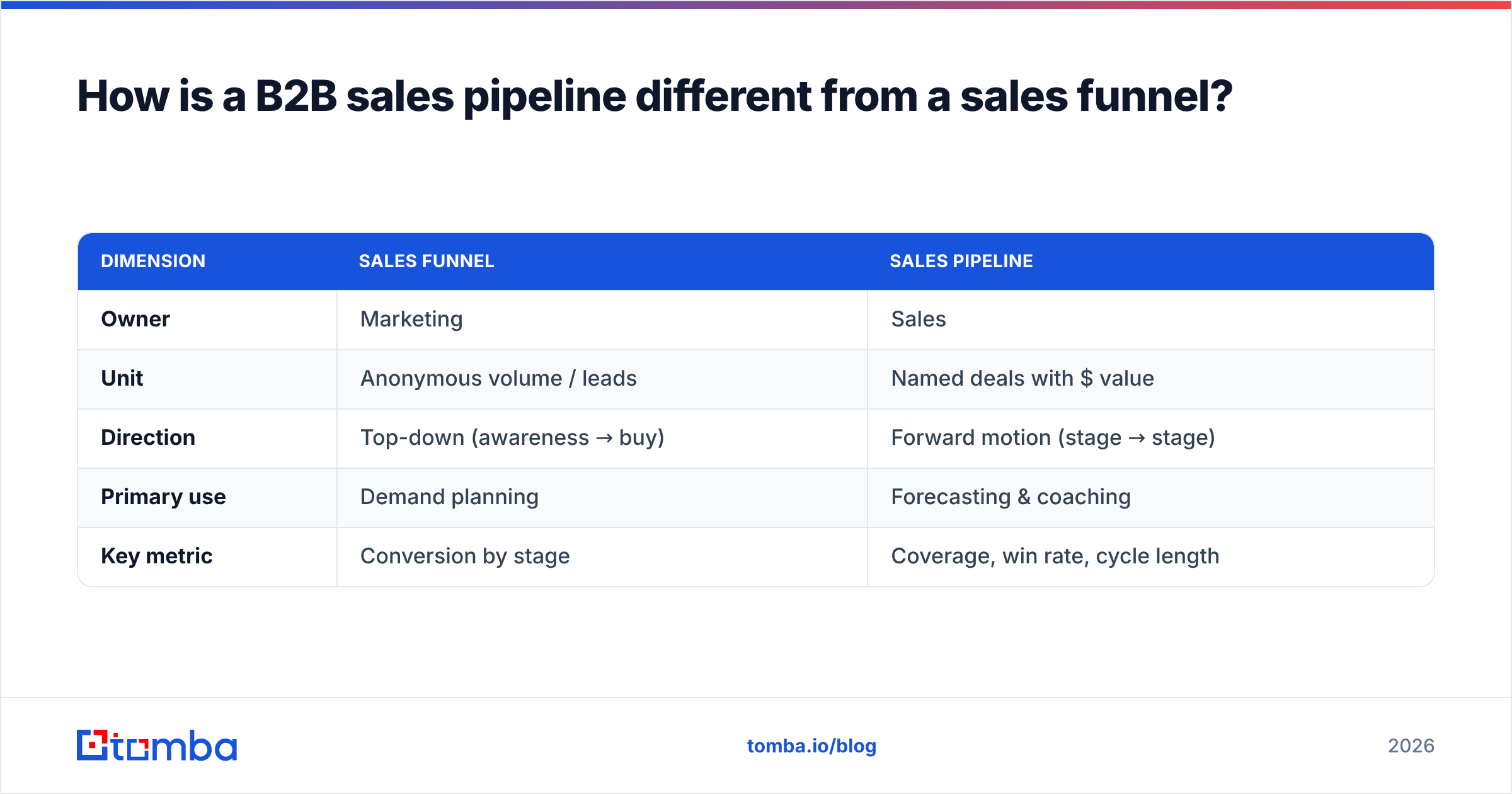
People often confuse the pipeline with the sales funnel. The funnel is a top-down marketing view of volume shrinking from awareness to purchase. The pipeline is the bottom-up sales view of specific named deals and their dollar value. You need both, but reps live in the pipeline.
What are the stages of a B2B sales pipeline?#
Here is a practical seven-stage model that fits most B2B motions, from SMB to mid-market. Use it as a starting template, then cut stages you do not need.
- Prospecting — You identify accounts and contacts that match your ICP and gather verified contact details. Exit criterion: a reachable, qualified contact exists in the CRM.
- Outreach / Connect — First meaningful touch (email, call, LinkedIn). Exit criterion: the prospect responds or books time.
- Discovery — You qualify need, budget, authority, and timing. Exit criterion: confirmed pain plus a defined buying process.
- Demo / Evaluation — You map the solution to their problem. Exit criterion: stakeholders agree the solution fits.
- Proposal — Pricing and terms are on the table. Exit criterion: prospect is reviewing a real quote.
- Negotiation — Procurement, security, and contract details. Exit criterion: verbal yes or redlines agreed.
- Closed-Won / Closed-Lost — Signed, or a documented reason for the loss that feeds your learning loop.
Notice that stage one is not "send a bunch of emails." It is identifying real, reachable contacts. A pipeline built on guessed addresses and info@ catch-alls is fiction. This is exactly where an email finder and a domain search earn their keep — you fill the top of the pipeline with people who actually exist at accounts that actually match.
Which B2B sales pipeline metrics actually matter?#
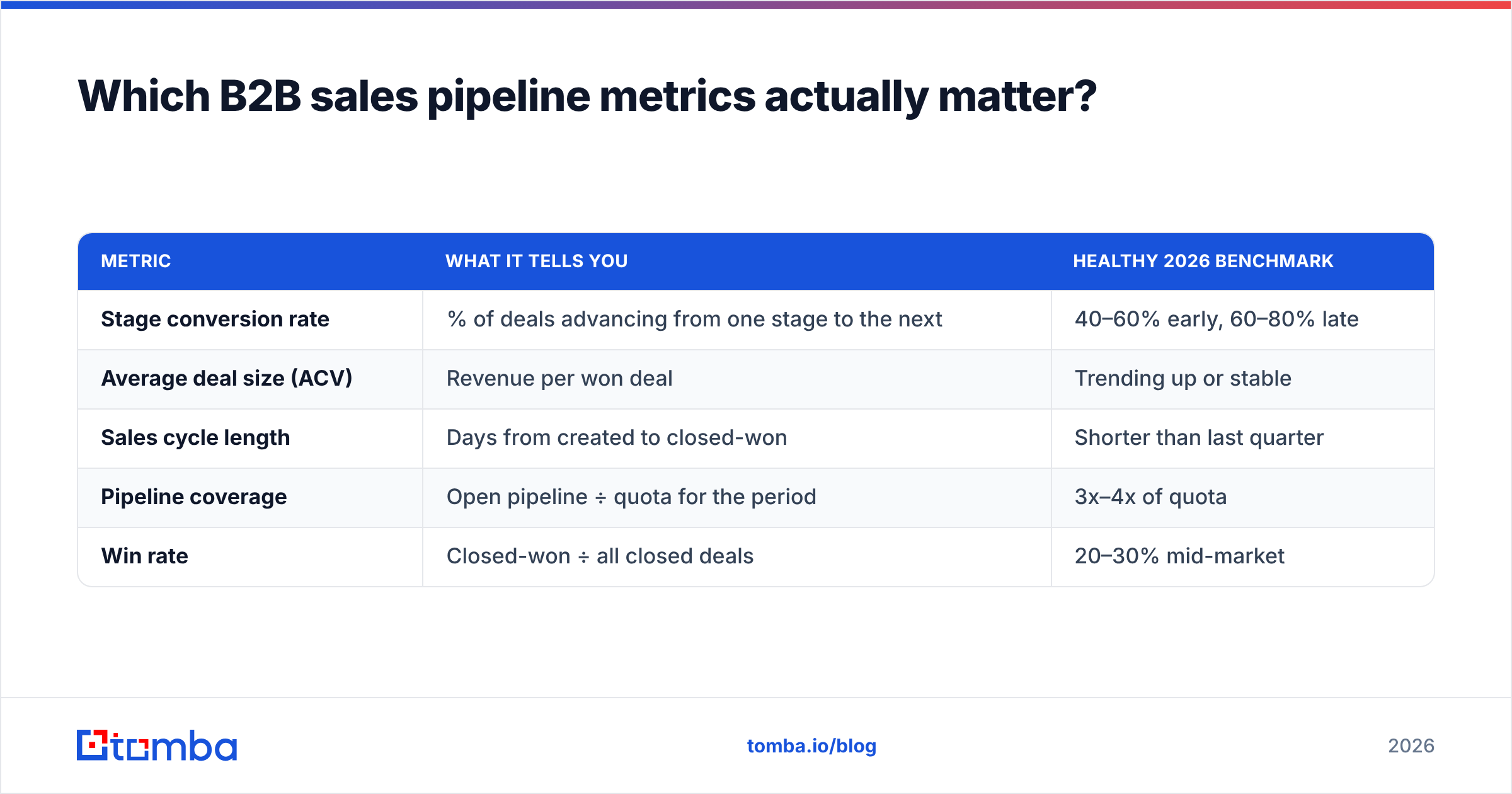
Most teams drown in vanity numbers. Five metrics carry almost all the predictive signal. Track these religiously and ignore the rest until these are healthy.
| Metric | What it tells you | Healthy 2026 benchmark |
|---|---|---|
| Stage conversion rate | % of deals advancing from one stage to the next | 40–60% early, 60–80% late |
| Average deal size (ACV) | Revenue per won deal | Trending up or stable |
| Sales cycle length | Days from created to closed-won | Shorter than last quarter |
| Pipeline coverage | Open pipeline ÷ quota for the period | 3x–4x of quota |
| Win rate | Closed-won ÷ all closed deals | 20–30% mid-market |
Pipeline coverage is the one executives obsess over, and rightly so. If your team needs $1M and only has $1.5M in open pipeline, you are already behind — average win rates mean you will land roughly $300–450K. Coverage of 3x–4x gives you room for normal slippage.
Stage conversion rate is your diagnostic tool. A sudden drop between Discovery and Demo usually means weak qualification, not weak demos. Reading conversion stage by stage tells you where to coach, which is far more useful than a single blended win rate. For a deeper definition of the denominator, see Tomba's glossary entry on win rate.
How do you build a B2B sales pipeline from scratch?#
Building a pipeline is less about software and more about agreement. Follow this sequence:
- Define your ICP in writing. Industry, company size, region, tech stack, trigger events. Vague ICP equals a polluted pipeline.
- Map your buyer's process, not your sales process. Stages should mirror how customers actually buy. If procurement always involves a security review, that is a stage.
- Write exit criteria for every stage. Objective and checkable. "Has budget confirmed" beats "seems interested."
- Source clean contact data. Build target account lists, then find and verify the decision-makers. Garbage contacts at stage one compound into garbage forecasts at stage seven.
- Instrument it in your CRM. Use a real CRM with required fields per stage so reps cannot skip qualification.
- Set a review cadence. Weekly pipeline reviews focused on next steps and stuck deals — not status theater.
Most teams nail steps one through three, then ruin everything at step four by buying a stale list or scraping unverified emails. Your pipeline is only as trustworthy as the contacts feeding it.
Why does bad data destroy a B2B sales pipeline?#
Bad data is the silent killer of pipeline accuracy. Here is the chain reaction: a rep imports 500 "leads" from a cheap list. Thirty percent of the emails are dead or catch-all. Bounces tank your sender reputation, so even the good emails stop landing. Reps mark these as "contacted," inflating the Outreach stage. Forecasts built on those numbers overshoot, leadership plans hiring around fake revenue, and the quarter misses.
The fix is unglamorous but decisive: verify before you send, and enrich before you qualify. Three habits keep data clean:
- Verify every email with an email verifier before it enters a sequence — catch invalids and risky catch-alls up front.
- Enrich thin contacts so reps qualify against real titles, company size, and seniority via data enrichment.
- De-duplicate on import so one account does not appear as three deals and triple-count your coverage.
According to research compiled by HubSpot, B2B data decays at roughly 22–30% per year as people change jobs. That means a pipeline you do not actively maintain is meaningfully wrong within months. Verification is not a one-time cleanup; it is hygiene.
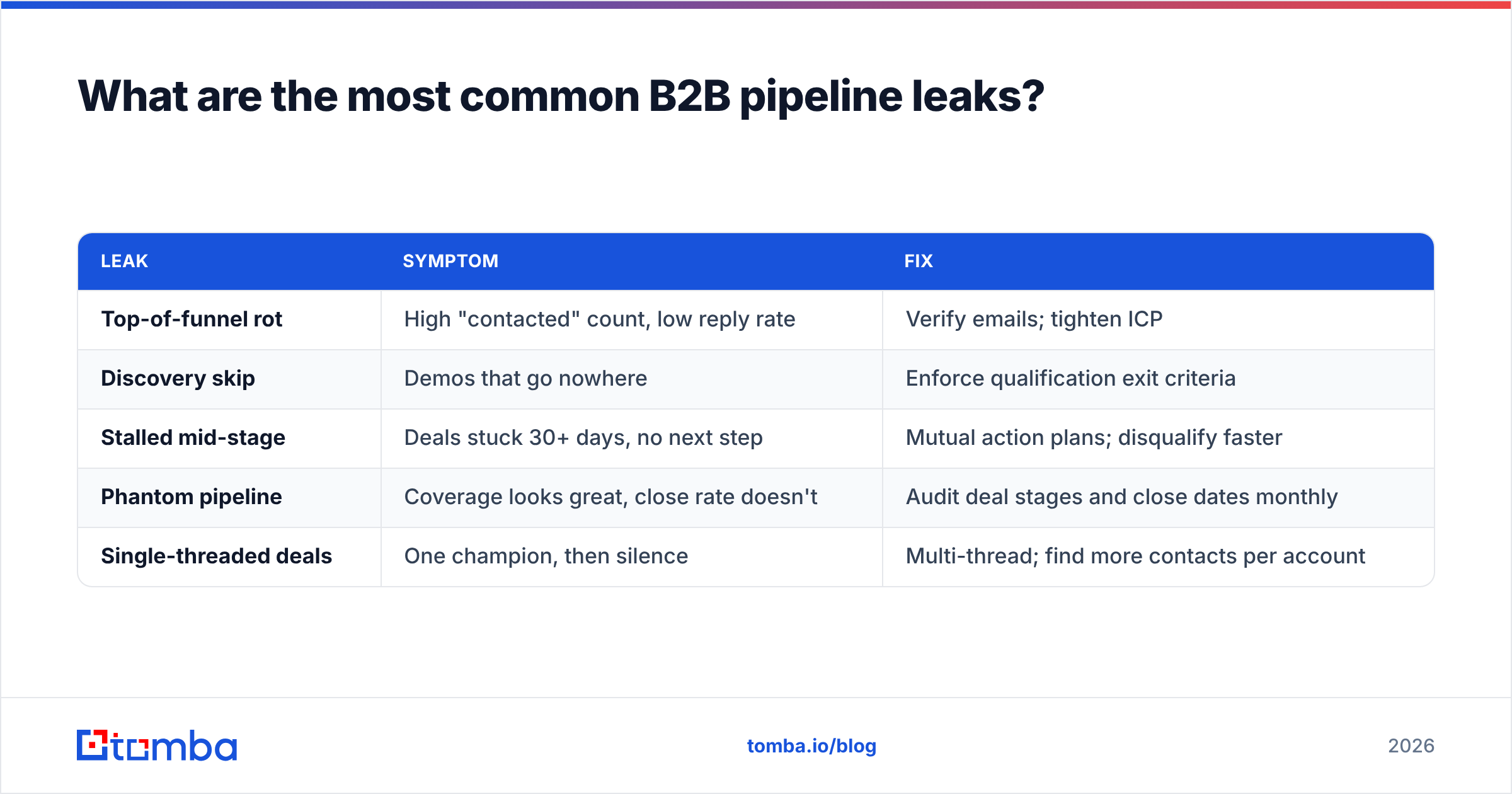
What are the most common B2B pipeline leaks?#
Deals do not vanish randomly. They leak at predictable points. Find yours and patch them.
| Leak | Symptom | Fix |
|---|---|---|
| Top-of-funnel rot | High "contacted" count, low reply rate | Verify emails; tighten ICP |
| Discovery skip | Demos that go nowhere | Enforce qualification exit criteria |
| Stalled mid-stage | Deals stuck 30+ days, no next step | Mutual action plans; disqualify faster |
| Phantom pipeline | Coverage looks great, close rate doesn't | Audit deal stages and close dates monthly |
| Single-threaded deals | One champion, then silence | Multi-thread; find more contacts per account |
Two of these — top-of-funnel rot and single-threading — are data problems disguised as process problems. If your reps can only reach one person per account, a single job change kills the deal. Finding additional stakeholders with a LinkedIn finder or pulling the full contact map with domain search turns fragile, single-threaded deals into resilient, multi-threaded ones.
How is a B2B sales pipeline different from a sales funnel?#
Quick conclusion: the funnel measures volume, the pipeline measures specific deals and dollars. They answer different questions.
| Dimension | Sales funnel | Sales pipeline |
|---|---|---|
| Owner | Marketing | Sales |
| Unit | Anonymous volume / leads | Named deals with $ value |
| Direction | Top-down (awareness → buy) | Forward motion (stage → stage) |
| Primary use | Demand planning | Forecasting & coaching |
| Key metric | Conversion by stage | Coverage, win rate, cycle length |
In practice they connect at the handoff: a marketing qualified lead exits the funnel and — if sales accepts it — enters the pipeline as a real opportunity. The cleaner that handoff and its data, the less friction between the two teams.
How do you manage and forecast a B2B pipeline in 2026?#
Modern pipeline management leans on three practices that were optional five years ago and are table stakes now.
Run weekly inspections on next steps, not status. The only question that matters in a pipeline review is "what is the next committed action and date?" Deals without a scheduled next step are not in your pipeline; they are in your imagination.
Use AI for hygiene, humans for judgment. AI is excellent at flagging stalled deals, scoring engagement, and surfacing accounts that went quiet. It is poor at deciding whether a CFO actually has budget. Let automation clean and prioritize; let reps qualify. Tools across the sales automation category increasingly do the first part well.
Forecast with a coverage model, not a gut feel. Take open pipeline by stage, apply historical stage-to-close conversion rates, and weight by close date. Compare the output to your gut. When they disagree, the data is usually right and the gut is anchored on a favorite deal. Independent analysts like Gartner consistently find that data-driven forecasting beats intuition-led forecasting on accuracy — and the gap widens as deal volume grows.
For teams that want to enrich and verify at scale without manual work, the Tomba API plugs finding, verification, and enrichment directly into your CRM workflow so contacts are validated the moment they enter the pipeline. You can also compare Tomba pricing tiers to match volume to budget.
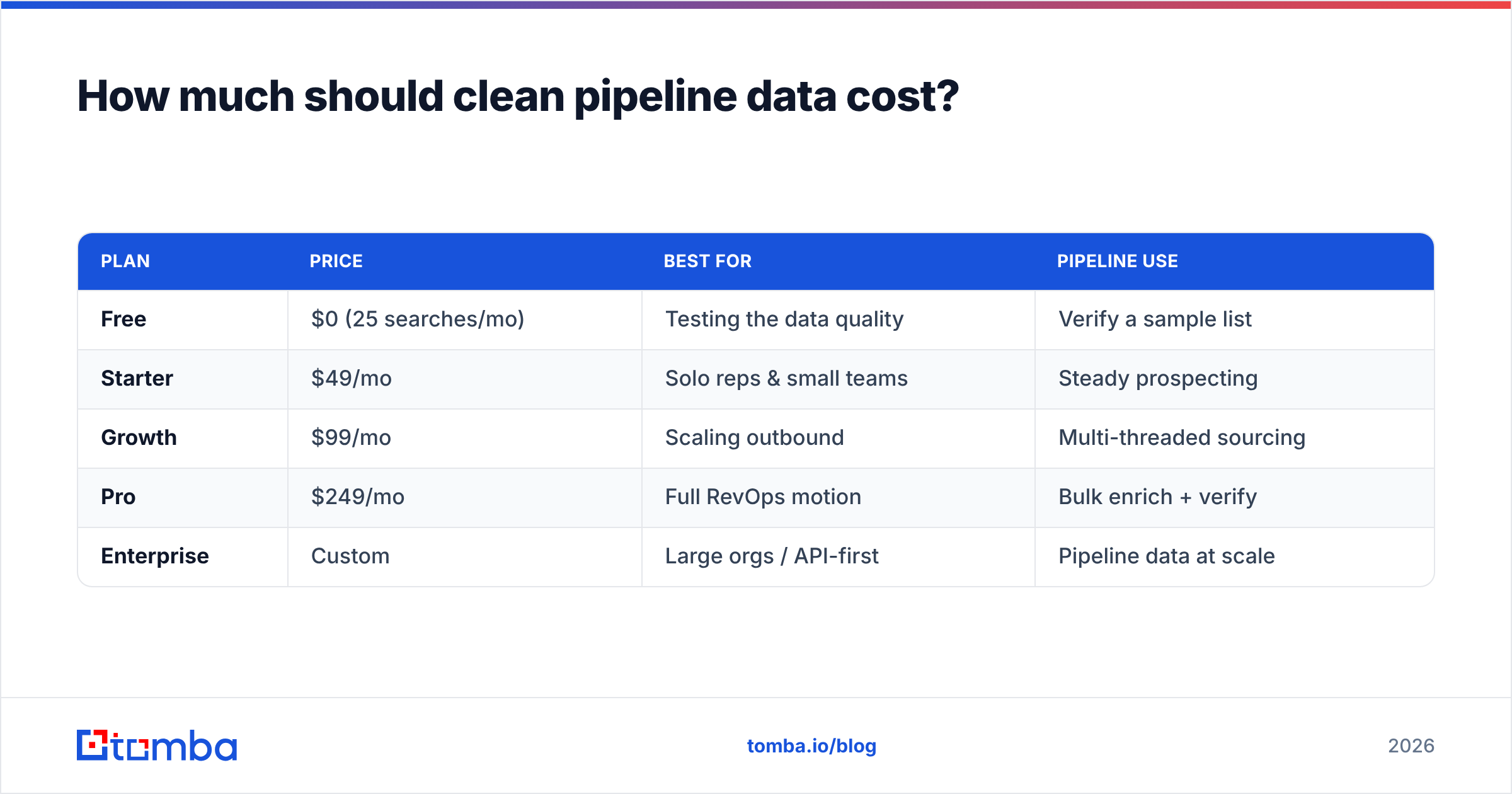
How much should clean pipeline data cost?#
Less than you think, and far less than a missed quarter. Here is how Tomba's plans map to pipeline stages:
| Plan | Price | Best for | Pipeline use |
|---|---|---|---|
| Free | $0 (25 searches/mo) | Testing the data quality | Verify a sample list |
| Starter | $49/mo | Solo reps & small teams | Steady prospecting |
| Growth | $99/mo | Scaling outbound | Multi-threaded sourcing |
| Pro | $249/mo | Full RevOps motion | Bulk enrich + verify |
| Enterprise | Custom | Large orgs / API-first | Pipeline data at scale |
The math is simple. If verified contacts lift your reply rate even a few points, the plan pays for itself before the month ends. The expensive option is the "free" scraped list that bounces and burns your domain.
Closing: keep the top of your pipeline clean#
A B2B sales pipeline can only forecast as well as the data feeding stage one. Tighten your ICP, write real exit criteria, inspect next steps weekly — but start by making sure the contacts entering your pipeline are real, reachable, and verified. The Tomba Email Finder finds professional email addresses by name, company, or domain, and pairs with the verifier and enrichment tools so every deal you forecast rests on a contact that actually exists. Build the pipeline on solid ground, and the forecast stops being a guess.
// get started
Find, verify and enrich your first contacts today
Start on the free plan with 25 searches a month, then scale when your team is ready.
Free plan · No credit card required · GDPR & CCPA
// about the author