B2B Sales Pipeline Management: The Complete 2026 Playbook
Most B2B pipelines lie. Stages drift, deals rot, and forecasts miss by 30%. Here's how to build a pipeline that actually predicts revenue in 2026 — stages, metrics, hygiene, and the data that feeds it.
TL;DR
- B2B sales pipeline management is the discipline of moving deals through defined stages while keeping the data clean enough to forecast revenue accurately.
- A pipeline is only as honest as its hygiene: stale deals, vague stage definitions, and bad contact data quietly destroy your forecast.
- Track four metrics that actually predict revenue — stage conversion, average deal velocity, win rate, and pipeline coverage — not just "total pipeline value."
- Exit criteria per stage beat gut feel. A deal advances only when objective conditions are met, not when a rep "feels good" about it.
- Clean, verified contact data feeds the whole machine. Garbage prospects in means inflated, unforecastable pipeline out.
What is B2B sales pipeline management?#
B2B sales pipeline management is the process of tracking, organizing, and advancing every active deal through a defined sequence of stages — from first touch to closed-won — so you can predict revenue and spot problems early.
Think of your pipeline like a factory conveyor belt. Raw materials (leads) enter one end, move through stations (stages), and finished products (closed deals) come out the other. Pipeline management is the job of the floor manager: making sure nothing gets stuck, nothing falls off, and you can tell from a glance how many units will ship this quarter. When the belt jams at one station, you fix that station — you don't just push harder at the end.
The technical definition: pipeline management combines stage design, deal hygiene, metric tracking, and forecasting into one repeatable system. It sits at the center of your sales process and pipeline operations and connects directly to your CRM, your prospecting motion, and your revenue forecast.
The reason most B2B teams struggle isn't effort — it's honesty. A pipeline full of deals that should have been disqualified months ago looks impressive and forecasts terribly. Good pipeline management is mostly about ruthlessly removing what doesn't belong.
Why do most B2B pipelines fail to predict revenue?#
Most pipelines fail because they measure activity, not probability. A pipeline worth "$2M" tells you nothing if half those deals are dead and the rep just hasn't updated the stage.
Here are the failure modes that show up again and again:
- Vague stage definitions. If "Qualified" means something different to every rep, your conversion rates are noise. Stages need objective exit criteria — a checklist, not a vibe.
- No deal decay rules. Deals sit in "Negotiation" for 90 days with zero activity and still count toward the forecast. Real pipelines have a clock on every stage.
- Bad contact data at the top. When you prospect into wrong emails, generic inboxes, or people who left the company, deals enter the pipeline already broken. You can't manage your way out of a data problem.
- Single-metric tunnel vision. Teams obsess over total pipeline value and ignore velocity and coverage — the numbers that actually tell you whether you'll hit quota.
- Manual hygiene. If keeping the pipeline clean depends on reps remembering to log things, it will rot. Automation and clear rules carry the load.
The cost is real. According to research summarized by HubSpot, sales reps spend a large share of their week on non-selling administrative work, and much of that is fighting messy CRM data. A pipeline you can't trust forces everyone — reps, managers, and the CFO — to make decisions on fiction.
What are the stages of a B2B sales pipeline?#
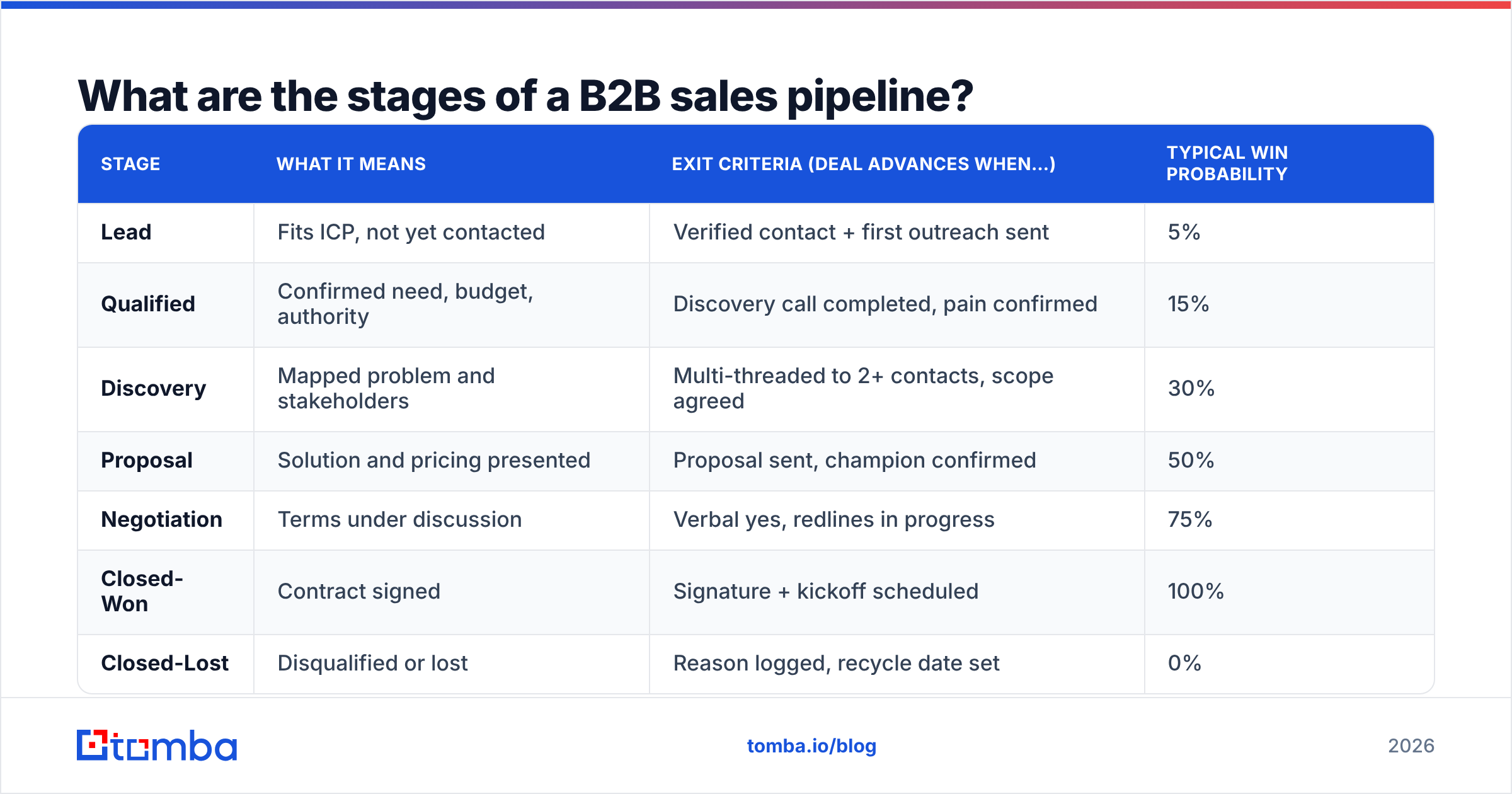
The exact names vary, but a healthy B2B pipeline has six to seven stages, each with a clear entry trigger and exit criteria. The point of stages is to convert a fuzzy relationship into a measurable probability.
Here's a reference model with concrete exit criteria you can adapt:
| Stage | What it means | Exit criteria (deal advances when…) | Typical win probability |
|---|---|---|---|
| Lead | Fits ICP, not yet contacted | Verified contact + first outreach sent | 5% |
| Qualified | Confirmed need, budget, authority | Discovery call completed, pain confirmed | 15% |
| Discovery | Mapped problem and stakeholders | Multi-threaded to 2+ contacts, scope agreed | 30% |
| Proposal | Solution and pricing presented | Proposal sent, champion confirmed | 50% |
| Negotiation | Terms under discussion | Verbal yes, redlines in progress | 75% |
| Closed-Won | Contract signed | Signature + kickoff scheduled | 100% |
| Closed-Lost | Disqualified or lost | Reason logged, recycle date set | 0% |
Two rules make this work. First, exit criteria are objective — a discovery call either happened or it didn't. Second, probability is tied to the stage, not the rep's optimism. When a deal sits in Proposal, it carries the Proposal probability for forecasting, full stop. This removes the "happy ears" bias that wrecks forecasts.
Notice that the first stage depends entirely on a verified contact. If you're pushing leads into the pipeline with guessed email addresses, your conversion math is broken before stage two. This is why a reliable email finder and an email verifier sit upstream of every good pipeline — they decide what's even allowed onto the belt.
Which metrics actually matter in pipeline management?#
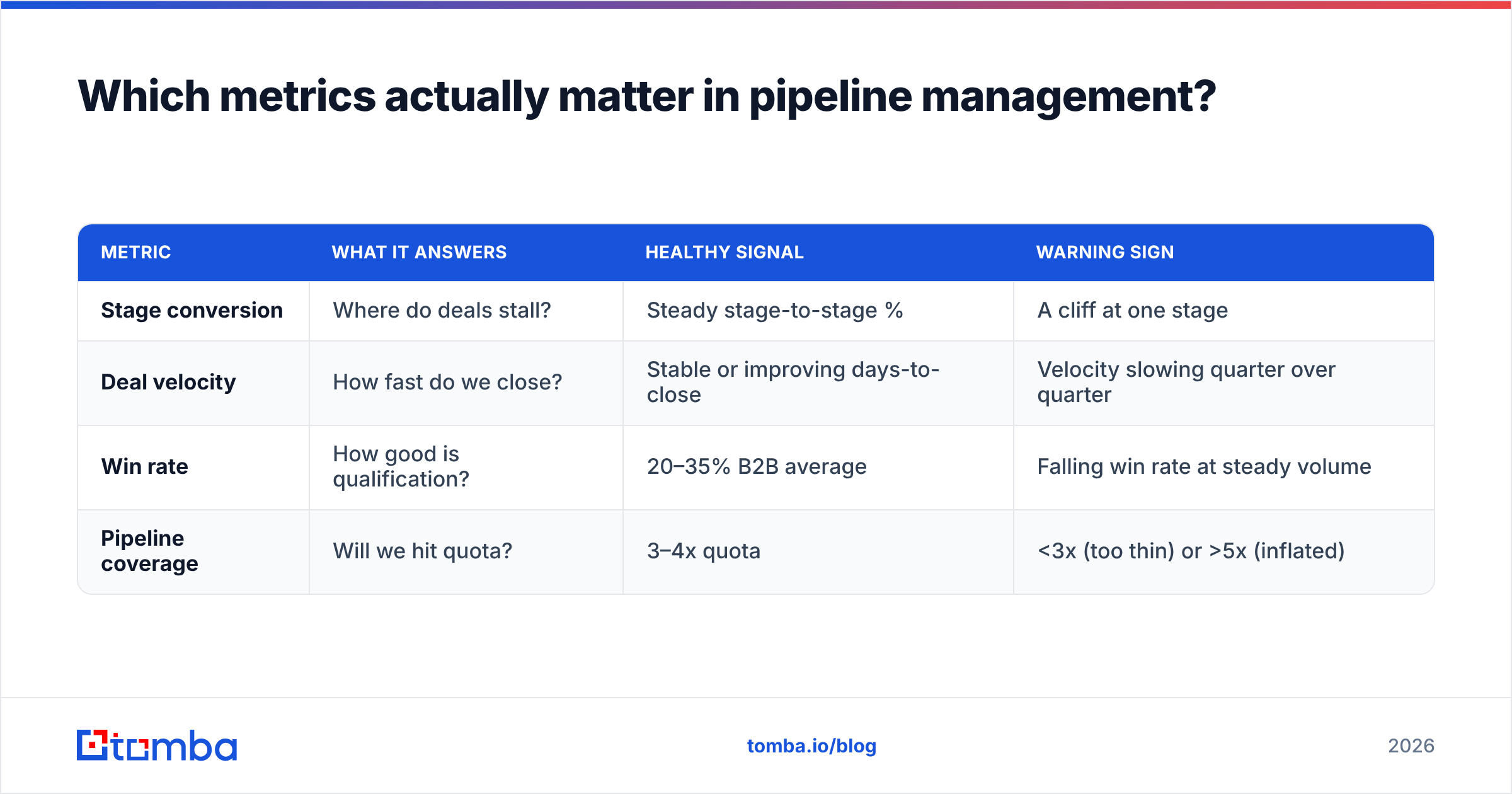
Four metrics predict revenue better than any dashboard full of vanity numbers: stage conversion rate, deal velocity, win rate, and pipeline coverage. Master these and you can forecast a quarter before it happens.
1. Stage conversion rate. The percentage of deals that move from one stage to the next. If only 20% of Proposals become Negotiations, your problem isn't lead volume — it's your proposal or pricing. Conversion rates tell you where the belt jams.
2. Deal velocity. How fast deals move through the full pipeline, in days. Slowing velocity is an early warning that something — a competitor, a budget freeze, a weak champion — is dragging deals down. Velocity also lets you calculate how much pipeline you need now to hit a number 90 days out.
3. Win rate. Closed-won divided by all closed deals (won + lost). A rising win rate with steady volume means your qualification is getting sharper. Track it by win rate segment — by source, by industry, by rep — to find what's working.
4. Pipeline coverage. Total open pipeline value divided by your quota for the period. A common benchmark is 3x to 4x coverage; less than that and you're almost certainly going to miss. More than 5x often signals junk deals inflating the number.
| Metric | What it answers | Healthy signal | Warning sign |
|---|---|---|---|
| Stage conversion | Where do deals stall? | Steady stage-to-stage % | A cliff at one stage |
| Deal velocity | How fast do we close? | Stable or improving days-to-close | Velocity slowing quarter over quarter |
| Win rate | How good is qualification? | 20–35% B2B average | Falling win rate at steady volume |
| Pipeline coverage | Will we hit quota? | 3–4x quota | <3x (too thin) or >5x (inflated) |
You don't need a data science team for this. A clean CRM and a weekly review will surface all four. The hard part isn't calculating them — it's trusting the underlying data, which brings us back to hygiene.
How do you keep a B2B pipeline clean?#
Pipeline hygiene is the practice of continuously removing dead deals, updating stages, and verifying data so your forecast reflects reality. Without it, every other tactic in this guide is built on sand.
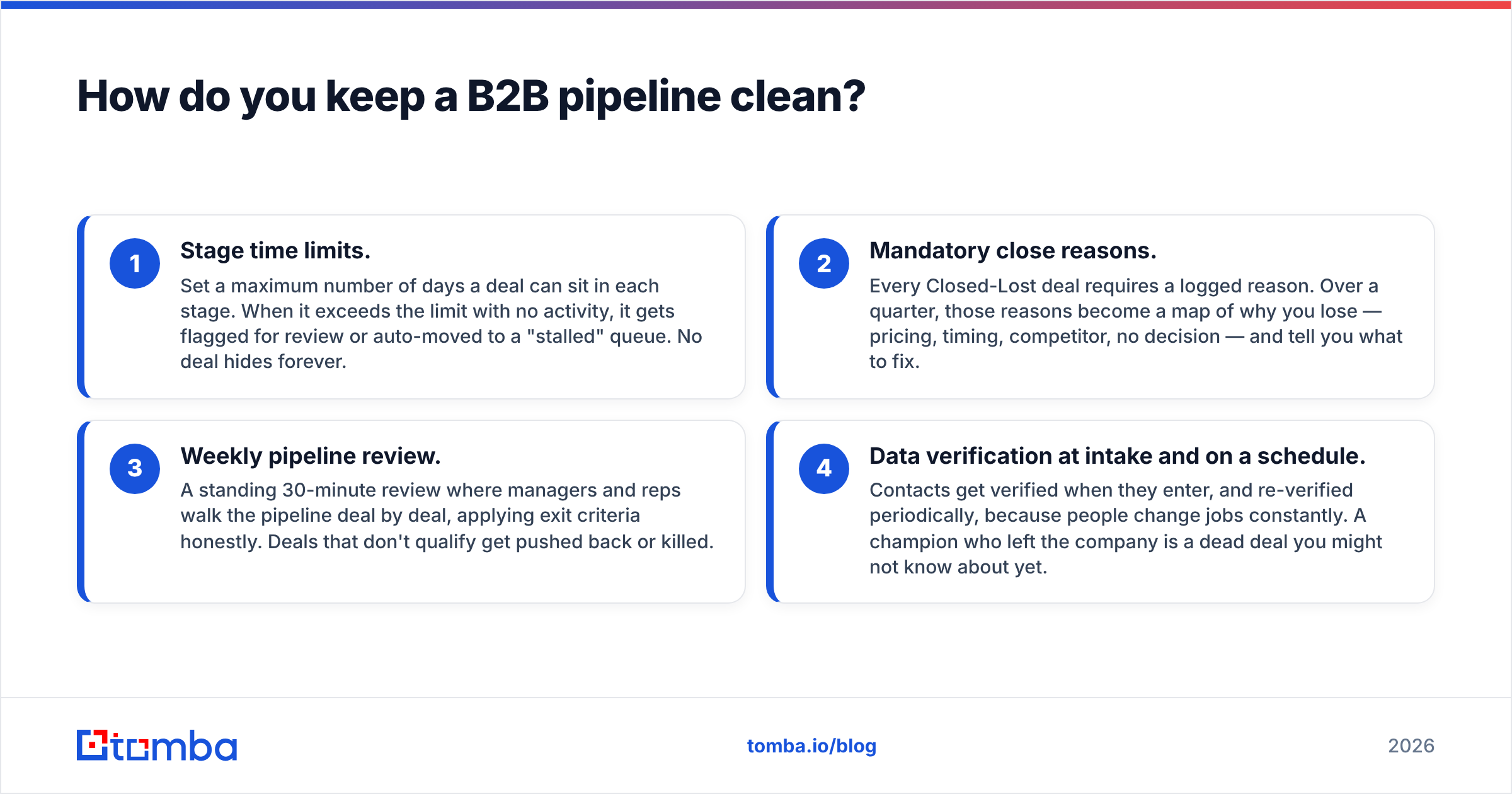
A practical hygiene system has four moving parts:
- Stage time limits. Set a maximum number of days a deal can sit in each stage. When it exceeds the limit with no activity, it gets flagged for review or auto-moved to a "stalled" queue. No deal hides forever.
- Mandatory close reasons. Every Closed-Lost deal requires a logged reason. Over a quarter, those reasons become a map of why you lose — pricing, timing, competitor, no decision — and tell you what to fix.
- Weekly pipeline review. A standing 30-minute review where managers and reps walk the pipeline deal by deal, applying exit criteria honestly. Deals that don't qualify get pushed back or killed.
- Data verification at intake and on a schedule. Contacts get verified when they enter, and re-verified periodically, because people change jobs constantly. A champion who left the company is a dead deal you might not know about yet.
That last point is where most teams under-invest. B2B contact data decays fast — a meaningful percentage of professionals change roles every year, which means email addresses, phone numbers, and even company affiliations go stale silently. You can run bulk verify passes across your open pipeline to catch dead contacts before they poison your forecast, and use data enrichment to fill the gaps when a key stakeholder's details are missing or outdated.
Hygiene feels like overhead until the first quarter you forecast within 5% of actual. Then it feels like a superpower.
How does contact data quality affect your pipeline?#
Contact data is the raw material of the entire pipeline — when it's wrong, every downstream metric lies. A pipeline built on unverified contacts inflates coverage, distorts conversion rates, and produces forecasts no one should trust.
Consider the chain reaction. You prospect into 500 contacts. If 20% of those emails are invalid or belong to people who've left, you're not working 500 deals — you're working 400 real ones plus 100 ghosts that will never convert. Those ghosts still enter your pipeline as "Leads," still count toward coverage, and still drag down your stage-one conversion rate. Worse, reps waste hours chasing them.
This is why the best-run B2B teams treat data quality as a pipeline function, not an afterthought:
- Verify before you prospect. Use an email verifier to confirm deliverability before a contact ever enters the CRM. Bounces hurt your sender reputation and your forecast.
- Find the right person, not a generic inbox. A domain search surfaces named decision-makers instead of info@ catch-alls, so you multi-thread to real stakeholders.
- Enrich what's thin. When you have a name but no contact details — or a deal stalls because your only champion went quiet — contact enrichment and a phone finder reopen the conversation.
- Re-verify on a cadence. Quarterly re-verification of open-deal contacts catches job changes before they become surprise losses.
For B2B teams specifically, accuracy of contact data correlates directly with forecast accuracy. Tools that publish their verification methodology and accuracy benchmarks — and let you check work through resources like G2 reviews — are worth more than tools that just dump volume. Tomba's verification layer is built for exactly this: keeping the top of your pipeline honest so the rest of it can be too. You can see where the data comes from rather than taking accuracy on faith.
What tools do you need for B2B pipeline management?#
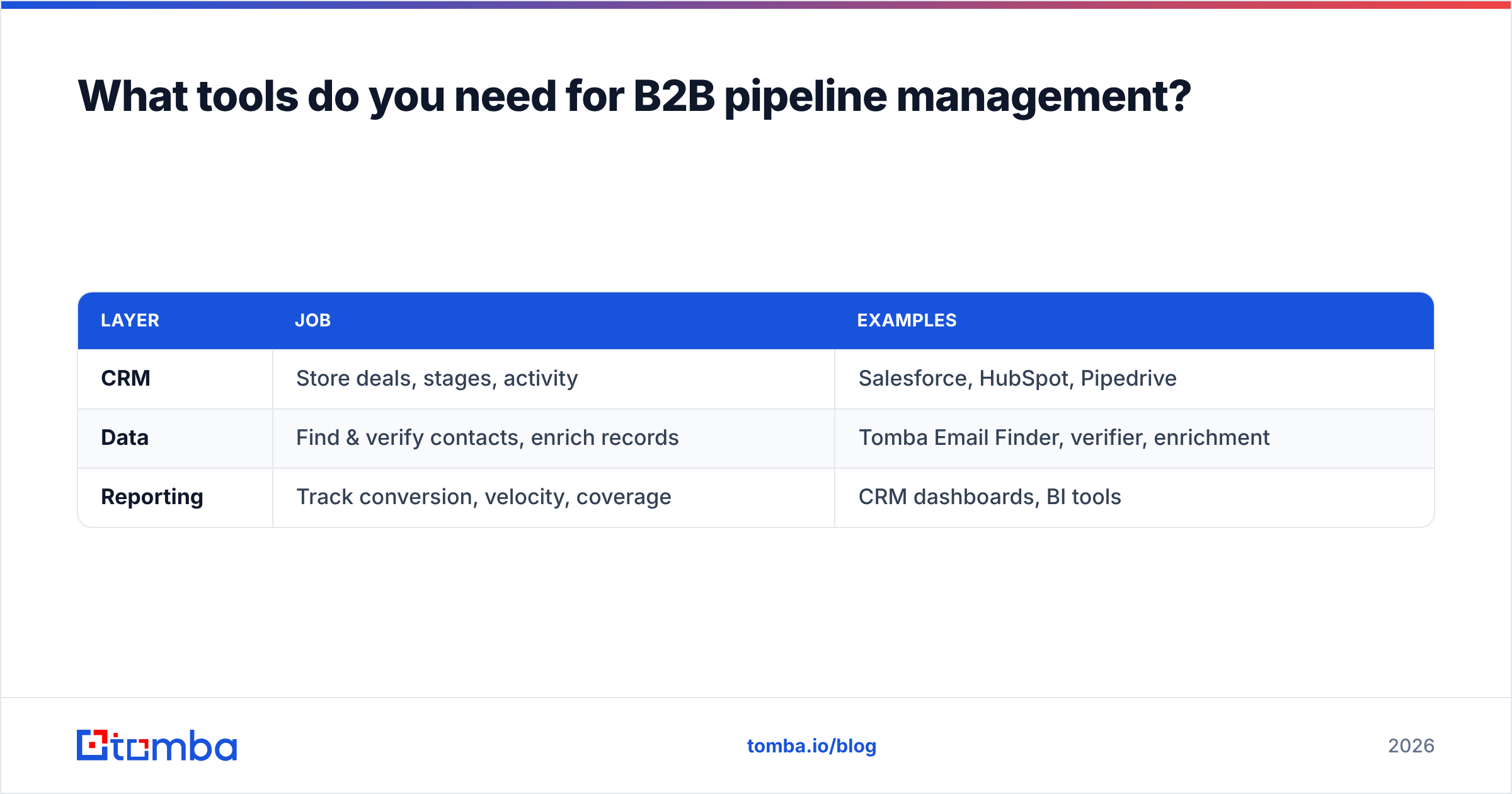
You need three layers working together: a CRM to hold deals, a data layer to keep contacts accurate, and a reporting layer to surface the four metrics that matter. Most teams have the first and neglect the other two.
| Layer | Job | Examples |
|---|---|---|
| CRM | Store deals, stages, activity | Salesforce, HubSpot, Pipedrive |
| Data | Find & verify contacts, enrich records | Tomba Email Finder, verifier, enrichment |
| Reporting | Track conversion, velocity, coverage | CRM dashboards, BI tools |
The integration between layers is what makes pipeline management low-effort instead of a constant fight. When your data tool writes verified contacts straight into the CRM, hygiene becomes automatic rather than a chore reps skip. Tomba connects directly into the stack through its HubSpot integration, Salesforce integration, Pipedrive integration, and Zapier integration, plus a Tomba API for custom workflows.
A note on cost discipline: you don't need the most expensive tool in each category, you need the ones that integrate cleanly and keep data accurate. Tomba's plans start with a free tier (25 searches/mo) and scale to Starter at $49/mo and Growth at $99/mo — see full Tomba pricing — which keeps the data layer affordable enough to verify aggressively rather than rationing checks.
How do you forecast revenue from your pipeline?#
Forecasting is the payoff of good pipeline management: multiply each deal's value by its stage probability, sum it up, and weight it against velocity and coverage. A clean pipeline turns this into a number you can defend to leadership.
The basic weighted forecast:
- Assign each open deal its stage probability (from your stage model above).
- Multiply deal value by probability to get the weighted value.
- Sum weighted values across the pipeline for your raw forecast.
- Cross-check against velocity — can these deals actually close in the period given your average days-to-close?
- Cross-check against coverage — is your total pipeline at least 3–4x the quota?
When all three signals agree, you have a forecast. When they disagree — say, weighted value looks great but velocity says half the deals can't close in time — you've found a problem worth a conversation before the quarter ends, not after.
The forecast is only as good as the inputs, which is the through-line of this entire guide. Honest stages, clean data, and disciplined hygiene produce a forecast you can stake a hiring plan on. Optimistic stages and stale contacts produce a number that makes everyone look bad in 90 days. Mature revenue operations teams obsess over input quality for exactly this reason — the math is trivial, the data discipline is everything.
Putting it together#
B2B sales pipeline management isn't a dashboard you buy — it's a discipline you run. Define stages with objective exit criteria, track the four metrics that predict revenue, enforce hygiene with time limits and weekly reviews, and feed the whole thing with verified, enriched contact data. Do those four things and your forecast stops being a guess.
The cheapest place to improve pipeline accuracy is at the top, where contacts enter. Start there with the Tomba Email Finder: find and verify real decision-makers by name, domain, or company, push them straight into your CRM, and keep your pipeline honest from the first stage. Spin up the free tier, verify your next batch of prospects, and watch your stage-one conversion rate start telling the truth.
Ready to find emails that actually work?
Join 150,000+ professionals who stopped guessing and started sending. Free credits on signup — no credit card required.
Get the Tomba newsletter
Practical outbound tactics and product updates — once every two weeks.
About the author