The B2B Sales Process in 2026: 7 Stages That Close Deals
A repeatable b2b sales process beats heroics every quarter. Here are the 7 stages, the metrics that matter, and the tools that keep your pipeline honest in 2026.
A b2b sales process is the difference between a team that hits quota on purpose and one that hits it by luck. If you can't draw your sales motion on a whiteboard, you can't coach it, forecast it, or fix it. This guide breaks the process into seven concrete stages, the metrics that prove each one works, and where deals quietly leak.
TL;DR#
- A b2b sales process is a repeatable, stage-by-stage map from first contact to closed-won (and renewal) that any rep can follow.
- The seven core stages: prospecting, qualification, discovery, demo/value, proposal, negotiation, and close — plus handoff to onboarding.
- Measure conversion rate between stages, not just total pipeline. The biggest leaks usually sit at qualification and proposal.
- Clean contact data is the foundation. Bad emails and missing phone numbers kill stage one before reps ever get a reply.
- Tools matter, but only after the stages are defined. Process first, then automate with a CRM, a sequencer, and an accurate email finder.
What is a B2B sales process?#
A b2b sales process is a documented sequence of stages a deal moves through, with clear entry and exit criteria for each one. Think of it like a commercial kitchen: every dish follows the same line — prep, cook, plate, pass — so quality doesn't depend on which chef is working that night. The recipe is the process; the chefs are your reps.
The opposite is "freestyle selling," where every rep improvises. Freestyle works when you have two founders closing friends-of-friends. It collapses the moment you hire a fifth rep, because nobody can tell why some deals close and others stall.
A real process answers three questions for every opportunity:
- Where is this deal right now? (which stage)
- What has to be true to move it forward? (exit criteria)
- What's the next action, and who owns it? (accountability)
According to HubSpot's sales research, teams with a formal, documented process consistently report higher win rates than teams that wing it. The reason is boring but true: a written process turns tribal knowledge into something you can train, measure, and improve.
)
What are the 7 stages of the B2B sales process?#
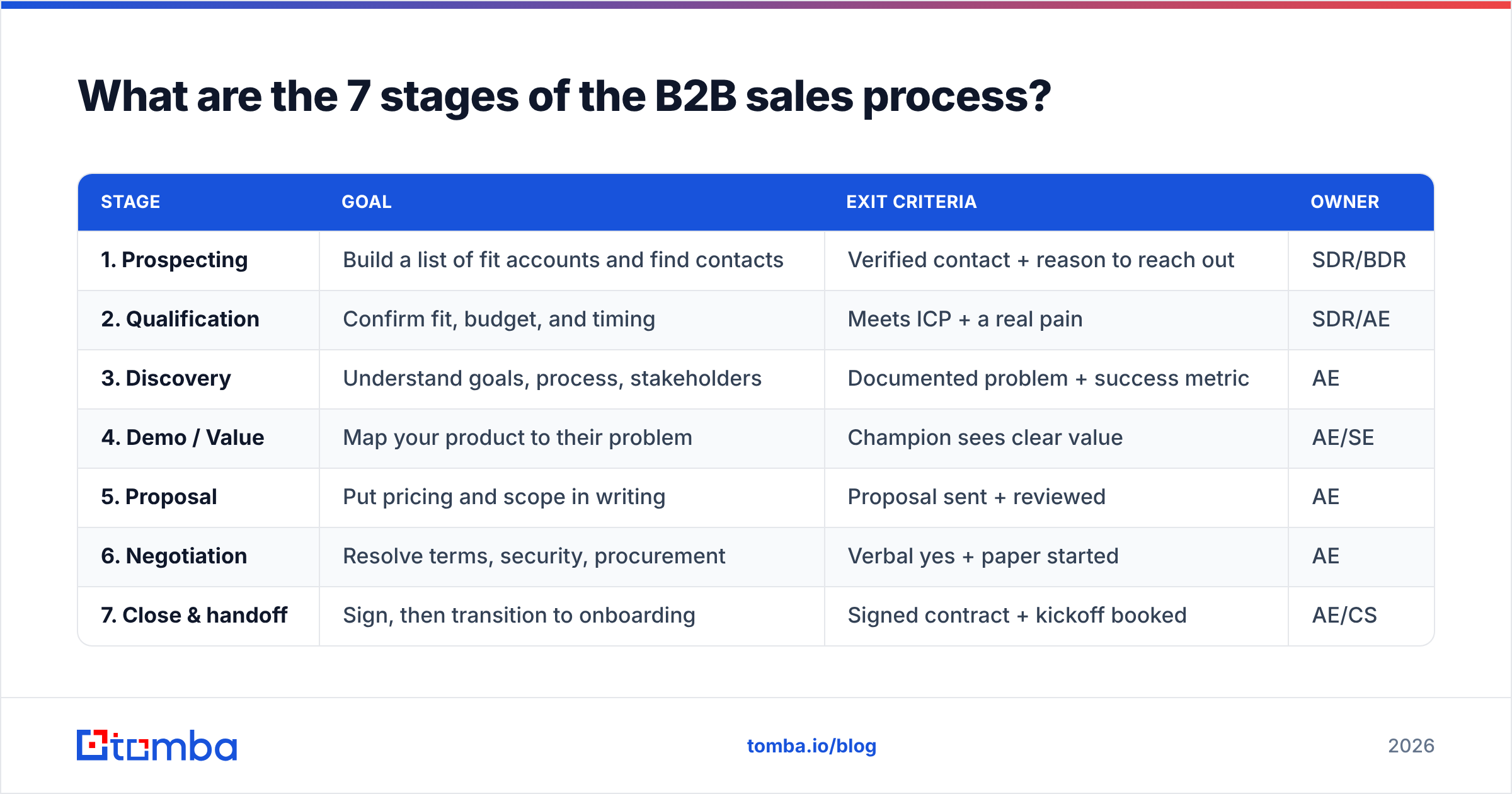
Here is the end-to-end flow most modern b2b teams run. Your names may differ, but the function of each stage rarely does.
| Stage | Goal | Exit criteria | Owner |
|---|---|---|---|
| 1. Prospecting | Build a list of fit accounts and find contacts | Verified contact + reason to reach out | SDR/BDR |
| 2. Qualification | Confirm fit, budget, and timing | Meets ICP + a real pain | SDR/AE |
| 3. Discovery | Understand goals, process, stakeholders | Documented problem + success metric | AE |
| 4. Demo / Value | Map your product to their problem | Champion sees clear value | AE/SE |
| 5. Proposal | Put pricing and scope in writing | Proposal sent + reviewed | AE |
| 6. Negotiation | Resolve terms, security, procurement | Verbal yes + paper started | AE |
| 7. Close & handoff | Sign, then transition to onboarding | Signed contract + kickoff booked | AE/CS |
A few things to notice. First, every stage has an exit criterion — not a vibe, a checkable fact. "Had a good call" is not an exit criterion. "Prospect confirmed a $40k budget and a Q3 deadline" is. Second, ownership changes hands as the deal matures. Forecasting falls apart when nobody knows who owns the next step.
The stages in plain terms#
- Prospecting is research plus outreach. You define your ideal customer profile, build a target list, and find the right person to contact. This is where data quality decides everything — an unverified email means your sequence dies in a bounce.
- Qualification filters. You're protecting your AEs' calendars from tire-kickers. Frameworks like BANT or MEDDICC live here.
- Discovery is listening, not pitching. The best AEs talk less than 45% of a discovery call.
- Demo/Value is where you show, tailored to what you heard. A generic demo is a wasted demo.
- Proposal puts numbers on paper. Ambiguity here creates negotiation pain later.
- Negotiation is procurement, legal, and security review. Multi-threading matters — single-threaded deals stall when your one champion goes on vacation.
- Close & handoff isn't the finish line. A sloppy handoff to onboarding is the number-one cause of first-year churn.
How do you measure a B2B sales process?#
Measure conversion rate between each stage, not just the size of your pipeline. A $2M pipeline that converts at 8% is worse than a $900k pipeline that converts at 30%.
Track these four numbers per stage:
- Stage conversion rate — what percent of deals move from stage N to N+1.
- Average time in stage — where deals sit and rot.
- Slippage — deals pushed to the next month or quarter.
- Win rate by source — which lead sources actually close.
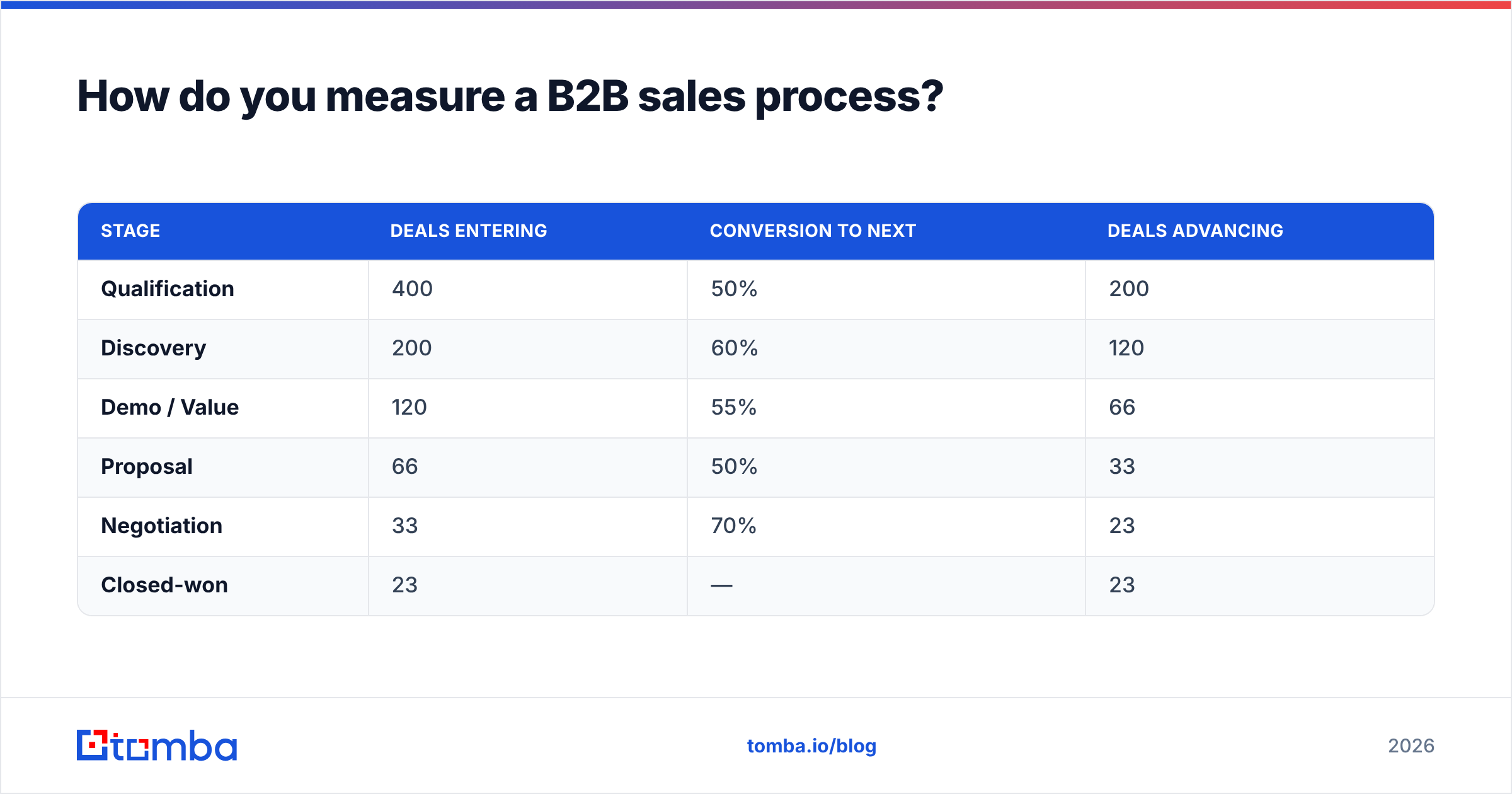
Here's a sample funnel so you can see where the math bites:
| Stage | Deals entering | Conversion to next | Deals advancing |
|---|---|---|---|
| Qualification | 400 | 50% | 200 |
| Discovery | 200 | 60% | 120 |
| Demo / Value | 120 | 55% | 66 |
| Proposal | 66 | 50% | 33 |
| Negotiation | 33 | 70% | 23 |
| Closed-won | 23 | — | 23 |
In this example, the worst leak is qualification — half your deals die there. That's either a targeting problem (bad ICP) or a data problem (you're reaching the wrong people). Fixing one stage's conversion from 50% to 65% would add roughly seven extra closed deals from the same top-of-funnel. Small percentages compound.
Gartner's research on B2B buying makes a related point: buyers now spend only a small fraction of their journey talking to any one vendor. That means your process has to create value in every interaction, because you get fewer of them than you think.
Why does prospecting data make or break the process?#
Because stage one feeds every stage after it — garbage in, garbage out. You can have a flawless discovery framework and a brilliant demo, but if your SDRs are emailing addresses that bounce, none of it ever fires.
Three data problems quietly wreck b2b pipelines:
- Bounces. Sending to invalid addresses tanks your sender reputation, which then hurts the deliverability of your good emails too.
- Wrong person. Reaching a junior IC when your buyer is a VP wastes the touch and the timing.
- Stale records. People change jobs constantly. A contact verified 18 months ago may be three companies away by now.
This is why mature teams put a verification step before outreach. Run your list through an email verifier so you only send to addresses that resolve, and use domain search to pull the full org chart at a target account instead of guessing one name. The goal isn't more emails — it's fewer wasted ones.
)
BANT vs MEDDICC: which qualification framework fits?#
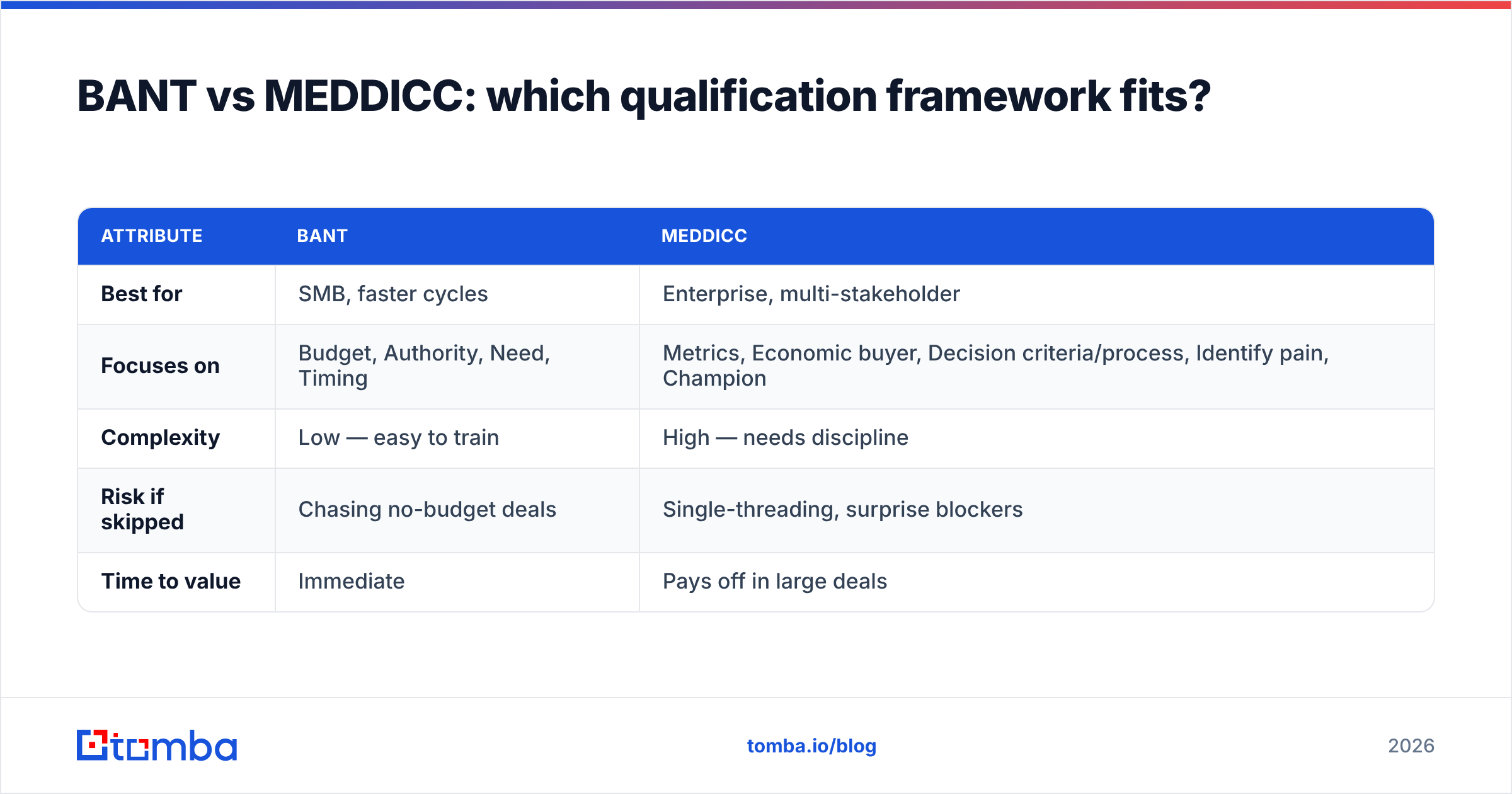
Use BANT for shorter, transactional cycles and MEDDICC for complex enterprise deals. The framework's job is to standardize what "qualified" means so two reps grade the same deal the same way.
| Attribute | BANT | MEDDICC |
|---|---|---|
| Best for | SMB, faster cycles | Enterprise, multi-stakeholder |
| Focuses on | Budget, Authority, Need, Timing | Metrics, Economic buyer, Decision criteria/process, Identify pain, Champion |
| Complexity | Low — easy to train | High — needs discipline |
| Risk if skipped | Chasing no-budget deals | Single-threading, surprise blockers |
| Time to value | Immediate | Pays off in large deals |
Neither is "better." A team selling a $200/month tool that adopts full MEDDICC will drown in overhead. A team selling a $250k platform with BANT will get blindsided in procurement. Match the framework to the deal size and complexity, then make it non-negotiable that reps fill it in before a deal advances.
What tools support a B2B sales process in 2026?#
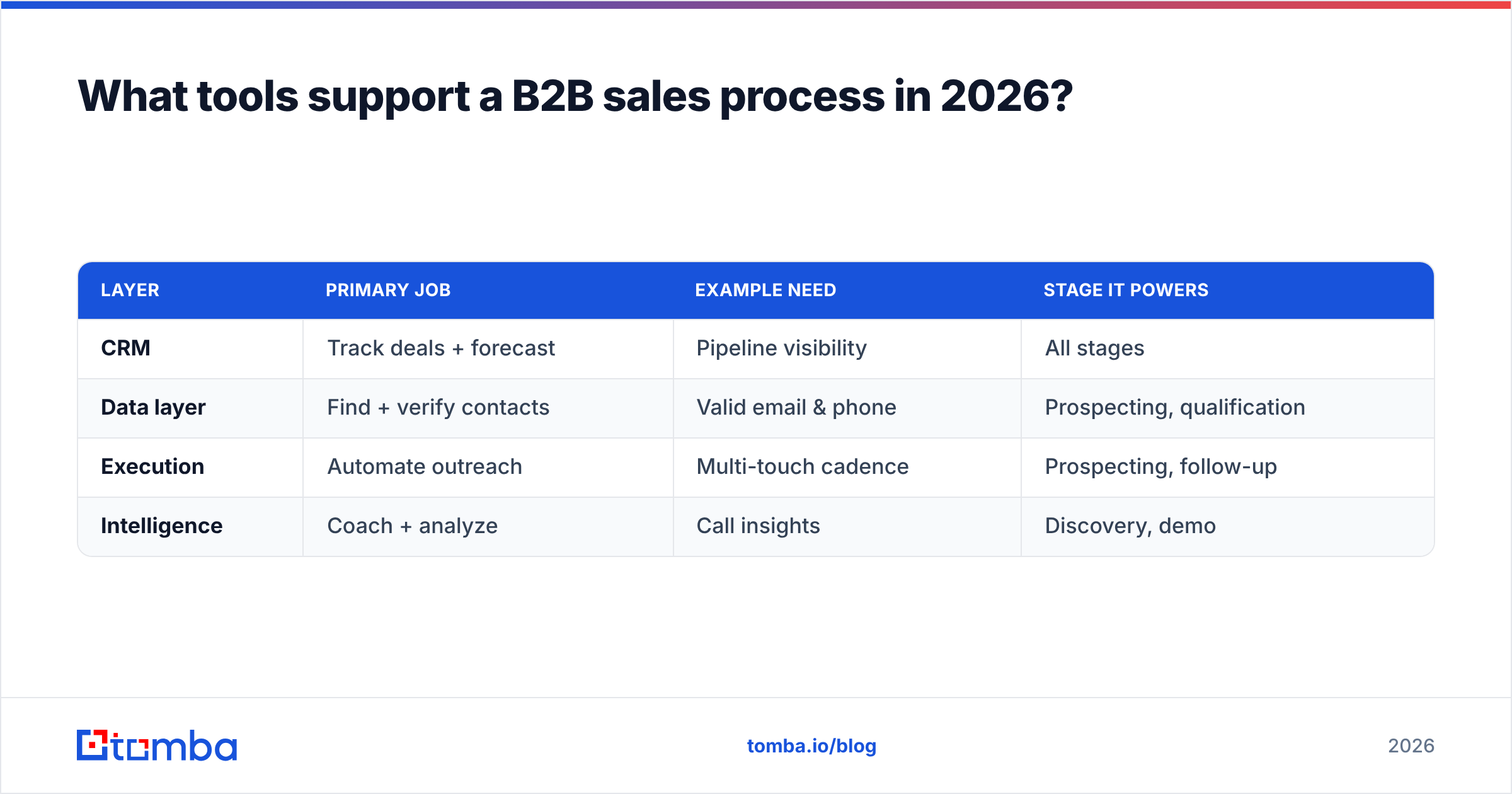
You need three categories of tooling, and you should adopt them in this order: a system of record, a data layer, and an execution layer. Buying execution tools before you have clean data is like buying a sports car with no fuel.
- CRM (system of record). Salesforce, HubSpot, or Pipedrive. This is where stages, exit criteria, and forecasts live. Read Salesforce's overview of the sales process if you're formalizing stages for the first time.
- Data layer (fuel). Contact discovery and verification. An accurate email finder, a phone finder for multi-channel outreach, and ongoing data enrichment so records don't go stale.
- Execution layer (motion). A sequencer for cadences, a calendar/scheduling tool, and a conversation-intelligence tool to coach calls.
Here's how the layers compare on what they actually do for your process:
| Layer | Primary job | Example need | Stage it powers |
|---|---|---|---|
| CRM | Track deals + forecast | Pipeline visibility | All stages |
| Data layer | Find + verify contacts | Valid email & phone | Prospecting, qualification |
| Execution | Automate outreach | Multi-touch cadence | Prospecting, follow-up |
| Intelligence | Coach + analyze | Call insights | Discovery, demo |
The trap most teams fall into is over-investing in the execution layer — fancy sequencers, AI writers — while feeding them dirty data. Tighten the data layer first. If you want to see plan options for the data side, the Tomba pricing page lays out a free tier (25 searches/month), Starter at $49/mo, Growth at $99/mo, and Pro at $249/mo, so you can start small and scale as your list-building volume grows.
What are the most common B2B sales process mistakes?#
The same five mistakes show up in audit after audit:
- No exit criteria. Stages become vibes. Reps mark a deal "Discovery" because they had a call, not because anything was qualified. Fix: write a one-line checkable criterion per stage.
- Single-threading. The whole deal rides on one contact. When they leave or go quiet, it dies. Fix: identify and engage at least three stakeholders using domain search to map the account.
- Skipping verification. Reps blast unverified lists, rack up bounces, and poison deliverability. Fix: verify before you send.
- No defined handoff. Sales closes, then disappears, and onboarding starts cold. Fix: a written handoff with the success metric the buyer agreed to.
- Forecasting on feelings. "I think this one closes." Fix: forecast on stage + exit criteria + close date, reviewed weekly.
None of these are exotic. They're the unglamorous fundamentals that separate teams that scale from teams that plateau.
How long should a B2B sales cycle take?#
It depends on deal size, but the honest answer is: shorter than you think if your process is tight. SMB deals often close in 14–30 days; mid-market in 1–3 months; enterprise in 6–12 months or more. The number itself matters less than its consistency. A predictable 90-day cycle is far more valuable than an erratic one that ranges from 20 to 200 days, because predictability is what makes forecasting possible.
If your cycle length is all over the map, the cause is almost always inconsistent qualification. Deals that should have been disqualified at stage two limp along for months, dragging your averages and your reps' morale with them. Tighten the front of the funnel and the back of the funnel speeds up on its own.
Putting it together#
Start by writing your seven stages and a single exit criterion for each — one afternoon of work that pays off for years. Then instrument the conversion rate between stages so you can see where deals leak. Then, and only then, layer in tooling: a CRM for the record, a data layer for clean contacts, and an execution layer for the motion.
The teams that win in 2026 aren't the ones with the most tools. They're the ones whose reps all run the same playbook, backed by data they can trust.
Your process is only as strong as the contacts feeding it. Before your reps spend a single touch, make sure they're reaching real people at real addresses. The Tomba Email Finder lets you find professional emails by name, company, or domain — and pairs with a built-in verifier so your sequences land in inboxes instead of bouncing. Start free with 25 searches a month, build a clean target list, and let the rest of your sales process do what it's designed to do.
// get started
Find, verify and enrich your first contacts today
Start on the free plan with 25 searches a month, then scale when your team is ready.
Free plan · No credit card required · GDPR & CCPA
// about the author