B2B Sales Process Examples: 7 Proven Stages for 2026
See real B2B sales process examples broken down stage by stage, with templates, KPIs, and the tools that move deals from cold list to closed-won in 2026.
You can have great reps, a strong product, and a full calendar and still miss quota — because the work between "interesting lead" and "signed contract" is improvised instead of repeatable. A defined B2B sales process fixes that. This guide breaks down concrete B2B sales process examples you can copy, stage by stage, with the metrics and tooling that make each step measurable.
TL;DR#
- A B2B sales process is the repeatable set of stages a deal moves through, from prospecting to closed-won and renewal — not a vague "funnel."
- Most high-performing teams run a 7-stage process: prospect, qualify, connect, discover, present, negotiate, close (plus onboarding/expansion).
- The best B2B sales process examples differ by motion — inbound-led, outbound-led, and product-led each weight the stages differently.
- Clean contact data is the silent multiplier: a process is only as good as the leads entering stage one, which is why accurate email finder data matters before any rep picks up the phone.
- Track stage-to-stage conversion, not just total pipeline — that's where the leaks hide.
What is a B2B sales process?#
A B2B sales process is the documented, repeatable sequence of stages a deal passes through from first contact to closed revenue. Think of it like a flight checklist: pilots don't improvise takeoff every time, and your best reps shouldn't improvise discovery calls either. The checklist guarantees the critical steps happen in order, every deal, regardless of who's flying.
The technical version: a sales process maps buyer actions to seller actions to exit criteria. Each stage has an entry trigger, a set of required activities, and a definition of "done" that lets a deal advance. When those exit criteria are explicit, your CRM stops lying to you — a deal in "negotiation" actually means negotiation, not "I had a good call three weeks ago."
A sales process is not the same as a sales methodology (MEDDIC, SPIN, Challenger). The process is the stages; the methodology is how you work inside them. You can run MEDDIC qualification inside stage two of any of the examples below.
What are the 7 stages of a B2B sales process?#
Here is the backbone most B2B teams use. The examples later in this post are variations on these seven stages.
- Prospecting — Build a target list and find verified contact details. Exit: contact identified, email/phone verified, fit confirmed against your ICP.
- Qualifying — Confirm budget, authority, need, and timing. Exit: lead meets your qualification bar (e.g., MQL → SQL).
- Connecting — Make first meaningful contact and book the discovery meeting. Exit: meeting scheduled and confirmed.
- Discovery — Diagnose the prospect's problem, quantify the cost of inaction. Exit: documented pain, metrics, and decision process.
- Presenting / demo — Map your solution to the discovered pain. Exit: prospect agrees the solution fits and requests pricing.
- Negotiation — Handle objections, align on price and terms. Exit: verbal agreement, contract sent.
- Closing — Sign, then hand off to onboarding. Exit: closed-won and kickoff scheduled.
A subtle but critical point: stage one quietly decides the ceiling on everything after it. If reps enter garbage contacts, every downstream conversion rate suffers, and no amount of discovery skill saves a deal that was never reachable. That's why teams pair their process with a domain search to pull verified contacts at a target company before the first outreach touch.
What are real B2B sales process examples by motion?#
Different go-to-market motions weight the same seven stages differently. Here are three concrete B2B sales process examples.
Example 1 — Outbound-led (SDR + AE)#
Common in mid-market SaaS selling $15k–$75k ACV deals.
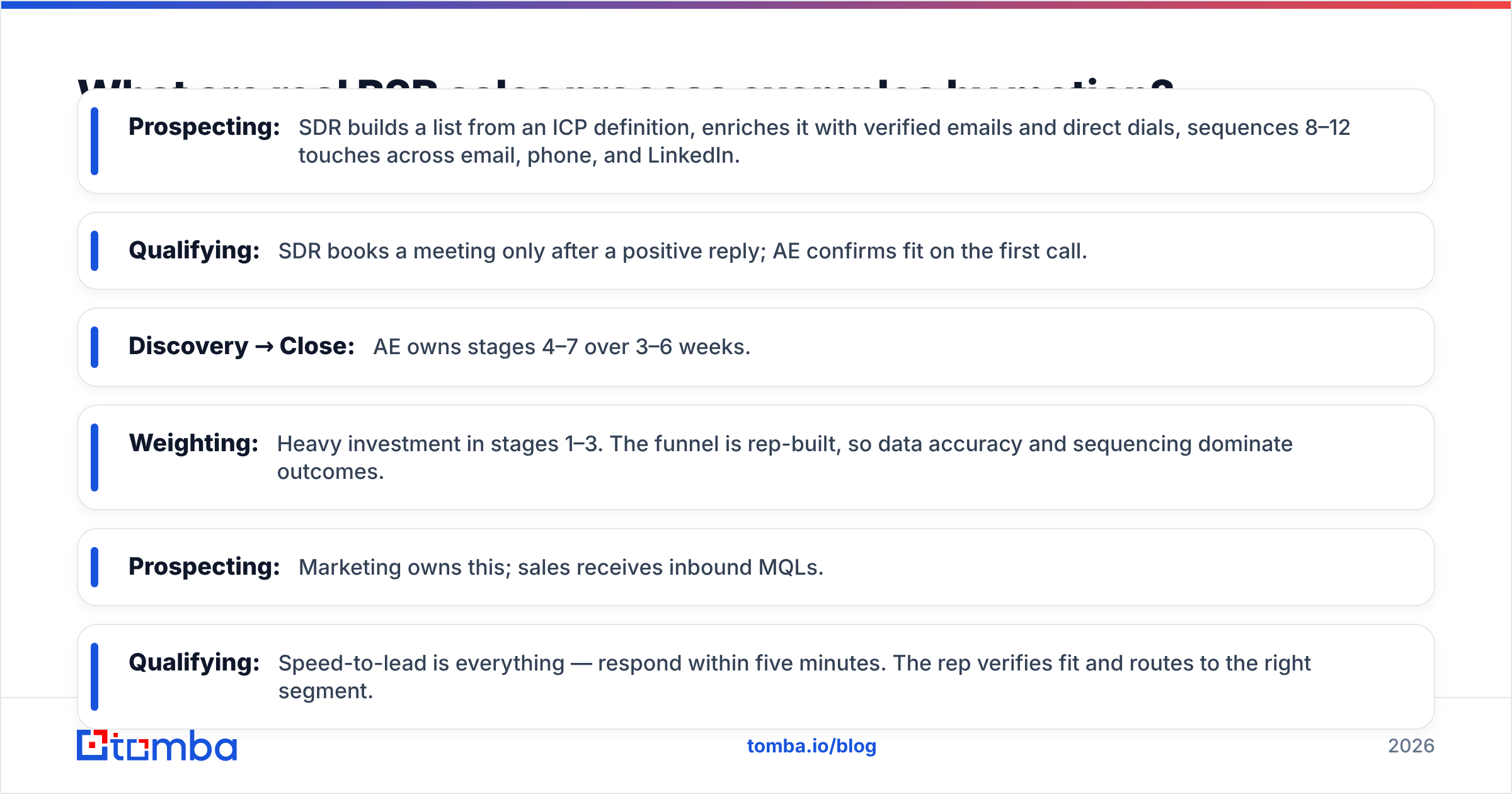
- Prospecting: SDR builds a list from an ICP definition, enriches it with verified emails and direct dials, sequences 8–12 touches across email, phone, and LinkedIn.
- Qualifying: SDR books a meeting only after a positive reply; AE confirms fit on the first call.
- Discovery → Close: AE owns stages 4–7 over 3–6 weeks.
- Weighting: Heavy investment in stages 1–3. The funnel is rep-built, so data accuracy and sequencing dominate outcomes.
Example 2 — Inbound-led (marketing-sourced)#
Common when content and SEO generate demo requests.
- Prospecting: Marketing owns this; sales receives inbound MQLs.
- Qualifying: Speed-to-lead is everything — respond within five minutes. The rep verifies fit and routes to the right segment.
- Discovery → Close: Shorter cycle because intent is already high.
- Weighting: Light stage 1, heavy stages 2 and 4. The risk is wasting AE time on unqualified inbound, so qualification rigor matters most.
Example 3 — Product-led (PLG with sales assist)#
Common in tools with a free tier or trial.
- Prospecting: Self-serve signups create the top of funnel automatically.
- Qualifying: Product usage signals (activation, seat growth) trigger sales involvement on accounts crossing a usage threshold.
- Discovery → Close: Sales "assists" expansion rather than originating the deal.
- Weighting: Stage 1 is product-driven; sales concentrates on stages 5–7 for expansion and enterprise upgrades.
How do these B2B sales process examples compare?#
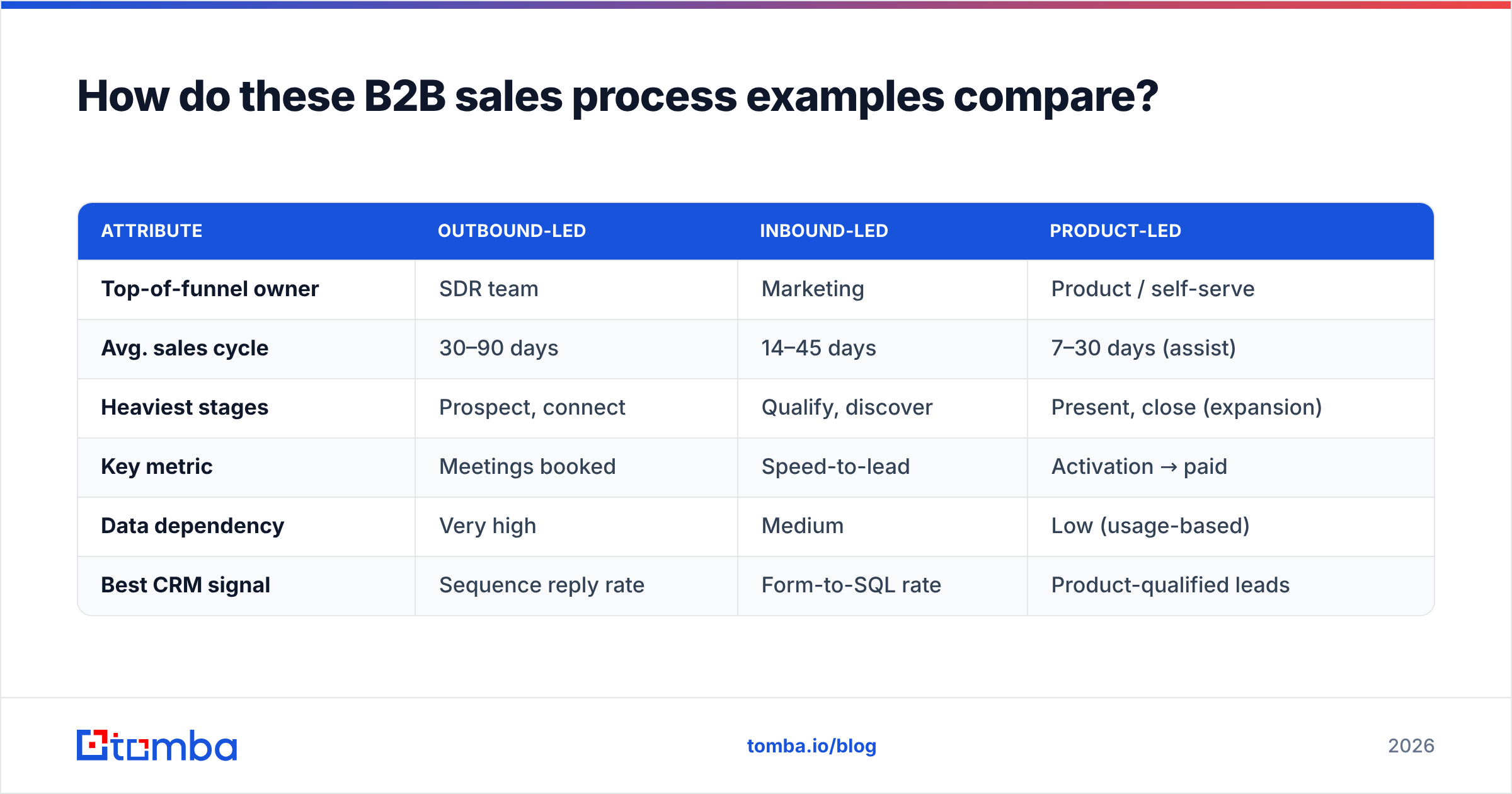
| Attribute | Outbound-led | Inbound-led | Product-led |
|---|---|---|---|
| Top-of-funnel owner | SDR team | Marketing | Product / self-serve |
| Avg. sales cycle | 30–90 days | 14–45 days | 7–30 days (assist) |
| Heaviest stages | Prospect, connect | Qualify, discover | Present, close (expansion) |
| Key metric | Meetings booked | Speed-to-lead | Activation → paid |
| Data dependency | Very high | Medium | Low (usage-based) |
| Best CRM signal | Sequence reply rate | Form-to-SQL rate | Product-qualified leads |
The takeaway: there is no single "correct" B2B sales process. There's the process that matches your motion, your ACV, and your buyer's behavior. Copy the structure that fits, then refine the stage where your data says deals stall.
How do you build your own B2B sales process?#
Start from your existing won deals, not from a template. Reverse-engineer what actually happened in your last 20 closed-won accounts and you'll find your real process hiding underneath the official one.
Step 1 — Map buyer actions to your stages. For each stage, write down what the buyer does (not just what your rep does). A stage only advances when the buyer takes the next action.
Step 2 — Define exit criteria in plain language. "Champion confirmed and metrics quantified" beats "had a good call." Exit criteria are the difference between an honest pipeline and a hopeful one.
Step 3 — Attach one primary KPI per stage. Meetings booked, SQL rate, demo-to-proposal rate, win rate. Tracking win rate per stage tells you where to coach.
Step 4 — Instrument the entry point. Garbage in, garbage out. Feed verified contacts into stage one using a bulk email finder and confirm each address with an email verifier before reps spend time on outreach.
Step 5 — Review stage-to-stage conversion monthly. If 60% of deals die between discovery and demo, that's a discovery problem, not a closing problem.
What metrics prove a B2B sales process is working?#
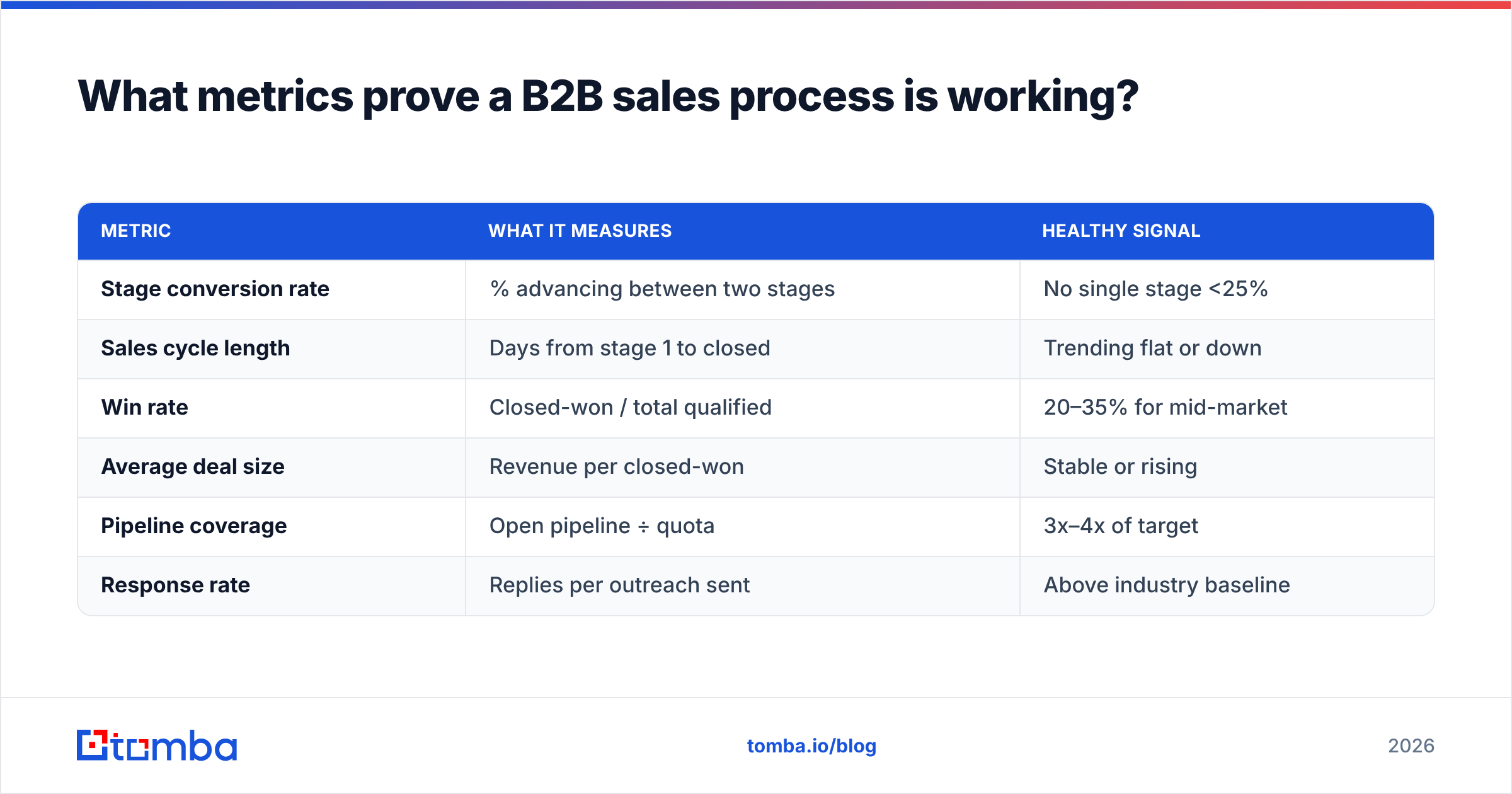
A process you can't measure is just a wall chart. These are the numbers that show whether your stages are healthy. According to HubSpot's sales research, response rates and follow-up cadence are among the strongest predictors of pipeline health — which makes stage-level tracking non-negotiable.
| Metric | What it measures | Healthy signal |
|---|---|---|
| Stage conversion rate | % advancing between two stages | No single stage <25% |
| Sales cycle length | Days from stage 1 to closed | Trending flat or down |
| Win rate | Closed-won / total qualified | 20–35% for mid-market |
| Average deal size | Revenue per closed-won | Stable or rising |
| Pipeline coverage | Open pipeline ÷ quota | 3x–4x of target |
| Response rate | Replies per outreach sent | Above industry baseline |
Watch response rate closely at the top of the funnel — it's the earliest warning that your data or messaging has decayed. A sudden drop usually means bounced or stale contacts, not bad copy.
What tools support each stage of the process?#
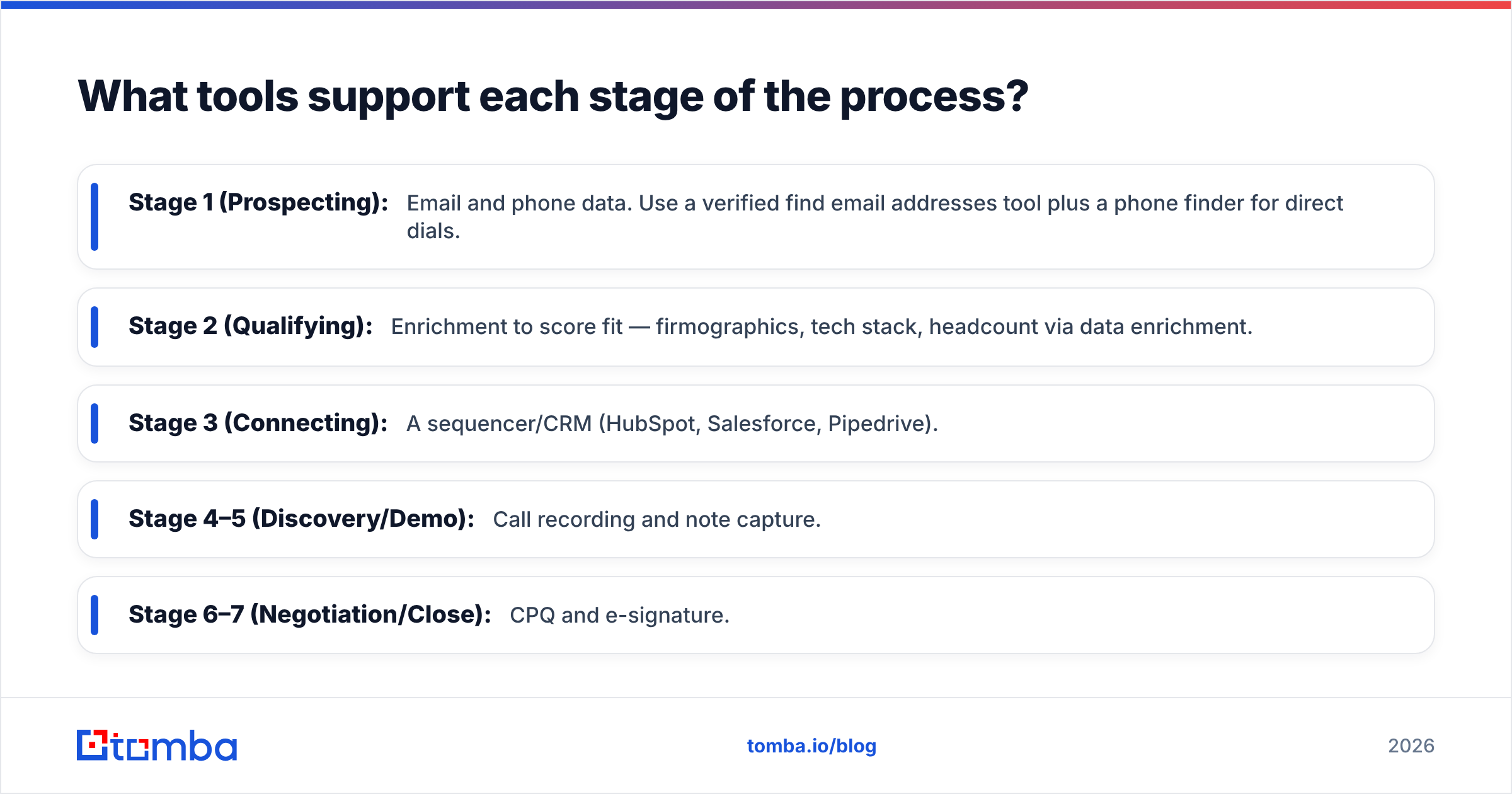
You don't need 30 tools. You need the right tool at the friction point of each stage. Industry review sites like G2 catalog hundreds of options, but most teams converge on a small stack: a data/enrichment layer, a CRM, a sequencer, and a verifier.
- Stage 1 (Prospecting): Email and phone data. Use a verified find email addresses tool plus a phone finder for direct dials.
- Stage 2 (Qualifying): Enrichment to score fit — firmographics, tech stack, headcount via data enrichment.
- Stage 3 (Connecting): A sequencer/CRM (HubSpot, Salesforce, Pipedrive).
- Stage 4–5 (Discovery/Demo): Call recording and note capture.
- Stage 6–7 (Negotiation/Close): CPQ and e-signature.
The single highest-leverage investment is stage one data quality, because errors there compound through every later stage. Vendors publish accuracy methodology — for example, you can review how a provider sources and validates contacts on a data sources page before trusting it with your pipeline. Compare that transparency against any tool you're evaluating; if a vendor won't explain where the data comes from, treat its numbers skeptically (a reasonable habit reinforced by analyst firms like Gartner).
What are the most common B2B sales process mistakes?#
- No exit criteria. Deals advance on optimism, and forecasts become fiction.
- Skipping discovery. Reps demo before they diagnose, so the pitch misses the real pain.
- One process for every deal size. A $5k transactional deal and a $250k enterprise deal should not share a playbook.
- Stale or unverified data at stage one. Bounces tank your sender reputation and waste rep hours. Verifying lists against an email verifier before sending prevents this.
- Measuring only total pipeline. Without stage-to-stage conversion, you can't see where deals actually die.
Fix the data and the exit criteria first. Those two changes alone usually lift win rate more than any new closing technique.
Frequently asked questions#
How many stages should a B2B sales process have? Most teams land between five and seven stages. Fewer than five and you lose visibility into where deals stall; more than eight and reps stop updating the CRM accurately. Start with the seven-stage backbone above and merge any stages your data shows are redundant.
What's the difference between a sales process and a sales methodology? The process is the stages (prospect → qualify → close). The methodology is how you sell inside them (MEDDIC, SPIN, Challenger). You run a methodology on top of a process — they're complementary, not competing.
How long does it take to build a documented sales process? A first usable version takes about a week: two days analyzing won deals, two days defining stages and exit criteria, and a day instrumenting your CRM. Refinement is continuous after that.
Where does contact data fit into the process? At stage one, and it sets the ceiling for everything downstream. Accurate emails and direct dials determine how many qualified conversations your reps can even start, which is why teams treat verified data as infrastructure, not a nice-to-have.
Build the first stage right#
Every B2B sales process example here shares one truth: the process only performs as well as the leads entering stage one. Before you obsess over discovery scripts or closing tactics, make sure your reps are working verified, accurate contacts — not a list of guesses that bounce.
Start there. Use the Tomba Email Finder to pull and verify professional emails by name, company, or domain, so stage one feeds your pipeline real, reachable buyers instead of dead addresses. The free tier includes 25 searches a month, and paid plans start at $49/mo — check current Tomba pricing to match a plan to your prospecting volume. Fix the top of the funnel, and the other six stages finally start converting like they should.
// get started
Find, verify and enrich your first contacts today
Start on the free plan with 25 searches a month, then scale when your team is ready.
Free plan · No credit card required · GDPR & CCPA
// about the author