B2B Sales Stats 2026: 50+ Data Points That Drive Pipeline
The B2B sales stats that actually matter in 2026 — response rates, cycle length, prospecting touches, win rates, and what they mean for your pipeline.
Most B2B sales advice is recycled opinion. Stats are the antidote: they tell you where deals actually stall, how many touches a reply really takes, and which assumptions are costing you pipeline. This post collects the numbers worth knowing in 2026 — and, more importantly, what to do with each one.
TL;DR — The B2B Sales Stats That Matter Most#
- The average B2B sale takes 5–8 touchpoints to generate a qualified lead, yet most reps stop after two — the single biggest source of wasted pipeline.
- Email still wins on reach: cold email reply rates sit around 1–5% on cold lists but climb to 8–15% when the data is verified and the targeting is tight.
- Sales cycles are getting longer — enterprise B2B deals now average 6–9 months, and buying committees have grown to 6–10 stakeholders.
- Data decay is brutal: B2B contact data goes stale at roughly 22–30% per year, so list hygiene is not optional.
- Speed-to-lead is a multiplier: responding within 5 minutes can make you up to 21x more likely to qualify a lead than waiting 30 minutes.
Why Should You Care About B2B Sales Stats At All?#
Conclusion first: because gut feeling is expensive. Every B2B sales stat in this article represents a decision you are already making — how many times to follow up, which leads to call first, how much to trust your CRM data. The only question is whether you make that decision blind or informed.
Think of sales stats like the dashboard in a car. You can drive without looking at the speedometer or fuel gauge, but you will get tickets and run dry at the worst moment. The numbers below are your gauges. They do not drive the car for you, but ignoring them guarantees avoidable failures.
The catch: a stat is only useful if your underlying data is clean. A "21x more likely to convert" benchmark means nothing if half your phone numbers are wrong or your emails bounce. That is the thread running through everything here — good tactics on bad data still lose.
What Are The Key B2B Prospecting And Outreach Stats?#
Prospecting is where most pipeline is won or lost, and the data is unforgiving about persistence.
- 5–8 touchpoints are typically needed to convert a cold prospect into a qualified conversation, according to widely cited HubSpot sales research.
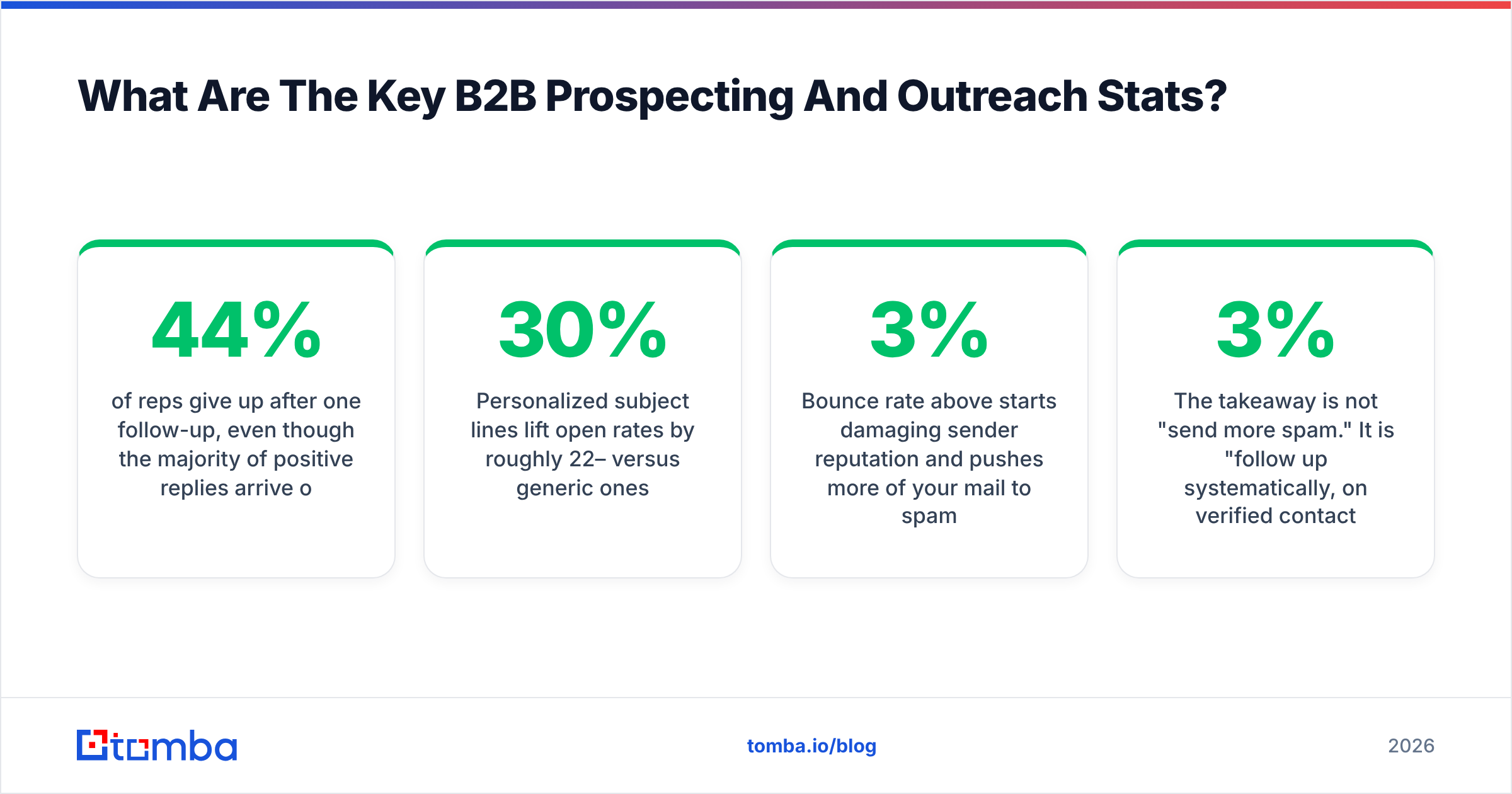
- 44% of reps give up after one follow-up, even though the majority of positive replies arrive on the third touch or later.
- Personalized subject lines lift open rates by roughly 22–30% versus generic ones.
- The best time to send cold email clusters around mid-morning on Tuesday through Thursday, though your own send-time tests beat any benchmark.
- Bounce rate above 3% starts damaging sender reputation and pushes more of your mail to spam.
The takeaway is not "send more spam." It is "follow up systematically, on verified contacts." If you are burning your domain reputation on bad addresses, more volume makes things worse, not better. Running every list through an email verifier before the first send keeps your bounce rate under that 3% line and protects email deliverability for the whole team.
How Long Is The B2B Sales Cycle In 2026?#
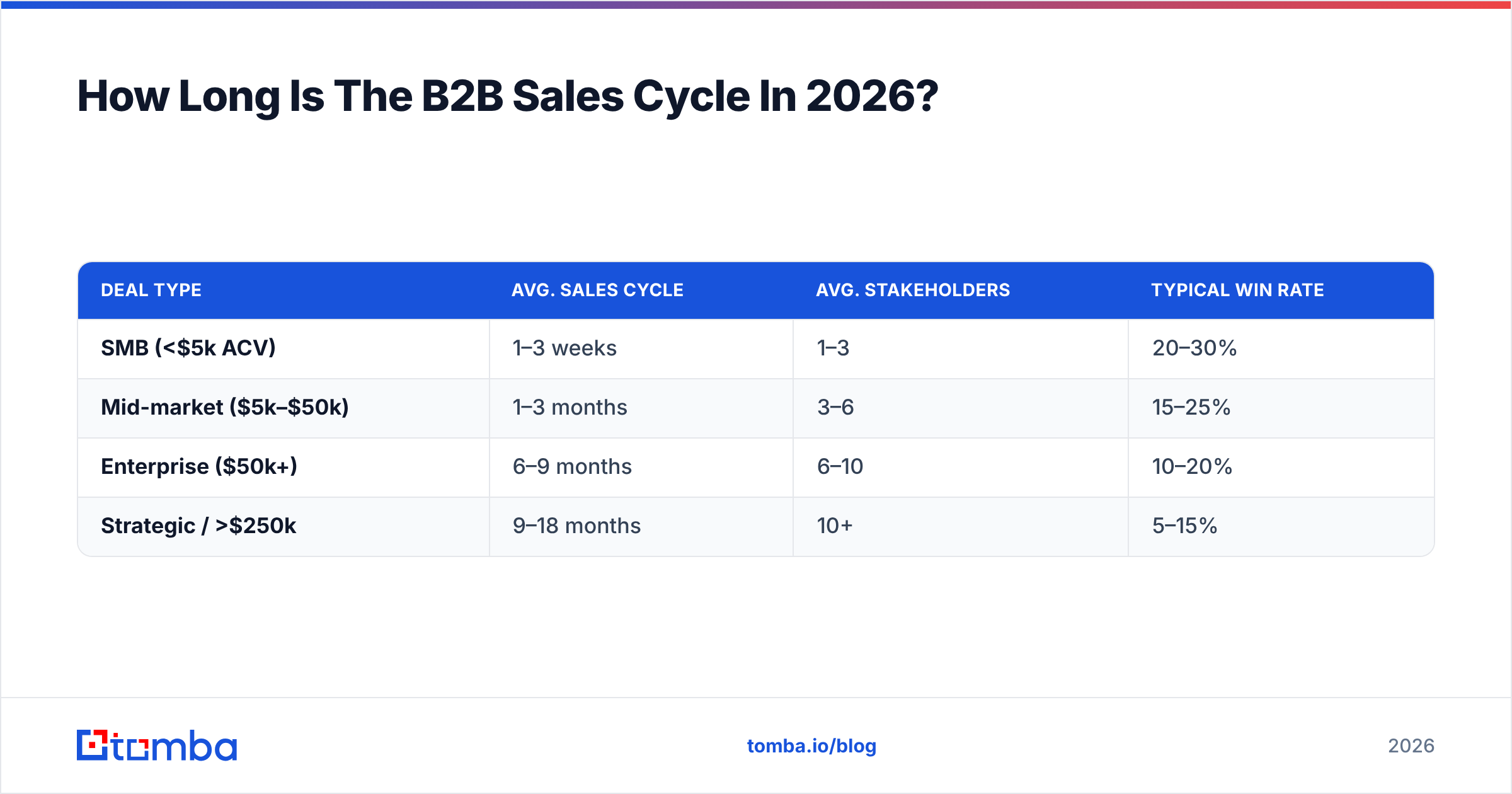
Short answer: longer than your forecast assumes. Buying committees expanded, budgets tightened, and "let me loop in a few people" became the default response to any deal over a few thousand dollars.
| Deal type | Avg. sales cycle | Avg. stakeholders | Typical win rate |
|---|---|---|---|
| SMB (<$5k ACV) | 1–3 weeks | 1–3 | 20–30% |
| Mid-market ($5k–$50k) | 1–3 months | 3–6 | 15–25% |
| Enterprise ($50k+) | 6–9 months | 6–10 | 10–20% |
| Strategic / >$250k | 9–18 months | 10+ | 5–15% |
Two implications. First, your pipeline coverage needs to scale with cycle length — a 9-month enterprise motion needs 3–4x pipeline coverage, not the 3x rule of thumb built for shorter cycles. Second, multi-threading is no longer optional. With 6–10 stakeholders on enterprise deals, single-threaded reps lose when their champion changes jobs (which happens on roughly 1 in 5 deals during a long cycle).
What Do Email And Response-Rate Stats Tell Us?#
Email is still the workhorse of B2B outbound, but the benchmarks have tightened.
- Cold email reply rates: 1–5% on cold, unverified lists; 8–15% when contacts are verified and messaging is segmented.
- Average B2B email open rate: 15–25%, depending heavily on sender reputation and subject relevance.
- Click-through rate on B2B campaigns: 2–5%.
- Meetings booked per 100 verified, well-targeted cold emails: 1–3 — which is why list quality compounds so fast at volume.
Here is the math that changes behavior. If you send 1,000 emails to a list that is 30% invalid, you have wasted 300 sends, dragged your response rate down, and risked a spam flag. Clean that same list first and you protect deliverability while improving every downstream metric. This is the unglamorous reason verified data beats clever copy: the copy never gets read if the email bounces.
What Are The Most Important Sales Conversion And Win-Rate Stats?#
Conversion stats expose where your funnel leaks. The headline numbers:
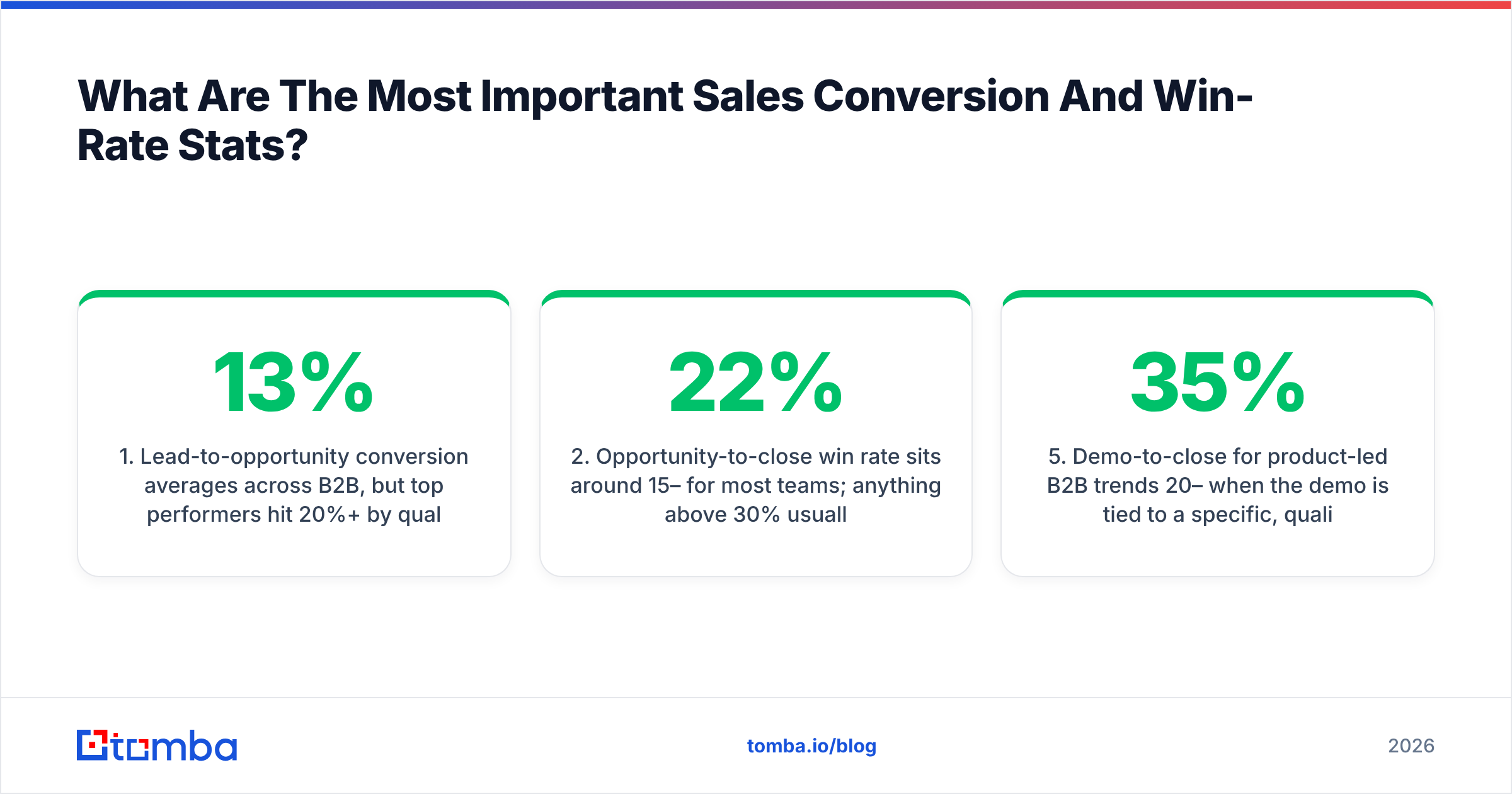
- Lead-to-opportunity conversion averages 13% across B2B, but top performers hit 20%+ by qualifying harder, not pitching harder.
- Opportunity-to-close win rate sits around 15–22% for most teams; anything above 30% usually signals either elite execution or under-qualified pipeline being cut early.
- Speed-to-lead is the cheapest lever: contacting a web lead within 5 minutes makes you up to 21x more likely to qualify it than waiting 30 minutes, per the classic Lead Response Management study echoed in Salesforce research.
- Referral leads convert at roughly 2–4x the rate of cold leads, yet most teams have no systematic referral motion.
- Demo-to-close for product-led B2B trends 20–35% when the demo is tied to a specific, qualified pain — far lower when it is a generic feature tour.
The pattern across all five: qualification and speed beat volume. A smaller number of fast, well-researched, multi-threaded conversations consistently outperforms a firehose of poorly targeted activity.
How Bad Is B2B Data Decay, Really?#
Bad enough to deserve its own section. B2B contact data degrades at 22–30% per year — people change jobs, companies rebrand, domains migrate. At 30% annual decay, a list you bought 18 months ago is closer to a coin flip than a contact database.
| Data hygiene factor | Cost of ignoring it |
|---|---|
| Email decay (~22%/yr) | Higher bounce, spam flags, blocked domain |
| Job changes (~1 in 5/yr) | Champion lost, deal stalls mid-cycle |
| Catch-all domains | Verifier can't confirm — wasted or risky sends |
| Duplicate records | Double-touching prospects, skewed reporting |
| Missing direct dials | Reps stuck in gatekeeper loops |
This is why enrichment and verification belong in your workflow, not as a one-time cleanup. Re-verifying before each campaign and using data enrichment to refresh job titles and company details keeps your CRM closer to reality than to fiction. For numbers, a phone finder that pulls current direct dials saves reps from the gatekeeper maze that eats so much calling time.
How Do Email Finders Compare On The Stats That Matter?#
When the underlying data drives every other metric in this article, the tool you use to source and verify contacts is a strategic choice, not a commodity. Here is how the dimensions stack up, with where Tomba lands.
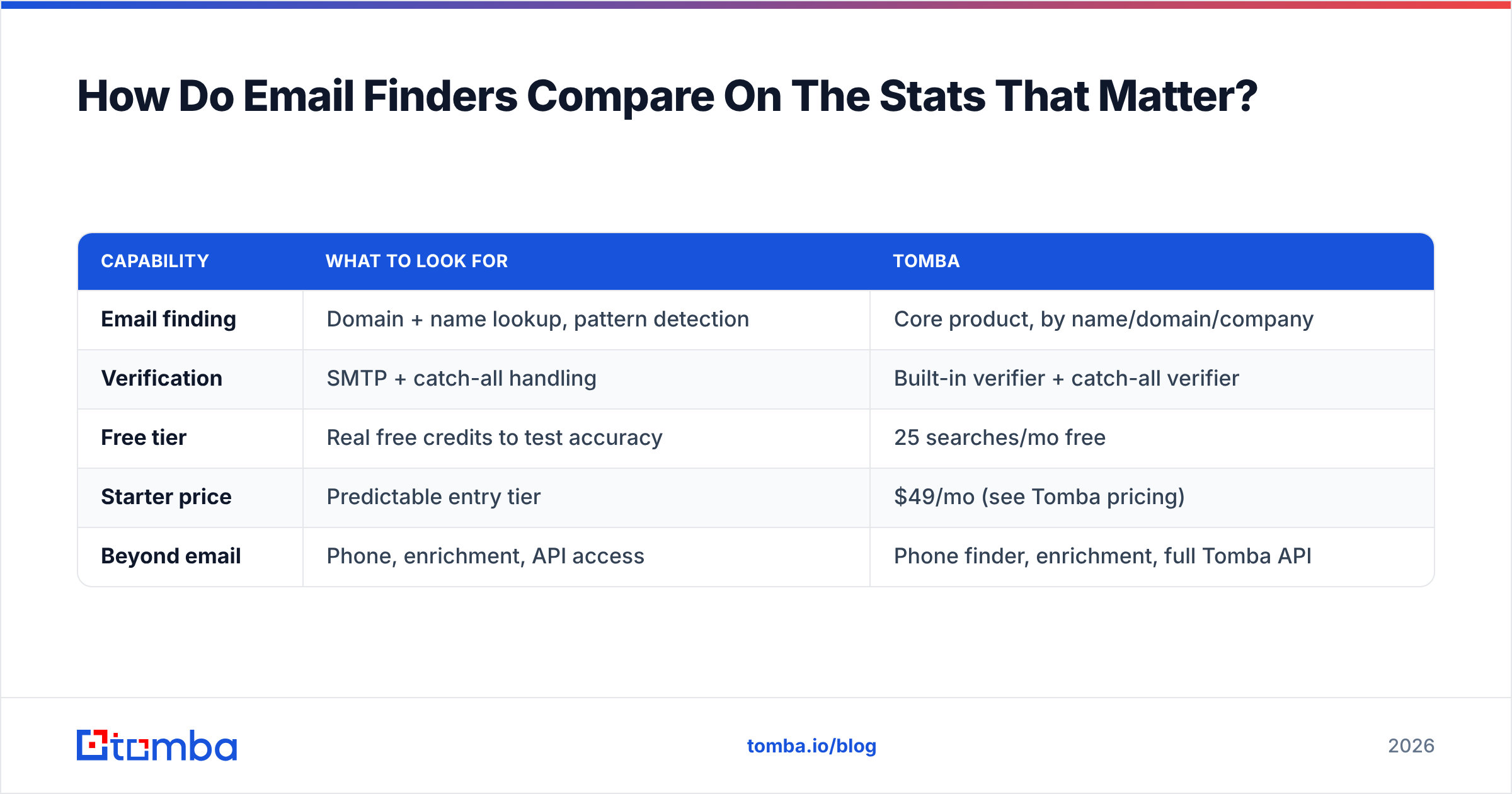
| Capability | What to look for | Tomba |
|---|---|---|
| Email finding | Domain + name lookup, pattern detection | Core product, by name/domain/company |
| Verification | SMTP + catch-all handling | Built-in verifier + catch-all verifier |
| Free tier | Real free credits to test accuracy | 25 searches/mo free |
| Starter price | Predictable entry tier | $49/mo (see Tomba pricing) |
| Beyond email | Phone, enrichment, API access | Phone finder, enrichment, full Tomba API |
The point is not that one tool wins every row — it is that you should benchmark on your domains. Pull a sample of 100 known contacts, run them through any tool's free tier, and measure the hit rate and bounce rate yourself. Vendor accuracy claims are marketing; your own test set is data. You can compare options on independent review sites like G2 before committing, then validate with a live test.
What Do These B2B Sales Stats Mean For Your Process?#
Pulling the threads together, here is how the numbers translate into changes you can make this quarter:
- Build follow-up cadences of at least 5–8 touches. If your sequences stop at two, the data says you are leaving most of your replies on the table.
- Verify before you send, every time. Keep bounce rate under 3% to protect deliverability and sender reputation.
- Multi-thread every deal over mid-market size. With 6–10 stakeholders, single-threading is a forecast risk.
- Treat speed-to-lead as a KPI. A 5-minute response window is one of the highest-ROI process changes available.
- Schedule data hygiene. Re-verify and re-enrich quarterly to fight 22–30% annual decay.
None of this requires a bigger team or a bigger budget. It requires clean inputs and disciplined process — the two things stats consistently reward over raw effort.
Frequently Asked Questions#
What is the average B2B sales conversion rate? Lead-to-opportunity conversion averages around 13%, and opportunity-to-close win rates land between 15% and 22% for most teams. Top performers exceed these by qualifying more strictly, not by pitching more aggressively.
How many follow-ups should a B2B sales email sequence have? The data supports 5–8 touchpoints. Most positive replies arrive on the third touch or later, yet a large share of reps stop after one follow-up.
How fast does B2B contact data go stale? Roughly 22–30% per year. That makes quarterly verification and enrichment a practical necessity rather than a nice-to-have.
Does email still work for B2B outbound in 2026? Yes — reply rates of 8–15% are achievable on verified, well-targeted lists. The differentiator is data quality and segmentation, not channel choice.
Turn These Stats Into Pipeline#
Every benchmark in this article rests on one foundation: accurate, current contact data. The teams that hit the top of these ranges are not working harder than you — they are working from cleaner lists. Start with the Tomba Email Finder to source verified professional emails by name, domain, or company, run them through built-in verification to keep bounce rates low, and feed the results straight into your sequences. Test it free with 25 searches a month, measure your own hit rate, and let the numbers — not the guesswork — decide your next move.
// get started
Find, verify and enrich your first contacts today
Start on the free plan with 25 searches a month, then scale when your team is ready.
Free plan · No credit card required · GDPR & CCPA
// about the author