B2B Sales vs B2C Sales: Key Differences and Strategy in 2026
B2B sales and B2C sales look similar on the surface but reward opposite playbooks. Here's how cycles, buyers, pricing, and tooling actually differ in 2026.
The whole debate around B2B sales vs B2C sales comes down to one question. Are you selling to a person spending their own money, or to a committee spending the company's? That single fact reshapes everything downstream. It changes how long the deal takes. It changes how many people say "no" before one says "yes." And it decides what your tech stack has to do for you.
TL;DR#
- B2B sales targets organizations: longer cycles (weeks to quarters), 5–11 stakeholders per deal, high contract values, and relationship-driven follow-up.
- B2C sales targets individuals: short cycles (minutes to days), one or two decision-makers, lower price points, and emotion-driven, high-volume conversion.
- The metrics diverge — B2B optimizes for ACV, pipeline velocity, and win rate; B2C optimizes for conversion rate, AOV, and lifetime value at scale.
- Tooling differs too: B2B runs on CRM, accurate contact data, and sequenced outreach; B2C runs on ad platforms, storefronts, and lifecycle email.
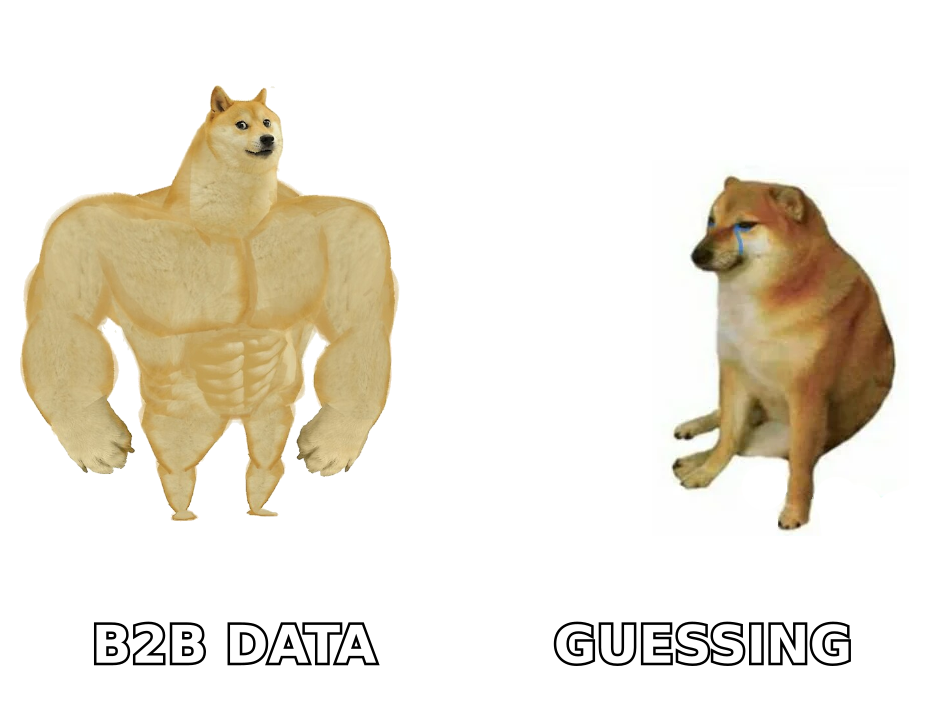
- If you run outbound B2B, contact accuracy is the whole game — bad data quietly kills cycles that already take months.
B2B Sales vs B2C Sales: What Is the Core Difference?#
B2B sells to businesses; B2C sells to consumers — and that audience split drives every other difference. A B2B (business-to-business) rep sells software, services, or supply to another company. A B2C (business-to-consumer) rep sells directly to the end user who clicks "buy now."
The audience changes the psychology of the purchase. A consumer buying running shoes can decide in five minutes. They go on color, price, and a review score. A procurement lead buying a $90,000 logistics platform has a harder job. They must justify the spend to finance, get security to sign off, and prove ROI to a VP who never saw the demo. One purchase is personal and fast. The other is political and slow.
That's why copy-pasting a B2C growth playbook into a B2B motion (or vice versa) usually fails. The funnels share vocabulary — leads, pipeline, conversion — but the mechanics underneath are different machines.
How do the buying cycles compare?#
B2B cycles are long because risk is shared across people. B2C cycles are short because risk sits with one person who can absorb a small mistake.
In B2B, the average deal now involves 6 to 10 decision-makers, according to long-running research from Gartner on the buying group. Each stakeholder adds a review step, an objection, and a delay. A mid-market software deal commonly runs 30–90 days. An enterprise deal can stretch past two quarters.
In B2C, the "buying group" is usually one shopper, occasionally a partner or parent. The trigger is often emotional — desire, urgency, a discount timer. The path from awareness to purchase can collapse into a single session.
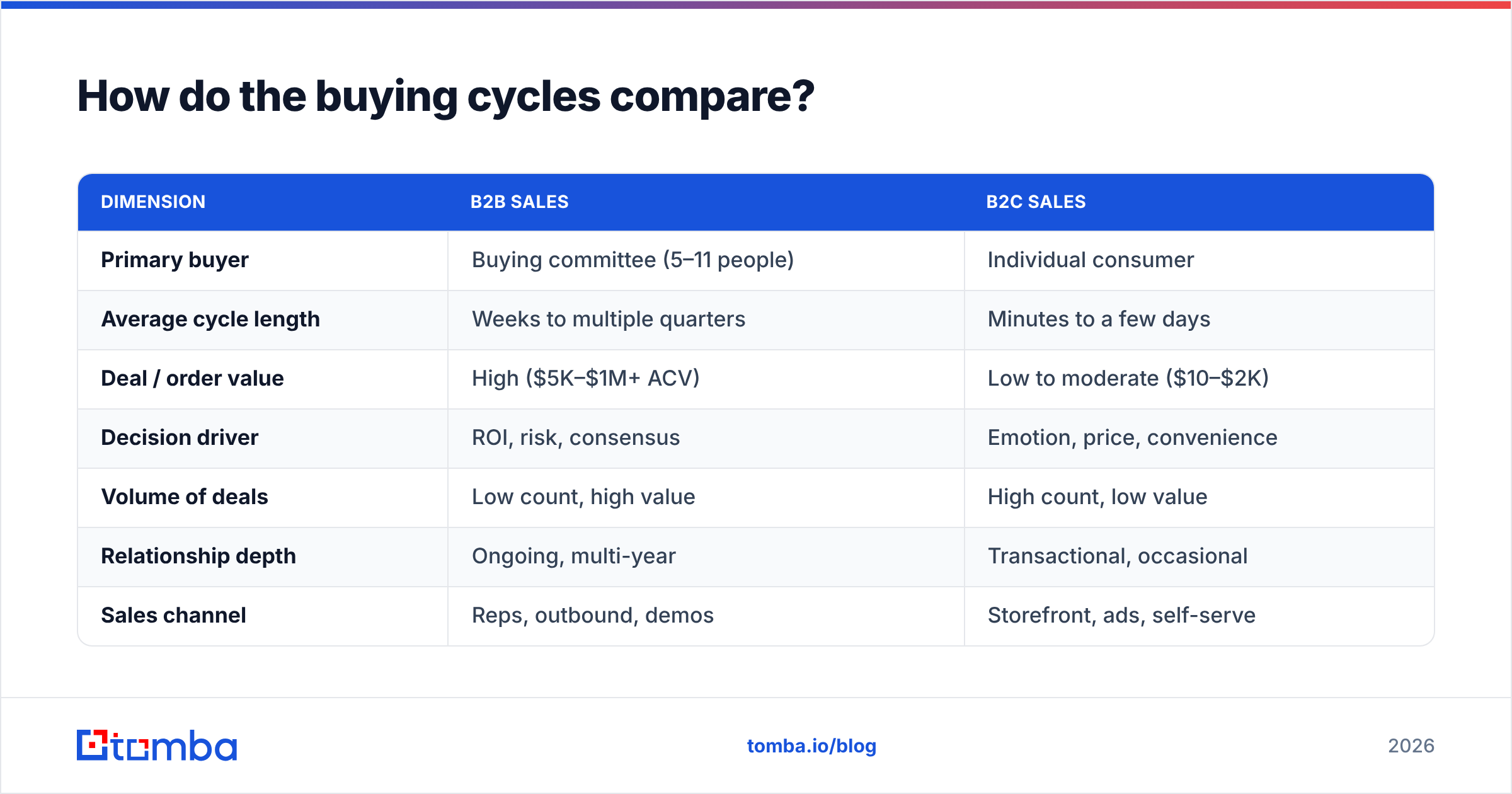
This is the single biggest operational gap between the two motions, so it's worth seeing the contrast side by side.
| Dimension | B2B Sales | B2C Sales |
|---|---|---|
| Primary buyer | Buying committee (5–11 people) | Individual consumer |
| Average cycle length | Weeks to multiple quarters | Minutes to a few days |
| Deal / order value | High ($5K–$1M+ ACV) | Low to moderate ($10–$2K) |
| Decision driver | ROI, risk, consensus | Emotion, price, convenience |
| Volume of deals | Low count, high value | High count, low value |
| Relationship depth | Ongoing, multi-year | Transactional, occasional |
| Sales channel | Reps, outbound, demos | Storefront, ads, self-serve |
| Primary metric | ACV, win rate, pipeline velocity | Conversion rate, AOV, LTV |
Who are the decision-makers in each model?#
In B2B, you rarely sell to one person — you sell to a chain. A typical enterprise software deal touches an economic buyer (signs the check), a champion (wants the product internally), technical evaluators (security, IT), and blockers (legal, procurement, or a skeptical exec). Your job is to arm the champion to sell on your behalf in rooms you'll never enter.
In B2C, the decision-maker is the user, and the influence layer is social: reviews, ratings, influencer endorsements, and friends. You're not navigating an org chart. You're reducing friction and answering objections before they form.
This is why B2B prospecting is identity-heavy. You need the right named person, their role, their email, and often their direct phone before outreach even starts. Get the wrong contact and you've spent a quarter selling to someone with no budget authority. Accurate data enrichment and verified contact details aren't a nice-to-have here. They're the difference between reaching a champion and emailing a dead inbox.
How does pricing and value differ?#
B2B pricing is negotiated and value-based; B2C pricing is fixed and transparent.
A consumer sees a price tag and accepts or rejects it. A business buyer sees a starting point. Enterprise B2B deals routinely involve custom quotes, volume discounts, multi-year commitments, and procurement haggling. The list price on a SaaS site marked "Contact sales" is rarely the price anyone pays.
Because B2B contract values are high and customers are few, every account matters enormously. Losing one enterprise logo can dent a quarter. In B2C, no single customer is decisive. The model is built on volume, and you optimize the average rather than the individual.
Here's how the economics break down across the funnel:
- Customer acquisition cost (CAC) — High in B2B (sales salaries, long cycles, demos), low-to-moderate in B2C (ad spend amortized over many buyers).
- Average order/contract value — B2B lands far higher per deal, which is what justifies the heavier acquisition spend.
- Sales-to-revenue ratio — B2B leans on human reps; B2C leans on automated funnels and paid media.
- Lifetime value (LTV) — Both care about it, but B2B LTV is concentrated in a handful of renewing accounts, while B2C LTV is spread across a large base.
- Margin sensitivity — A single B2B discount negotiation can move margin more than thousands of B2C transactions combined.
If you want to see this logic applied to a real product ladder, Tomba's own pricing tiers — Free, Starter at $49/mo, Growth at $99/mo, Pro at $249/mo, and custom Enterprise — follow the classic B2B SaaS pattern: self-serve at the bottom, sales-assisted at the top.
Is B2B sales harder than B2C sales?#
Neither is "harder" — they're hard in different ways, and the skills don't transfer cleanly.
B2B difficulty is about complexity and patience: multi-threading a deal, managing a buying committee, surviving a six-month cycle without the deal going dark, and keeping a champion engaged through internal politics. The rep who wins is part consultant, part project manager.
B2C difficulty is about scale and volume: converting strangers at a high enough rate to make the unit economics work, fighting cart abandonment, and standing out in a feed where attention lasts under two seconds. The team that wins is part marketer, part conversion scientist.
A great enterprise AE might flounder running a high-velocity e-commerce funnel. A brilliant DTC growth marketer might stall the moment a deal needs months of nurturing a skeptical CFO. Match the person to the motion.
What tools does each sales model need?#
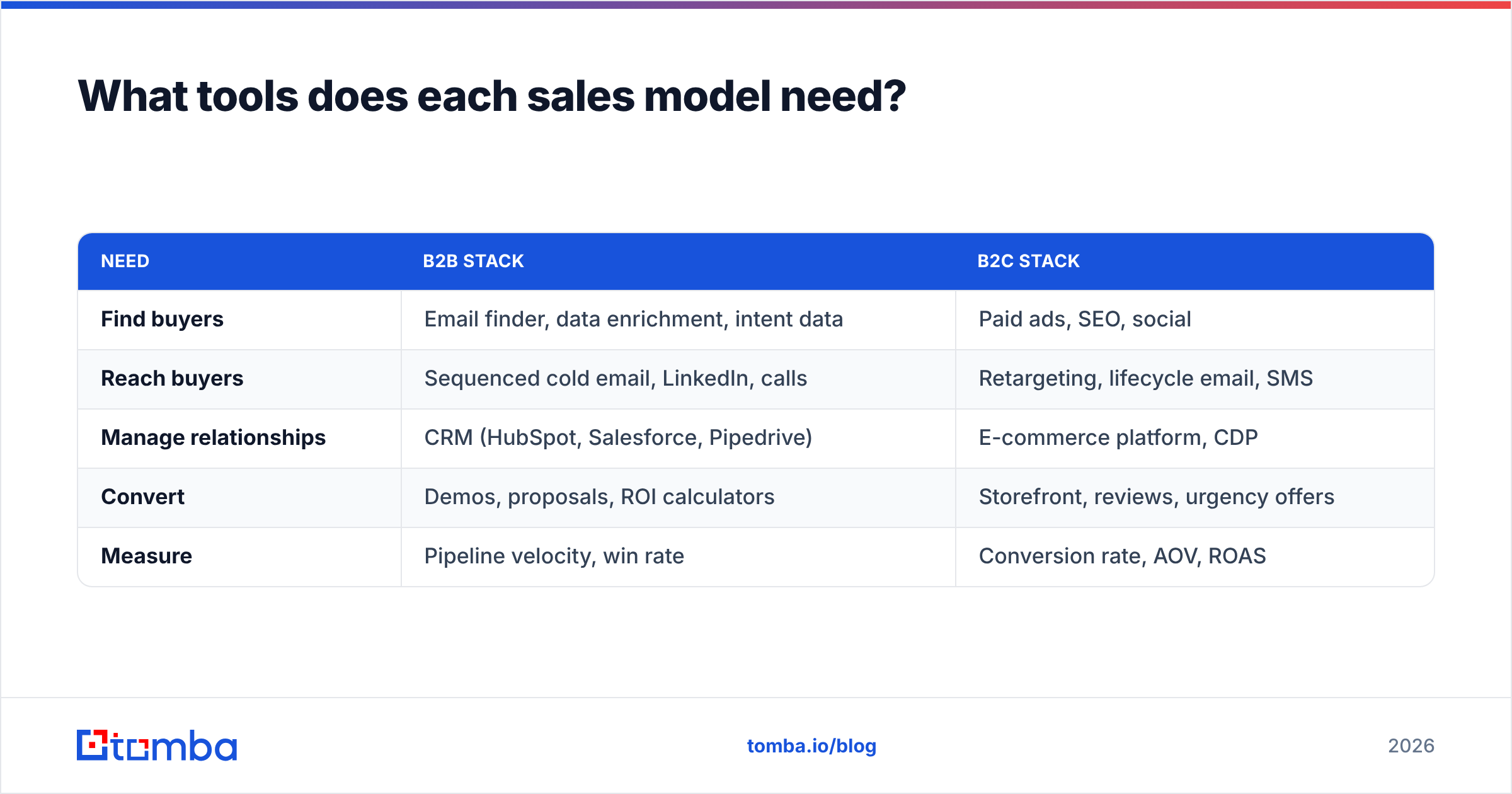
The stacks overlap in name only. B2C revolves around demand capture and checkout; B2B revolves around targeted outreach and relationship management.
| Need | B2B Stack | B2C Stack |
|---|---|---|
| Find buyers | Email finder, data enrichment, intent data | Paid ads, SEO, social |
| Reach buyers | Sequenced cold email, LinkedIn, calls | Retargeting, lifecycle email, SMS |
| Manage relationships | CRM (HubSpot, Salesforce, Pipedrive) | E-commerce platform, CDP |
| Convert | Demos, proposals, ROI calculators | Storefront, reviews, urgency offers |
| Measure | Pipeline velocity, win rate | Conversion rate, AOV, ROAS |
For B2B specifically, the top of the funnel lives or dies on contact data. You can't sequence outreach to a champion whose email you don't have. You can't multi-thread an account without reaching several named people inside it. That's where a domain search earns its keep — feed it a company URL and pull back the verified work emails and roles of the people who actually make decisions.
It also explains why bought lists fail in B2B. A scraped, unverified list torches your sender reputation with bounces. It lands you in spam before a single champion sees your pitch. Verified, freshly sourced contacts protect the deliverability that long B2B cycles depend on. Industry review sites like G2 track dozens of tools in this category if you want to compare approaches.
How should your strategy change between the two?#
Start with the cycle length, then design backward. The B2B sales vs B2C sales split should shape every choice that follows.
If you sell B2B:
- Build for the committee. Identify and reach multiple stakeholders per account, not just one contact.
- Prioritize data accuracy over list size. Ten verified, well-fit contacts beat a thousand guesses — quality compounds over a long cycle.
- Invest in nurture. A deal that takes a quarter needs consistent, value-led touches, not a single blast.
- Measure pipeline velocity and win rate, not raw volume.
If you sell B2C:
- Build for friction reduction. Every extra click costs conversions.
- Optimize the average — AOV, conversion rate, and repeat-purchase rate move the business.
- Lean on social proof and urgency; emotion closes faster than spec sheets.
- Treat email as lifecycle (cart recovery, win-back) rather than cold outreach.
Many companies run a hybrid. They use a self-serve B2C-style bottom of the funnel and a sales-assisted B2B-style top for larger accounts. The mistake is using one playbook for both. Your $20/month self-serve plan and your $50,000 enterprise contract need different cycles, different copy, and different tooling, even when they sell the same product.
What does this mean for your outbound in 2026?#
The lines are blurring on the surface. Consumers expect B2C-grade ease from B2B vendors, and B2B buyers self-educate like consumers before they ever talk to a rep. But underneath, the fundamentals of B2B sales vs B2C sales hold firm: businesses buy by committee over time, and consumers buy individually in the moment.
For revenue teams, the practical takeaway is simple. Stop treating "sales" as one discipline. Audit which motion you're actually running, then equip it correctly. If you're B2B, that audit almost always surfaces the same gap: outreach built on stale or guessed contact data. Fix the data layer first — it's the cheapest, highest-leverage improvement available to a long-cycle motion.
Close the data gap before your next campaign#
If you run a B2B motion, your pipeline starts with reaching the right named person at the right account — and that starts with accurate email data. The Tomba Email Finder lets you find verified professional emails by name, company, or domain, so your reps spend their long cycles selling to real decision-makers instead of bouncing off dead inboxes. Pair it with the built-in email verifier to protect deliverability before your first send, and start free with 25 searches a month — no card required — to see how clean data shortens even the slowest B2B deal.
// get started
Find, verify and enrich your first contacts today
Start on the free plan with 25 searches a month, then scale when your team is ready.
Free plan · No credit card required · GDPR & CCPA
// about the author