What Makes a Great B2B Salesperson in 2026 (Skills + Tools)
The modern B2B salesperson isn't a smooth talker with a quota — they're a researcher, a systems operator, and a trusted advisor. Here's the 2026 skill stack, the tools, and the daily habits that separate top reps from the pack.
The job title sounds simple. The job is not. A modern B2B salesperson spends less time pitching and more time researching, qualifying, and operating a stack of tools that would make a 2015 rep dizzy. If you're trying to break into the role, hire for it, or just get better at it, this is the playbook for what the job actually looks like in 2026.
TL;DR#
- A B2B salesperson sells products or services to other businesses — longer cycles, multiple stakeholders, and bigger deal sizes than B2C.
- The top performers in 2026 win on research and relevance, not charisma. Clean data and tight targeting beat volume.
- The modern skill stack is part analyst, part communicator, part systems operator — and the tool budget reflects that.
- Comp is heavily leveraged: base plus commission, with OTE (on-target earnings) the number that actually matters.
- Bad contact data is the silent quota killer. Verified emails and direct dials are the unglamorous foundation everything else sits on.
What is a B2B salesperson?#
A B2B salesperson sells to organizations rather than individual consumers. Instead of convincing one person to buy a pair of shoes, you're convincing a buying committee — often five to ten people — to approve a contract that might run into six figures and reshape how their team works.
That structural difference changes everything. According to Gartner research on B2B buying, a typical purchase now involves multiple stakeholders and a buying journey that loops back on itself rather than moving in a straight line. The rep's job is to navigate that maze: find the right people, understand each one's motivation, and keep the deal moving when any single "no" can stall it.
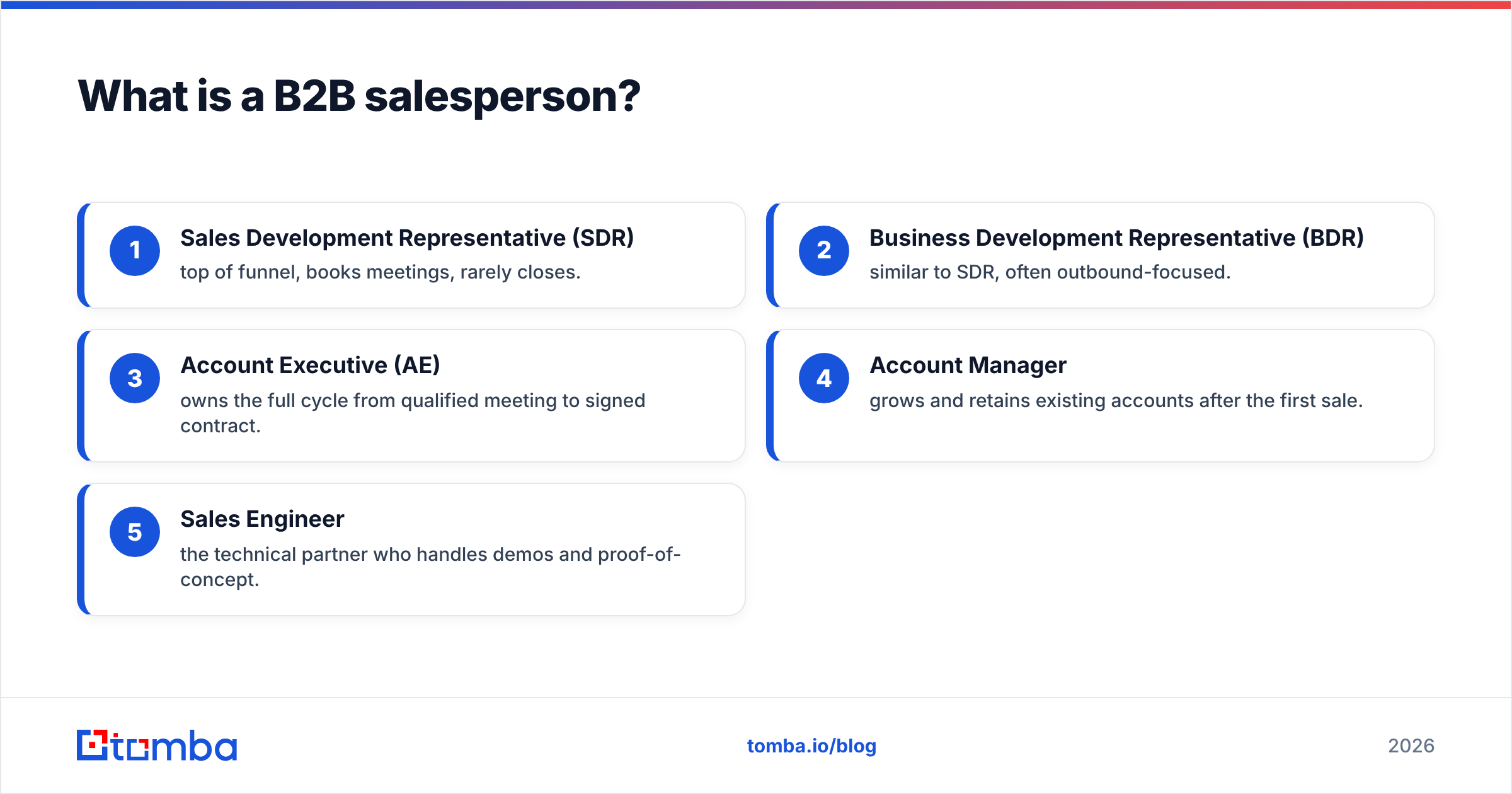
Common B2B salesperson titles you'll see:
- Sales Development Representative (SDR) — top of funnel, books meetings, rarely closes.
- Business Development Representative (BDR) — similar to SDR, often outbound-focused.
- Account Executive (AE) — owns the full cycle from qualified meeting to signed contract.
- Account Manager — grows and retains existing accounts after the first sale.
- Sales Engineer — the technical partner who handles demos and proof-of-concept.
Think of it like a relay race. The SDR runs the first leg and hands a qualified lead to the AE, who runs it across the finish line. Drop the baton — usually because of a bad handoff or stale data — and the whole team loses the deal.
What does a B2B salesperson actually do all day?#
The cliché is the smooth talker on the phone. The reality is closer to a researcher who occasionally talks.
A realistic day breaks down like this:
- Research and list-building (1–2 hrs): Identifying target accounts, finding the right contacts, and pulling verified email addresses and phone numbers. This is where deals are won or lost before a word is spoken.
- Outreach (2–3 hrs): Cold email, follow-ups, LinkedIn touches, and calls. Sequenced, not random.
- Meetings and demos (1–3 hrs): Discovery calls, demos, and stakeholder check-ins.
- CRM and admin (1–2 hrs): Logging activity, updating deal stages, forecasting. Tedious, but the pipeline is only as honest as the data in it.
- Internal sync (30–60 min): Pipeline reviews, deal strategy, handoffs to sales engineering or customer success.
Notice what's missing from the glamorous version: most of the day is preparation. The actual selling — the part everyone pictures — is maybe a quarter of the time. The rest is making sure that quarter lands on the right person with the right message.
What skills does a B2B salesperson need in 2026?#
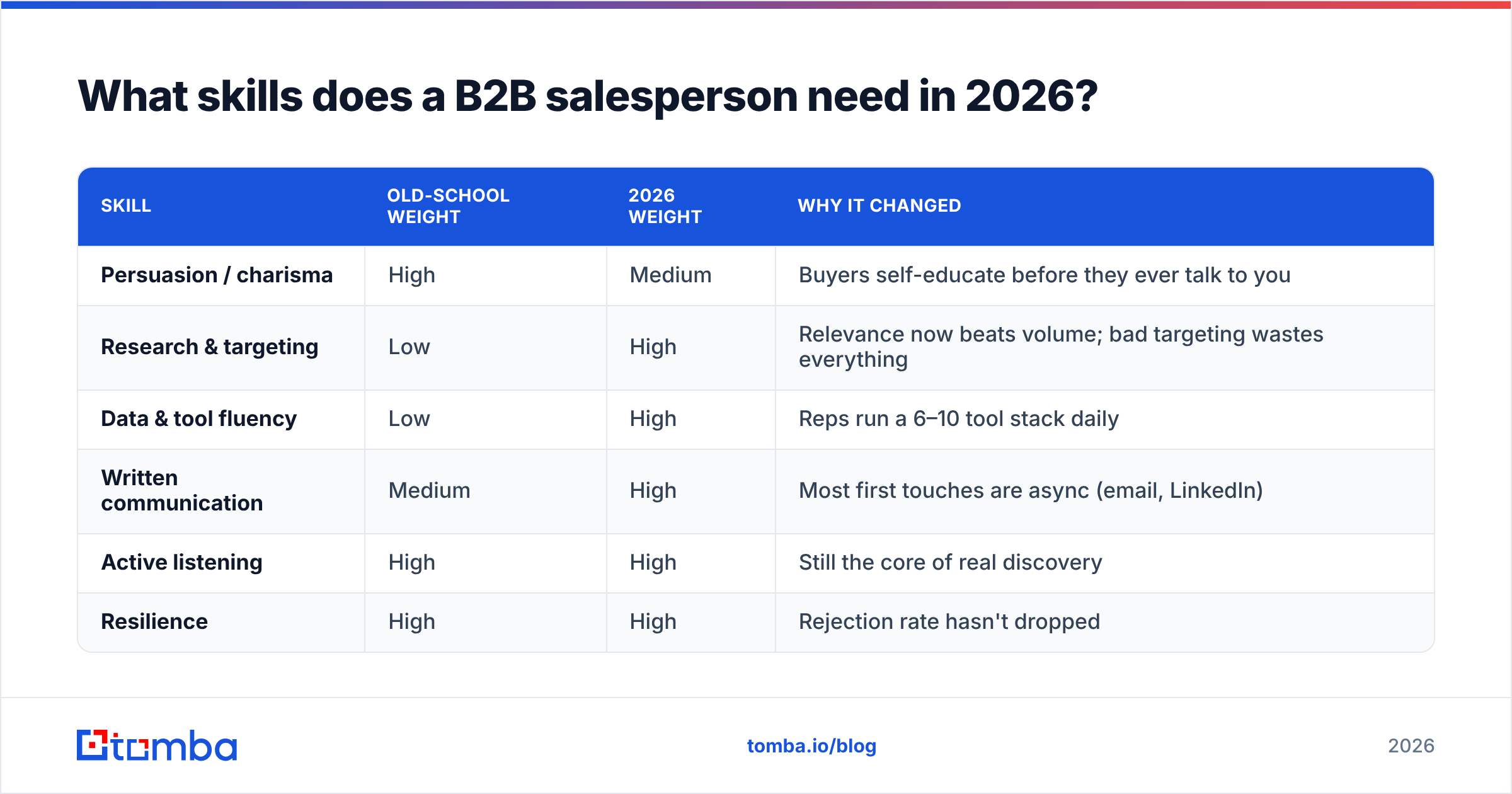
The skill mix has shifted. Persuasion still matters, but it's been demoted from "the whole job" to "one of several things you'd better be good at." Here's how the modern stack stacks up against the old one.
| Skill | Old-school weight | 2026 weight | Why it changed |
|---|---|---|---|
| Persuasion / charisma | High | Medium | Buyers self-educate before they ever talk to you |
| Research & targeting | Low | High | Relevance now beats volume; bad targeting wastes everything |
| Data & tool fluency | Low | High | Reps run a 6–10 tool stack daily |
| Written communication | Medium | High | Most first touches are async (email, LinkedIn) |
| Active listening | High | High | Still the core of real discovery |
| Resilience | High | High | Rejection rate hasn't dropped |
A few of these deserve a closer look.
Research and targeting. The single biggest lever a B2B salesperson has is who they contact. A perfect pitch to the wrong person is wasted. Top reps build tight ideal-customer-profile (ICP) lists and enrich them with real firmographic and contact data before they spend a minute on outreach.
Data and tool fluency. You don't need to be an engineer, but you need to be comfortable moving data between a CRM, an email finder, a sequencing tool, and a data-enrichment layer. Reps who fumble their tools spend their day fighting the stack instead of selling.
Written communication. The first impression in B2B is almost always text — a cold email or a LinkedIn message. If you can't write a tight, specific, jargon-free three-sentence opener, you're invisible. (This is also why cold email templates are a starting point, not a crutch — personalization is what gets replies.)
Active listening. Discovery isn't interrogation. The best reps talk less than their prospects and ask better questions. HubSpot's sales research consistently shows that reps who listen more close more — the talk-to-listen ratio is one of the most reliable predictors of a won deal.
How much does a B2B salesperson earn?#
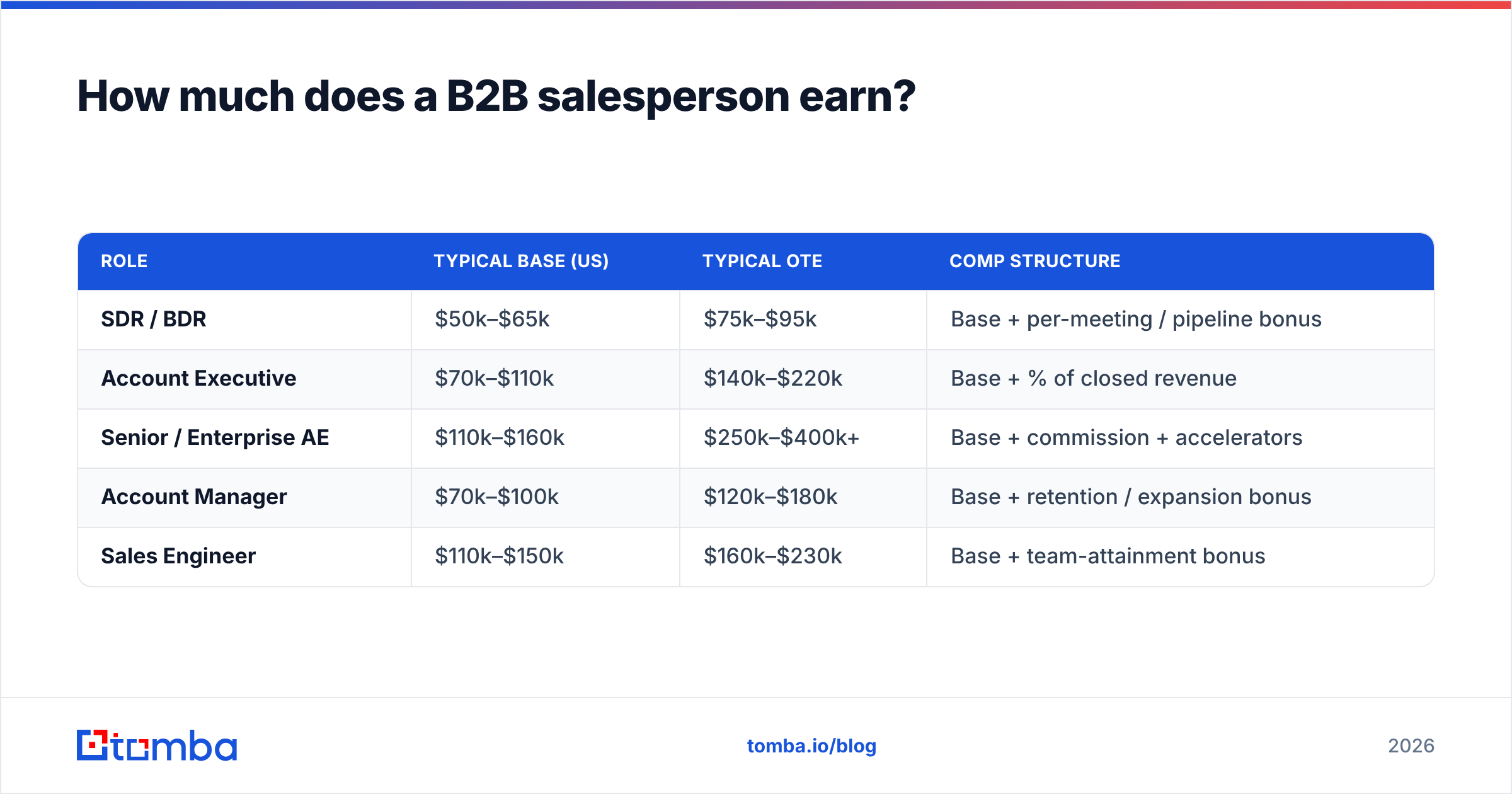
Compensation in B2B sales is built on leverage: a lower guaranteed base plus uncapped (or high-cap) commission. The number that matters is OTE — on-target earnings, what you make if you hit 100% of quota.
| Role | Typical base (US) | Typical OTE | Comp structure |
|---|---|---|---|
| SDR / BDR | $50k–$65k | $75k–$95k | Base + per-meeting / pipeline bonus |
| Account Executive | $70k–$110k | $140k–$220k | Base + % of closed revenue |
| Senior / Enterprise AE | $110k–$160k | $250k–$400k+ | Base + commission + accelerators |
| Account Manager | $70k–$100k | $120k–$180k | Base + retention / expansion bonus |
| Sales Engineer | $110k–$150k | $160k–$230k | Base + team-attainment bonus |
Ranges vary widely by region, industry, and deal size — check live benchmarks on G2 or Glassdoor for your specific market. Two things are near-universal, though: the split gets more leveraged as you move up, and accelerators (higher commission rates once you blow past quota) are where top reps make outsized money. A rep at 130% of quota often earns far more than 1.3x a rep at 100%.
How is B2B selling different from B2C?#
The differences aren't cosmetic — they reshape the whole job.
- Deal size: B2B deals are larger, which justifies a longer, more consultative sales process.
- Buying committee: B2C is usually one buyer. B2B is a committee, each member with a different agenda (the user wants features, finance wants ROI, IT wants security).
- Sales cycle: B2C can close in minutes. B2B cycles run weeks to many months.
- Relationship depth: B2B is built on ongoing relationships and renewals, not one-off transactions.
- Rational vs. emotional: B2C leans emotional; B2B blends emotion with hard ROI justification.
Practically, that means a B2B salesperson has to manage a process, not just close a sale. You're tracking a sales pipeline, mapping stakeholders, and nurturing accounts that might not buy for two quarters. Patience and organization are as important as the pitch.
What does the modern B2B sales tool stack look like?#
Here's where the job has changed most. A 2026 B2B salesperson runs a stack, and the categories break down like this:
- CRM — the system of record (Salesforce, HubSpot, Pipedrive). Everything else feeds it.
- Contact data / email finder — turns a name and company into a verified email and phone number.
- Email verification — confirms an address is deliverable before you send, protecting your sender reputation.
- Sequencing / engagement — automates multi-step outreach across email and LinkedIn.
- Data enrichment — fills in firmographic and intent signals so you can prioritize.
- Conversation intelligence — records and analyzes calls for coaching.
The unglamorous truth: the data layer underpins all of it. Your sequencing tool, your CRM, and your beautifully written email are all worthless if the email address bounces or the phone number is dead. This is the most common reason good reps miss quota — they're working a list that's quietly rotting.
That's why the foundation of a modern stack is a reliable email finder paired with an email verifier. Find the right person, confirm the address is live, then spend your energy on the message. Reps who skip the verification step torch their domain reputation chasing contacts who were never reachable. For team-scale prospecting, a bulk email finder or a domain search across a target account turns hours of manual digging into minutes.
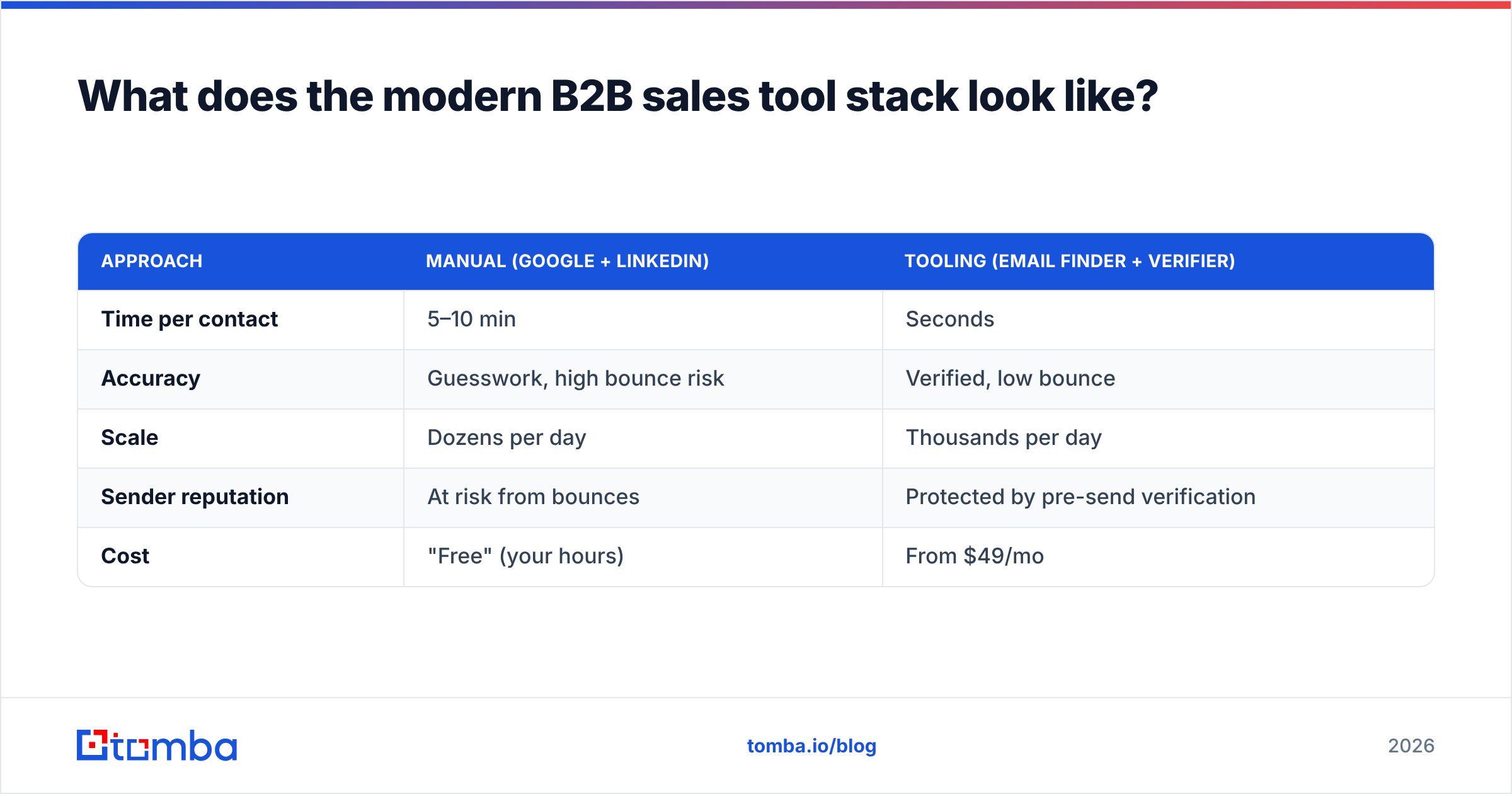
Build vs. buy your contact data#
| Approach | Manual (Google + LinkedIn) | Tooling (email finder + verifier) |
|---|---|---|
| Time per contact | 5–10 min | Seconds |
| Accuracy | Guesswork, high bounce risk | Verified, low bounce |
| Scale | Dozens per day | Thousands per day |
| Sender reputation | At risk from bounces | Protected by pre-send verification |
| Cost | "Free" (your hours) | From $49/mo |
The "free" manual route is the most expensive option once you price your own time and the cost of a damaged sending domain. A starter tool — see Tomba pricing — pays for itself in the hours it saves in a single week.
How do you become a great B2B salesperson?#
Skills and tools are table stakes. The habits below are what separate the rep who scrapes to quota from the one who blows past it.
- Pick a niche and own it. Generalists blend in. A rep who deeply understands one industry's problems sounds like an insider, not a vendor.
- Treat data as your edge. Spend the first hour of every day on clean, verified, well-targeted lists. Garbage in, garbage out is brutally literal in sales.
- Personalize the first line, template the rest. Reference something specific — a funding round, a job posting, a product launch. Then let your sequence do the heavy lifting.
- Follow up more than feels comfortable. Most deals die in the follow-up gap, not the first email. Persistence (without being a pest) is a genuine differentiator.
- Live in your CRM. A clean pipeline isn't bureaucracy — it's how you forecast, prioritize, and avoid letting deals slip through the cracks.
- Ask for the meeting. Discovery and rapport are great, but a B2B salesperson who never asks for the next step never advances the deal.
The through-line: modern B2B selling rewards preparation. The rep who shows up to a call already knowing the prospect's tech stack, headcount, and likely pain points has won before the conversation starts. That preparation is built on data — and the quality of that data is something you control.
The bottom line#
The B2B salesperson role in 2026 is more demanding and more rewarding than it's ever been. It rewards reps who are part analyst, part communicator, and part operator — people who do the unglamorous research so the glamorous closing becomes easy. The charisma myth is dead; relevance and reliability won.
Start where the leverage is highest: your data. Before you write another cold email, make sure you're reaching a real person at a real address. The Tomba Email Finder turns a name and a company domain into a verified, deliverable email in seconds — so every minute you spend selling lands on someone who can actually say yes. Start free with 25 searches a month, and scale up only when the pipeline proves it's worth it.
// get started
Find, verify and enrich your first contacts today
Start on the free plan with 25 searches a month, then scale when your team is ready.
Free plan · No credit card required · GDPR & CCPA
// about the author