B2B Search Engines in 2026: Find Companies and Contacts Fast
B2B search engines turn a company name into verified decision-maker contacts. Here's how they work, who the top players are, and how to pick one in 2026.
TL;DR
- A B2B search engine lets you query a database of companies and people by attributes — industry, role, location, tech stack — and returns structured, contactable records instead of blue links.
- The category splits into three jobs: company discovery, contact discovery, and contact verification. Most teams need all three.
- Accuracy and freshness matter more than database size. A 200M-record dump full of bounced emails costs you sender reputation, not pipeline.
- Pricing ranges from free tiers (25–50 lookups/mo) to enterprise seats above $1,000/mo. Watch credit definitions — a "credit" can mean a company, a contact, or a verified email.
- Tomba sits in the contact-discovery and verification slice: find emails by domain or name, verify them, and enrich, starting free and scaling to $49/mo.
What is a B2B search engine?#
A B2B search engine is a database you query by business attributes instead of keywords. Think of Google as a library card catalog for web pages, and a B2B search engine as a customer-relationship Rolodex you can filter — "show me every VP of Engineering at a 50–200 person SaaS company in Germany using HubSpot." The result isn't a list of articles. It's a list of named people, their employers, and a way to reach them.
That distinction is the whole point. A consumer search engine optimizes for documents; a B2B search engine optimizes for records. Each record bundles firmographic data (company size, revenue, industry), technographic data (the tools a company runs), and contact data (email, phone, LinkedIn URL). When you run a query, you're filtering structured fields, not ranking text relevance.
These platforms power outbound sales, account-based marketing, recruiting, and competitive research. If your job involves building a list of the right people to contact, a B2B search engine is the tool that turns "I know my ideal customer" into "here are 800 of them with verified emails."
How do B2B search engines actually work?#
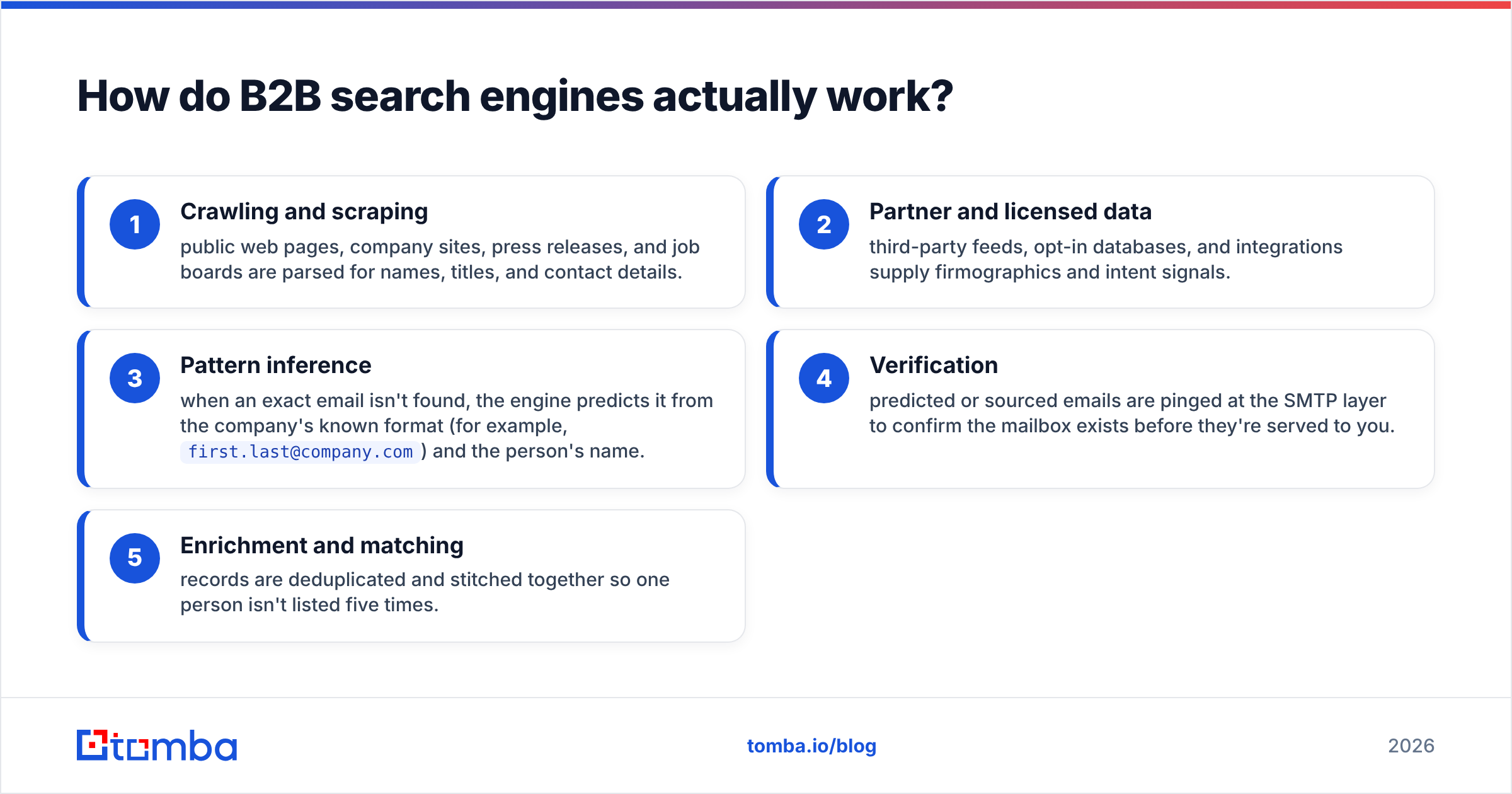
They assemble data from many sources, then resolve it into a single record per person or company. The pipeline usually looks like this:
- Crawling and scraping — public web pages, company sites, press releases, and job boards are parsed for names, titles, and contact details.
- Partner and licensed data — third-party feeds, opt-in databases, and integrations supply firmographics and intent signals.
- Pattern inference — when an exact email isn't found, the engine predicts it from the company's known format (for example,
first.last@company.com) and the person's name. - Verification — predicted or sourced emails are pinged at the SMTP layer to confirm the mailbox exists before they're served to you.
- Enrichment and matching — records are deduplicated and stitched together so one person isn't listed five times.
The verification step is where quality is won or lost. An engine that skips it hands you addresses that look plausible but bounce. That's why a serious workflow pairs discovery with an email verifier and, for risky domains, a catch-all verifier. Curious where the underlying records come from? Tomba documents its data sources openly, which is the kind of transparency you should demand from any vendor.
What are the types of B2B search engines?#
Not every tool does every job. Sorting the category by primary function keeps you from overpaying for features you won't use.
- Company search engines — start from firmographics. You filter by industry, size, funding, or location to build a target account list. Good for ABM and territory planning.
- Contact search engines — start from a person or a role. You find the decision-maker and their direct contact details. This is the email-finder and people-search slice.
- Domain-based finders — start from a company URL and return every reachable email at that domain. Fast for penetrating a single account. Tomba's domain search is built for exactly this.
- Verification engines — don't find new data; they validate what you already have, cutting bounce rates before a send.
- Intent and visitor engines — surface accounts showing buying signals or identify anonymous website traffic, like Tomba's website visitor reveal.
Most revenue teams stitch two or three of these together. A common stack: a company engine to define the account list, a contact finder to get the people, and a verifier to clean the output before it touches a sequence.
Which B2B search engines are best in 2026?#
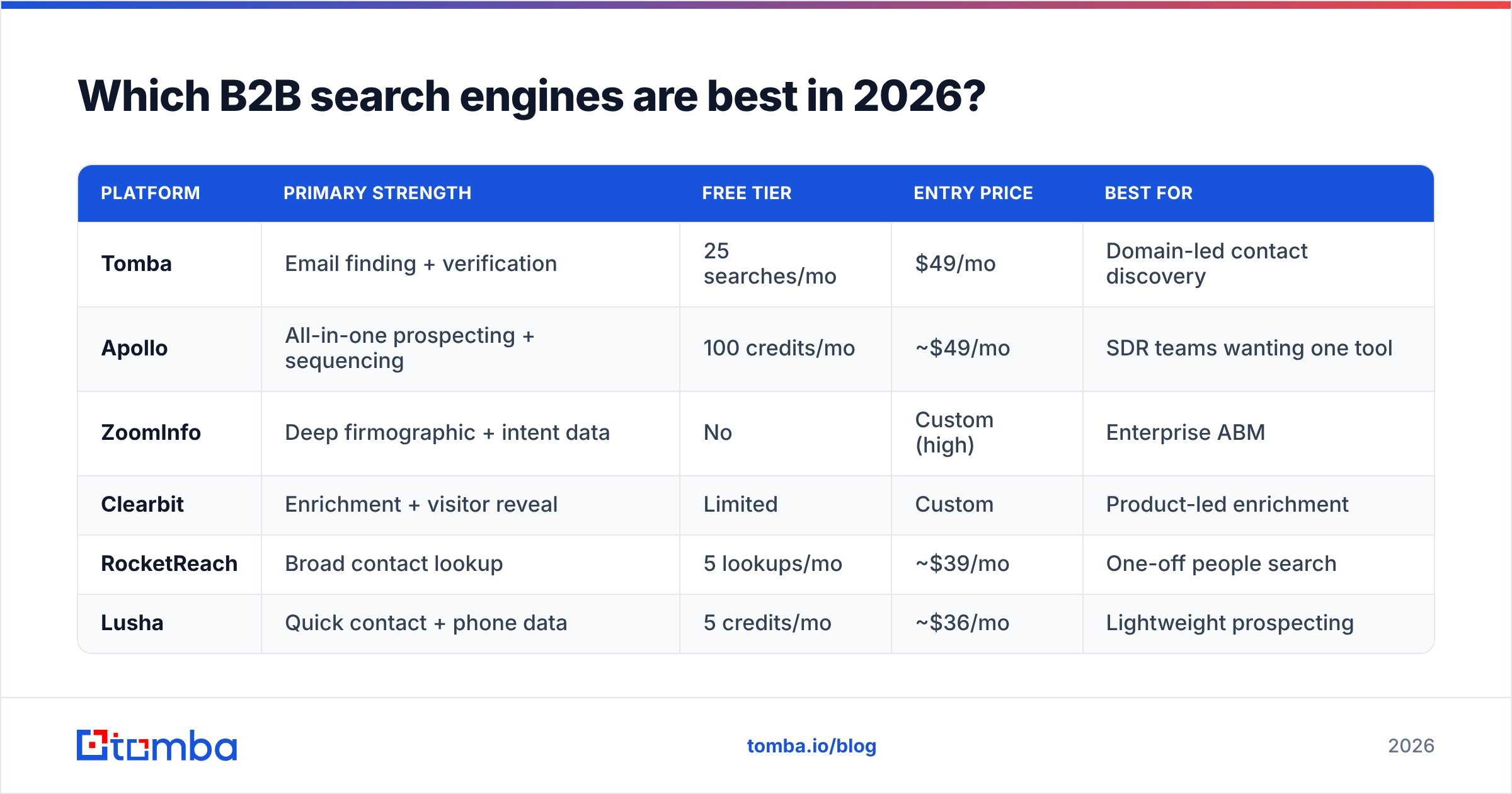
There's no single winner — there's a best fit for your job-to-be-done and budget. The table below compares widely used platforms across the attributes that actually change your results. Pricing reflects published entry tiers as of 2026 and shifts often, so confirm before you buy.
| Platform | Primary strength | Free tier | Entry price | Best for |
|---|---|---|---|---|
| Tomba | Email finding + verification | 25 searches/mo | $49/mo | Domain-led contact discovery |
| Apollo | All-in-one prospecting + sequencing | 100 credits/mo | ~$49/mo | SDR teams wanting one tool |
| ZoomInfo | Deep firmographic + intent data | No | Custom (high) | Enterprise ABM |
| Clearbit | Enrichment + visitor reveal | Limited | Custom | Product-led enrichment |
| RocketReach | Broad contact lookup | 5 lookups/mo | ~$39/mo | One-off people search |
| Lusha | Quick contact + phone data | 5 credits/mo | ~$36/mo | Lightweight prospecting |
A few honest takeaways. ZoomInfo has the deepest enterprise dataset but the steepest price and contract terms — read independent reviews on G2 before committing. Apollo bundles discovery and sending, which is convenient until you outgrow its deliverability. If your core job is "turn a domain or a name into a verified email at predictable cost," a focused finder beats a sprawling suite. See full Tomba pricing for how the tiers scale.

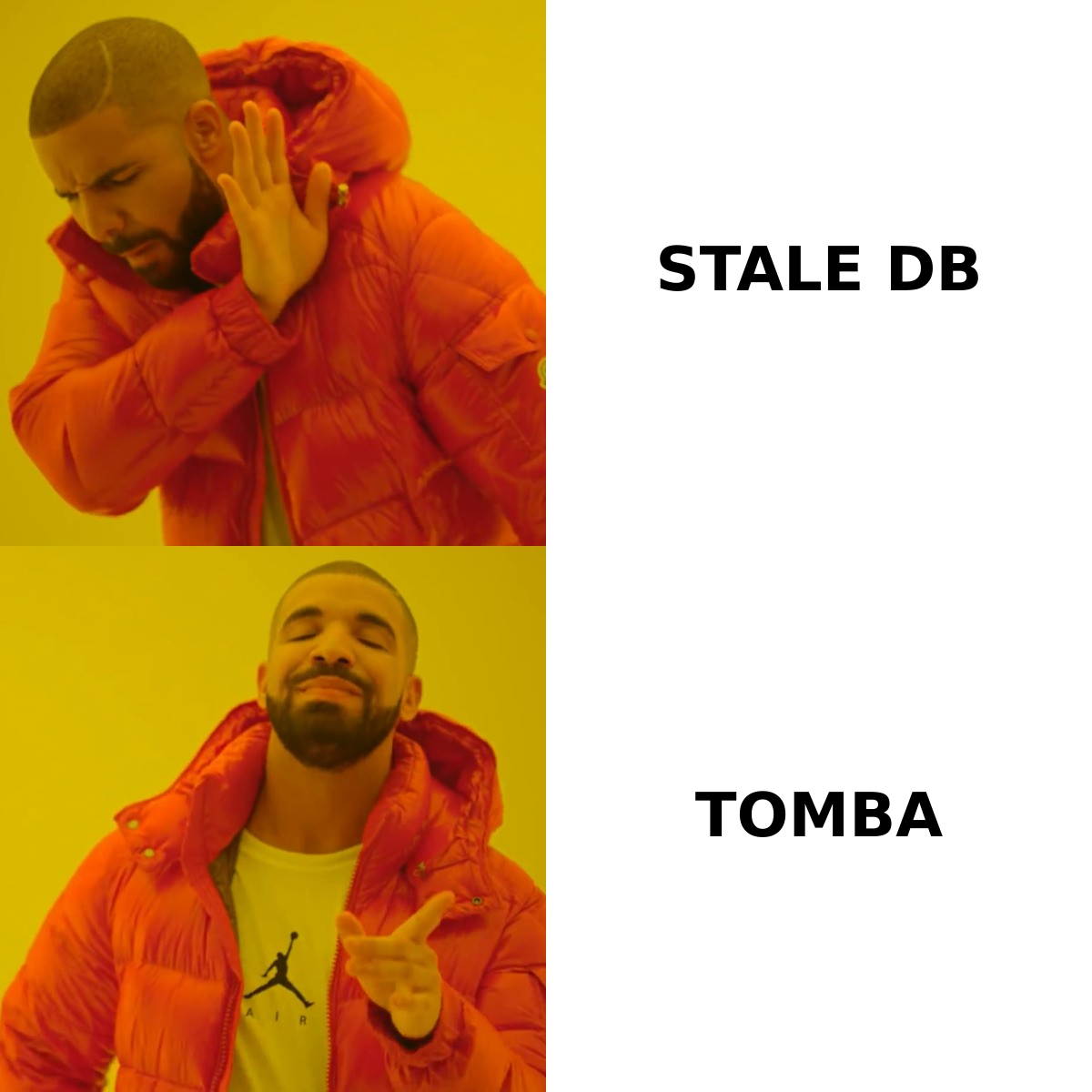
How accurate are B2B search engines?#
Accuracy is the only metric that survives contact with a real campaign — and vendor-claimed accuracy is almost always higher than what you'll measure. Independent tests routinely find a gap between marketing numbers (often "95%+") and field bounce rates. The reasons are structural:
- Data decay. Roughly 30% of B2B contact data goes stale every year as people change jobs. A record verified in January can bounce by June.
- Catch-all domains. Many company mail servers accept every address, so a naive check can't tell a real mailbox from a fake one. You need a dedicated catch-all verifier to resolve these.
- Source quality. Inferred emails based on a guessed pattern are only as good as the pattern. If the company switched from
first.lasttoflast, the guess fails silently.
Protect yourself with a simple discipline: never send to an unverified list. Run every export through a verifier, segment catch-all results separately, and re-verify any list older than 90 days. This is also why the size of a database is a vanity metric. A clean 10M-record set you can trust beats a 250M-record set where a third bounces and torches your sender reputation. Want to understand the downstream stakes? Review the basics of email deliverability before you scale sending.
How do you choose the right B2B search engine?#
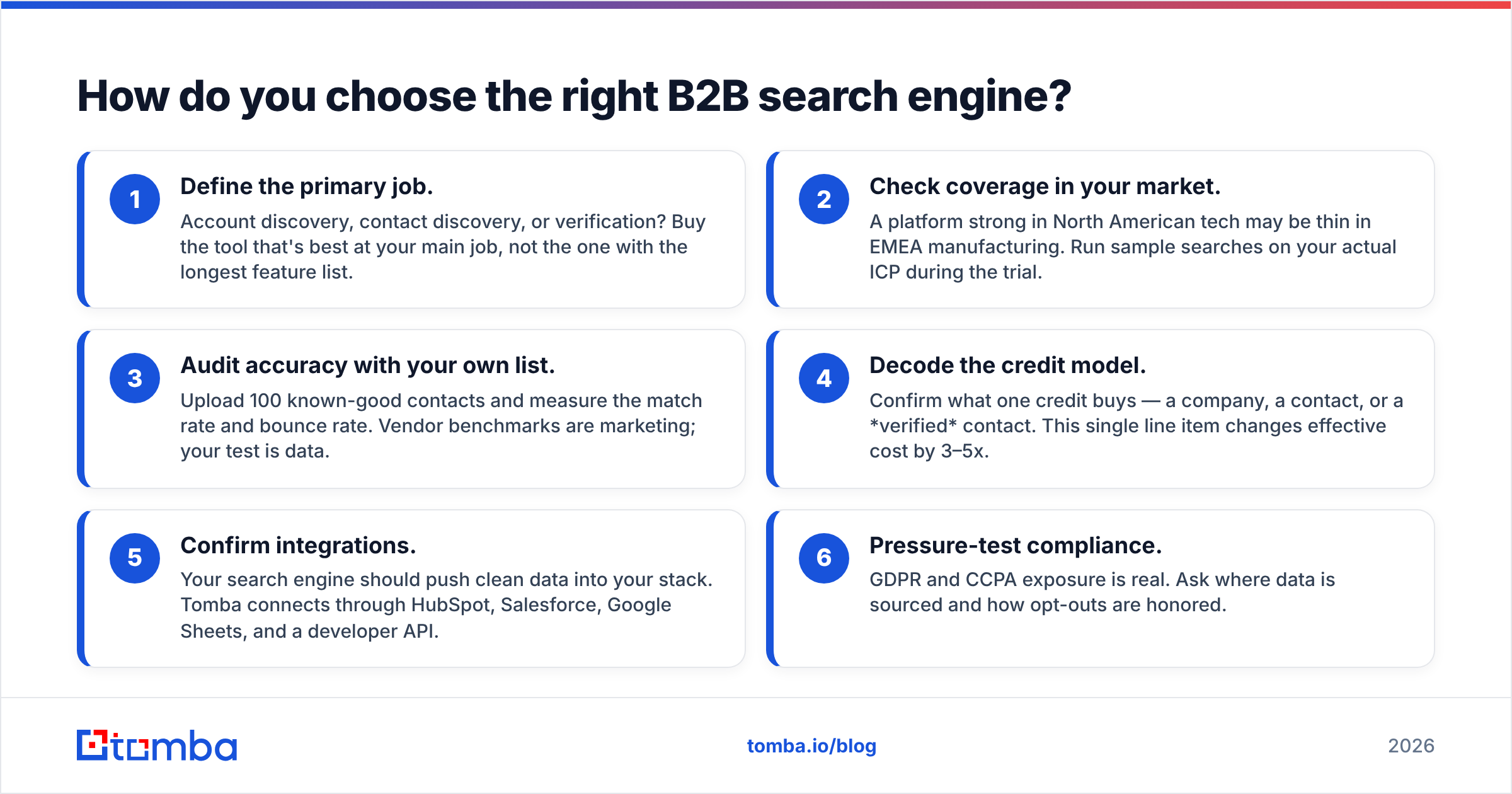
Match the tool to your job, your data hygiene needs, and your budget — in that order. Walk these criteria before you commit to an annual contract:
- Define the primary job. Account discovery, contact discovery, or verification? Buy the tool that's best at your main job, not the one with the longest feature list.
- Check coverage in your market. A platform strong in North American tech may be thin in EMEA manufacturing. Run sample searches on your actual ICP during the trial.
- Audit accuracy with your own list. Upload 100 known-good contacts and measure the match rate and bounce rate. Vendor benchmarks are marketing; your test is data.
- Decode the credit model. Confirm what one credit buys — a company, a contact, or a verified contact. This single line item changes effective cost by 3–5x.
- Confirm integrations. Your search engine should push clean data into your stack. Tomba connects through HubSpot, Salesforce, Google Sheets, and a developer API.
- Pressure-test compliance. GDPR and CCPA exposure is real. Ask where data is sourced and how opt-outs are honored.
Run a structured trial against these six points and the right choice usually becomes obvious. The wrong choice — buying on database size or brand alone — is how teams end up with a six-figure contract and a 25% bounce rate.
How do B2B search engines fit a modern prospecting workflow?#
They're the front of the funnel, not the whole funnel. A clean record is the raw input; what you do next determines pipeline. A typical 2026 outbound motion looks like this:
- Target — use a company engine to build the account list from firmographics and intent.
- Find — pull decision-makers and their emails with a contact finder or bulk email finder for volume.
- Verify — clean the list so only deliverable addresses enter a sequence.
- Enrich — fill gaps with data enrichment so messaging can be personalized at the field level.
- Engage — hand the verified, enriched list to your sequencing or CRM tool.
The mistake teams make is treating the search engine as the finish line. Finding 5,000 contacts feels like progress, but unverified, un-enriched contacts produce bounces and generic copy. The leverage is in the middle steps — verification and enrichment — which is exactly where a focused tool earns its keep. For scale, a developer-friendly email finder API lets you wire this whole sequence into your own systems instead of clicking through a UI.
What does a B2B search engine cost in 2026?#
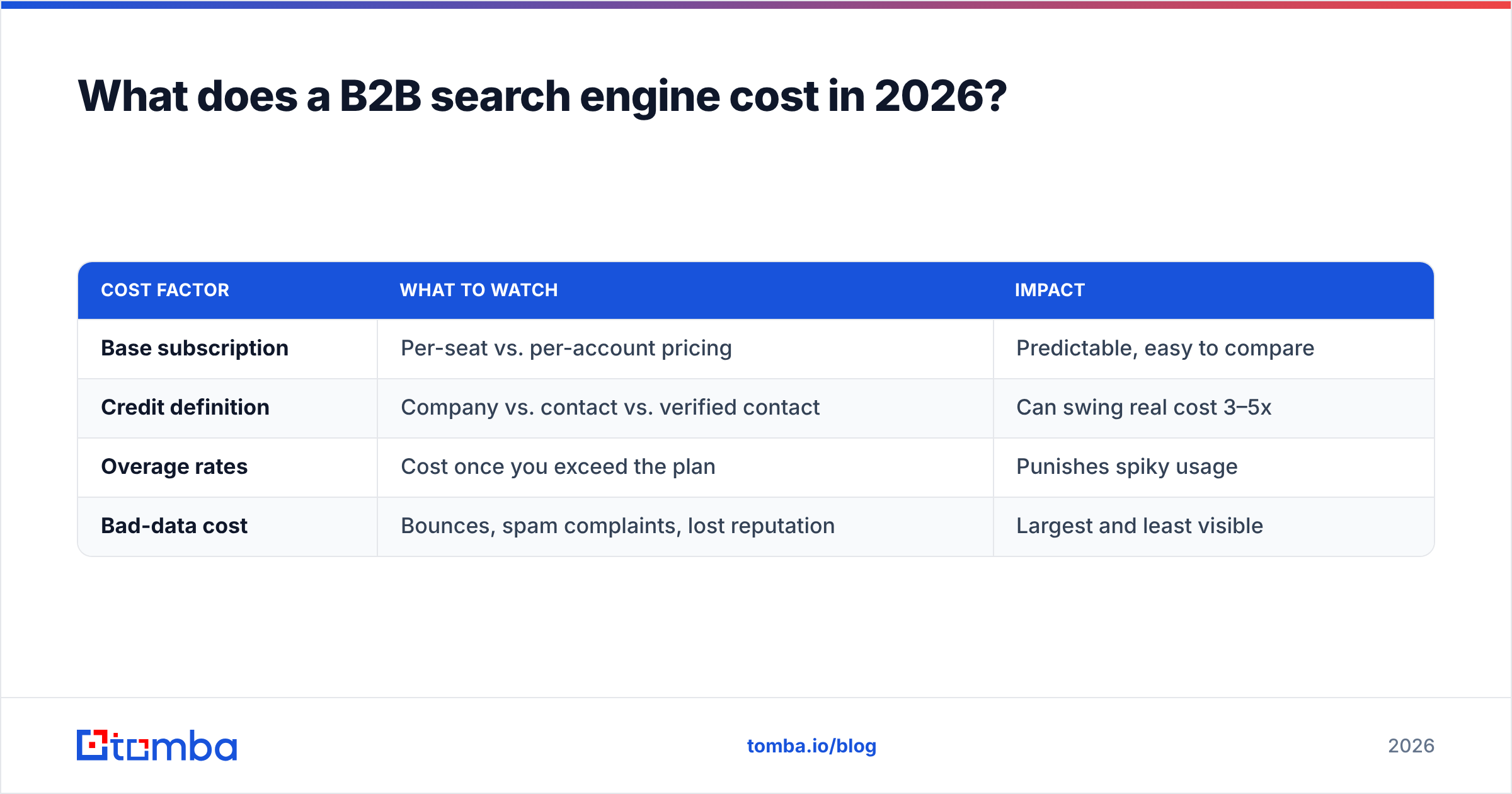
Plan on three cost layers: the platform subscription, the per-credit data cost, and the hidden cost of bad data. Subscriptions range from free starter tiers to enterprise seats north of $1,000/mo. But the sticker price misleads if you ignore credits and accuracy.
| Cost factor | What to watch | Impact |
|---|---|---|
| Base subscription | Per-seat vs. per-account pricing | Predictable, easy to compare |
| Credit definition | Company vs. contact vs. verified contact | Can swing real cost 3–5x |
| Overage rates | Cost once you exceed the plan | Punishes spiky usage |
| Bad-data cost | Bounces, spam complaints, lost reputation | Largest and least visible |
The cheapest tool is rarely the lowest total cost. A $36/mo plan that serves unverified data can cost more than a $49/mo plan with built-in verification once you price in a damaged sending domain. Start on a free tier, measure your real match and bounce rates, then upgrade based on evidence rather than the feature grid. Tomba's free tier gives you 25 searches a month to run that test before spending a dollar — full details on the pricing page.
The bottom line#
A B2B search engine is only as valuable as the deliverable contacts it produces. Database size, brand recognition, and feature lists are distractions; match rate, verification quality, and freshness are the metrics that move pipeline. Pick the tool that's best at your primary job, prove its accuracy on your own list, and pair discovery with verification every single time.
If your core job is turning a domain or a name into a verified, contactable email, start with the Tomba Email Finder. Search by domain, name, or company, verify the result in the same workflow, and push clean records straight into your CRM. Run it free for 25 searches a month, measure your real bounce rate, and scale to $49/mo only once the data has earned your trust.
Ready to find emails that actually work?
Join 150,000+ professionals who stopped guessing and started sending. Free credits on signup — no credit card required.
Get the Tomba newsletter
Practical outbound tactics and product updates — once every two weeks.
About the author