B2B Segmentation Strategy in 2026: A Practical Playbook
Most B2B teams still blast one message at everyone. Here's how to build a B2B segmentation strategy that lifts reply rates, pipeline, and win rate in 2026.
You can have the best product on the market and still lose because you talked to everyone the same way. A B2B segmentation strategy fixes that: it splits your total addressable market into groups that buy for different reasons, so your message, offer, and channel actually match the person reading them.
This guide is the practical version. No abstract frameworks you'll never use. Just the segmentation models that work, the data you need to run them, and a rollout plan you can ship this quarter.
TL;DR#
- Segmentation is grouping accounts and contacts by shared buying behavior, not by whatever fields happen to be in your CRM.
- Start with three layers: firmographic (who they are), technographic/behavioral (what they do), and persona (who you talk to).
- Bad data kills segmentation. If 30% of your contacts are wrong, every segment is wrong. Clean and enrich first.
- A focused segment beats a big list on reply rate, meeting rate, and win rate — usually by 2-4x.
- Operationalize it in your CRM and sequencing tools, then measure per-segment, not in aggregate.
What is a B2B segmentation strategy?#
A B2B segmentation strategy is a repeatable way to divide your market into groups that share a buying motive, then tailor go-to-market motions to each group. Think of it like a restaurant menu. You don't serve one dish to every table — you have sections for people who want something quick, something fancy, or something vegetarian. Segmentation is writing your menu so each guest finds their dish fast.
Technically, you're defining segments along dimensions (industry, size, tech stack, behavior, role), assigning every account and contact to one, and routing each to a message and motion built for it. The payoff is relevance, and relevance is the single biggest lever on B2B conversion.
The opposite — one list, one message — feels efficient. It isn't. You burn domain reputation and goodwill emailing people who were never going to care.
Why does segmentation matter more in 2026?#
Three things changed. Buyers now ignore generic outreach faster than ever, inbox providers punish low-engagement sends harder, and AI made it trivial for everyone to send more volume. The result: volume is commoditized, relevance is the moat.
When ten vendors all reach a prospect the same week, the one whose message names the buyer's exact industry, stack, and pain wins the reply. Segmentation is how you earn that specificity at scale instead of hand-writing every email.
It also protects deliverability. Tighter segments mean higher engagement per send, and engagement is what keeps you out of spam. A focused list is a healthier list. (If deliverability is shaky, your sender reputation is doing the talking before your copy ever gets read.)
What are the main B2B segmentation models?#
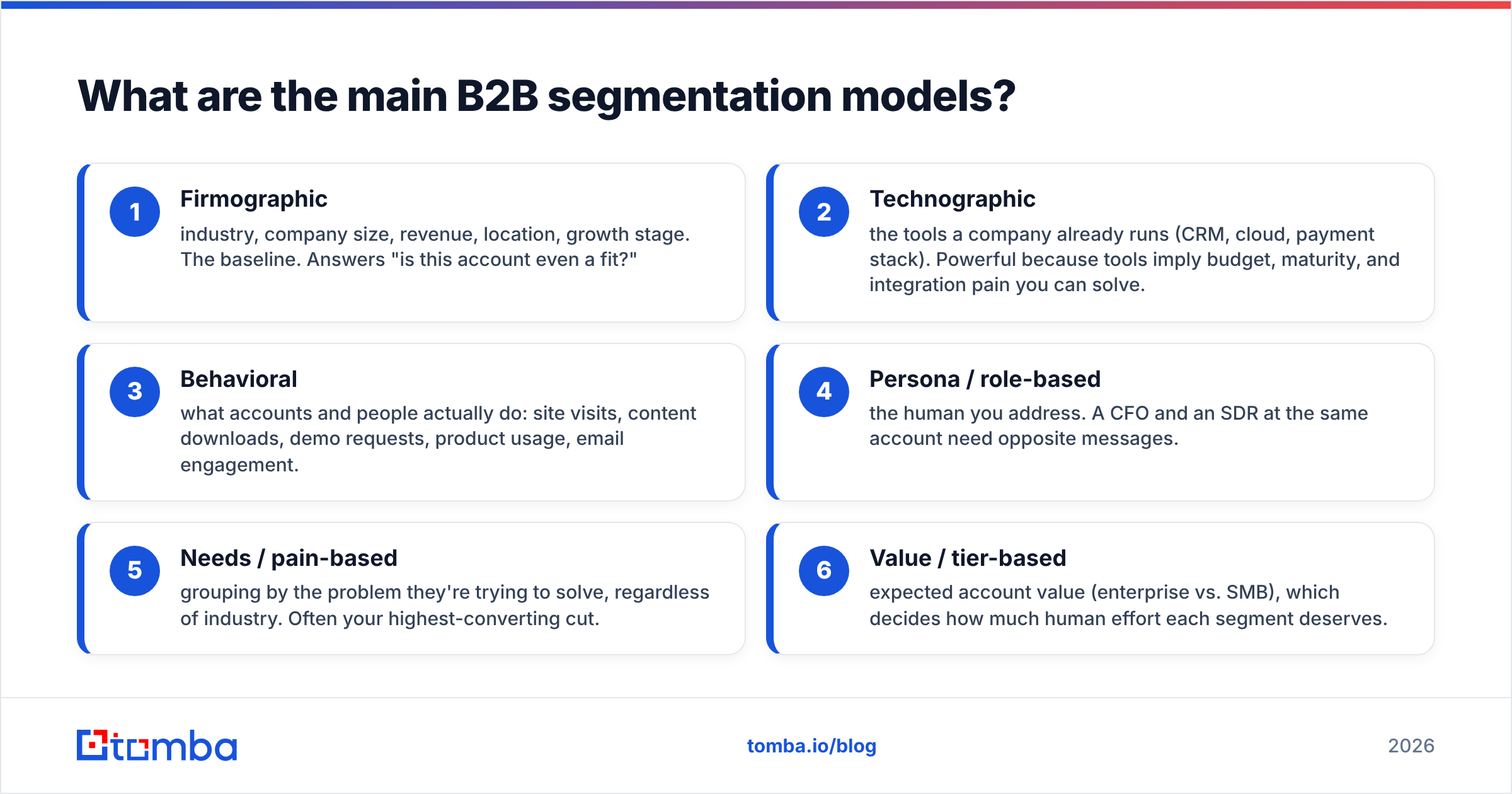
There's no single correct model — you stack several. Here are the six that earn their keep, with bold leads so you can scan them:
- Firmographic — industry, company size, revenue, location, growth stage. The baseline. Answers "is this account even a fit?"
- Technographic — the tools a company already runs (CRM, cloud, payment stack). Powerful because tools imply budget, maturity, and integration pain you can solve.
- Behavioral — what accounts and people actually do: site visits, content downloads, demo requests, product usage, email engagement.
- Persona / role-based — the human you address. A CFO and an SDR at the same account need opposite messages.
- Needs / pain-based — grouping by the problem they're trying to solve, regardless of industry. Often your highest-converting cut.
- Value / tier-based — expected account value (enterprise vs. SMB), which decides how much human effort each segment deserves.
The art is combining two or three. "Mid-market SaaS companies (firmographic) running HubSpot (technographic) where the VP of Sales (persona) recently posted about pipeline gaps (behavioral)" is a segment you can write a killer email to.
How do segmentation models compare?#
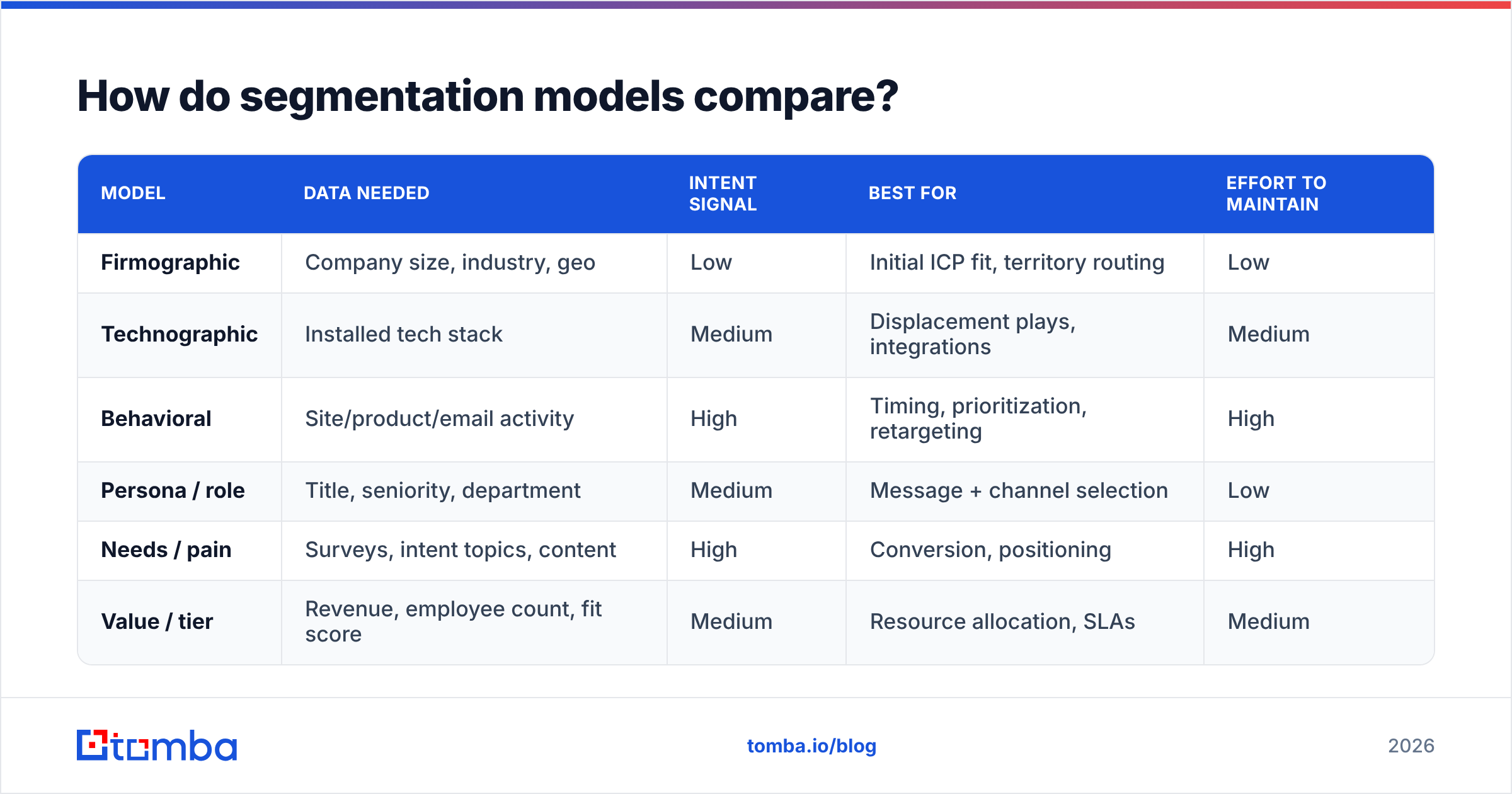
Pick by data availability and intent signal. Here's how the common models stack up:
| Model | Data needed | Intent signal | Best for | Effort to maintain |
|---|---|---|---|---|
| Firmographic | Company size, industry, geo | Low | Initial ICP fit, territory routing | Low |
| Technographic | Installed tech stack | Medium | Displacement plays, integrations | Medium |
| Behavioral | Site/product/email activity | High | Timing, prioritization, retargeting | High |
| Persona / role | Title, seniority, department | Medium | Message + channel selection | Low |
| Needs / pain | Surveys, intent topics, content | High | Conversion, positioning | High |
| Value / tier | Revenue, employee count, fit score | Medium | Resource allocation, SLAs | Medium |
Most teams start with firmographic + persona (cheap, fast) and layer behavioral and technographic as their data maturity grows. Don't wait for perfect — ship the two-layer version and improve.
What data do you need to make it work?#
Segmentation is only as good as the data underneath it. Garbage fields produce garbage segments, and you won't notice until your campaigns underperform for reasons that look like "bad copy."
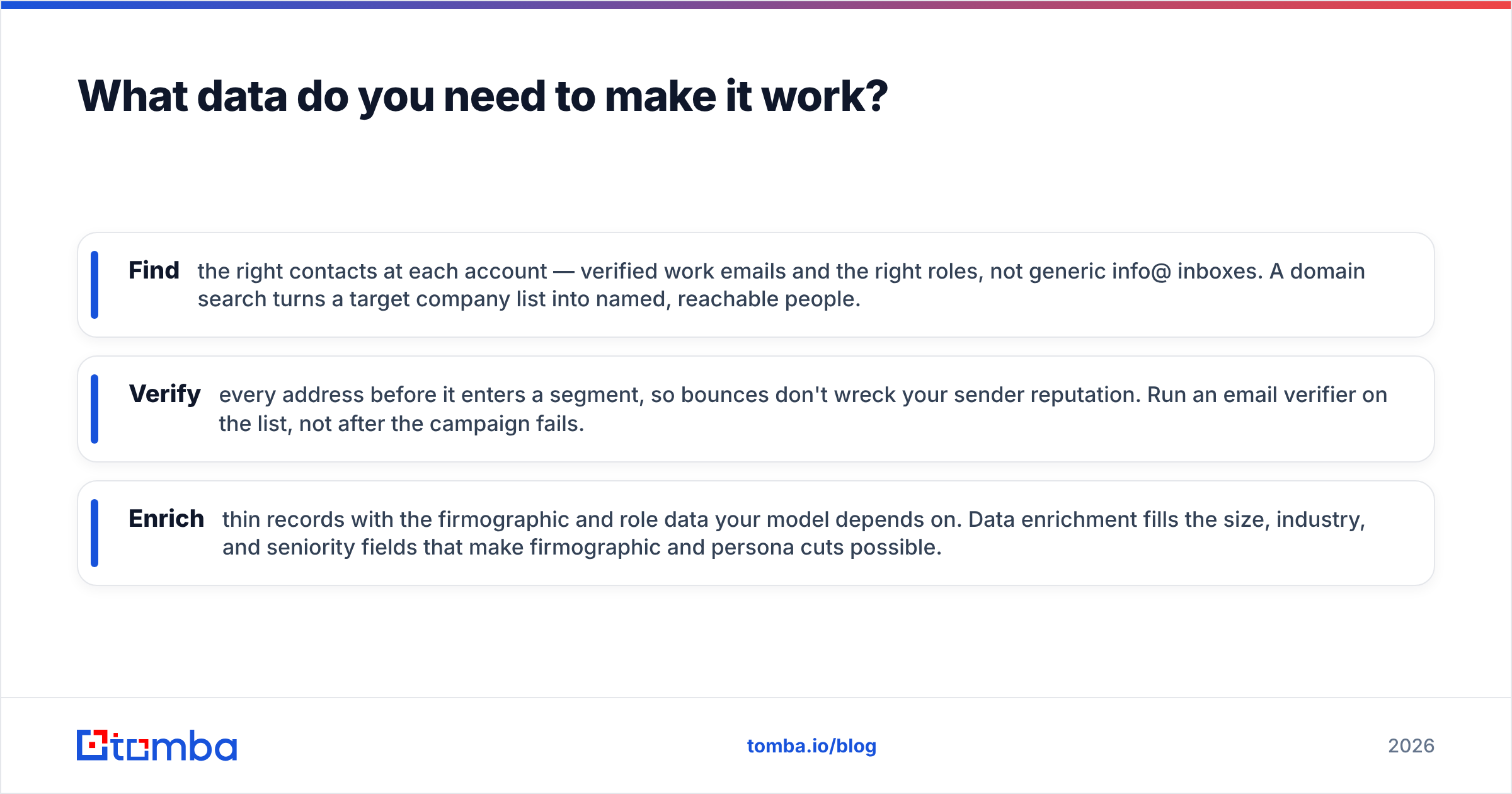
You need three data jobs running reliably:
- Find the right contacts at each account — verified work emails and the right roles, not generic info@ inboxes. A domain search turns a target company list into named, reachable people.
- Verify every address before it enters a segment, so bounces don't wreck your sender reputation. Run an email verifier on the list, not after the campaign fails.
- Enrich thin records with the firmographic and role data your model depends on. Data enrichment fills the size, industry, and seniority fields that make firmographic and persona cuts possible.
Where that data comes from matters for accuracy and compliance. It's worth understanding where Tomba gets its data and how providers source and refresh records — stale data silently mis-sorts accounts into the wrong segment.
For a sense of how much sourcing approach affects quality, the analyst reviews on G2 are a reasonable neutral starting point before you trust any single vendor's accuracy claim.
How do you build segments step by step?#
Here's the rollout that survives contact with reality. Each step gates the next — don't skip ahead.
- Define your ICP first. Before segmenting, know who you should never sell to. Pull your last 50 closed-won and closed-lost deals and find what the winners share. That pattern is your ideal customer profile.
- Pick two or three dimensions, not six. Start with firmographic + persona. You can always add behavioral signals once the basics work. Over-segmenting on day one creates dozens of tiny lists you can't service.
- Audit and clean your data. Verify emails, dedupe records, and fill missing firmographic fields. Budget real time here — it's the step everyone shortchanges and everyone regrets.
- Build the segments in your CRM. Use saved views, lists, or filters so segments are live objects, not a spreadsheet that goes stale in a week. Connect them through your integrations so enrichment flows automatically.
- Write per-segment messaging. One value proposition, proof point, and call to action per segment. If two segments share copy, they probably should be one segment.
- Route and sequence. High-value segments get human-led, multi-touch sequences. Low-value, high-volume segments get lighter automation. Match effort to expected return.
- Measure per segment. Track reply rate, meeting rate, and win rate by segment. Kill or rework anything that underperforms after a fair sample.
What does good segmentation look like in numbers?#
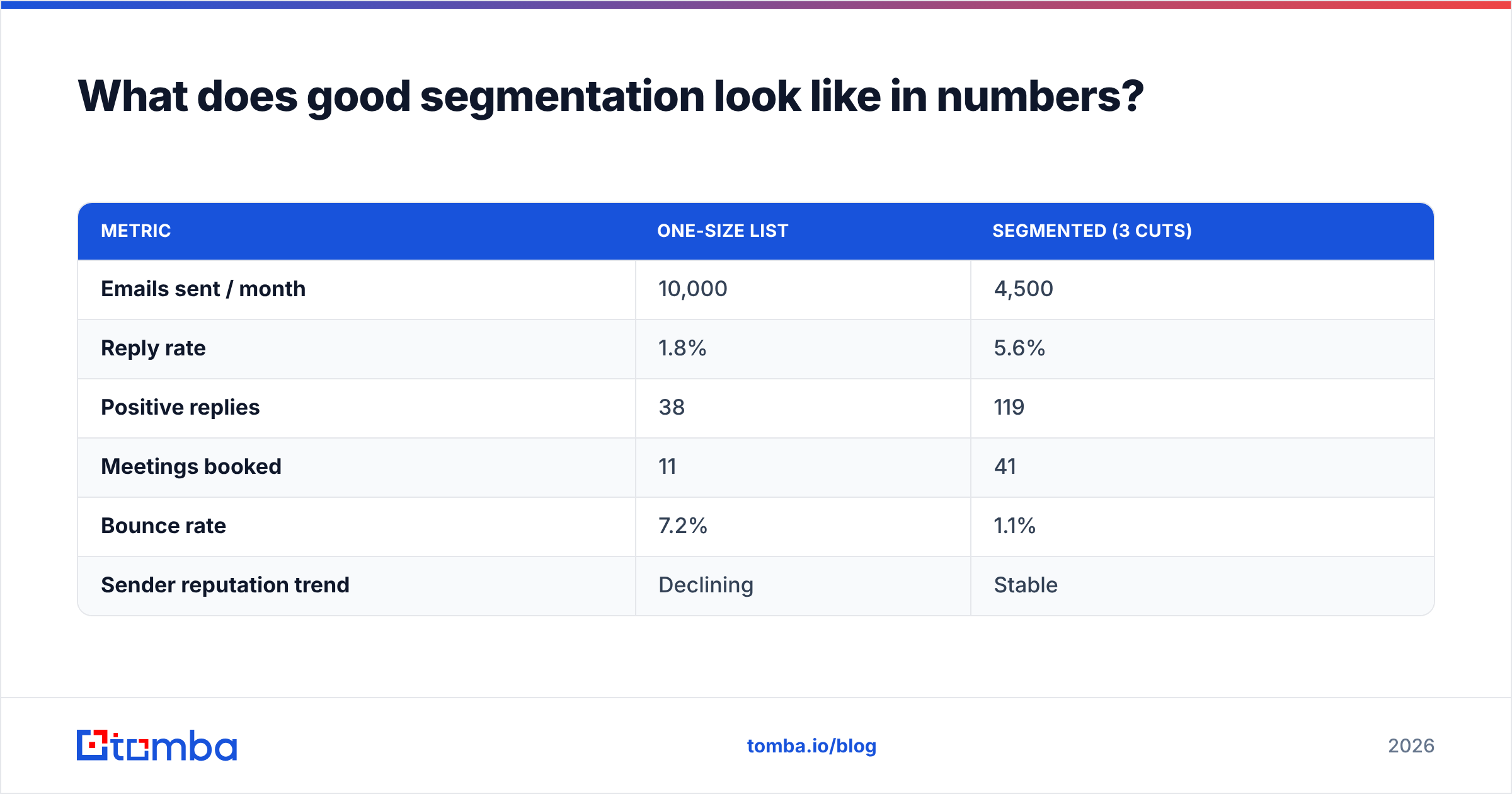
The difference shows up in the funnel, not in a vanity metric. Here's a realistic before/after for a mid-market outbound team that moved from one blast to three tailored segments:
| Metric | One-size list | Segmented (3 cuts) |
|---|---|---|
| Emails sent / month | 10,000 | 4,500 |
| Reply rate | 1.8% | 5.6% |
| Positive replies | 38 | 119 |
| Meetings booked | 11 | 41 |
| Bounce rate | 7.2% | 1.1% |
| Sender reputation trend | Declining | Stable |
Fewer sends, more meetings, healthier domain. That's the whole argument. The volume you cut wasn't producing pipeline — it was producing risk. Segmentation doesn't just raise response rates; it raises them while shrinking the work and protecting your email deliverability.
What are the most common segmentation mistakes?#
Most failed segmentation projects die from the same handful of errors:
- Segmenting on dirty data. If your titles and company sizes are wrong, every downstream cut is wrong. Clean first, always.
- Too many segments. Forty micro-segments you can't write unique copy for is worse than four you can. Granularity has a cost.
- Set-and-forget. Markets move, accounts grow, people change jobs. A segment built in January is decaying by March without enrichment.
- No per-segment measurement. If you only look at aggregate reply rate, you can't tell which segment is carrying the others — or dragging them down.
- Confusing fit with intent. A perfect firmographic match who shows zero behavioral signal still isn't ready. Layer intent on top of fit.
Avoid these five and you're ahead of most teams, who treat segmentation as a one-time spreadsheet exercise instead of a living system.
How does this fit with your existing GTM stack?#
Segmentation isn't a tool you buy — it's a layer that sits across the tools you have. Your CRM stores the segments, your enrichment provider keeps them accurate, and your sequencing platform acts on them. For the broader operating model that ties these together, the revenue operations discipline is where segmentation rules usually live and get governed.
Vendors like HubSpot and Salesforce give you the list and workflow infrastructure; the missing piece is usually fresh, verified contact data to populate the segments in the first place. That's the gap most teams underestimate — the framework is easy, the accurate data behind it is the hard part.
Frequently asked questions#
What's the difference between segmentation and an ICP? Your ICP is the single profile of your best-fit customer. Segmentation divides the accounts that match (and sometimes near-match) your ICP into smaller groups you message differently. ICP is the filter; segments are the buckets inside it.
How many segments should a B2B team have? Start with three to five. Enough to be relevant, few enough that you can write and maintain distinct messaging for each. Add more only when a segment is clearly large and distinct enough to justify its own motion.
How often should I re-segment? Re-verify and re-enrich quarterly at minimum, and re-evaluate the segment definitions themselves twice a year. Behavioral segments need near-continuous updating since signals expire fast.
Can I segment without expensive software? Yes. CRM filters plus a reliable email finder and verifier cover the essentials. The cost driver is data quality, not seat licenses.
Where to start#
Pick one thing this week: take your highest-value target account list, verify and enrich it, and split it into two or three persona-based segments with distinct messages. Measure reply rate against your old blast. The lift will fund the rest of the rollout.
The foundation under all of it is accurate, verified contact data — without it, every segment is a guess. The Tomba Email Finder gives you verified professional emails by domain, name, or company, so your segments start clean instead of decaying from day one. It plugs into the CRM and sequencing tools you already run, and the free tier (25 searches/month) is enough to test segmentation on a real account list before you commit. Build the segment, find the people, and send the message that actually fits.
// get started
Find, verify and enrich your first contacts today
Start on the free plan with 25 searches a month, then scale when your team is ready.
Free plan · No credit card required · GDPR & CCPA
// about the author