B2B Segments in 2026: The Complete Market Segmentation Guide
Most B2B segments are too broad to be useful. Here's how to build firmographic, technographic, and intent-based segments that actually move pipeline in 2026.
Most teams say they segment their market. What they actually have is one giant list with a few tags nobody trusts. B2B segments only earn their keep when they change what you send, to whom, and when — and most don't.
This guide fixes that. You'll learn the five segmentation models that matter in 2026, how to combine them into segments tight enough to act on, and how to keep the underlying data clean enough that your segments don't rot in a quarter.
TL;DR#
- B2B segments are groups of accounts or contacts that share traits predicting how they buy — used to tailor targeting, messaging, and channel.
- The five models worth your time: firmographic, technographic, behavioral/intent, needs-based, and value-based. The best segments stack two or three.
- A segment is only useful if it changes a decision. If your outreach looks identical across two "segments," they're one segment.
- Garbage data kills segmentation faster than bad strategy. Enrich and verify contact records before you slice them.
- Start with 4–6 segments, not 40. Depth beats breadth until you can prove each segment behaves differently.
What are B2B segments?#
B2B segments are groups of companies (or the people inside them) that share characteristics which predict buying behavior. Think of segmentation like sorting mail at a post office: instead of dumping every letter into one bin and hoping, you route each piece by destination so it actually arrives. A segment is a destination — a cohort distinct enough that a tailored message lands better than a generic one.
The technical definition: segmentation partitions your total addressable market into subsets where intra-group similarity is high and inter-group similarity is low. In plain terms, accounts inside a segment should look alike and act alike, and accounts in different segments should not.
The test for whether a segment is real is simple. If you can't name a specific thing you'd do differently for Segment A versus Segment B — a different hook, channel, price, or offer — then you have one segment wearing two name tags. According to Gartner, buying groups in complex B2B deals now average six to ten stakeholders, which means your segments increasingly need to account for role and buying-committee dynamics, not just company size.
Why does B2B segmentation matter in 2026?#
Conclusion first: untargeted outreach is getting punished harder every year, and segmentation is the cheapest lever to fix it. Inbox providers weigh engagement signals heavily, and broad blasts to mismatched contacts tank your reply rates and your sender reputation at the same time.
Three forces make segmentation non-optional now:
- Buyer fatigue. Decision-makers receive more cold outreach than ever. Relevance is the only thing that earns a reply.
- AI-generated noise. Everyone can now produce volume. Differentiation comes from precision targeting, not output speed.
- Tighter budgets. When every dollar of pipeline spend is scrutinized, you can't afford to spray. Segments let you concentrate effort on accounts most likely to convert.
The payoff is measurable: better-targeted campaigns lift response rate, shorten sales cycles, and raise win rate because reps walk into conversations already aligned to the account's context.
What are the main types of B2B segments?#
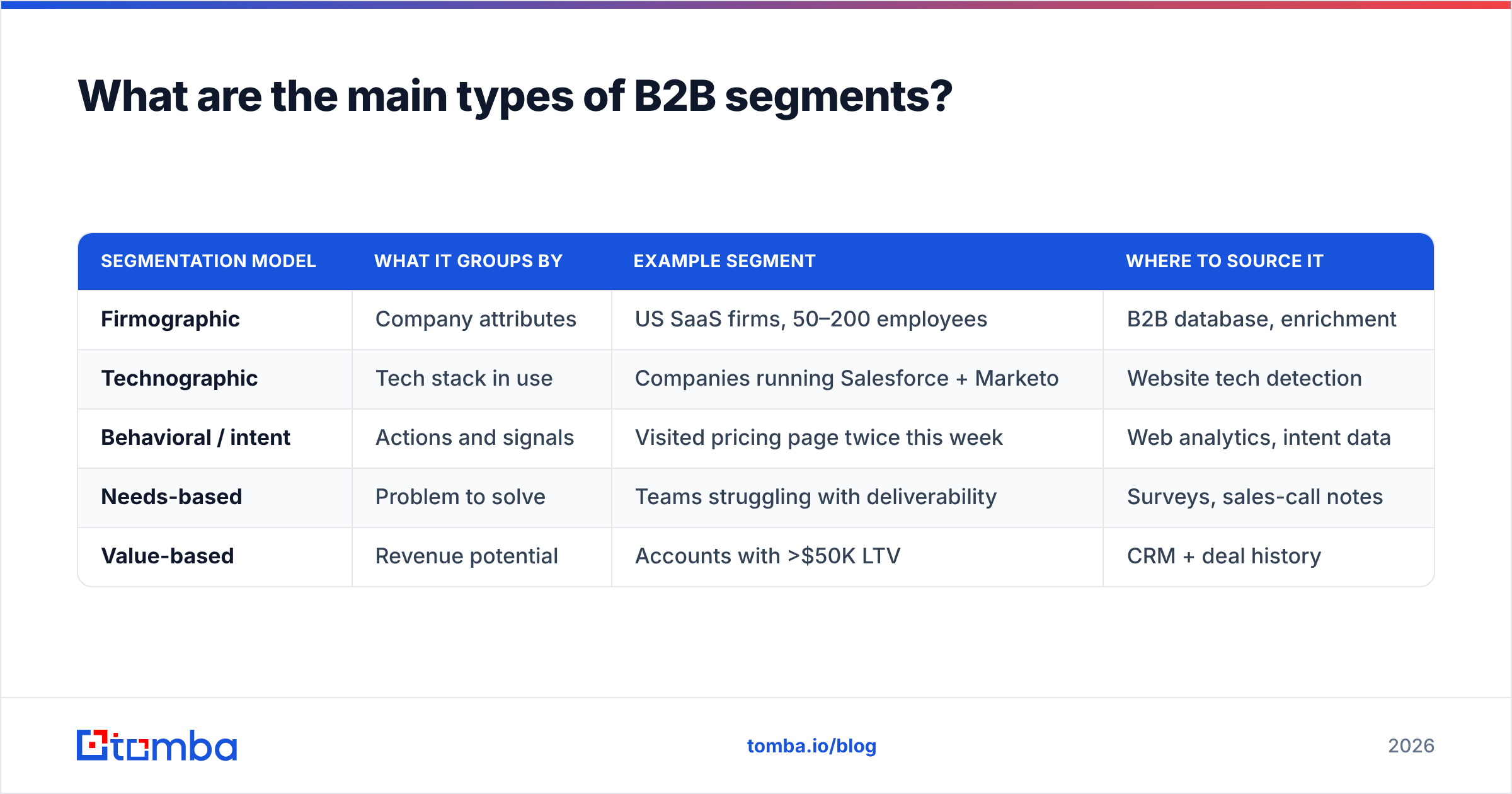
There are five models worth knowing. Most teams over-index on the first one and ignore the rest, which is exactly why their segments feel generic.
| Segmentation model | What it groups by | Example segment | Where to source it |
|---|---|---|---|
| Firmographic | Company attributes | US SaaS firms, 50–200 employees | B2B database, enrichment |
| Technographic | Tech stack in use | Companies running Salesforce + Marketo | Website tech detection |
| Behavioral / intent | Actions and signals | Visited pricing page twice this week | Web analytics, intent data |
| Needs-based | Problem to solve | Teams struggling with deliverability | Surveys, sales-call notes |
| Value-based | Revenue potential | Accounts with >$50K LTV | CRM + deal history |
Firmographic is the foundation: industry, company size, revenue, geography, growth stage. It's the B2B equivalent of demographics. Easy to source, easy to action, but too coarse on its own.
Technographic segments by the tools a company already uses. If you integrate with HubSpot, a segment of confirmed HubSpot users is gold. You can detect stacks with a website tech stack checker and build outreach around the exact tools they run.
Behavioral and intent segments group by what accounts do — site visits, content downloads, repeat pricing-page views, or third-party intent spikes. These are the highest-converting segments because the signal is fresh.
Needs-based segmentation groups accounts by the problem they're trying to solve, regardless of size or industry. Two very different companies with the same pain belong in the same segment.
Value-based segmentation ranks accounts by expected revenue or lifetime value so you can match effort to payoff — white-glove for high-value accounts, automation for the long tail.
How do you build B2B segments that actually work?#
Stack models instead of picking one. A single-dimension segment ("all manufacturers") is almost always too broad. A stacked segment ("US manufacturers, 200–1,000 employees, running legacy ERP, who downloaded our migration guide") is specific enough to write one perfect email for.
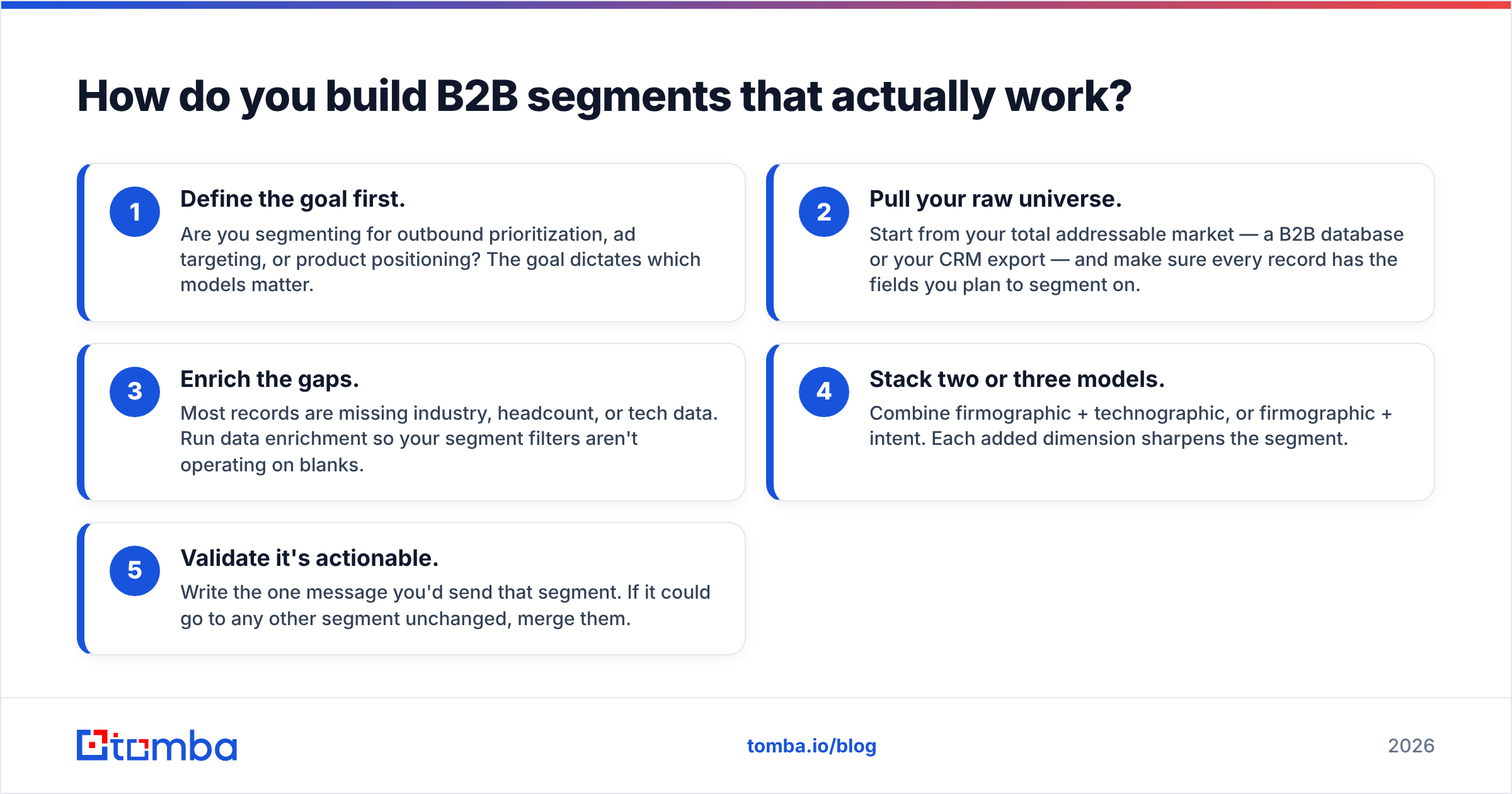
Here's a five-step framework:
- Define the goal first. Are you segmenting for outbound prioritization, ad targeting, or product positioning? The goal dictates which models matter.
- Pull your raw universe. Start from your total addressable market — a B2B database or your CRM export — and make sure every record has the fields you plan to segment on.
- Enrich the gaps. Most records are missing industry, headcount, or tech data. Run data enrichment so your segment filters aren't operating on blanks.
- Stack two or three models. Combine firmographic + technographic, or firmographic + intent. Each added dimension sharpens the segment.
- Validate it's actionable. Write the one message you'd send that segment. If it could go to any other segment unchanged, merge them.
A practical note on contact data: a segment of companies is useless until you can reach the right people inside them. Once a segment is defined, use domain search to pull verified contacts at each account, then prioritize the roles that match your buying-committee map.
What data do B2B segments need to stay accurate?#
Segments decay. People change jobs, companies adopt new tools, and roughly a quarter of B2B contact data goes stale every year. A segment built on six-month-old data is targeting ghosts.
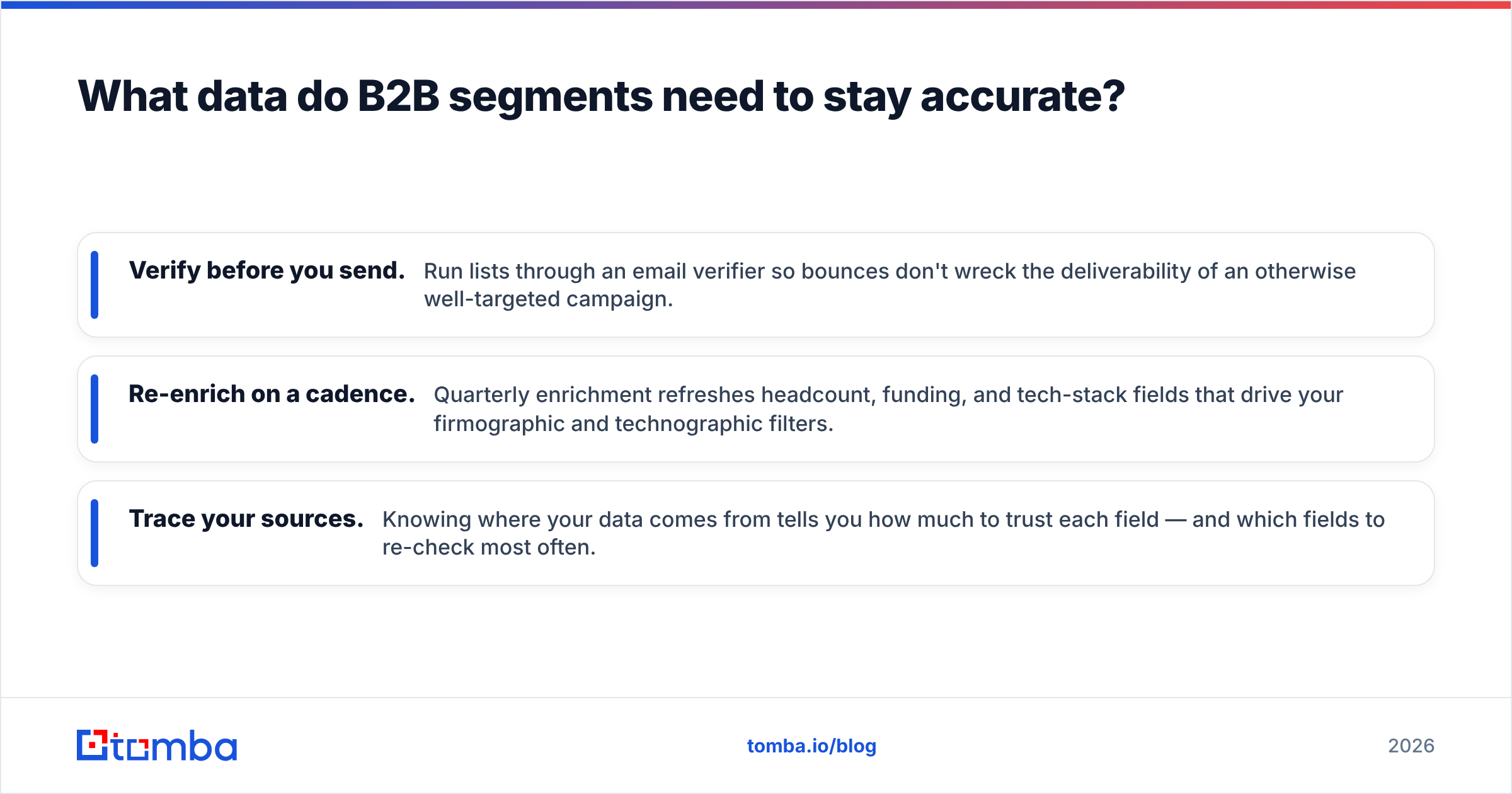
Three data hygiene habits keep segments alive:
- Verify before you send. Run lists through an email verifier so bounces don't wreck the deliverability of an otherwise well-targeted campaign.
- Re-enrich on a cadence. Quarterly enrichment refreshes headcount, funding, and tech-stack fields that drive your firmographic and technographic filters.
- Trace your sources. Knowing where your data comes from tells you how much to trust each field — and which fields to re-check most often.
This is where data quality and segmentation strategy meet. The most elegant segmentation model collapses if the underlying CRM records are wrong. Tools like HubSpot and Salesforce give you the fields to store segment data, but they don't keep those fields fresh — that's on your enrichment and verification workflow.
How many B2B segments should you have?#
Start with four to six. Resist the urge to build forty micro-segments you can't possibly maintain or message uniquely.
The right number is governed by one constraint: can you create distinct, sustained treatment for each segment? If you have five segments but only enough content and rep capacity to truly differentiate three, you have three segments and two aspirations.
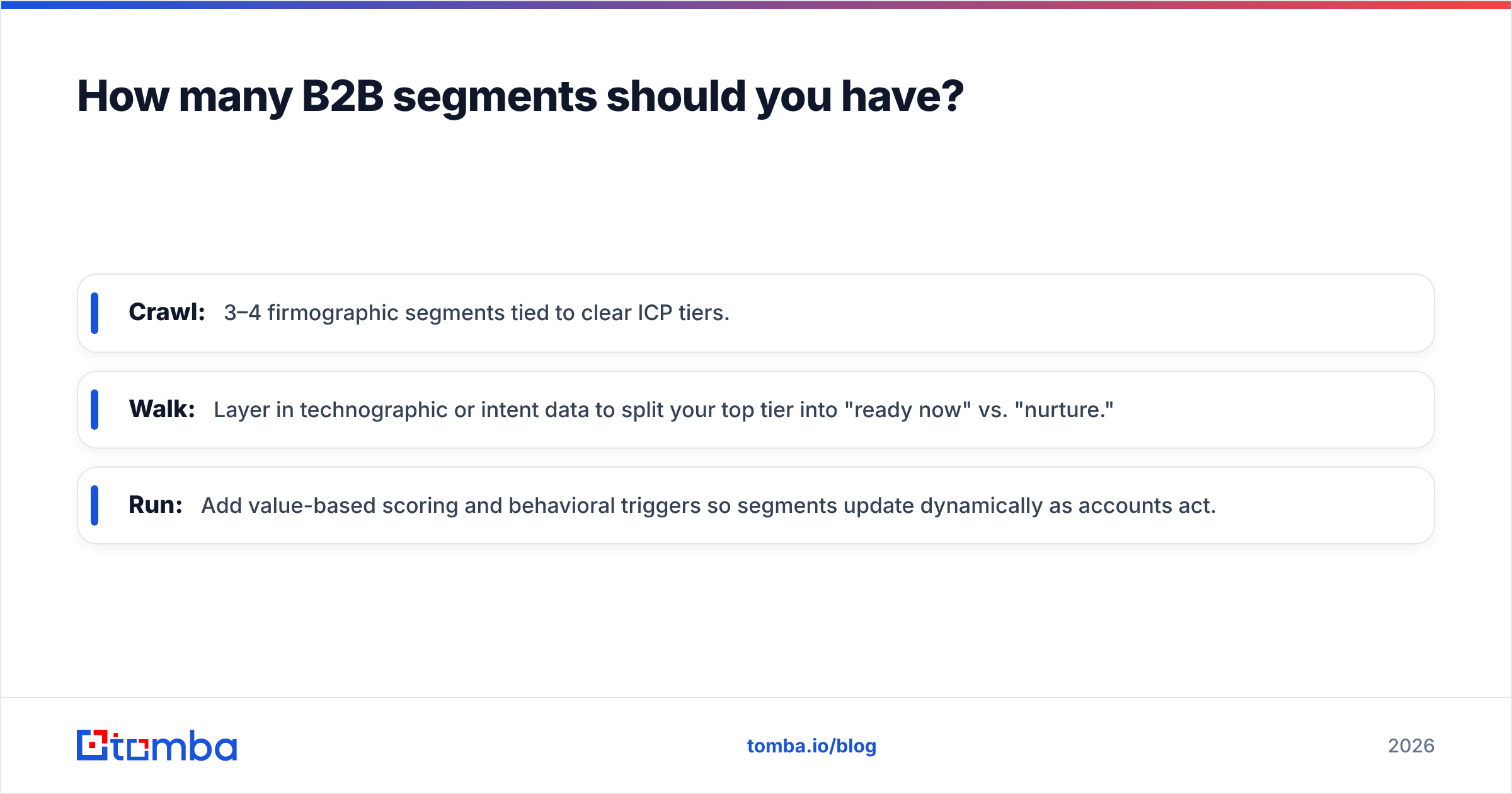
A simple maturity path:
- Crawl: 3–4 firmographic segments tied to clear ICP tiers.
- Walk: Layer in technographic or intent data to split your top tier into "ready now" vs. "nurture."
- Run: Add value-based scoring and behavioral triggers so segments update dynamically as accounts act.
Each stage should prove out before you advance. Segmentation is a discipline, not a one-time spreadsheet exercise — review segment performance quarterly and prune the ones that don't behave differently from their neighbors.
How do B2B segments connect to scoring and routing?#
Segments answer who; scoring answers how ready. They work together. A marketing qualified lead inside your highest-value segment deserves faster, higher-touch follow-up than the same score inside a low-fit segment.
In practice, your segment becomes a routing input:
- High-value segment + high intent → route to senior AE, immediate outreach.
- High-value segment + low intent → nurture sequence, quarterly check-in.
- Low-value segment + high intent → self-serve or automated motion.
This is the bridge between segmentation and your broader revenue operations motion. When segments feed scoring, and scoring feeds routing, your go-to-market machine stops treating every lead the same — which is the entire point of segmenting in the first place. Independent reviews on G2 consistently show that teams pairing segmentation with intent-based routing report stronger pipeline efficiency than those relying on lead volume alone.
Common B2B segmentation mistakes to avoid#
- Segmenting on data you can't act on. A "left-handed CFO" segment is precise and useless. Every dimension must change a decision.
- Building segments once and never revisiting. Stale segments are worse than none because they create false confidence.
- Confusing personas with segments. Personas describe individuals; segments group accounts. You need both, but don't substitute one for the other.
- Over-segmenting before you have content. Forty segments with one generic email is just one segment with extra admin.
- Ignoring contact-level reachability. A perfect account segment with no verified emails inside it produces zero meetings.
Frequently asked questions#
What is the difference between B2B and B2C segmentation? B2B segments emphasize firmographics (company size, industry, tech stack) and buying committees, because purchases involve multiple stakeholders and longer cycles. B2C leans on individual demographics and psychographics. The unit of analysis differs: B2B segments accounts, B2C segments individuals.
What's the fastest way to start segmenting? Begin with three firmographic tiers based on your best existing customers, enrich the records so the filters work, then validate each tier converts differently before adding complexity.
How often should I update my B2B segments? Re-enrich and review at least quarterly. Intent-based segments should update continuously since the signals are time-sensitive.
Put your B2B segments to work#
Good segments are only as good as the contacts inside them. Once you've defined who you're targeting, you need verified, reachable people at every account — not a list full of guesses and bounces. The Tomba Email Finder turns a segment of target companies into a working list of verified professional emails by domain, name, or company, so your carefully built segments translate into actual conversations.
Start free with 25 searches a month, then scale on the Starter plan at $49/mo when your segments are pulling pipeline. Segment smart, reach the right people, and let the data do the heavy lifting.
// get started
Find, verify and enrich your first contacts today
Start on the free plan with 25 searches a month, then scale when your team is ready.
Free plan · No credit card required · GDPR & CCPA
// about the author