B2B Software Buyer Intent Data: The 2026 Playbook
Buyer intent data tells you which B2B software accounts are in-market right now. Here's how the signals work, what they cost, and how to act on them in 2026.
TL;DR
- B2B software buyer intent data is behavioral signal that shows which accounts are actively researching a solution like yours — before they fill out a form.
- There are three layers: first-party (your own site/product), second-party (review sites like G2), and third-party (publisher co-ops tracking content consumption across the web).
- Intent only works when it's tied to clean contact data. A "surging" account is worthless if you can't reach the right buyer.
- Expect to pay anywhere from bundled-in (Apollo, HubSpot) to $25k+/year for dedicated platforms (Bombora, 6sense, ZoomInfo).
- The winning play in 2026: narrow your topics, score accounts, enrich with verified emails, and reach out within 48 hours of a spike.
What is B2B software buyer intent data?#
Buyer intent data is the digital body language of a buying committee. It is the aggregated record of what an account's employees read, search, compare, and download — interpreted to answer one question: is this company in-market for what I sell, right now?
Think of it like a smoke detector for demand. You don't see the fire (the internal budget meeting, the Slack thread where someone says "our current tool is killing us"), but you detect the smoke: a spike in people at Acme Corp reading "best CRM migration tools," visiting three competitor pricing pages, and leaving reviews on G2. None of that is a form fill. All of it tells you Acme is shopping.
For software vendors specifically, intent matters more than in most categories because the sales cycle is research-heavy and the buying committee is large — often 6 to 10 people per Gartner's B2B buying research. Catching an account early, before they've shortlisted three competitors, is the difference between leading the deal and being column fodder.
The catch: intent data tells you who is interested, not how to reach them. That second half — turning an anonymous surging account into a named contact with a verified email — is where most intent programs quietly fall apart.
How does buyer intent data actually work?#
Intent data is collected, scored, and matched to accounts. Here are the three signal layers, ordered from most reliable to most scalable:
- First-party intent — Behavior on properties you own: website visits, pricing-page dwell time, demo requests, product usage, support tickets. This is the highest-quality signal because it's your funnel, but it only sees the fraction of the market already aware of you. Tools like website visitor reveal de-anonymize this traffic so a visit becomes a company name.
- Second-party intent — Signals from a platform where buyers actively compare vendors, most notably review sites. G2 and TrustRadius sell "buyer intent" feeds showing which companies viewed your category, your profile, or a competitor's. It's narrower than third-party but far more decisive — someone on a comparison grid is deep in the funnel.
- Third-party intent — Aggregated content consumption across a co-op of thousands of B2B publishers. Vendors like Bombora track when an account's content engagement on a topic spikes above its own historical baseline (a "surge"). This is the most scalable layer and the one most people mean when they say "intent data," but it's also the noisiest.
A practical program blends all three. First-party tells you who's at your door; second-party tells you who's actively comparing; third-party tells you who's just begun to look — the accounts you can still get ahead of.
)
What types of intent signals matter for software buyers?#
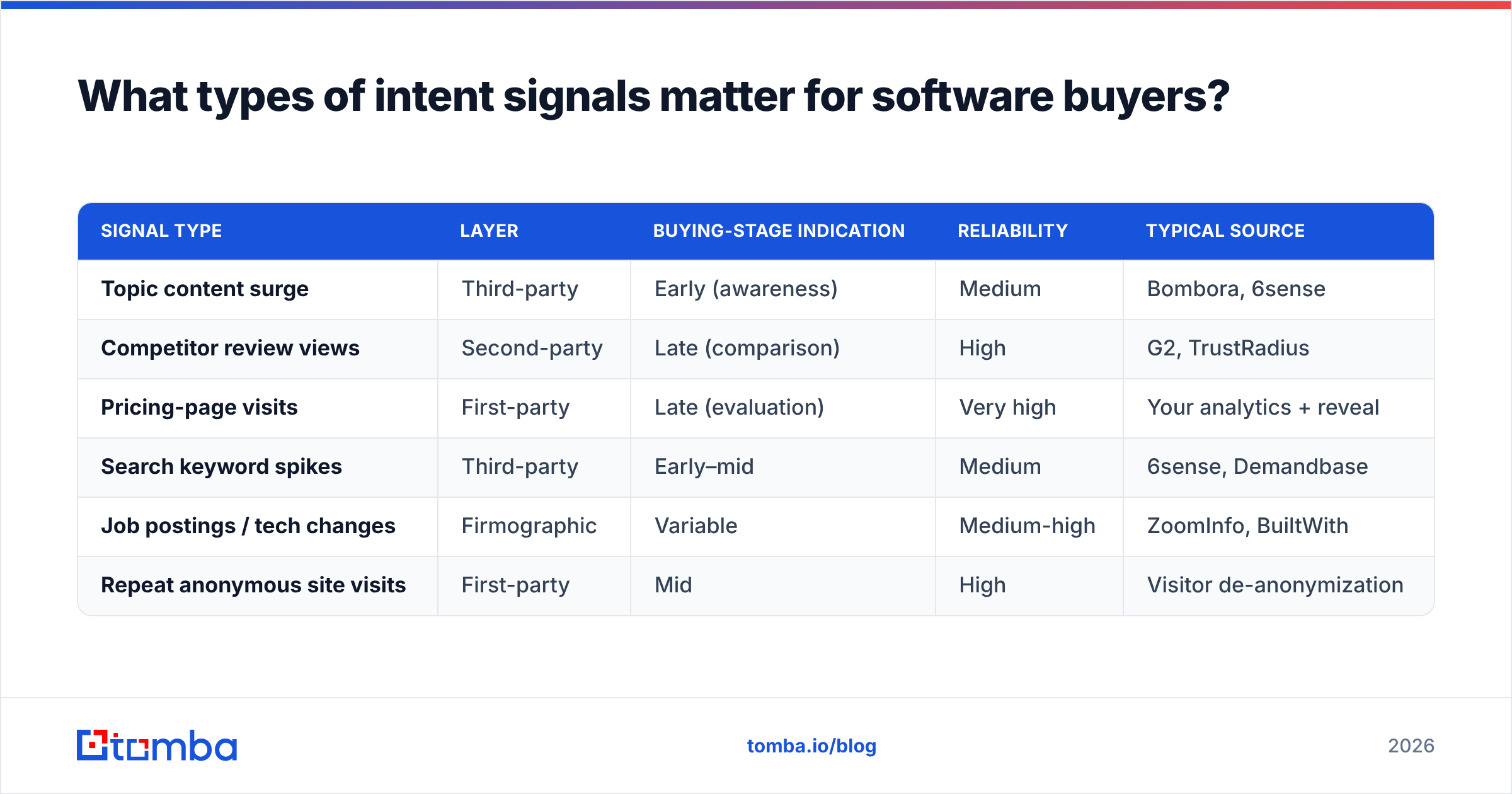
Not all signals carry equal weight. A topic surge is a whisper; a pricing-page visit is a shout. Here's how the common signals stack up for a B2B software seller:
| Signal type | Layer | Buying-stage indication | Reliability | Typical source |
|---|---|---|---|---|
| Topic content surge | Third-party | Early (awareness) | Medium | Bombora, 6sense |
| Competitor review views | Second-party | Late (comparison) | High | G2, TrustRadius |
| Pricing-page visits | First-party | Late (evaluation) | Very high | Your analytics + reveal |
| Search keyword spikes | Third-party | Early–mid | Medium | 6sense, Demandbase |
| Job postings / tech changes | Firmographic | Variable | Medium-high | ZoomInfo, BuiltWith |
| Repeat anonymous site visits | First-party | Mid | High | Visitor de-anonymization |
The strategic takeaway: weight late-stage, high-reliability signals heavily, and treat early-stage topic surges as a watch list rather than a call-now list. A common mistake is dialing every account that surges on a generic topic — you burn rep time on companies that were idly reading a blog post.
Who are the major B2B intent data providers in 2026?#
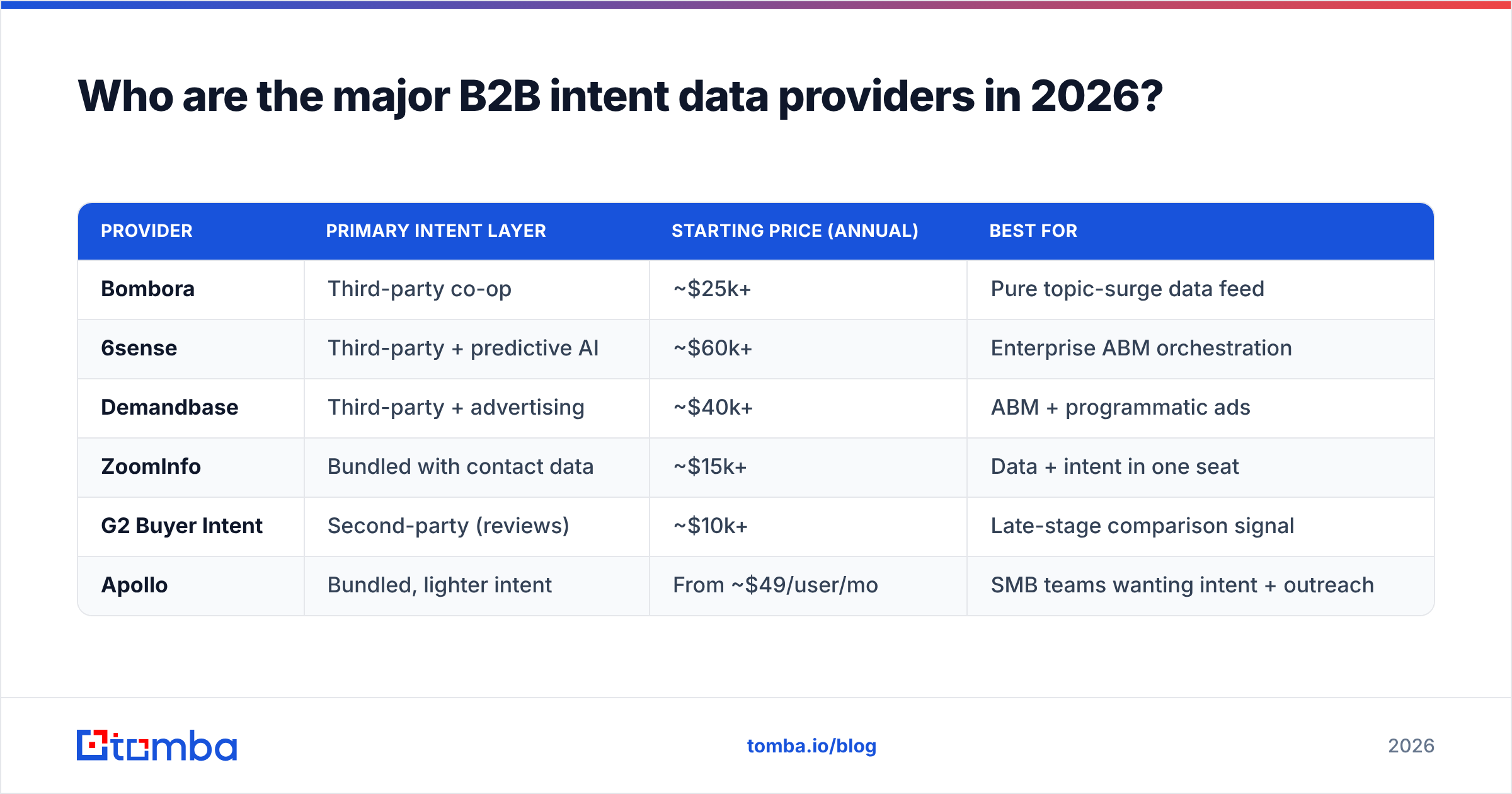
The market splits into three buckets: dedicated intent/ABM platforms, data clouds that bundle intent, and review-site feeds. Here's how the main players compare:
| Provider | Primary intent layer | Starting price (annual) | Best for |
|---|---|---|---|
| Bombora | Third-party co-op | ~$25k+ | Pure topic-surge data feed |
| 6sense | Third-party + predictive AI | ~$60k+ | Enterprise ABM orchestration |
| Demandbase | Third-party + advertising | ~$40k+ | ABM + programmatic ads |
| ZoomInfo | Bundled with contact data | ~$15k+ | Data + intent in one seat |
| G2 Buyer Intent | Second-party (reviews) | ~$10k+ | Late-stage comparison signal |
| Apollo | Bundled, lighter intent | From ~$49/user/mo | SMB teams wanting intent + outreach |
A few honest notes. The dedicated platforms (Bombora, 6sense, Demandbase) are powerful but priced for funded mid-market and enterprise teams — annual contracts, onboarding, and a RevOps person to run them. If you're a smaller software vendor, the bundled options (ZoomInfo, Apollo) or a review-site feed plus strong first-party tracking will get you 80% of the value at a fraction of the cost. You can read independent reviews on G2 before committing to any annual deal.
The piece none of these solve cleanly: contact-level reachability. Most intent platforms hand you an account, not a person with a verified email. That's the gap you fill with a dedicated email finder and email verifier.
Is buyer intent data accurate enough to act on?#
Short answer: third-party intent is directionally accurate, not surgically accurate — treat it as a probability, not a fact.
The accuracy problem has two parts. First, attribution: co-op data maps content consumption to a company by IP and device graphs, and that matching is imperfect, especially for remote-heavy workforces on home and mobile networks. An account can "surge" because one curious intern read three articles. Second, freshness: many feeds report weekly, so by the time you see the surge, the account may already be three vendor calls deep.
This is why the durable programs layer signals rather than trusting any single one. A topic surge plus a competitor review view plus a pricing-page visit is a real buying committee. A lone topic surge is a coin flip.
And accuracy compounds downstream. Even a perfectly identified in-market account produces zero pipeline if the email you reach out with bounces. Intent accuracy and contact accuracy are two different problems, and the second one is where revenue actually leaks. Running your target list through bulk verification — see how data enrichment and bulk verification close that gap — protects your sender reputation and your reps' time.
)
How do you turn intent data into actual pipeline?#
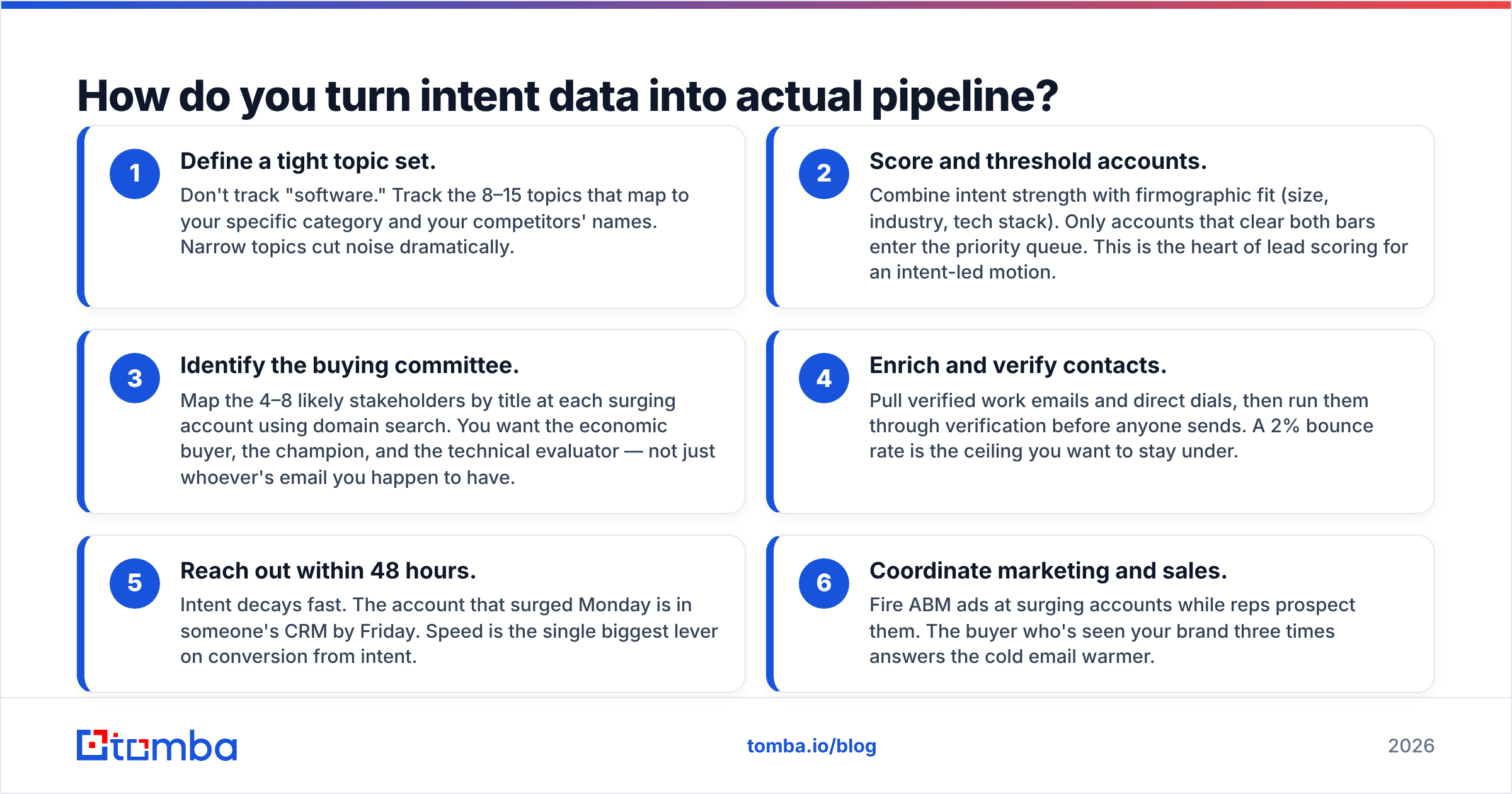
Intent without action is just an expensive dashboard. Here's the operating loop that converts signal into closed-won:
- Define a tight topic set. Don't track "software." Track the 8–15 topics that map to your specific category and your competitors' names. Narrow topics cut noise dramatically.
- Score and threshold accounts. Combine intent strength with firmographic fit (size, industry, tech stack). Only accounts that clear both bars enter the priority queue. This is the heart of lead scoring for an intent-led motion.
- Identify the buying committee. Map the 4–8 likely stakeholders by title at each surging account using domain search. You want the economic buyer, the champion, and the technical evaluator — not just whoever's email you happen to have.
- Enrich and verify contacts. Pull verified work emails and direct dials, then run them through verification before anyone sends. A 2% bounce rate is the ceiling you want to stay under.
- Reach out within 48 hours. Intent decays fast. The account that surged Monday is in someone's CRM by Friday. Speed is the single biggest lever on conversion from intent.
- Coordinate marketing and sales. Fire ABM ads at surging accounts while reps prospect them. The buyer who's seen your brand three times answers the cold email warmer.
Steps 3 and 4 are where most teams stall — they have the surging account but no clean path to a human inbox. That's the exact handoff a purpose-built finder-and-verifier handles, and it's why intent data and contact data belong in the same workflow, not separate tools bought a year apart.
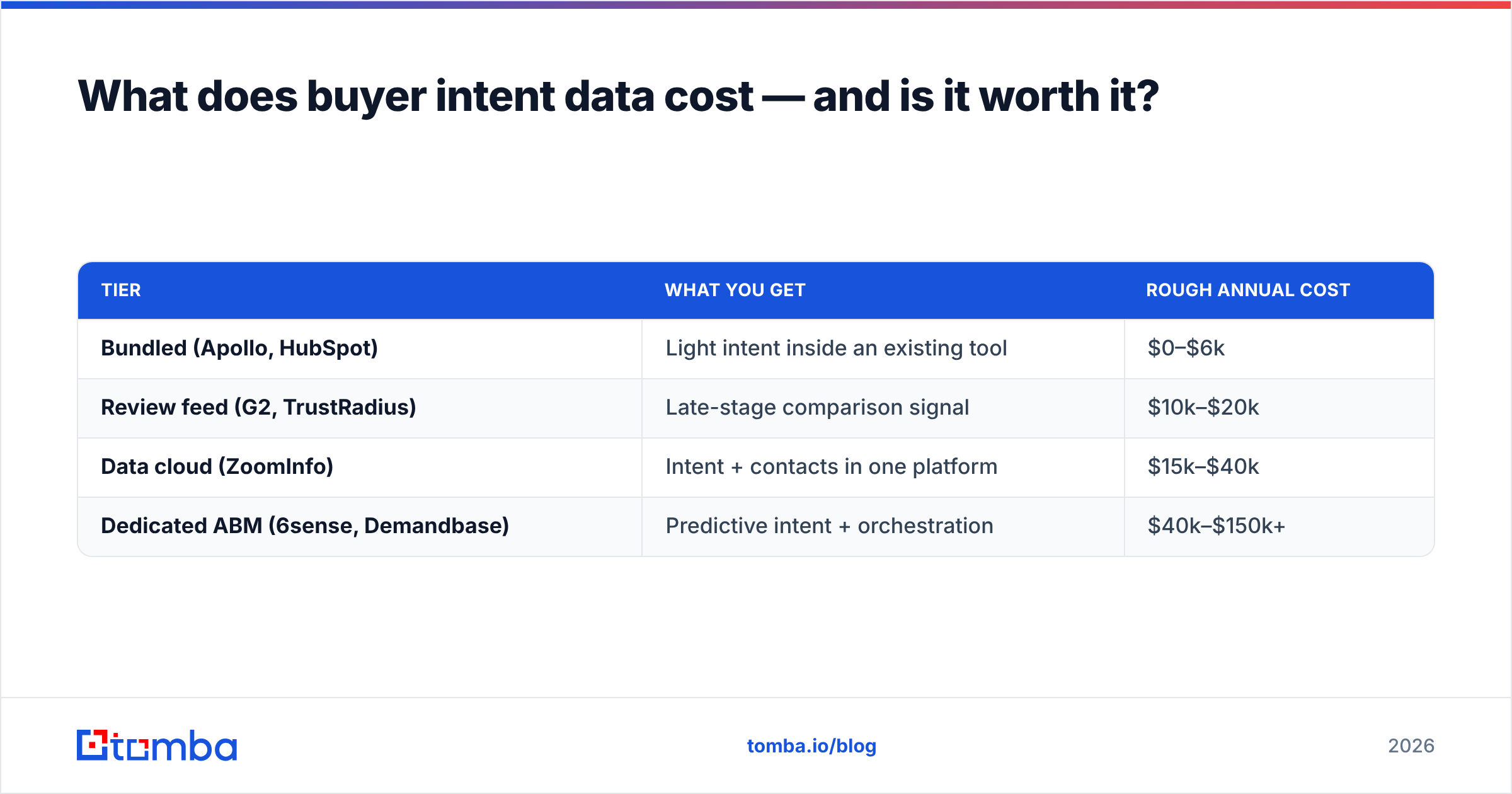
What does buyer intent data cost — and is it worth it?#
Cost scales with the layer and the level of orchestration you want:
| Tier | What you get | Rough annual cost |
|---|---|---|
| Bundled (Apollo, HubSpot) | Light intent inside an existing tool | $0–$6k |
| Review feed (G2, TrustRadius) | Late-stage comparison signal | $10k–$20k |
| Data cloud (ZoomInfo) | Intent + contacts in one platform | $15k–$40k |
| Dedicated ABM (6sense, Demandbase) | Predictive intent + orchestration | $40k–$150k+ |
Is it worth it? For software teams with a defined ICP and an outbound motion, yes — but only if you operationalize it. The failure mode isn't bad data; it's data that lands in a dashboard nobody acts on. A modest review-site feed that a rep actually works beats a six-figure ABM platform that RevOps never operationalized.
If you're starting out, the highest-ROI build is cheap: strong first-party tracking (de-anonymize your own traffic), a G2-style review feed for late-stage signal, and a reliable email finder API to convert accounts into verified, reachable contacts. You can layer in a Bombora or 6sense later, once you've proven your team will actually chase the signal. Compare what each tier costs against the simpler, predictable Tomba pricing for the contact-data half of the stack.
Frequently asked questions#
Is buyer intent data GDPR compliant? Reputable third-party providers operate on aggregated, account-level (not individual) consumption data from consented publisher networks, which generally keeps the surge signal itself compliant. The compliance burden shifts to you when you enrich an account into named individuals and contact them — that outreach must respect GDPR, CAN-SPAM, and local rules. Keep your contact sourcing and consent posture documented.
What's the difference between intent data and lead scoring? Intent data is an input; lead scoring is the model that weighs it. Scoring blends intent signals with firmographic fit, engagement history, and demographic fit to rank an account or lead. Intent makes scoring smarter, but it doesn't replace it.
Can small software companies use intent data? Yes. Start with first-party (de-anonymized site traffic) and a review-site feed rather than an enterprise ABM contract. Pair it with an affordable email finder, and you'll run a credible intent-led motion without a six-figure spend.
How fresh does intent data need to be? As fresh as you can act on. Weekly feeds are common, but the value lives in the first 48 hours after a spike. If your process can't act inside that window, faster data won't help — fix the process first.
Turn intent signals into reachable contacts#
Buyer intent data tells you which software accounts are in-market. It can't tell you how to reach the buyer — and that's the half of the funnel where pipeline is actually won or lost. A surging account with no verified contact is a missed quarter.
Tomba's Email Finder closes that gap: feed it the domains your intent platform surfaces, and get back verified, deliverable emails for the exact stakeholders on the buying committee — economic buyer, champion, and technical evaluator. Start free with 25 searches a month, scale on the $49/mo Starter plan as your intent program grows, and stop letting good signals die in a dashboard. Your intent data found the fire. Tomba hands you the door.
// get started
Find, verify and enrich your first contacts today
Start on the free plan with 25 searches a month, then scale when your team is ready.
Free plan · No credit card required · GDPR & CCPA
// about the author