B2B Startup Marketing Strategy: The 2026 Growth Playbook
A no-fluff B2B startup marketing strategy for 2026: how to pick a niche, build a repeatable pipeline, and spend your first marketing dollars where they actually convert.
TL;DR
- A B2B startup marketing strategy is not "do more channels" — it's choosing one sharp ICP, one wedge message, and one or two channels you can actually win.
- Founders waste their first $10k chasing brand awareness. Spend it on pipeline: targeted outbound, founder-led content, and a clean contact database instead.
- The fastest path to revenue is a tight loop: define ICP → build a verified list → run founder-led outbound → book calls → close → document what worked.
- Track three numbers only in year one: cost per qualified meeting, reply rate, and pipeline created. Vanity metrics (impressions, followers) come later.
- You don't need a 12-person growth team. You need accurate data, a repeatable message, and the discipline to say no to channels that don't move pipeline.
What is a B2B startup marketing strategy, really?#
A B2B startup marketing strategy is the set of deliberate bets you make about who you sell to, what you say, and where you reach them — written down so your tiny team stops improvising every week.
Think of it like a restaurant opening in a crowded street. You don't win by serving every cuisine to everyone walking by. You win by being the obvious choice for one hungry crowd — say, late-night ramen for nurses finishing a shift — and owning that reputation until word spreads. Startups die when they try to be the all-day buffet on day one.
Technically, your strategy answers four questions before you spend a dollar:
- Who is the ICP? The specific company profile and the specific human inside it who feels the pain.
- What is the wedge? The single sharp problem you solve better than the status quo.
- Which motion fits? Product-led, sales-led, or community-led — pick the one your price point and sales cycle demand.
- What proves it's working? The leading metric that tells you to double down or kill a channel.
Everything else — the blog, the ads, the webinar, the swag — is downstream of those four answers. Get them wrong and no amount of budget saves you.
How do you define your ICP without a research budget?#
Lead with the conclusion: your ICP is the 20 customers who would be furious if your product disappeared — find what they share, then go find more of them.
You don't need Gartner reports or a six-figure market study. You need pattern recognition across your best early conversations. If you have zero customers yet, use the companies you came from or the niche where you have unfair access.
Build the profile across these dimensions:
- Firmographics — industry, headcount, revenue band, region. "Series A B2B SaaS, 20–80 employees, US-based" is a real ICP. "Tech companies" is not.
- Trigger events — new funding, a new VP of Sales, a hiring spree, a tech-stack change. Triggers are when budget unlocks.
- The buyer vs. the champion — who signs and who advocates internally are usually different people. You market to both.
- The pain in their words — copy the exact phrases prospects use on calls. That language becomes your messaging.
Once the profile is sharp, you need contact data to act on it. This is where most founders stall: they have a perfect ICP and a spreadsheet of company names with no way to reach the right humans. A domain search turns a list of target companies into named contacts with role titles, and an email finder gets you the verified address so your first outbound doesn't bounce. Clean data here is the difference between a 40% reply rate and a spam folder.
Which marketing channels actually work for B2B startups in 2026?#
Short answer: the channel where your buyer already pays attention and you can show up credibly without a big budget. For most early B2B startups in 2026, that's a combination of targeted outbound and founder-led content — not paid ads.
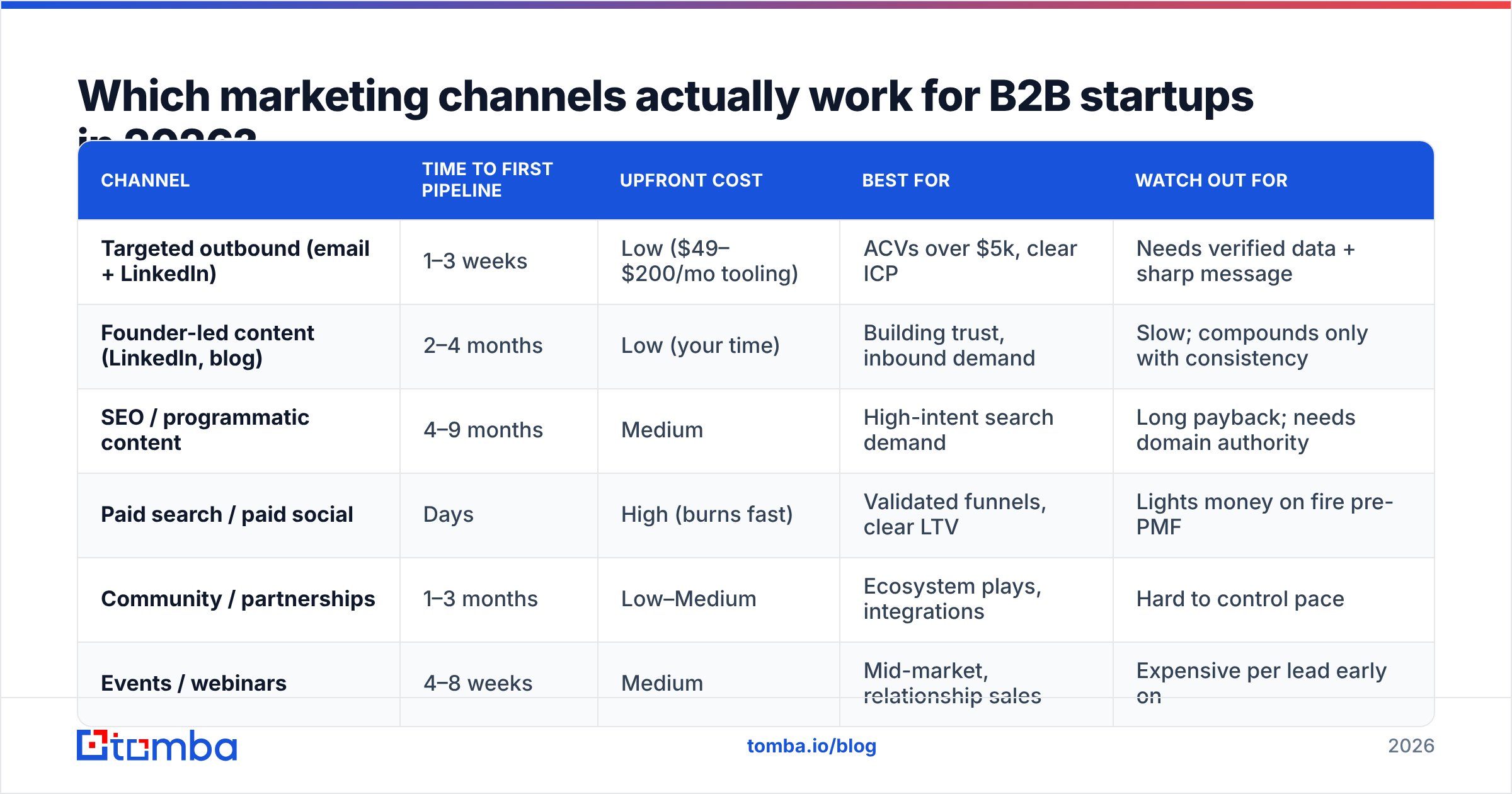
Here's how the main channels compare for a pre-Series-A B2B startup:
| Channel | Time to first pipeline | Upfront cost | Best for | Watch out for |
|---|---|---|---|---|
| Targeted outbound (email + LinkedIn) | 1–3 weeks | Low ($49–$200/mo tooling) | ACVs over $5k, clear ICP | Needs verified data + sharp message |
| Founder-led content (LinkedIn, blog) | 2–4 months | Low (your time) | Building trust, inbound demand | Slow; compounds only with consistency |
| SEO / programmatic content | 4–9 months | Medium | High-intent search demand | Long payback; needs domain authority |
| Paid search / paid social | Days | High (burns fast) | Validated funnels, clear LTV | Lights money on fire pre-PMF |
| Community / partnerships | 1–3 months | Low–Medium | Ecosystem plays, integrations | Hard to control pace |
| Events / webinars | 4–8 weeks | Medium | Mid-market, relationship sales | Expensive per lead early on |
The mistake is running five of these at 20% effort. Pick the top two for your motion, run them at 100%, and ignore the rest until one is clearly working. A B2B startup with a $12k ACV and a 45-day sales cycle should live in outbound and founder content for the first year — paid ads can wait until you know your numbers cold.
If you're weighing outbound tooling, our breakdown of Tomba pricing versus enterprise data platforms shows why founders rarely need a $1,000/month contract to start.
How much should a B2B startup spend on marketing?#
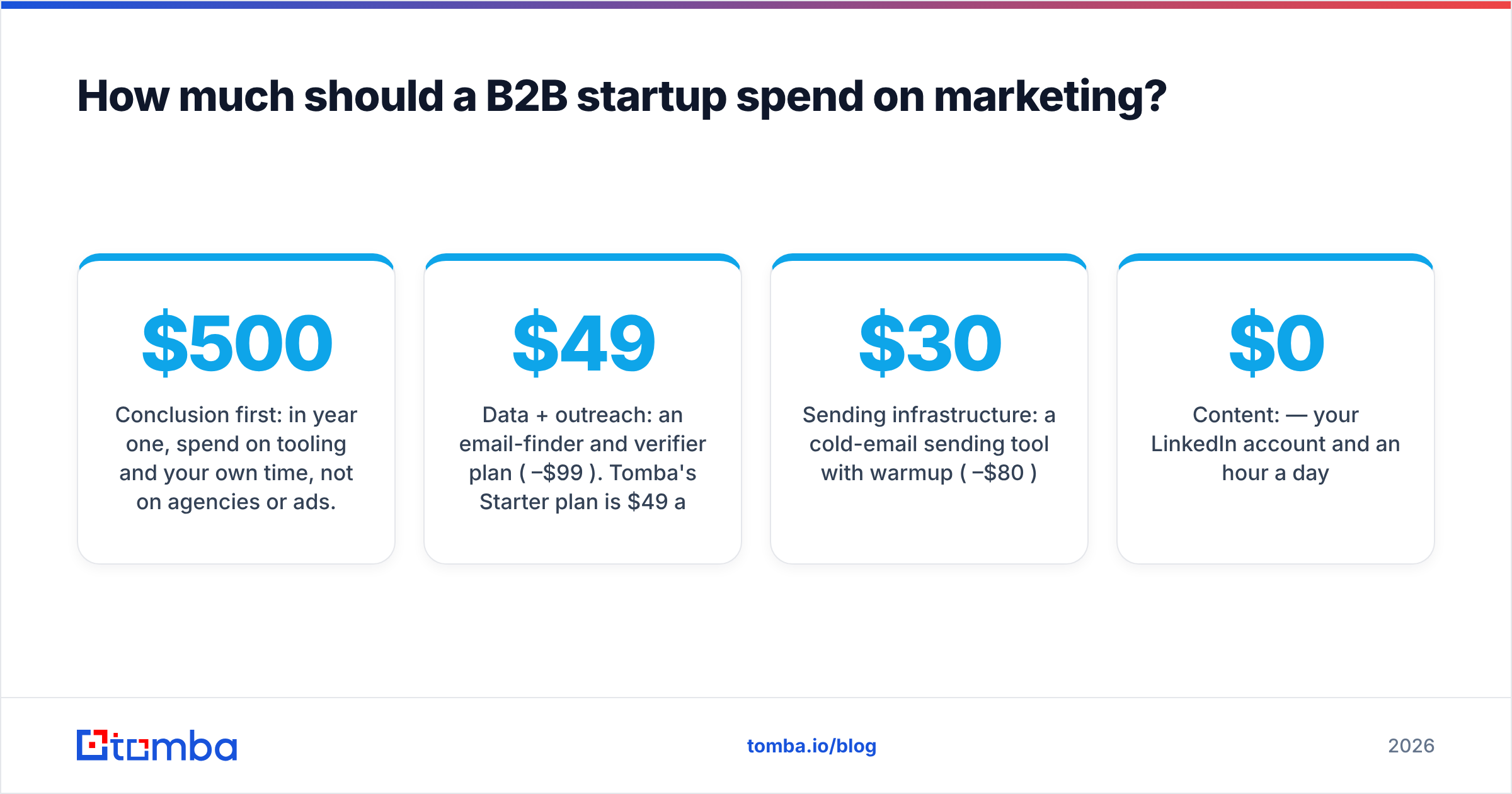
Conclusion first: in year one, spend on tooling and your own time, not on agencies or ads. A realistic pre-revenue or early-revenue marketing stack costs under $500/month.
A lean 2026 starting stack looks like this:
- Data + outreach: an email-finder and verifier plan ($49–$99/mo). Tomba's Starter plan is $49/mo and the Growth plan is $99/mo — enough volume to prospect seriously.
- Sending infrastructure: a cold-email sending tool with warmup ($30–$80/mo).
- CRM: free tier of a startup-friendly CRM until you outgrow it.
- Content: $0 — your LinkedIn account and an hour a day.
That's roughly $130–$230/month to run a real pipeline engine. Compare that to a single month of an agency retainer ($3k–$8k) that produces a logo and a "brand strategy deck" but no booked meetings. According to HubSpot's research on startup marketing, early-stage companies see the strongest ROI from owned channels and direct outreach rather than paid brand spend — which matches what the unit economics force on you anyway.
Scale spend only when a channel hits a repeatable cost per qualified meeting you can live with. If outbound books a meeting for $40 and your ACV is $12k, you don't need permission to spend more — the math gives it.
What does a repeatable B2B pipeline loop look like?#
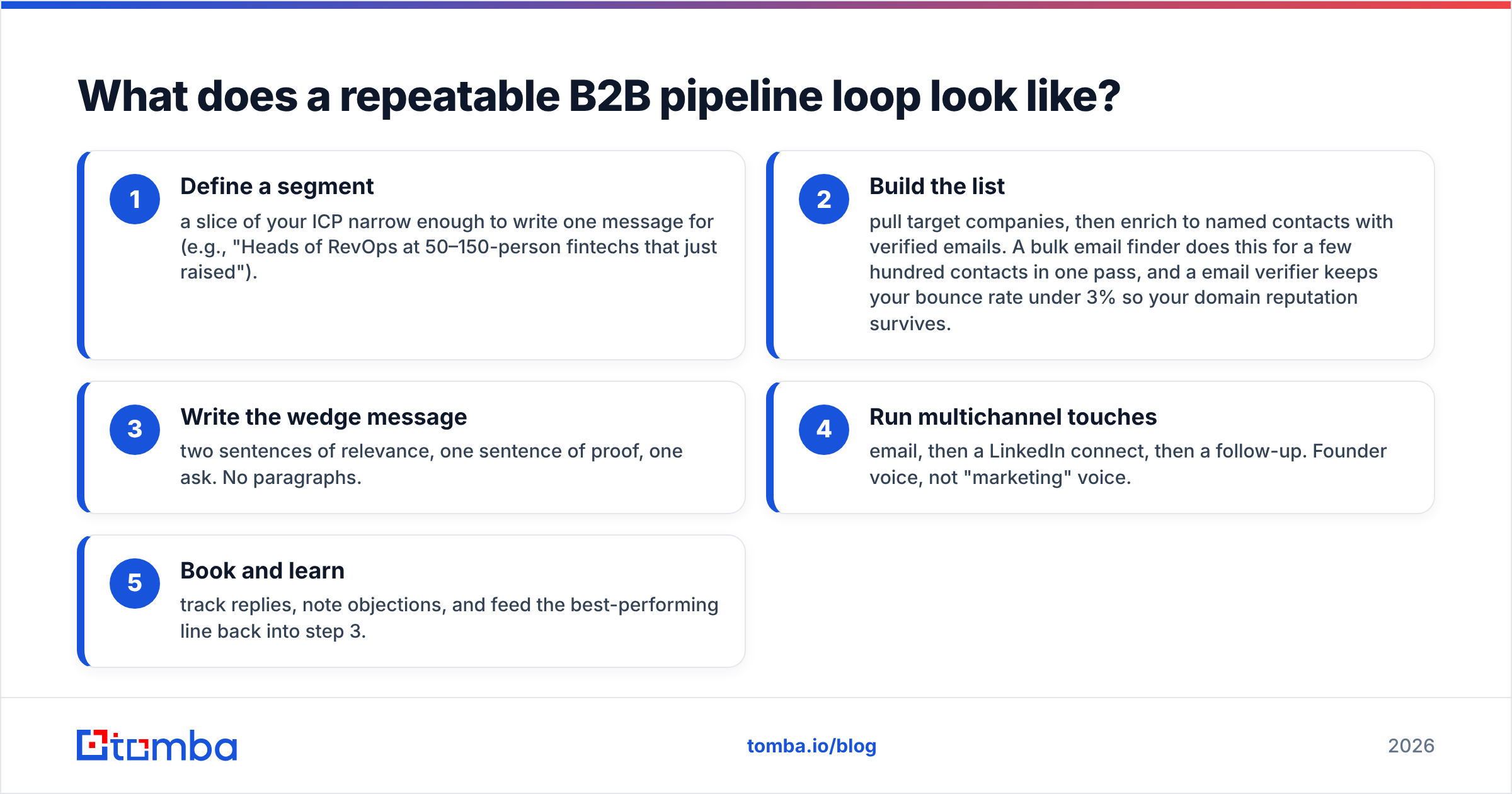
The whole strategy collapses into one loop you run every week. Master this before adding anything fancy.
- Define a segment — a slice of your ICP narrow enough to write one message for (e.g., "Heads of RevOps at 50–150-person fintechs that just raised").
- Build the list — pull target companies, then enrich to named contacts with verified emails. A bulk email finder does this for a few hundred contacts in one pass, and a email verifier keeps your bounce rate under 3% so your domain reputation survives.
- Write the wedge message — two sentences of relevance, one sentence of proof, one ask. No paragraphs.
- Run multichannel touches — email, then a LinkedIn connect, then a follow-up. Founder voice, not "marketing" voice.
- Book and learn — track replies, note objections, and feed the best-performing line back into step 3.
Each cycle teaches you something concrete: which trigger converts, which subject line gets replies, which objection kills deals. That documented learning is your marketing strategy maturing in real time. By cycle ten you'll have a message-market fit you could hand to a first sales hire.
The reason data quality sits at the center of this loop is simple: a wrong email doesn't just fail to convert, it actively damages your sender reputation and poisons the channel for the next campaign. Founders who skip verification spend month two recovering deliverability instead of booking meetings.
Should a B2B startup do inbound or outbound first?#
Outbound first — almost always. Here's the reasoning after the conclusion.
Inbound (content, SEO, community) compounds beautifully but slowly. You publish for months before search and word-of-mouth produce predictable pipeline. A startup that needs revenue in 90 days can't wait for that flywheel.
Outbound gives you three things immediately: a pulse on whether your message lands, direct conversations with your ICP, and pipeline you can forecast. The smartest founders run both in parallel but weight them by stage:
- Pre-PMF (months 0–6): 80% outbound, 20% founder content. You're learning the message.
- Early traction (months 6–18): 50/50. Outbound funds the business while content starts pulling inbound.
- Scaling (18+ months): shift toward inbound and paid as your CAC and LTV stabilize.
Founder-led content isn't a separate strategy here — it's the public version of your outbound message. The objections you hear on cold calls become your best LinkedIn posts. The case study from your first happy customer becomes the proof line in every email. One narrative, two delivery mechanisms.
For deeper plays once outbound is humming, our guide to LinkedIn outreach covers layering social touches onto email sequences without burning your prospects.
What metrics matter for a B2B startup marketing strategy?#
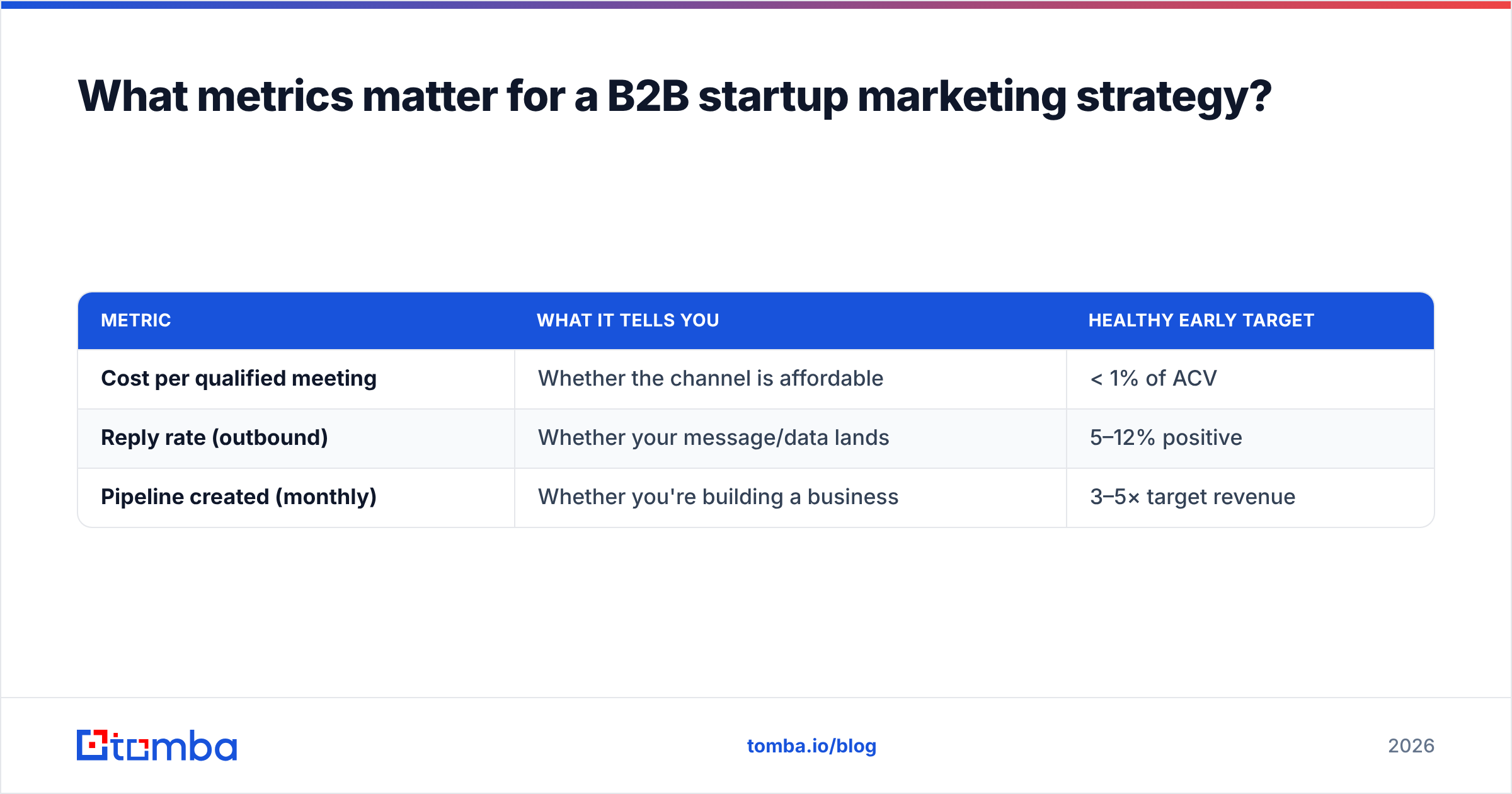
Track three numbers in year one and ignore the rest. Conclusion delivered — now the why.
| Metric | What it tells you | Healthy early target |
|---|---|---|
| Cost per qualified meeting | Whether the channel is affordable | < 1% of ACV |
| Reply rate (outbound) | Whether your message/data lands | 5–12% positive |
| Pipeline created (monthly) | Whether you're building a business | 3–5× target revenue |
Impressions, followers, and website visits feel like progress because they go up. But they don't pay salaries. A post with 50,000 views and zero booked calls is entertainment, not marketing. Anchor every weekly review to pipeline and the leading indicators that predict it.
One caution on reply rate: it's only meaningful if your list is clean. A 3% reply rate on a list that's 30% invalid emails is actually a strong rate on the deliverable portion — you just can't see it. This is why verification and accurate sourcing aren't a "nice to have" line item; they're the denominator under every metric you trust. Founders who audit their data sources make better channel decisions because their numbers aren't lying to them.
Common mistakes that sink early B2B marketing#
- Targeting everyone. "Our product is for any business" means it's compelling to none. Narrow until it's almost uncomfortable.
- Buying a stale list. Purchased lists are months out of date, full of role-changers and dead inboxes. Build and verify your own.
- Hiring a marketer too early. Founders must find the message first. You can't delegate something that doesn't exist yet.
- Confusing brand with demand. A beautiful brand with no pipeline is a hobby. Demand first, polish later.
- Switching channels every two weeks. Channels compound. Give each a fair, fully-resourced run before judging it.
- Ignoring deliverability. Skip warmup and verification and your best campaign lands in spam. Reputation is a startup asset you can't rebuild quickly.
Avoid these six and you're ahead of most funded competitors who outspend you.
Putting your B2B startup marketing strategy into motion#
Your strategy is only as good as your next 30 days. Pick one ICP segment, build a verified list of 200 contacts, write one sharp wedge message, and run the loop. Measure cost per meeting, reply rate, and pipeline. Double down on what works, cut what doesn't, and document every lesson.
The single highest-leverage investment at this stage is accurate contact data — because it sits underneath outbound, content targeting, and every metric you'll use to make decisions. Start with the Tomba Email Finder to turn your target account list into verified, reach-the-right-human contacts, pair it with the built-in verifier to protect your sender reputation, and run your first pipeline loop this week. The startups that win in 2026 aren't the ones with the biggest budgets — they're the ones with the sharpest focus and the cleanest data. Build both, and pipeline follows.
// get started
Find, verify and enrich your first contacts today
Start on the free plan with 25 searches a month, then scale when your team is ready.
Free plan · No credit card required · GDPR & CCPA
// about the author