B2B Technographic Data in 2026: The Complete Guide
B2B technographic data tells you what tools your prospects already run — so you can target the accounts most likely to switch. Here's how to use it in 2026.

TL;DR
- B2B technographic data tells you which software, hardware, and infrastructure a company actually runs — Salesforce vs. HubSpot, Shopify vs. Magento, AWS vs. Azure.
- It answers a question firmographics can't: is this account a fit for what I sell, based on the tools they already use?
- Detection methods range from website tag scraping to job-post parsing to BuiltWith-style signal databases — each with different accuracy and freshness trade-offs.
- The highest-ROI play is displacement targeting: find accounts running a competitor or a complementary tool, then time your outreach to their renewal or pain window.
- Technographics are most powerful when layered with firmographic and intent data, then attached to a verified contact you can actually reach.
What is B2B technographic data?#
B2B technographic data is information about the technology stack a company uses — the apps, platforms, and infrastructure powering its business. Where firmographic data describes who a company is (industry, headcount, revenue, location), technographic data describes what they run: CRM, marketing automation, payment processor, cloud host, analytics, helpdesk, and dozens of other categories.
Think of it like reading a house's utility bills instead of its street address. The address tells you the neighborhood. The bills tell you they heat with gas, stream on three TVs, and just added solar. That's far more useful if you sell energy services. Technically, technographic data is a structured map of detected tools tied to a domain. Each entry usually carries a confidence score and a first- and last-seen date.
For sales and marketing teams, this shifts targeting. You move from "companies that look like my customers" to "companies whose stack proves they need what I sell." Say you sell a Shopify app. A list of every domain running Shopify beats a generic list of e-commerce brands. Or say you sell a Salesforce integration. Knowing which accounts already run Salesforce removes your biggest qualification step before the first email.
How is technographic data different from firmographic and intent data?#
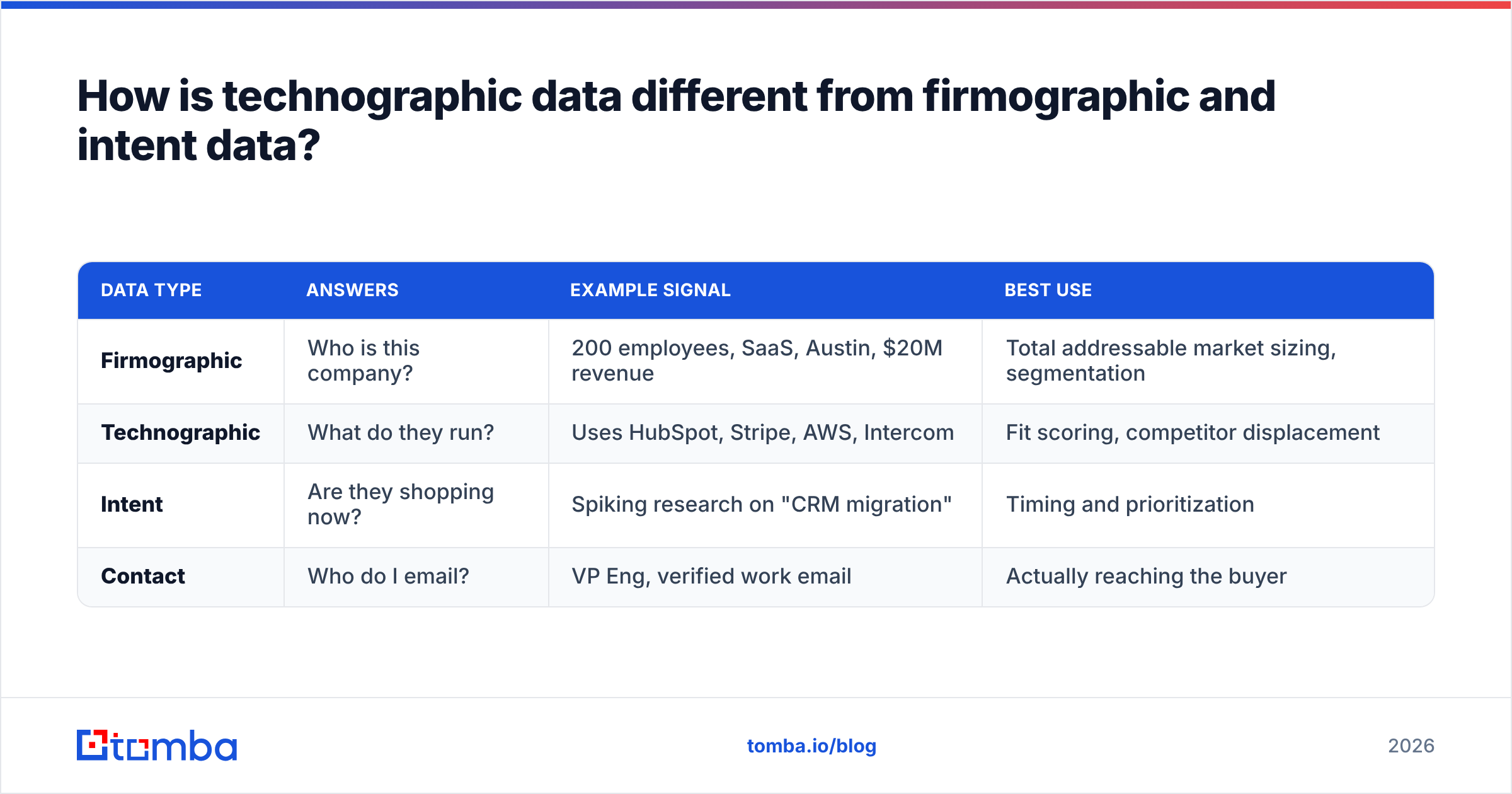
The three data types answer different questions. The best go-to-market motions use all three together. Here's how technographic data stacks up against the others:
| Data type | Answers | Example signal | Best use |
|---|---|---|---|
| Firmographic | Who is this company? | 200 employees, SaaS, Austin, $20M revenue | Total addressable market sizing, segmentation |
| Technographic | What do they run? | Uses HubSpot, Stripe, AWS, Intercom | Fit scoring, competitor displacement |
| Intent | Are they shopping now? | Spiking research on "CRM migration" | Timing and prioritization |
| Contact | Who do I email? | VP Eng, verified work email | Actually reaching the buyer |
Firmographics get you a universe. Technographics narrow it to fit. Intent tells you when. None of it matters until you attach a real, reachable contact. That's where a layer of data enrichment turns an account list into something your reps can act on. Treating these as competing sources is the common mistake. They're a pipeline, not a menu.
How is technographic data collected?#
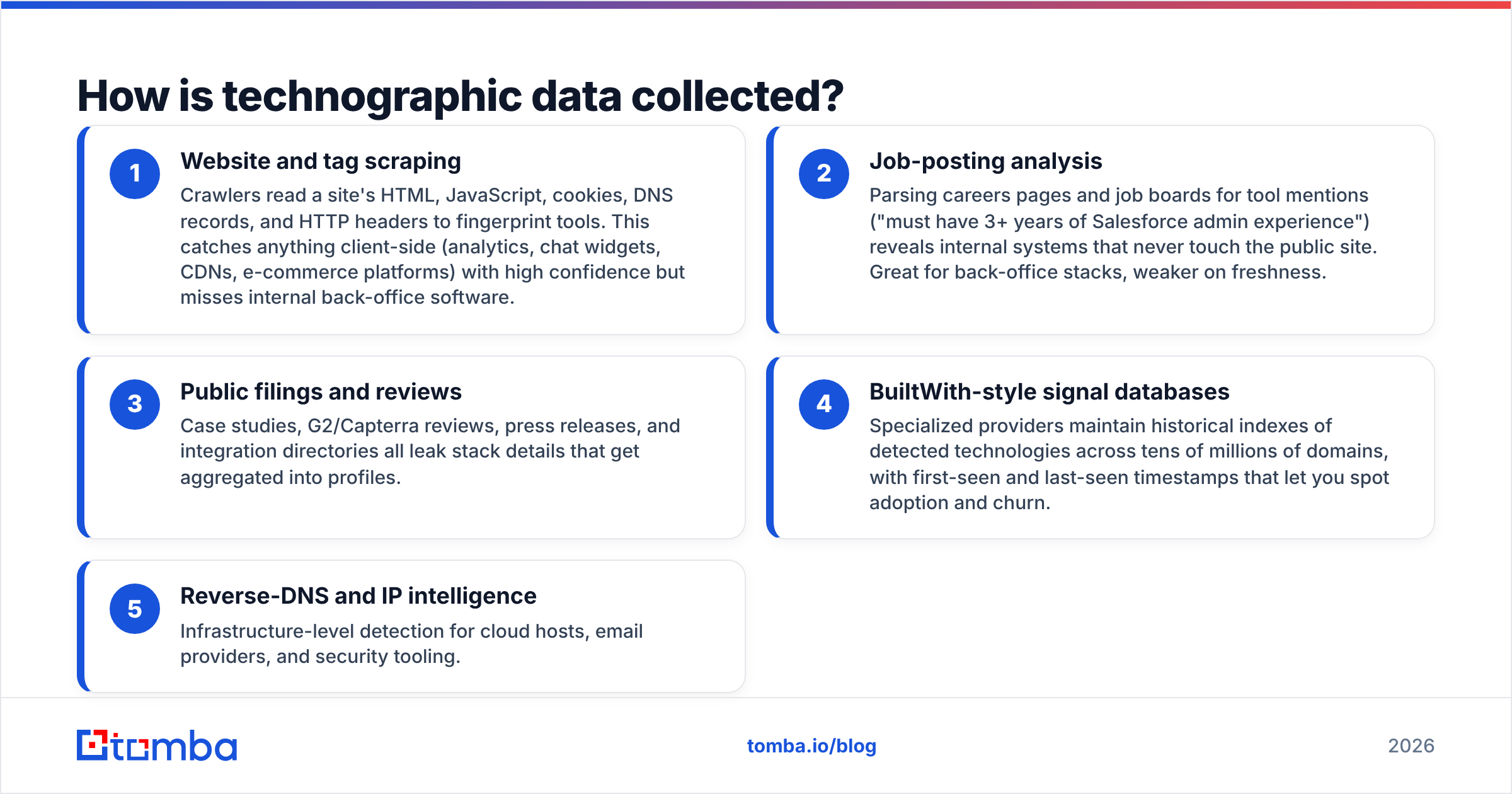
There's no single source of truth for a company's stack. So providers of B2B technographic data blend several detection methods. Each has different strengths in accuracy, coverage, and freshness:
- Website and tag scraping — Crawlers read a site's HTML, JavaScript, cookies, DNS records, and HTTP headers to fingerprint tools. This catches client-side tools like analytics, chat widgets, CDNs, and e-commerce platforms with high confidence. It misses internal back-office software.
- Job-posting analysis — Careers pages and job boards mention tools, like "must have 3+ years of Salesforce admin experience." Those mentions reveal internal systems that never touch the public site. They're great for back-office stacks but weaker on freshness.
- Public filings and reviews — Case studies, G2 and Capterra reviews, press releases, and integration directories all leak stack details. Providers aggregate these into profiles.
- BuiltWith-style signal databases — Specialized providers index detected technologies across tens of millions of domains. First-seen and last-seen timestamps let you spot adoption and churn.
- Reverse-DNS and IP intelligence — Infrastructure-level detection for cloud hosts, email providers, and security tooling.
No method is complete on its own. Reputable vendors fuse them and publish a confidence score per detected tool. Always treat a single low-confidence signal as a hypothesis, not a fact. The Wikipedia overview of technographic segmentation is a useful primer. It shows how these methods grew out of consumer market research.
Why does B2B technographic data matter for sales in 2026?#
Because it removes guesswork from the two most expensive parts of outbound: targeting and messaging. Generic prospecting wastes reps' time on accounts that were never a fit. B2B technographic data flips that. You reach out because the data shows a clear reason to.
The most common high-value plays:
- Competitor displacement. Build a list of every account running a rival product. Then time outreach to renewal cycles or known pain events, like an outage, a price hike, or a bad earnings call. Your pitch writes itself: "We hear teams on [Competitor] struggle with X."
- Integration and add-on selling. If your product extends a platform, target only accounts already on it. Conversion rates jump because you've pre-qualified compatibility.
- Stack-gap selling. Find accounts that run adjacent tools but lack yours. An example: a company with marketing automation but no dedicated deliverability tool.
- Lead and account scoring. Feed detected technologies into your scoring model. Your CRM then prioritizes accounts whose stack signals fit and budget.
- Churn-risk prediction. When a customer's stack shifts toward a competitor, that's an early warning your CS team can act on.
According to HubSpot's research on sales productivity, reps spend a large share of their week on research and non-selling tasks. Technographic data attacks that directly. The qualification work is done before the rep ever opens the account.
How do you action technographic data without wasting it?#
Buying a dataset and dumping it into a spreadsheet is where most teams stall. Technographic data only creates pipeline when it's tied to a contact and a message. Here's the workflow that actually moves deals:
- Define your fit signals. Decide which detected tools mean "good fit" (runs a complementary tool), "displacement target" (runs a competitor), or "disqualify" (runs something incompatible). Write these as explicit rules.
- Pull the account list. Query a technographic source for domains that match your signals. Layer in firmographic filters like size, region, and industry so you don't drown in noise.
- Find the right people. An account is not a contact. Use domain search to surface decision-makers at each company, then narrow by role.
- Verify before you send. Stale or guessed emails tank deliverability. Run every address through an email verifier so your campaign doesn't bounce into spam.
- Personalize on the stack signal. Reference the actual tool in your opener. "Noticed your team runs [Tool]" earns a reply. "I wanted to introduce our solution" gets deleted.
- Score and route. Push enriched, verified, scored accounts into your pipeline so reps work the hottest fits first.
The gap between steps 1–2 (data) and steps 3–6 (revenue) is contact quality. A perfect account list with bad emails produces zero meetings.
What should you look for in a technographic data provider?#
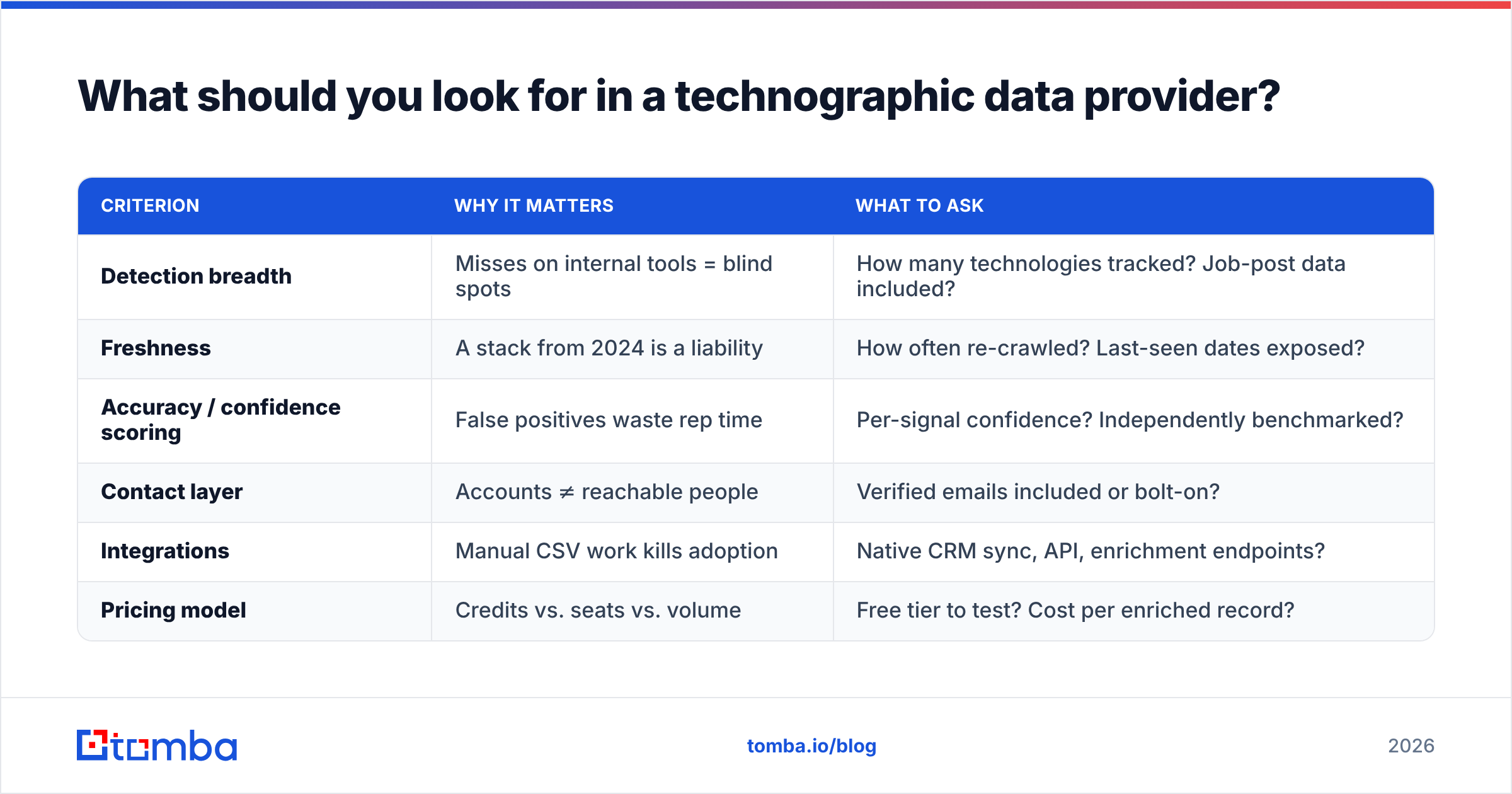
Coverage and freshness of B2B technographic data vary widely between vendors, and price scales fast. Judge providers on these dimensions, not raw record counts:
| Criterion | Why it matters | What to ask |
|---|---|---|
| Detection breadth | Misses on internal tools = blind spots | How many technologies tracked? Job-post data included? |
| Freshness | A stack from 2024 is a liability | How often re-crawled? Last-seen dates exposed? |
| Accuracy / confidence scoring | False positives waste rep time | Per-signal confidence? Independently benchmarked? |
| Contact layer | Accounts ≠ reachable people | Verified emails included or bolt-on? |
| Integrations | Manual CSV work kills adoption | Native CRM sync, API, enrichment endpoints? |
| Pricing model | Credits vs. seats vs. volume | Free tier to test? Cost per enriched record? |
Compare offerings on a neutral marketplace like G2's sales intelligence category before you commit. Review patterns reveal freshness and support issues that vendor decks hide. The best providers are transparent about where their data comes from and how often it's refreshed. That's exactly where weak vendors get vague.
Where does Tomba fit in a technographic workflow?#
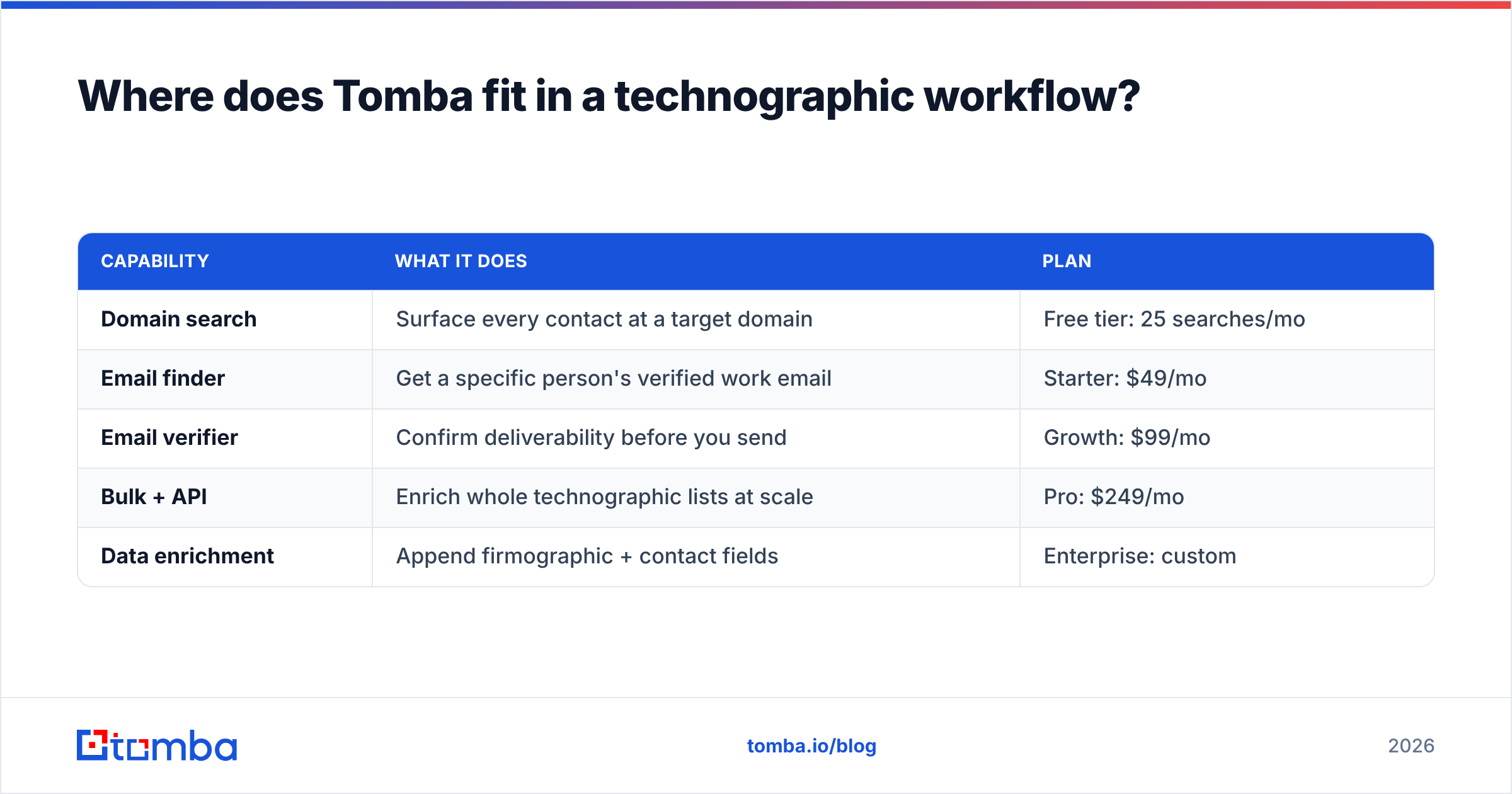
Tomba isn't a pure-play technographic index like BuiltWith. It's the layer that turns technographic accounts into reachable contacts. Once you've identified the domains running the stack you care about, Tomba finds and verifies the people behind them.
| Capability | What it does | Plan |
|---|---|---|
| Domain search | Surface every contact at a target domain | Free tier: 25 searches/mo |
| Email finder | Get a specific person's verified work email | Starter: $49/mo |
| Email verifier | Confirm deliverability before you send | Growth: $99/mo |
| Bulk + API | Enrich whole technographic lists at scale | Pro: $249/mo |
| Data enrichment | Append firmographic + contact fields | Enterprise: custom |
The pattern is simple. Source your account list from a B2B technographic data provider. Push the domains into Tomba's bulk email finder. Get back a verified, enriched contact list ready for your sequencer. You can wire the whole flow together with the Tomba API, so enrichment runs the moment an account hits your CRM. Full Tomba pricing is public, with a free tier to test the flow before you scale.
Frequently asked questions#
Is technographic data legal to use? Yes. Detected technologies are inferred from publicly observable signals like website code, job posts, and public filings. They're not private data. Your outreach still must comply with regional rules like GDPR and CAN-SPAM. Those govern how you contact people, not what stack data you analyze.
How accurate is technographic data? Accuracy depends on method and recency. Client-side detections, like analytics, chat, and e-commerce platforms, are highly reliable. Internal back-office tools inferred from job posts are softer. Always weight by the provider's confidence score and last-seen date.
Can I get technographic data for free? You can spot-check individual sites with free browser tools. But building a filterable account list at scale needs a paid index. Pair a technographic source with a free-tier contact tool to test the full workflow cheaply.
Does technographic data replace intent data? No. They're complementary. Technographics tell you fit. Intent tells you timing. The strongest campaigns trigger when a good-fit account also shows a buying signal.
Turn stack signals into booked meetings#
B2B technographic data is only as valuable as the conversations it starts. Once you know which accounts run the stack you sell into, the bottleneck becomes reaching the right person with a verified email — not another bounced guess. The Tomba Email Finder closes that gap. Feed it your technographic account list. Get back accurate, deliverability-checked contacts. Then let your reps spend the week selling to fits instead of researching strangers. Start on the free tier, prove the workflow on one displacement campaign, and scale from there.
Ready to find emails that actually work?
Join 150,000+ professionals who stopped guessing and started sending. Free credits on signup — no credit card required.
Get the Tomba newsletter
Practical outbound tactics and product updates — once every two weeks.
About the author