B2B Telemarketers in 2026: What They Do and How to Hire
What B2B telemarketers actually do in 2026, how much they cost, in-house vs outsourced, and how clean phone data decides whether the channel works at all.
B2B telemarketers are still booking pipeline in 2026 — but only the ones working from clean, verified phone data. The channel didn't die; the bad lists did.
TL;DR#
- B2B telemarketers are reps who call businesses to qualify leads, set appointments, and move buyers into a sales process — not consumer cold callers reading off scripts.
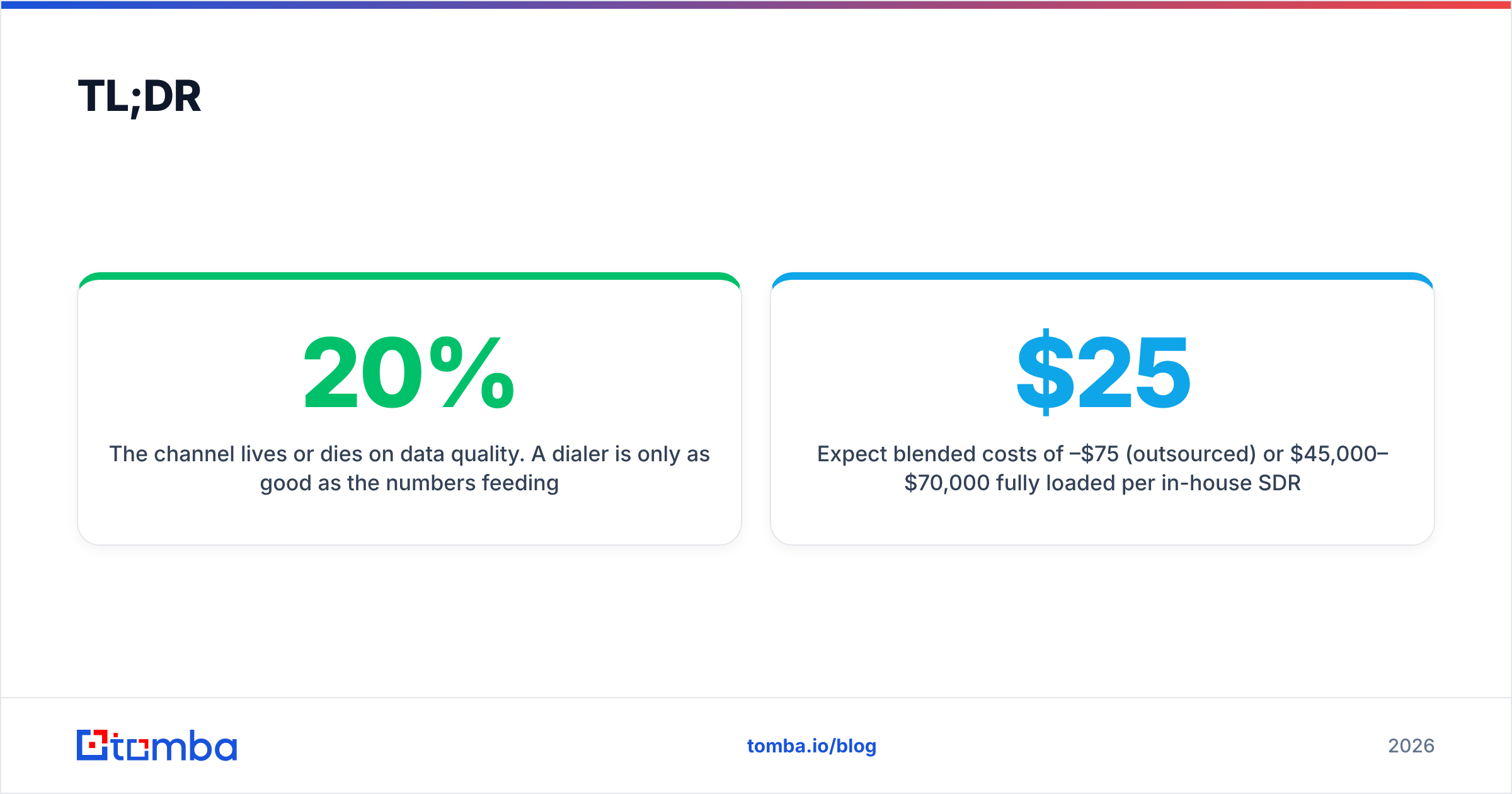
- The channel lives or dies on data quality. A dialer is only as good as the numbers feeding it; wrong-number rates above 20% quietly destroy ROI.
- In-house gives you control and brand consistency; outsourced gives you speed and lower fixed cost. Most teams run a hybrid.
- Expect blended costs of $25–$75 per hour (outsourced) or $45,000–$70,000 fully loaded per in-house SDR, plus tooling.
- Pair telemarketing with verified email and enrichment so reps spend time talking, not chasing dead numbers.
What is a B2B telemarketer?#
A B2B telemarketer is a sales professional who calls other businesses to generate, qualify, or advance sales opportunities. Think of them as the scouts of your revenue team: they go ahead of your closers, knock on doors, and figure out which accounts are worth a real conversation.
Unlike B2C telemarketing — high-volume calls to consumers — B2B work is lower volume and higher value. One booked meeting with a VP of Operations can be worth tens of thousands in pipeline, so the job rewards research, listening, and tailored conversations over rapid-fire dialing.
In practice the role overlaps heavily with the modern SDR (sales development representative) and BDR (business development representative). The phone is one channel among several, but it remains the fastest way to get a synchronous, human "yes" or "no" from a prospect.
What do B2B telemarketers actually do?#
The job is broader than "make calls." A strong B2B caller handles the full top-of-funnel motion:
- List building and research — Identifying target accounts and the right contact within them, then confirming direct-dial B2B phone numbers before the first call.
- Cold and warm calling — Reaching decision-makers, opening with a relevant reason to talk, and earning the next 30 seconds.
- Qualification — Running a framework (BANT, MEDDIC, or a lighter custom version) to separate real buyers from tire-kickers.
- Appointment setting — Booking discovery calls or demos directly on an account executive's calendar.
- CRM hygiene — Logging outcomes, updating contact records, and flagging dead numbers so the list gets cleaner over time.
- Follow-up across channels — Sending the promised email, connecting on LinkedIn, and sequencing touches so a single missed call doesn't kill the opportunity.
The last two points are where most teams leak money. A rep who spends half a shift dialing disconnected lines isn't a bad rep — they're a rep with bad data.
Is B2B telemarketing still effective in 2026?#
Yes — when the data is clean and the targeting is tight. The "cold calling is dead" headlines confuse channel decline with list decline. Buyers still pick up the phone; they just refuse to engage with irrelevant, mistimed, wrong-number spam.
Three forces keep the channel alive in 2026:
- Inbox saturation. Cold email volume has exploded, so a relevant phone call now stands out more than another unread message.
- Hybrid buying. Decision-makers research online but still want a human to de-risk a purchase. A timely call fills that gap.
- AI-assisted prep. Reps walk into calls with enriched context — role, tech stack, recent funding — so conversations start warmer.
According to widely cited sales research aggregated by HubSpot, it takes multiple touches to reach most prospects, and phone remains one of the highest-intent of those touches. The teams winning with telemarketing aren't dialing more — they're dialing smarter accounts with correct numbers.
In-house vs outsourced B2B telemarketers: which is better?#
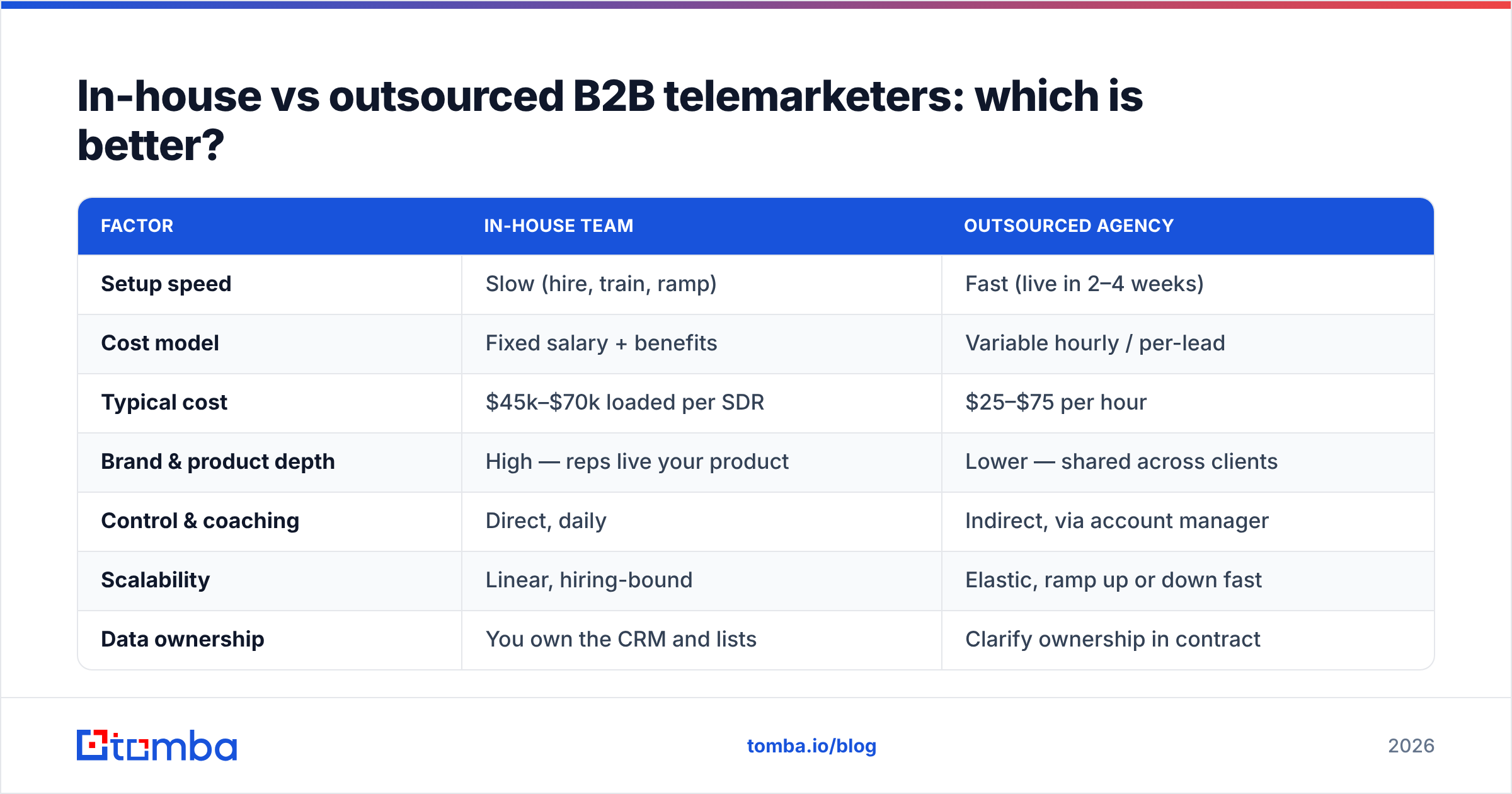
There's no universal winner — it depends on deal complexity, brand sensitivity, and how fast you need to scale. Here's the honest comparison.
| Factor | In-house team | Outsourced agency |
|---|---|---|
| Setup speed | Slow (hire, train, ramp) | Fast (live in 2–4 weeks) |
| Cost model | Fixed salary + benefits | Variable hourly / per-lead |
| Typical cost | $45k–$70k loaded per SDR | $25–$75 per hour |
| Brand & product depth | High — reps live your product | Lower — shared across clients |
| Control & coaching | Direct, daily | Indirect, via account manager |
| Scalability | Linear, hiring-bound | Elastic, ramp up or down fast |
| Data ownership | You own the CRM and lists | Clarify ownership in contract |
| Best for | Complex, high-ACV sales | Volume qualification, new markets |
A common pattern: outsource the early, repeatable qualification work to test a market, then build an in-house bench once the motion is proven and the deals get complex enough to justify product expertise.
Whichever route you choose, you supply the fuel — the contact list. Agencies rarely include premium data enrichment in their base rate, so you'll get better results feeding them verified records than letting them scrape whatever's cheapest.
How much do B2B telemarketers cost?#
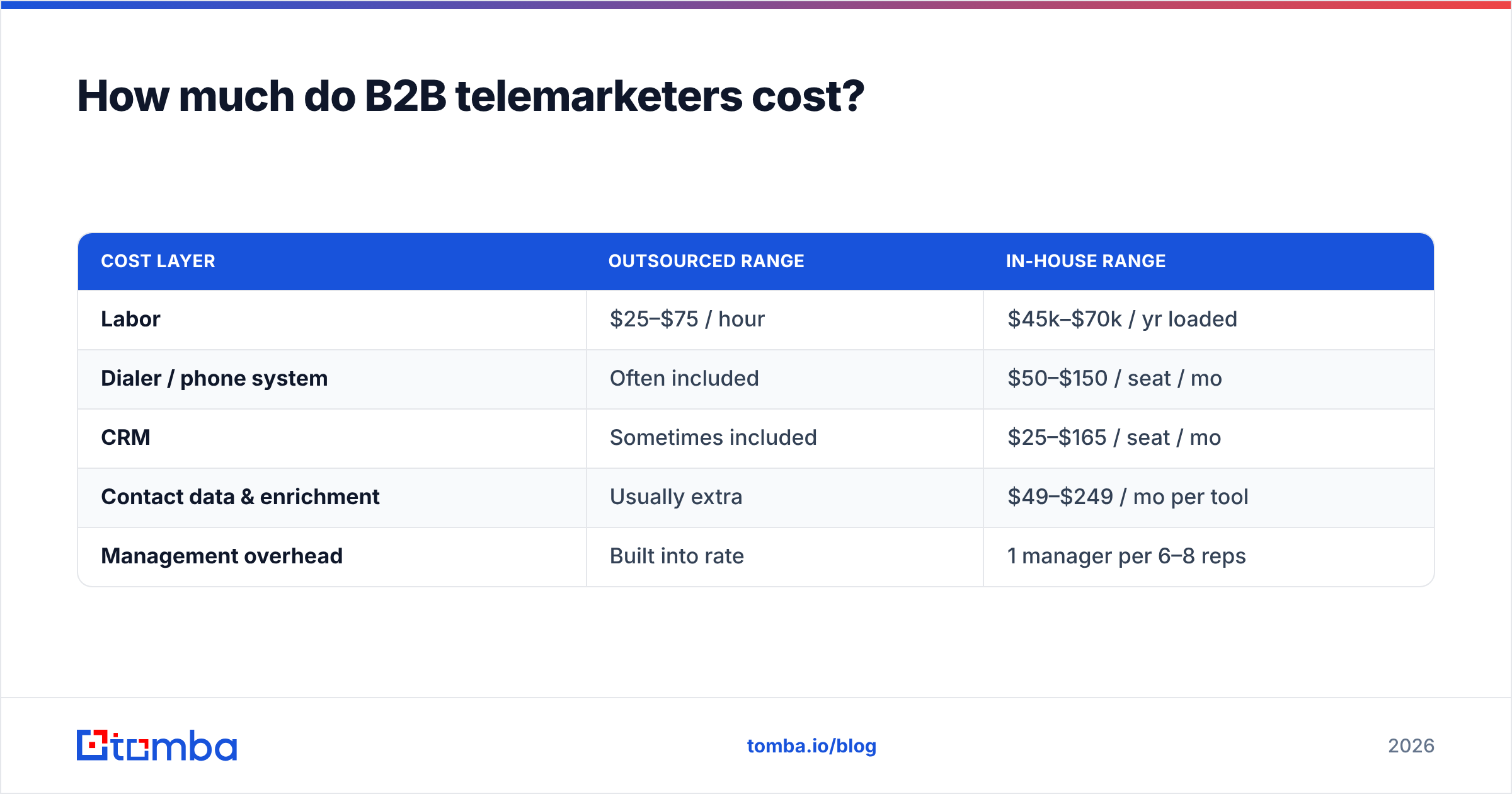
Budget for three layers: people, data, and tooling. Skipping the middle layer is the single most common reason telemarketing programs underperform.
| Cost layer | Outsourced range | In-house range |
|---|---|---|
| Labor | $25–$75 / hour | $45k–$70k / yr loaded |
| Dialer / phone system | Often included | $50–$150 / seat / mo |
| CRM | Sometimes included | $25–$165 / seat / mo |
| Contact data & enrichment | Usually extra | $49–$249 / mo per tool |
| Management overhead | Built into rate | 1 manager per 6–8 reps |
For data specifically, plans scale with volume. As a reference point, Tomba pricing runs a free tier at 25 searches per month, Starter at $49/mo, Growth at $99/mo, and Pro at $249/mo — enough to keep a small dialing team supplied with verified contacts without an enterprise contract.
The math that matters: if a rep costs you $40/hour and makes 40 connect-attempts an hour, a 25% wrong-number rate means you're paying $10/hour for your rep to listen to disconnect tones. Clean data isn't a nice-to-have line item — it's the difference between profit and loss on the whole program.

What makes a B2B telemarketing list actually work?#
A great list has three properties: it's targeted, current, and verified. Miss any one and call volume becomes call waste.
- Targeted — Right industry, company size, and role. A perfect number for the wrong persona is still a wasted dial.
- Current — People change jobs constantly. A contact verified six months ago may already be gone.
- Verified — Both the phone number and the email should be confirmed live before a rep touches the record.
This is where your data stack earns its keep. Use a phone validator to strip dead and invalid numbers before they ever hit the dialer, and pull from a maintained B2B database rather than a static CSV someone bought two years ago. For multichannel follow-up, confirm emails with an email verifier so the "I'll send that over" promise actually lands.
The goal is simple: every minute a rep is on the clock, they should be talking to a real human at a real target account — not troubleshooting your list.
How do you measure telemarketing performance?#
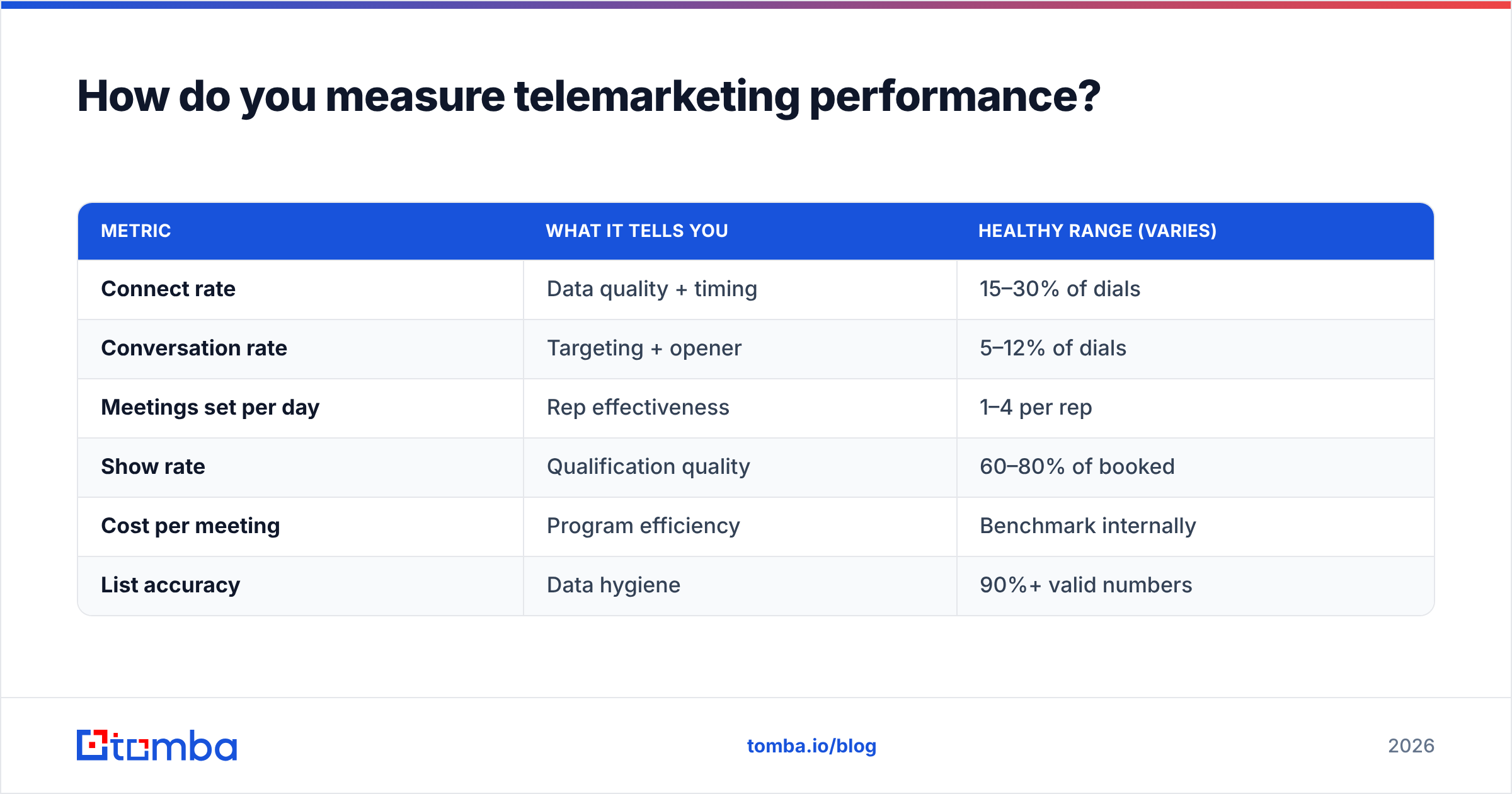
Track leading and lagging indicators together, or you'll optimize the wrong thing. Dials alone tell you nothing; meetings booked from those dials tell you everything.
| Metric | What it tells you | Healthy range (varies) |
|---|---|---|
| Connect rate | Data quality + timing | 15–30% of dials |
| Conversation rate | Targeting + opener | 5–12% of dials |
| Meetings set per day | Rep effectiveness | 1–4 per rep |
| Show rate | Qualification quality | 60–80% of booked |
| Cost per meeting | Program efficiency | Benchmark internally |
| List accuracy | Data hygiene | 90%+ valid numbers |
Watch response rate trends across the whole sequence, not just the call. If connect rates sag, the first suspect is almost always the list, not the rep. Software review sites like G2 are useful for benchmarking dialers and data tools against peer reviews before you commit budget.
What's the difference between B2B telemarketing and cold calling?#
They overlap, but they're not synonyms. Cold calling is one activity; telemarketing is the broader function that contains it.
- Cold calling is the act of phoning a prospect with no prior relationship. It's a tactic.
- B2B telemarketing is the organized program — list building, calling (cold and warm), qualifying, booking, and reporting — that the cold call lives inside.
- Modern SDR work wraps telemarketing into a multichannel motion where the phone coordinates with email and social touches.
Put plainly: every cold call is telemarketing, but not all telemarketing is cold. A follow-up call to a lead who downloaded your whitepaper is warm telemarketing, and it usually converts far better than a true cold dial — which is exactly why list segmentation matters so much.
How do you get started with B2B telemarketing?#
Start small, prove the motion, then scale the parts that work. A sensible first 30 days:
- Define one ICP and one offer. Narrow beats broad when you're learning.
- Build a 200–300 contact pilot list with verified direct dials and emails.
- Write one script with three openers and let reps test which lands.
- Run a two-week sprint and track connect rate, conversation rate, and meetings set.
- Clean as you go — flag every bad number so the list compounds in quality.
- Decide in-house vs outsourced based on real numbers, not a vendor's pitch deck.
The teams that succeed treat the first month as a data-collection exercise, not a revenue sprint. You're learning which accounts answer, which openers work, and which numbers your provider gets right.
The bottom line: data first, dialing second#
B2B telemarketing in 2026 rewards precision over volume. The reps who win aren't grinding through more dials — they're working tighter lists of verified, well-targeted contacts and spending their hours in actual conversations.
That starts upstream of the phone. Before you scale headcount or sign an agency contract, fix the fuel. Use the Tomba Email Finder to source accurate contact details by domain, name, or company, then enrich and verify those records so your callers — in-house or outsourced — dial real decision-makers instead of dead ends. Clean data is the cheapest performance upgrade your telemarketing program will ever buy. Start free with 25 searches, and only scale spend once the connect rates prove the channel works for you.
// get started
Find, verify and enrich your first contacts today
Start on the free plan with 25 searches a month, then scale when your team is ready.
Free plan · No credit card required · GDPR & CCPA
// about the author