B2B Telemarketing Campaigns: A 2026 Playbook That Converts
B2B telemarketing isn't dead — it's just changed. Here's how to plan, staff, script, and measure phone campaigns that actually book meetings in 2026.
B2B Telemarketing Campaigns: A 2026 Playbook That Converts
TL;DR
- B2B telemarketing still works in 2026 — but only when the list is accurate, the call is research-led, and the cadence is multi-touch. Random dialing through a bought list is what died, not the phone.
- The single biggest lever on cost-per-meeting is data quality. A verified direct-dial list beats a bigger, dirtier one every time.
- Structure beats scripts: a tight opener, a permission-based question, and one clear ask outperform a word-for-word read.
- Compliance (DNC, GDPR, consent logging) is not optional — one careless campaign can put your whole domain and brand at risk.
- Measure connect rate, conversation rate, and meetings-booked — not "dials made." Activity vanity metrics hide bad campaigns.
What is a B2B telemarketing campaign?#
A B2B telemarketing campaign is a structured outbound effort where reps call a defined list of business contacts to generate interest, qualify fit, and book a next step — usually a demo or discovery meeting. Think of it like fishing with a guide instead of a net: you're not blasting a market, you're working a curated list of named accounts where you already have a reason to call.
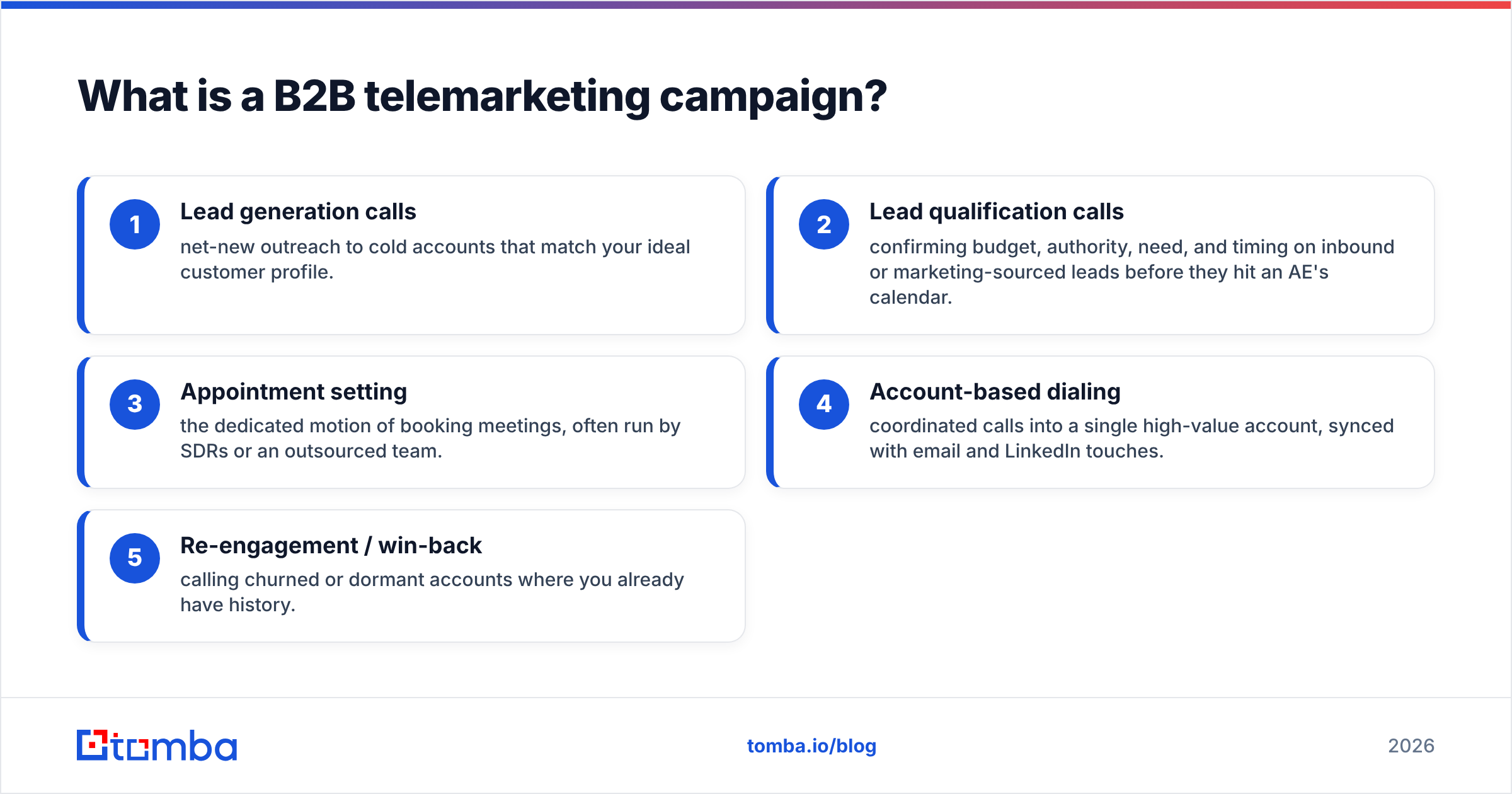
Modern B2B telephone outreach splits into a few distinct plays, and mixing them up is where most teams waste money:
- Lead generation calls — net-new outreach to cold accounts that match your ideal customer profile.
- Lead qualification calls — confirming budget, authority, need, and timing on inbound or marketing-sourced leads before they hit an AE's calendar.
- Appointment setting — the dedicated motion of booking meetings, often run by SDRs or an outsourced team.
- Account-based dialing — coordinated calls into a single high-value account, synced with email and LinkedIn touches.
- Re-engagement / win-back — calling churned or dormant accounts where you already have history.
The common thread is that the phone is a channel, not a strategy. The strategy lives in who you call, why, and what happens before and after the dial.
Is B2B telemarketing still effective in 2026?#
Yes — when it's data-led and multi-touch. The phone remains one of the few channels where you get a real-time, two-way conversation with a decision-maker, and that's worth more than ever in an inbox flooded with AI-written cold email.
What changed is the bar. Buyers screen unknown numbers, gatekeepers are tougher, and a single bad list can torch your connect rate. The teams winning with phone in 2026 share three habits:
- They call fewer, better-matched accounts. A list of 300 verified direct dials at ICP-fit companies outperforms 3,000 random contacts.
- They blend channels. A call lands far better after a relevant email or LinkedIn touch than out of the blue. According to HubSpot's sales research, multi-touch sequences consistently beat single-channel outreach.
- They treat the call as discovery, not a pitch. The goal of the first call is to earn the second conversation, not to close.
The reps who complain "telemarketing is dead" are almost always working a stale, unverified list with a robotic script — and blaming the channel for a data and process problem.
)
How do you build a high-converting telemarketing list?#
Start with data, because everything downstream depends on it. A campaign on a clean list with a mediocre script beats a brilliant script on a dirty list — every single time.
A strong B2B calling list has three layers:
- Firmographic fit — industry, size, revenue, and tech stack matching your ICP.
- Contact accuracy — the right named person in the right role, with a valid direct-dial or mobile number, not a generic switchboard line.
- A reason to call — a trigger event (funding, hiring, new tool, leadership change) that makes the timing relevant.
This is where enrichment tooling earns its keep. You can find decision-makers by company with domain search, pull verified mobile and direct-dial numbers with a phone finder, and confirm numbers are live before your reps waste time with a phone validator. Pairing phone data with a verified email gives reps a multi-channel angle on the same contact — and you can layer in data enrichment to add role, seniority, and company context for sharper openers.
The mistake to avoid: buying a giant static list once and dialing it for six months. Contacts change jobs, numbers get reassigned, and your connect rate quietly collapses. Refresh and re-validate before each campaign wave.
Buy-a-list vs. build-and-verify#
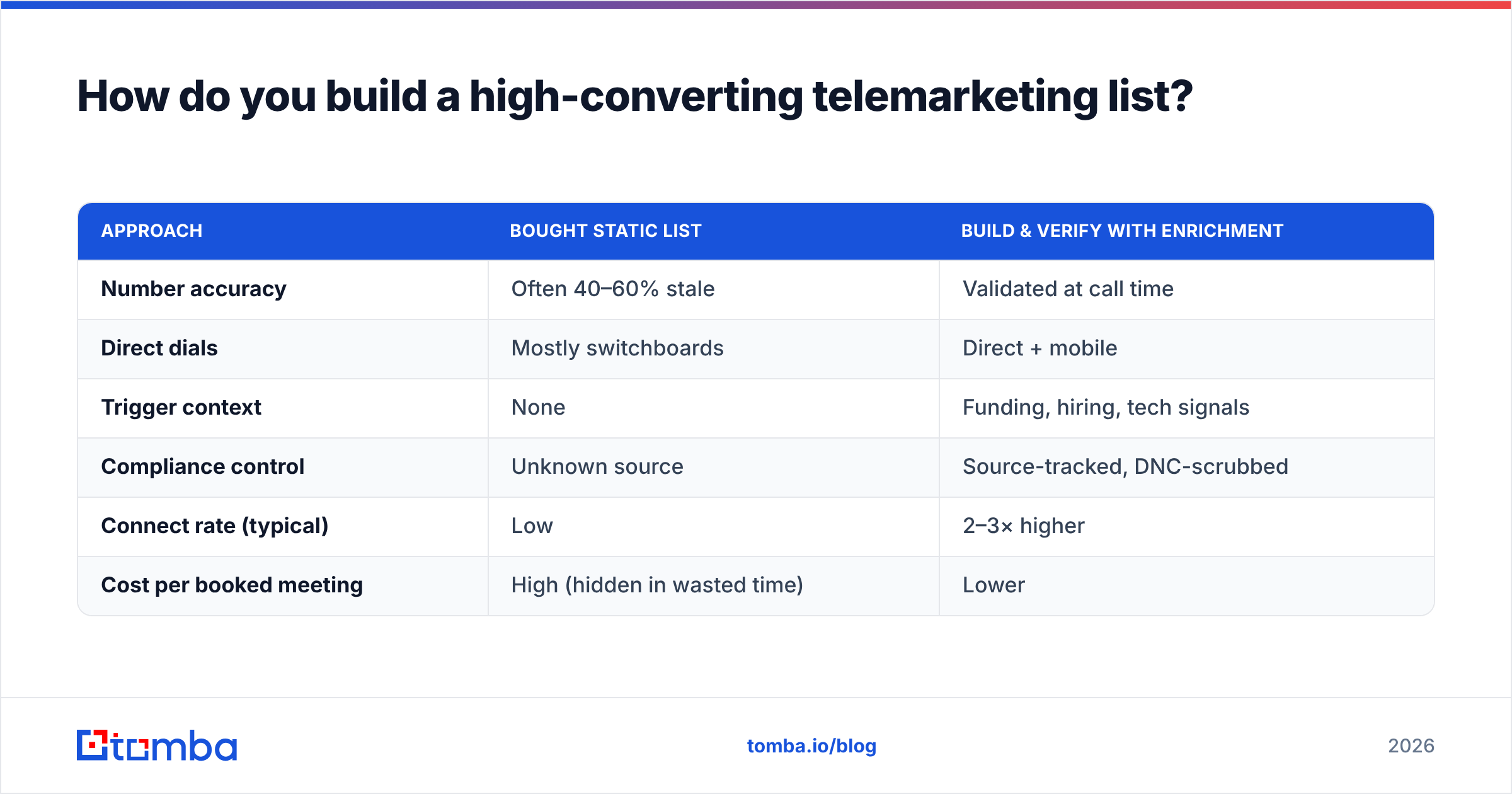
| Approach | Bought static list | Build & verify with enrichment |
|---|---|---|
| Number accuracy | Often 40–60% stale | Validated at call time |
| Direct dials | Mostly switchboards | Direct + mobile |
| Trigger context | None | Funding, hiring, tech signals |
| Compliance control | Unknown source | Source-tracked, DNC-scrubbed |
| Connect rate (typical) | Low | 2–3× higher |
| Cost per booked meeting | High (hidden in wasted time) | Lower |
What does a winning B2B telemarketing call structure look like?#
A repeatable structure beats a rigid script. You want reps who can hold a real conversation inside a reliable frame, not robots reading paragraphs. Here's the frame that consistently books meetings:
- Pattern-interrupt opener (10 seconds). State who you are and why you're calling this person, then ask permission to continue. "Did I catch you at a bad time?" disarms the guard reflex.
- Relevance hook (15 seconds). Tie the call to a trigger or pain specific to their role or company. Generic value props get hung up on.
- Permission-based discovery (1–2 questions). Ask, don't pitch. One good question about their current process earns more than three benefit statements.
- The single clear ask. Book the meeting. One call to action, one proposed time, no menu of options.
- Confirm and bridge. Lock the calendar invite while you're still on the line, and set expectations for the next step.
Two rules separate good callers from great ones. First, talk less — top SDRs let the prospect talk more than half the conversation. Second, handle the brush-off, not just the objection: "send me an email" is rarely a real no; it's a polite exit. A quick "Happy to — so I send the right thing, are you the person who owns this?" keeps the conversation alive.
How should you staff and run the campaign?#
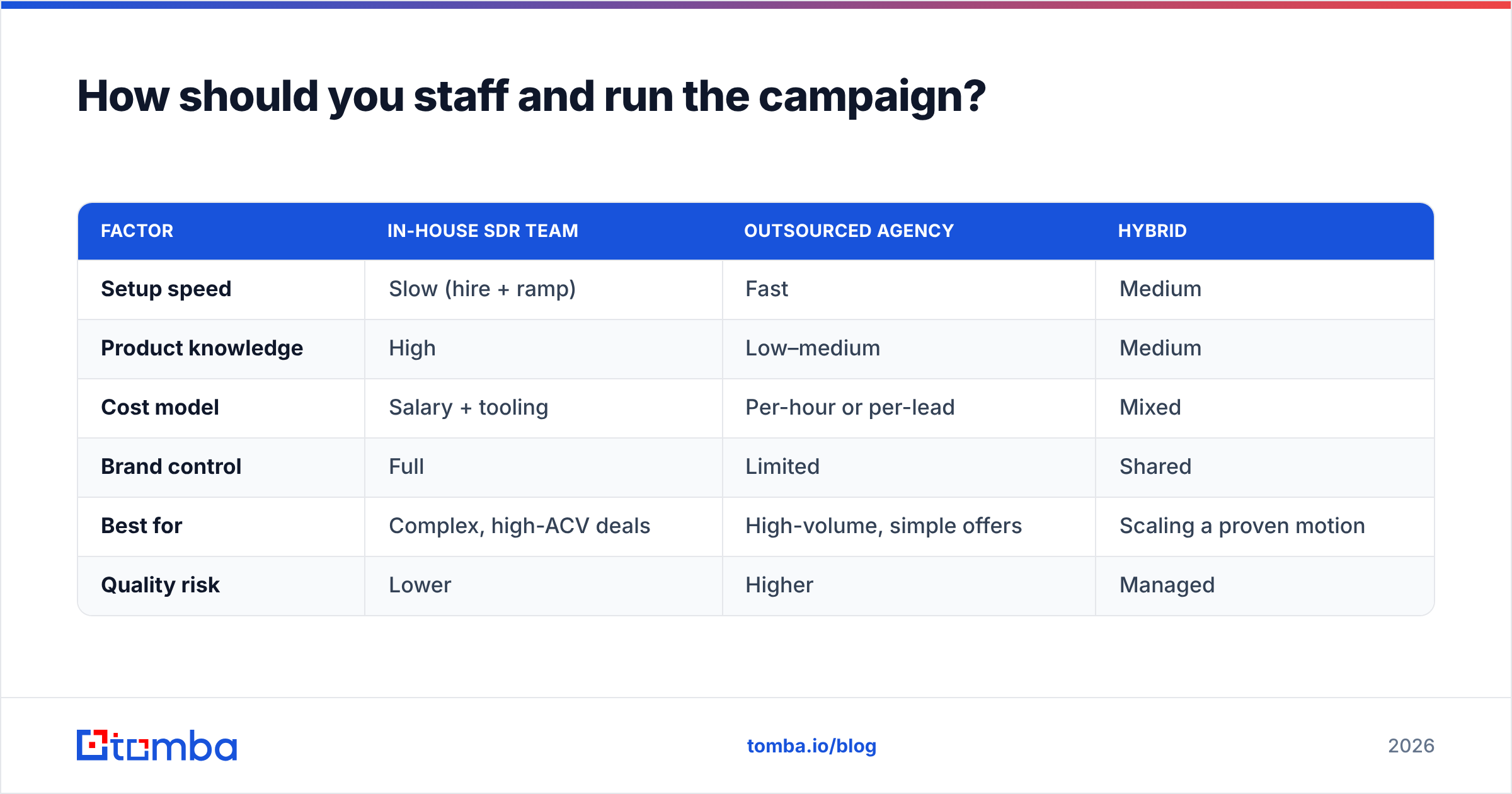
Decide first: in-house, outsourced, or hybrid. Each has a clear trade-off, and the right answer depends on call complexity and how protective you are of your brand voice.
| Factor | In-house SDR team | Outsourced agency | Hybrid |
|---|---|---|---|
| Setup speed | Slow (hire + ramp) | Fast | Medium |
| Product knowledge | High | Low–medium | Medium |
| Cost model | Salary + tooling | Per-hour or per-lead | Mixed |
| Brand control | Full | Limited | Shared |
| Best for | Complex, high-ACV deals | High-volume, simple offers | Scaling a proven motion |
| Quality risk | Lower | Higher | Managed |
Whatever model you choose, the operating cadence matters more than headcount:
- Set a realistic dial target, not a vanity one. 60–100 quality dials a day per rep beats 250 rushed ones that burn good contacts.
- Use a multi-touch sequence. Call, then email, then LinkedIn, spaced over days. A booked meeting usually takes 5–8 touches across channels.
- Hold daily call reviews. Listen to two recorded calls per rep per day. Coaching on real calls is the fastest path to a better connect-to-meeting rate.
- Protect the email side of the sequence. If your reps email between calls, sender reputation matters — verify addresses first and keep an eye on email deliverability so your follow-ups actually land.
)
What compliance rules apply to B2B telemarketing?#
Compliance is the part teams skip until it costs them — don't. The rules vary by region, but the principles are consistent, and ignoring them risks fines and brand damage far larger than any campaign upside.
- Honor Do-Not-Call (DNC) lists. In the US, scrub against the National DNC Registry and maintain your own internal suppression list. Even B2B calls have limits.
- Respect GDPR and local consent laws. In the EU and UK, you generally need a lawful basis to process contact data and call business prospects; document where your data came from. Wikipedia's GDPR overview is a useful primer before you brief your team.
- Log consent and call outcomes. Keep records of who you called, when, the result, and opt-out requests. This protects you in a dispute and keeps your list clean.
- Time your calls. Call within legal local-time windows and avoid weekends and holidays.
- Caller ID and identification. Use accurate, traceable numbers and identify your company clearly at the start of every call.
Source-tracked data is your friend here. Knowing exactly where each number came from — and being able to suppress and re-validate at scale — is far easier when your contact data lives in a system with transparent data sources rather than an anonymous spreadsheet someone bought two years ago.
How do you measure telemarketing campaign ROI?#
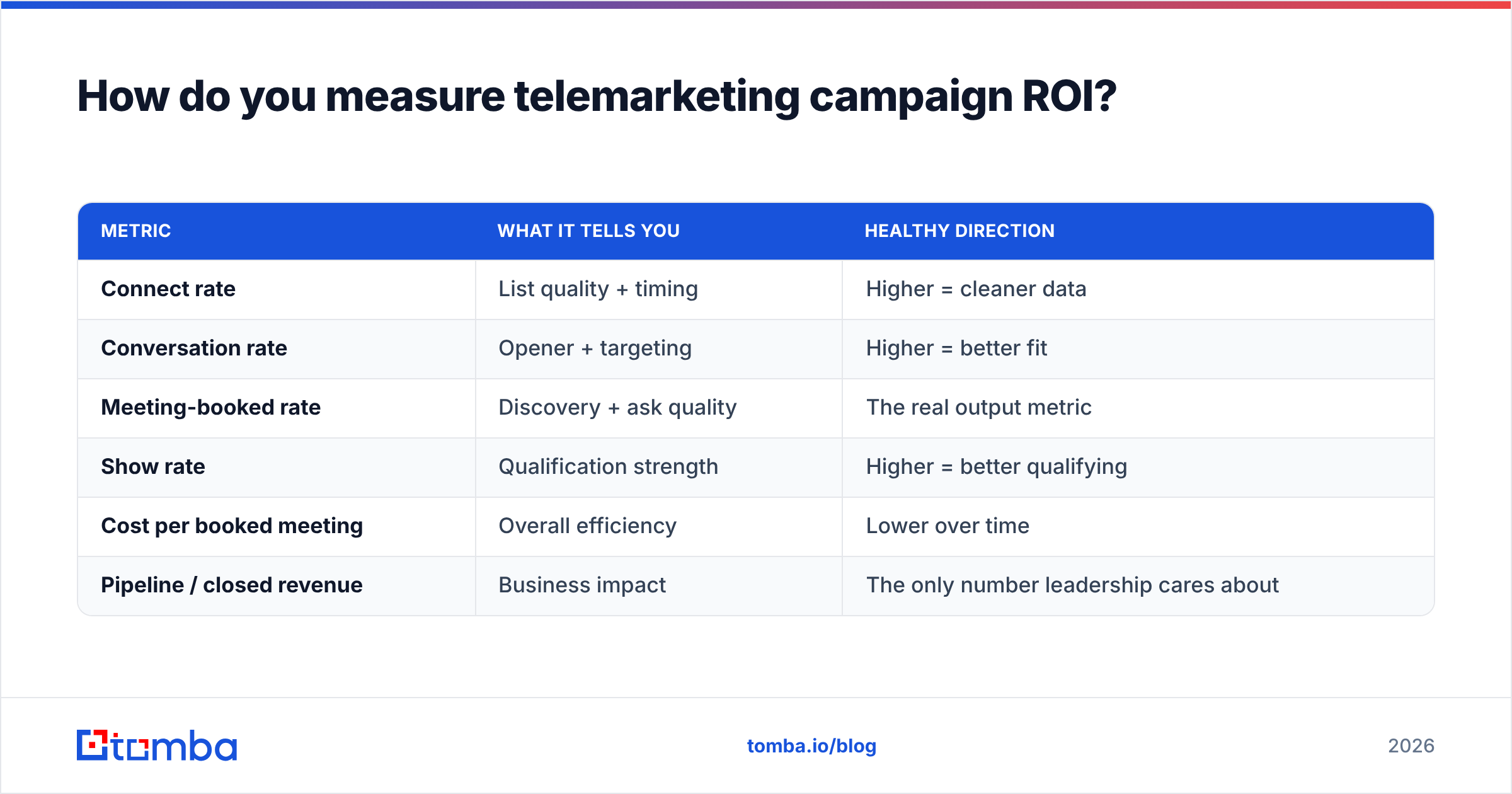
Measure outcomes, not effort. "Dials made" is the most misleading number in outbound — a rep can hit a huge dial count on a terrible list and book nothing. Track the funnel instead:
| Metric | What it tells you | Healthy direction |
|---|---|---|
| Connect rate | List quality + timing | Higher = cleaner data |
| Conversation rate | Opener + targeting | Higher = better fit |
| Meeting-booked rate | Discovery + ask quality | The real output metric |
| Show rate | Qualification strength | Higher = better qualifying |
| Cost per booked meeting | Overall efficiency | Lower over time |
| Pipeline / closed revenue | Business impact | The only number leadership cares about |
A few practices keep these metrics honest:
- Attribute the meeting to the channel that booked it, not the last touch. Phone often does the heavy lifting that email gets credit for.
- Segment by list source. If one data source produces a 3% connect rate and another produces 12%, you've just found where to spend.
- Review cost per meeting weekly. It's the early-warning signal that a list has gone stale.
- Tie everything back to pipeline. A campaign that books 40 meetings but sources zero qualified pipeline has a targeting problem, not a phone problem.
If your connect rate is sliding, the fix is almost never "dial more." It's "fix the data." Re-verify numbers, refresh triggers, and tighten the ICP before you ask reps to grind harder.
Common B2B telemarketing mistakes to avoid#
- Dialing an unverified list. Every disconnected number is paid rep time set on fire.
- Pitching before qualifying. The first call earns the second conversation; it doesn't close.
- One channel only. Phone without email and LinkedIn support converts far worse than a coordinated sequence.
- Measuring activity, not outcomes. Dial counts make managers feel busy and hide bad campaigns.
- Ignoring compliance. A single DNC violation or sloppy data practice can cost more than the campaign earns.
- Never coaching. Untouched scripts and unreviewed calls plateau fast.
Conclusion: the phone still works when the data does#
B2B telemarketing in 2026 is a precision channel, not a volume one. The teams that win aren't the ones making the most calls — they're the ones calling the right people, with verified numbers, a relevant reason, and a coordinated multi-channel cadence behind every dial.
That all starts with accurate contact data. Use Tomba's phone finder to pull verified direct-dial and mobile numbers for your target accounts, pair them with verified work emails from the Tomba Email Finder so your reps can call and follow up on the same contact, and check the Tomba pricing plans — a free tier with 25 searches a month lets you test a list before you commit. Build the campaign on clean data, and the phone will pull its weight.
// get started
Find, verify and enrich your first contacts today
Start on the free plan with 25 searches a month, then scale when your team is ready.
Free plan · No credit card required · GDPR & CCPA
// about the author