B2B vs B2C: Key Sales and Marketing Differences (2026)
B2B vs B2C isn't just who you sell to. It changes your sales cycle, pricing, data needs, and outreach. Here's the 2026 breakdown that actually matters.
You sell to businesses or you sell to consumers. That single fork decides almost everything else about how you go to market — how long deals take, who signs off, what your data has to look like, and which channels actually convert. Getting "B2B vs B2C" wrong is how teams burn budget running consumer tactics at enterprise buyers, or smother a $30 impulse purchase under an enterprise sales process.
This guide breaks down the real differences in 2026, where the lines blur, and how to build the right motion for each.
TL;DR#
- B2B sells to organizations with multiple stakeholders, long cycles, high deal values, and relationship-driven, data-heavy outreach. B2C sells to individuals with short cycles, emotional triggers, and high-volume, brand-driven marketing.
- Sales cycles differ by an order of magnitude: B2B often runs 1–12 months; B2C can close in minutes.
- Decision-making is a committee in B2B (averaging 6–10 buyers) versus one or two people in B2C.
- Data is the dividing line. B2B depends on accurate firmographic and contact data — verified work emails, titles, company size. B2C runs on behavioral and demographic signals at scale.
- The two are converging: "B2B2C" and product-led growth borrow consumer UX, while premium DTC brands borrow B2B-style retention.
What is the difference between B2B and B2C?#
B2B (business-to-business) means your customer is an organization — a SaaS company buying security software, a manufacturer buying steel, an agency buying ad tools. B2C (business-to-consumer) means your customer is an individual buying for themselves — sneakers, a streaming subscription, a meal kit.
The simplest way to think about it: B2B sells outcomes to a committee; B2C sells feelings to a person. A B2B buyer has to justify the purchase to a CFO and prove ROI. A B2C buyer mostly has to justify it to themselves, and often does so emotionally in under five minutes.
That difference cascades into every part of the operation. Here's the side-by-side.
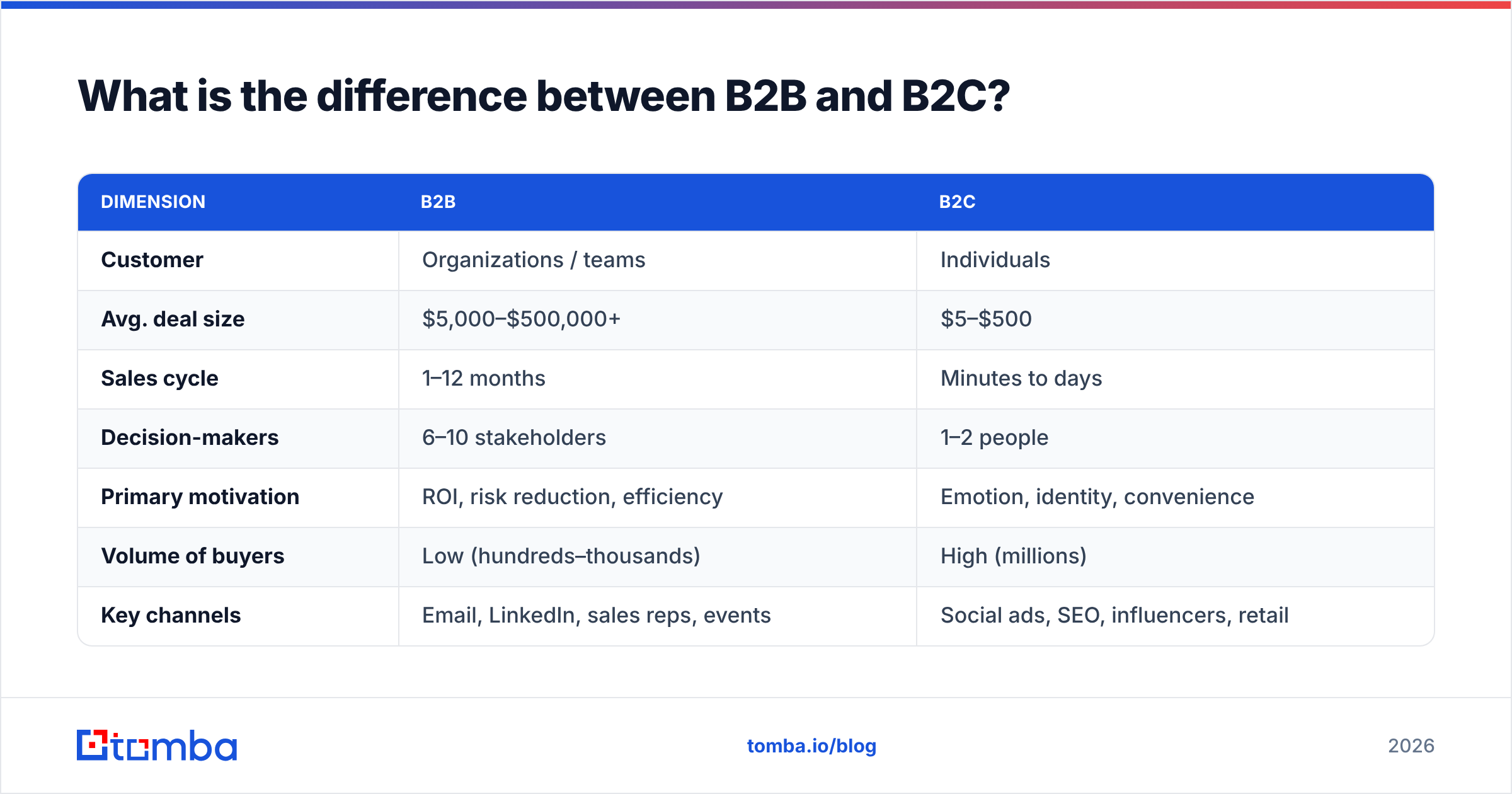
| Dimension | B2B | B2C |
|---|---|---|
| Customer | Organizations / teams | Individuals |
| Avg. deal size | $5,000–$500,000+ | $5–$500 |
| Sales cycle | 1–12 months | Minutes to days |
| Decision-makers | 6–10 stakeholders | 1–2 people |
| Primary motivation | ROI, risk reduction, efficiency | Emotion, identity, convenience |
| Volume of buyers | Low (hundreds–thousands) | High (millions) |
| Key channels | Email, LinkedIn, sales reps, events | Social ads, SEO, influencers, retail |
| Data that matters | Firmographics, titles, verified work emails | Demographics, behavior, purchase history |
| Relationship | Long-term, account-managed | Transactional or loyalty-driven |
| Pricing | Negotiated, tiered, custom | Fixed, public |
Why does the sales cycle differ so much?#
The B2B sales cycle is long because the purchase is risky and shared. A $60,000 platform decision touches procurement, security, finance, and the end-user team. Each adds a review step. According to Gartner research on B2B buying, buyers spend the majority of their journey doing independent research and meeting internally — not talking to your reps.
B2C compresses all of that into one head. The "committee" is the buyer plus maybe a partner. The risk is low, the price is public, and the emotional payoff is immediate. That's why B2C marketing optimizes for impulse and friction removal — one-click checkout, free returns, social proof — while B2B marketing optimizes for trust, education, and de-risking.
This is why the same tactic produces opposite results:
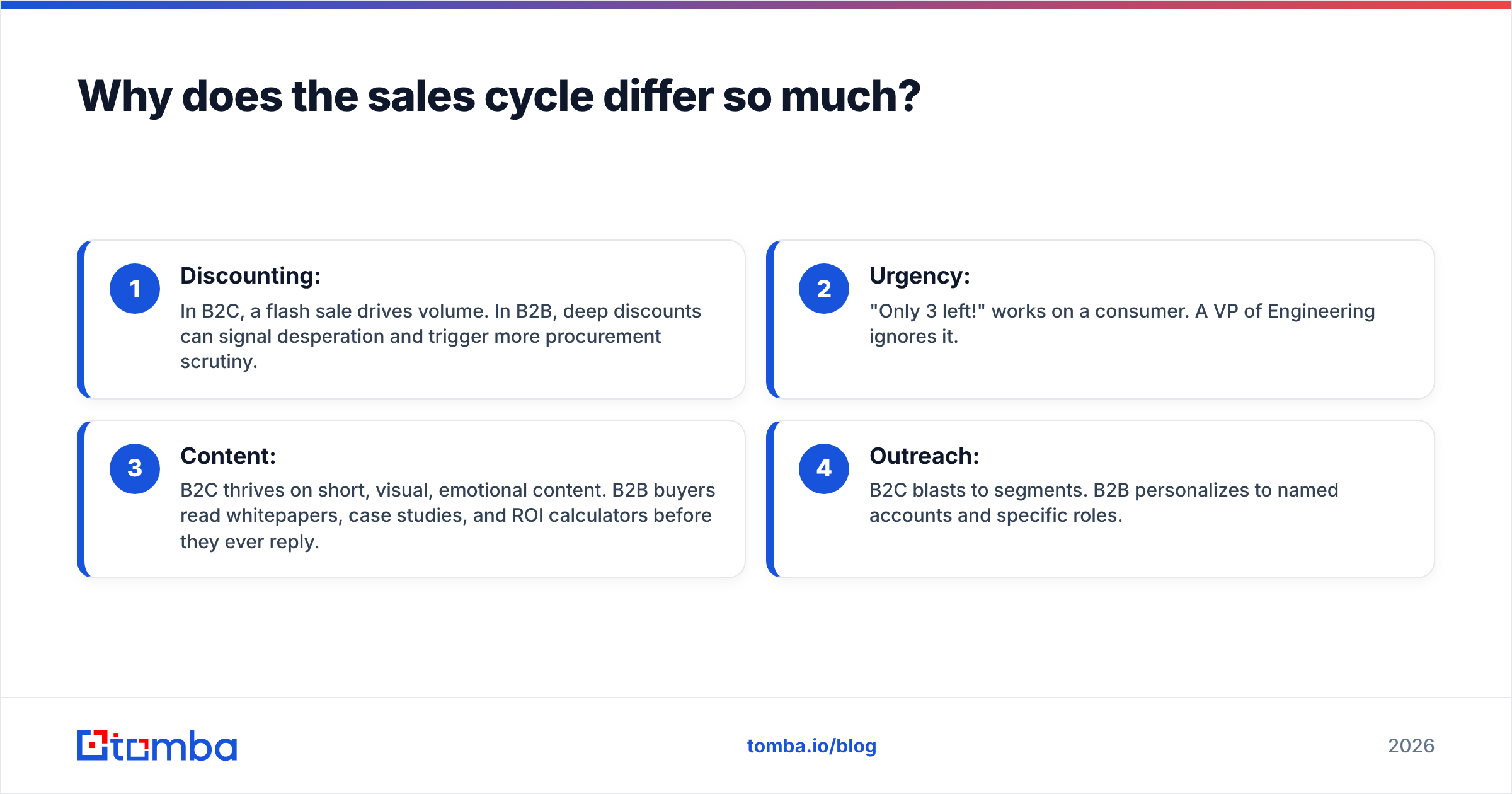
- Discounting: In B2C, a flash sale drives volume. In B2B, deep discounts can signal desperation and trigger more procurement scrutiny.
- Urgency: "Only 3 left!" works on a consumer. A VP of Engineering ignores it.
- Content: B2C thrives on short, visual, emotional content. B2B buyers read whitepapers, case studies, and ROI calculators before they ever reply.
- Outreach: B2C blasts to segments. B2B personalizes to named accounts and specific roles.
Who actually makes the buying decision?#
In B2C, the buyer and the user are usually the same person. In B2B, they're often not — and that gap defines the whole motion.
A modern B2B deal involves a buying committee: an economic buyer (signs the check), a technical buyer (vets the product), champions (push internally), and end users (live with it daily). Your job is to arm the champion to sell on your behalf when you're not in the room. That requires knowing exactly who these people are, their titles, and how to reach them — which is a data problem before it's a messaging problem.
This is where prospecting tooling separates the two worlds. B2C marketers buy audiences through ad platforms. B2B teams build targeted lists of real decision-makers and need their verified contact details. If you're sending to a generic info@ inbox or a guessed email, your champion never sees the message. Using an accurate email finder and email verifier to reach the right person at the right company is the entry fee for B2B outbound.
How do data and prospecting differ in B2B vs B2C?#
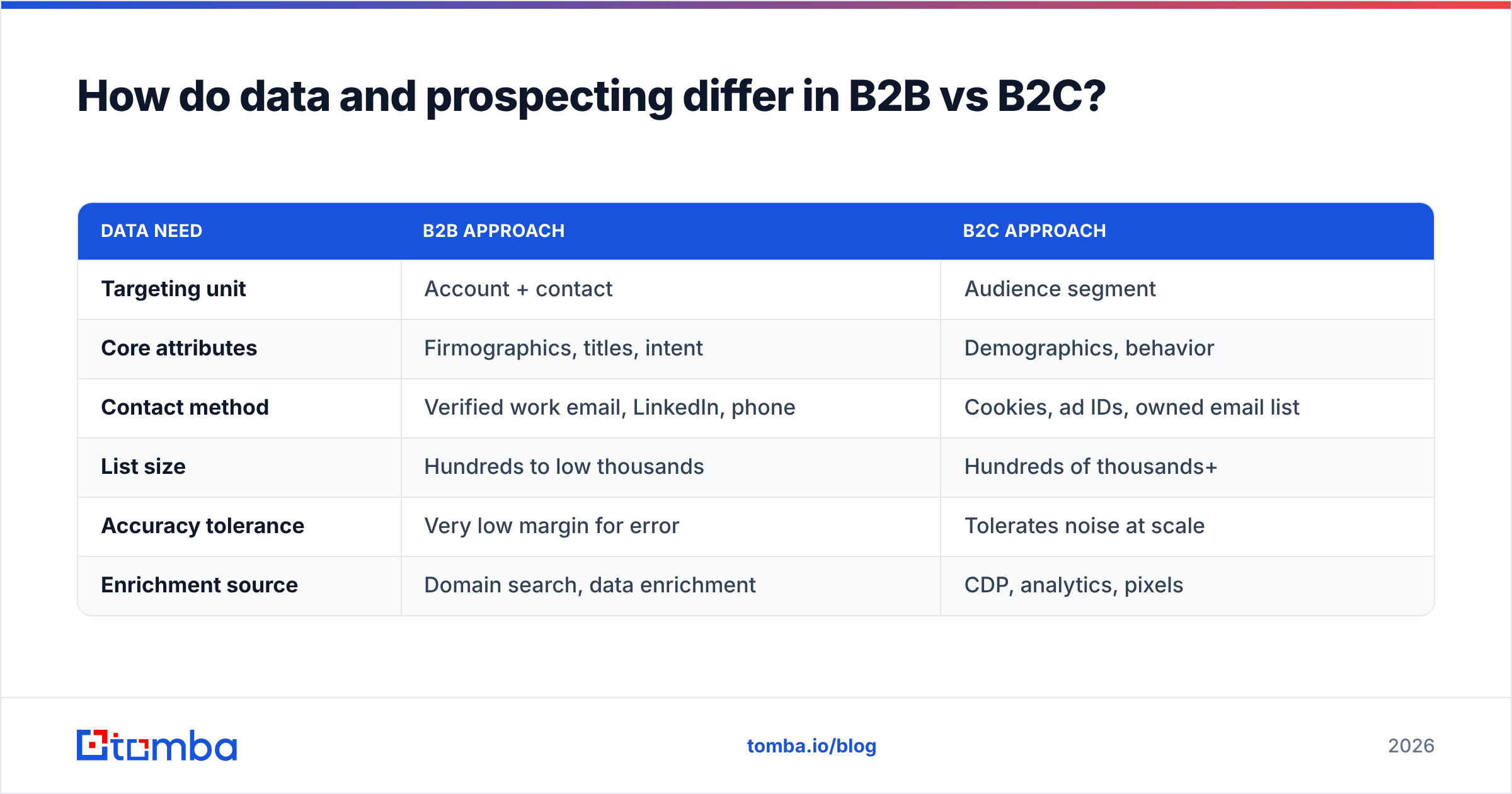
Data is the cleanest dividing line between the two models. B2C runs on scale and behavior; B2B runs on precision and firmographics.
A B2C team segments millions of users by demographics, browsing history, and past purchases, then optimizes creative against conversion rate. A B2B team works a much smaller universe — maybe 2,000 ideal-fit accounts — and needs depth on each: company size, tech stack, industry, the right contacts, and verified ways to reach them.
| Data need | B2B approach | B2C approach |
|---|---|---|
| Targeting unit | Account + contact | Audience segment |
| Core attributes | Firmographics, titles, intent | Demographics, behavior |
| Contact method | Verified work email, LinkedIn, phone | Cookies, ad IDs, owned email list |
| List size | Hundreds to low thousands | Hundreds of thousands+ |
| Accuracy tolerance | Very low margin for error | Tolerates noise at scale |
| Enrichment source | Domain search, data enrichment | CDP, analytics, pixels |
Because B2B works small, high-value lists, bad data is expensive. A 30% bounce rate on a cold campaign doesn't just waste effort — it damages your sender reputation and hurts email deliverability for every future send. That's why B2B teams lean on tools like domain search to map every contact at a target company and data enrichment to fill the gaps before outreach. Consumer marketers rarely worry about an individual bad record; B2B teams can't afford a dirty list.
Is B2B marketing better than B2C marketing?#
Neither is "better" — they optimize for different math. B2C wins on volume and velocity; B2B wins on deal size and retention. The mistake is importing one playbook into the other.
Where B2C tactics fail in B2B:
- Vanity reach. A million impressions means little if your buying committee is 8 people at 200 companies.
- Pure emotion. Feelings open the door, but B2B buyers still need a business case to get budget approved.
- Set-and-forget funnels. B2B needs human follow-up; most deals require multiple touches across weeks.
Where B2B tactics fail in B2C:
- Heavy gating. Forcing a consumer to "book a demo" for a $40 product kills conversion.
- Long nurture. Consumers want to buy now, not enter a 6-week email sequence.
- Account-based everything. There are no "accounts" — just people.
The channels reflect this. B2B leans on email outreach, LinkedIn, webinars, and sales-led motions; the response rate on a well-targeted, personalized email still beats almost any paid channel for high-ticket deals. B2C leans on paid social, influencers, SEO, and retail presence.
What about B2B2C and the blurring lines?#
The clean split is getting messier, and 2026 makes that obvious. Three forces are blurring B2B and B2C:
- Product-led growth (PLG). Tools like Slack, Notion, and Figma sell bottom-up to individual users who then drag the company into a contract. The buyer experience feels B2C; the contract is B2B.
- B2B2C models. A payments provider sells to a marketplace (B2B) that serves end consumers (B2C). You have to win both.
- Consumerized B2B buyers. The people buying enterprise software shop on Amazon at night. They expect the same clean UX, instant answers, and self-serve options at work.
The practical takeaway: even PLG and B2B2C companies still need accurate B2B contact data the moment they shift from self-serve to sales-assisted. When a free user signals expansion intent, your sales team needs to identify the economic buyer at that company and reach them — fast. The motion borrows B2C polish, but the underlying B2B database requirement doesn't go away.
How do you choose the right go-to-market motion?#
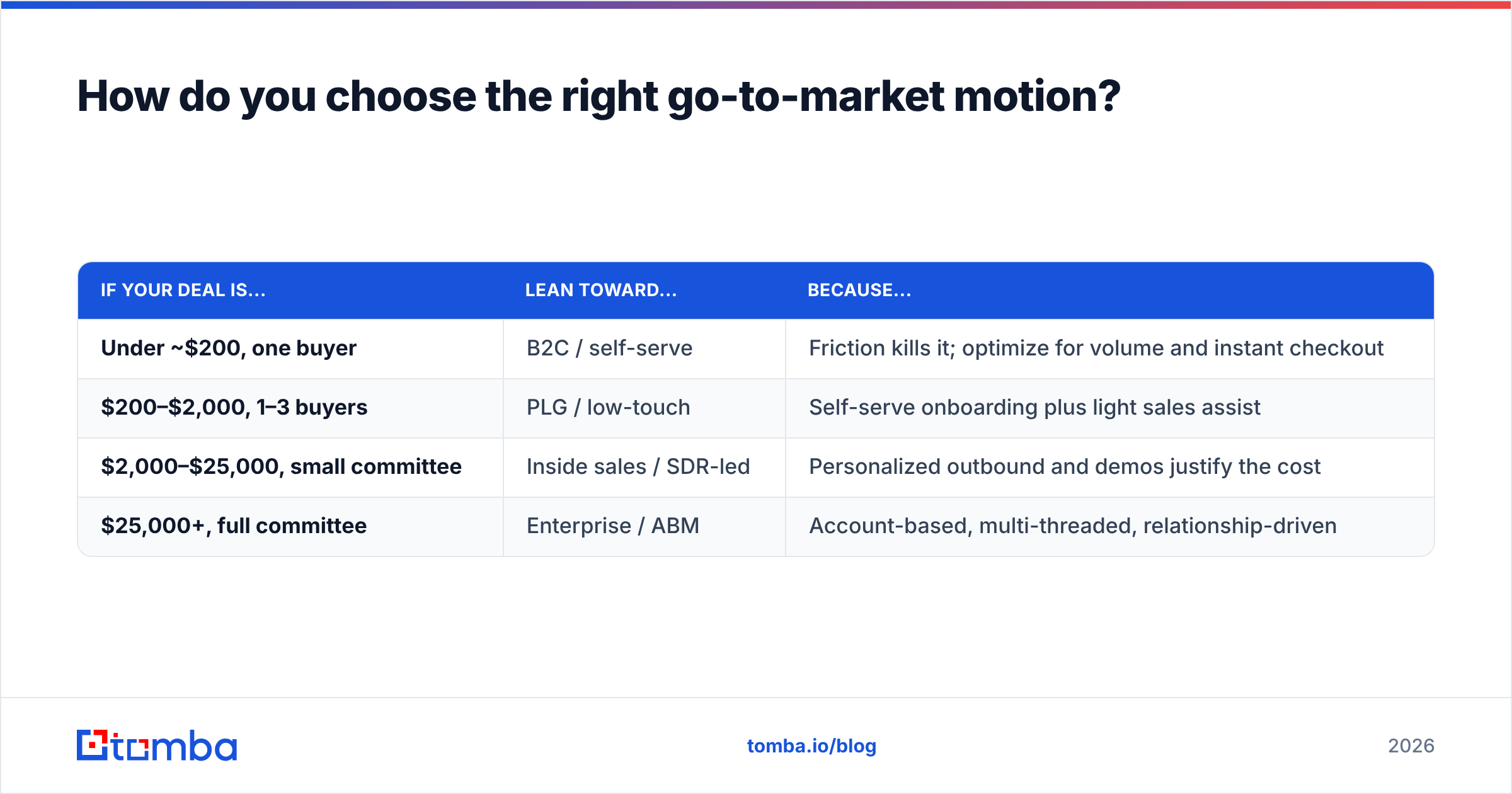
Start by being honest about your average deal size and who has to approve it. That single answer points you to the right motion.
| If your deal is... | Lean toward... | Because... |
|---|---|---|
| Under ~$200, one buyer | B2C / self-serve | Friction kills it; optimize for volume and instant checkout |
| $200–$2,000, 1–3 buyers | PLG / low-touch | Self-serve onboarding plus light sales assist |
| $2,000–$25,000, small committee | Inside sales / SDR-led | Personalized outbound and demos justify the cost |
| $25,000+, full committee | Enterprise / ABM | Account-based, multi-threaded, relationship-driven |
For anything in the bottom three rows, your outbound engine is only as good as your data. That means a repeatable way to find decision-makers, verify their emails, and enrich the record before a rep ever reaches out. Spending on ads while sending to bad addresses is the most common way B2B teams waste budget — see Tomba pricing for how teams scale verified contact discovery without per-seat enterprise costs.
Frequently asked questions#
Is B2B harder than B2C? Not harder — different. B2B has fewer buyers, longer cycles, and higher stakes, so precision matters more. B2C has shorter cycles but brutal competition for attention and thin margins per sale.
Can one company do both B2B and B2C? Yes. Many do (Amazon, Apple, Microsoft). The key is running separate playbooks — separate messaging, data, pricing, and teams — rather than forcing one approach across both.
Which has a higher customer lifetime value? Usually B2B, because of larger contracts and multi-year retention. But strong B2C loyalty brands (subscriptions, memberships) can rival it through volume.
Does email outreach work for B2C? It works, but differently. B2C email relies on owned, opted-in lists and lifecycle automation. B2B email relies on cold-but-targeted outreach to verified work addresses — which is why list accuracy is non-negotiable.
The bottom line#
B2B vs B2C isn't a branding label — it's a decision that sets your sales cycle, your pricing, your channels, and above all your data strategy. B2C scales on behavioral data and broad reach. B2B lives or dies on reaching the right person at the right company with a verified email and a relevant reason to talk.
If you're running any kind of B2B motion, that starts with clean contact data. Use the Tomba Email Finder to find and verify decision-maker emails by name, company, or domain — so your outreach lands in the right inbox instead of bouncing. Start free with 25 searches a month, and scale up only when the pipeline proves itself.
Ready to find emails that actually work?
Join 150,000+ professionals who stopped guessing and started sending. Free credits on signup — no credit card required.
Get the Tomba newsletter
Practical outbound tactics and product updates — once every two weeks.
About the author