B2B vs B2C Lead Generation: Key Differences in 2026
B2B and B2C lead generation look similar on the surface but reward opposite playbooks. Here's how funnels, channels, data, and cost differ in 2026 — and which model fits you.
You are running the same job title — "demand gen" or "growth" — but if you sell to businesses versus consumers, almost nothing about your daily playbook should match. B2B and B2C lead generation share a goal (turn strangers into pipeline) and share none of the math that gets you there.
TL;DR#
- B2B lead generation targets a small, defined set of accounts and buying committees. Fewer leads, higher value, longer cycles, and data quality is everything.
- B2C lead generation targets large, broad audiences. Volume wins, decisions are fast and emotional, and cost-per-lead is low but conversion is thin.
- The channels overlap (search, social, email) but the weighting flips: B2B leans on intent data, account targeting, and outbound; B2C leans on paid social, influencers, and offers.
- B2B sales cycles run weeks to quarters with 6–10 stakeholders; B2C is minutes to days with one decision-maker.
- If you sell to businesses, accurate contact data is the highest-leverage investment you can make. Bad emails kill outbound before copy ever matters.
What is the difference between B2B and B2C lead generation?#
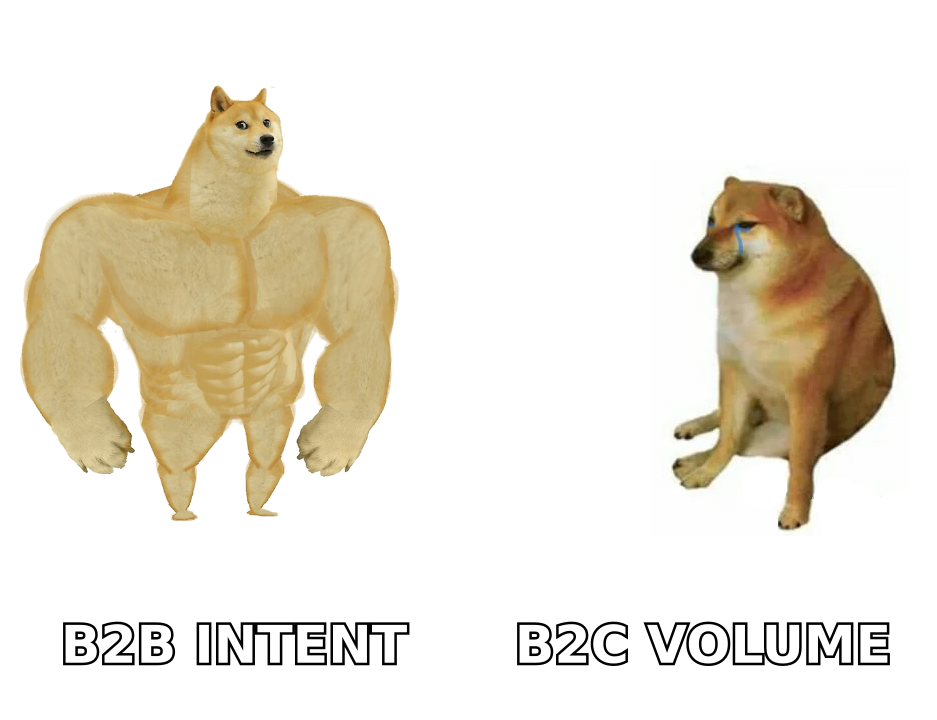
The short answer: B2B optimizes for precision, B2C optimizes for scale.
Think of it like fishing. B2C lead generation is casting a wide net in a crowded bay — you'll haul in a lot, most of it small, and you keep what's worth keeping. B2B is spearfishing for specific, large fish you've already identified. You don't want 50,000 leads; you want the 200 accounts that match your ideal customer profile, and you want the right five people inside each one.
That single difference — net versus spear — cascades into every other decision: which channels you fund, how you measure cost, how long you nurture, and how much you spend per contact.
In B2B, a "lead" is usually a named person at a named company who fits firmographic criteria (industry, headcount, revenue, tech stack) and shows buying signals. In B2C, a "lead" is often just an email address or phone number attached to demonstrated interest — a quiz completion, a discount sign-up, an abandoned cart.
How do the funnels and sales cycles compare?#
The funnels are shaped differently because the buyers behave differently.
A B2C buyer can go from ad click to purchase in a single session. A B2B buyer can't — even if they personally love your product, they need budget approval, security review, legal sign-off, and consensus from a buying committee. Gartner has repeatedly found that the typical B2B buying group involves six to ten decision-makers, each armed with their own research. That structural reality is why B2B nurturing exists at all.
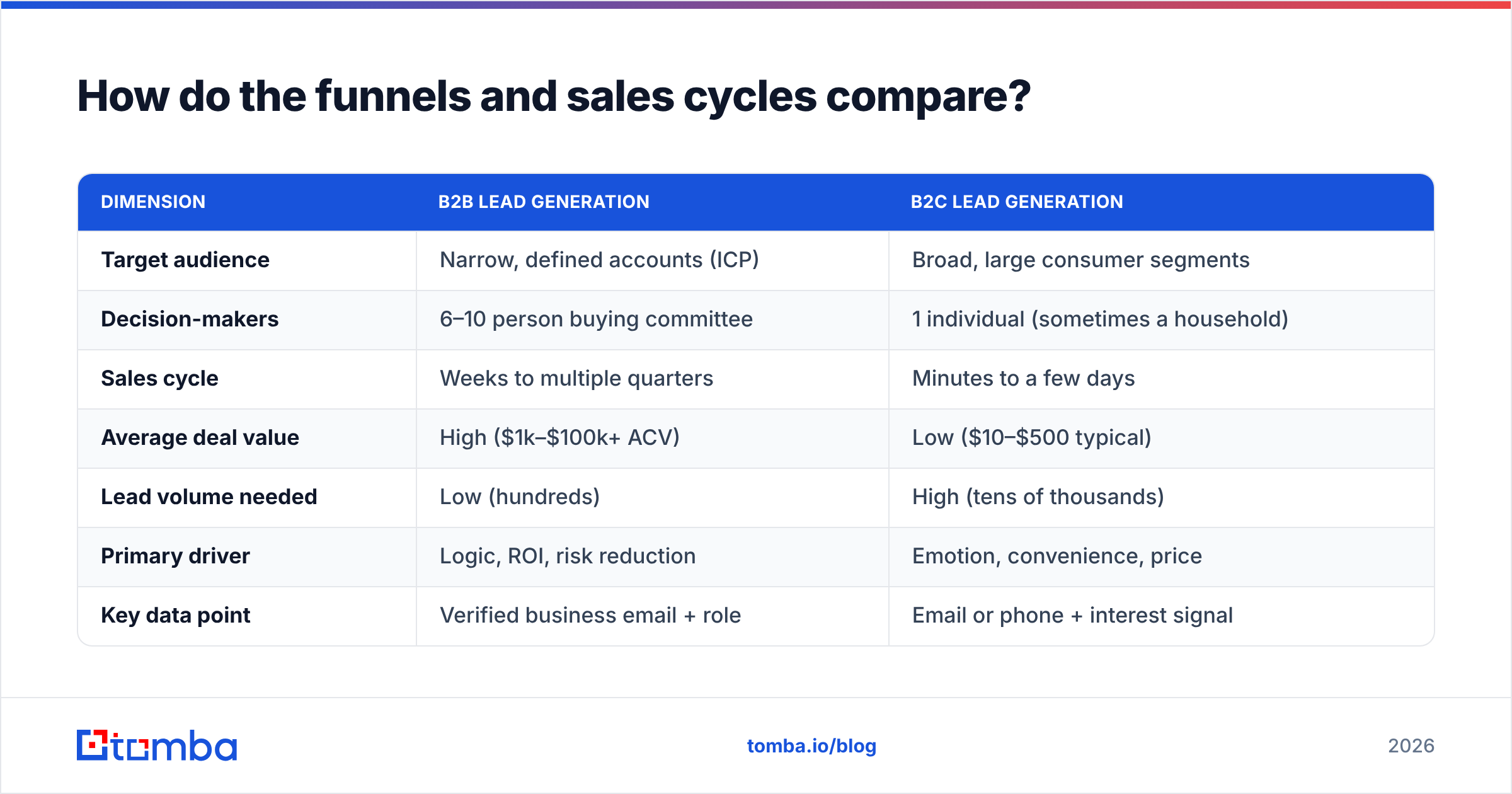
Here's the side-by-side:
| Dimension | B2B Lead Generation | B2C Lead Generation |
|---|---|---|
| Target audience | Narrow, defined accounts (ICP) | Broad, large consumer segments |
| Decision-makers | 6–10 person buying committee | 1 individual (sometimes a household) |
| Sales cycle | Weeks to multiple quarters | Minutes to a few days |
| Average deal value | High ($1k–$100k+ ACV) | Low ($10–$500 typical) |
| Lead volume needed | Low (hundreds) | High (tens of thousands) |
| Primary driver | Logic, ROI, risk reduction | Emotion, convenience, price |
| Key data point | Verified business email + role | Email or phone + interest signal |
| Content that works | Case studies, ROI calculators, demos | Offers, reviews, social proof, UGC |
The practical takeaway: B2B teams should obsess over lead quality and routing, because each lead is expensive to source and you can't afford to waste a sales rep's time on a bad fit. B2C teams should obsess over conversion-rate optimization and cost-per-acquisition, because the model only works when you process volume efficiently.
Which channels work for B2B vs B2C?#
The channel list looks similar — search, social, email, content, paid — but the return on each differs sharply.
Channels that overrun for B2B:
- Outbound email and cold outreach — Still the backbone of B2B pipeline. It works because you can target named accounts precisely, but only if your contact data is accurate. This is where an email finder and an email verifier earn their keep.
- LinkedIn and account-based marketing — B2B buyers are findable and reachable by role on LinkedIn in a way consumers are not.
- Intent data and content syndication — Knowing an account is researching your category lets you strike at the right moment.
- SEO for bottom-funnel, high-intent queries — "best [category] software for [industry]" converts far above its traffic weight.
Channels that outperform for B2C:
- Paid social (Meta, TikTok, Pinterest) — Cheap reach, strong creative testing, fast feedback loops.
- Influencer and creator partnerships — Borrowed trust at scale.
- Referral and loyalty programs — Consumers refer friends; procurement departments do not.
- SMS and push — High open rates for time-sensitive offers.
Notice that email shows up on both lists — but it means two different things. B2C email marketing is mostly retention and offers to people who already opted in. B2B email is often cold prospecting to people you've researched and verified. The deliverability stakes are higher in B2B cold outreach, which is why sender reputation and clean lists matter so much. One bad scrape of invalid addresses can spike your bounce rate and tank your domain.
Why does data quality matter more in B2B?#
Because in B2B, one wrong email doesn't just lose a lead — it can poison your whole outbound channel.
In B2C, you're typically emailing people who handed you their address. The list is opt-in, bounce rates are low, and a bad address here or there is noise. In B2B cold outreach, you're constructing contact lists from research — names, roles, company domains — and inferring email addresses. Get that wrong and three things happen at once: your bounce rate climbs, mailbox providers flag you, and your good emails start landing in spam.
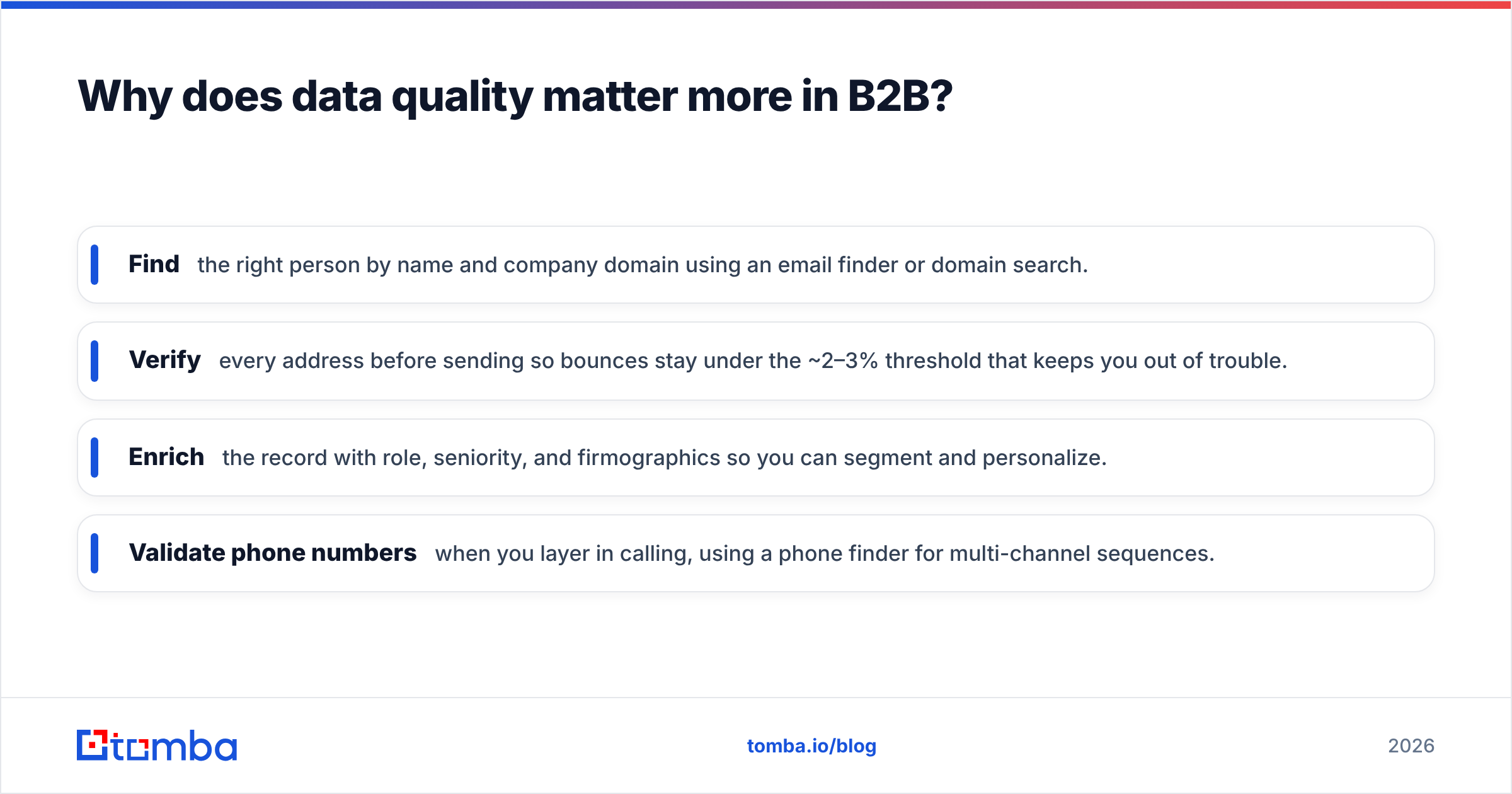
That's why serious B2B teams treat contact data as infrastructure, not an afterthought. The workflow usually looks like this:
- Find the right person by name and company domain using an email finder or domain search.
- Verify every address before sending so bounces stay under the ~2–3% threshold that keeps you out of trouble.
- Enrich the record with role, seniority, and firmographics so you can segment and personalize.
- Validate phone numbers when you layer in calling, using a phone finder for multi-channel sequences.
The accuracy of your underlying data sources determines whether this works. If you're curious how a provider builds and validates its dataset, it's worth understanding where the data comes from before you commit a budget to it. Third-party review sites like G2 are useful for cross-checking accuracy claims against real user feedback.
For B2C, by contrast, the data investment is lighter — you're capturing opt-ins through forms, not reconstructing contacts. Your money goes into creative and media, not data enrichment.
How does cost per lead differ?#
Cost-per-lead (CPL) numbers look alarming for B2B until you remember the deal sizes.
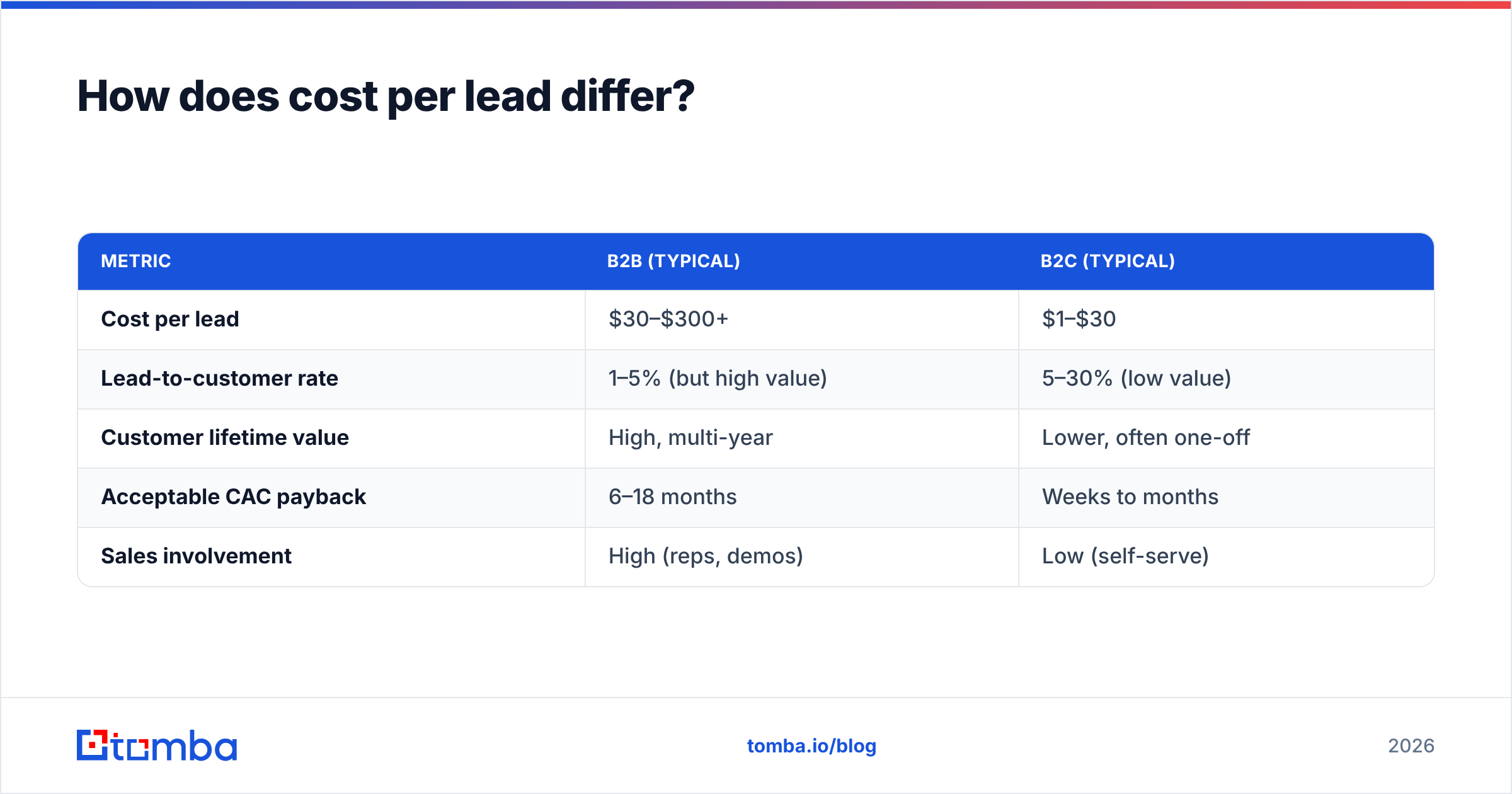
| Metric | B2B (typical) | B2C (typical) |
|---|---|---|
| Cost per lead | $30–$300+ | $1–$30 |
| Lead-to-customer rate | 1–5% (but high value) | 5–30% (low value) |
| Customer lifetime value | High, multi-year | Lower, often one-off |
| Acceptable CAC payback | 6–18 months | Weeks to months |
| Sales involvement | High (reps, demos) | Low (self-serve) |
A B2B lead that costs $150 is perfectly healthy if it converts to a $40,000 annual contract at a 3% close rate. A B2C lead that costs $150 would be a disaster for a $60 product. The models aren't better or worse — they're solving different equations.
This is also why B2B teams can justify spending on premium data tooling and B2C teams generally can't. When each closed deal is worth thousands, paying for verified contacts and enrichment is trivially worth it. You can see the tiering logic in most Tomba pricing plans: the Free tier (25 searches/month) suits testing, Starter at $49/mo fits a solo SDR, and Growth at $99/mo or Pro at $249/mo serve scaling teams running real outbound volume.
Can the same team run both motions?#
Sometimes — but the metrics and mindsets pull in opposite directions, so be deliberate.
Companies with both motions (think a software tool sold to individuals and to enterprises, or a marketplace serving buyers and sellers) often try to run one unified "growth" team. It usually strains. The B2C side is measured on CPL and conversion rate and wants to move fast on creative; the B2B side is measured on pipeline and win rate and needs patience, data hygiene, and tight sales-marketing alignment.
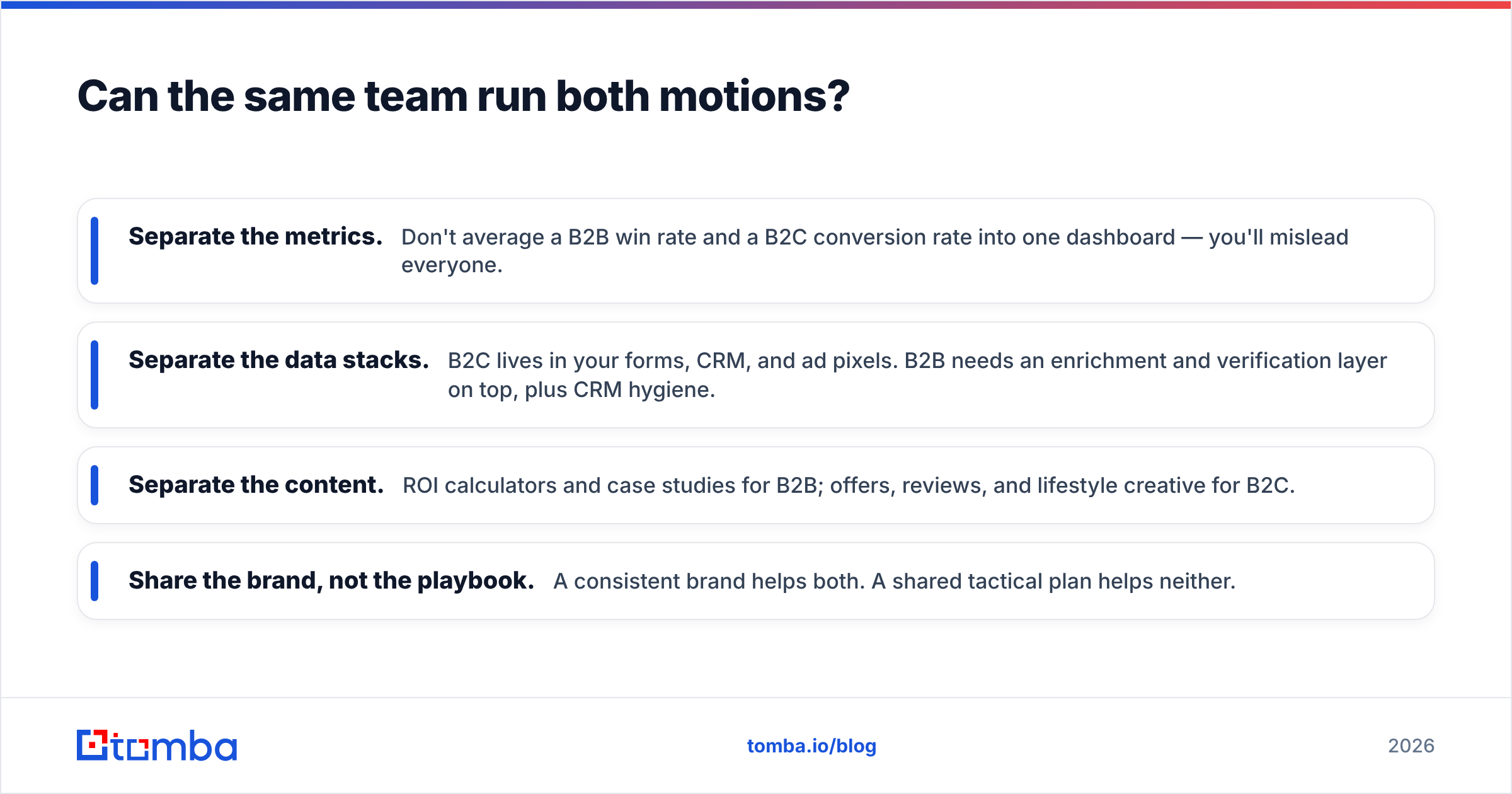
If you must run both:
- Separate the metrics. Don't average a B2B win rate and a B2C conversion rate into one dashboard — you'll mislead everyone.
- Separate the data stacks. B2C lives in your forms, CRM, and ad pixels. B2B needs an enrichment and verification layer on top, plus CRM hygiene.
- Separate the content. ROI calculators and case studies for B2B; offers, reviews, and lifestyle creative for B2C.
- Share the brand, not the playbook. A consistent brand helps both. A shared tactical plan helps neither.
For teams scaling outbound, connecting your data tooling directly to the CRM removes manual export pain — a HubSpot integration or Salesforce integration keeps verified contacts flowing into the right pipeline without copy-paste.
Which model is right for you?#
Match the motion to your economics, not to fashion.
Choose a B2B-style motion if: your average deal value is high, your total addressable market is countable (thousands, not millions), buyers research before they buy, and a human closes the sale. Invest in ICP definition, accurate contact data, account-based targeting, and sales enablement.
Choose a B2C-style motion if: your product is low-priced and self-serve, your audience is large and broad, decisions are fast and emotional, and you can win on creative and offers. Invest in paid social, CRO, retention, and referral loops.
Hybrid? Pick a primary motion, resource it fully, and treat the second as a separate experiment with its own budget and metrics. The most common failure is running B2B outreach with a B2C mindset — blasting a huge unverified list and wondering why the domain got blacklisted. Use a blacklist checker if that's already happening to you.
The bottom line#
B2B and B2C lead generation answer the same question — "how do we turn attention into revenue?" — with opposite strategies. B2C wins by processing volume cheaply and converting on emotion and offer. B2B wins by precisely identifying a small set of high-value accounts, reaching the right people with verified data, and nurturing a committee through a long, logical decision.
If you're on the B2B side, the single highest-leverage upgrade is your contact data. Targeting, copy, and sequencing all sit on top of one assumption: that the email actually reaches a real person in the right role. When that assumption breaks, everything downstream breaks with it.
That's exactly the problem the Tomba Email Finder is built to solve. Find verified professional emails by name, company, or domain, confirm they're deliverable before you send, and feed clean contacts straight into your outbound stack. Start free with 25 searches a month, and scale into the Tomba plans as your pipeline grows — so your B2B lead generation rests on data you can trust instead of guesses you can't.
// get started
Find, verify and enrich your first contacts today
Start on the free plan with 25 searches a month, then scale when your team is ready.
Free plan · No credit card required · GDPR & CCPA
// about the author