B2B Website Visitor Identification: The 2026 Playbook
98% of your site traffic leaves without filling a form. Here's how B2B website visitor identification turns anonymous IPs into named, contactable accounts in 2026.

You spend thousands driving traffic to your site, and roughly 98% of those visitors leave without filling out a single form. B2B website visitor identification is how you stop losing them. It matches anonymous visits to real companies — and sometimes real people — so your sales team can follow up with accounts that were already shopping.
This guide breaks down what the technology actually does in 2026, where the legal lines are, how the tools compare, and how to wire identified visitors into a workflow that produces pipeline instead of a spreadsheet nobody opens.
TL;DR#
- Visitor identification matches anonymous web traffic to companies (firmographic) or, in some cases, individuals (person-level), using reverse-IP lookups, cookies, and data partnerships.
- Company-level reveal is the safe, scalable default; person-level identification carries real GDPR/CCPA exposure and should be handled carefully.
- Match rates matter more than vendor claims — expect 30–60% company match on B2B traffic, far less on consumer ISPs.
- Identification is worthless without enrichment and routing. Knowing "Acme visited" only converts when you attach the right contact, email, and a same-day follow-up.
- Tomba's website visitor reveal plus its email finder closes the loop from anonymous IP to a verified inbox.
What is B2B website visitor identification?#
B2B website visitor identification is the practice of de-anonymizing the companies (and sometimes the people) browsing your website. Think of it like a doorbell camera for your storefront: you may not know every shopper by name, but you can see which businesses keep walking past the window and which aisles they linger in.
Technically, when a visitor loads your page, their device sends an IP address. For corporate networks and many business ISPs, that IP can be reverse-mapped to a registered organization. Layer in third-party data partnerships, cookie graphs, and de-anonymization providers, and you can often resolve the visit to a company record — industry, size, location, and the pages they viewed.
The output isn't "John from Acme looked at pricing." For most compliant setups it's "an account that matches Acme Corp viewed your pricing and integrations pages twice this week." That account-level signal is the raw material for an outbound play.
The three layers of identification#
- Company-level (firmographic) reveal — Reverse-IP plus a B2B database returns the organization. This is the workhorse and the most defensible legally.
- Account intent — Pages viewed, frequency, and recency are scored to flag accounts showing buying behavior. This feeds lead scoring and routing.
- Person-level identification — Matching the visit to a named individual via cookie syncs or identity graphs. Highest value, highest risk, lowest match rate.
How does website visitor identification actually work?#
The pipeline is more plumbing than magic. Here's the path a single anonymous visit travels before it becomes a usable lead.
- Capture. A lightweight JavaScript snippet or server-side tag records the visit, IP, referrer, UTM parameters, and page path.
- Resolve. The IP is checked against reverse-IP and ISP-exclusion databases. Residential and mobile IPs are filtered out because they rarely map cleanly to a business.
- Match. The resolved organization is cross-referenced with a B2B database to attach firmographics — employee count, industry, revenue band, HQ location.
- Enrich. The matched company is expanded with decision-maker contacts so sales has someone to actually email or call. This is where data enrichment turns a company name into a workable lead.
- Score & route. Intent signals (pricing-page views, repeat visits) push the account into a priority tier and assign it to the right rep or sequence.
The weakest link is usually match rate. A visitor on a corporate VPN resolves cleanly; the same person browsing from home on a Comcast connection often doesn't. Vendors that advertise "80% identification" are typically measuring a narrow slice of clean B2B traffic, not your whole funnel. Treat any single headline number with skepticism and ask for a match rate on your traffic during a trial.
Is website visitor identification legal in 2026?#
Short answer: company-level identification is broadly defensible; person-level identification is where you need legal cover. The distinction matters more than any vendor will admit.
Company-level reverse-IP reveal generally processes business firmographic data, not personal data, so it sits outside the strictest parts of GDPR. Person-level identification — tying a visit to a named human via cookies or an identity graph — processes personal data and triggers consent, legitimate-interest, and disclosure obligations under GDPR, CCPA/CPRA, and similar regimes.
Practical guardrails for 2026:
- Default to company-level reveal for EU and UK traffic unless you have explicit consent.
- Disclose identification and enrichment in your privacy policy and cookie banner.
- Honor opt-outs and DSARs — if a person asks what you hold, you must answer.
- Vet your vendor's data sourcing. You inherit their compliance posture. Ask where the data comes from and request their DPA.
This is not legal advice — get your counsel to sign off on person-level use. But the rule of thumb is simple: the more individual the data, the more consent you need.
What should you look for in a visitor identification tool?#
Five attributes separate a tool that drives pipeline from one that just inflates a dashboard.
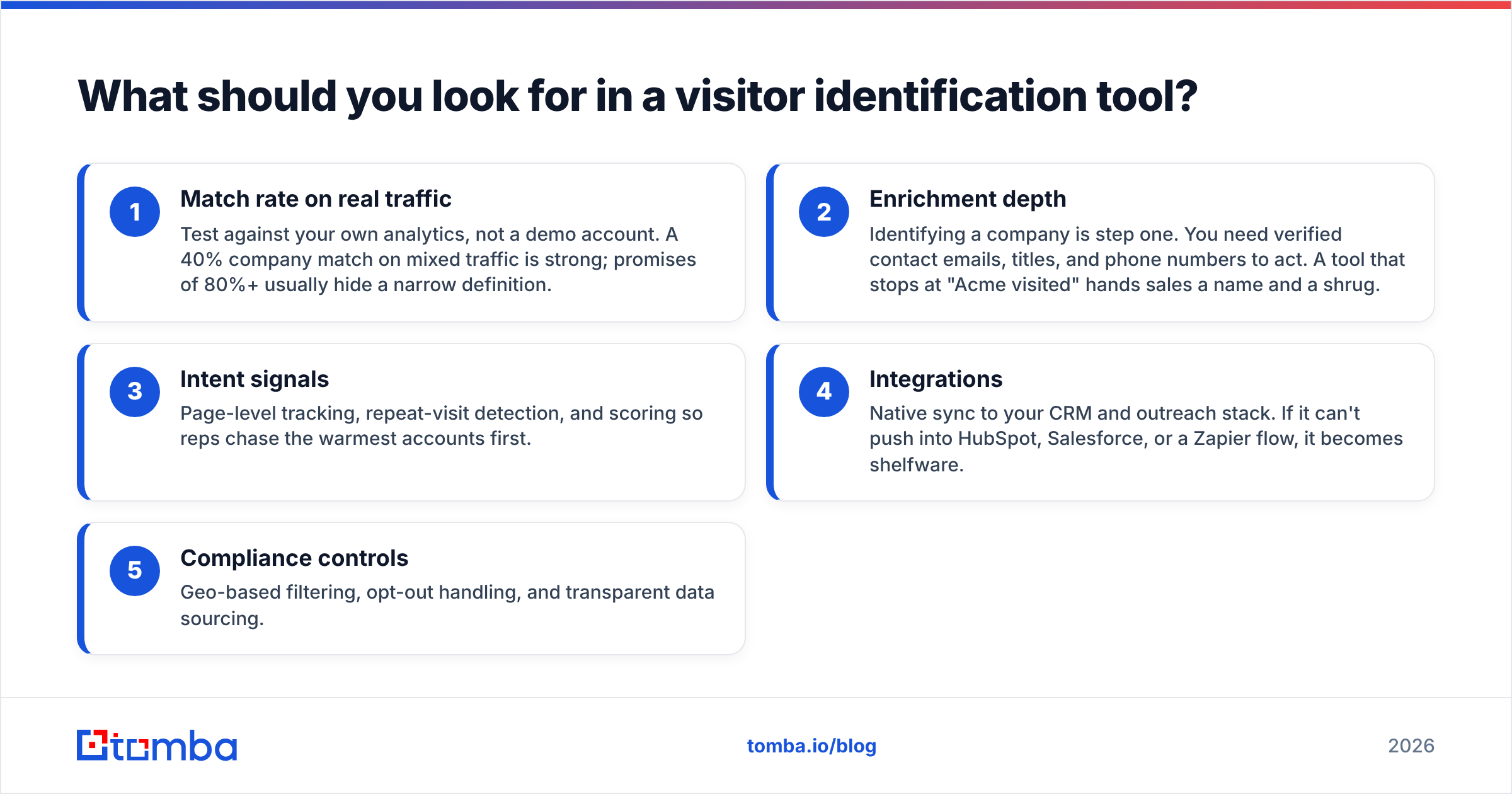
- Match rate on real traffic — Test against your own analytics, not a demo account. A 40% company match on mixed traffic is strong; promises of 80%+ usually hide a narrow definition.
- Enrichment depth — Identifying a company is step one. You need verified contact emails, titles, and phone numbers to act. A tool that stops at "Acme visited" hands sales a name and a shrug.
- Intent signals — Page-level tracking, repeat-visit detection, and scoring so reps chase the warmest accounts first.
- Integrations — Native sync to your CRM and outreach stack. If it can't push into HubSpot, Salesforce, or a Zapier flow, it becomes shelfware.
- Compliance controls — Geo-based filtering, opt-out handling, and transparent data sourcing.
How do the main approaches compare?#
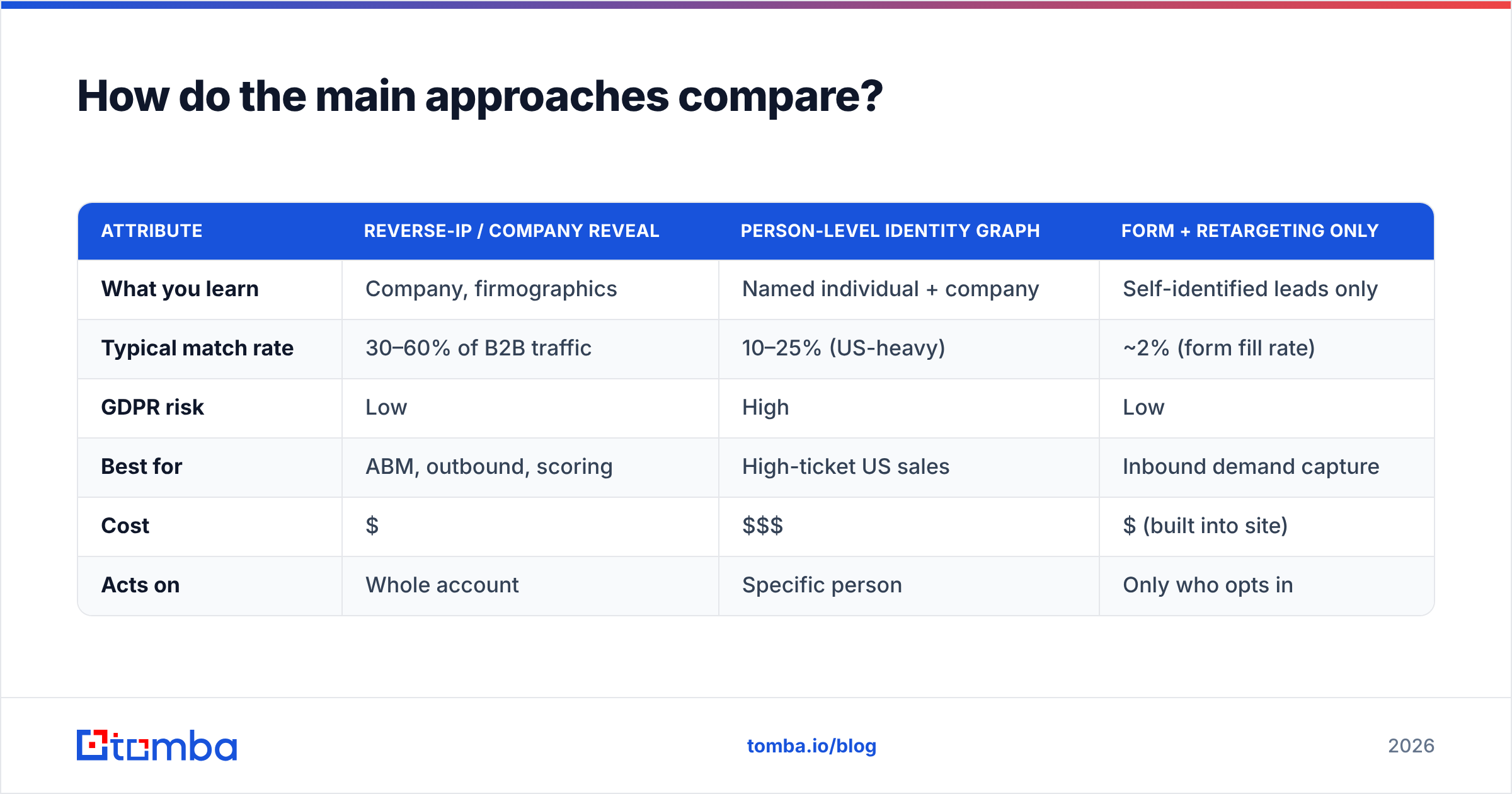
There are three broad ways to identify visitors, and they trade off coverage, cost, and risk. This table maps the landscape so you can pick what fits your funnel.
| Attribute | Reverse-IP / company reveal | Person-level identity graph | Form + retargeting only |
|---|---|---|---|
| What you learn | Company, firmographics | Named individual + company | Self-identified leads only |
| Typical match rate | 30–60% of B2B traffic | 10–25% (US-heavy) | ~2% (form fill rate) |
| GDPR risk | Low | High | Low |
| Best for | ABM, outbound, scoring | High-ticket US sales | Inbound demand capture |
| Cost | $ | $$$ | $ (built into site) |
| Acts on | Whole account | Specific person | Only who opts in |
For most B2B teams, reverse-IP company reveal plus enrichment is the sweet spot: meaningful coverage, manageable risk, and a clear path to action. Person-level graphs make sense when deal sizes justify the cost and your traffic skews US. Forms alone leave 98% of your traffic on the table — they're necessary, not sufficient.
How does Tomba fit into a visitor identification stack?#
Tomba's strength is the back half of the pipeline — the part where most identification tools fall down. Reveal tells you Acme visited; Tomba turns Acme into a verified, contactable human you can put in a sequence today.
The flow looks like this:
- Website visitor reveal identifies the anonymous account and the pages it touched.
- Domain search pulls the relevant decision-makers at that company by role and department.
- Email finder returns the specific person's professional address, and the email verifier confirms it's deliverable before you send.
- Data enrichment fills in title, seniority, and LinkedIn so your first message is personalized, not generic.
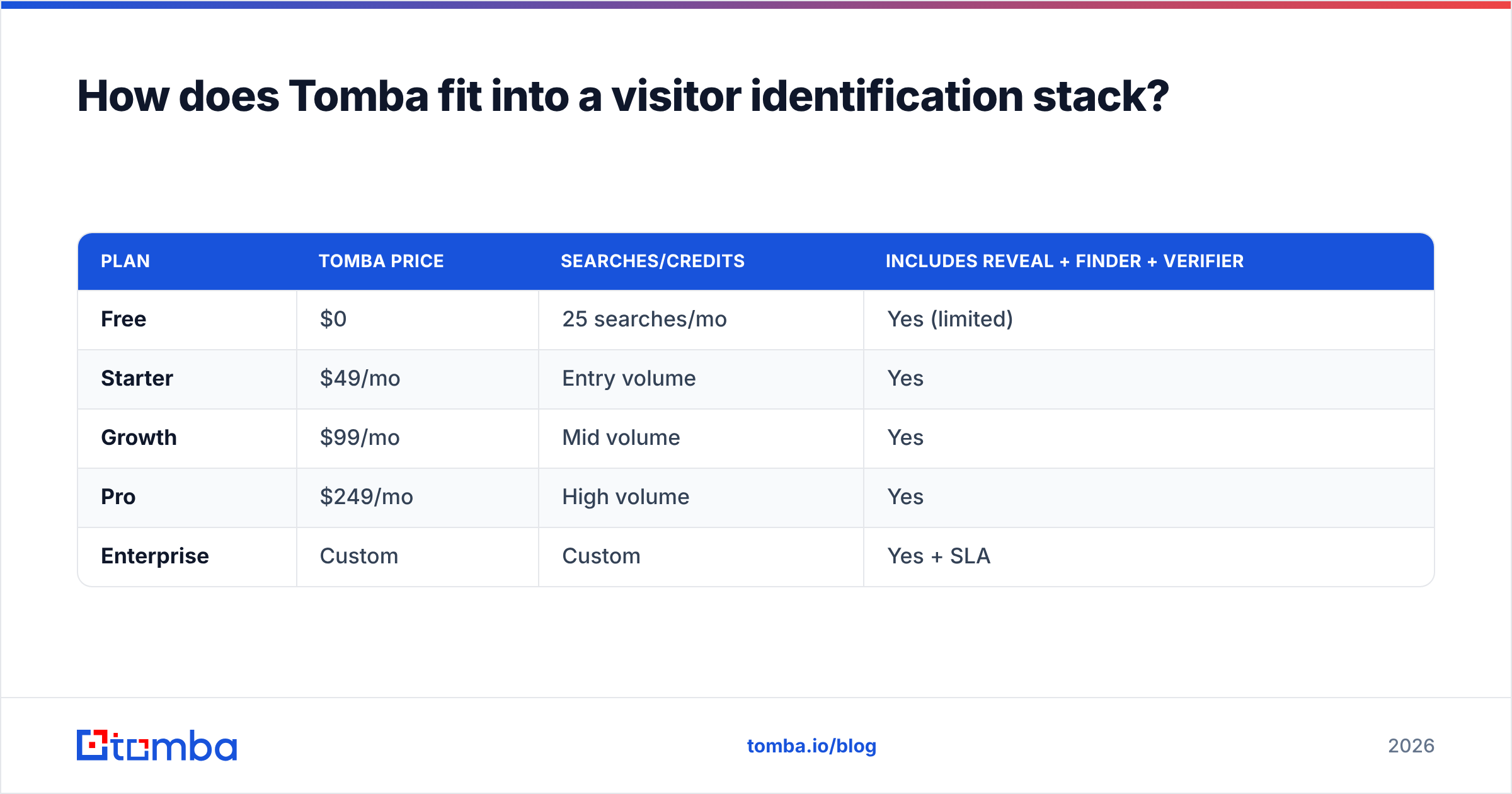
Here's how Tomba's pricing maps to that workflow versus the typical standalone identification-only vendor.
| Plan | Tomba price | Searches/credits | Includes reveal + finder + verifier |
|---|---|---|---|
| Free | $0 | 25 searches/mo | Yes (limited) |
| Starter | $49/mo | Entry volume | Yes |
| Growth | $99/mo | Mid volume | Yes |
| Pro | $249/mo | High volume | Yes |
| Enterprise | Custom | Custom | Yes + SLA |
Standalone visitor-ID tools often charge $99–$300+/month just for the reveal and still leave you to source contacts elsewhere. Bundling identification with finding and verification removes a vendor and a hand-off. See full Tomba pricing for current credit allocations.
What's a realistic workflow that converts identified visitors?#
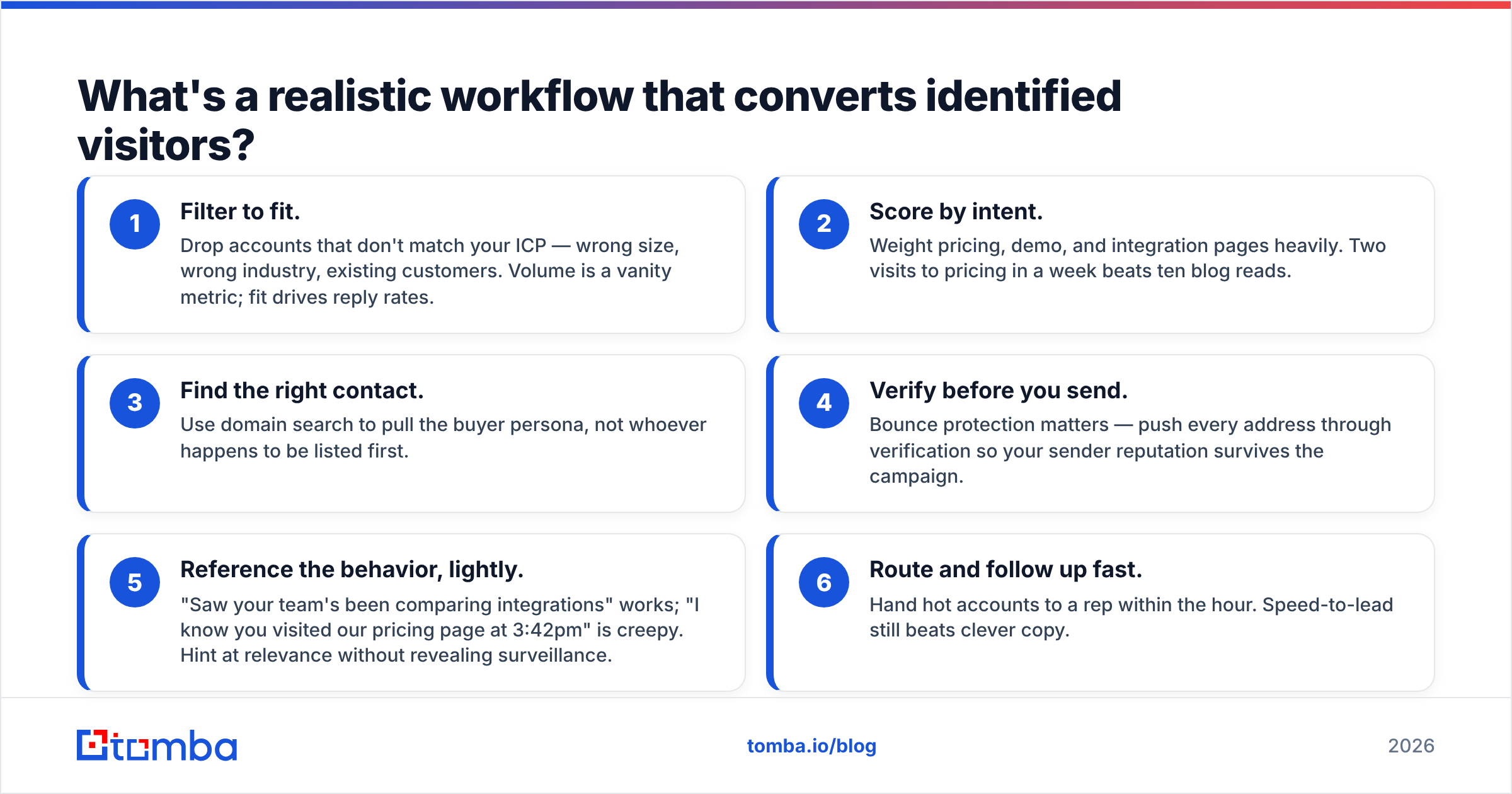
Identification only pays off when it's wired into a same-day motion. Here's a repeatable loop teams use to turn reveal data into booked meetings.
- Filter to fit. Drop accounts that don't match your ICP — wrong size, wrong industry, existing customers. Volume is a vanity metric; fit drives reply rates.
- Score by intent. Weight pricing, demo, and integration pages heavily. Two visits to pricing in a week beats ten blog reads.
- Find the right contact. Use domain search to pull the buyer persona, not whoever happens to be listed first.
- Verify before you send. Bounce protection matters — push every address through verification so your sender reputation survives the campaign.
- Reference the behavior, lightly. "Saw your team's been comparing integrations" works; "I know you visited our pricing page at 3:42pm" is creepy. Hint at relevance without revealing surveillance.
- Route and follow up fast. Hand hot accounts to a rep within the hour. Speed-to-lead still beats clever copy.
The teams that win treat reveal as a trigger, not a database. The signal is perishable — an account that viewed pricing on Monday is a different prospect by Friday.
What are the limitations you should plan around?#
No tool is magic, and overselling visitor ID to your sales team is a fast way to burn trust. Set expectations on three fronts.
- Coverage gaps. Remote workforces, VPNs, and mobile traffic erode match rates. A distributed startup may resolve far fewer visits than a company on a corporate LAN.
- Stale or shared IPs. Co-working spaces, universities, and large ISPs can mis-attribute visits. Always sanity-check surprising matches.
- Contact accuracy decay. B2B data goes stale at roughly 2–2.5% per month as people change jobs. Re-verify before every campaign; don't trust a contact you pulled six months ago. Independent reviews on G2 consistently flag data freshness as the deciding factor between tools.
Plan for these and visitor ID becomes a durable channel. Ignore them and you'll blame the tool for a process problem.
Turn anonymous traffic into pipeline#
Your highest-intent buyers are already on your site — they're just invisible until you light them up. Start with company-level reveal to stay compliant and scalable, score by behavior, then close the loop with verified contacts so your reps reach a real person while the interest is hot.
That last step is where Tomba earns its place. Pair website visitor reveal with the Tomba Email Finder to go from anonymous IP to a verified, ready-to-email decision-maker — without bolting on a second vendor. Spin up the free tier with 25 searches, point it at last week's traffic, and see how many named accounts you've been letting walk out the door.
// get started
Find, verify and enrich your first contacts today
Start on the free plan with 25 searches a month, then scale when your team is ready.
Free plan · No credit card required · GDPR & CCPA
// about the author