B2B Website Visitor Tracking: The 2026 Playbook for Turning Anonymous Traffic Into Pipeline
Most B2B sites let 97% of buyers leave unidentified. Here's how website visitor tracking works in 2026, what it can and can't do, and how to turn anonymous sessions into named accounts and real pipeline.
You spend thousands of dollars driving traffic to your site, and then you watch almost all of it walk back out the door without a name attached. B2B website visitor tracking is the set of techniques that tries to fix that — figuring out which companies and, where legally possible, which people are on your pages, so sales and marketing can act before the lead goes cold.
This guide is the practical version: how the tracking actually works, what it genuinely identifies versus what vendors overpromise, the privacy rules you can't ignore in 2026, and how to wire the data into a workflow that produces pipeline instead of a dashboard nobody opens.
TL;DR#
- B2B website visitor tracking identifies the companies (and sometimes contacts) behind anonymous web sessions using reverse-IP lookup, first-party cookies/pixels, and data enrichment — typically recovering 20–50% of B2B traffic at the company level.
- Company-level identification is reliable and low-risk. Person-level identification is powerful but legally fraught under GDPR/ePrivacy and various US state laws — treat it carefully.
- The tracking tool is only half the system. The other half is enrichment plus contact discovery: turning "Acme Corp visited pricing" into a named decision-maker with a verified email.
- Intent + freshness beats volume. A visitor who hit your pricing page yesterday is worth ten cold names from a static list.
- You can build a lean stack with a reveal/identification layer, a B2B database for firmographics, and an email finder to reach the right person — without paying enterprise ABM platform prices.
What is B2B website visitor tracking?#
B2B website visitor tracking is the practice of identifying the organizations — and, in some setups, the individuals — behind the otherwise anonymous people browsing your website. Think of your website analytics like a store's foot-traffic counter: it tells you 500 people walked in, but not who they were or where they work. Visitor tracking is the equivalent of recognizing that the person lingering by the enterprise-plan shelf works at a 2,000-person logistics company that's evaluating vendors right now.
Standard analytics (Google Analytics 4, for example) is built around anonymous, aggregated behavior: sessions, pageviews, sources, conversions. It deliberately avoids telling you the identity of a visitor. B2B visitor tracking layers identity on top of behavior, so a pricing-page visit becomes "a senior ops leader at a named account viewed pricing twice this week."
The reason this matters: industry estimates consistently put the share of B2B web visitors who never fill out a form somewhere around 95–98%. If your entire demand-gen motion depends on form fills, you're harvesting a sliver of the actual buying interest hitting your site. For more on how a visit becomes a qualified lead, see how a marketing qualified lead is defined and scored.
How does website visitor tracking actually work?#
There's no magic. Every identification method is a variation on three mechanisms, usually combined.
Reverse-IP lookup (company-level). Your server already logs every visitor's IP address. Reverse-IP databases map ranges of IPs to the organizations that own them. When a visitor comes from a corporate network, you can often resolve that to a company name and domain. This is the backbone of most B2B tracking and is generally considered low-risk because it identifies a company, not a person.
First-party pixels and cookies (behavioral + identity stitching). A small script on your site sets a first-party identifier, watches page behavior, and — when a known visitor (someone who clicked an email link, filled a form, or arrived from an identified ad) returns — stitches the anonymous session to a known profile. This is how "deanonymization" platforms claim person-level matches.
Data enrichment (turning a signal into a record). Once you have a domain or a partial identifier, data enrichment fills in the firmographics: company size, industry, location, tech stack, and candidate decision-makers. This is the step that converts "someone from acme.com" into "here are the three people you should actually contact."
The honest limitation: reverse-IP works best for medium-to-large companies on corporate networks. Remote workers on home wifi, mobile traffic, and VPNs degrade match rates. Realistic company-level identification lands in the 20–50% of B2B sessions range for most sites — useful, but never 100%, and anyone promising near-total person-level identification is waving a red flag.
What can it identify — and what can't it?#
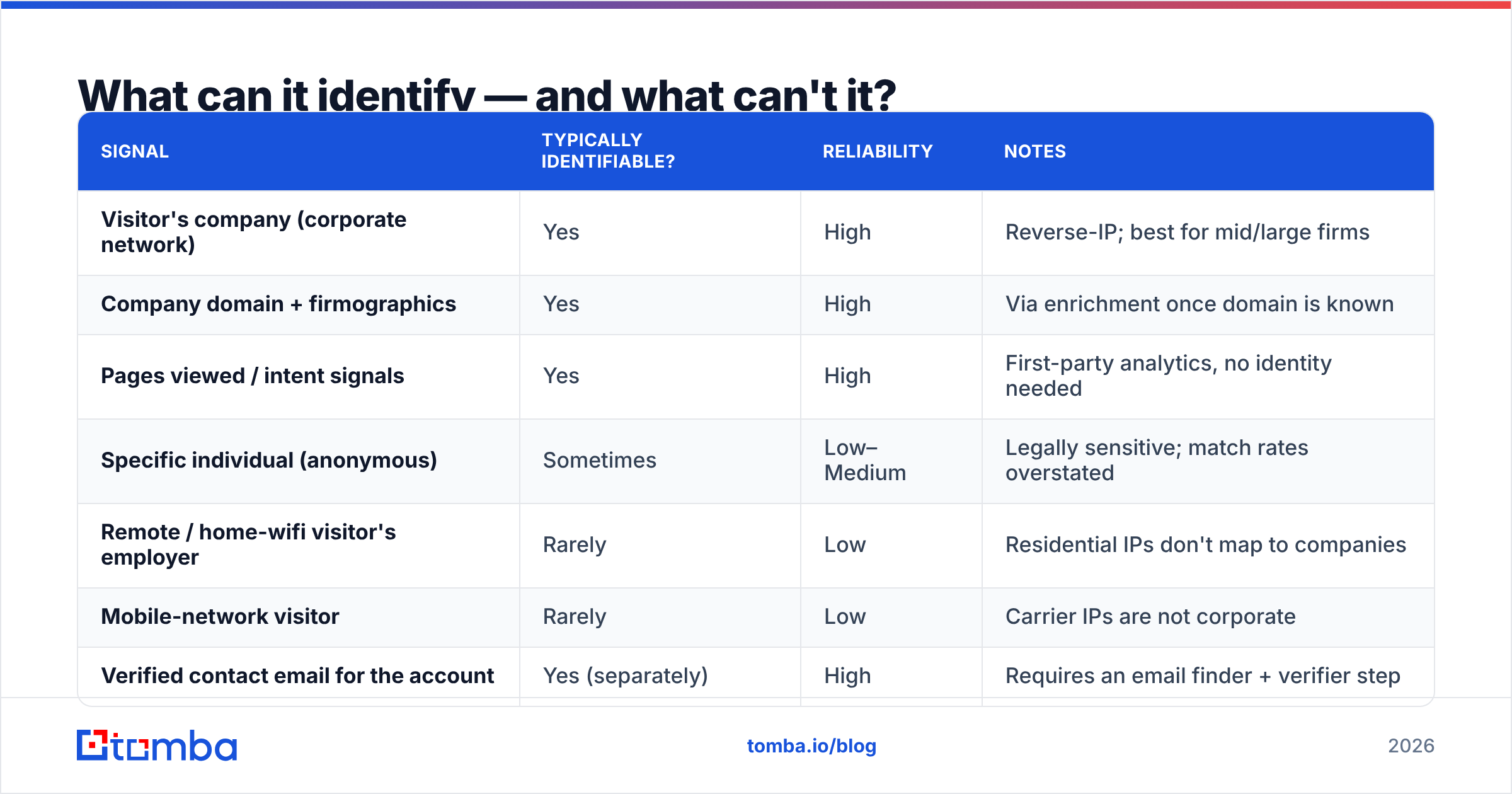
Set expectations correctly or you'll waste budget. Here's the split.
| Signal | Typically identifiable? | Reliability | Notes |
|---|---|---|---|
| Visitor's company (corporate network) | Yes | High | Reverse-IP; best for mid/large firms |
| Company domain + firmographics | Yes | High | Via enrichment once domain is known |
| Pages viewed / intent signals | Yes | High | First-party analytics, no identity needed |
| Specific individual (anonymous) | Sometimes | Low–Medium | Legally sensitive; match rates overstated |
| Remote / home-wifi visitor's employer | Rarely | Low | Residential IPs don't map to companies |
| Mobile-network visitor | Rarely | Low | Carrier IPs are not corporate |
| Verified contact email for the account | Yes (separately) | High | Requires an email finder + verifier step |
The pattern: company-level identification is a solved, dependable problem. Person-level identification is the hyped, risky frontier. The smart play in 2026 is to identify the account reliably, then use legitimate contact-discovery tools to find the right person — rather than relying on a black-box "we know exactly who this anonymous visitor is" claim.
Is B2B visitor tracking legal? (GDPR, ePrivacy, US state laws)#
Short answer: company-level tracking is generally fine; person-level tracking requires real care.
- IP addresses can be personal data under GDPR when they relate to an identifiable individual. Resolving an IP to a company is far lower risk than resolving it to a person. The European Data Protection Board and national regulators have repeatedly treated dynamic IPs as potentially personal — read the GDPR text before you assume otherwise.
- ePrivacy / cookie consent governs the pixels and cookies that do behavioral stitching. If you operate in the EU/UK, non-essential tracking generally needs consent.
- US state privacy laws (CCPA/CPRA in California and the growing list of state equivalents) give consumers rights over personal data and create disclosure and opt-out obligations.
Practical guardrails that keep you out of trouble:
- Lead with company-level identification. It's the most useful and least risky layer.
- Honor consent banners before firing behavioral pixels in regulated regions.
- Update your privacy policy to disclose visitor identification and enrichment.
- Don't buy "we secretly identify every individual" tools — if the vendor can't explain their lawful basis, that's your liability, not theirs.
None of this is legal advice; loop in counsel for your jurisdiction. But the framing is simple: identify accounts confidently, identify people carefully.
How do you turn an identified visitor into pipeline?#
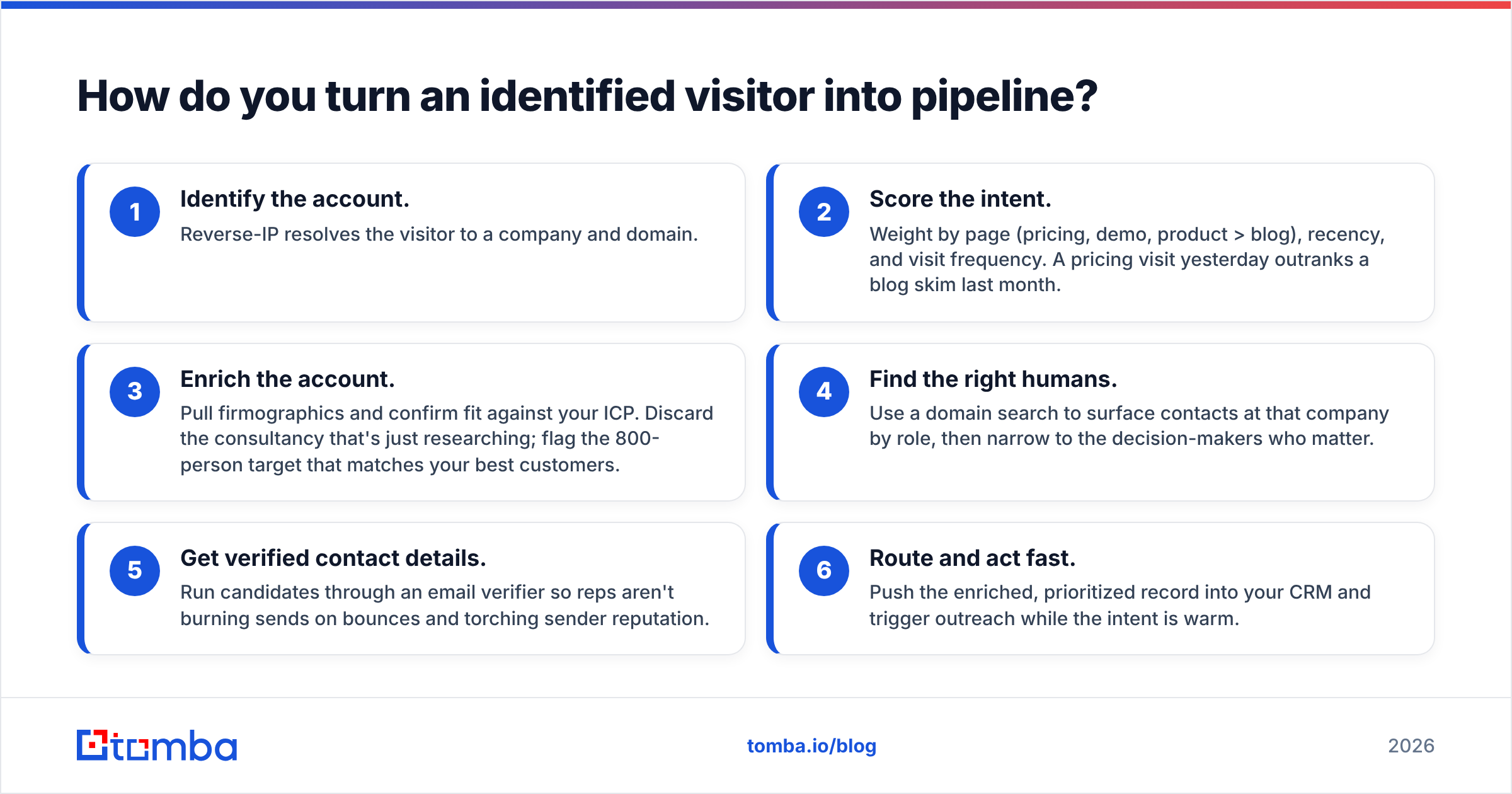
A list of company names is not pipeline. The workflow that actually converts looks like this:
- Identify the account. Reverse-IP resolves the visitor to a company and domain.
- Score the intent. Weight by page (pricing, demo, product > blog), recency, and visit frequency. A pricing visit yesterday outranks a blog skim last month.
- Enrich the account. Pull firmographics and confirm fit against your ICP. Discard the consultancy that's just researching; flag the 800-person target that matches your best customers.
- Find the right humans. Use a domain search to surface contacts at that company by role, then narrow to the decision-makers who matter.
- Get verified contact details. Run candidates through an email verifier so reps aren't burning sends on bounces and torching sender reputation.
- Route and act fast. Push the enriched, prioritized record into your CRM and trigger outreach while the intent is warm.
Speed is the multiplier here. Classic lead-response research from Harvard Business Review found that contacting a web lead within an hour makes you dramatically more likely to qualify it than waiting even a day. Visitor tracking only pays off if step 6 happens fast.

What should a B2B visitor-tracking stack include?#
You don't need a six-figure ABM platform to do this well. A lean, effective stack has four jobs covered:
- Identification layer — resolves anonymous sessions to companies (reverse-IP) and optionally stitches known visitors. Tomba's website visitor reveal sits here.
- Behavioral analytics — tells you what visitors did (pages, frequency, recency) so you can score intent. GA4 or a product-analytics tool covers this.
- Firmographic + contact data — a B2B database and enrichment to qualify the account and surface candidate contacts.
- Contact discovery + verification — an email finder and verifier to convert "company X" into "reachable person Y," cleanly.
The mistake teams make is buying one giant suite and using 15% of it. Composing focused tools is cheaper, easier to swap, and usually more accurate per dollar.
How do the main approaches compare?#
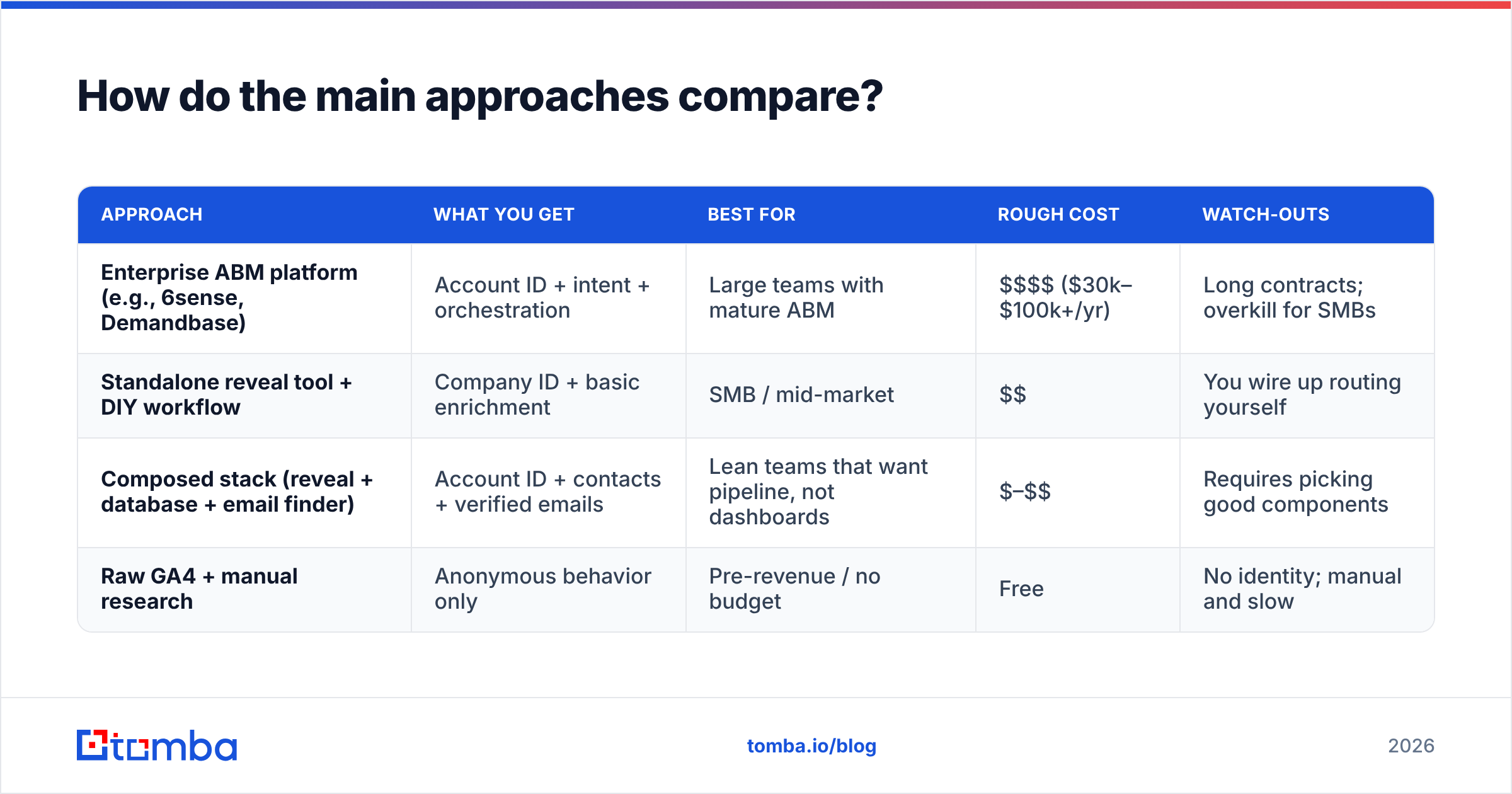
Three broad approaches dominate the market. Pick based on budget, team size, and how much you value person-level claims (and how much legal risk you'll tolerate).
| Approach | What you get | Best for | Rough cost | Watch-outs |
|---|---|---|---|---|
| Enterprise ABM platform (e.g., 6sense, Demandbase) | Account ID + intent + orchestration | Large teams with mature ABM | $$$$ ($30k–$100k+/yr) | Long contracts; overkill for SMBs |
| Standalone reveal tool + DIY workflow | Company ID + basic enrichment | SMB / mid-market | $$ | You wire up routing yourself |
| Composed stack (reveal + database + email finder) | Account ID + contacts + verified emails | Lean teams that want pipeline, not dashboards | $–$$ | Requires picking good components |
| Raw GA4 + manual research | Anonymous behavior only | Pre-revenue / no budget | Free | No identity; manual and slow |
For most lean B2B teams, the composed stack wins: you get reliable account identification, real contact data, and verified emails without an enterprise contract. If you're weighing platforms, neutral review sites like G2 are a sensible place to sanity-check vendor claims against real user feedback.
What does this cost, and where does Tomba fit?#
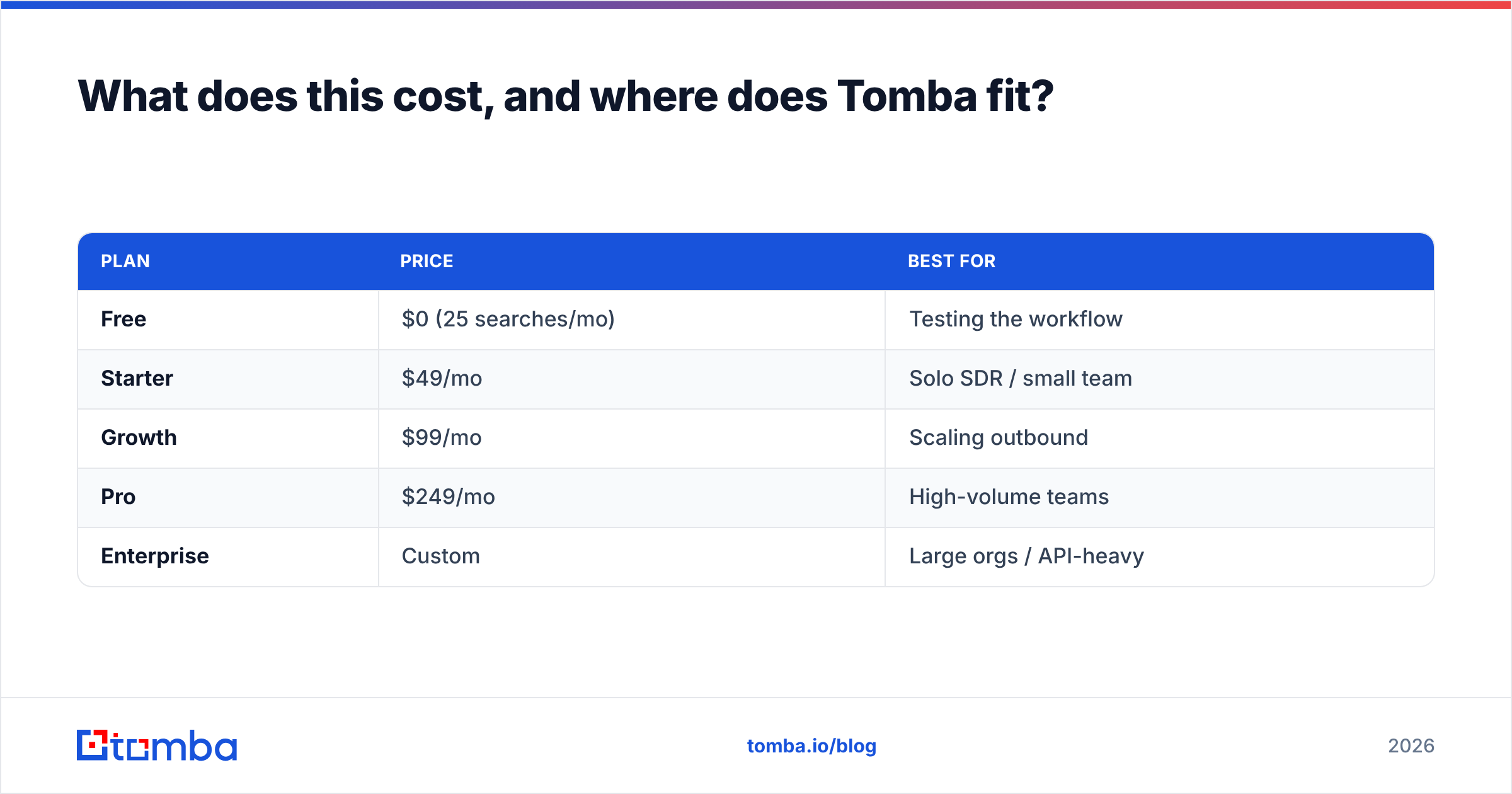
The identification layer and the contact-data layer are usually priced separately. On the contact-data side, Tomba's pricing is straightforward and built for this exact workflow:
| Plan | Price | Best for |
|---|---|---|
| Free | $0 (25 searches/mo) | Testing the workflow |
| Starter | $49/mo | Solo SDR / small team |
| Growth | $99/mo | Scaling outbound |
| Pro | $249/mo | High-volume teams |
| Enterprise | Custom | Large orgs / API-heavy |
The point isn't that one tool does everything — it's that the contact discovery and verification half of the stack (find the person, confirm the email) is where deals are won or lost, and it shouldn't cost enterprise money. Whether you're enriching revealed accounts in bulk via the bulk email finder or wiring identification into your CRM through the Tomba API, the goal is the same: a revealed company becomes a verified, contactable human in minutes.
Common mistakes to avoid#
- Chasing person-level identification first. It's the riskiest, least reliable layer. Nail account-level ID before you flirt with deanonymization.
- Treating every visitor as a lead. A competitor, a job-seeker, and a current customer all visit your pricing page. Score and filter against your ICP.
- Letting the data sit. A revealed account that nobody contacts for a week is just an expensive log file.
- Skipping verification. Sending to unverified emails from enriched lists tanks deliverability and wastes the whole effort.
- Ignoring privacy hygiene. Update your policy, respect consent, and document your lawful basis. The fine is always more expensive than the disclosure.
Frequently asked questions#
Can you identify individual website visitors by name? Sometimes, but it's legally sensitive and far less reliable than vendors imply. Company-level identification (which firm a visitor works for) is dependable; pinning an anonymous session to a specific named individual is the part to approach carefully and lawfully.
What match rate is realistic? For company-level identification, expect to recover roughly 20–50% of B2B sessions, weighted toward visitors on corporate networks. Remote, mobile, and VPN traffic lowers that. Be skeptical of anyone promising 90%+ person-level matches.
Do I need consent to track visitors? For behavioral pixels and cookies in the EU/UK, generally yes. Reverse-IP at the company level is lower risk. US state laws add disclosure and opt-out obligations. Check your jurisdiction and update your privacy policy.
Is this the same as Google Analytics? No. GA4 measures anonymous behavior and aggregates it. Visitor tracking adds identity — which company (and sometimes who) is behind the behavior — so sales can act on it.
Start turning anonymous traffic into named pipeline#
Website visitor tracking only creates revenue when a revealed company becomes a verified, reachable person fast. Identify the account, score the intent, enrich the firmographics — then close the last mile with the Tomba Email Finder: give it a domain or a name and a company, and get back the verified professional email of the decision-maker who was just on your pricing page. Pair it with the email verifier and the API, and your visitor-tracking data stops being a dashboard and starts being a pipeline engine. Spin up the free tier, point it at your last week of revealed accounts, and see how many real conversations are hiding in the traffic you already paid for.
Ready to find emails that actually work?
Join 150,000+ professionals who stopped guessing and started sending. Free credits on signup — no credit card required.
Get the Tomba newsletter
Practical outbound tactics and product updates — once every two weeks.
About the author