B2B Website Visitor Tracking Tools: 2026 Buyer's Guide
Most of your B2B website traffic leaves without filling a form. Here's how website visitor tracking tools de-anonymize that traffic and turn it into pipeline in 2026.
TL;DR
- 95%+ of B2B website visitors never fill out a form — visitor tracking tools de-anonymize that traffic so sales can act on intent.
- Two distinct categories exist: company-level reveal (firmographics from IP) and person-level identification (matching visitors to contacts). Know which you're buying.
- Match rates, data freshness, and CRM integration matter far more than dashboard polish. Most tools inflate their match-rate claims.
- GDPR and CCPA hard-limit person-level tracking in the EU — company-level reveal is the safer default for most teams.
- Pair reveal with an enrichment and email-finding layer (like Tomba Email Finder) so identified accounts become contactable, not just visible.
What are B2B website visitor tracking tools?#
B2B website visitor tracking tools identify the companies — and sometimes the individual people — browsing your site, even when they never submit a form. Think of your website like a retail store with no checkout: hundreds of people walk in, browse the shelves, and walk out, and you never learn who they were. Visitor tracking is the security-camera-plus-loyalty-card layer that tells you "Acme Corp's VP of Ops spent four minutes on your pricing page yesterday."
Technically, these tools work by capturing a visitor's IP address and device fingerprint, then matching it against a database that maps IP ranges to companies (reverse IP lookup) or, for person-level tools, against cookie pools and identity graphs built from other data partnerships.
The output is what makes them valuable: instead of an anonymous spike in Google Analytics, you get an account name, firmographics, the pages viewed, and a timestamp. That's a buying signal your SDRs can work the same day.
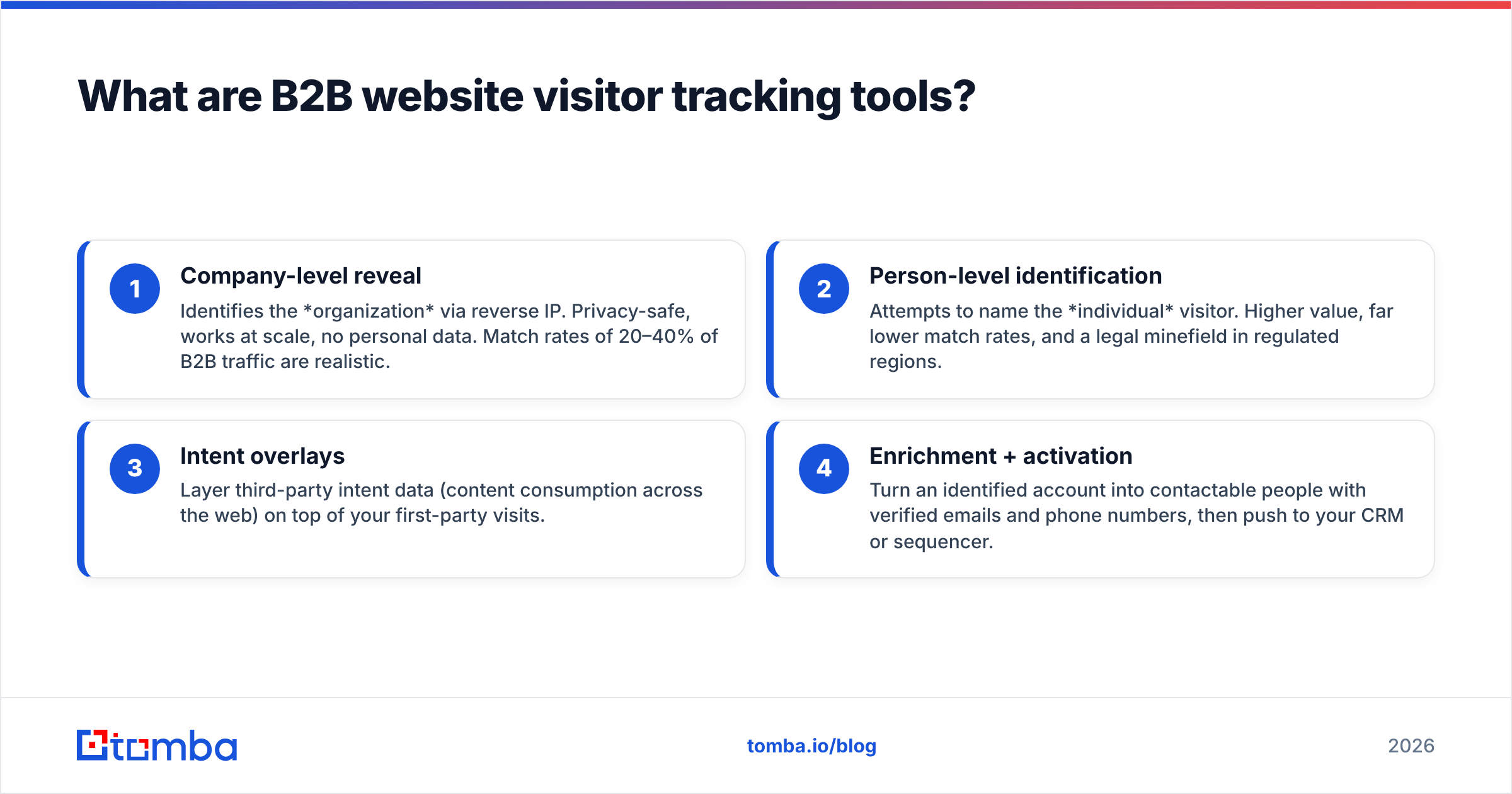
There are two fundamentally different products sold under the same banner, and conflating them is the most common buying mistake:
- Company-level reveal — Identifies the organization via reverse IP. Privacy-safe, works at scale, no personal data. Match rates of 20–40% of B2B traffic are realistic.
- Person-level identification — Attempts to name the individual visitor. Higher value, far lower match rates, and a legal minefield in regulated regions.
- Intent overlays — Layer third-party intent data (content consumption across the web) on top of your first-party visits.
- Enrichment + activation — Turn an identified account into contactable people with verified emails and phone numbers, then push to your CRM or sequencer.
Most "all-in-one" platforms do one of these well and bolt the rest on. Knowing which job you're hiring the tool for keeps you from overpaying.
Why does anonymous B2B traffic matter so much?#
Because the math is brutal: the average B2B site converts 1–3% of visitors into known leads. That means 97–99% of the traffic you paid for — through SEO, ads, events, and content — leaves no trace you can follow up on. Visitor tracking recovers a chunk of that wasted spend.
The strategic value shows up in three places:
- Sales prioritization. When an SDR sees that a target account hit your pricing page three times this week, that account jumps the queue. This is warmer than any cold list.
- ABM activation. Account-based plays depend on knowing when target accounts engage. Visitor tracking is the trigger that fires the play.
- Ad and content ROI. You finally learn which companies your campaigns attract, not just clicks and bounce rates.
The catch is that identification alone is inert. Knowing "Acme Corp visited" does nothing until you know who at Acme to contact and how to reach them. That's where a data enrichment and email layer turns a passive dashboard into an outbound engine.
How do B2B website visitor tracking tools actually work?#
The pipeline is consistent across vendors, even when the marketing language differs. Here's the chain from page-load to pipeline:
- Tracking script fires. A lightweight JavaScript snippet on your site captures IP, user agent, referrer, and page path.
- IP-to-company resolution. The IP is matched against a reverse-IP database. Corporate and static IPs resolve well; residential and mobile IPs usually don't.
- Firmographic enrichment. The matched company is appended with industry, size, revenue, location, and tech stack.
- De-duplication and scoring. Sessions are stitched into account-level activity and scored by recency, frequency, and page intent (pricing > blog).
- Activation. Results push to your CRM, Slack, or sequencer — ideally with contact-level enrichment attached.
The weakest link is step 2. Reverse-IP coverage is shrinking as more traffic moves to home offices, VPNs, and mobile networks that don't map cleanly to a corporate entity. Any vendor quoting a 70% match rate is either counting differently or selling you optimism. Treat 25–35% company-level identification of B2B traffic as a strong real-world result.
For person-level claims, be even more skeptical. Those match rates depend on the visitor having been cookied elsewhere in the vendor's network, which is collapsing under browser privacy changes and third-party cookie deprecation.
What are the best B2B website visitor tracking tools in 2026?#
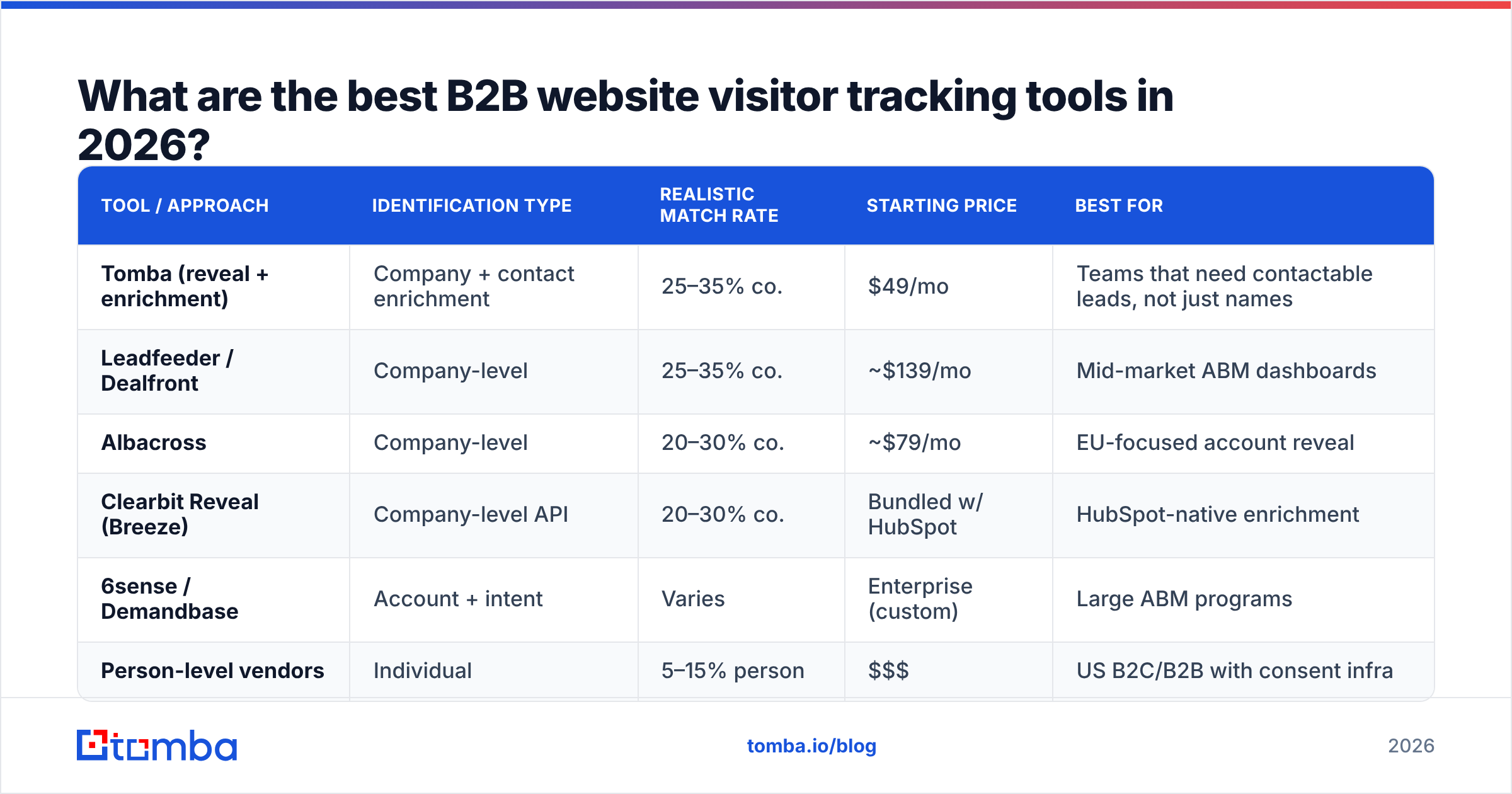
The market splits into pure-play reveal tools, full ABM platforms, and enrichment-first stacks that add reveal. Here's a concrete comparison across the attributes that actually drive ROI.
| Tool / Approach | Identification type | Realistic match rate | Starting price | Best for |
|---|---|---|---|---|
| Tomba (reveal + enrichment) | Company + contact enrichment | 25–35% co. | $49/mo | Teams that need contactable leads, not just names |
| Leadfeeder / Dealfront | Company-level | 25–35% co. | ~$139/mo | Mid-market ABM dashboards |
| Albacross | Company-level | 20–30% co. | ~$79/mo | EU-focused account reveal |
| Clearbit Reveal (Breeze) | Company-level API | 20–30% co. | Bundled w/ HubSpot | HubSpot-native enrichment |
| 6sense / Demandbase | Account + intent | Varies | Enterprise (custom) | Large ABM programs |
| Person-level vendors | Individual | 5–15% person | $$$ | US B2C/B2B with consent infra |
A few honest takeaways from that table:
- Pure dashboards are commoditized. Leadfeeder, Albacross, and similar tools largely resell overlapping IP databases. The differentiator is workflow and CRM fit, not raw data.
- Enterprise ABM suites (6sense, Demandbase) bundle reveal into a much larger intent-and-orchestration platform. Overkill — and over-budget — if all you want is to know who's on your site.
- Enrichment-first stacks win when your real goal is outreach. Identifying the account is step one; getting a verified email for the right decision-maker is what books the meeting.
If you're evaluating dashboards head-to-head, G2's visitor identification category and Gartner's Digital Markets reviews are the least-biased third-party sources for current user ratings.

Company-level vs person-level: which should you buy?#
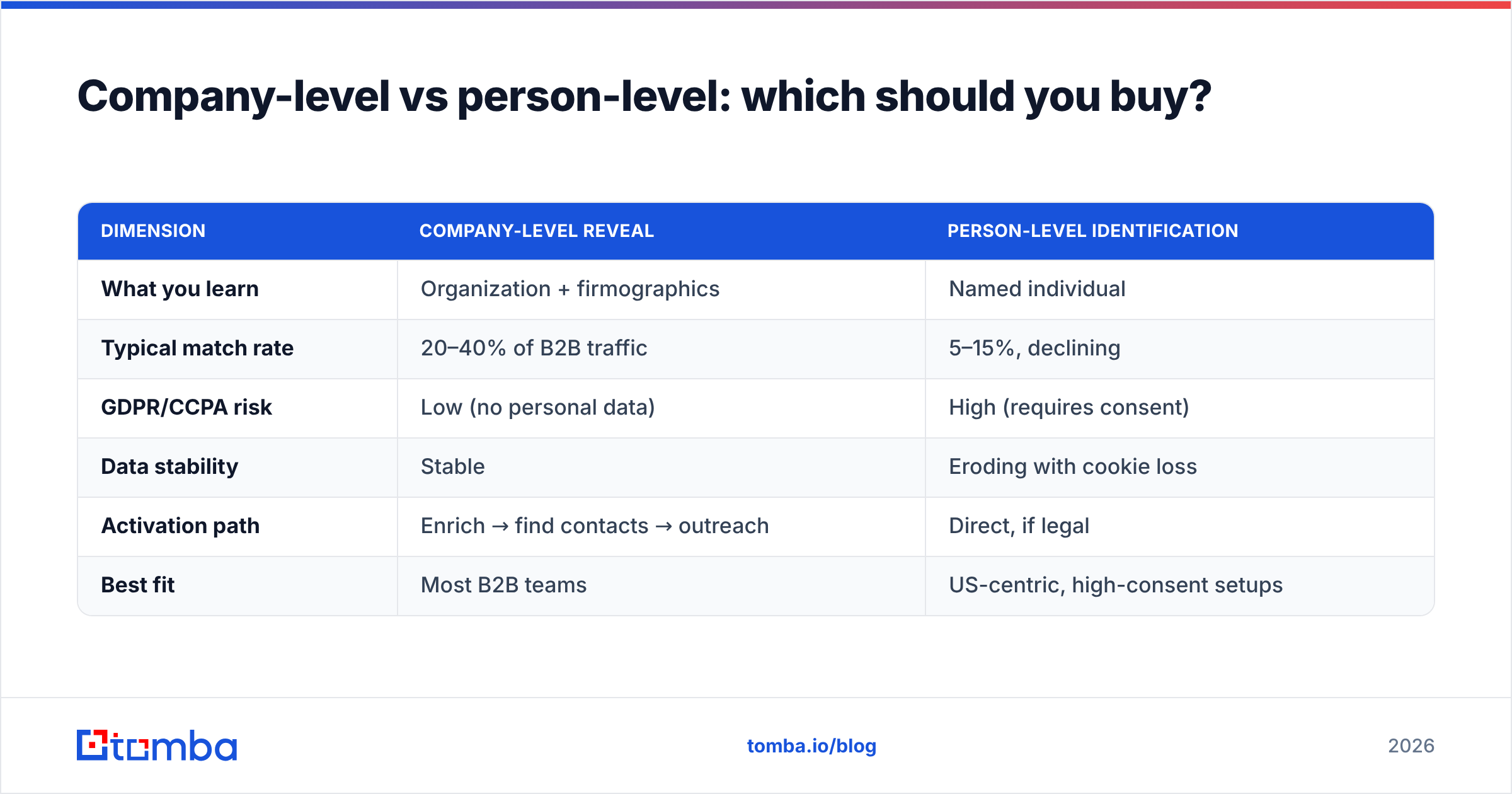
Buy company-level reveal unless you have a specific, consent-backed reason to need individuals. Company-level is more accurate, far cheaper to run at scale, and dramatically lower-risk legally.
Here's the side-by-side on the trade-offs that matter:
| Dimension | Company-level reveal | Person-level identification |
|---|---|---|
| What you learn | Organization + firmographics | Named individual |
| Typical match rate | 20–40% of B2B traffic | 5–15%, declining |
| GDPR/CCPA risk | Low (no personal data) | High (requires consent) |
| Data stability | Stable | Eroding with cookie loss |
| Activation path | Enrich → find contacts → outreach | Direct, if legal |
| Best fit | Most B2B teams | US-centric, high-consent setups |
The person-level pitch is seductive — "know exactly who visited" — but it's built on identity graphs that are degrading every quarter as browsers kill third-party cookies. In the EU, Article 6 of the GDPR makes person-level tracking without a lawful basis a genuine liability, not a theoretical one.
The pragmatic 2026 architecture: identify the account with reveal, then use a compliant enrichment and email finder to surface the right publicly-available business contacts at that account. You get the targeting precision of person-level data without the legal exposure of person-level tracking.
How do you turn identified visitors into pipeline?#
Identification is the start of the workflow, not the end. A name on a dashboard that nobody acts on is a cost, not an asset. Here's the operational loop that actually produces meetings:
- Filter to fit. Drop traffic that doesn't match your ICP — ISPs, your own team, students, competitors. Most reveal feeds are 60% noise before filtering.
- Score by intent. Weight pricing, demo, and product pages far above blog visits. Recency and repeat visits compound the score.
- Enrich the account. Append the decision-makers' roles and verified contact details. This is where contact enrichment and a bulk email finder convert "Acme visited" into "email the VP of Ops at Acme."
- Route and trigger. Push qualified, enriched accounts into your CRM and fire a Slack alert or sequence enrollment the same day — speed-to-lead decays fast.
- Measure and prune. Track meetings-booked per identified account, not vanity "companies revealed." Kill sources that don't convert.
Two integrations make or break this loop in practice. First, native CRM sync so reveal data lands where reps already work — see Tomba's HubSpot integration and Salesforce integration. Second, a website visitor reveal layer that connects directly to enrichment, so you skip the manual copy-paste between "who visited" and "how do I reach them."
For benchmarks on what a healthy speed-to-lead and follow-up cadence looks like, HubSpot's research on lead response time remains the most-cited reference.
What about privacy, GDPR, and CCPA compliance?#
Compliance is a feature, not a footnote — and it's where person-level tools quietly create risk for your company. The short version:
- Company-level reveal is generally safe. A company name tied to a corporate IP is not personal data under most readings of GDPR. This is why EU-heavy teams default to it.
- Person-level identification needs a lawful basis. Under GDPR you typically need consent; under CCPA/CPRA you need disclosure and opt-out. "We bought a list that says it's compliant" is not a defense.
- Cookie consent applies. Your tracking script should respect consent management platform (CMP) signals. Firing identification before consent in the EU is a violation.
- Document your basis. Keep a record of why and how you process visitor data. Regulators ask for the paper trail, not the intent.
A clean rule of thumb: if your traffic is meaningfully EU-based, run company-level reveal plus consent-respecting enrichment of public business contact data. Reserve person-level tracking for jurisdictions and consent setups where you can defend it. When in doubt, the conservative architecture is also the higher-accuracy one in 2026 — a rare case where the safe choice is also the better-performing one.
How much should you pay for visitor tracking?#
Pricing splits along the same company-vs-person line, and the headline number rarely reflects total cost. Watch for these traps:
- Per-identified-company pricing punishes you for high traffic. Great for low-volume niche sites, expensive for content-heavy ones.
- Reveal-only tools look cheap until you add the enrichment and email-finding you need to actually contact anyone — that's a second subscription.
- Enterprise ABM suites bundle everything but start in the thousands per month and require annual contracts.
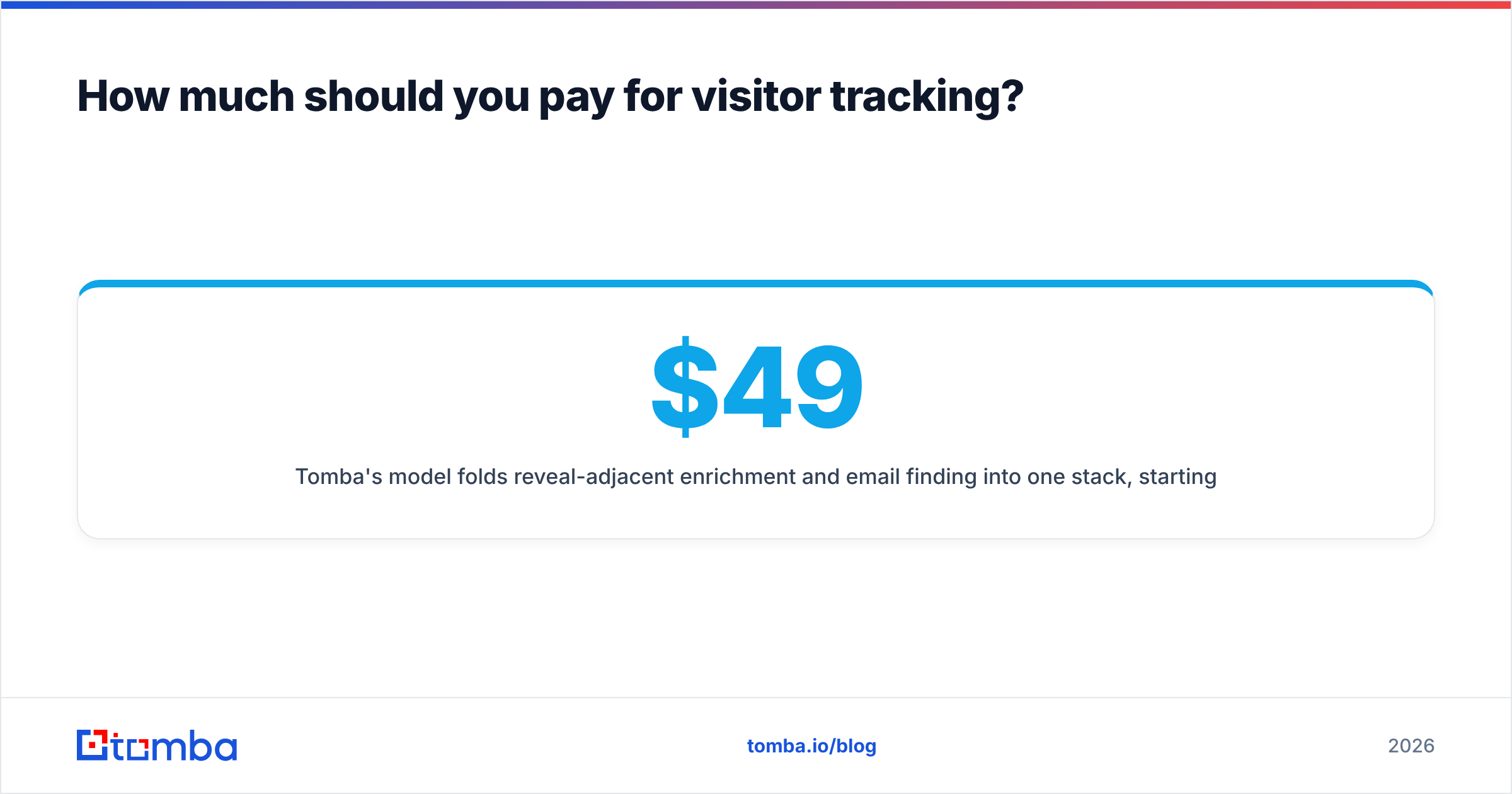
Tomba's model folds reveal-adjacent enrichment and email finding into one stack, starting at $49/mo (Starter), with Growth at $99/mo, Pro at $249/mo, and a free tier of 25 searches to test the data quality first. Full breakdown on the Tomba pricing page. The point isn't that one tool is universally cheapest — it's that you should price the whole workflow (reveal → enrich → contact → CRM), not just the dashboard.
The bottom line#
Website visitor tracking only pays off when "who visited" becomes "who we contacted and closed." Company-level reveal is the accurate, compliant foundation for 2026; person-level tracking is a shrinking, higher-risk niche. Whichever you choose, the value is unlocked by the enrichment-and-outreach layer sitting on top.
If your goal is to turn anonymous, high-intent traffic into booked meetings, start with the activation layer that makes every identified account contactable. Use the Tomba Email Finder to attach verified, decision-maker emails to the accounts hitting your site — then route them into your CRM and let your reps work warm pipeline instead of cold lists. Spin up the free tier, point it at your last week of revealed accounts, and measure meetings booked. That's the only metric that matters.
// get started
Find, verify and enrich your first contacts today
Start on the free plan with 25 searches a month, then scale when your team is ready.
Free plan · No credit card required · GDPR & CCPA
// about the author