B2C Go-To-Market Strategy: The 2026 Playbook That Scales
A practical 2026 framework for building a B2C go-to-market strategy that wins on positioning, channels, and unit economics — without burning your budget on guesswork.
TL;DR
- A B2C go to market strategy is your repeatable plan for getting a consumer product from "launched" to "loved at scale" — it decides who you sell to, how you reach them, what you charge, and how you keep CAC below LTV.
- B2C differs from B2B on every axis: shorter buying cycles, emotional triggers, broad audiences, and channels measured in cost-per-install, not enterprise demos.
- The five pillars are segmentation, positioning, channel mix, pricing/packaging, and launch sequencing — skip one and growth stalls.
- Channel economics decide everything. Paid social, influencer, SEO, retail, and referral each have wildly different CAC and payback curves.
- Even a "no-sales-team" B2C motion needs accurate contact data for partnerships, retail buyers, influencers, and affiliates — that's where tools like the Tomba Email Finder quietly earn their keep.
What is a B2C go-to-market strategy?#
A B2C go-to-market strategy is the operating plan that connects a consumer product to the people who will buy it — repeatably and profitably. Think of it as the flight plan for a passenger jet: the plane (your product) can fly, but without a route, fuel math, and air-traffic coordination, it never reaches the destination on time or on budget.
In B2C you're rarely selling to a procurement committee. You're selling to one person scrolling a feed at 9 p.m. who decides in seconds whether your product is worth a tap. That changes the whole motion. Your strategy has to win attention fast, reduce friction to near zero, and turn a first purchase into a habit.
A complete B2C GTM strategy answers five questions:
- Who exactly is the buyer? Demographics plus the emotional job-to-be-done.
- Why you, not the incumbent? Your positioning and category entry point.
- Where do they discover and decide? Your channel mix.
- What do they pay, and how? Pricing, packaging, and offers.
- In what order do you launch? Sequencing across audience, geo, and channel.
How is B2C GTM different from B2B GTM?#
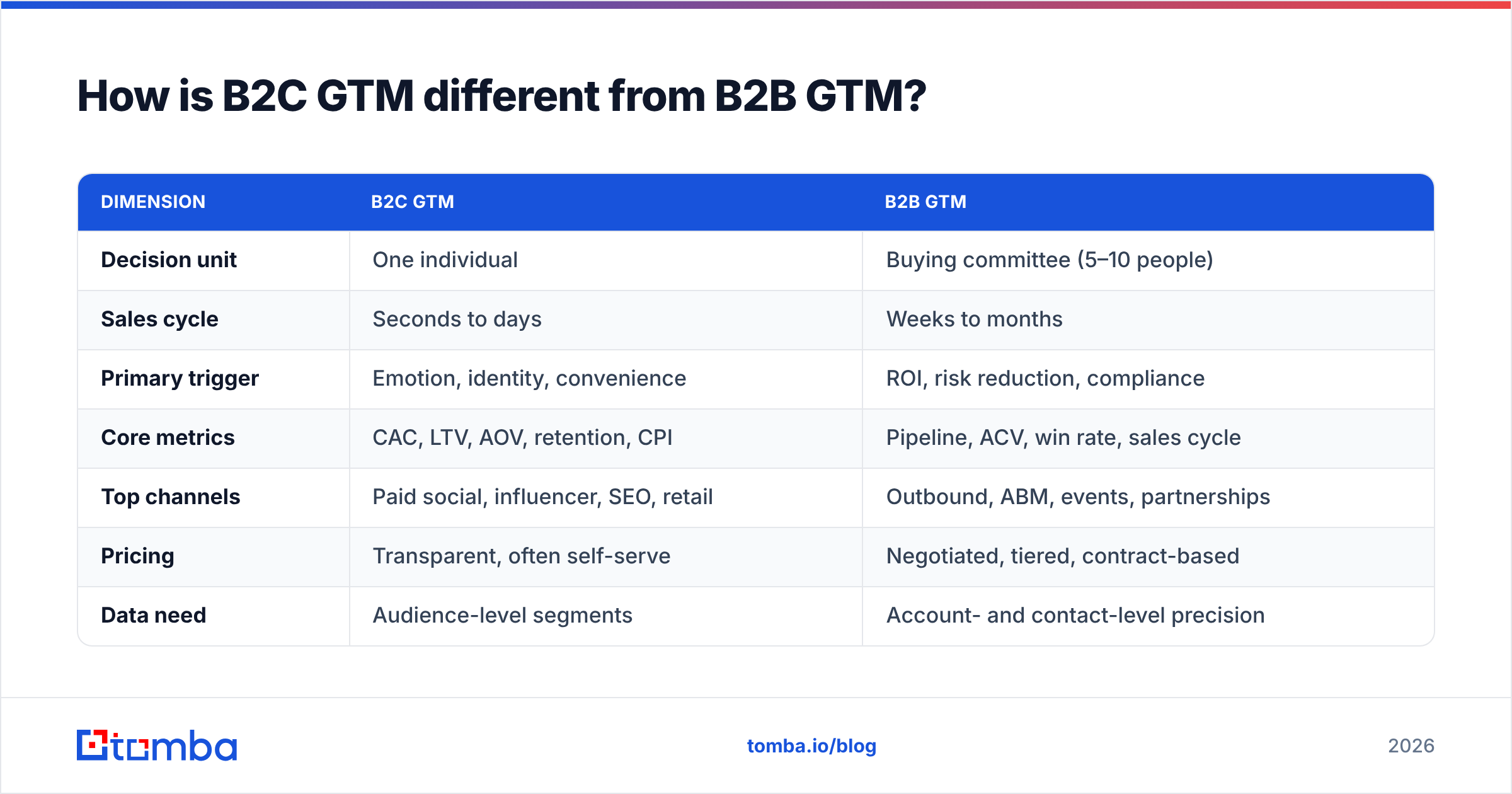
The short answer: B2C optimizes for volume and velocity, B2B for value and validation. A B2B deal might take six months and three stakeholders; a B2C purchase can take six seconds and one thumb.
| Dimension | B2C GTM | B2B GTM |
|---|---|---|
| Decision unit | One individual | Buying committee (5–10 people) |
| Sales cycle | Seconds to days | Weeks to months |
| Primary trigger | Emotion, identity, convenience | ROI, risk reduction, compliance |
| Core metrics | CAC, LTV, AOV, retention, CPI | Pipeline, ACV, win rate, sales cycle |
| Top channels | Paid social, influencer, SEO, retail | Outbound, ABM, events, partnerships |
| Pricing | Transparent, often self-serve | Negotiated, tiered, contract-based |
| Data need | Audience-level segments | Account- and contact-level precision |
This doesn't mean B2C ignores contact-level data. Modern consumer brands run partnership, affiliate, retail-buyer, and creator programs that look a lot like B2B outbound — and those motions live or die on whether you can reach the right human. If you're pitching a Target buyer or a YouTube creator, a generic info@ inbox won't cut it. Tools like a domain search help you find the actual decision-maker behind a brand.
What are the five pillars of a B2C go-to-market strategy?#
Use these five pillars as a checklist near the start of any GTM doc. Each one is a place where consumer launches commonly break.
- Segmentation — Define 2–3 concrete buyer segments, each with a distinct job-to-be-done. "Women 25–34" is a demographic, not a segment. "New parents who want one-handed, mess-free feeding at 3 a.m." is a segment.
- Positioning — Pick the category you compete in and the single sharpest reason to choose you. Borrow from your strongest alternative and beat it on one dimension.
- Channel mix — Choose 1 primary acquisition channel and 1–2 secondary. Spreading thin across six channels at launch is the most common B2C mistake.
- Pricing and packaging — Decide your price point, tiers, intro offer, and the psychological anchor. Free trial vs. money-back vs. first-order discount each pull different behaviors.
- Launch sequencing — Roll out by audience and geography in waves so you can read signal, fix, and scale — not bet the whole budget on day one.
Master these and the tactics get easier. Skip pricing discipline or channel focus and you'll feel it in the CAC report within a quarter.
Who is your B2C buyer, really?#
Start with the emotional job, then layer the demographics — not the other way around. People don't buy a $9 reusable water bottle because of its volume in milliliters; they buy the identity of "someone who has their life together." Functional specs justify a decision that emotion already made.
Build each segment around four inputs:
- The trigger — the moment they realize they need a solution (a move, a breakup, a New Year, a doctor's visit).
- The job-to-be-done — the functional and emotional progress they want.
- The alternatives — what they use today, including "do nothing."
- The watering holes — the specific subreddits, creators, hashtags, and stores where they already spend attention.
That last point is where many GTM plans go vague. "Social media" is not a watering hole. "The r/SkincareAddiction community and three mid-tier dermatologist creators on TikTok" is. Precision here directly lowers your acquisition cost because you stop paying to reach people who will never convert.
For deeper context on how qualified demand forms, the concept of a marketing qualified lead still applies in B2C — it's just measured in newsletter signups, wishlist adds, and abandoned carts rather than demo requests.
Which channels should a B2C go-to-market strategy use?#
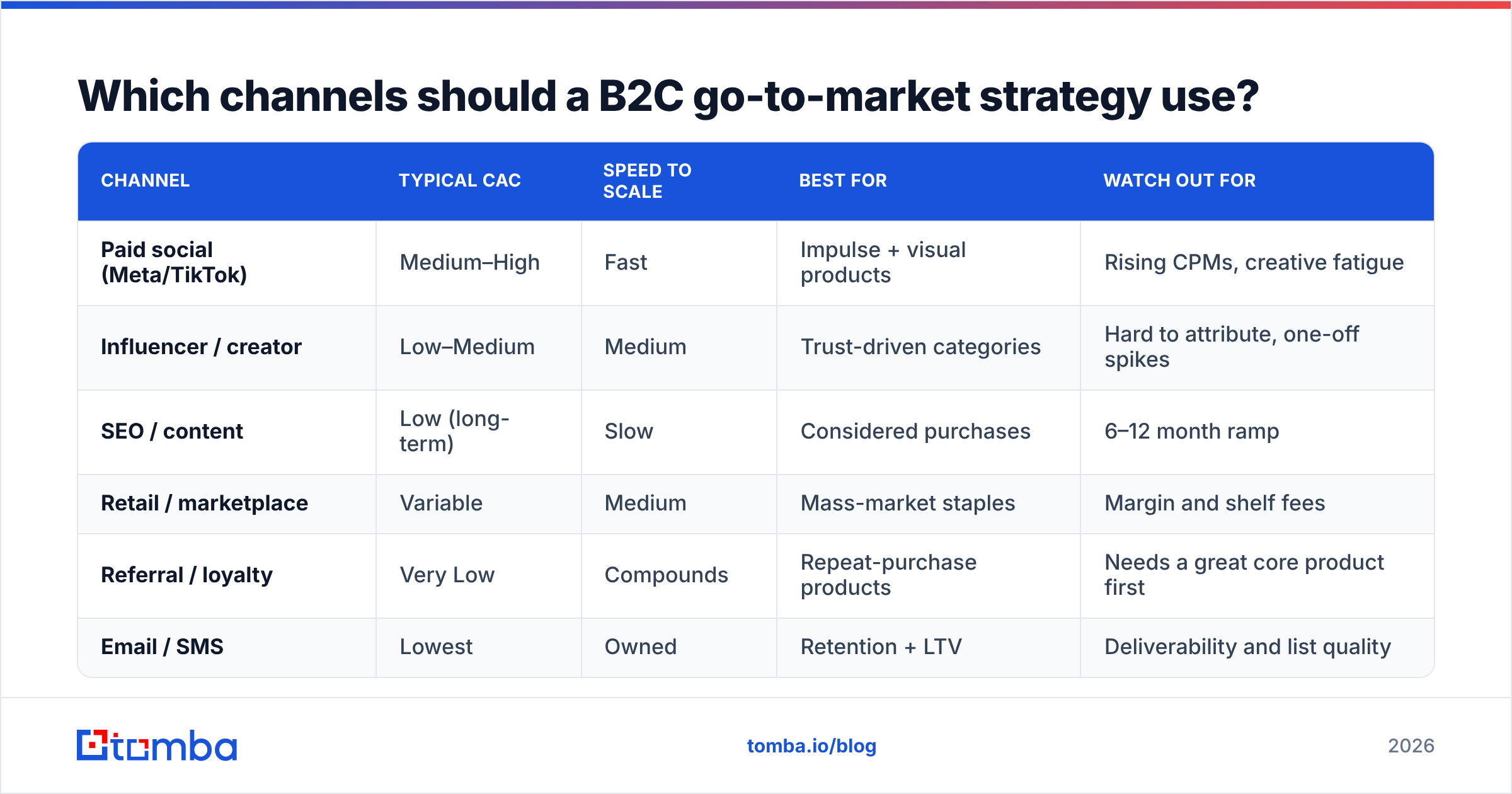
Pick channels by their math, not their buzz. Every channel has a different cost-per-acquisition, payback period, and scalability ceiling. Here's how the major consumer channels compare in 2026.
| Channel | Typical CAC | Speed to scale | Best for | Watch out for |
|---|---|---|---|---|
| Paid social (Meta/TikTok) | Medium–High | Fast | Impulse + visual products | Rising CPMs, creative fatigue |
| Influencer / creator | Low–Medium | Medium | Trust-driven categories | Hard to attribute, one-off spikes |
| SEO / content | Low (long-term) | Slow | Considered purchases | 6–12 month ramp |
| Retail / marketplace | Variable | Medium | Mass-market staples | Margin and shelf fees |
| Referral / loyalty | Very Low | Compounds | Repeat-purchase products | Needs a great core product first |
| Email / SMS | Lowest | Owned | Retention + LTV | Deliverability and list quality |
A healthy B2C portfolio usually pairs one fast paid channel (to buy data and validate creative) with one compounding owned channel (SEO, email, referral) that lowers blended CAC over time. The paid channel is rented attention; the owned channels are equity you keep.
Email deserves special attention because it's the cheapest channel you'll ever run — but only if messages land. Protect your email deliverability by verifying every address before you send, or your sender reputation erodes and even loyal customers stop seeing you.
How do you handle pricing and packaging in B2C?#
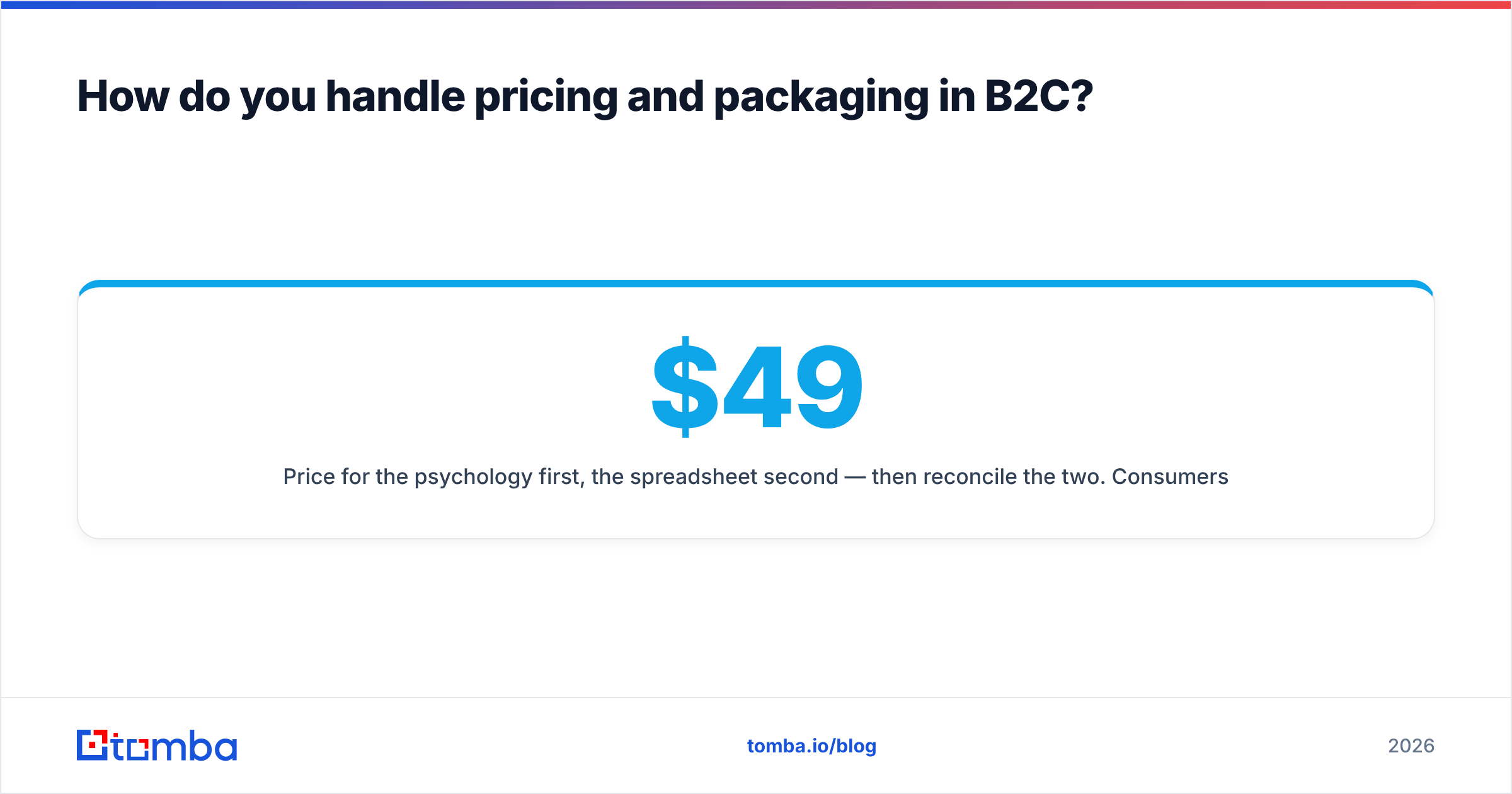
Price for the psychology first, the spreadsheet second — then reconcile the two. Consumers anchor hard. A $49 product next to a $99 "most popular" tier feels like a deal; the same $49 alone feels expensive. Your job is to architect the comparison.
Three pricing levers carry most of the weight:
- The anchor — a higher-priced option that makes your target tier feel reasonable.
- The entry offer — first-order discount, free trial, or bundle that lowers the activation barrier without training customers to wait for sales.
- The repeat mechanic — subscription, replenishment, or loyalty points that turn one purchase into predictable LTV.
Whatever you choose, your unit economics have to clear one bar: LTV should be at least 3× CAC, with payback under 12 months for most consumer categories. If a channel can't hit that, it's a brand-awareness play, not a growth engine — fund it as such, deliberately, not by accident.
What does a B2C launch sequence look like?#
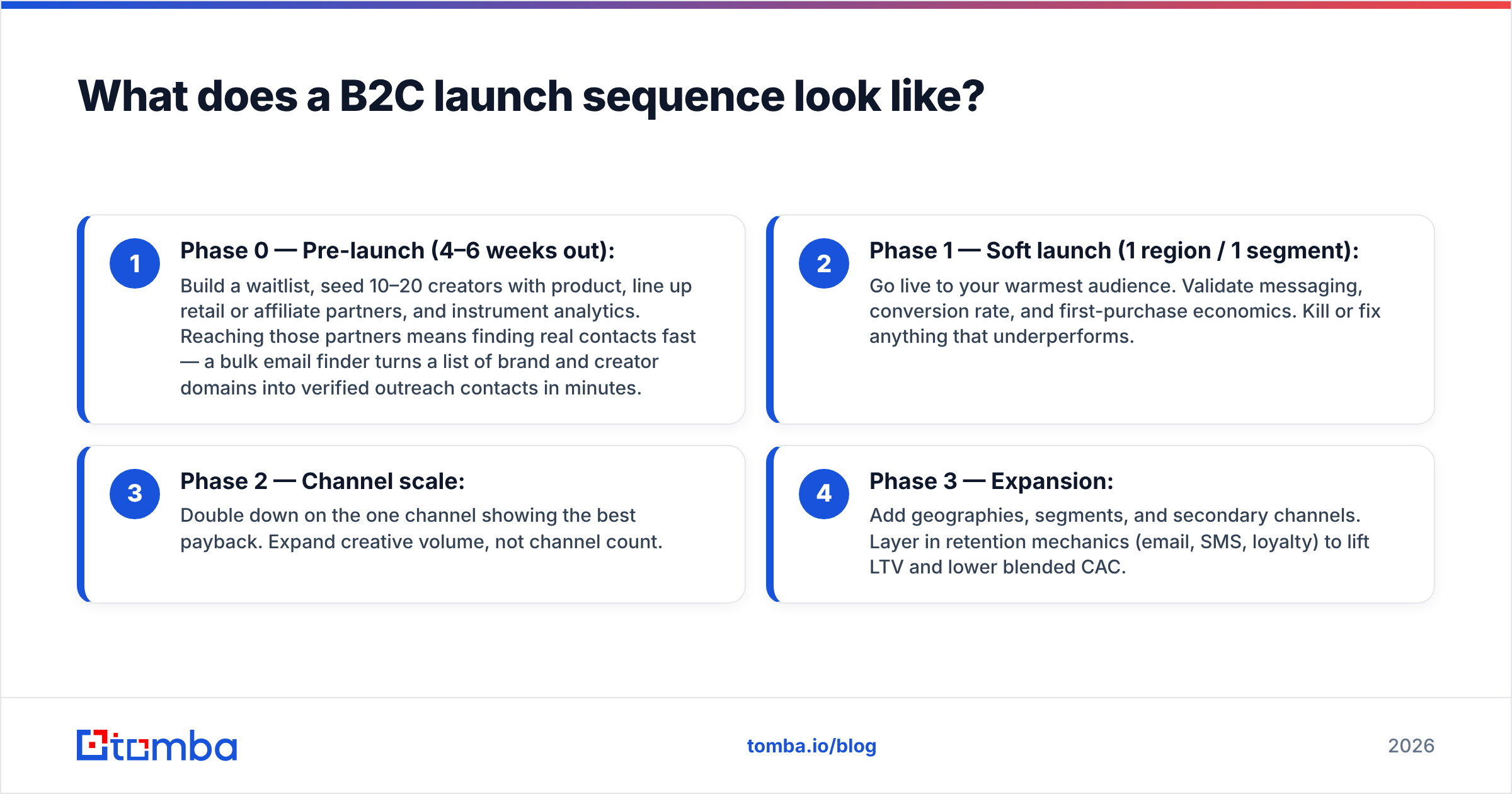
Launch in waves, never all at once. A staged rollout lets you read real signal cheaply, fix what breaks, and pour budget only into what's already working. Here's a pragmatic four-phase sequence.
- Phase 0 — Pre-launch (4–6 weeks out): Build a waitlist, seed 10–20 creators with product, line up retail or affiliate partners, and instrument analytics. Reaching those partners means finding real contacts fast — a bulk email finder turns a list of brand and creator domains into verified outreach contacts in minutes.
- Phase 1 — Soft launch (1 region / 1 segment): Go live to your warmest audience. Validate messaging, conversion rate, and first-purchase economics. Kill or fix anything that underperforms.
- Phase 2 — Channel scale: Double down on the one channel showing the best payback. Expand creative volume, not channel count.
- Phase 3 — Expansion: Add geographies, segments, and secondary channels. Layer in retention mechanics (email, SMS, loyalty) to lift LTV and lower blended CAC.
This sequencing mindset is core to modern revenue operations: align marketing, product, and data so each wave informs the next instead of guessing in the dark.
What metrics prove your B2C GTM is working?#
Watch four numbers weekly and you'll catch problems before they compound:
- CAC by channel — not blended. Blended CAC hides the channel that's quietly bleeding budget.
- LTV:CAC ratio — your north star for sustainable growth; aim for 3:1 or better.
- Activation rate — the percentage of buyers who reach the "aha" moment (second purchase, first share, profile completion).
- Retention / repeat rate — the single best predictor of whether your economics ever turn positive.
For a sharper read on top-of-funnel efficiency, layer in cost-per-install and creative-level response rate so you know which message, not just which channel, is doing the work.
Common B2C go-to-market mistakes to avoid#
- Launching on six channels at once. You can't read signal from any of them. Start with one or two.
- Confusing demographics with segments. Age and gender don't tell you the job-to-be-done.
- Funding brand spend like growth spend. Brand is real and valuable — but budget it on purpose, with different success metrics.
- Ignoring retention until it's a crisis. Acquisition gets the headlines; retention pays the bills.
- Sending to unverified contact lists. Whether it's customers, affiliates, or retail buyers, bad data tanks deliverability and wastes spend. Run lists through an email verifier first.
For authoritative external benchmarks while you build your plan, HubSpot's marketing research and Gartner's marketing insights are solid, vendor-neutral references, and G2 category reviews help you pressure-test any tool before you commit budget.
How does contact data fit a consumer (B2C) motion?#
It fits more than founders expect. A pure direct-to-consumer brand still runs at least four motions that need real, verified contact data: retail and marketplace buyer outreach, influencer and creator partnerships, affiliate recruitment, and PR/media pitching. Each of those is, functionally, a B2B sales motion wrapped inside a B2C company — and each fails on a bad email.
That's the quiet infrastructure layer beneath a great consumer launch. You can have flawless creative and still stall because you couldn't reach the buyer at the retailer, or the email to your top affiliate bounced. Accurate data isn't glamorous, but it's the difference between a partnership deck that gets opened and one that dies in a spam folder.
Conclusion: build the plan, then fuel it with clean data#
A winning B2C go to market strategy in 2026 isn't about chasing the trendiest channel — it's about disciplined segmentation, sharp positioning, channel math that respects CAC, and a staged launch that earns the right to scale. Get the five pillars right and the tactics fall into place.
When your plan calls for reaching real people behind partnerships, retail, affiliates, and press, don't gamble on guessed addresses. Use the Tomba Email Finder to turn any company domain or name into a verified, deliverable contact — so the outreach that powers your launch actually lands. Start free with 25 searches a month, and check the Tomba pricing page when you're ready to scale from $49/mo. Build the strategy, fuel it with clean data, and let your launch fly its full route.
// get started
Find, verify and enrich your first contacts today
Start on the free plan with 25 searches a month, then scale when your team is ready.
Free plan · No credit card required · GDPR & CCPA
// about the author