B2C Sales Pipeline in 2026: Stages, Metrics & Playbook
A practical 2026 guide to building a B2C sales pipeline: the stages, the metrics that matter, where it differs from B2B, and how to fill the top of funnel with clean contact data.
A B2C sales pipeline is the visual map of every step a single consumer takes from first contact to a closed purchase — and in 2026 it is shorter, faster, and far more data-hungry than its B2B cousin. If you are still managing high-volume consumer deals on the same seven-stage process your enterprise team uses, you are leaking revenue at every handoff.
This guide breaks down what a B2C pipeline actually looks like, the stages that matter, the metrics to track, and how to keep the top of the funnel full without drowning in junk contacts.
TL;DR#
- A B2C sales pipeline tracks individual consumers through a short, high-velocity buying journey — usually 4 to 5 stages versus 6 to 8 in B2B.
- Volume and speed beat relationship depth: you win on conversion rate, response time, and average order value, not on six-month nurture cycles.
- The biggest leak is a dirty top of funnel — bad contact data means wasted ad spend, dead leads, and inflated pipeline.
- Track stage conversion, velocity, and cost per acquisition; ignore vanity metrics like raw lead count.
- Tools like a B2B database and an email verifier keep your pipeline clean so reps spend time selling, not scrubbing lists.
What is a B2C sales pipeline?#
A B2C sales pipeline is a structured sequence of stages representing where each consumer prospect sits in their journey toward buying. Think of it like a supermarket checkout queue rather than a chess match: lots of people moving quickly through clear, repeatable steps, where the goal is throughput and a smooth path to the register — not a custom strategy for every shopper.
Technically, the pipeline is a model inside your CRM that assigns every contact a stage, a probability, and a value. As consumers move forward — or drop out — you get a real-time picture of expected revenue and where the bottlenecks are.
The core difference from B2B is scale and intent. A B2C rep might touch hundreds of leads a week with average order values in the tens or hundreds of dollars. Decisions are emotional, fast, and made by one person. That changes everything about how you design the stages.
Wait — that image is a meme, not a chart. Here it is properly:
What are the stages of a B2C sales pipeline?#
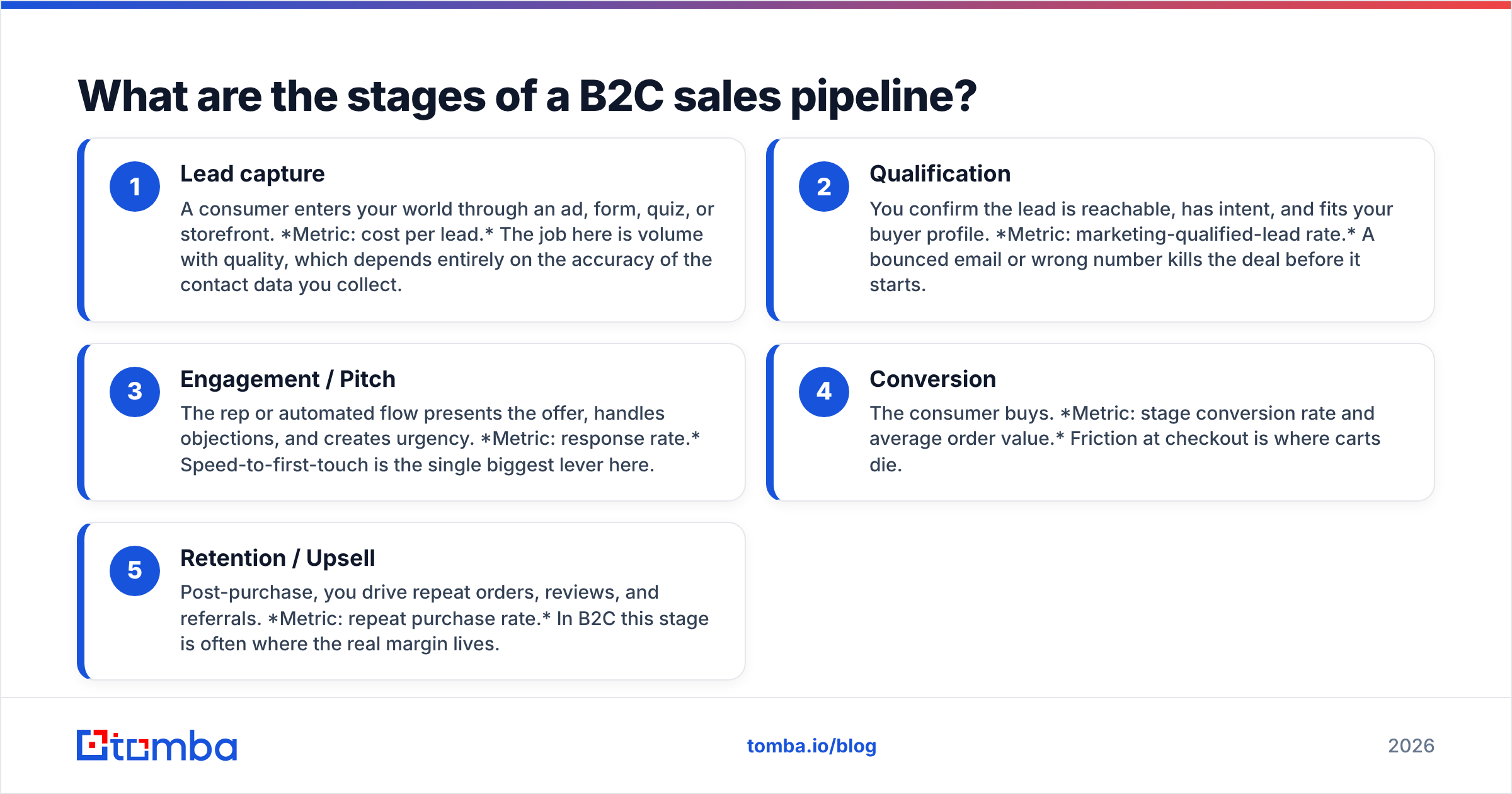
Most consumer pipelines collapse to four or five clean stages. Adding more just creates drag. Here is the standard 2026 model with the rep action and the metric that defines each stage:
- Lead capture — A consumer enters your world through an ad, form, quiz, or storefront. Metric: cost per lead. The job here is volume with quality, which depends entirely on the accuracy of the contact data you collect.
- Qualification — You confirm the lead is reachable, has intent, and fits your buyer profile. Metric: marketing-qualified-lead rate. A bounced email or wrong number kills the deal before it starts.
- Engagement / Pitch — The rep or automated flow presents the offer, handles objections, and creates urgency. Metric: response rate. Speed-to-first-touch is the single biggest lever here.
- Conversion — The consumer buys. Metric: stage conversion rate and average order value. Friction at checkout is where carts die.
- Retention / Upsell — Post-purchase, you drive repeat orders, reviews, and referrals. Metric: repeat purchase rate. In B2C this stage is often where the real margin lives.
Because the pipeline auto-renders structured lists like the one above into a branded diagram, you can drop this straight into a sales playbook and reps will instantly know which number they own.
How is a B2C pipeline different from a B2B pipeline?#
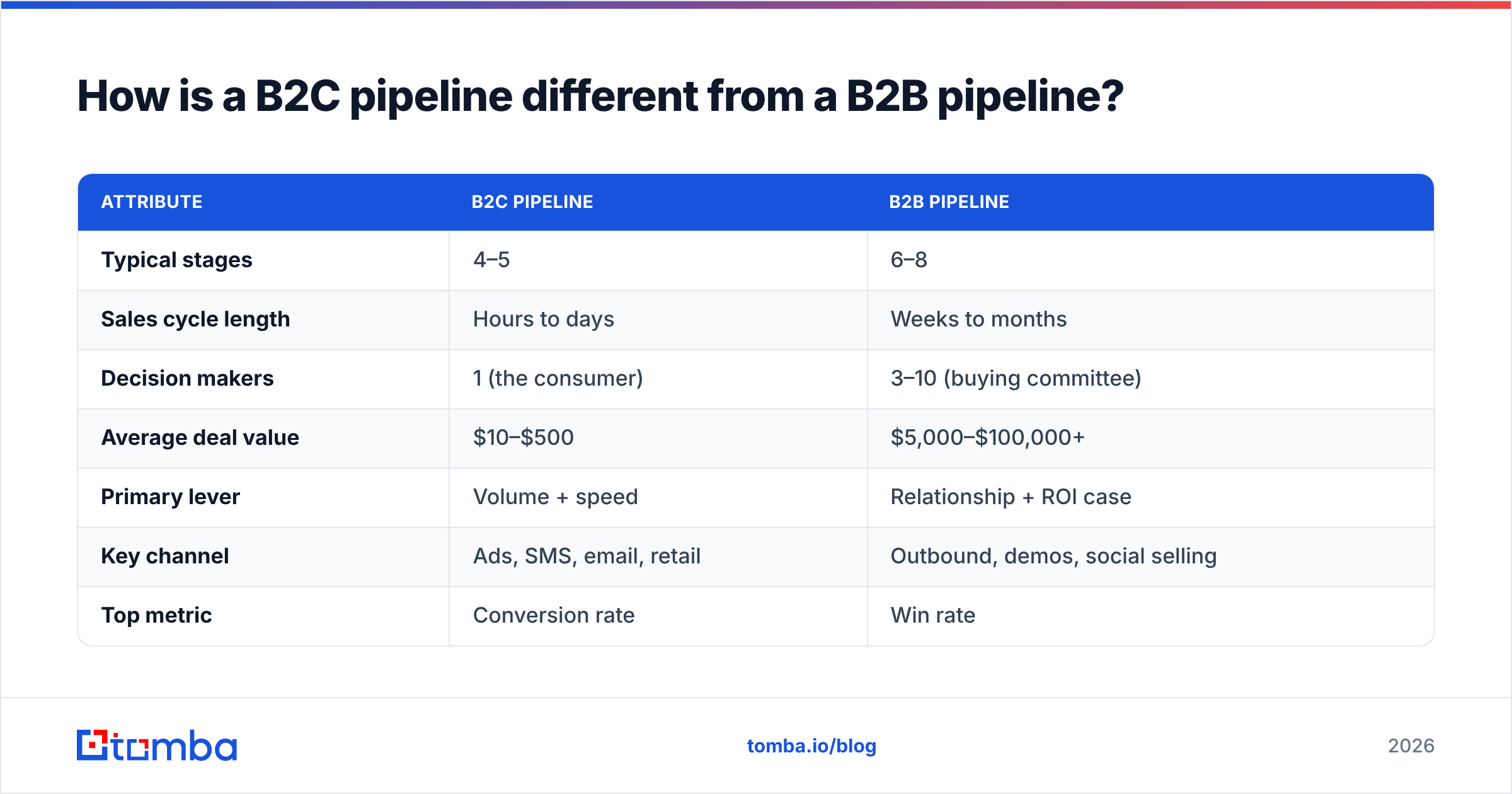
The short answer: B2C trades depth for velocity. You optimize for a high number of short, single-decision-maker deals instead of a small number of long, multi-stakeholder ones.
| Attribute | B2C Pipeline | B2B Pipeline |
|---|---|---|
| Typical stages | 4–5 | 6–8 |
| Sales cycle length | Hours to days | Weeks to months |
| Decision makers | 1 (the consumer) | 3–10 (buying committee) |
| Average deal value | $10–$500 | $5,000–$100,000+ |
| Primary lever | Volume + speed | Relationship + ROI case |
| Key channel | Ads, SMS, email, retail | Outbound, demos, social selling |
| Top metric | Conversion rate | Win rate |
The practical takeaway: do not copy a B2B template into your consumer org. A long qualification stage that makes sense for a $50k contract becomes a conversion killer when the buyer is one impulse away from closing the tab. Strip stages out until each one earns its place.
Which metrics actually matter in a B2C pipeline?#
Conclusion first: track conversion rate by stage, pipeline velocity, and cost per acquisition. Everything else is supporting detail or vanity.
- Stage conversion rate — What percentage moves from one stage to the next. This is your leak detector. If 60% drop between qualification and pitch, your data or your speed is broken.
- Pipeline velocity — How fast deals move through the whole pipeline. In B2C, a one-day delay can mean the impulse is gone. HubSpot's research on sales velocity consistently ties faster response times to dramatically higher close rates.
- Cost per acquisition (CPA) — Total spend divided by customers won. This keeps your ad-heavy top of funnel honest.
- Average order value (AOV) — The lever that makes thin-margin B2C profitable, especially when paired with upsell stages.
- Lead-to-customer rate — The full-funnel truth. A high lead count with a low conversion rate usually means a dirty list, not a sales problem.
According to industry analysts at Gartner, the teams that win in high-volume consumer sales are the ones that instrument every stage and act on the leak, rather than just pouring more leads into a leaky bucket.
Why does data quality make or break your B2C pipeline?#
Because a B2C pipeline runs on volume, a small percentage of bad data compounds into a massive waste. If 20% of your captured emails bounce, you are not just losing those leads — you are damaging your sender reputation, inflating your CPA, and feeding your reps a queue of ghosts.
Picture a leaky garden hose. At low pressure (B2B, few deals) you notice every drip and patch it. At high pressure (B2C, thousands of contacts) the same pinholes spray water everywhere and you never find them all. The fix is not more water — it is a better hose.
That is why clean contact data sits at the very front of a healthy pipeline. Before a lead ever reaches a rep, you want to confirm the email is real, the phone number is valid, and the record is enriched with enough context to personalize the pitch. Running new contacts through an email verifier and a phone validator at capture time removes the dead weight before it pollutes your conversion math.
For teams pulling consumer leads from their own forms and storefronts, a quick pass with the bulk email finder and data enrichment turns a thin name-and-email row into a usable profile — without manual research.
How do you build a B2C pipeline that converts in 2026?#
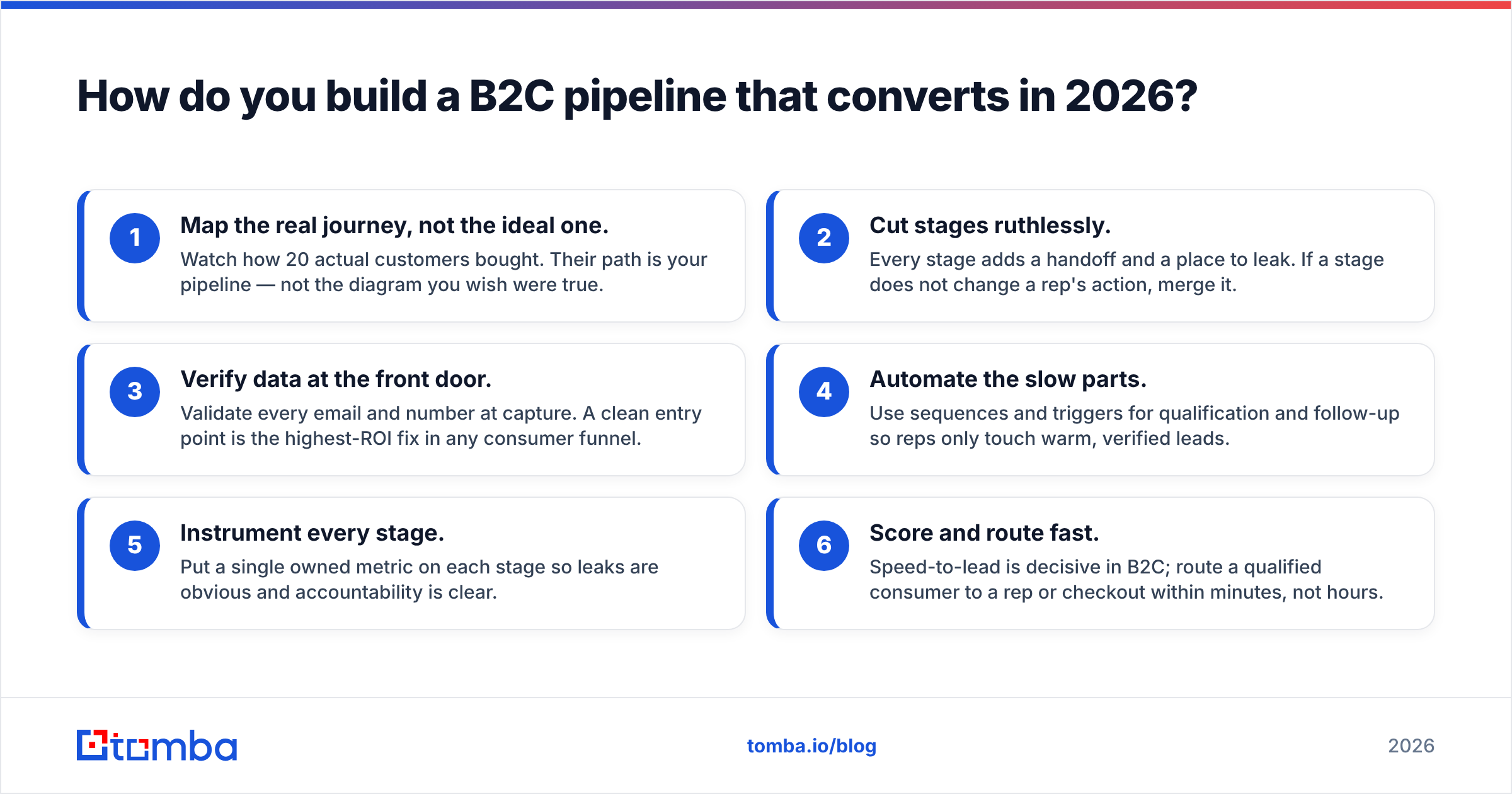
Here is the playbook, in order of impact:
- Map the real journey, not the ideal one. Watch how 20 actual customers bought. Their path is your pipeline — not the diagram you wish were true.
- Cut stages ruthlessly. Every stage adds a handoff and a place to leak. If a stage does not change a rep's action, merge it.
- Verify data at the front door. Validate every email and number at capture. A clean entry point is the highest-ROI fix in any consumer funnel.
- Automate the slow parts. Use sequences and triggers for qualification and follow-up so reps only touch warm, verified leads.
- Instrument every stage. Put a single owned metric on each stage so leaks are obvious and accountability is clear.
- Score and route fast. Speed-to-lead is decisive in B2C; route a qualified consumer to a rep or checkout within minutes, not hours.
A note on tooling: your CRM defines the stages, but the quality of what flows through them is set upstream. Plenty of comparisons on G2 rank pipeline tools on features, yet the teams that actually hit their numbers are the ones that solved data hygiene first. You can review Tomba pricing to see how verification and enrichment fit a high-volume budget — the Free tier (25 searches/mo) is enough to test the workflow, with Starter at $49/mo when you scale.
What tools support a B2C sales pipeline?#
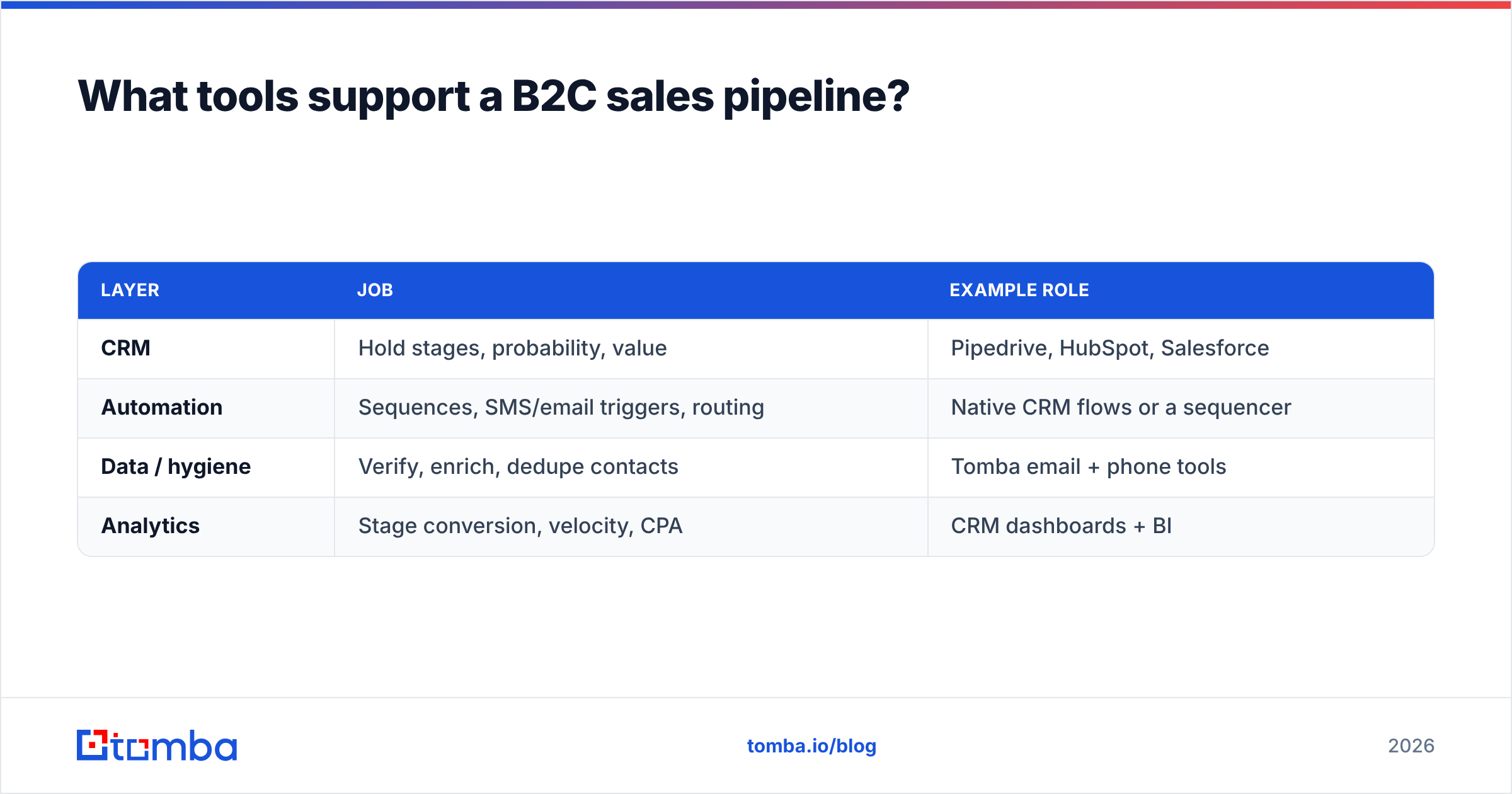
You need three layers: a CRM for the stages, an automation engine for the motion, and a data layer for accuracy. Here is how a typical stack splits the work:
| Layer | Job | Example role |
|---|---|---|
| CRM | Hold stages, probability, value | Pipedrive, HubSpot, Salesforce |
| Automation | Sequences, SMS/email triggers, routing | Native CRM flows or a sequencer |
| Data / hygiene | Verify, enrich, dedupe contacts | Tomba email + phone tools |
| Analytics | Stage conversion, velocity, CPA | CRM dashboards + BI |
Notice the data layer is its own line item, not an afterthought. In B2C, where margins are thin and volume is high, the cheapest way to lift conversion is usually to stop spending on contacts that were never reachable in the first place.
Frequently asked questions#
How many stages should a B2C sales pipeline have? Four to five. Lead capture, qualification, pitch, conversion, and an optional retention stage cover almost every consumer model. More than five usually signals stages that should be merged.
What is a good conversion rate for a B2C pipeline? It varies wildly by industry and price point, but a healthy benchmark is steady, predictable movement between stages with no single drop above 50%. Focus on improving your worst-converting stage rather than chasing an absolute number.
Do I need an email finder for B2C if customers come from ads? Yes for enrichment and verification. Even inbound consumer leads arrive with typos, fake emails, and disconnected numbers. Verifying and enriching them protects your sender reputation and your ad ROI.
Is B2C pipeline management worth the CRM cost? At any real volume, yes. Without a pipeline you are guessing at forecast and blind to leaks. The CRM pays for itself the first time it shows you a stage that is quietly killing 40% of deals.
Keep your B2C pipeline full of real, reachable people#
A great pipeline design still fails if the contacts inside it are fake. Before you obsess over stages and dashboards, fix the front door: make sure every lead is a real person you can actually reach.
Tomba Email Finder helps you do exactly that — find and confirm professional and consumer contact details so your reps spend their time selling, not scrubbing dead leads. Pair it with the built-in verifier and start with the free tier, then scale on the $49/mo Starter plan when your pipeline volume takes off. Fill the top of your funnel with people who actually pick up, and watch every downstream conversion metric follow.
// get started
Find, verify and enrich your first contacts today
Start on the free plan with 25 searches a month, then scale when your team is ready.
Free plan · No credit card required · GDPR & CCPA
// about the author