B2G Lead Generation: The 2026 Government Sales Playbook
Selling to government is slow, regulated, and relationship-driven. Here is a concrete 2026 playbook for building a B2G lead generation engine that actually fills your pipeline.
Selling to the government is not selling to a company with extra paperwork. It is a different motion entirely: longer cycles, committee buyers, public budgets, and procurement rules that can disqualify you before a human ever reads your email. B2G (business-to-government) lead generation is the discipline of finding the right agency, the right official, and the right buying window — then reaching them in a way that survives compliance.
This is the practical version. No "leverage synergies" filler. Just where government demand actually lives, how to qualify it, and the stack that turns a name on an org chart into a verified contact you can work.
TL;DR#
- B2G lead generation means targeting agencies and public officials, not companies — the buyer is a procurement officer, program manager, or department head working inside published budgets and rules.
- Public data is your unfair advantage. Budgets, contract awards, and org charts are open records. SAM.gov, USAspending, and agency directories tell you who is buying what, and when.
- Qualification beats volume. A government lead is only real when budget authority, a funding source, and a buying window line up. Score those three before you spend a sequence.
- Contact data still has to be found and verified. Knowing "the city of Austin needs this" is useless without the named official's working email — which is where a B2G-grade email finder earns its keep.
- Compliance is part of the funnel, not an afterthought. Records retention, opt-out handling, and registration requirements shape how you prospect from day one.
What is B2G lead generation?#
B2G lead generation is the process of identifying government organizations that have a need and a budget, then surfacing the specific people who influence or control that purchase. Think of it like fishing in a stocked, regulated lake: the fish are documented, the seasons are posted, and there is a warden checking your license. You catch more by reading the rules than by casting harder.
The "lead" in B2G is rarely one person. A typical public-sector deal touches several roles, and you need a map of all of them before outreach:
- Program manager — owns the operational need and writes the early requirements.
- Procurement / contracting officer — controls the legal buying process and the RFP.
- Budget or finance lead — confirms the money exists and which fiscal line it sits on.
- Department head or elected official — the executive sponsor who can accelerate or kill it.
- End users — the staff who will actually run your product and influence renewal.
Miss the contracting officer and your deal stalls in procurement. Miss the program manager and you are pitching to someone with no felt pain. B2G lead generation is fundamentally about completeness: you are not done when you have a contact, you are done when you have the committee.

Wait — ignore that placeholder logic; here is the meme that fits:
How is B2G different from B2B lead generation?#
The motions look similar on a Kanban board and behave nothing alike in real life. Here is the honest comparison.
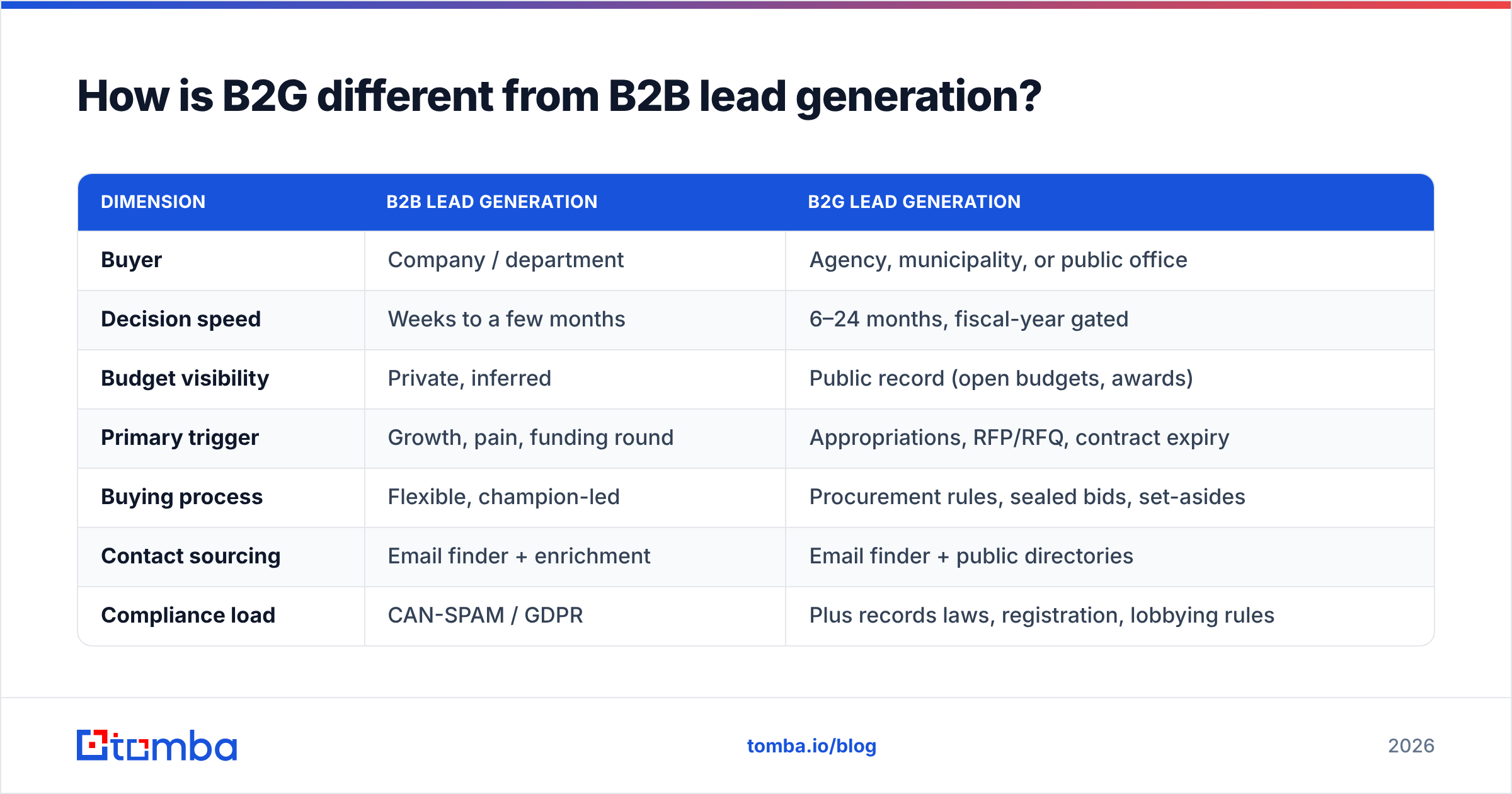
| Dimension | B2B lead generation | B2G lead generation |
|---|---|---|
| Buyer | Company / department | Agency, municipality, or public office |
| Decision speed | Weeks to a few months | 6–24 months, fiscal-year gated |
| Budget visibility | Private, inferred | Public record (open budgets, awards) |
| Primary trigger | Growth, pain, funding round | Appropriations, RFP/RFQ, contract expiry |
| Buying process | Flexible, champion-led | Procurement rules, sealed bids, set-asides |
| Contact sourcing | Email finder + enrichment | Email finder + public directories |
| Compliance load | CAN-SPAM / GDPR | Plus records laws, registration, lobbying rules |
| Renewal logic | Usage + ROI | Re-compete every contract cycle |
The most counterintuitive part: in B2B you fight for information, in B2G you drown in it. Government transparency means budgets, vendors, award amounts, and contact directories are published. The skill is not access — it is filtering signal from a firehose of open data and attaching a verified email to each name you pull.
That difference reshapes your whole approach. If you are coming from a SaaS background, treat B2G like an outbound motion where the "intent data" is already public and the bottleneck is contact accuracy plus patience through the fiscal calendar.
Where do you actually find B2G leads?#
Government demand leaves a paper trail. Your job is to read it earlier than competitors. The richest sources, roughly in order of intent strength:
- Active solicitations — SAM.gov is the U.S. federal system for contract opportunities and entity registration. An open RFP is the strongest possible signal: a buyer with budget and a deadline.
- Spending and award records — USAspending.gov shows who got paid, how much, and for what. Expiring contracts are future opportunities; incumbents are your competitive intel.
- Published budgets — federal, state, county, and city budgets are public. A new line item or a funded initiative is a buying window before any RFP exists.
- Agency org charts and staff directories — most agencies publish leadership and department contacts. This is your raw material for mapping the buying committee.
- Grant announcements — federal grants to states and municipalities often fund downstream purchasing. Follow the grant, find the buyer.
- Public meeting minutes and agendas — city council and school board agendas telegraph priorities months before procurement.
- GSA schedules — GSA Multiple Award Schedules show which vendors are pre-approved, telling you the competitive field and the buying vehicle.
Each of these gives you an organization and often a role — but rarely a clean, current email. A directory might list a department's general line; a budget PDF names a program director with no contact at all. That gap between "I know who" and "I can reach them" is the real bottleneck, and it is exactly the gap a domain search closes by returning the email pattern and known addresses for an agency's domain.
How do you qualify a B2G lead?#
A government lead is qualified when three things are true at the same time: there is a need, there is money, and there is a window. Miss any one and you are early, broke, or too late.
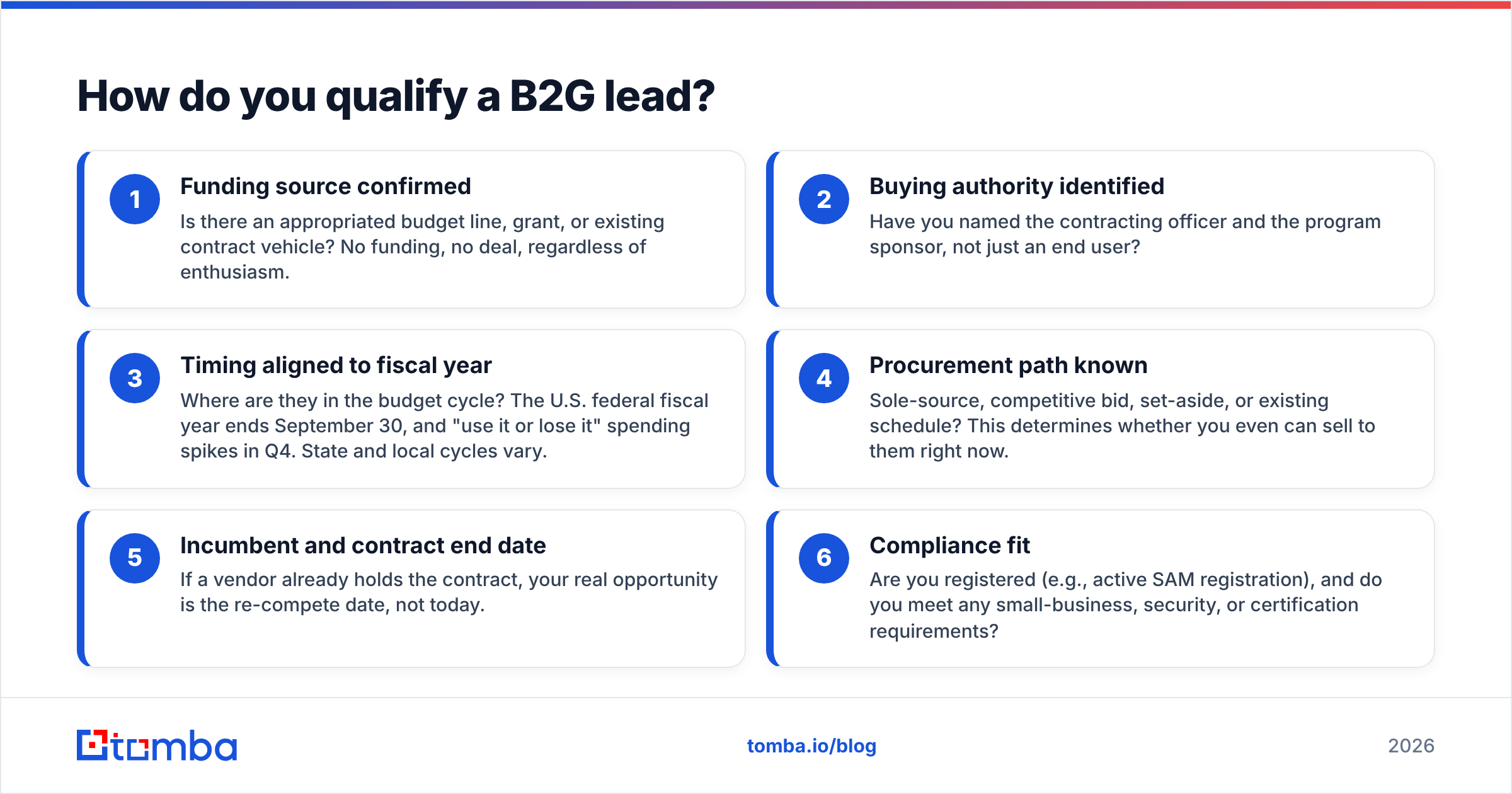
Score each lead against this checklist before it earns a sequence:
- Funding source confirmed — Is there an appropriated budget line, grant, or existing contract vehicle? No funding, no deal, regardless of enthusiasm.
- Buying authority identified — Have you named the contracting officer and the program sponsor, not just an end user?
- Timing aligned to fiscal year — Where are they in the budget cycle? The U.S. federal fiscal year ends September 30, and "use it or lose it" spending spikes in Q4. State and local cycles vary.
- Procurement path known — Sole-source, competitive bid, set-aside, or existing schedule? This determines whether you even can sell to them right now.
- Incumbent and contract end date — If a vendor already holds the contract, your real opportunity is the re-compete date, not today.
- Compliance fit — Are you registered (e.g., active SAM registration), and do you meet any small-business, security, or certification requirements?
The discipline here mirrors a strong lead scoring model: you are not ranking interest, you are ranking winnability. A loud program manager with no funding scores lower than a quiet finance lead sitting on an expiring contract.
What does a B2G lead generation stack look like?#
You need four capabilities, and you can assemble them without an enterprise budget. The layers, and what each one does:
- Opportunity discovery — monitoring SAM.gov, USAspending, budgets, and meeting agendas for triggers. Some teams buy a govtech intelligence platform here; many start with free alerts and a tracked spreadsheet.
- Account and committee mapping — turning an agency into a named list of roles. Public directories plus LinkedIn get you names and titles.
- Contact sourcing and verification — converting names into verified, working emails and phone numbers. This is where accuracy compounds: a 30% bounce rate on government domains shreds your sender reputation and your credibility.
- Outreach and CRM — sequencing, tracking, and compliance logging. Public-sector cycles are long, so your CRM has to hold a thread warm for a year.
The middle two layers are where most teams bleed time. You have a name from a budget PDF and a department from an org chart, but no email. Manually guessing firstname.lastname@agency.gov and hoping is not a strategy — government domains use inconsistent patterns, and a wrong guess to a .gov address is a deliverability liability.
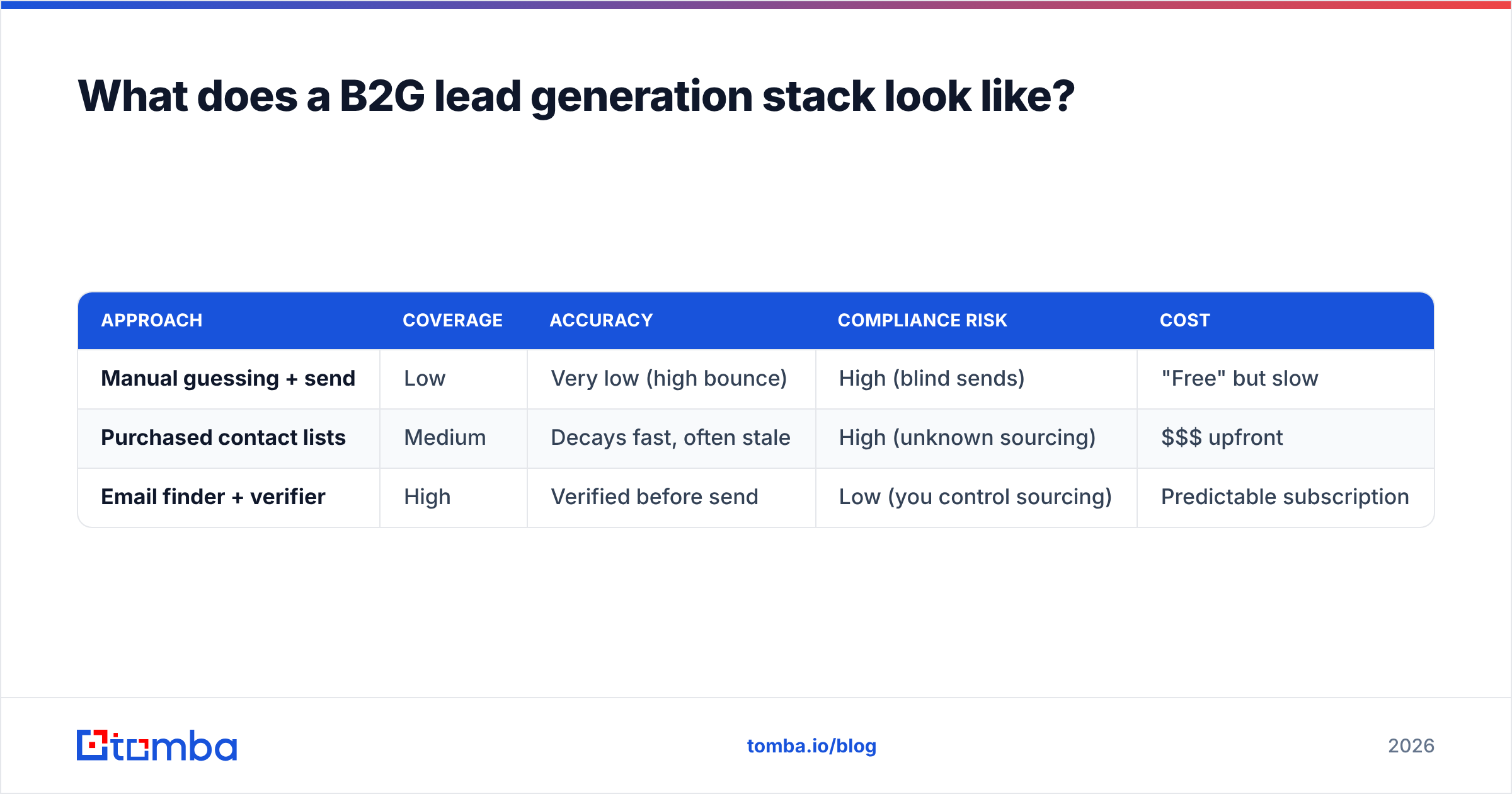
Here is how a dedicated finder-plus-verifier layer compares to the two shortcuts teams usually reach for:
| Approach | Coverage | Accuracy | Compliance risk | Cost |
|---|---|---|---|---|
| Manual guessing + send | Low | Very low (high bounce) | High (blind sends) | "Free" but slow |
| Purchased contact lists | Medium | Decays fast, often stale | High (unknown sourcing) | $$$ upfront |
| Email finder + verifier | High | Verified before send | Low (you control sourcing) | Predictable subscription |
A B2G-grade tool should let you search by agency domain, return the contact's role, and verify the address before you ever hit send. With Tomba pricing starting free at 25 searches a month and a Starter plan at $49/mo, you can validate the motion on a single agency before committing budget — then scale into bulk once your qualification checklist is dialed in. Pair the finder with an email verifier so every .gov and .us address is confirmed deliverable, and use a phone finder for the relationship-building calls that public-sector deals ultimately turn on.
How do you stay compliant while prospecting government?#
Compliance is not a legal afterthought you bolt on before signing — it shapes how you prospect from the first email. Get this wrong and you do not just lose a deal, you can get your domain blocked across an entire agency.
The non-negotiables:
- Honor anti-spam law. CAN-SPAM in the U.S. requires accurate headers, a real physical address, and a working opt-out. Government recipients are not exempt, and they are unusually quick to report.
- Respect public records reality. Emails you send to officials may become public record. Write every message as if it could be published — because it can.
- Register where required. Selling to the U.S. federal government generally requires an active SAM.gov registration and often specific certifications. Some states maintain their own vendor registries.
- Mind lobbying and gift rules. Certain outreach can be construed as lobbying. Anything resembling a gift or inducement is off-limits with public officials.
- Source contacts cleanly. This is why verified, transparently-sourced data beats purchased lists. Knowing where your contact data came from is part of your compliance posture — check how Tomba sources its data before you build on any provider.
Strong email deliverability hygiene — verifying before sending, warming your domain, keeping bounce rates low — doubles as compliance hygiene. The same practices that keep you out of spam folders keep you out of trouble.
A 30-day B2G lead generation starting plan#
You do not need a six-figure govtech platform to begin. Run this in your first month:
- Week 1 — Pick one vertical and one geography. Public safety in mid-size cities. K-12 IT in one state. Narrow beats broad; the procurement rules and buyer roles repeat within a niche.
- Week 2 — Build the trigger watchlist. Set SAM.gov and USAspending alerts, bookmark 10 target agencies' budget and agenda pages, and log expiring contracts in your niche.
- Week 3 — Map and source contacts. For each triggered account, build the buying committee from directories and LinkedIn, then find and verify emails with an email finder and verifier.
- Week 4 — Launch compliant, role-specific outreach. Write separately to the program manager (pain), the contracting officer (process), and the budget lead (ROI). Log everything in your CRM for the long cycle ahead.
Measure leading indicators, not just closed deals — government cycles are too long for monthly revenue to tell you anything. Track verified contacts added, committees completed, and triggers acted on per week.
Frequently asked questions#
Is B2G lead generation worth it for a small company? Yes, often more than B2B. Government buyers value stability and frequently have set-asides for small and disadvantaged businesses. The barrier is patience and process, not company size.
How long is a typical B2G sales cycle? Plan for 6 to 24 months. Federal tends to be longest; local government and "use it or lose it" end-of-fiscal-year spending can move faster.
Can I just buy a list of government contacts?
You can, but accuracy decays fast and sourcing is opaque — a real compliance and deliverability risk on .gov domains. Finding and verifying contacts yourself, on demand, is more accurate and more defensible.
What is the single highest-intent B2G signal? An active, funded solicitation (RFP/RFQ) in your niche. Right behind it: a contract approaching its expiry date, which tells you exactly when the re-compete window opens.
Build your government pipeline on verified contacts#
The hard part of B2G lead generation is not finding demand — government publishes its budgets, its awards, and its org charts. The hard part is turning a name in a budget PDF into a verified person you can actually reach without torching your sender reputation. That last mile is where deals are won or quietly lost.
Start there. Use the Tomba Email Finder to search any agency domain, surface the program managers and contracting officers behind your target opportunities, and verify every address before you send. Begin on the free tier, prove the motion on one agency, and scale into a compliant public-sector pipeline that compounds with every fiscal year. Your government buyers are already documented — go find the right person and reach them cleanly.
// get started
Find, verify and enrich your first contacts today
Start on the free plan with 25 searches a month, then scale when your team is ready.
Free plan · No credit card required · GDPR & CCPA
// about the author