BANT Appointment Setting in 2026: A Qualification Playbook
BANT appointment setting filters tire-kickers before they hit your calendar. Here's how to qualify on Budget, Authority, Need, and Timing without killing your meeting volume.
TL;DR
- BANT appointment setting means qualifying a prospect on Budget, Authority, Need, and Timing before you put a meeting on a closer's calendar.
- Done right, it raises meeting-to-opportunity conversion and cuts no-shows — done wrong, it strangles your pipeline by disqualifying good-fit leads too early.
- Modern BANT is a flexible scorecard, not a rigid gate: weight Need and Timing higher than Budget for early-stage buyers.
- Accurate contact data is the unsung half of the job — you can't set an appointment with the right authority figure if you can't reach them.
- Pair a lightweight BANT script with a verified contact source like Tomba Email Finder to keep both quality and volume high.
What is BANT appointment setting?#
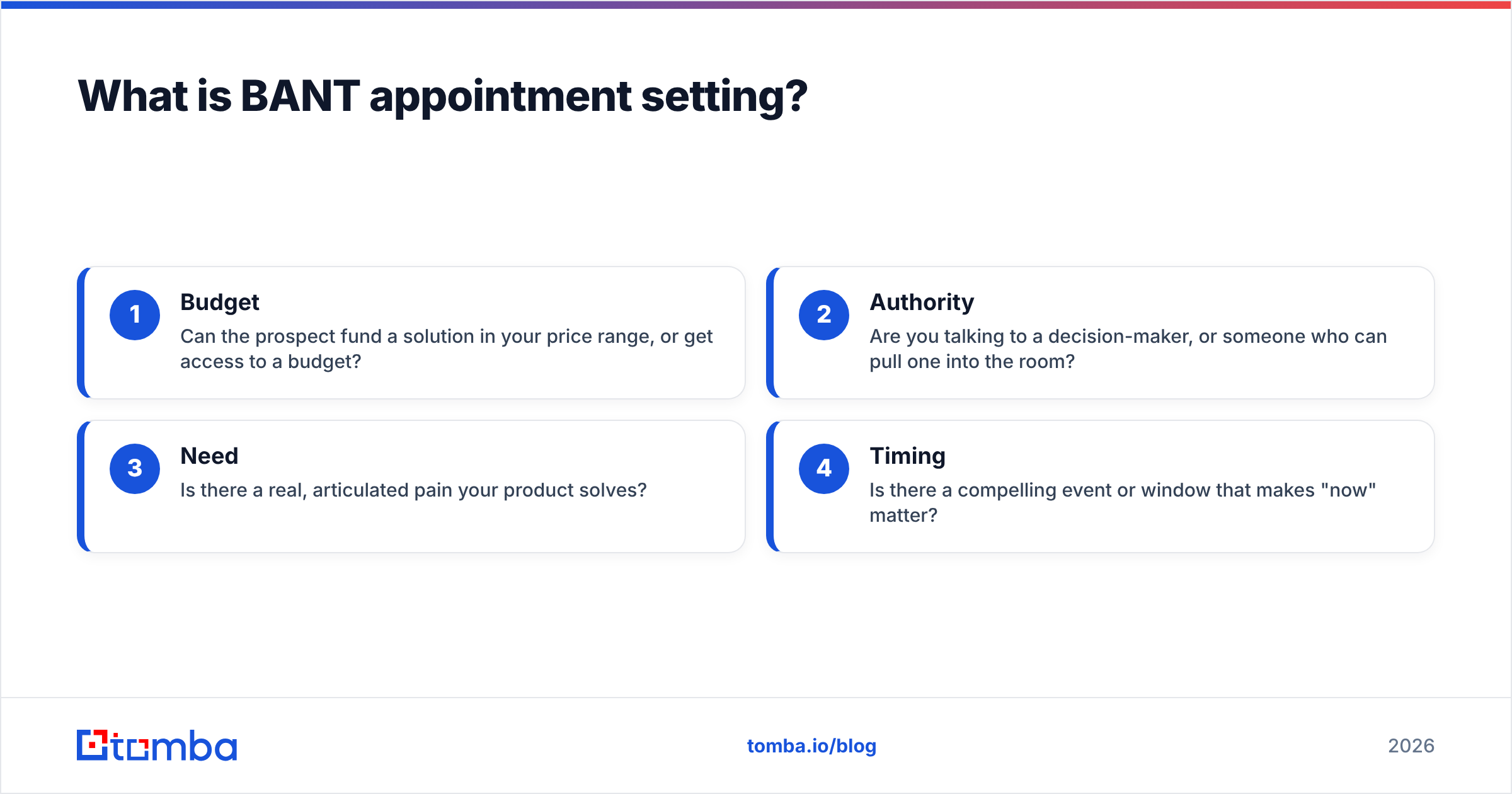
BANT appointment setting is the practice of running a prospect through four qualification checks — Budget, Authority, Need, and Timing — and only booking a sales meeting once they clear a defined threshold.
Think of it like a restaurant's reservation desk. You don't seat every walk-in at the chef's tasting table; you confirm party size, the occasion, and whether they actually want the tasting menu before you commit the kitchen's best hour to them. BANT does the same for your closers' calendars: it protects the most expensive resource in your sales org — rep selling time — from low-intent bookings.
BANT itself is old. IBM popularized it decades ago as a way for sellers to decide which deals deserved attention. What's changed in 2026 is where it sits. Instead of a closer running BANT live on a discovery call, the qualification now happens earlier — during outreach and appointment setting — so the meeting that lands on the calendar is already pre-vetted. That shift is why "BANT appointment setting" is now its own discipline, often owned by SDRs, BDRs, or a dedicated appointment-setting team.
The four pillars, briefly:
- Budget — Can the prospect fund a solution in your price range, or get access to a budget?
- Authority — Are you talking to a decision-maker, or someone who can pull one into the room?
- Need — Is there a real, articulated pain your product solves?
- Timing — Is there a compelling event or window that makes "now" matter?
Why does BANT still matter for appointment setters?#
Because a booked meeting is a vanity metric until it converts. The job of an appointment setter is not to fill a calendar — it's to fill a calendar with meetings a closer can actually win.
Unqualified meetings cost more than they look. Every no-show or instant-disqualify call burns prep time, context-switching, and follow-up admin. Worse, they pollute your data: when half your "meetings booked" never had budget or authority, your conversion benchmarks become noise and you can't forecast.

BANT appointment setting fixes the signal. When every booked meeting carries a BANT note — "Director of Ops, evaluating two vendors, renewal in Q3, budget approved" — the closer walks in warm and the pipeline forecast means something. According to HubSpot's sales research, reps who prioritize and qualify leads before outreach consistently outperform those who treat every contact equally.
There's a second, quieter reason: reputation. Booking a VP into a demo they have zero need for doesn't just waste your time — it teaches that VP that your brand wastes theirs. Good qualification is good manners.
How is modern BANT different from the old version?#
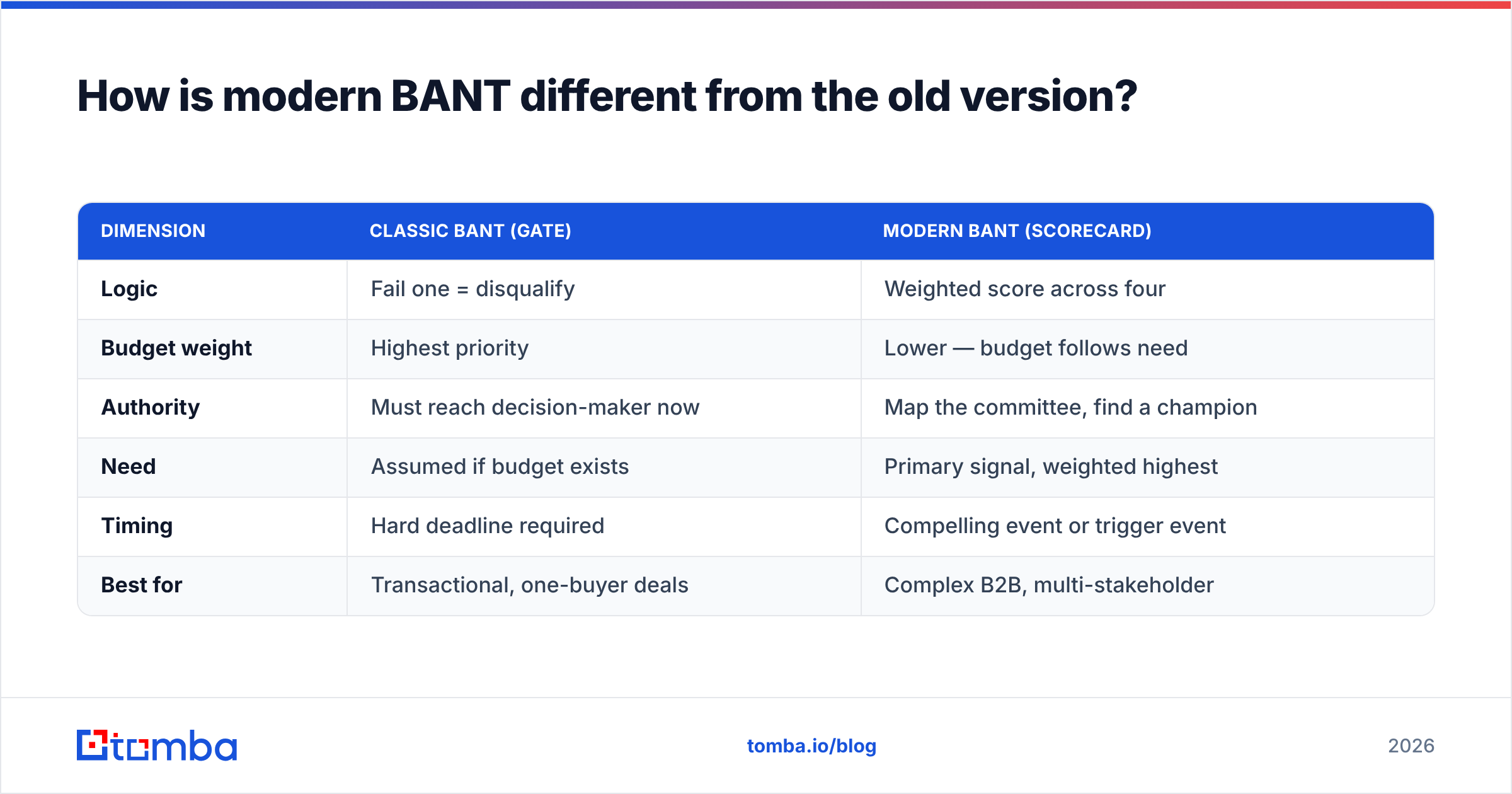
The old BANT was a hard gate: fail any one pillar, lose the lead. That logic kills too many deals in a 2026 buying environment where budgets are assembled mid-cycle and authority is distributed across buying committees.
Modern BANT treats the four pillars as a weighted scorecard, not a pass/fail checklist. A prospect with screaming Need and a tight Timing window but no confirmed Budget is still worth a meeting — budget often appears once need is validated. Conversely, a prospect with budget but no real need is a polite "no."
Here's the practical contrast:
| Dimension | Classic BANT (gate) | Modern BANT (scorecard) |
|---|---|---|
| Logic | Fail one = disqualify | Weighted score across four |
| Budget weight | Highest priority | Lower — budget follows need |
| Authority | Must reach decision-maker now | Map the committee, find a champion |
| Need | Assumed if budget exists | Primary signal, weighted highest |
| Timing | Hard deadline required | Compelling event or trigger event |
| Best for | Transactional, one-buyer deals | Complex B2B, multi-stakeholder |
The reorder matters. For most B2B SaaS and services in 2026, the priority is N → T → A → B: confirm the pain, find the window, identify who decides, then talk money. Leading with budget on a first touch reads as pushy and disqualifies champions who don't control the purse but do control the agenda.

How do you score a lead with BANT?#
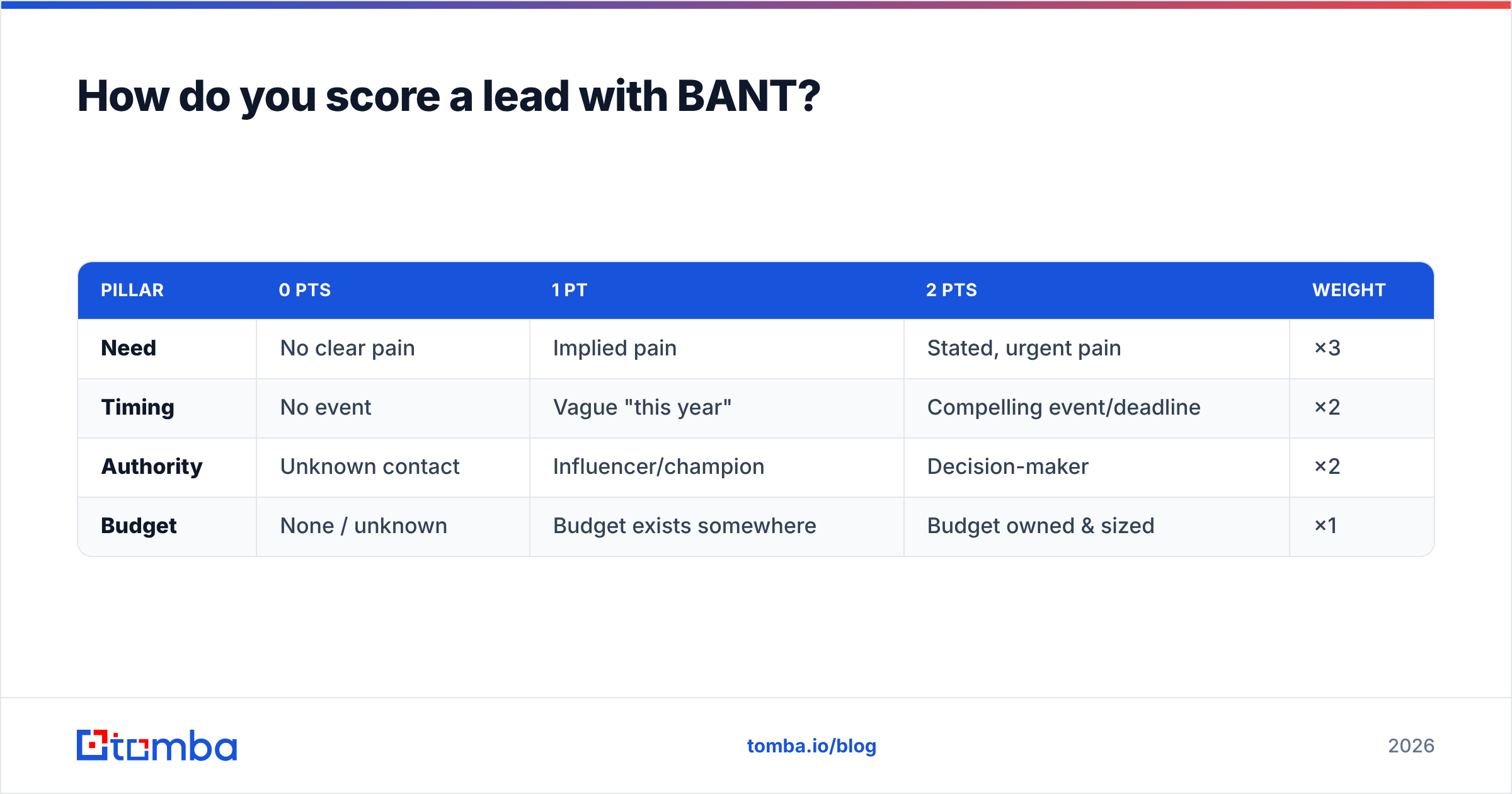
Assign points per pillar, set a booking threshold, and write the rationale into the CRM so the closer inherits it. A simple, defensible model:
| Pillar | 0 pts | 1 pt | 2 pts | Weight |
|---|---|---|---|---|
| Need | No clear pain | Implied pain | Stated, urgent pain | ×3 |
| Timing | No event | Vague "this year" | Compelling event/deadline | ×2 |
| Authority | Unknown contact | Influencer/champion | Decision-maker | ×2 |
| Budget | None / unknown | Budget exists somewhere | Budget owned & sized | ×1 |
Multiply each pillar's points by its weight and sum. With this model the max is 16. A reasonable booking threshold is 8+, meaning a lead can clear the bar on strong Need and Timing alone even with unknown budget — exactly the flexibility complex deals require.
The discipline isn't the math; it's forcing a number and a note. "Booked — score 11: stated pain (data hygiene), renewal Q3 (timing), spoke to RevOps lead (champion), budget TBD" gives the closer a real starting point. A blank "demo booked" gives them nothing.
For appointment-setting teams, bake the four questions into your discovery flow so scoring is a byproduct of a normal conversation, not an interrogation. If you run outbound at scale, you can even pre-score on firmographic fit (company size, industry, tech stack) using data enrichment before a human ever dials — so reps spend BANT energy only on accounts that already fit.
What questions actually surface BANT on a call?#
Ask about the pillars indirectly. Nobody answers "What's your budget?" honestly on a cold call, but everyone answers "What have you tried so far?" Here's a usable script frame:
Need (lead with this):
- "What pushed you to take this call today?"
- "How are you handling [problem] right now — and where does it break?"
Timing:
- "Is this something you're looking to fix this quarter, or is it more exploratory?"
- "Is there an event — a renewal, a launch, a board target — driving the timeline?"
Authority:
- "Besides yourself, who else would weigh in on a decision like this?"
- "How did the last tool in this category get approved?"
Budget (last, softest):
- "Do you have a sense of what you'd want to invest to solve this — or is that something we'd scope together?"
Notice the budget question assumes collaboration, not interrogation. That phrasing keeps champions on side instead of triggering a defensive "we don't have budget" reflex.
Where does contact data fit into BANT appointment setting?#
You can run flawless BANT logic and still fail if you can't reach the right person. Authority — the "A" — is a data problem before it's a conversation problem.
Here's the trap: your SDR qualifies an account, identifies that the VP of Operations is the real decision-maker, and then... has no working email or phone number for that VP. The meeting never gets set, or it gets set with the wrong, reachable-but-powerless contact. That's not a qualification failure; it's a reach failure dressed up as one.
This is where accurate, verified contact data earns its keep. To book the right authority figure, you need:
- The decision-maker's actual email, not a guessed
firstname@company.comthat bounces and torches your sender reputation. - A direct phone line when email goes cold — appointment setting is still a multi-channel game.
- Verification before send, so your carefully qualified outreach actually lands.
A bounced email to a qualified buyer is a self-inflicted disqualification. Use an email verifier to confirm deliverability before outreach, and a phone finder to add a second channel when your top-scored accounts go quiet on email. For reaching a named decision-maker at a known company, domain search returns the email patterns and contacts for that organization so you're aiming at the right person from the first touch.
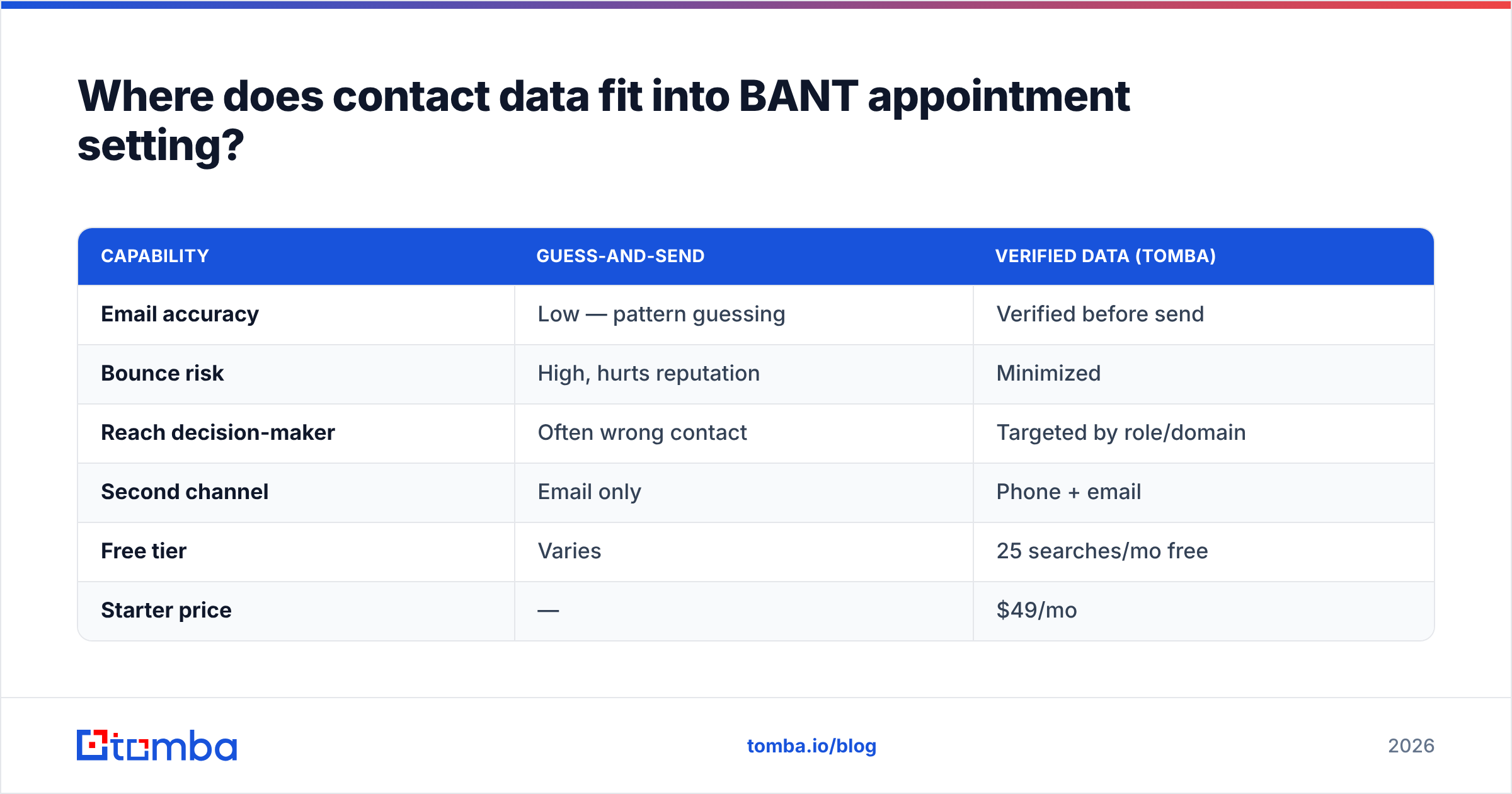
Tomba's role here is narrow and honest: it doesn't qualify the lead for you, but it makes sure the lead you qualified is reachable. Compare the data side of your stack like this:
| Capability | Guess-and-send | Verified data (Tomba) |
|---|---|---|
| Email accuracy | Low — pattern guessing | Verified before send |
| Bounce risk | High, hurts reputation | Minimized |
| Reach decision-maker | Often wrong contact | Targeted by role/domain |
| Second channel | Email only | Phone + email |
| Free tier | Varies | 25 searches/mo free |
| Starter price | — | $49/mo |
You can see full Tomba pricing for where the credits scale, but the point stands at any tier: BANT qualifies the who; verified data makes the who reachable.
What are the common BANT appointment-setting mistakes?#
Leading with budget. It's the fastest way to lose a champion who doesn't control spend but does control whether you get into the room. Budget comes last, softly.
Treating BANT as pass/fail. A no-budget-yet lead with urgent need is one internal conversation away from being your best deal. Score it, don't bin it.
Booking the reachable contact instead of the right one. If your only working email is for a non-decision-maker, you've optimized for convenience over outcome. Fix the data gap with a proper email finder instead of settling.
No BANT note in the CRM. Qualification that lives only in the setter's head is qualification that dies at the handoff. Write the score and the rationale every time.
Over-qualifying on cold outreach. You cannot fully BANT a prospect who hasn't agreed to talk. On the first touch, qualify on fit (firmographics, role, trigger events); save the full BANT for the live conversation. Tools like G2's buyer intent data can flag fit-and-timing signals before you ever reach out.
Ignoring the disqualified. A "not now" with strong need and no timing isn't a no — it's a nurture. Tag it and recycle it when the compelling event arrives.
How do you operationalize BANT across a team?#
Make it boring and repeatable. The teams that win with BANT appointment setting treat it as a system, not a talent:
- Standardize the scorecard. One model, one threshold, documented. Everyone scores the same way or your data is noise.
- Script the discovery. Bake the four pillars into your call flow so scoring happens naturally.
- Gate the handoff. Closers only accept meetings that carry a BANT score and note. No note, no meeting.
- Feed the data layer. Before a setter spends BANT effort, enrich the account so they're only qualifying good-fit, reachable contacts. Bulk-enrich lists with a bulk email finder so your team starts every day with verified targets.
- Review the misses. Audit booked-but-lost meetings monthly. Were they mis-scored, or mis-reached? The fix is different for each.
The compounding effect is real: tighter qualification produces cleaner data, cleaner data produces better forecasts, and better forecasts let you double down on the segments that actually convert. For a deeper definition of the qualification stage in your funnel, Salesforce's guide to lead qualification is a solid neutral reference.
The bottom line#
BANT appointment setting works in 2026 when you treat it as a weighted scorecard — Need and Timing first, Budget last — and when you close the data gap that quietly sinks half of all "qualified" meetings. Qualify the who, then make sure the who is reachable.
That second half is where your stack matters. Once your scorecard says a decision-maker is worth a meeting, you need their real, verified contact details to actually book it — not a guessed address that bounces and burns your reputation. Tomba Email Finder gives you verified emails by name, domain, or company, with an email verifier and phone finder alongside it, so every qualified lead becomes a reachable one. Start on the free tier (25 searches/month), and scale to Starter at $49/mo when your booked-meeting quality starts compounding. Qualify smarter, reach the right person, and let your closers walk into meetings that were already worth taking.
Ready to find emails that actually work?
Join 150,000+ professionals who stopped guessing and started sending. Free credits on signup — no credit card required.
Get the Tomba newsletter
Practical outbound tactics and product updates — once every two weeks.
About the author