BANT Framework in 2026: How to Qualify B2B Leads Faster
BANT has qualified B2B leads since the IBM era. Here's how the framework works in 2026, where it breaks, and how to feed it real data so reps stop chasing dead deals.
BANT Framework in 2026: How to Qualify B2B Leads Faster
TL;DR
- BANT (Budget, Authority, Need, Timing) is a 60-year-old lead qualification framework from IBM that still works — but only when you stop guessing the answers.
- It is fast and rep-friendly, which is why it survives, yet it fails on complex deals with buying committees and no fixed budget line.
- In 2026, the winning move is to pre-fill Budget, Authority, Need, and Timing signals with enriched data before the rep ever dials.
- BANT pairs well with modern frameworks like MEDDIC and CHAMP — use BANT to disqualify fast, then go deep.
- Accurate contact and company data is the fuel. Bad data turns BANT into expensive guesswork.
If your reps are spending discovery calls asking "So, do you have budget for this?", you are burning pipeline. The BANT framework is supposed to answer that question before the call — not during it. This guide breaks down what BANT is, where it still wins in 2026, where it quietly costs you deals, and how to feed it the data it needs to actually work.
What is the BANT framework?#
BANT is a sales qualification checklist that scores a lead on four criteria: Budget, Authority, Need, and Timing. If a prospect clears all four, they are "BANT qualified" and worth a rep's time. If they miss two or more, you disqualify or nurture instead of chasing.
IBM created BANT in the 1960s to help sellers triage leads at scale, and the logic has barely changed because the underlying questions never go out of style. Here is what each letter actually asks:
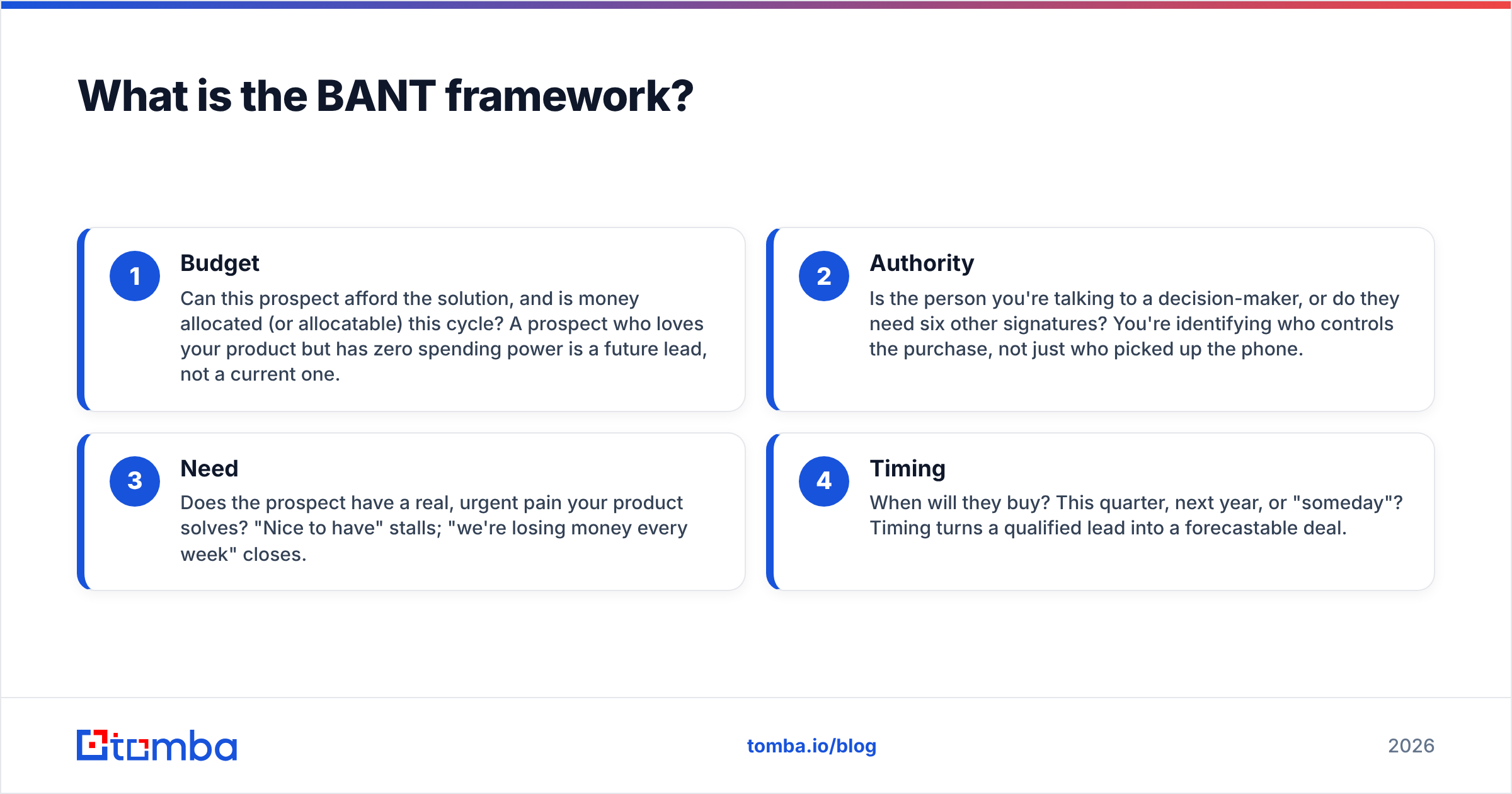
- Budget — Can this prospect afford the solution, and is money allocated (or allocatable) this cycle? A prospect who loves your product but has zero spending power is a future lead, not a current one.
- Authority — Is the person you're talking to a decision-maker, or do they need six other signatures? You're identifying who controls the purchase, not just who picked up the phone.
- Need — Does the prospect have a real, urgent pain your product solves? "Nice to have" stalls; "we're losing money every week" closes.
- Timing — When will they buy? This quarter, next year, or "someday"? Timing turns a qualified lead into a forecastable deal.
The framework is deliberately blunt. Its whole value is speed — a rep can run BANT in the first few minutes of a conversation and decide whether to invest the next two hours or move on. For a deeper definition of where qualification sits in the funnel, see how a marketing qualified lead becomes sales-ready in the first place.

Wait — ignore that. There is no chart here; the four criteria above are the diagram. Let's keep moving.
Why does BANT still matter in 2026?#
Because speed-to-disqualify is a competitive advantage. The average B2B rep wastes a huge share of their week on deals that were never going to close. BANT's job is to kill those deals on day one.
The reason teams keep coming back to BANT — even after trying flashier frameworks — comes down to three things:
- It's memorable. Four letters. A new SDR can learn it in an afternoon, which matters when you're onboarding at scale.
- It maps to a real buying decision. Every purchase eventually needs money, a signer, a reason, and a date. BANT just names them.
- It's a filter, not a full methodology. You're not trying to win the deal with BANT. You're trying to decide whether the deal is real. That narrow scope is a feature.
)
The catch: BANT is only as good as the answers you put into it. And most teams are still asking for those answers when they should already have them.
How do you actually run a BANT qualification?#
Run it as a scorecard, not an interrogation. The mistake reps make is treating BANT like a literal four-question survey on the call. Prospects hate it, and the answers you get under pressure are unreliable. Instead, gather what you can in advance and use the call to confirm and deepen.
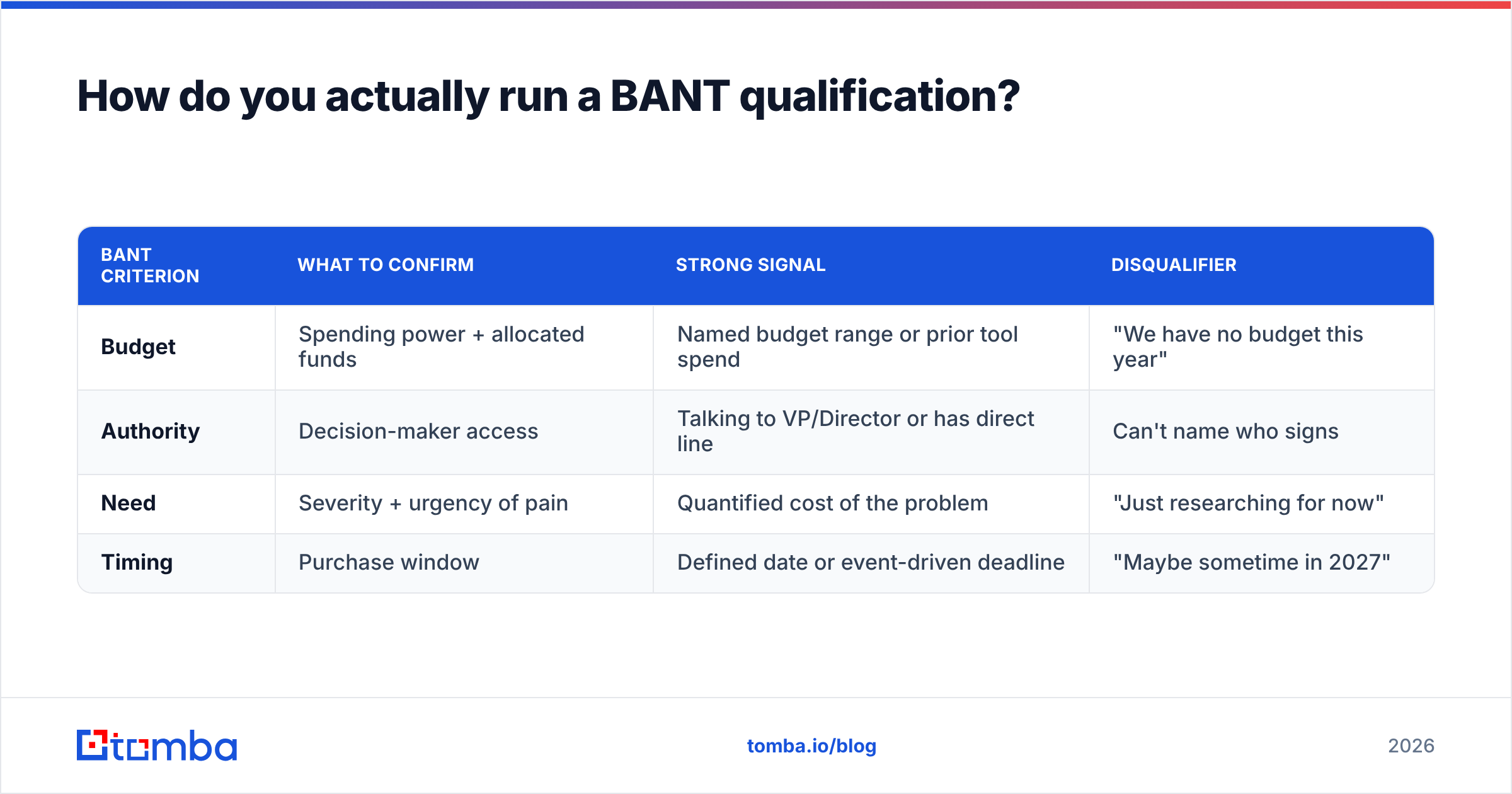
Here's a practical BANT scorecard you can drop into your CRM:
| BANT criterion | What to confirm | Strong signal | Disqualifier |
|---|---|---|---|
| Budget | Spending power + allocated funds | Named budget range or prior tool spend | "We have no budget this year" |
| Authority | Decision-maker access | Talking to VP/Director or has direct line | Can't name who signs |
| Need | Severity + urgency of pain | Quantified cost of the problem | "Just researching for now" |
| Timing | Purchase window | Defined date or event-driven deadline | "Maybe sometime in 2027" |
Score each from 0–2. A lead scoring 6+ is hot, 4–5 needs nurturing, and below 4 gets disqualified or recycled. The point is consistency: every rep grades the same way, so your pipeline forecast actually means something.
Two of these four — Budget and Authority — can be largely answered before the call using firmographic and contact data. If you know the company's size, funding stage, tech stack, and the exact title and seniority of the person you're emailing, you've pre-scored half of BANT without asking a single awkward question. That's where enrichment earns its keep; pulling data enrichment into the lead record means your rep walks in already knowing who controls the money.
What are the weaknesses of the BANT framework?#
BANT's bluntness is also its blind spot. It was built for a single-buyer, fixed-budget world, and modern B2B deals often aren't that. Knowing where BANT breaks lets you patch it instead of abandoning it.
- Budget-first thinking kills early-stage deals. Many real buyers don't have a budget line until after they're convinced there's a problem worth solving. Leading with budget disqualifies prospects who would have created budget for the right solution.
- "Authority" ignores buying committees. Gartner's research on B2B buying shows the typical purchase now involves a committee of multiple stakeholders, not one decision-maker. BANT's single-authority lens misses the other people who can quietly veto your deal.
- Need is treated as binary. Real need exists on a spectrum and shifts as the buyer learns. A one-time "yes/no" check freezes a moving target.
- Timing is easy to fake. Prospects say "next quarter" to be polite. Without an event-driven trigger (contract renewal, funding round, new hire), stated timing is noise.
This is why some teams layer BANT with a deeper methodology once a lead passes the initial filter. BANT gets you to "this is real"; frameworks like MEDDIC get you to "and here's how we win it."
BANT vs MEDDIC vs CHAMP vs ANUM: which framework wins?#
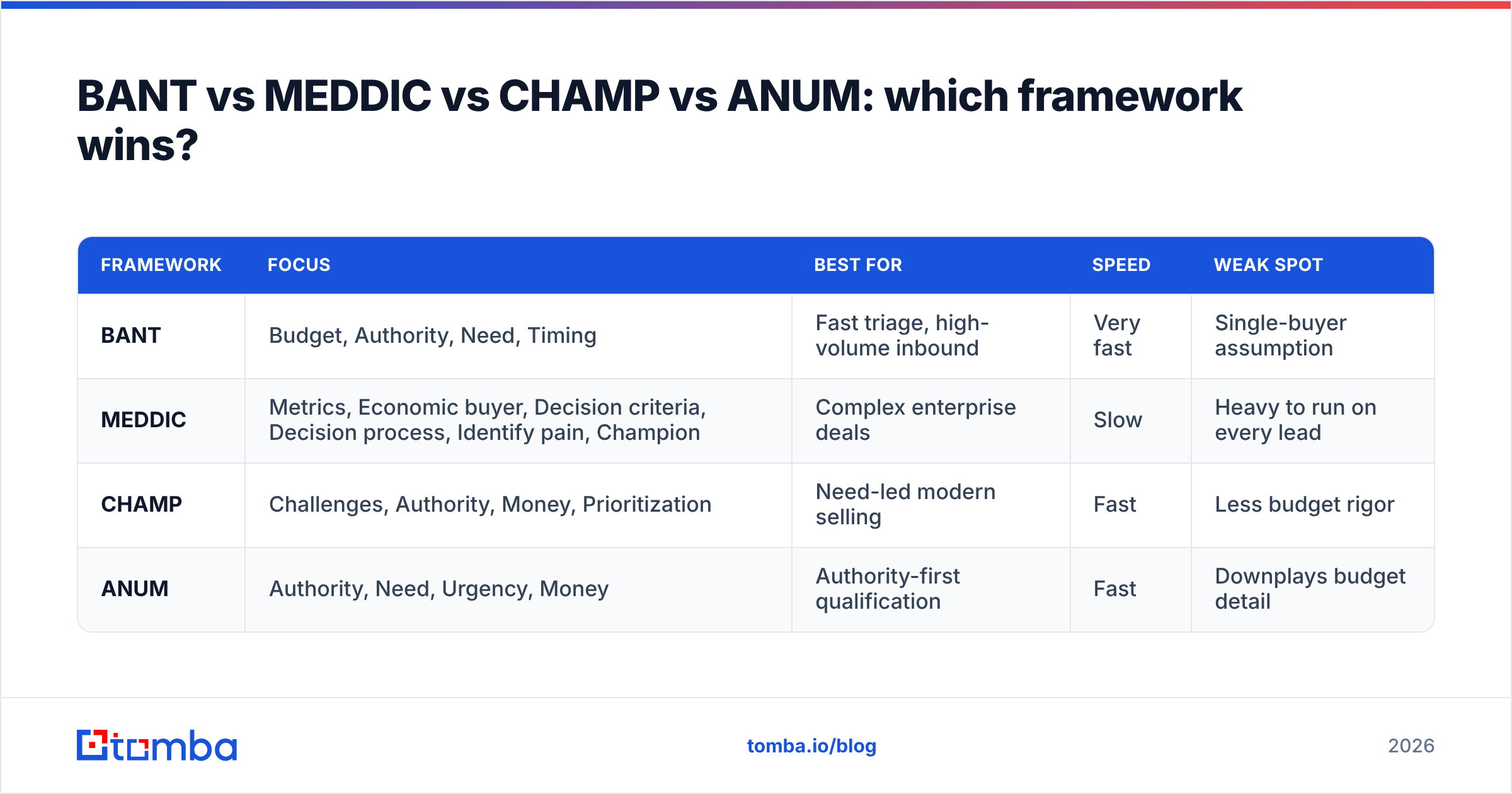
None of them "win" outright — they solve different problems. BANT is your fast triage filter. The others trade speed for depth. Pick based on deal complexity and sales cycle length.
| Framework | Focus | Best for | Speed | Weak spot |
|---|---|---|---|---|
| BANT | Budget, Authority, Need, Timing | Fast triage, high-volume inbound | Very fast | Single-buyer assumption |
| MEDDIC | Metrics, Economic buyer, Decision criteria, Decision process, Identify pain, Champion | Complex enterprise deals | Slow | Heavy to run on every lead |
| CHAMP | Challenges, Authority, Money, Prioritization | Need-led modern selling | Fast | Less budget rigor |
| ANUM | Authority, Need, Urgency, Money | Authority-first qualification | Fast | Downplays budget detail |
The pragmatic 2026 stack: use BANT to disqualify in the first touch, then graduate surviving deals into MEDDIC for the discovery and close. CHAMP is a solid swap if your market rarely has pre-set budgets — it reorders the priorities so you lead with the prospect's challenges instead of their wallet. HubSpot's sales methodology library has good worked examples of each if you want to see them applied to real cadences.
)
How does data make or break BANT?#
Garbage in, garbage out — BANT amplifies whatever data quality you feed it. A perfectly run BANT process on stale contact records still routes reps to dead numbers and departed decision-makers. The framework can't tell the difference between a real "Authority" and a contact who left the company eight months ago.
Three data problems quietly wreck BANT scoring:
- Wrong contact = wrong Authority. If you're emailing a generic info@ address or a junior IC, your Authority score is fiction. You need verified, role-accurate contacts to know you're talking to a signer.
- No firmographics = guessed Budget. Company size, funding, and headcount are your best proxies for spending power. Without them, reps inflate Budget scores on hope.
- Bouncing emails = no Timing data at all. If your outreach never lands, you never learn the buying window. Deliverability is upstream of every BANT signal you hope to collect.
This is the unglamorous truth: most "BANT isn't working" complaints are actually "our data isn't working" complaints. Before you blame the framework, check whether the inputs are real. Tools that find and verify the right contact — like an email finder tied to company-level data — turn BANT from a guessing game into a scoring system. The richer your lead record before qualification, the more of BANT you can answer without burning a call.
For high-volume inbound, the play is to enrich and pre-score every lead automatically, so reps only see leads that already clear the Budget and Authority bars. That's the difference between a team that runs BANT and a team that runs BANT fast.
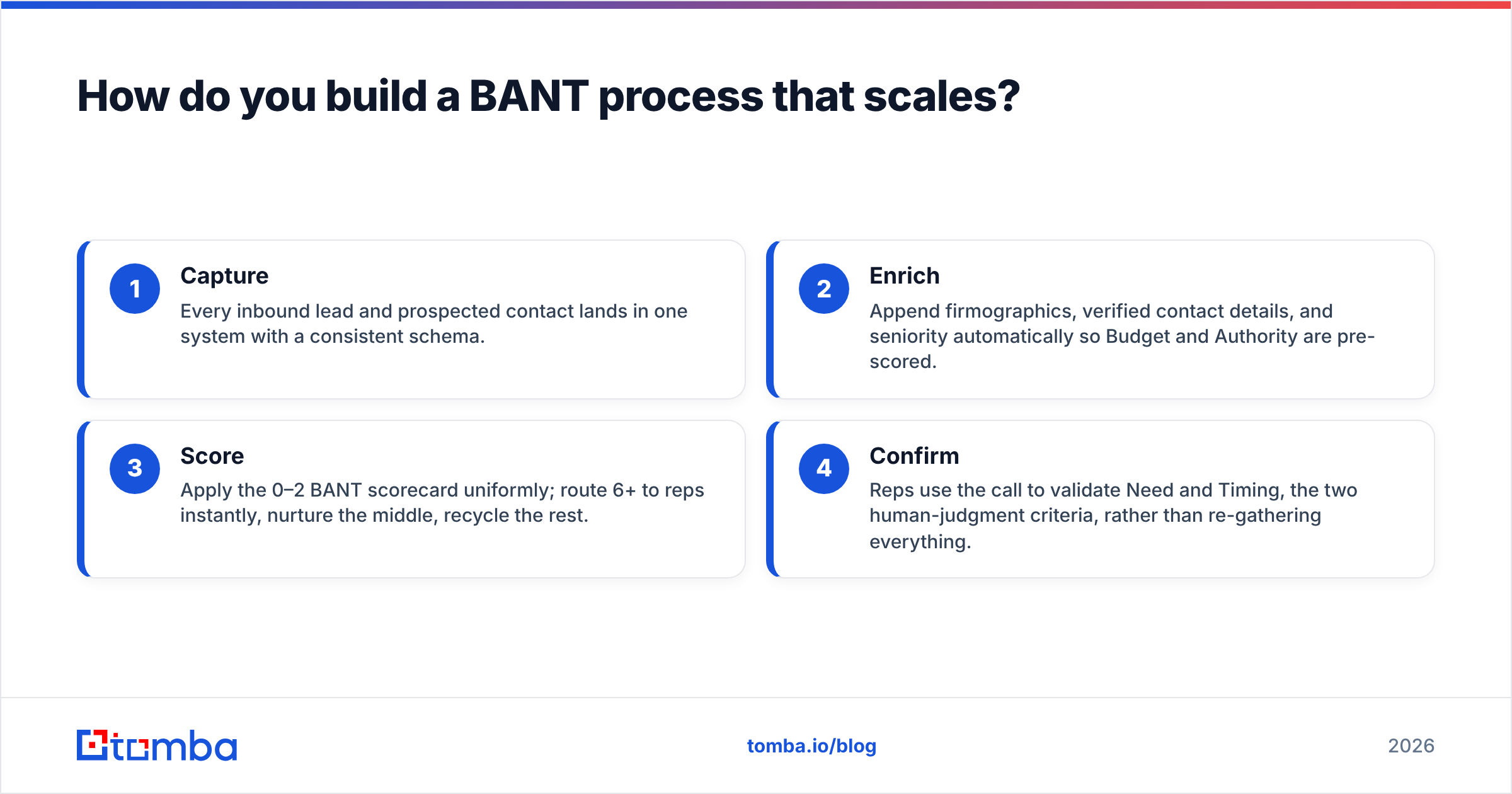
How do you build a BANT process that scales?#
Automate the inputs, standardize the scoring, and keep the human judgment for the call. A scalable BANT process has four moving parts:
- Capture — Every inbound lead and prospected contact lands in one system with a consistent schema.
- Enrich — Append firmographics, verified contact details, and seniority automatically so Budget and Authority are pre-scored.
- Score — Apply the 0–2 BANT scorecard uniformly; route 6+ to reps instantly, nurture the middle, recycle the rest.
- Confirm — Reps use the call to validate Need and Timing, the two human-judgment criteria, rather than re-gathering everything.
The teams that scale BANT don't have better reps asking better questions. They have cleaner data arriving before the question is ever asked. When your CRM already shows the verified decision-maker, the company's funding stage, and a deliverable email, qualification stops being an interview and becomes a quick confirmation.
The bottom line on BANT in 2026#
BANT survives because the four questions it asks are the four questions every B2B deal eventually answers. It struggles when teams treat it as a literal call script or run it on bad data. Fix both — pre-fill the answers with enrichment, reserve the call for Need and Timing — and a 60-year-old framework still outperforms the fancy new methodology your competitor just bought.
Start with the input that breaks BANT most often: the contact. If you can't reach a verified decision-maker, your Authority and Timing scores are fiction. Tomba's Email Finder finds and verifies professional email addresses by name, company, or domain — so your BANT process scores real people at real companies instead of bouncing into the void. Pair it with enriched firmographics and your reps walk into every call already knowing who controls the budget. Check the Tomba pricing plans — a free tier with 25 searches a month lets you test it against your next batch of leads before you commit.
Ready to find emails that actually work?
Join 150,000+ professionals who stopped guessing and started sending. Free credits on signup — no credit card required.
Get the Tomba newsletter
Practical outbound tactics and product updates — once every two weeks.
About the author