BANT Criteria in 2026: The Complete Sales Qualification Guide
BANT (Budget, Authority, Need, Timeline) is still the fastest way to qualify leads. Here's how the BANT criteria work in 2026, where they fail, and how to modernize them.
TL;DR
- BANT criteria stand for Budget, Authority, Need, and Timeline — a four-part checklist for deciding whether a lead is worth your reps' time.
- IBM invented BANT in the 1950s, and it survives in 2026 because it's fast, memorable, and forces a rep to ask the four questions that actually predict a deal.
- Modern buying committees (6–10 people), product-led signups, and self-serve budgets break the original "one decision-maker" assumption.
- The fix isn't to abandon BANT — it's to score each criterion instead of treating it as pass/fail, and to enrich leads with real data before a rep ever dials.
- Pair BANT with clean contact data so qualification time goes to selling, not hunting for the right person.
What is the BANT criteria framework?#
BANT is a lead-qualification method that scores a prospect on four things: Budget, Authority, Need, and Timeline. If a lead clears all four, they're sales-ready. If they miss one or more, you either nurture them or disqualify them.
Think of BANT like a bouncer's checklist at a club. The bouncer doesn't interview every person about their life story — they check ID, dress code, and the guest list in seconds, then make a call. BANT does the same for your pipeline: it's a fast filter that keeps reps from wasting hours on people who were never going to buy.
IBM developed BANT in the mid-20th century, and it became the default qualification language for B2B sales. The reason it stuck is simple: a rep can hold four words in their head during a live call, and those four words map almost perfectly to the questions that decide whether a deal closes.

Here's what each letter actually means in practice:
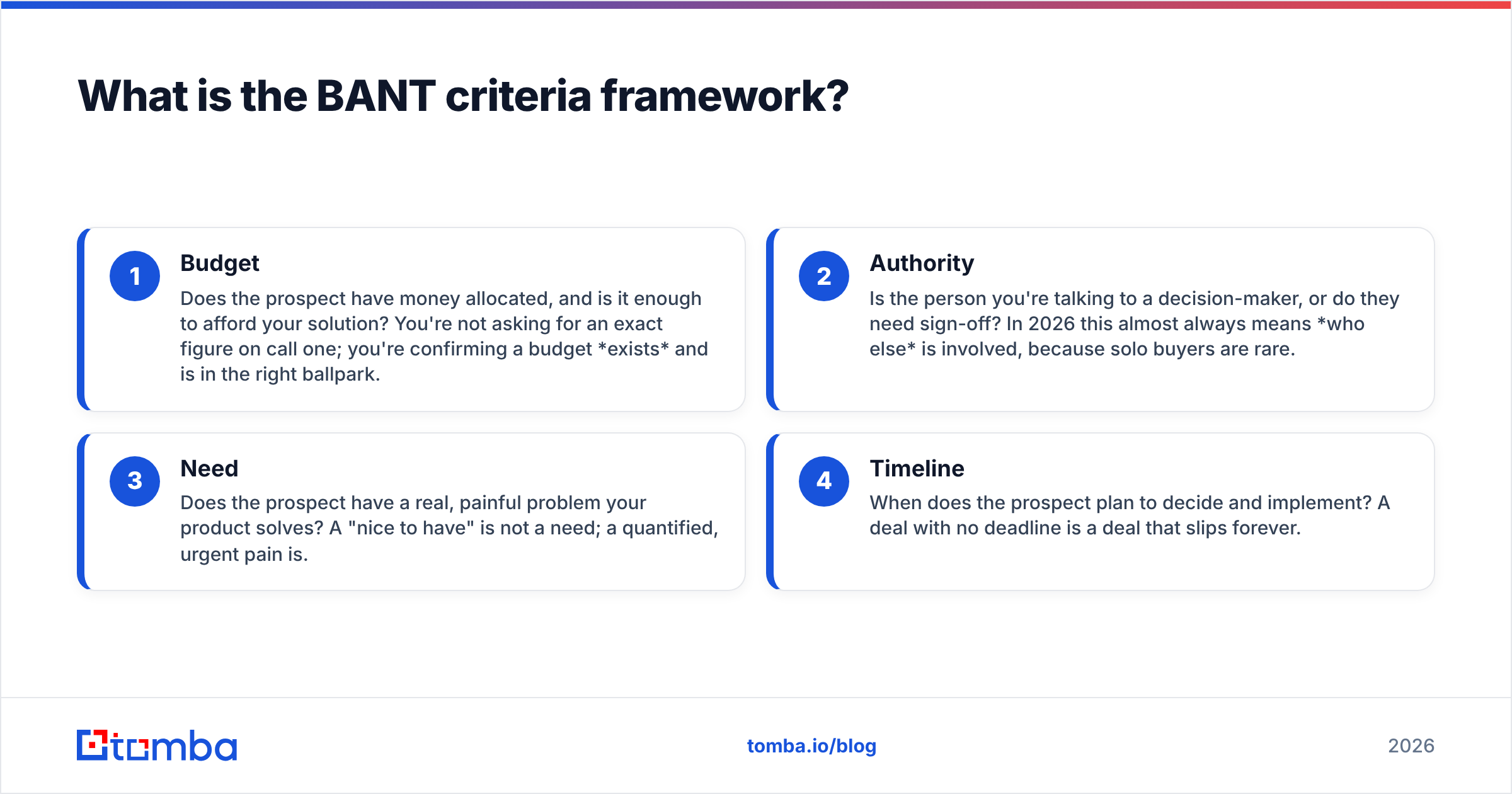
- Budget — Does the prospect have money allocated, and is it enough to afford your solution? You're not asking for an exact figure on call one; you're confirming a budget exists and is in the right ballpark.
- Authority — Is the person you're talking to a decision-maker, or do they need sign-off? In 2026 this almost always means who else is involved, because solo buyers are rare.
- Need — Does the prospect have a real, painful problem your product solves? A "nice to have" is not a need; a quantified, urgent pain is.
- Timeline — When does the prospect plan to decide and implement? A deal with no deadline is a deal that slips forever.
How do the BANT criteria work in a real sales call?#
You don't read BANT off a script like a customs form. You weave the four questions into a normal discovery conversation, and you listen for the answers in what the prospect volunteers.
A natural sequence usually starts with Need — "What's pushing you to look at this now?" — because need is the hook that makes the other three worth pursuing. Once you've confirmed a real problem, you probe Timeline ("When do you need this solved?"), then Authority ("Who else weighs in on a decision like this?"), and finally Budget ("Have you set aside resources for this, or is that part of what we're figuring out?").
The order matters. Leading with budget feels transactional and can kill rapport. Leading with need feels like you're trying to help — which you are.
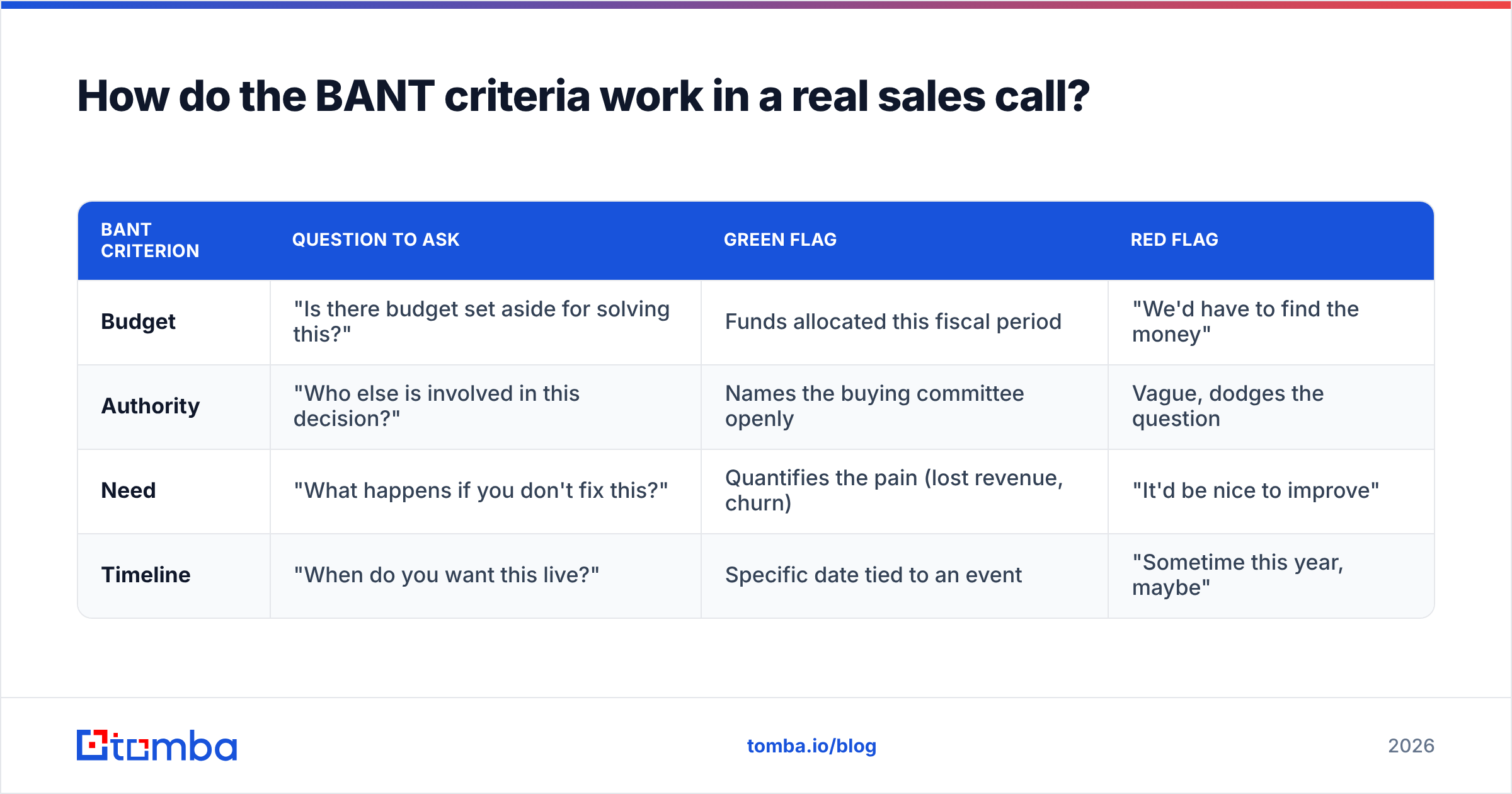
| BANT criterion | Question to ask | Green flag | Red flag |
|---|---|---|---|
| Budget | "Is there budget set aside for solving this?" | Funds allocated this fiscal period | "We'd have to find the money" |
| Authority | "Who else is involved in this decision?" | Names the buying committee openly | Vague, dodges the question |
| Need | "What happens if you don't fix this?" | Quantifies the pain (lost revenue, churn) | "It'd be nice to improve" |
| Timeline | "When do you want this live?" | Specific date tied to an event | "Sometime this year, maybe" |
A lead that hits three of four is usually worth a follow-up. A lead that hits Need and Timeline but is unsure on Budget and Authority is a classic nurture candidate — the pain is real, you just haven't reached the right people yet. That's a data problem as much as a sales problem, and it's where tools like a data enrichment workflow earn their keep by surfacing the rest of the buying committee.
Why is BANT still used in 2026?#
Because nothing has beaten it on speed-to-decision. Newer frameworks like MEDDIC, CHAMP, and GPCTBA/C&I are more thorough, but thoroughness has a cost: they take longer to run and require more training. For high-velocity inbound and mid-market deals, BANT's four questions still give reps 80% of the signal in 20% of the time.
According to HubSpot's sales research, reps spend a shrinking fraction of their week actually selling — the rest goes to admin, research, and chasing the wrong contacts. A lightweight qualification gate like BANT is one of the few levers that directly returns hours to selling. Industry analysts at Gartner consistently note that the modern buying group now spans six to ten stakeholders, which makes a fast first-pass filter more valuable, not less — you need to disqualify quickly so you can spend your time mapping the accounts that matter.
BANT also travels well. A new SDR can be productive with it on day one. Compare that to MEDDIC, which can take weeks to internalize. For most teams, the right move isn't replacing BANT — it's deciding which deals deserve a heavier framework on top of it.
Where do the BANT criteria break down?#
BANT was designed for a world with one buyer, one budget line, and a linear purchase. That world is mostly gone. Here's where the original framework cracks:
- Authority is now plural. The single decision-maker has been replaced by a committee. A strict "are you the decision-maker?" question gets a "yes" from someone who controls maybe one vote out of eight.
- Budget often comes after need. In product-led and bottoms-up motions, teams adopt first and find budget later. Disqualifying on "no budget today" kills deals that would have funded themselves in 60 days.
- Pass/fail is too blunt. Treating each criterion as a binary throws away nuance. A lead with a huge need and no timeline is very different from a lead with a small need and a hard deadline — but naive BANT scores them the same.
- It ignores fit. BANT says nothing about whether the prospect matches your ideal customer profile. A perfectly BANT-qualified lead in the wrong industry is still a bad deal.

The honest takeaway: BANT is a starting filter, not a complete qualification system. Used alone and rigidly, it leaks good deals and waves through bad ones.
How do you modernize the BANT criteria?#
You keep the four letters and change how you score them. Move from pass/fail to a weighted model, and feed the model real data instead of a rep's gut read.
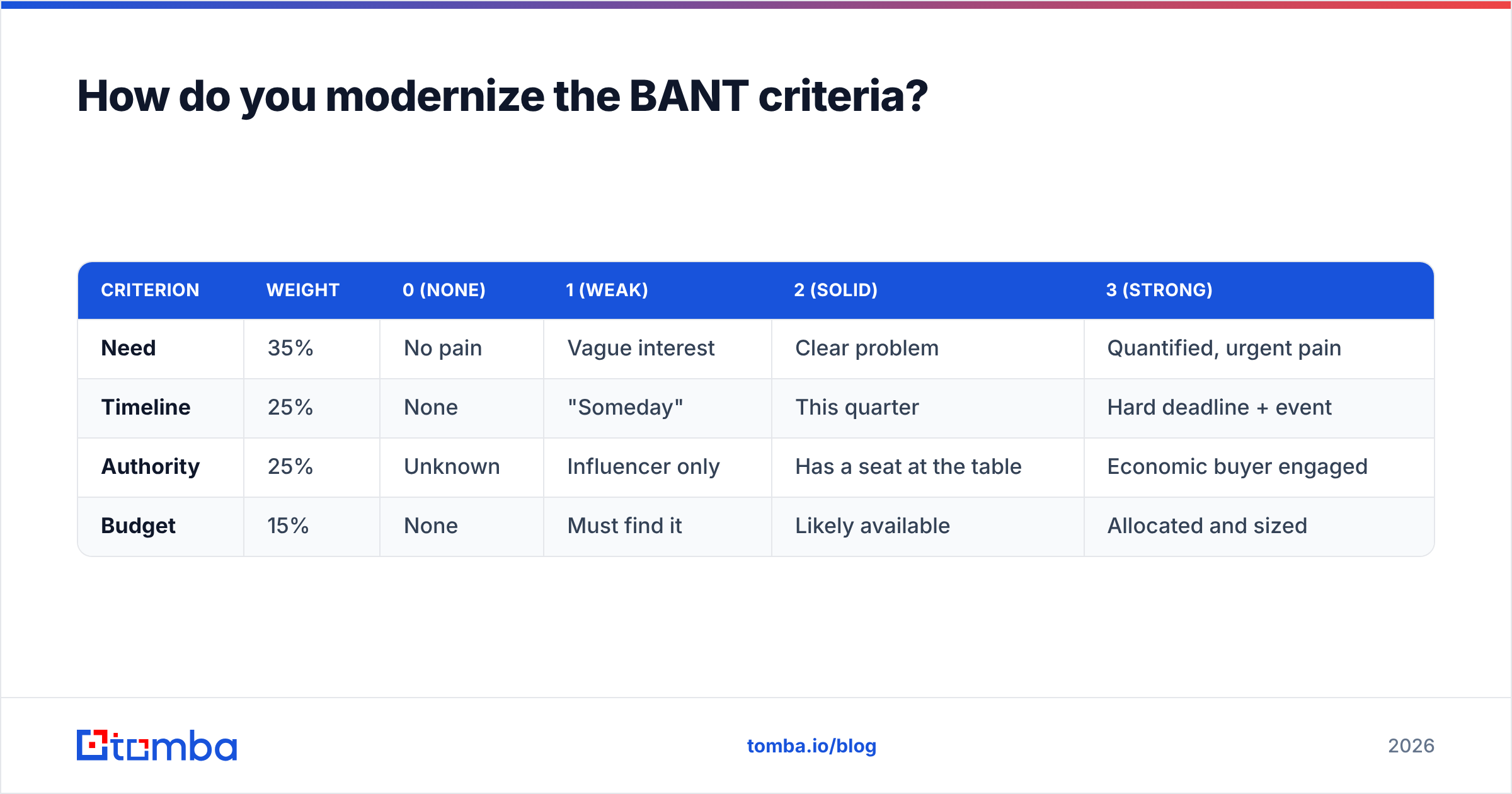
Here's a practical scoring approach. Rate each criterion 0–3, weight them to your business, and set a threshold for "sales-ready."
| Criterion | Weight | 0 (none) | 1 (weak) | 2 (solid) | 3 (strong) |
|---|---|---|---|---|---|
| Need | 35% | No pain | Vague interest | Clear problem | Quantified, urgent pain |
| Timeline | 25% | None | "Someday" | This quarter | Hard deadline + event |
| Authority | 25% | Unknown | Influencer only | Has a seat at the table | Economic buyer engaged |
| Budget | 15% | None | Must find it | Likely available | Allocated and sized |
Two upgrades make this work in 2026:
- Re-weight toward Need and Timeline. These two predict urgency better than budget or a single title. Budget gets the smallest weight because in modern motions it's the most fluid.
- Enrich before you score. Authority is impossible to score if you don't know who's on the buying committee. That's a data problem. Use a domain search to map the company's org, then layer in titles and verified contact details so "Authority" reflects reality, not a guess.
This is also where qualification connects to your funnel definitions. A modernized BANT score is essentially a structured way to decide when a marketing qualified lead becomes sales-accepted — and getting that handoff right is one of the highest-leverage fixes in B2B revenue.
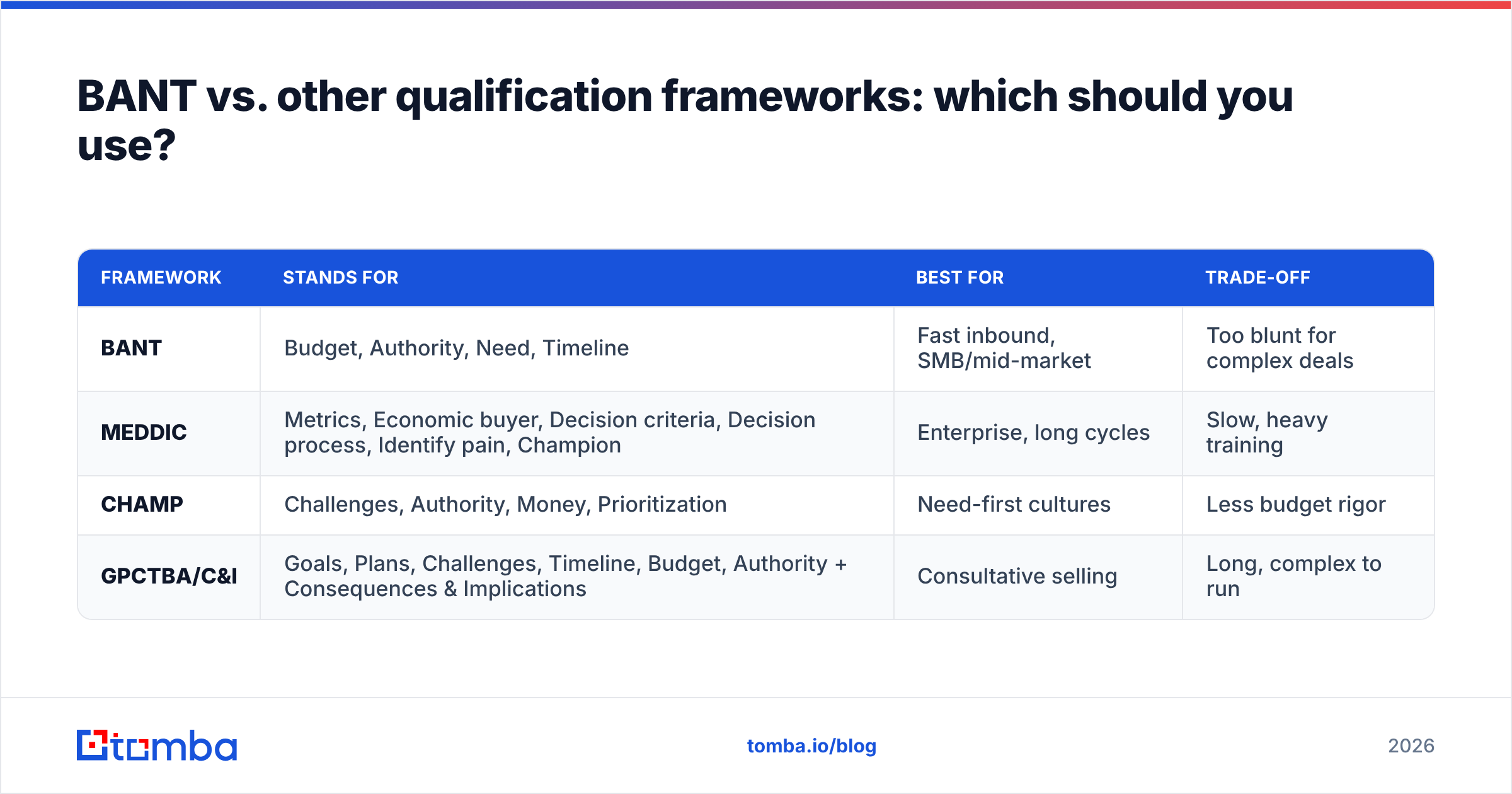
BANT vs. other qualification frameworks: which should you use?#
BANT isn't the only game in town. The right choice depends on deal size, sales cycle, and how much your reps can absorb.
| Framework | Stands for | Best for | Trade-off |
|---|---|---|---|
| BANT | Budget, Authority, Need, Timeline | Fast inbound, SMB/mid-market | Too blunt for complex deals |
| MEDDIC | Metrics, Economic buyer, Decision criteria, Decision process, Identify pain, Champion | Enterprise, long cycles | Slow, heavy training |
| CHAMP | Challenges, Authority, Money, Prioritization | Need-first cultures | Less budget rigor |
| GPCTBA/C&I | Goals, Plans, Challenges, Timeline, Budget, Authority + Consequences & Implications | Consultative selling | Long, complex to run |
A pragmatic rule: use BANT as the first-pass filter on every lead, then escalate qualifying deals above a certain size into MEDDIC for the rigor enterprise buyers demand. You don't have to pick one religion. Most high-performing teams run a layered system — a cheap filter up front, a deep framework where the dollars justify it.
Whatever framework you choose, it's only as good as the contact data feeding it. A flawless MEDDIC profile is useless if you're emailing an address that bounces. Verifying contacts with an email verifier before outreach keeps your qualified leads from dying in a spam folder, and it protects your sender reputation so the messages you send to real buyers actually land.
What are the most common BANT mistakes?#
Even teams that swear by BANT misuse it. The usual offenders:
- Interrogating instead of conversing. Firing all four questions in a row turns discovery into a deposition. Spread them across a natural dialogue.
- Disqualifying on budget too early. "No budget" today often means "no budget yet." If need and timeline are strong, nurture instead of dropping.
- Confusing a contact with a committee. One enthusiastic champion is not Authority. Map the full group before you forecast.
- Skipping enrichment. Reps waste qualification calls confirming titles and emails they could have looked up in seconds. Front-load that research so the call is about the deal, not data hygiene.
- Never revisiting the score. BANT isn't a one-time stamp. Budgets get approved, champions leave, deadlines move. Re-qualify as the deal evolves.
The thread connecting most of these mistakes is missing or stale data. Salesforce's own guidance on lead qualification stresses that qualification quality lives or dies on the accuracy of the underlying contact and account information. Fix the data, and BANT gets sharper automatically.
How does better data make BANT criteria work harder?#
Three of the four BANT criteria depend on information you can gather before a conversation. Authority needs an org map. Budget correlates with company size, funding, and headcount. Need can be inferred from the prospect's tech stack and recent hiring. Only Timeline truly requires asking.
That means a huge share of qualification can be pre-filled with enrichment, so your reps walk into every call already knowing who holds the budget and who the likely committee members are. The conversation shifts from "let me figure out if you're qualified" to "I already know you fit — let's talk about the timeline." That's a faster, more confident sale.
To pull that off you need three things working together: a reliable way to find the right people, a way to verify they're reachable, and a way to enrich what you know about them. Get those right, and BANT stops being a manual checklist and becomes a partly automated scoring layer on top of clean data.
Put your BANT criteria into action#
BANT will still be in your reps' vocabulary in 2026 because it's the fastest honest answer to "is this lead worth my time?" The teams that win don't throw it out — they feed it better data and score it instead of rubber-stamping it.
Start at the top of the funnel. Before a rep ever runs BANT, use the Tomba Email Finder to identify the real decision-makers at your target accounts and confirm you're reaching the people who hold Authority and Budget — not a generic inbox. Pair it with verification and data enrichment, check the Tomba pricing tiers (a free plan with 25 searches/month, then Starter at $49/mo), and you'll spend your qualification time closing deals instead of chasing the wrong contacts. Cleaner data in, sharper BANT out.
// get started
Find, verify and enrich your first contacts today
Start on the free plan with 25 searches a month, then scale when your team is ready.
Free plan · No credit card required · GDPR & CCPA
Get the Tomba newsletter
Product and data updates
// about the author