BANT Framework 2026: The Complete Sales Qualification Guide
The BANT framework still decides which deals you chase and which you drop. Here's how Budget, Authority, Need, and Timeline work in 2026 — and where it breaks.
The BANT Framework in 2026
TL;DR
- BANT qualifies leads on four signals: Budget, Authority, Need, and Timeline. If a deal misses on all four, it does not belong in your pipeline.
- It was invented by IBM decades ago for a single-decision-maker, top-down buying world — which is not how most B2B purchases work in 2026.
- BANT is still useful as a fast disqualifier, but rigid "all four boxes or bust" scoring kills good deals early.
- Modern teams blend BANT with frameworks like MEDDIC or GPCTBA/C&I and feed it with verified contact and company data instead of rep gut-feel.
- The qualification is only as good as the data behind it: wrong contact, wrong "authority," wasted quarter.
What is the BANT framework?#
BANT is a sales qualification framework that scores a prospect on four questions: do they have the Budget, is your contact the Authority (or close to it), is there a real Need, and what is the Timeline to buy? If a lead clears a reasonable bar on most of these, it is worth a rep's time. If it fails on most, you move on.
Think of BANT like a bouncer at a club door. The bouncer does not interview every person for ten minutes — they run a quick four-point check and decide who gets in. BANT is that four-point check for your pipeline, and its whole value is speed: it tells a rep within one or two calls whether to invest or walk.
The acronym comes from IBM, which used it to standardize how thousands of salespeople decided what counted as a "real" opportunity. The logic was sound for its era: enterprise buying ran through a single budget holder, and a rep's biggest risk was burning weeks on a deal that was never going to close.
What does each letter in BANT stand for?#
Here is the core of the framework. Each dimension maps to a question you are trying to answer, and a signal that tells you the answer.
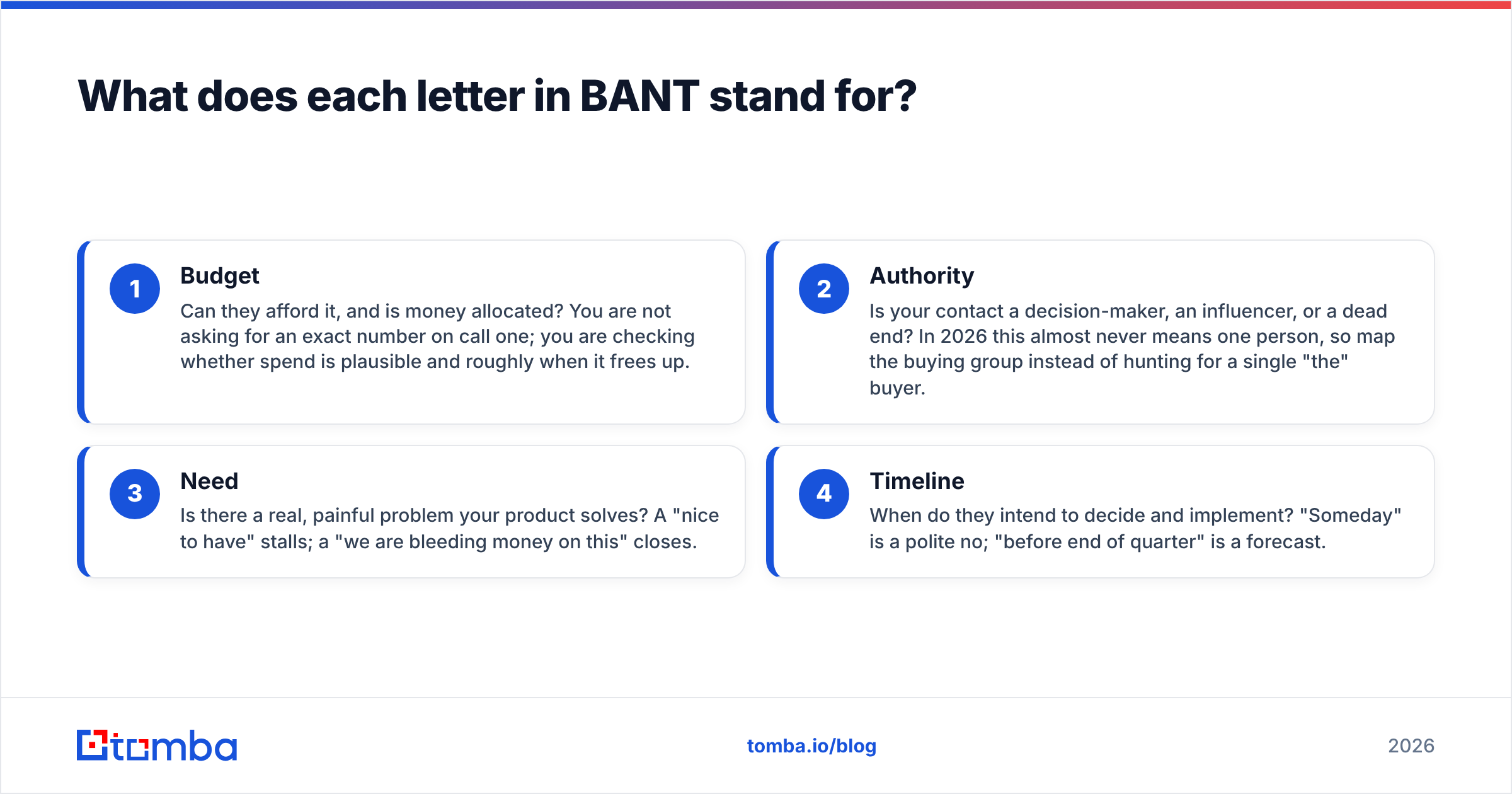
- Budget — Can they afford it, and is money allocated? You are not asking for an exact number on call one; you are checking whether spend is plausible and roughly when it frees up.
- Authority — Is your contact a decision-maker, an influencer, or a dead end? In 2026 this almost never means one person, so map the buying group instead of hunting for a single "the" buyer.
- Need — Is there a real, painful problem your product solves? A "nice to have" stalls; a "we are bleeding money on this" closes.
- Timeline — When do they intend to decide and implement? "Someday" is a polite no; "before end of quarter" is a forecast.
A common mistake is treating these as a pass/fail checklist where all four must be green. They are better read as a weighted picture. A red-hot Need with a tight Timeline can carry a fuzzy Budget, because urgency tends to find money. Score the blend, not the boxes.
How does BANT compare to MEDDIC, CHAMP, and GPCTBA/C&I?#
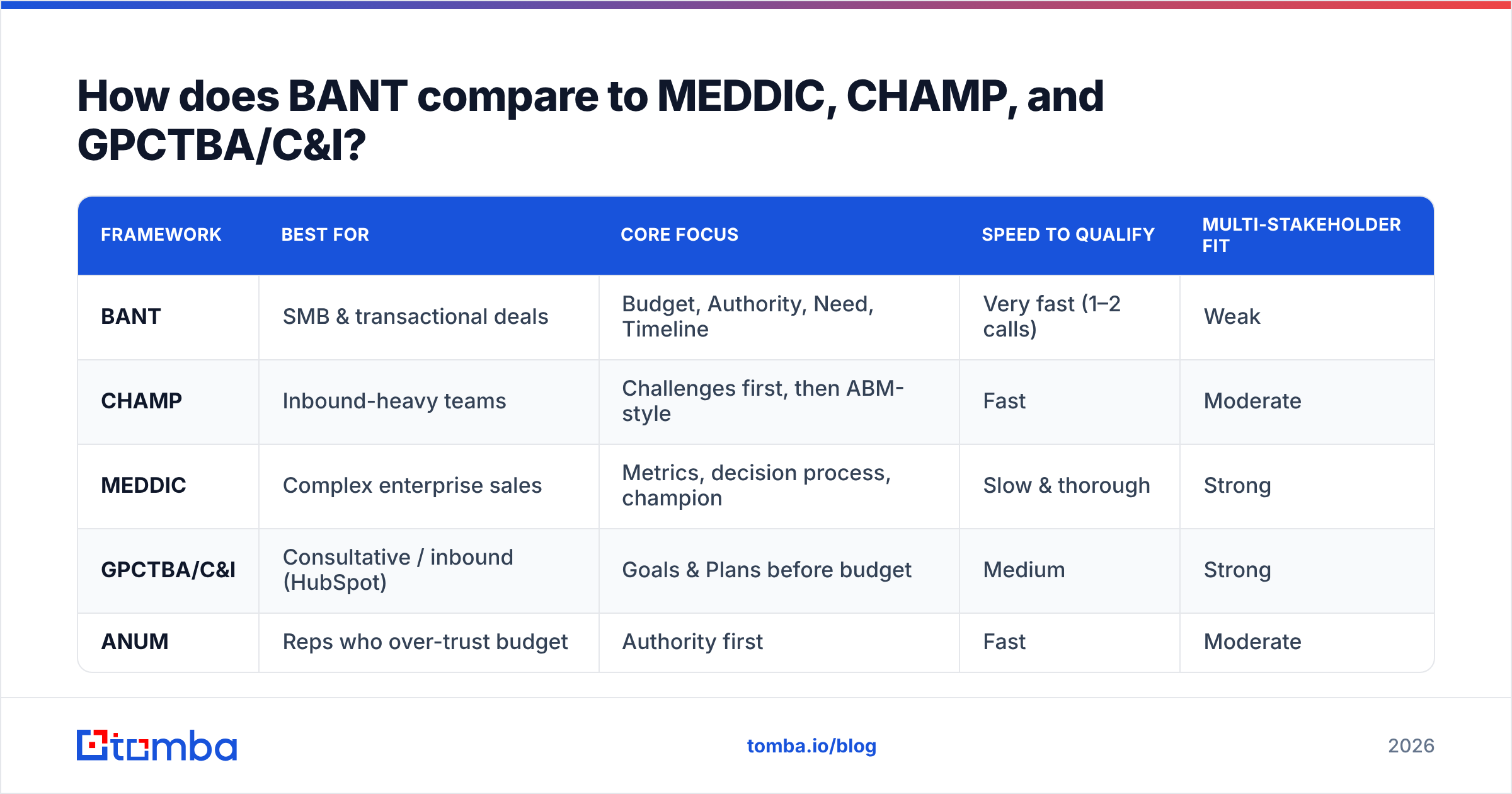
BANT is the fastest framework to learn and the bluntest in practice. Newer frameworks were built to fix its blind spots — mainly its weak handling of multi-stakeholder deals and its tendency to lead with budget instead of pain. Here is how the main options stack up.
| Framework | Best for | Core focus | Speed to qualify | Multi-stakeholder fit |
|---|---|---|---|---|
| BANT | SMB & transactional deals | Budget, Authority, Need, Timeline | Very fast (1–2 calls) | Weak |
| CHAMP | Inbound-heavy teams | Challenges first, then ABM-style | Fast | Moderate |
| MEDDIC | Complex enterprise sales | Metrics, decision process, champion | Slow & thorough | Strong |
| GPCTBA/C&I | Consultative / inbound (HubSpot) | Goals & Plans before budget | Medium | Strong |
| ANUM | Reps who over-trust budget | Authority first | Fast | Moderate |
The short version: use BANT when deal velocity matters and the sale is relatively simple. Move toward MEDDIC when you are selling six figures into a committee of eight people. Many teams run BANT at the top of the funnel as a disqualifier, then switch to MEDDIC once a deal is genuinely live. For a refresher on where qualified leads sit in the funnel, see the difference between a marketing qualified lead and a sales-ready one.
Is BANT still relevant in 2026?#
Yes — but only as a filter, not a verdict. The original BANT assumed a top-down purchase signed off by one budget owner. Gartner's well-known research on B2B buying puts the typical buying group at six to ten stakeholders, which breaks the "find the one Authority" assumption at the center of classic BANT. (See Gartner's B2B buying journey research.)
So the letter that ages worst is A. In a committee sale, "is my contact the decision-maker?" is the wrong question. The right one is "who are the six people who must say yes, and is my contact wired into them?" That is a data problem as much as a discovery problem — you need to map an org, not interrogate one person.
B ages second-worst. Leading with budget on a first call signals you care about your quota before their problem. Most modern playbooks, including HubSpot's, push goals and pain ahead of budget for exactly this reason.
What still holds up beautifully is N and T. A real, urgent need with a real deadline is the most reliable close signal in any era. If you stripped BANT down to just Need and Timeline, you would still disqualify most of the junk in your pipeline.
How do you actually run BANT on a sales call?#
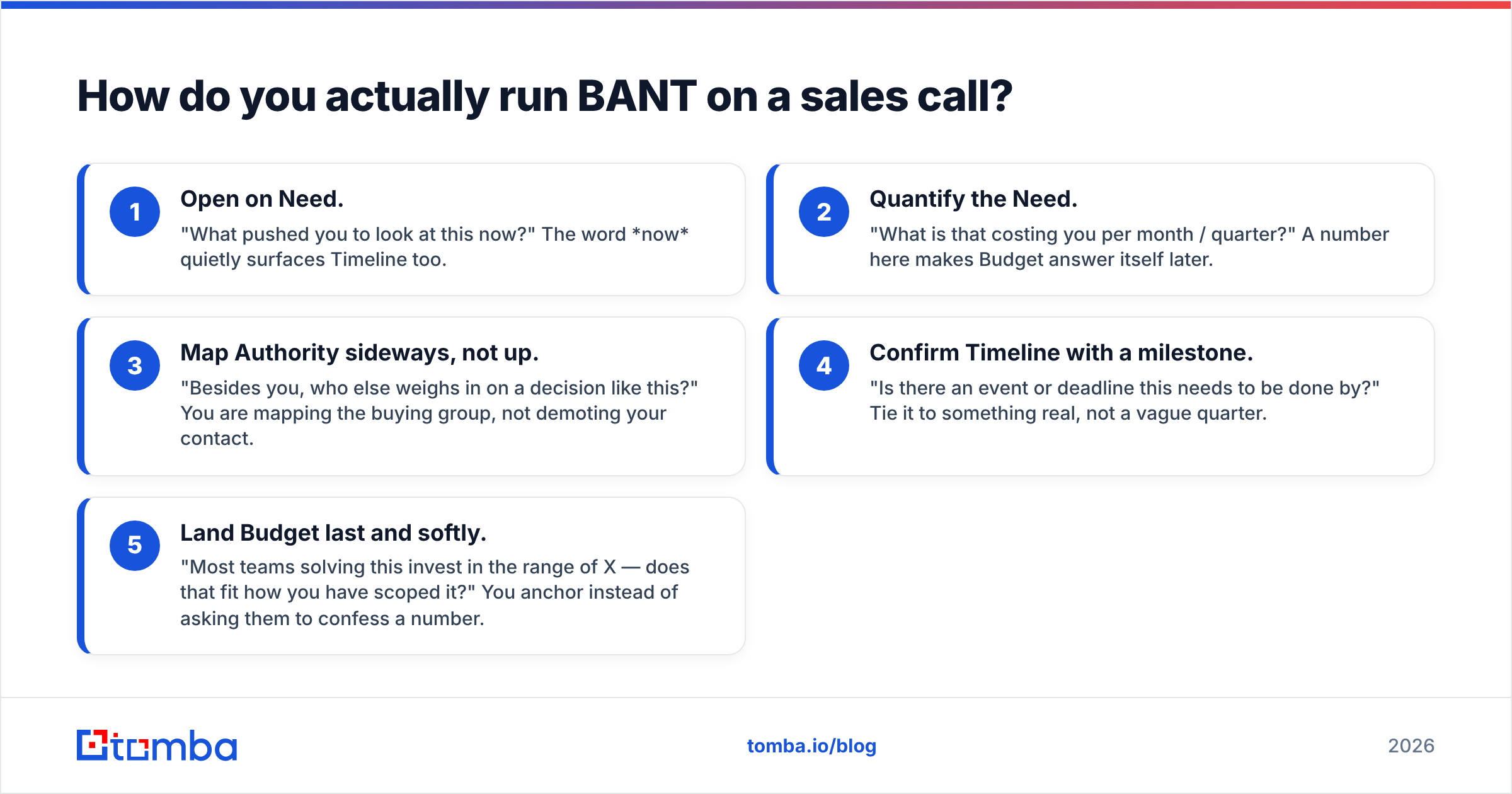
Do not read the four letters out like an interrogation. Weave them into a normal discovery conversation. Here is a practical order that flips the classic sequence to lead with pain:
- Open on Need. "What pushed you to look at this now?" The word now quietly surfaces Timeline too.
- Quantify the Need. "What is that costing you per month / quarter?" A number here makes Budget answer itself later.
- Map Authority sideways, not up. "Besides you, who else weighs in on a decision like this?" You are mapping the buying group, not demoting your contact.
- Confirm Timeline with a milestone. "Is there an event or deadline this needs to be done by?" Tie it to something real, not a vague quarter.
- Land Budget last and softly. "Most teams solving this invest in the range of X — does that fit how you have scoped it?" You anchor instead of asking them to confess a number.
Notice that good BANT execution depends on knowing things before the call — who the other stakeholders are, how big the company is, what they likely spend. That pre-call intelligence is where most reps lose the deal, because they walk in blind and waste the first call gathering data they could have looked up.
Why does BANT fail without good data?#
BANT fails most often not because the framework is wrong, but because the inputs are garbage. You can run a flawless qualification call against the wrong person at a company whose budget reality you completely misjudged. The four letters are only as trustworthy as the contact and company data underneath them.
Three data failures sink BANT in practice:
- Wrong Authority. You qualify an enthusiastic contact who turns out to have zero pull. Mapping the real buying group requires accurate, current org and contact data — not a guess from a stale CRM record.
- Blind Budget. Without firmographics (headcount, funding, growth stage) you cannot sanity-check whether a stated budget is real or aspirational.
- Dead contacts. Half your "qualified" pipeline is unreachable because the email bounces or the phone number is wrong, so Timeline slips indefinitely.
This is where enrichment does the heavy lifting. Before a rep ever dials, you can enrich leads with company size, role, and seniority so the Authority and Budget questions are half-answered going in. You can use a reliable email finder to make sure the contact you qualified is actually reachable, and a phone finder to add a second channel when email goes quiet. Good data does not replace BANT — it makes every letter answerable. And keeping that data clean inside your CRM is what stops qualified deals from rotting between calls.
What are the biggest mistakes teams make with BANT?#
- Treating it as pass/fail. Demanding all four boxes green disqualifies deals where urgency would have found budget. Score the blend.
- Leading with Budget. Asking "what's your budget?" on call one is the fastest way to sound like a vendor instead of an advisor.
- Hunting for one Authority. In a committee sale, the single-decision-maker assumption is a trap. Map the group.
- Confusing interest with Need. "This looks cool" is not a need. "We lose two deals a week because of this" is.
- Ignoring Timeline drift. A deal with no event-based deadline will slip forever. Always tie Timeline to a real milestone.
- Qualifying on bad data. No framework survives wrong contacts. Verify before you invest rep hours.
How should you adapt BANT for a modern buying committee?#
The cleanest 2026 adaptation keeps the speed of BANT but upgrades two letters. Replace single-person Authority with buying-group coverage — track how many of the known stakeholders you have actually engaged. And move Budget from a first-call question to a value-anchored conversation you earn later. Keep Need and Timeline exactly as they are; they were always the strongest signals.
Some teams formalize this by scoring each letter 0–2 and flagging any deal that scores below a threshold for review rather than auto-disqualification. That turns BANT from a gate into a triage system, which is what a high-volume pipeline actually needs. If you want a deeper read on tooling that supports this, browse the B2B sales tools coverage on the blog, and compare how vendors like Salesforce and HubSpot bake qualification fields directly into the opportunity record.
BANT scoring example: a simple triage model#
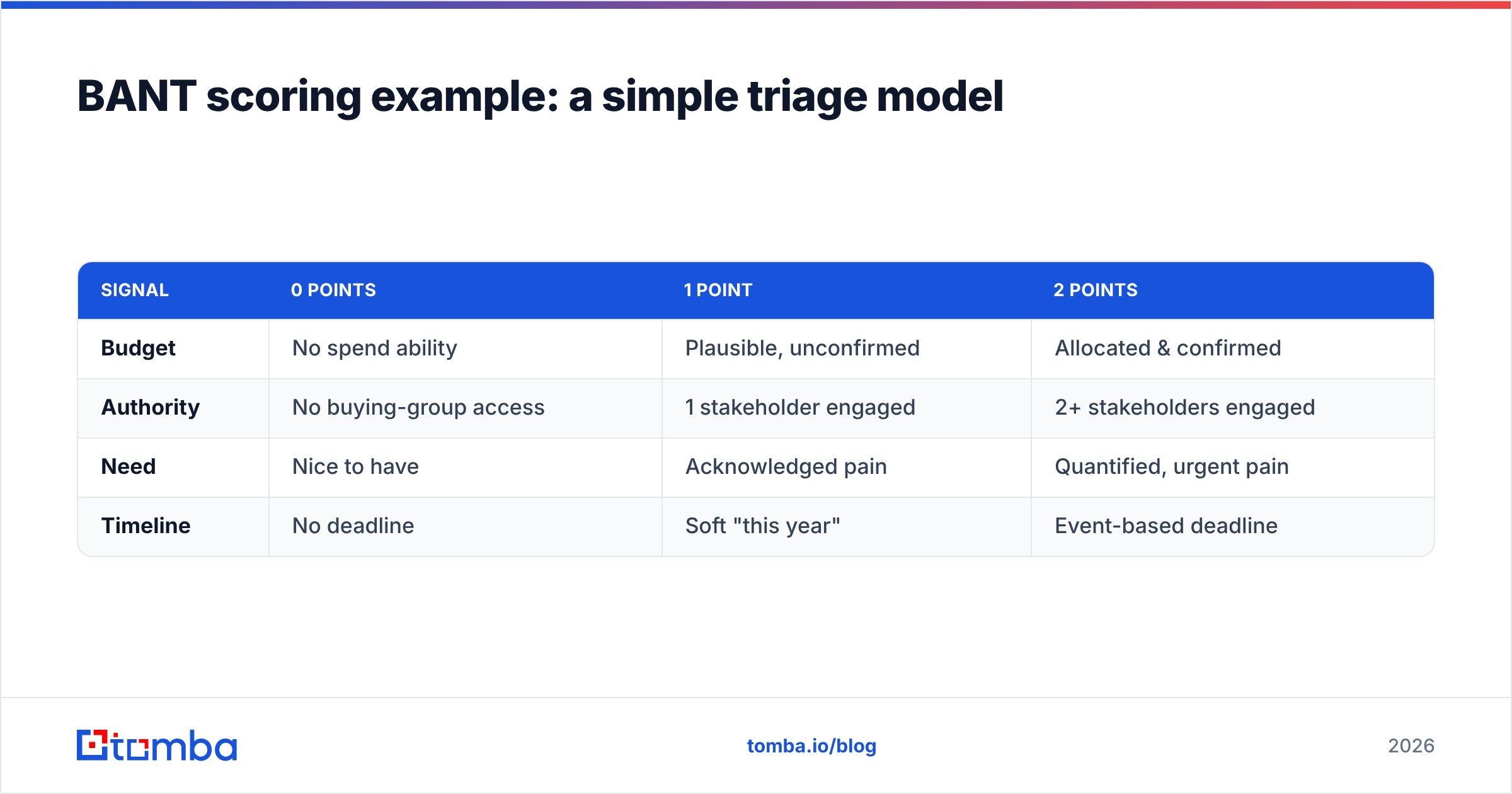
Here is a lightweight model you can drop into any CRM as four custom fields. Sum the scores; anything 5+ is worth a rep's time, 3–4 goes to nurture, below 3 is disqualified.
| Signal | 0 points | 1 point | 2 points |
|---|---|---|---|
| Budget | No spend ability | Plausible, unconfirmed | Allocated & confirmed |
| Authority | No buying-group access | 1 stakeholder engaged | 2+ stakeholders engaged |
| Need | Nice to have | Acknowledged pain | Quantified, urgent pain |
| Timeline | No deadline | Soft "this year" | Event-based deadline |
The point of scoring this way is that it forces honesty. A rep who wants to keep a pet deal alive has to justify the points, and a manager scanning the pipeline can see at a glance which "qualified" deals are actually held together by hope.
How does BANT fit into your broader sales process?#
BANT lives at one specific stage: the handoff between a raw lead and a working opportunity. Before BANT, you are doing lead generation and routing. After BANT clears, you are into discovery, solutioning, and the close — stages where MEDDIC-style depth matters more than a four-point filter. Treating BANT as your entire process is the mistake; treating it as the gate to your process is correct.
The healthiest pipelines pair a fast top-of-funnel qualifier (BANT) with a rigorous mid-funnel framework (MEDDIC or GPCTBA/C&I), and feed both with verified data so reps spend their hours on deals that can actually close. If you want the textbook definition of the surrounding terms, the BANT entry on Wikipedia is a fine neutral starting point.
The bottom line#
BANT is not dead — it is just narrower than it used to be. As a fast disqualifier built on Need and Timeline, it still earns its place at the top of every pipeline. As a rigid four-box gate run on rep guesswork, it quietly kills good deals and waves through unreachable ones. The fix is not a trendier acronym; it is better inputs.
If your qualification keeps failing on the Authority and Budget letters, the problem is usually data, not discovery. Start by making sure every lead you score is real and reachable: use the Tomba Email Finder to confirm the contact exists, enrich the record with company and role data so Budget and Authority answer themselves, and you will spend the next quarter qualifying deals instead of chasing ghosts. You can try it on the free tier (25 searches a month) before committing to a plan — see Tomba pricing for the Starter ($49/mo) and Growth ($99/mo) tiers when you are ready to scale.
// get started
Find, verify and enrich your first contacts today
Start on the free plan with 25 searches a month, then scale when your team is ready.
Free plan · No credit card required · GDPR & CCPA
// about the author