Basho Email Structure: The 2026 Guide to Executive Cold Outreach
The Basho email structure turns ignored cold emails into executive replies. Here's the exact framework, templates, and metrics that make it work in 2026.
Basho Email Structure: The 2026 Guide to Executive Cold Outreach
Most cold emails die in the first line. The Basho email structure is the cure — a tightly engineered format built to earn a reply from busy, senior buyers who delete generic outreach on reflex. If you sell to VPs, directors, and C-suite decision-makers, this is the framework worth memorizing.
TL;DR#
- The Basho email is a hyper-personalized, account-based cold email designed to provoke a reply from senior decision-makers — not to pitch.
- The Basho email structure has four moving parts: a relevant trigger, a personalized observation, a clear value bridge, and a single low-friction ask.
- It trades volume for precision: fewer sends, deeper research, dramatically higher response rates.
- It only works when your data is clean — wrong name, wrong company, or a bounced address kills the whole effect.
- Pair the framework with a reliable email finder and verified contacts so your research actually reaches a human inbox.
What Is a Basho Email?#
A Basho email is a short, research-driven cold email aimed at a specific person, referencing something true and timely about them or their company. The name traces back to sales trainer Jeff Hoffman and the "Basho" sales methodology, which borrowed from the Japanese poet Bashō — the idea being that, like haiku, a great outreach email says a lot in very few words.
Think of it like knocking on someone's door versus shouting into a stadium. A mass blast is the stadium: loud, generic, easy to tune out. A Basho email is the knock — quiet, specific, impossible to confuse for spam because it's clearly meant for one person.
The point is not to describe your product. The point is to prove, in the first two sentences, that a human did homework. That credibility is what buys you a reply.

What Is the Basho Email Structure?#
The Basho email structure is a four-part skeleton. Every strong Basho email contains these elements in roughly this order:
- Trigger — A recent, verifiable event: a funding round, a new hire, a product launch, a podcast appearance, an earnings call, a LinkedIn post. This is your reason for reaching out now.
- Personalized observation — One sentence connecting that trigger to a challenge or goal the prospect plausibly has. This shows insight, not just awareness.
- Value bridge — A concise, specific reason you might help, ideally with a proof point (a comparable customer, a number, a result). No feature dumps.
- Single CTA — One small, easy-to-say-yes-to ask. Usually an interest-check question, not a meeting demand.
Keep the whole thing under 90 words. Senior buyers read on mobile between meetings; length is friction.
Basho Structure vs. a Standard Cold Email#
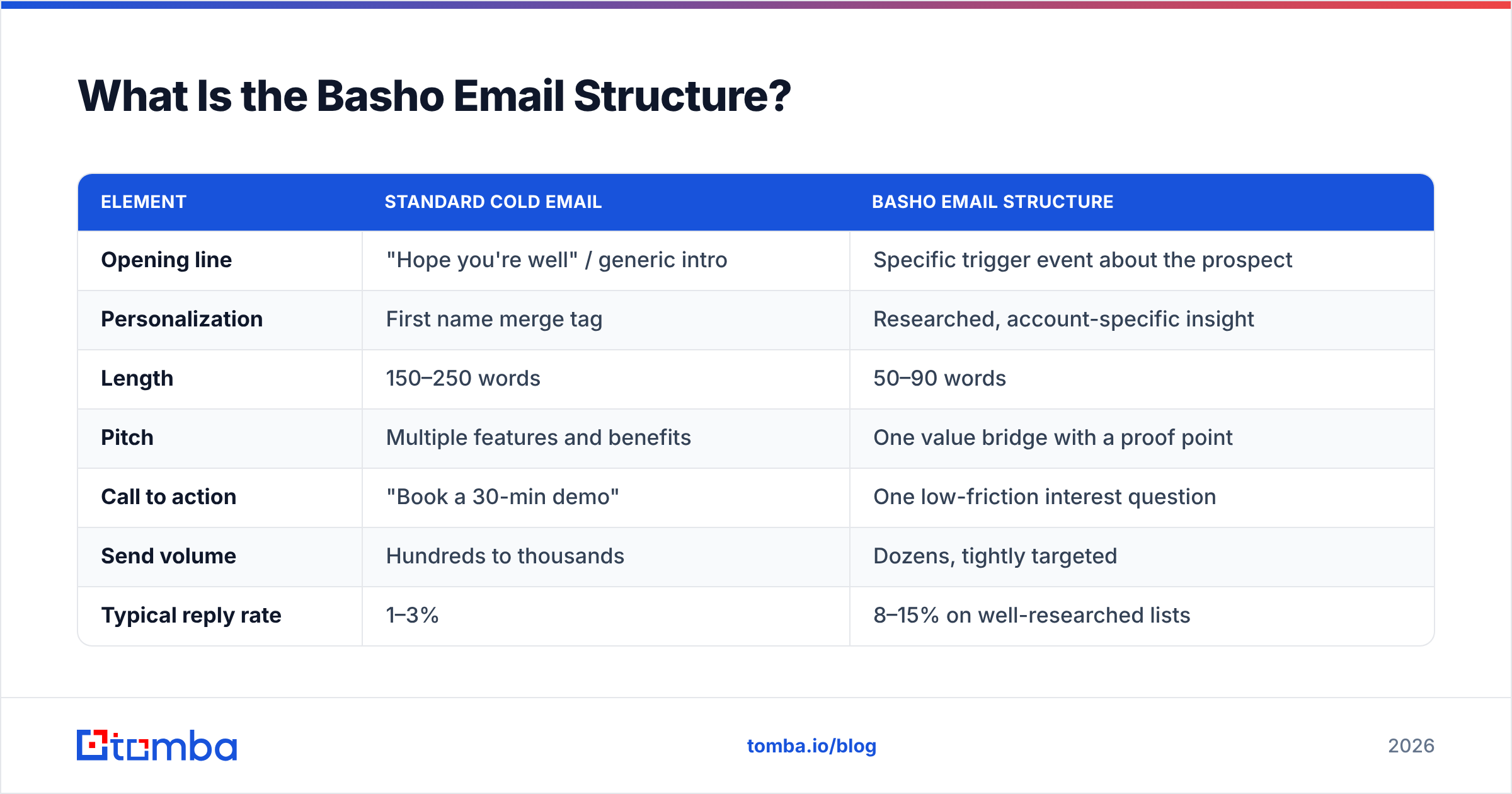
| Element | Standard Cold Email | Basho Email Structure |
|---|---|---|
| Opening line | "Hope you're well" / generic intro | Specific trigger event about the prospect |
| Personalization | First name merge tag | Researched, account-specific insight |
| Length | 150–250 words | 50–90 words |
| Pitch | Multiple features and benefits | One value bridge with a proof point |
| Call to action | "Book a 30-min demo" | One low-friction interest question |
| Send volume | Hundreds to thousands | Dozens, tightly targeted |
| Typical reply rate | 1–3% | 8–15% on well-researched lists |
The numbers vary by industry and list quality, but the pattern holds across teams: precision beats volume when you're targeting people who can actually sign.
How Do You Write Each Part of a Basho Email?#
The Trigger#
Your trigger is the spark. Without it, you're just another vendor who "wanted to reach out." Strong triggers are recent (last 30–60 days), public, and relevant to what you sell.
Examples that work:
- "Saw [Company] just closed your Series B — congrats."
- "Caught your comment on [LinkedIn post] about scaling SDR onboarding."
- "Noticed you're hiring three enterprise AEs in EMEA."
Avoid fake triggers. "I came across your website" is not a trigger; it's filler that signals automation.
The Personalized Observation#
This is where you earn the read. Connect the trigger to a likely pain. If they raised a Series B and are hiring AEs, the implied challenge is ramping a bigger team fast without tanking pipeline quality. Name that tension.
The Value Bridge#
Now — and only now — hint at why you're relevant. One sentence. Lead with outcome, not feature: "We helped [comparable company] cut new-rep ramp time by 40%." Specificity and a real reference point do more than three paragraphs of benefits.
The Call to Action#
End with one question that's cheap to answer. "Worth a quick look?" or "Is ramp speed even on your radar this quarter?" beats "Do you have 30 minutes Thursday?" The smaller the ask, the higher the reply rate. You can earn the meeting in the reply thread.
For subject lines, keep them lowercase, short, and curiosity-driven — try a subject line generator if you're stuck, and lean on proven cold email templates as scaffolding rather than crutches.
What Does a Real Basho Email Look Like?#
Here's the structure in action, targeting a VP of Sales after a funding announcement:
Subject: ramping after the Series B
Hi Dana,
Saw the $30M round last week — congrats. With three new AE reqs open in EMEA, I'd guess onboarding speed is suddenly a top-three problem.
We helped Retool's revenue team cut ramp from 5 months to 3 by fixing their first-90-days playbook. Might map to what you're walking into.
Is ramp time something you're actively solving this quarter, or already handled?
— Sam
Under 70 words. One trigger, one insight, one proof point, one easy question. No "circling back," no calendar link, no nine-paragraph pitch.
Why Does Data Quality Make or Break Basho Emails?#
The Basho email structure rewards research — and punishes bad data harder than any other format. Spend 15 minutes crafting the perfect personalized email, send it to a guessed address, and it bounces. Worse, get the company or name wrong and your "personalization" reads as a careless mail-merge, instantly destroying the credibility the whole approach depends on.
Three data problems quietly kill Basho campaigns:
- Wrong or stale email addresses → bounces that hurt your sender reputation and never reach the prospect.
- Outdated roles → you reference a trigger for someone who changed jobs two months ago.
- Unverified catch-all domains → your email is "accepted" but routed to a black hole.
Because you're sending fewer, higher-effort emails, every single address has to land. That's the opposite of spray-and-pray, where a few bounces don't matter. Here, one bad record wastes your best research.
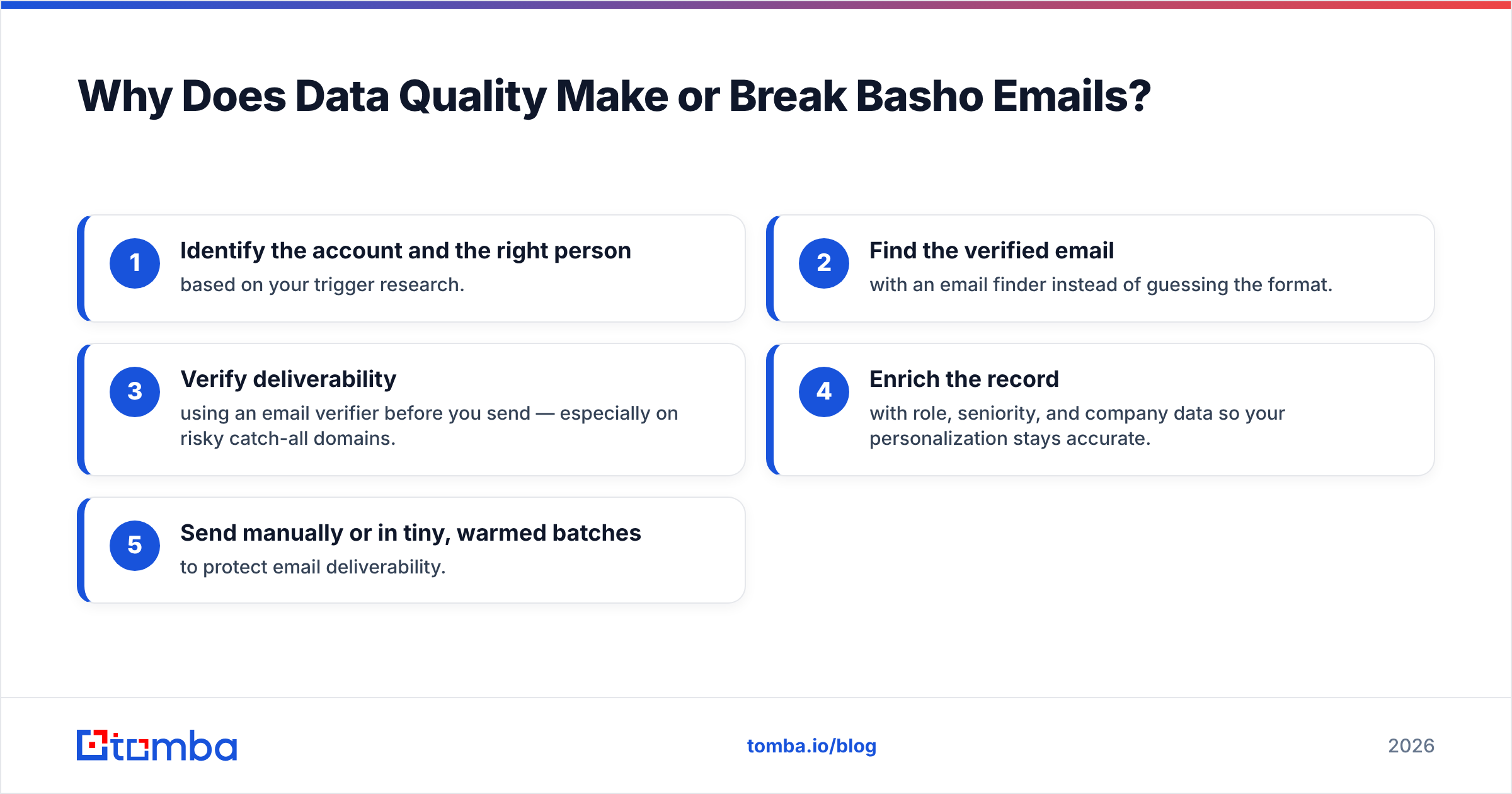
A Clean Data Workflow for Basho Outreach#
- Identify the account and the right person based on your trigger research.
- Find the verified email with an email finder instead of guessing the format.
- Verify deliverability using an email verifier before you send — especially on risky catch-all domains.
- Enrich the record with role, seniority, and company data so your personalization stays accurate.
- Send manually or in tiny, warmed batches to protect email deliverability.
If you're working a whole target list at once, a bulk email finder plus verification step keeps quality high without slowing your research to a crawl.
When Should You Use the Basho Structure Instead of Volume Outreach?#
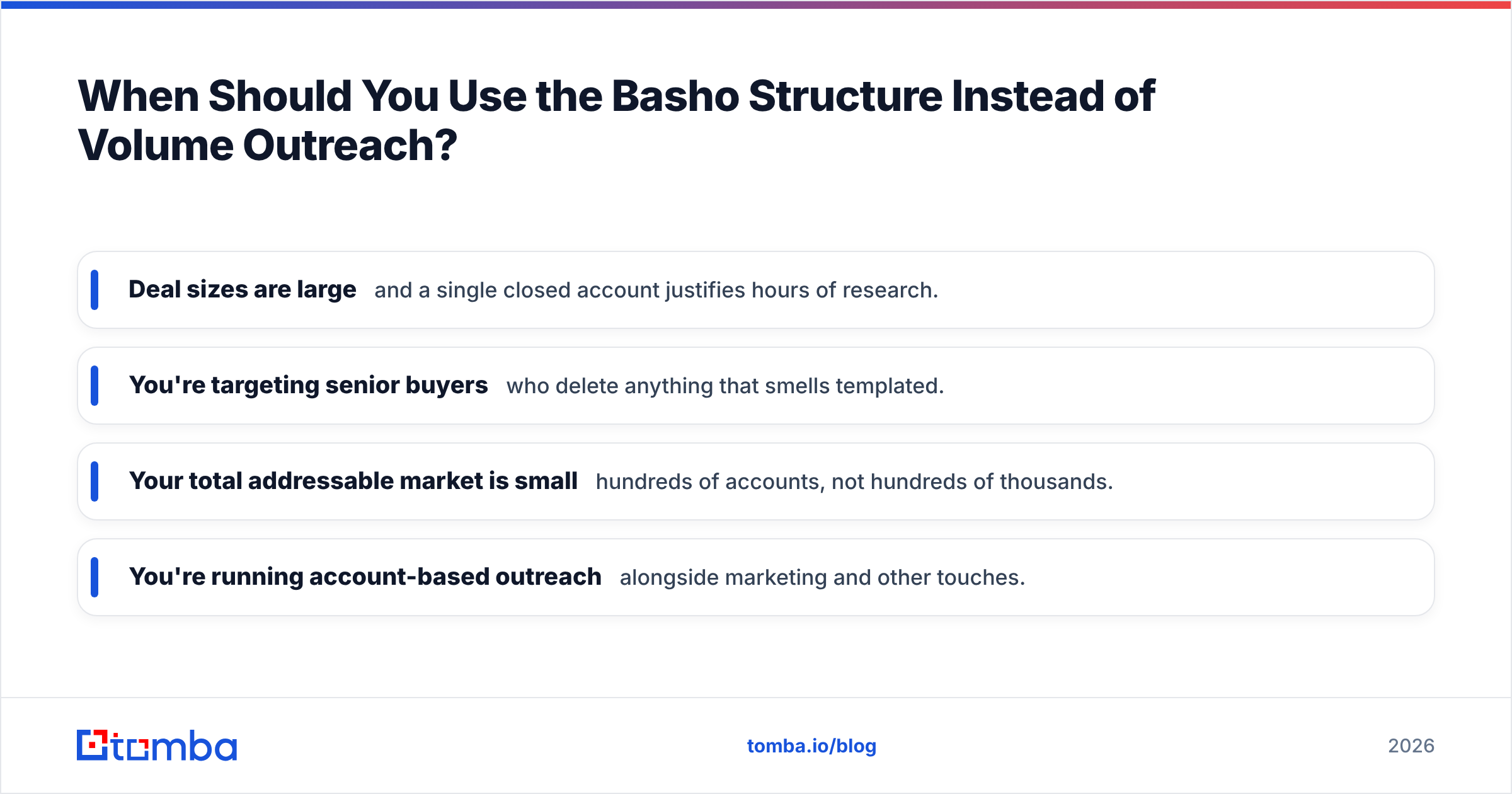
Basho is a scalpel, not a chainsaw. Use it when:
- Deal sizes are large and a single closed account justifies hours of research.
- You're targeting senior buyers who delete anything that smells templated.
- Your total addressable market is small — hundreds of accounts, not hundreds of thousands.
- You're running account-based outreach alongside marketing and other touches.
Use higher-volume, lighter-touch sequences when your ACV is low, your market is huge, and the math favors reach over depth. Many teams run both: Basho for tier-one accounts, scaled sequences for the long tail. The two approaches aren't rivals — they're different tools for different deal economics. (Forrester and Gartner have both documented this account-tiering split in their B2B buying research, and you'll see it echoed across vendor playbooks on HubSpot and Salesforce.)
How Do You Measure Basho Email Performance?#
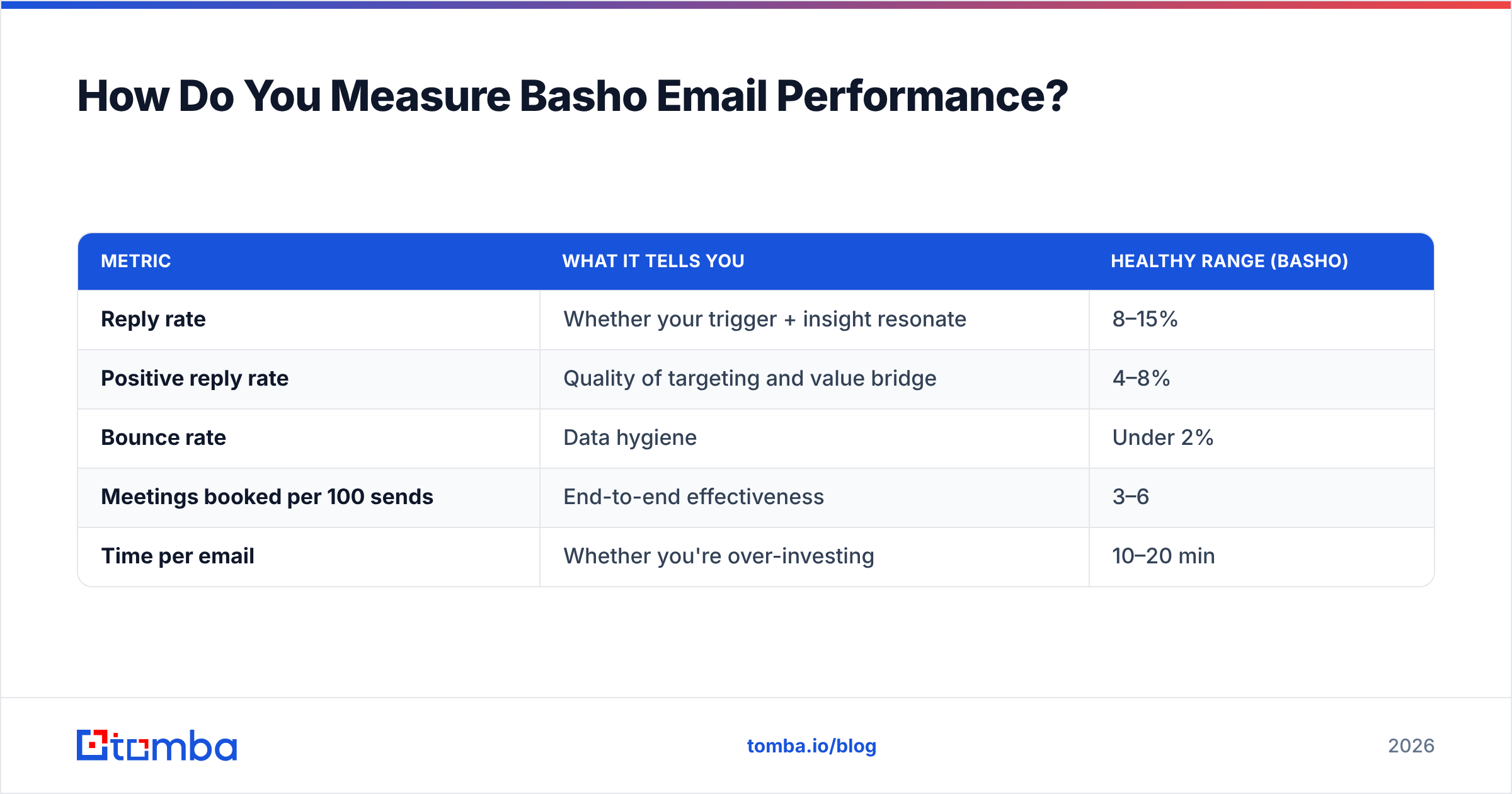
Because volume is low, vanity metrics like total sends are meaningless. Track quality signals instead:
| Metric | What It Tells You | Healthy Range (Basho) |
|---|---|---|
| Reply rate | Whether your trigger + insight resonate | 8–15% |
| Positive reply rate | Quality of targeting and value bridge | 4–8% |
| Bounce rate | Data hygiene | Under 2% |
| Meetings booked per 100 sends | End-to-end effectiveness | 3–6 |
| Time per email | Whether you're over-investing | 10–20 min |
If your bounce rate creeps up, the problem is data, not copy — go back to verification. If replies are high but positive replies are low, your targeting is off: you're reaching real people who aren't a fit. Tracking response rate by segment tells you which triggers and personas actually convert.
A quick sanity check: read the cross-vendor benchmarks on a neutral source like G2 before you decide your numbers are "bad." Context matters, and reply-rate norms shift by industry.
What Are the Most Common Basho Email Mistakes?#
- Fake personalization. "I love what you're doing at [Company]" fools no one. Reference something specific or skip it.
- Burying the trigger. Lead with it. If your reason for reaching out is in paragraph three, you've already lost them.
- Multiple CTAs. Asking for a demo, a referral, and a webinar signup in one email signals desperation. Pick one.
- Over-researching. Twenty minutes is plenty. An hour per email doesn't scale and rarely improves reply rates.
- Skipping verification. The single biggest avoidable failure. A bounced Basho email is wasted research and a reputation hit.
- Writing a novel. If it scrolls on mobile, cut it. Brevity is the entire point of the format.
Frequently Asked Questions#
Is the Basho email structure still effective in 2026? Yes — arguably more than ever. As AI floods inboxes with generic "personalized" emails, genuinely researched outreach stands out further. Buyers can spot the difference between real insight and a clever merge tag.
How long should a Basho email be? Aim for 50–90 words. Senior buyers skim on mobile, and length reads as friction. If you can't make your point in four short sentences, your point isn't sharp enough yet.
Can you automate Basho emails? Partly. Automate the data layer — finding and verifying addresses, enriching records — but keep the trigger research and copy human. Fully automated "Basho" emails are just dressed-up spam, and prospects notice.
What's the difference between a Basho email and an account-based email? A Basho email is one tactic within account-based outreach. ABM is the broader strategy of coordinating sales and marketing around target accounts; the Basho structure is a specific email format you'd use to execute it.
Put the Basho Structure to Work#
The Basho email structure is only as strong as the data behind it. The best trigger, the sharpest insight, and the cleanest CTA all fail if your email bounces or your "personalization" names the wrong person. Get the research right, then make sure it actually lands.
Start by finding and verifying every contact before you send. Use the Tomba Email Finder to get accurate, professional email addresses by name or company, verify deliverability, and enrich each record so your personalization holds up. Check the Tomba pricing — there's a free tier with 25 searches a month to test it, and paid plans start at $49/mo when you're ready to scale your tier-one outreach. Precise emails deserve precise data.
Ready to find emails that actually work?
Join 150,000+ professionals who stopped guessing and started sending. Free credits on signup — no credit card required.
Get the Tomba newsletter
Practical outbound tactics and product updates — once every two weeks.
About the author