BATNA in Negotiation: The 2026 Guide to Winning Deals
Your BATNA is the quiet power behind every deal. Learn how to build, calculate, and use a strong BATNA in negotiation to close on your terms in 2026.
You walk into a renewal call ready to hold your price. The buyer says "your competitor is 30% cheaper — match it or we walk." Do you cave, or do you smile? The answer depends entirely on one thing you should have prepared days ago: your BATNA.
TL;DR#
- BATNA = Best Alternative To a Negotiated Agreement — what you do if the current deal falls through. It is your walk-away power, not a bluff.
- The side with the stronger, better-researched BATNA controls the negotiation, regardless of who talks more.
- You calculate a BATNA by listing every real alternative, valuing each one, and picking the best — then comparing it to the offer on the table.
- A weak pipeline equals a weak BATNA. The more qualified alternatives you have lined up, the less any single deal can squeeze you.
- BATNA is not a one-time prep step; you improve it actively before and during the conversation.
What is BATNA in negotiation?#
BATNA is your best move if the deal in front of you collapses. The term came out of Getting to Yes by Roger Fisher and William Ury at the Harvard Program on Negotiation, and it has become the single most useful concept in deal-making.
Think of it like a job offer. If you already hold a signed offer from Company B paying $120k, you negotiate with Company A from a place of calm. You are not desperate, because you have somewhere good to go. Your BATNA is that Company B offer. Take it away, and suddenly every demand from Company A feels heavier.
In sales and procurement, the logic is identical. Your BATNA might be another prospect ready to sign, a different supplier, or simply keeping your money and walking. Whatever it is, it sets the floor: you should never accept a deal worse than your BATNA, because by definition you have a better option waiting.
The mistake most people make is treating BATNA as a vague feeling ("I think we have other options"). A real BATNA is specific, valued, and verified.
Why does your BATNA decide who wins?#
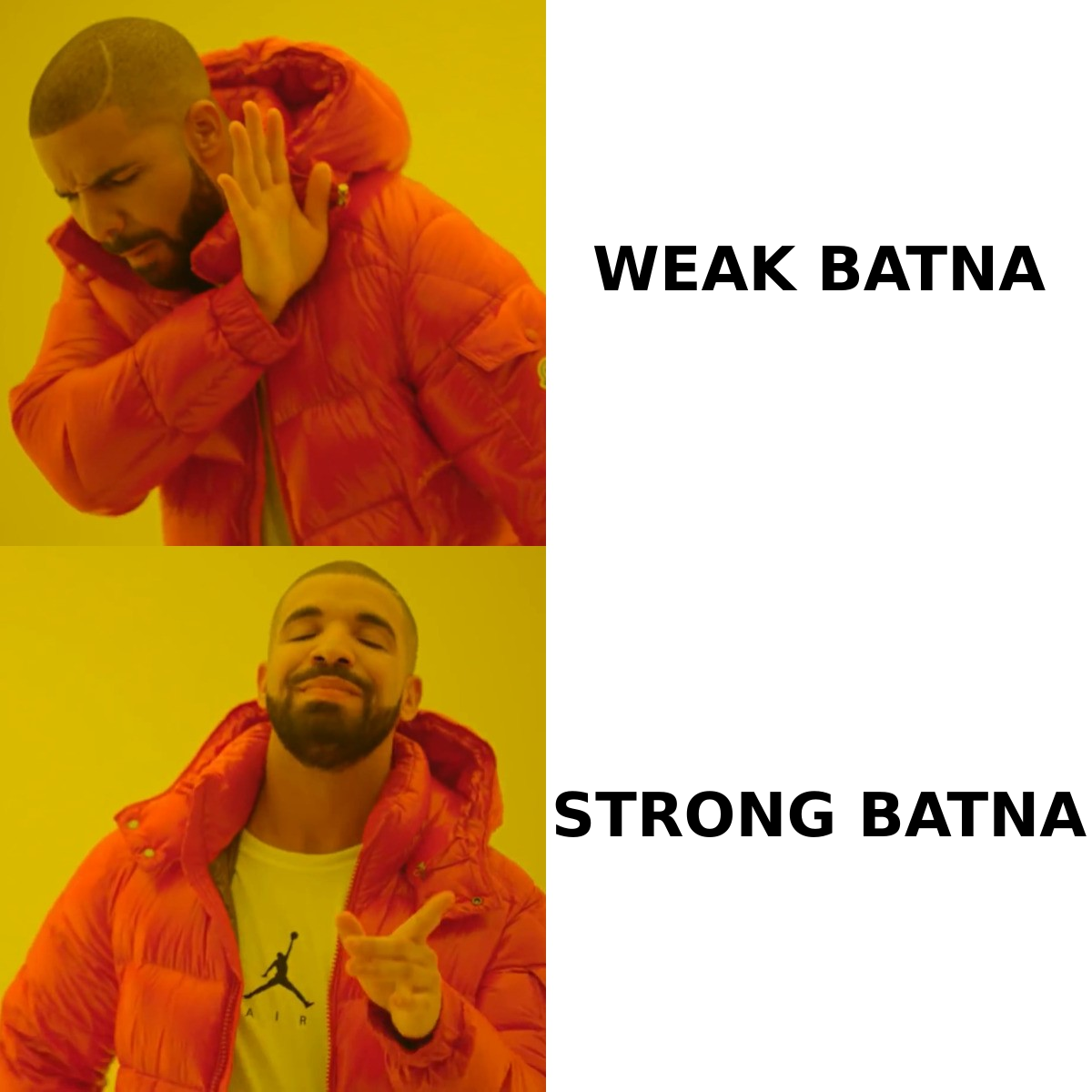
Leverage in negotiation comes from alternatives, not arguments. The party who can comfortably walk away dictates the terms.
Here is the uncomfortable truth: the buyer who says "match the price or we leave" is testing your BATNA, not stating a fact. If you have three other deals closing this month, that threat barely registers. If this is your only live opportunity at quarter-end, the threat is lethal — and skilled buyers can smell which situation you are in.
Your BATNA shapes three things at once:
- Your reservation point — the worst deal you will accept. It sits just above your BATNA's value.
- Your confidence — buyers read tone, pace, and willingness to pause. Real alternatives make these authentic.
- Your concession discipline — with a strong BATNA you give ground slowly and only in trades, because you are not afraid of the deal dying.
This is why prospecting and negotiation are the same muscle. A full, qualified pipeline is a portfolio of BATNAs. When you can always find your next buyer, no single buyer owns you. Tools like the Tomba Email Finder and a healthy B2B database exist precisely so your "next alternative" is never empty.
How do you calculate your BATNA step by step?#
Calculating a BATNA means turning "I have options" into a single, comparable number. Follow five steps.
- List every real alternative. Not wishes — actual paths you could take if this deal dies (another vendor, in-house build, status quo, a different prospect).
- Value each one. Estimate the net outcome of each alternative in money, time, and risk. Be honest about effort and probability.
- Pick the best alternative. The single highest-value option is your BATNA. The rest are backups.
- Set your reservation point. This is the least you will accept in the current deal, anchored just above your BATNA value.
- Identify the other side's BATNA. Estimate their walk-away too. The gap between the two reservation points is your "zone of possible agreement" (ZOPA).
Here is what that looks like in practice for a SaaS seller negotiating an annual contract:
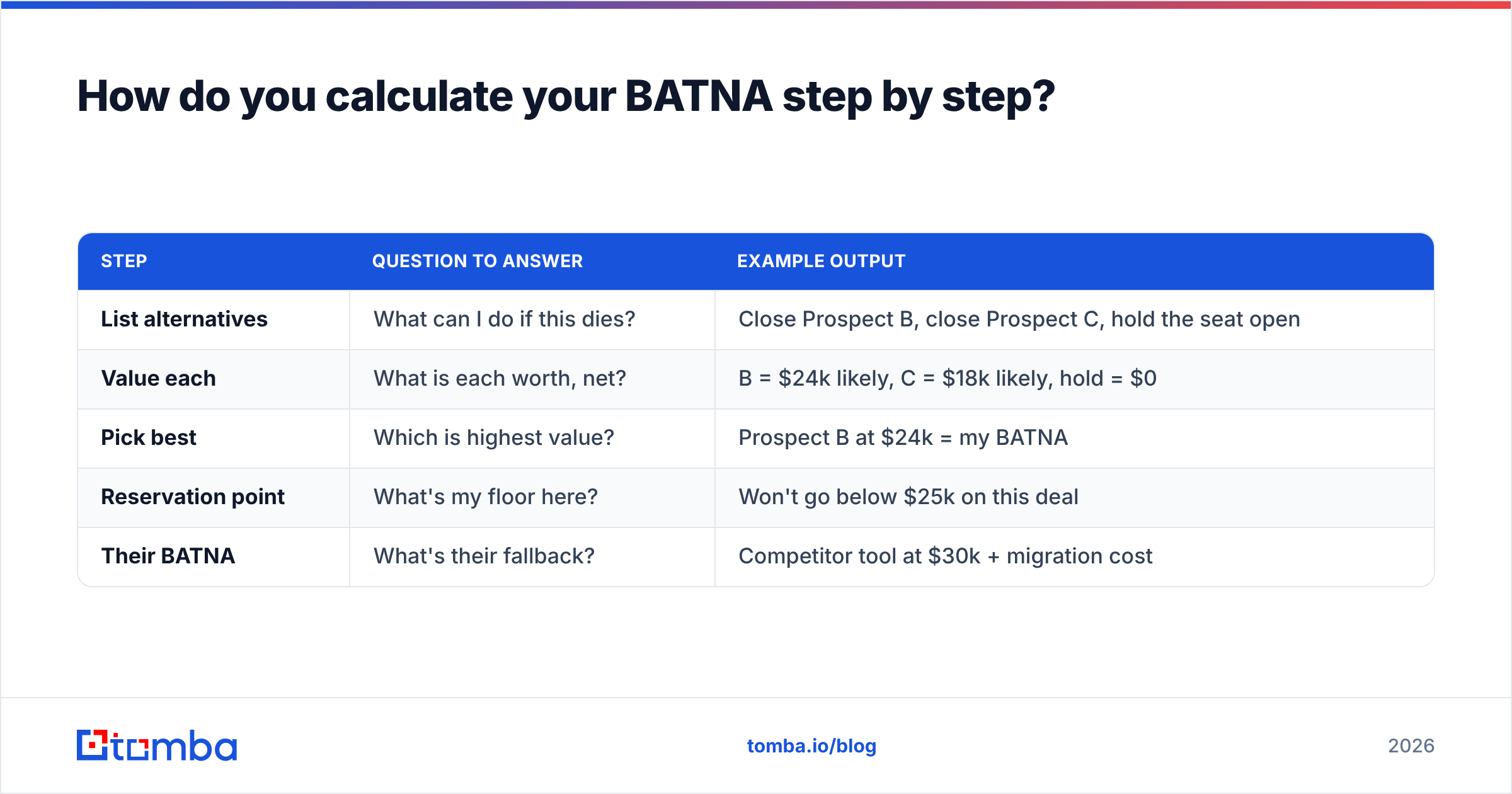
| Step | Question to answer | Example output |
|---|---|---|
| List alternatives | What can I do if this dies? | Close Prospect B, close Prospect C, hold the seat open |
| Value each | What is each worth, net? | B = $24k likely, C = $18k likely, hold = $0 |
| Pick best | Which is highest value? | Prospect B at $24k = my BATNA |
| Reservation point | What's my floor here? | Won't go below $25k on this deal |
| Their BATNA | What's their fallback? | Competitor tool at $30k + migration cost |
Once the table is filled in, the negotiation stops being emotional. You know your floor is $25k, you know their realistic alternative costs them more than your offer, and you can hold firm where it matters.
What's the difference between BATNA, WATNA, ZOPA, and reservation price?#
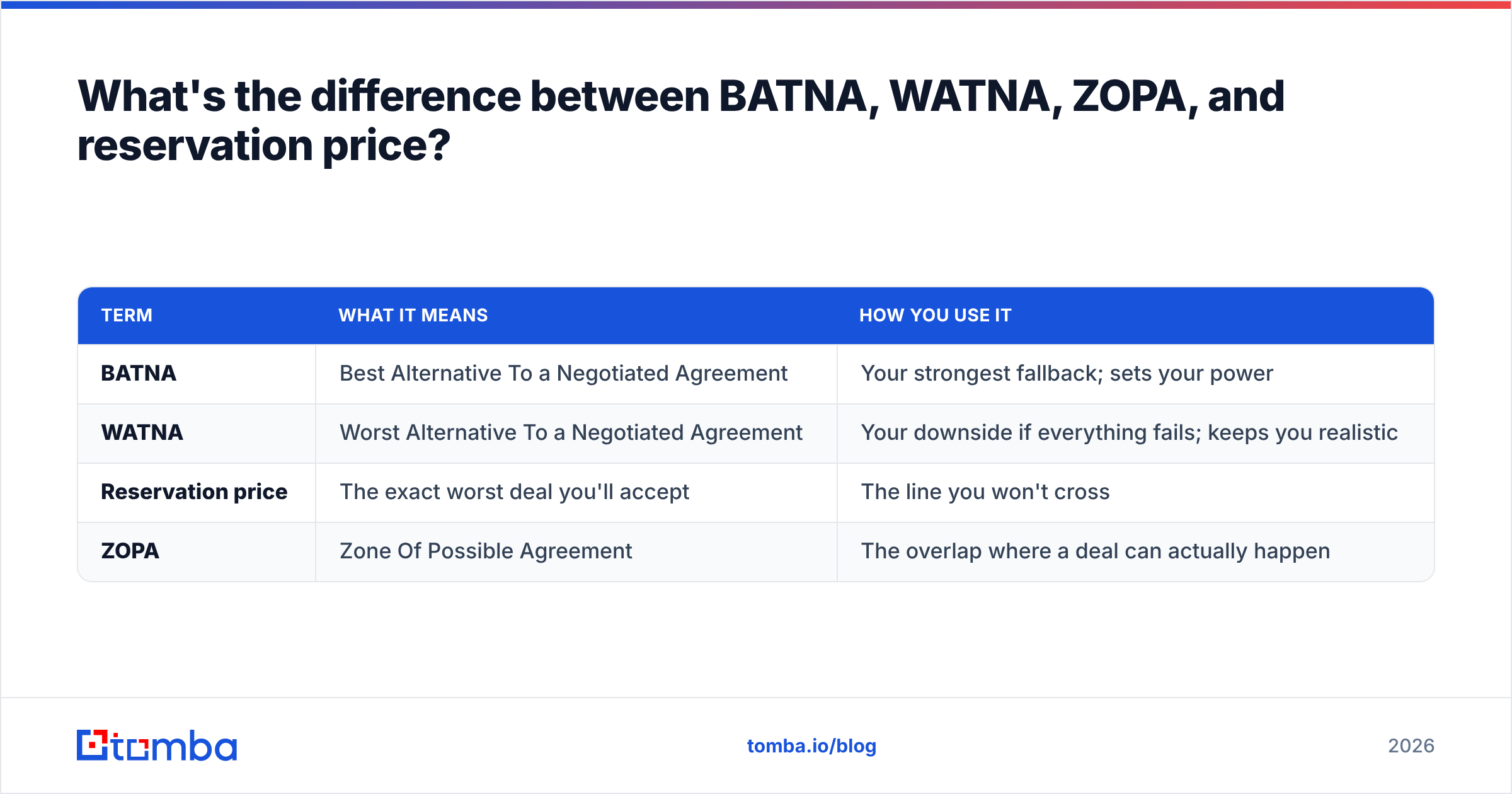
These four terms get tangled constantly. Keep them straight and you will never lose your bearings mid-deal.
| Term | What it means | How you use it |
|---|---|---|
| BATNA | Best Alternative To a Negotiated Agreement | Your strongest fallback; sets your power |
| WATNA | Worst Alternative To a Negotiated Agreement | Your downside if everything fails; keeps you realistic |
| Reservation price | The exact worst deal you'll accept | The line you won't cross |
| ZOPA | Zone Of Possible Agreement | The overlap where a deal can actually happen |
A simple way to remember it: BATNA is your best escape route, WATNA is the worst-case ditch, your reservation price is the fence you won't climb over, and ZOPA is the field where both fences leave room to meet. If there is no overlap between your reservation price and theirs, there is no ZOPA — and no honest deal is possible.
How do you strengthen a weak BATNA?#
You improve a BATNA by creating more and better alternatives before you sit down. A BATNA is not fixed; it is something you build.
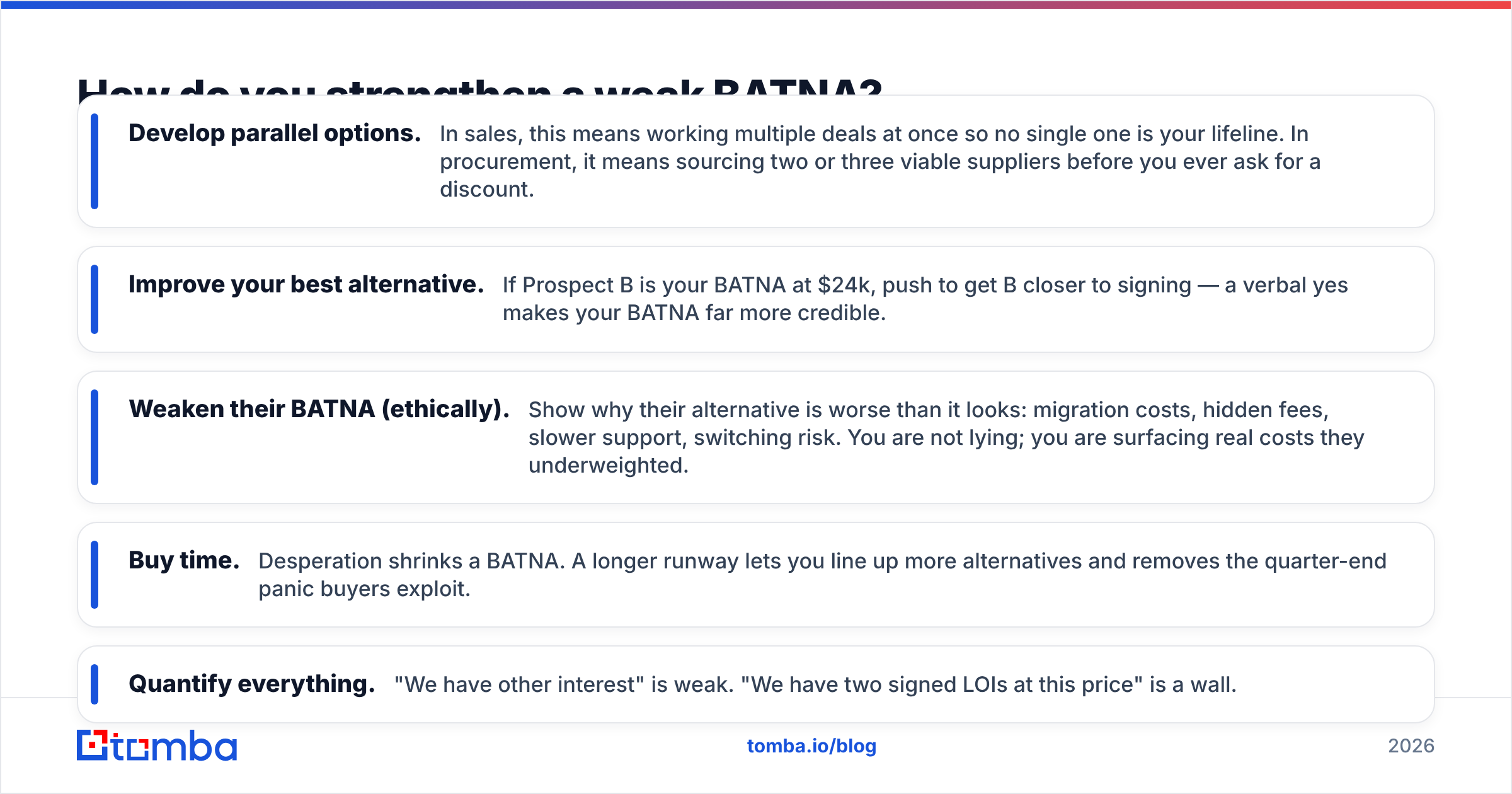
- Develop parallel options. In sales, this means working multiple deals at once so no single one is your lifeline. In procurement, it means sourcing two or three viable suppliers before you ever ask for a discount.
- Improve your best alternative. If Prospect B is your BATNA at $24k, push to get B closer to signing — a verbal yes makes your BATNA far more credible.
- Weaken their BATNA (ethically). Show why their alternative is worse than it looks: migration costs, hidden fees, slower support, switching risk. You are not lying; you are surfacing real costs they underweighted.
- Buy time. Desperation shrinks a BATNA. A longer runway lets you line up more alternatives and removes the quarter-end panic buyers exploit.
- Quantify everything. "We have other interest" is weak. "We have two signed LOIs at this price" is a wall.
The throughline: a strong BATNA is built upstream, in your pipeline and your research, long before anyone names a number.

How does BATNA work in B2B sales specifically?#
In B2B, your BATNA is the rest of your pipeline — so your prospecting engine is your negotiation engine. Sellers with thin pipelines negotiate scared. Sellers with deep pipelines negotiate from abundance.
Picture two account executives at the same quota. The first has one big deal and three weeks left. The second has that same deal plus six other qualified opportunities. When the big buyer demands a discount, the first AE folds because losing the deal means missing quota. The second AE holds the line, because the win rate math says one of those other six will land. Same product, same price, opposite outcomes — driven entirely by BATNA strength.
That is why disciplined teams treat continuous sales prospecting as deal protection, not just deal creation. Every fresh, verified contact you add is one more alternative that makes you harder to squeeze. When your data is accurate, your alternatives are real — and a BATNA built on stale or fake contacts collapses the moment you test it. Keeping a clean list with an email verifier means the alternatives you're counting on actually exist.
You can read the original framework on the Harvard Program on Negotiation site and the broader concept on Wikipedia; both reinforce the same point — alternatives are leverage.
What are common BATNA mistakes to avoid?#
Even experienced negotiators trip over the same handful of errors. Watch for these.
- Overvaluing your BATNA. Optimism inflates your alternatives. If you assume Prospect B "will definitely close," you will walk away from good deals chasing a fantasy. Discount by probability.
- Ignoring their BATNA. Negotiating only from your side is half-blind. If you misjudge how much their alternative costs them, you will either give away margin or push them out the door.
- Confusing BATNA with a target. Your BATNA is your floor, not your goal. Anchor high, but know where the floor is.
- Bluffing a BATNA you don't have. Skilled counterparts will call it, and once your bluff collapses, so does your credibility for the entire negotiation.
- Letting it go stale. A BATNA from last month may be dead today. Refresh it before every major conversation.
The cleanest defense against all five is real data: known alternatives, valued honestly, verified recently.
A quick BATNA checklist before any negotiation#
Run this list before you pick up the phone or open the contract:
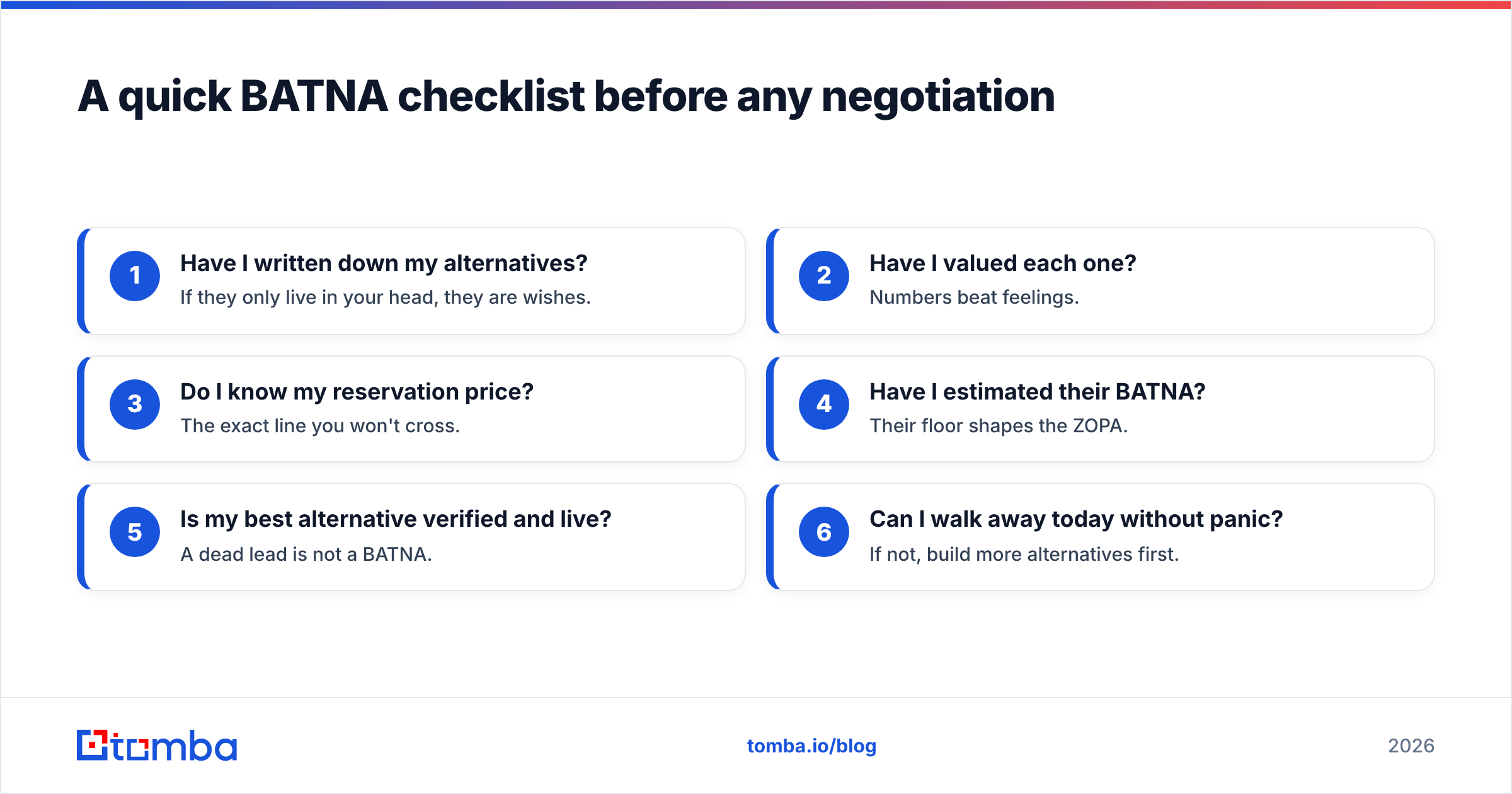
- Have I written down my alternatives? If they only live in your head, they are wishes.
- Have I valued each one? Numbers beat feelings.
- Do I know my reservation price? The exact line you won't cross.
- Have I estimated their BATNA? Their floor shapes the ZOPA.
- Is my best alternative verified and live? A dead lead is not a BATNA.
- Can I walk away today without panic? If not, build more alternatives first.
If you can answer all six with evidence, you are negotiating from strength. If you can't, you are negotiating from hope — and hope is exactly what the other side is counting on.
Build the pipeline that becomes your BATNA#
The strongest BATNA in B2B is never a clever line at the table — it is a deep bench of qualified, verified opportunities waiting behind the deal you're working. You can't bluff your way to that; you build it, one accurate contact at a time.
That is where Tomba Email Finder fits. Find decision-maker emails by name, company, or domain, verify them before you reach out, and keep your pipeline full enough that no single buyer can corner you. Start on the free tier (25 searches a month) and scale up through Tomba's plans — Starter at $49/mo, Growth at $99/mo — as your alternatives multiply. The more real options you have, the less any one negotiation can cost you. Build the BATNA before you need it.
// get started
Find, verify and enrich your first contacts today
Start on the free plan with 25 searches a month, then scale when your team is ready.
Free plan · No credit card required · GDPR & CCPA
// about the author