BDR Lead Generation in 2026: The Complete Playbook
A practical 2026 guide to BDR lead generation: how to build the pipeline, source accurate contacts, structure outreach, and measure what actually drives meetings.
BDR lead generation is the engine that fills the top of a B2B pipeline: business development reps researching accounts, sourcing accurate contacts, and running outbound until they book qualified meetings. Get it right and your AEs stay busy with real opportunities. Get it wrong and you burn budget on bad data and ignored emails.
This playbook breaks down how high-performing teams run BDR lead generation in 2026 — the workflow, the tooling, the cadences, and the metrics that matter.
TL;DR#
- BDR lead generation = sourcing + qualifying + outreach. The reps don't close; they create pipeline by turning target accounts into booked meetings.
- Data quality decides everything. A 2% bounce list outperforms a "10x bigger" list with 30% bad emails — clean contacts protect deliverability and rep time.
- Multi-channel beats email-only. Email, phone, and LinkedIn together lift reply rates well above any single channel.
- Measure leading indicators. Track meetings booked, reply rate, and pipeline created per rep — not just activity volume.
- Tooling matters. An accurate email finder plus verification and enrichment is the difference between a cadence that lands and one that gets filtered.
What is BDR lead generation?#
BDR lead generation is the process by which business development representatives identify, research, and engage potential buyers to create qualified pipeline for the sales team. Think of a BDR as the scout ahead of the main army: they map the terrain, find the right doors, and knock until someone worth talking to opens one.
Unlike a closing rep, a BDR's job ends at the handoff — a booked meeting or a qualified opportunity passed to an account executive. That single focus is what makes BDR work measurable and coachable.
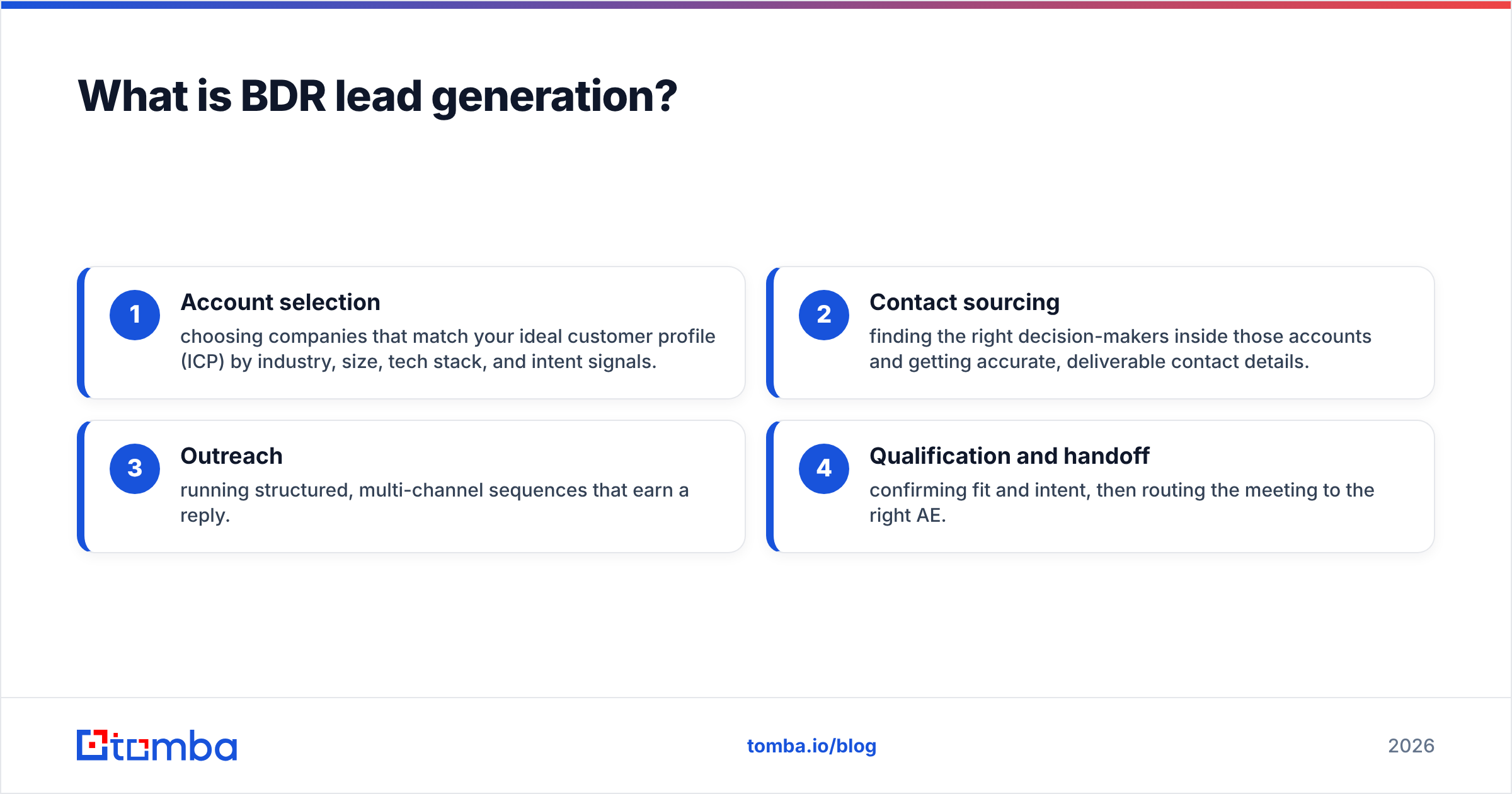
The modern BDR motion has four moving parts:
- Account selection — choosing companies that match your ideal customer profile (ICP) by industry, size, tech stack, and intent signals.
- Contact sourcing — finding the right decision-makers inside those accounts and getting accurate, deliverable contact details.
- Outreach — running structured, multi-channel sequences that earn a reply.
- Qualification and handoff — confirming fit and intent, then routing the meeting to the right AE.
Each stage feeds the next, so a weak link early (bad accounts or bad data) quietly wrecks everything downstream.
)
Why does data quality make or break BDR results?#
Bad data is the silent pipeline killer. You can hire great reps, write great copy, and still get nowhere if half your contacts bounce or route to the wrong person.
Here's the chain reaction: high bounce rates damage your domain's sender reputation, which pushes more of your good emails into spam, which drops reply rates across every campaign — even to valid contacts. One dirty list can poison an entire sending domain for weeks.
That's why elite BDR teams treat contact data as infrastructure, not a commodity. Before any contact enters a sequence, it should be:
- Found accurately — sourced from a tool that maps real people to real companies, not a guess-and-check permutator.
- Verified — checked against the mail server so you know it will actually deliver. Run lists through an email verifier before launch.
- Enriched — supplemented with role, seniority, location, and company data so personalization is possible.
- Deduplicated — so the same prospect doesn't get hit by three reps at once.
A smaller, clean list almost always beats a giant dirty one. Volume feels productive; deliverability is what produces meetings.
How do you build a BDR lead generation workflow?#
A repeatable workflow turns BDR work from improvisation into a system. Here's the core loop most high-output teams run, expressed as concrete steps:
- Define the ICP and trigger list. Lock the firmographics (industry, headcount, region) and the buying triggers (new funding, hiring for a relevant role, tech adoption). This is your account universe.
- Pull target accounts. Use a B2B database or intent provider to assemble the company list that matches the ICP.
- Identify the right personas. For each account, list the 2–4 titles who actually own the problem you solve.
- Source and verify contacts. Run domain search to get the people and patterns at each company, then verify every address before it touches a sequence.
- Enrich and segment. Add context for personalization and split the list by persona and use case so messaging stays relevant.
- Launch a multi-channel cadence. Combine email, calls, and LinkedIn touches over 2–3 weeks.
- Qualify, book, and hand off. Score replies, confirm fit, schedule the meeting, and route to the AE with full context.
The magic isn't any single step — it's running this loop consistently and measuring where prospects fall out.
Which channels should BDRs use in 2026?#
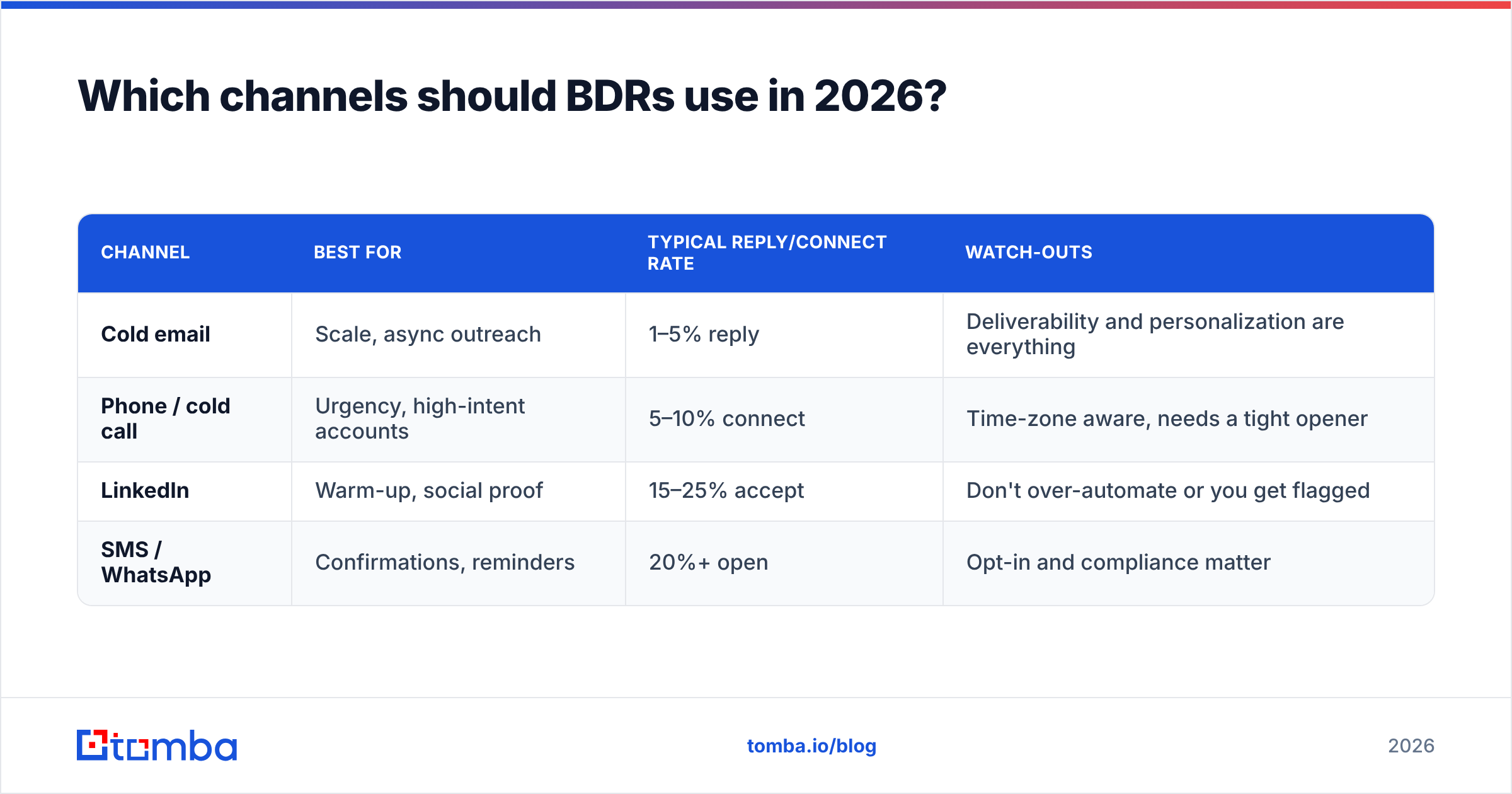
Email-only outbound is fading. Inboxes are crowded and filters are smarter, so the teams winning in 2026 sequence multiple channels around the same prospect. Each channel covers the others' blind spots.
| Channel | Best for | Typical reply/connect rate | Watch-outs |
|---|---|---|---|
| Cold email | Scale, async outreach | 1–5% reply | Deliverability and personalization are everything |
| Phone / cold call | Urgency, high-intent accounts | 5–10% connect | Time-zone aware, needs a tight opener |
| Warm-up, social proof | 15–25% accept | Don't over-automate or you get flagged | |
| SMS / WhatsApp | Confirmations, reminders | 20%+ open | Opt-in and compliance matter |
The point isn't to use every channel for every prospect. It's to layer two or three so a prospect who ignores email might pick up the phone, and someone who declines a call might accept a thoughtful LinkedIn note. To do that you need more than emails — you need phone numbers and social profiles, which is where a phone finder and LinkedIn finder earn their keep.
For deeper tactical guidance on the social channel specifically, the discipline of social selling pairs naturally with outbound: warm a prospect on LinkedIn, then reference it in your email.
What does a strong BDR cadence look like?#
A cadence is a scripted sequence of touches across channels and days. The goal is persistent without being annoying — enough contact to break through, spaced so you don't feel like a stalker.
Here's a proven 14-day structure you can adapt:
- Day 1 — Personalized email referencing a specific trigger (funding, hire, product launch).
- Day 2 — LinkedIn connection request, no pitch.
- Day 4 — Short follow-up email adding one new piece of value (a stat, a customer result).
- Day 6 — Phone call + voicemail.
- Day 8 — LinkedIn message referencing your earlier email.
- Day 11 — "Break-up" email that makes it easy to say no — which often gets the most replies.
- Day 14 — Final call attempt, then move to nurture.
Two rules keep cadences effective. First, every touch should add something, not just "bumping this to the top of your inbox." Second, keep your sending volume per rep low enough to protect deliverability — quality over blast. If you need help with the copy itself, a cold email AI writer and a subject line tester shorten the iteration loop.
)
How do you source accurate contacts at scale?#
Sourcing is where most BDR pipelines either fly or stall. You can have the perfect account list and the perfect cadence, but if you can't reach the right person, none of it matters.
There are three sourcing approaches, and serious teams blend them:
- Domain-first. Start with a target company, pull every relevant contact and the company's email pattern. Fastest way to cover an account fully.
- Person-first. You know the name (from LinkedIn or a referral) and need their work email. A direct email finder lookup solves this in seconds.
- Bulk. You have a CSV of hundreds of names or domains and need contacts and verification at once. A bulk email finder processes the whole file and returns deliverable results.
Whatever the approach, accuracy is the metric that counts. An email finder that returns a plausible-looking address that bounces is worse than no answer, because it costs you a send and a reputation hit. Look for tools that verify in real time and tell you their confidence level instead of guessing.
For teams that live in spreadsheets or a CRM, integrations remove the copy-paste tax. Pull contacts straight into Google Sheets, enrich a HubSpot list via the HubSpot integration, or wire everything through the Tomba API so sourcing happens inside your existing workflow.
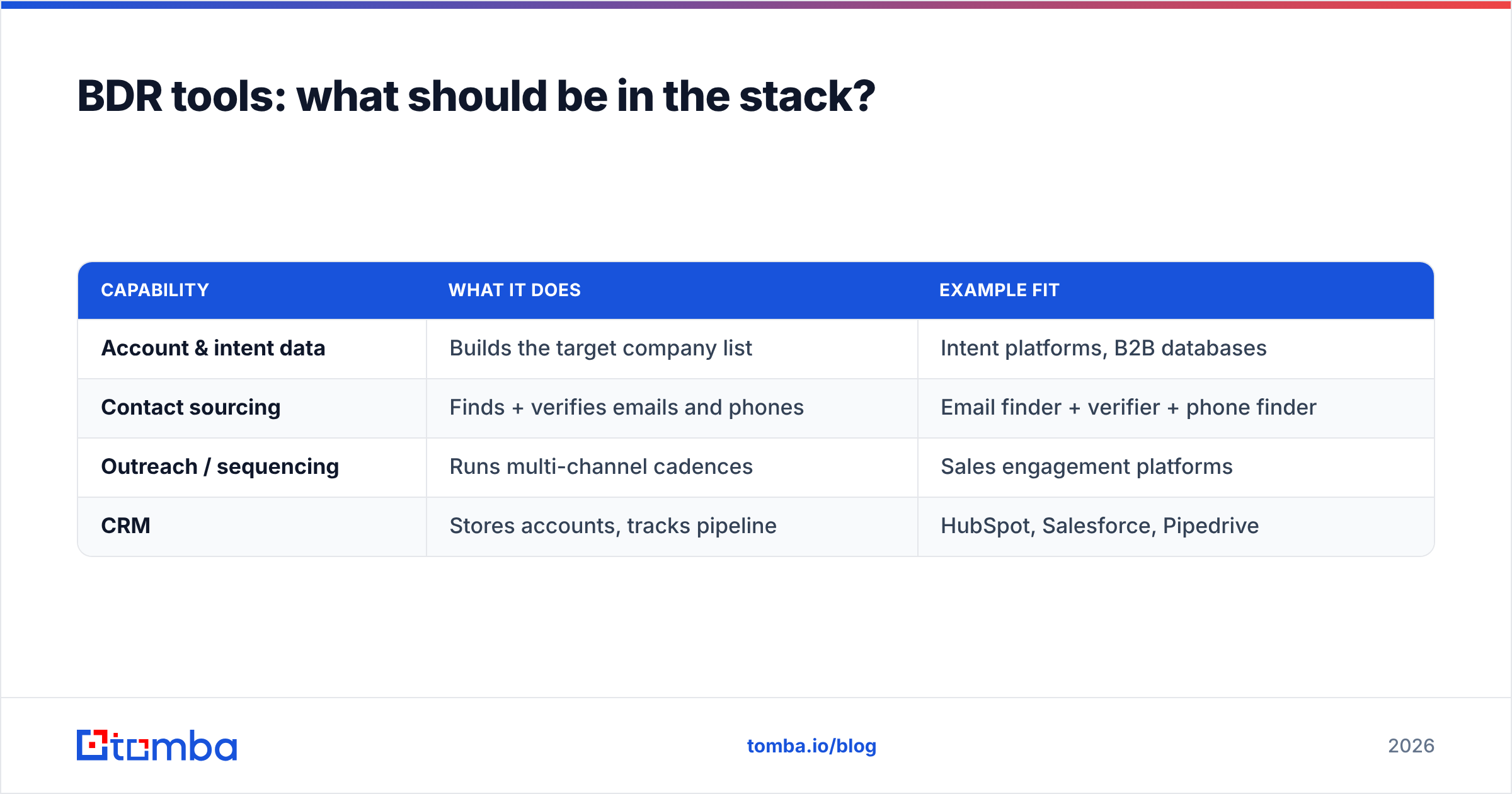
BDR tools: what should be in the stack?#
A BDR stack has four jobs: find accounts, find contacts, run outreach, and track results. You don't need a dozen tools — you need one reliable option for each job that plays nicely with the others.
| Capability | What it does | Example fit |
|---|---|---|
| Account & intent data | Builds the target company list | Intent platforms, B2B databases |
| Contact sourcing | Finds + verifies emails and phones | Email finder + verifier + phone finder |
| Outreach / sequencing | Runs multi-channel cadences | Sales engagement platforms |
| CRM | Stores accounts, tracks pipeline | HubSpot, Salesforce, Pipedrive |
The connective tissue matters as much as the tools. If your contact source doesn't push clean data into your CRM and sequencer automatically, reps lose hours to manual entry — time that should go to conversations. Tomba connects to the common stack through its integrations, including Salesforce and Pipedrive, so sourced contacts land where reps already work.
On budget: contact data is usually the cheapest high-leverage line item in the stack. Tomba's plans start with a free tier (25 searches/mo) and scale to Starter at $49/mo and Growth at $99/mo — see full Tomba pricing for the breakdown. Compared to the cost of a rep's wasted hours chasing bad numbers, accurate data pays for itself fast.
How do you measure BDR lead generation success?#
Measure outcomes, not just activity. Plenty of BDRs send 500 emails a week and book nothing; the dashboard should make that visible immediately.
Track these metrics in two tiers:
Leading indicators (daily/weekly):
- Reply rate — healthy cold email sits around 3–8% with good targeting and copy.
- Positive reply rate — replies that show interest, not just "unsubscribe."
- Connect rate — for calls, the share of dials that reach a human.
- Meetings booked — the BDR's north-star output.
Lagging indicators (monthly/quarterly):
- Pipeline created — dollar value of opportunities from BDR-sourced meetings.
- Meeting-to-opportunity rate — quality check on whether meetings are real.
- Cost per meeting — total spend (tools + comp) divided by meetings booked.
A useful gut-check: your response rate and bounce rate move in opposite directions. If replies are falling, check your bounce rate first — it's usually a data problem, not a copy problem. For more on benchmarking, G2 and HubSpot publish solid B2B outbound stats worth comparing against (HubSpot's sales statistics and G2's software reviews are good neutral references).
What are the most common BDR lead generation mistakes?#
Most BDR programs fail for predictable reasons. Avoid these and you're ahead of the majority:
- Buying static lists. Purchased lists decay fast — people change jobs every few years — and they bounce hard. Source fresh and verify instead.
- Spraying generic copy. "Hope you're doing well" templates get ignored. Reference a real trigger for the specific account.
- Ignoring deliverability. Sending too much, too fast, from an unwarmed domain tanks your inbox placement. Learn the basics of email deliverability before scaling volume.
- No follow-up discipline. Most replies come after the first touch. Reps who quit after one email leave the majority of pipeline on the table.
- Measuring activity, not outcomes. Rewarding "emails sent" trains reps to send junk. Reward meetings booked and pipeline created.
Notice the through-line: nearly every mistake traces back to either bad data or bad process. Fix those two and copy improvements compound on top.
Putting it together#
BDR lead generation in 2026 is a system, not a hustle. Pick the right accounts, source accurate and verified contacts, run disciplined multi-channel cadences, and measure the outcomes that predict revenue. The teams that win aren't the ones sending the most emails — they're the ones reaching the right person with a deliverable message and a relevant reason to reply.
The foundation under all of it is contact accuracy. If your BDRs are spending time chasing bounced addresses and wrong numbers, no cadence or copy tweak will save the pipeline.
Start there. Use the Tomba Email Finder to source decision-maker emails by name, company, or domain — verified in real time so your reps spend their hours on conversations instead of dead ends. Spin up the free tier, point it at your target account list, and watch your bounce rate drop and your meeting count climb.
// get started
Find, verify and enrich your first contacts today
Start on the free plan with 25 searches a month, then scale when your team is ready.
Free plan · No credit card required · GDPR & CCPA
// about the author