BDR Meaning: What a Business Development Rep Does in 2026
BDR meaning, decoded: what a business development representative actually does, how the role differs from an SDR, the skills that matter, salary ranges, and the stack that fills pipeline in 2026.
TL;DR
- BDR meaning: a Business Development Representative is a sales rep who sources and qualifies new pipeline through outbound prospecting — cold email, calls, and social — then hands warm opportunities to closers.
- BDRs focus on outbound (you reach out); SDRs typically handle inbound (leads come to you). Many companies blur the line, but the split still matters for comp and quotas.
- The job lives or dies on data quality. Bad contact data means wasted dials, bounced email, and missed quota.
- A modern BDR stack = accurate contact data + sequencer + CRM + intent signals.
- BDR is the most common entry point into B2B sales and the fastest on-ramp to an Account Executive role.
What does BDR mean?#
BDR stands for Business Development Representative — a frontline sales role focused on creating new pipeline through outbound prospecting. Think of a BDR as the scout for a sales army: they go out ahead, find where the prospects are, make first contact, and flag the ones worth pursuing so the closers can move in.
In practice, a BDR spends their day researching target accounts, finding the right people inside them, reaching out across email, phone, and LinkedIn, and booking qualified meetings for Account Executives (AEs). They rarely close deals themselves. Their product is a booked, qualified meeting — not a signed contract.
The role exists because closing and prospecting are different skills. Asking a senior AE to spend four hours a day cold-calling is like asking a surgeon to also run the hospital's front desk. Splitting the work lets each person specialize, and it gives new salespeople a structured way to learn the trade.
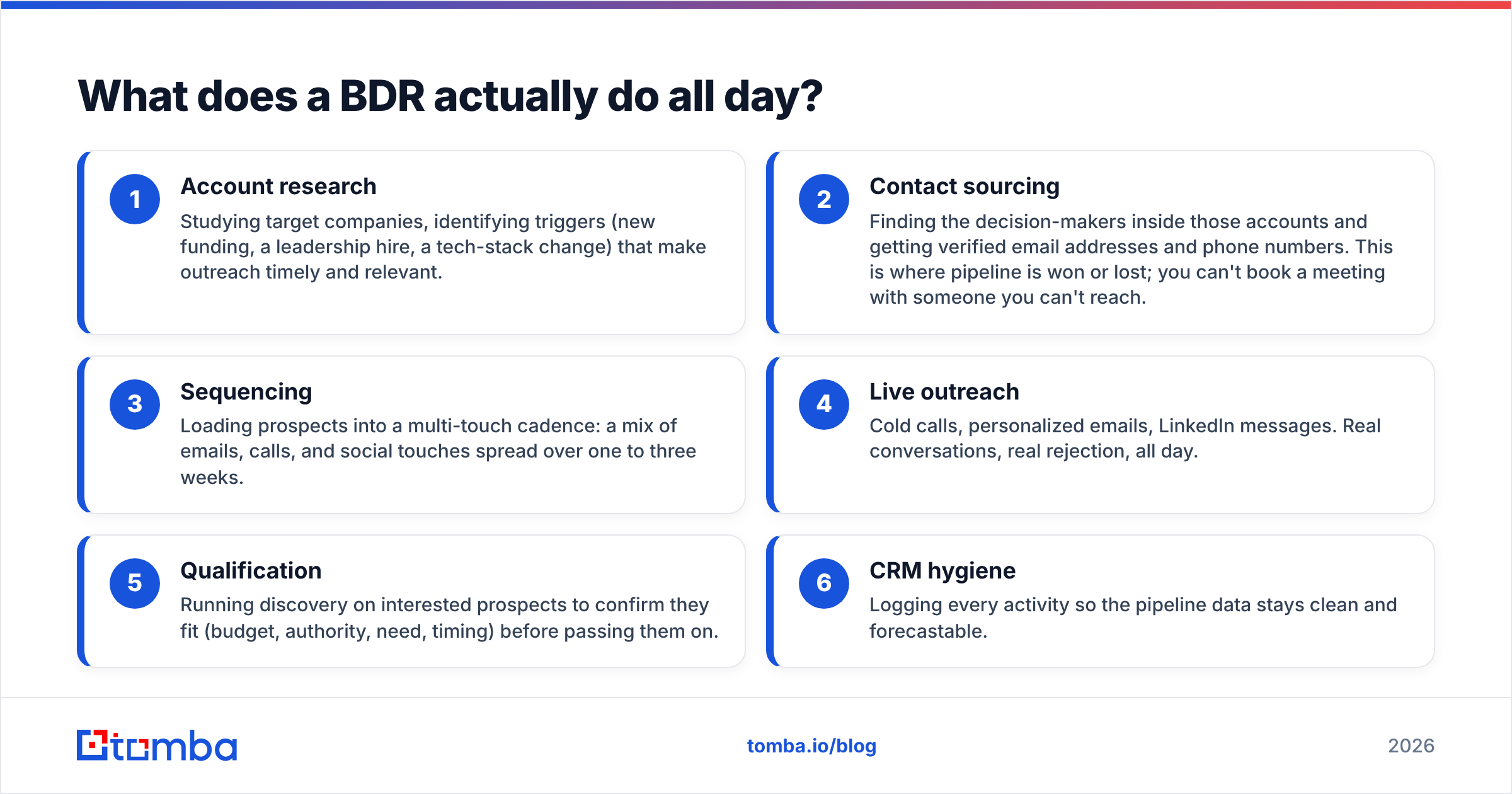
What does a BDR actually do all day?#
The job is more repetitive and more analytical than most people expect. A typical BDR day breaks down like this:
- Account research — Studying target companies, identifying triggers (new funding, a leadership hire, a tech-stack change) that make outreach timely and relevant.
- Contact sourcing — Finding the decision-makers inside those accounts and getting verified email addresses and phone numbers. This is where pipeline is won or lost; you can't book a meeting with someone you can't reach.
- Sequencing — Loading prospects into a multi-touch cadence: a mix of emails, calls, and social touches spread over one to three weeks.
- Live outreach — Cold calls, personalized emails, LinkedIn messages. Real conversations, real rejection, all day.
- Qualification — Running discovery on interested prospects to confirm they fit (budget, authority, need, timing) before passing them on.
- CRM hygiene — Logging every activity so the pipeline data stays clean and forecastable.
The unglamorous truth: a BDR's output is a numbers game built on top of quality inputs. More accurate data means more connects, which means more meetings, which means quota hit. That's why elite BDR teams obsess over their data sources before they obsess over their scripts.
What's the difference between a BDR and an SDR?#
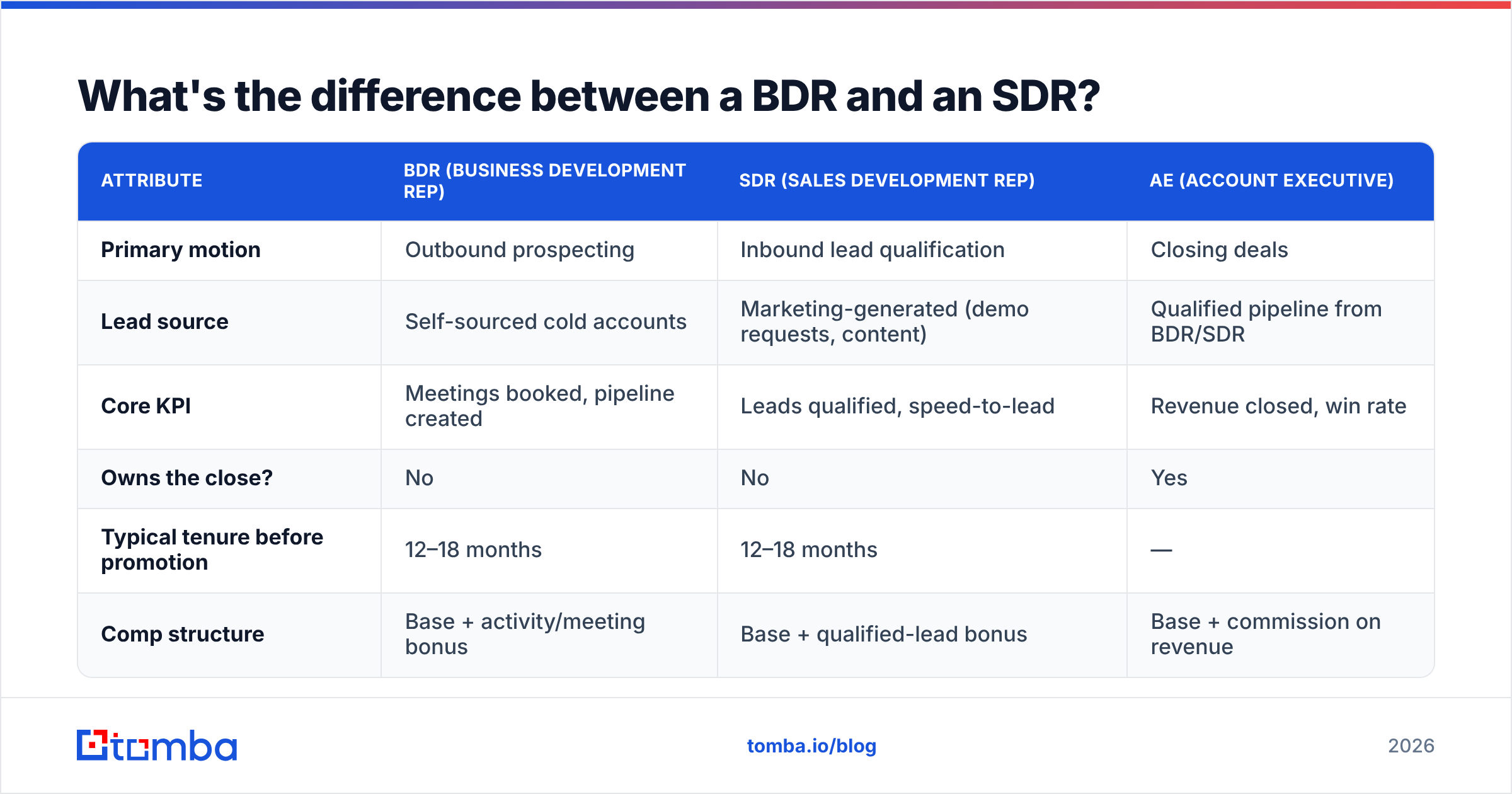
The short answer: BDRs usually own outbound (they hunt cold accounts), while SDRs usually own inbound (they qualify leads that already raised a hand). In reality the titles are used interchangeably at many companies, but the functional split below is the most common convention.
| Attribute | BDR (Business Development Rep) | SDR (Sales Development Rep) | AE (Account Executive) |
|---|---|---|---|
| Primary motion | Outbound prospecting | Inbound lead qualification | Closing deals |
| Lead source | Self-sourced cold accounts | Marketing-generated (demo requests, content) | Qualified pipeline from BDR/SDR |
| Core KPI | Meetings booked, pipeline created | Leads qualified, speed-to-lead | Revenue closed, win rate |
| Owns the close? | No | No | Yes |
| Typical tenure before promotion | 12–18 months | 12–18 months | — |
| Comp structure | Base + activity/meeting bonus | Base + qualified-lead bonus | Base + commission on revenue |
If you only remember one thing: BDRs make the first move; SDRs respond to interest; AEs sign the deal. Whether your company calls the outbound role "BDR" or "SDR," the work — finding people and starting conversations — is the same, and it depends on the same foundation of clean contact data. For a deeper look at the surrounding workflow, see how a tight sales prospecting motion feeds qualified leads downstream.
What skills make a great BDR?#
The best BDRs aren't the loudest people in the room. They're disciplined operators. The skills that separate quota-crushers from churned-out hires:
- Research instinct — Knowing why an account is a fit before reaching out, and leading with that reason.
- Written brevity — Cold emails that get replies are short, specific, and about the prospect, not the product. (A solid subject line generator and tested templates shorten the learning curve.)
- Resilience — A 2–5% reply rate is normal. You hear "no" far more than "yes," and the job is to keep dialing.
- Process discipline — Following the cadence, logging activity, and trusting the math over the course of a quarter.
- Curiosity over scripts — Real qualification means asking questions and listening, not reciting a pitch.
- Tooling fluency — A modern BDR runs a stack of five-plus tools daily. Comfort with sales automation is no longer optional.
According to industry benchmarks tracked by analysts like Gartner and peer-reviewed by buyers on G2, the single highest-leverage factor in BDR performance isn't talent — it's the quality of the data and tooling the rep is handed on day one.
How much does a BDR make?#
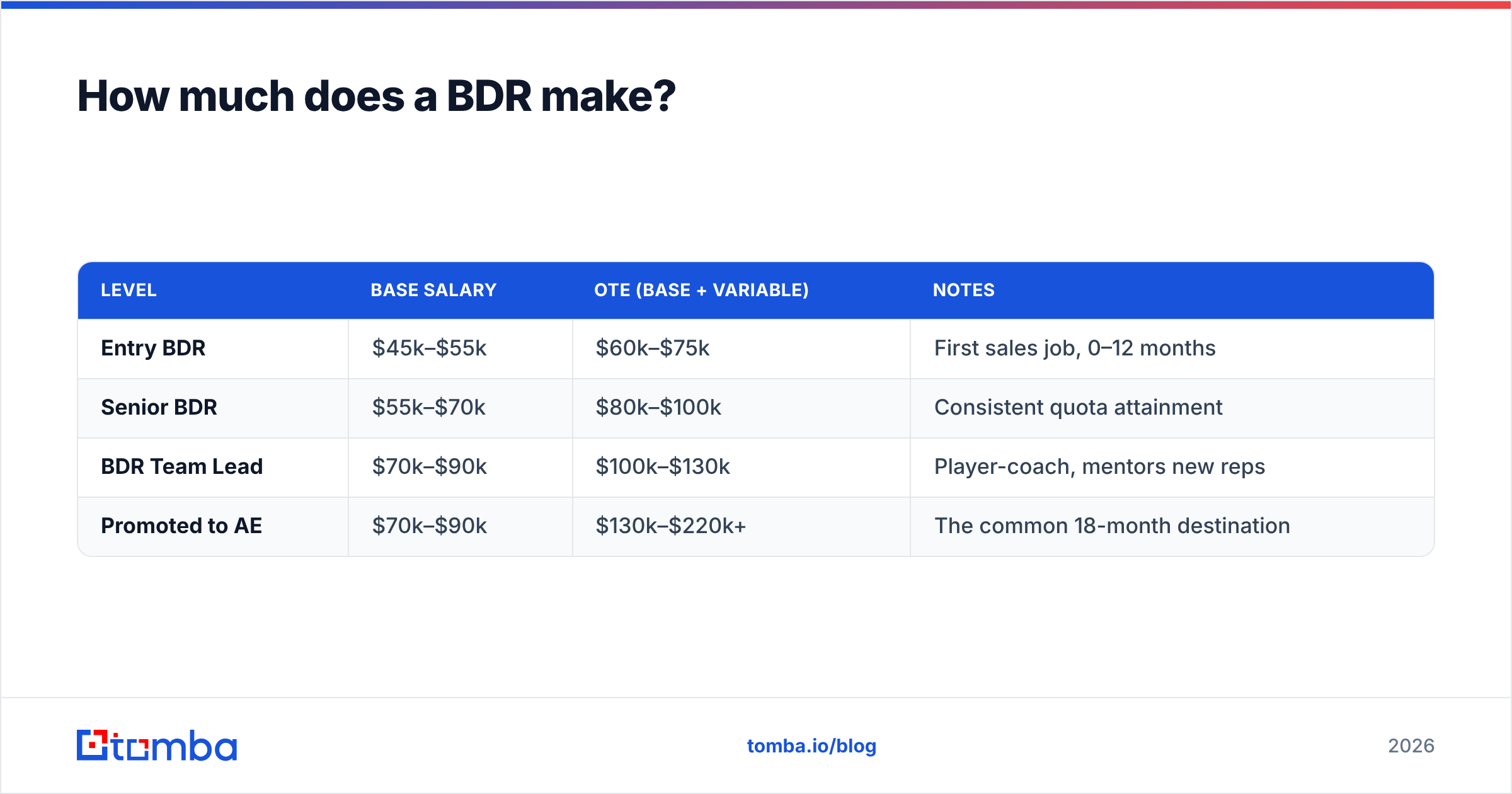
Compensation is typically a base salary plus a variable component tied to meetings booked or pipeline created. Numbers vary widely by region, industry, and company stage, but here's a realistic 2026 snapshot for the US market:
| Level | Base salary | OTE (base + variable) | Notes |
|---|---|---|---|
| Entry BDR | $45k–$55k | $60k–$75k | First sales job, 0–12 months |
| Senior BDR | $55k–$70k | $80k–$100k | Consistent quota attainment |
| BDR Team Lead | $70k–$90k | $100k–$130k | Player-coach, mentors new reps |
| Promoted to AE | $70k–$90k | $130k–$220k+ | The common 18-month destination |
The real value of a BDR role isn't the starting salary — it's the trajectory. BDR is the most reliable entry point into B2B sales, and a strong two-year run is the standard launchpad into a closing role with double the earning ceiling. Sites like HubSpot's sales blog publish updated comp surveys most years if you want to benchmark a specific market.
What does a modern BDR tech stack look like?#
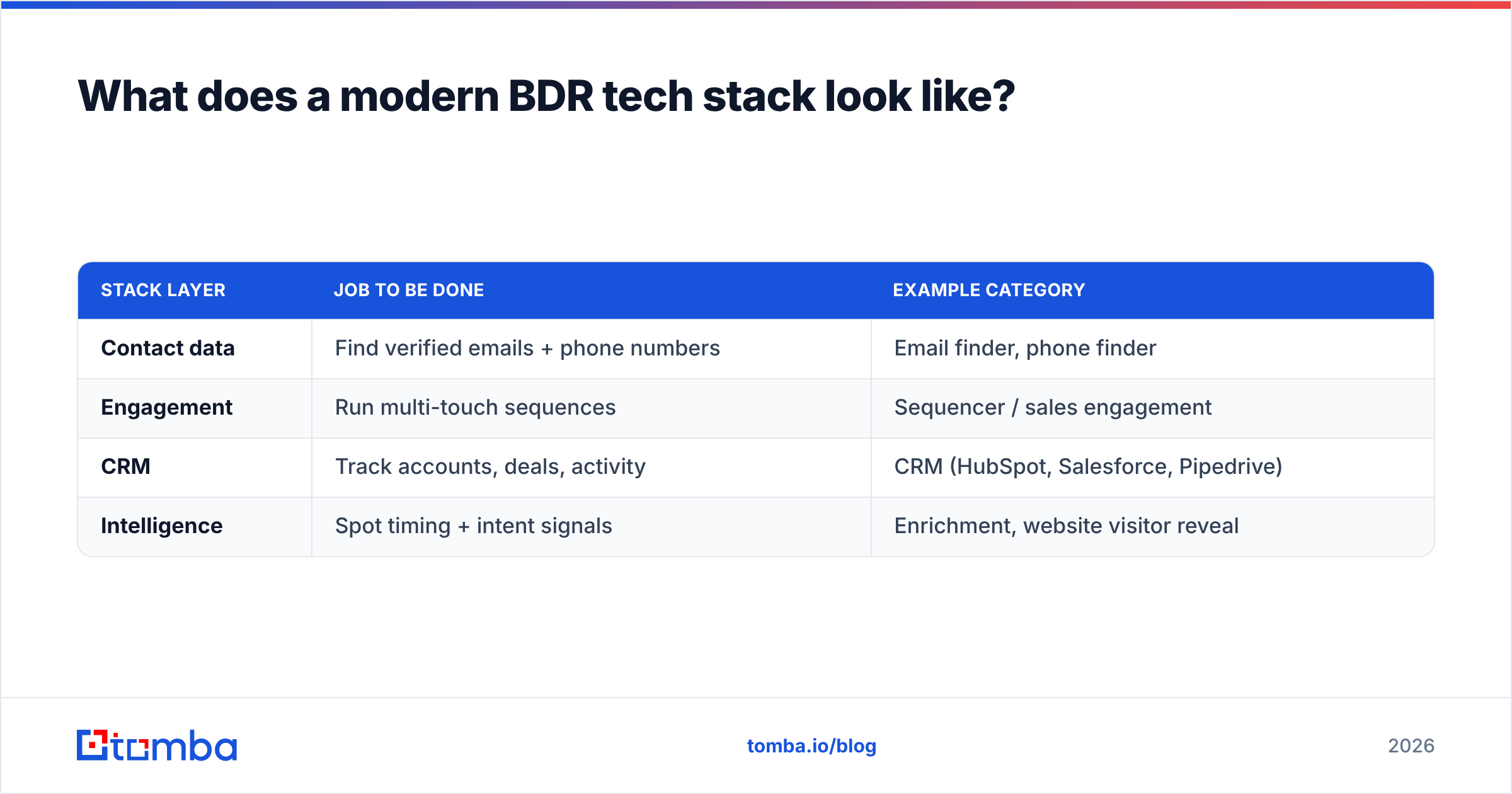
A BDR is only as good as their tools. The stack has four layers, and they have to work together — a great sequencer firing emails at bad addresses just produces bounces faster.
| Stack layer | Job to be done | Example category |
|---|---|---|
| Contact data | Find verified emails + phone numbers | Email finder, phone finder |
| Engagement | Run multi-touch sequences | Sequencer / sales engagement |
| CRM | Track accounts, deals, activity | CRM (HubSpot, Salesforce, Pipedrive) |
| Intelligence | Spot timing + intent signals | Enrichment, website visitor reveal |
The foundation layer — contact data — is the one most teams underinvest in, and it's the one that quietly caps everything above it. If 20% of your emails bounce, you're not just losing those sends; you're hurting your sender reputation and dragging down deliverability for the prospects you can reach.

This is exactly where a dedicated data tool earns its keep. Instead of buying stale lists or guessing email formats, a BDR can:
- Use a domain search to pull every reachable contact at a target account.
- Run an email verifier to scrub the list before it ever touches a sequence.
- Enrich thin records with titles, locations, and B2B phone numbers for multichannel outreach.
- Pull verified emails directly from a prospect's profile with a LinkedIn finder.
Each of those steps removes a failure point between "I found a company" and "I booked a meeting."
How do BDRs find and verify contact data?#
The reliable method is: identify the account, find the people, then verify every address before you send. Skipping verification is the most common rookie mistake, and it's the one that silently kills campaigns.
Here's the workflow most high-performing BDRs follow:
- Build the account list — Use firmographic filters (industry, size, geography, tech stack) to define your ideal accounts.
- Map the buying committee — Identify every relevant role, not just one champion. Enterprise deals involve 6–10 stakeholders.
- Source verified emails — Use a purpose-built email finder rather than guessing patterns by hand.
- Verify in bulk — Catch invalid, risky, and catch-all addresses before they bounce. A bulk email finder handles this at list scale.
- Enrich and prioritize — Layer in seniority and intent so you call the most likely buyers first.
The math is brutal but simple: if your data is 70% accurate, nearly a third of your effort is wasted before you say a word. Push that to 95%+ and the same activity produces a third more meetings. That's why data accuracy isn't a back-office detail — it's the BDR's single biggest performance lever. Tomba publishes its data sources openly so teams can audit where contacts come from, which matters when compliance teams ask.
Is BDR a good career path?#
Yes — BDR is widely considered the best entry point into B2B sales, with a clear, fast path upward. You learn the fundamentals (prospecting, qualification, objection handling, CRM discipline) in a structured environment, and strong performers are promoted to Account Executive within 12–18 months.
Beyond AE, the BDR foundation branches into sales management, revenue operations, customer success, and marketing. The prospecting and data skills transfer everywhere. Few entry-level roles in tech give you direct, measurable impact on revenue this early — and that visibility is what accelerates careers.
The catch: it's hard. The rejection is real, the activity targets are high, and the first three months are a grind. But the reps who lean into process and good tooling — rather than relying on raw hustle — are the ones who hit quota and get promoted.
Frequently asked questions#
Does BDR mean the same as SDR? Not strictly. BDR usually means outbound prospecting (you initiate contact with cold accounts), while SDR usually means inbound qualification (you work leads that came from marketing). Many companies use the terms interchangeably, so always check the actual responsibilities in a job description.
Do BDRs close deals? Rarely. A BDR's job is to source and qualify pipeline, then hand booked meetings to an Account Executive who owns the close. The BDR's "win" is a qualified meeting.
What's the most important tool for a BDR? Accurate contact data. Everything else — sequencers, dialers, CRM — multiplies whatever data you feed it. Garbage in, garbage out.
How long does someone stay a BDR? Typically 12–18 months before promotion to an AE or a senior BDR role, assuming consistent quota attainment.
Start filling pipeline with data you can trust#
Every BDR metric — connect rate, reply rate, meetings booked — traces back to one thing: can you actually reach the right person? The Tomba Email Finder gives you verified professional emails by name, domain, or company, so your sequences land in real inboxes instead of bouncing. Pair it with the built-in email verifier and start on the free tier (25 searches/month), then scale to the Starter plan at $49/mo when your pipeline outgrows it. Spend less time guessing email formats and more time booking meetings — that's the whole job.
// get started
Find, verify and enrich your first contacts today
Start on the free plan with 25 searches a month, then scale when your team is ready.
Free plan · No credit card required · GDPR & CCPA
// about the author