BDR Sales Tactics That Actually Book Meetings in 2026
The BDR sales tactics that book pipeline in 2026: multichannel cadences, clean data, trigger-based outreach, and a metric stack that actually predicts quota attainment.
Most BDR advice is recycled motivation. This is the opposite: a concrete set of BDR sales tactics you can run this quarter, with the cadence structure, data hygiene, and metrics that separate reps who hit 120% of quota from reps who burn their list and blame the market.
TL;DR#
- Multichannel beats single-channel. A blended email + phone + LinkedIn cadence books 2-3x the meetings of email-only sequences.
- Data quality is tactic zero. Bounced sends and wrong numbers don't just waste time — they wreck sender reputation and kill the whole cadence. Verify before you send.
- Trigger events out-convert cold lists. Outreach tied to a hiring spike, funding round, or tech-stack change gets replies; "Just checking in" gets ignored.
- Personalize the opener, templatize the rest. The first two lines must be specific to the prospect; the value prop can be reused.
- Track leading metrics, not just meetings booked. Connect rate, reply rate, and positive-reply rate tell you what to fix two weeks before the meeting count moves.
What does a BDR actually do in 2026?#
A BDR (business development representative) sits at the top of the funnel and has one job: turn a name on a list into a qualified conversation for an account executive. The role is part researcher, part copywriter, part cold caller, and increasingly part data analyst.
Think of a BDR like a scout for a hiking expedition. The AE is the climber who summits the deal, but if the scout picks a bad trail — wrong accounts, dead contacts, no read on the terrain — the whole team wastes a day. Good BDR sales tactics are mostly about choosing the right trail before anyone starts walking.
The economics are unforgiving. The average BDR sends hundreds of touches a week and books a handful of meetings. Small improvements in list quality and message relevance compound fast, because every touch downstream rides on the quality of the work done upstream.
What are the core BDR sales tactics that still work?#
The fundamentals haven't changed; the execution bar has risen. Buyers are flooded, spam filters are smarter, and "personalization" tokens fool no one anymore. Here are the tactics that earn replies in 2026, ranked by leverage:
- Build a tight ICP list before touching a sequence. Fewer, better-fit accounts beat a giant export. Define firmographics (size, industry, region) and a technographic or trigger signal, then cap the list so you can actually personalize each one.
- Verify every contact before the first send. A list is only as good as its deliverability. Run addresses through an email verifier and confirm direct dials before you dial — bad data is the single biggest silent killer of cadence performance.
- Lead with a trigger, not a pitch. Anchor your opener to something that just happened in the prospect's world: a new exec hire, a funding announcement, a product launch, a job posting that signals a pain you solve.
- Go multichannel from day one. Email alone has a ceiling. Layer phone and LinkedIn touches into the same cadence so you reach the prospect where they actually respond.
- Make the ask small. Don't ask for 30 minutes in touch one. Ask a question, or offer a relevant insight, and earn the meeting over the sequence.
- Measure leading indicators weekly. Reply rate and positive-reply rate move before booked meetings do. Watch them to catch a broken cadence early.
According to HubSpot's sales research, persistence and multichannel follow-up consistently outperform single-touch outreach — most replies come after the first message, not on it.
Why does data quality matter more than the script?#
Because a perfect script sent to a dead inbox books zero meetings. Data is the foundation every other BDR sales tactic stands on.
Here's the chain reaction most teams miss. When a meaningful share of your sends bounce, mailbox providers read it as spammy behavior and start routing even your valid sends to spam. Now your carefully written, well-targeted emails to real prospects never get seen. One dirty list can quietly suppress an entire team's deliverability for weeks.
The fix is process, not heroics:
- Source from accurate data. Use a tool that finds and confirms professional emails by domain and name rather than guessing patterns. Tomba's email finder returns verified business addresses with a confidence score, so you're not gambling on
firstname@company.com. - Verify in bulk before every campaign. Even good data decays — people change jobs roughly every two to three years. Re-verify lists older than 90 days.
- Confirm phone numbers too. Multichannel only works if the dials connect. A phone finder keeps your call blocks productive instead of feeding you disconnected lines.
- Watch your bounce rate like a sender-reputation gauge. Keep it under ~2% and your inbox placement stays healthy.
The payoff is direct: cleaner data means higher response rate, better reputation, and more conversations per hour of work.
How should a BDR structure a multichannel cadence?#
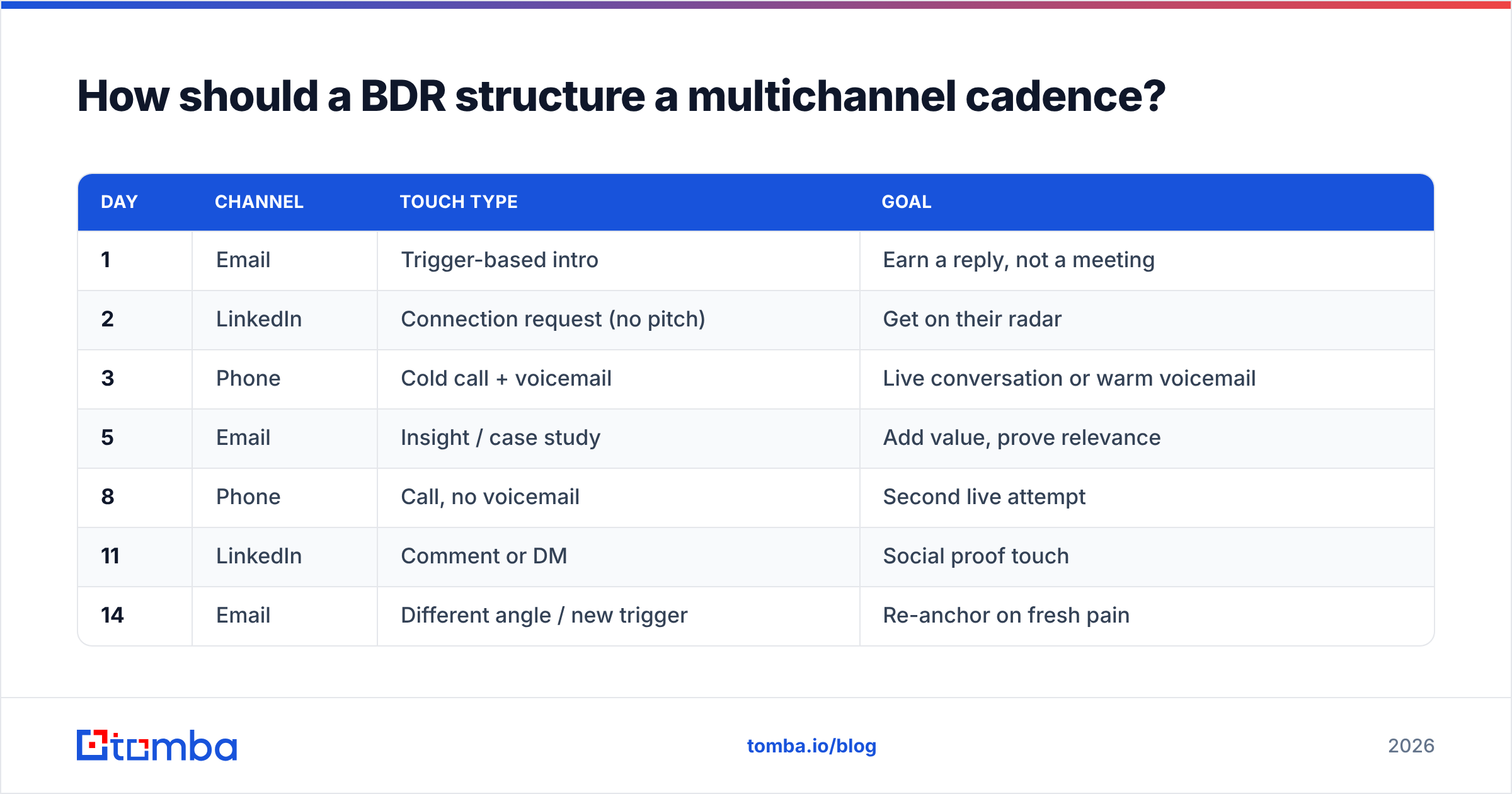
A cadence is a scheduled, repeatable series of touches across channels over a fixed window — usually 12 to 18 touches across 15 to 21 business days. The art is spacing and channel variety, not volume.
Here's a proven structure you can adapt:
| Day | Channel | Touch type | Goal |
|---|---|---|---|
| 1 | Trigger-based intro | Earn a reply, not a meeting | |
| 2 | Connection request (no pitch) | Get on their radar | |
| 3 | Phone | Cold call + voicemail | Live conversation or warm voicemail |
| 5 | Insight / case study | Add value, prove relevance | |
| 8 | Phone | Call, no voicemail | Second live attempt |
| 11 | Comment or DM | Social proof touch | |
| 14 | Different angle / new trigger | Re-anchor on fresh pain | |
| 18 | Breakup email | Provoke a yes/no |
A few rules that make this work:
- Never send the same message twice. Each touch should add a new angle, not nag.
- Front-load value, back-load the ask. Early touches give; later touches ask directly.
- The breakup email is a top performer. "Should I close your file?" routinely outpulls polite follow-ups because it triggers loss aversion.
Is multichannel really better than email-only?#
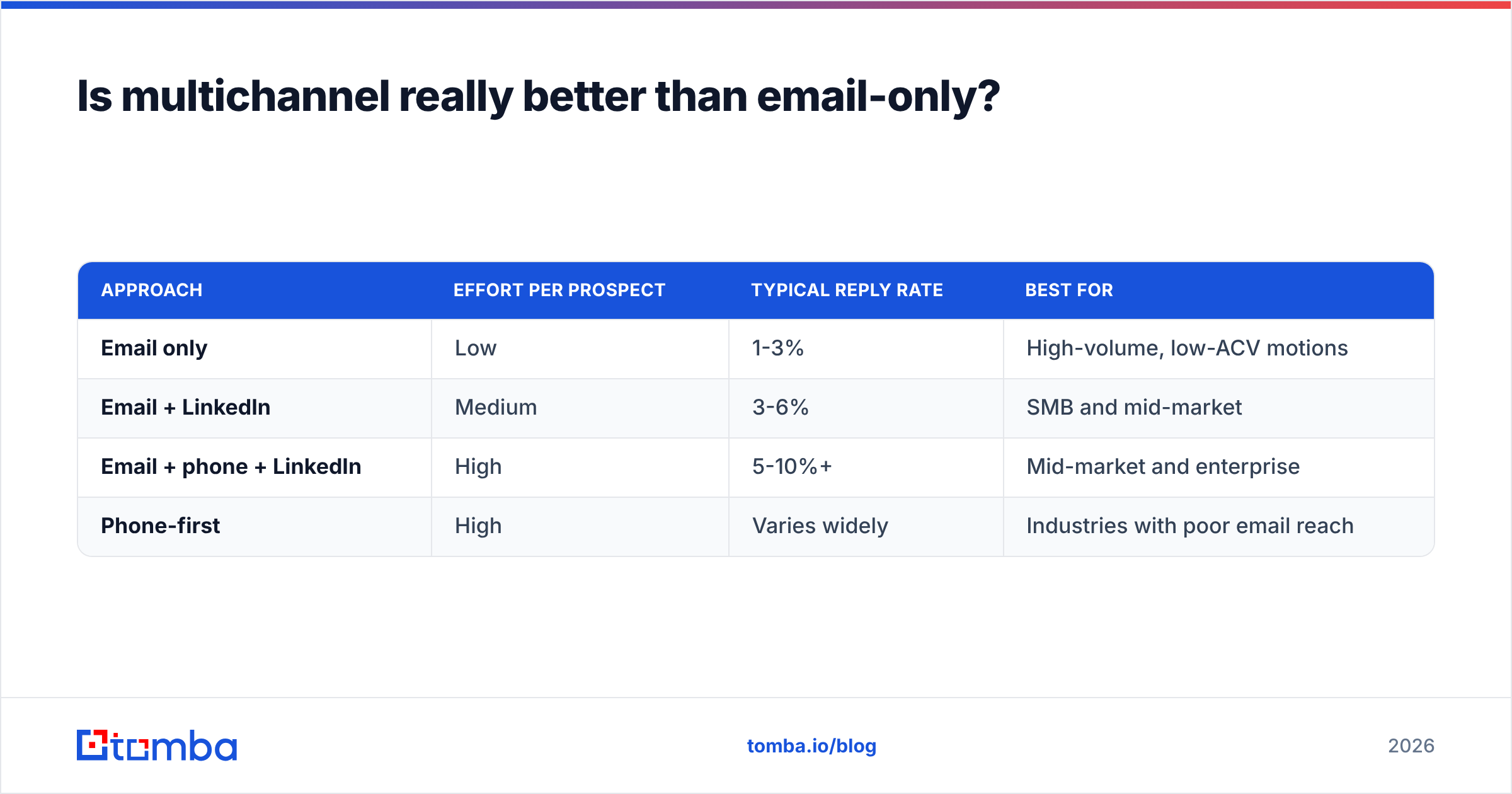
Yes — and it's not close. Email-only cadences are cheap and scalable, which is exactly why they're saturated. The reps who break through add the channels their competitors are too lazy to work.
| Approach | Effort per prospect | Typical reply rate | Best for |
|---|---|---|---|
| Email only | Low | 1-3% | High-volume, low-ACV motions |
| Email + LinkedIn | Medium | 3-6% | SMB and mid-market |
| Email + phone + LinkedIn | High | 5-10%+ | Mid-market and enterprise |
| Phone-first | High | Varies widely | Industries with poor email reach |
The numbers vary by industry and list quality, but the pattern holds across every credible dataset on G2 and analyst coverage from Gartner: more relevant channels, used well, equals more conversations. The catch is "used well." Three channels of generic spam is just three times the noise.
How do you personalize at scale without burning your day?#
Personalize the first two lines; templatize everything after. This is the single highest-ROI habit a BDR can build, and it resolves the eternal tension between volume and relevance.
The opener is where you prove you did your homework — a reference to their recent funding round, a comment they made on LinkedIn, a job posting that reveals a pain. The body, where you explain what you do and why it matters, can be a tested template. The close can be a standard soft ask.
Use the research signals that actually predict intent:
- Hiring signals — a company posting for roles you enable (e.g., hiring 5 SDRs = they're scaling outbound and need tooling).
- Funding events — fresh capital means new budget and new initiatives.
- Leadership changes — new VPs reevaluate the stack in their first 90 days.
- Technographic shifts — a tool they just adopted (or dropped) that pairs with yours.
Layer these on top of a verified contact and you've got a message that reads as one-to-one even though 80% of it scales. For social touches, the same logic applies to LinkedIn outreach: comment with substance before you connect, and connect before you pitch.
Which metrics tell a BDR what to fix?#
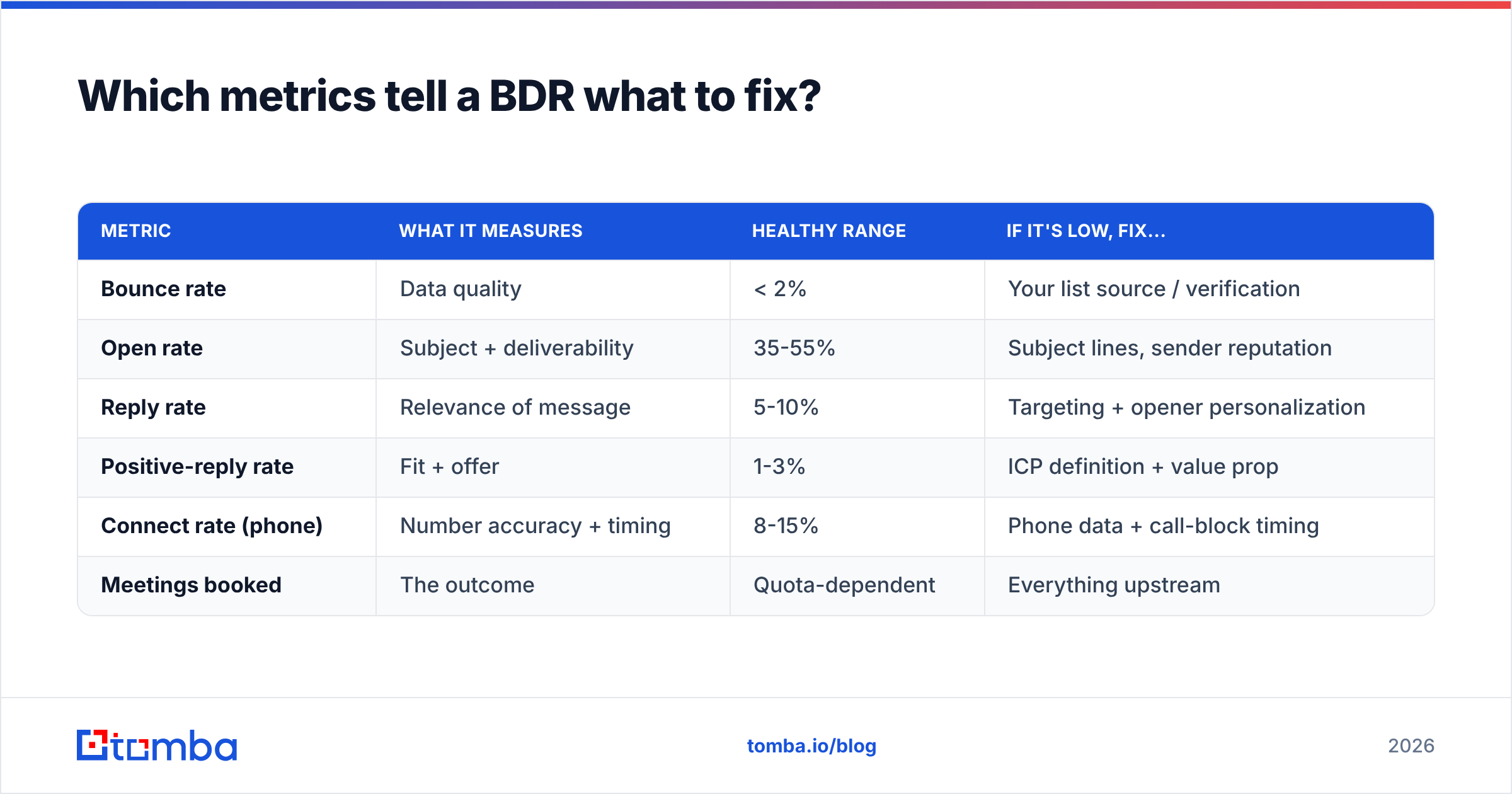
Track the funnel backward from meetings, and you'll see problems before they cost you the month. Booked meetings is a lagging indicator — by the time it drops, the damage was done two weeks earlier.
Here's the leading-to-lagging metric stack every BDR should review weekly:
| Metric | What it measures | Healthy range | If it's low, fix... |
|---|---|---|---|
| Bounce rate | Data quality | < 2% | Your list source / verification |
| Open rate | Subject + deliverability | 35-55% | Subject lines, sender reputation |
| Reply rate | Relevance of message | 5-10% | Targeting + opener personalization |
| Positive-reply rate | Fit + offer | 1-3% | ICP definition + value prop |
| Connect rate (phone) | Number accuracy + timing | 8-15% | Phone data + call-block timing |
| Meetings booked | The outcome | Quota-dependent | Everything upstream |
Read the table top to bottom: if your bounce rate is high, nothing below it matters until you fix data. If opens are fine but replies are flat, your targeting or opener is off. This diagnostic order saves BDRs from "rewriting the whole email" when the real problem was a stale list.
What tools belong in a 2026 BDR stack?#
You don't need fifteen tools. You need clean data, a sequencer, and a way to enrich on the fly. A lean stack looks like:
- Contact data + verification — to source and confirm emails and phones (this is where Tomba lives; see Tomba pricing for plan fit).
- A sales engagement platform — to run and track cadences.
- A CRM — the system of record for accounts and activity.
- An enrichment layer — to fill gaps and prioritize the list.
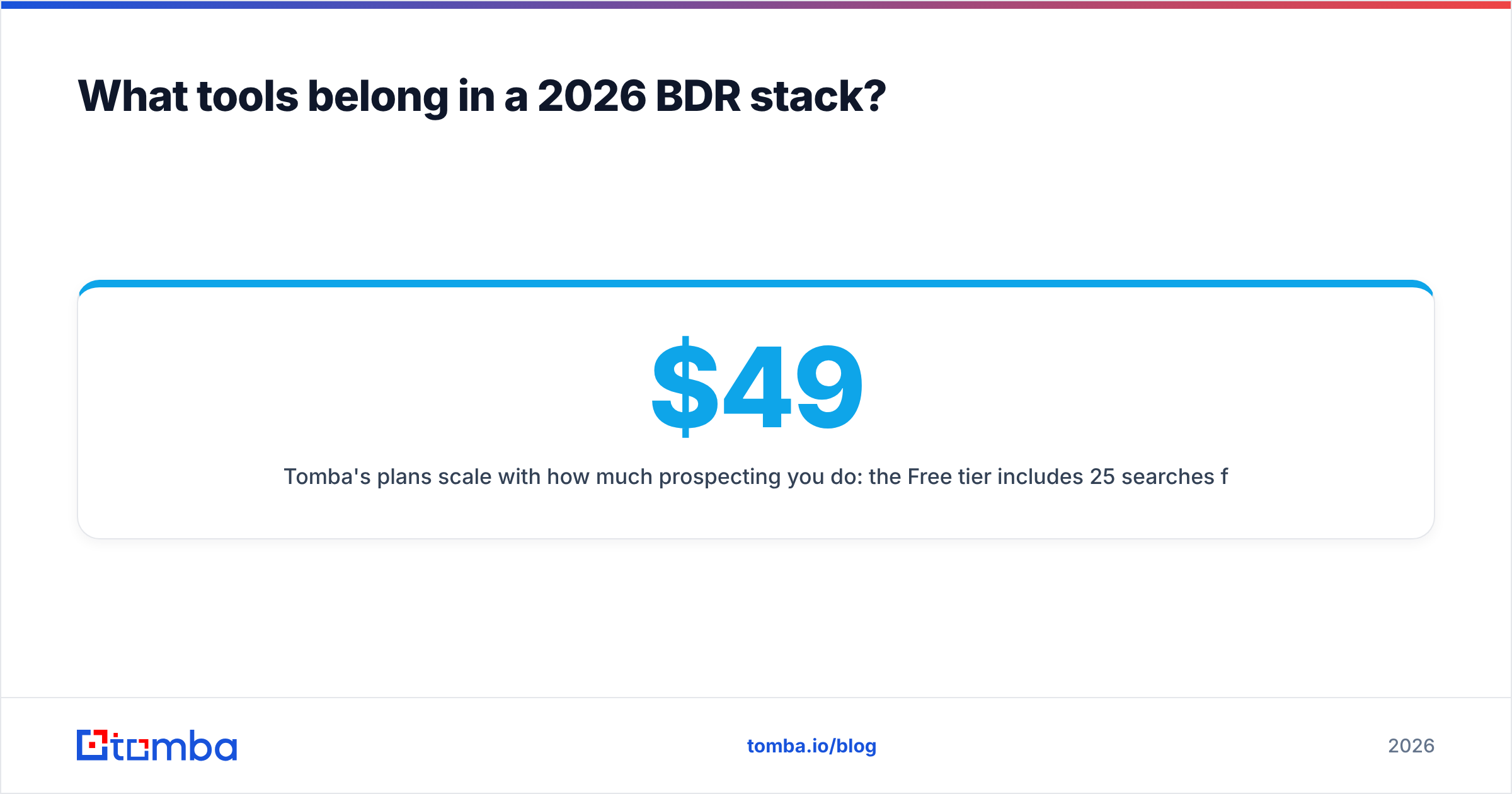
Tomba's plans scale with how much prospecting you do: the Free tier includes 25 searches/month for testing, Starter is $49/mo, Growth $99/mo, and Pro $249/mo for high-volume teams, with Enterprise pricing for custom needs. The point isn't the brand — it's that the data layer is the part of the stack you cannot afford to cheap out on, because every other tool consumes its output.
How do you avoid the most common BDR mistakes?#
The fastest way to improve is to stop doing the things that quietly tank performance:
- Sending before verifying. This is the cardinal sin. Verify, then send.
- Pitching in touch one. Earn the conversation; don't demand the meeting.
- Personalizing the wrong thing. "I see you're the CMO at [Company]" is not personalization. A reference to their actual situation is.
- Quitting after three touches. Most replies come later in the sequence. Persistence, not volume, wins.
- Ignoring the phone. Email is comfortable; the phone is where mid-market and enterprise meetings actually get booked.
- Optimizing for activity, not outcomes. 200 dials to bad numbers is theater. 60 dials to verified, well-timed prospects is a quota.
Closing: start with the data layer#
The best BDR sales tactics all rest on the same foundation — reaching the right person at a real address at the right moment. Get that wrong and your cadences, copy, and call scripts are noise. Get it right and everything downstream compounds.
If you want to fix the highest-leverage part first, start with your data. Tomba's Email Finder turns a name and a company domain into a verified, deliverable business email with a confidence score — so your cadence starts with contacts that actually exist, your sender reputation stays clean, and your booked-meeting count finally reflects how hard you're working. Spin up the free tier, verify your next list, and let your tactics do what they're supposed to.
// get started
Find, verify and enrich your first contacts today
Start on the free plan with 25 searches a month, then scale when your team is ready.
Free plan · No credit card required · GDPR & CCPA
// about the author