Best BDR Software in 2026: Tools, Pricing & How to Choose
BDR software keeps your reps prospecting instead of copy-pasting. Here's how the categories fit together, what to budget, and how to build a stack that books more meetings in 2026.
TL;DR
- BDR software is the stack of tools that lets business development reps find contacts, sequence outreach, and book meetings without drowning in manual work.
- The category splits into five jobs: data/contact discovery, sales engagement, dialers, CRM, and analytics. You need at least the first three to run outbound at scale.
- Tooling can't fix a weak list. Accurate contact data is the foundation — bad emails wreck deliverability and waste every other tool downstream.
- Expect to spend $50–$150 per rep per month for a lean stack, more once you add enterprise engagement platforms.
- A practical starting stack: a data/email-finder layer (like Tomba Email Finder), a sequencer, and a CRM that everything writes back to.
What is BDR software?#
BDR software is any tool that helps a Business Development Representative do the top-of-funnel job: find the right people, reach out across channels, and turn cold contacts into booked meetings. Think of it like a kitchen line. The BDR is the chef, but they can't cook fast without prepped ingredients (clean data), the right station setup (sequencing), and a ticket system that tells them what's next (CRM). Remove any one and the whole line slows down.
In technical terms, BDR software spans contact data and enrichment, multichannel sales engagement, dialers, CRM, and reporting. Most teams stitch several point solutions together rather than buying one monolith, because no single vendor is best at all five jobs.
The distinction worth keeping straight: BDRs handle outbound (you reach out cold), while SDRs often handle inbound (qualifying leads who raised a hand). The tooling overlaps heavily, so most "SDR software" lists and "BDR software" lists cover the same products. What changes is emphasis — BDR stacks lean harder on data discovery and cold sequencing.
)
What are the categories of BDR software?#
Before you compare brands, map the jobs. Buying a sequencer when your problem is bad data is like buying a faster car when the issue is you don't know the address.
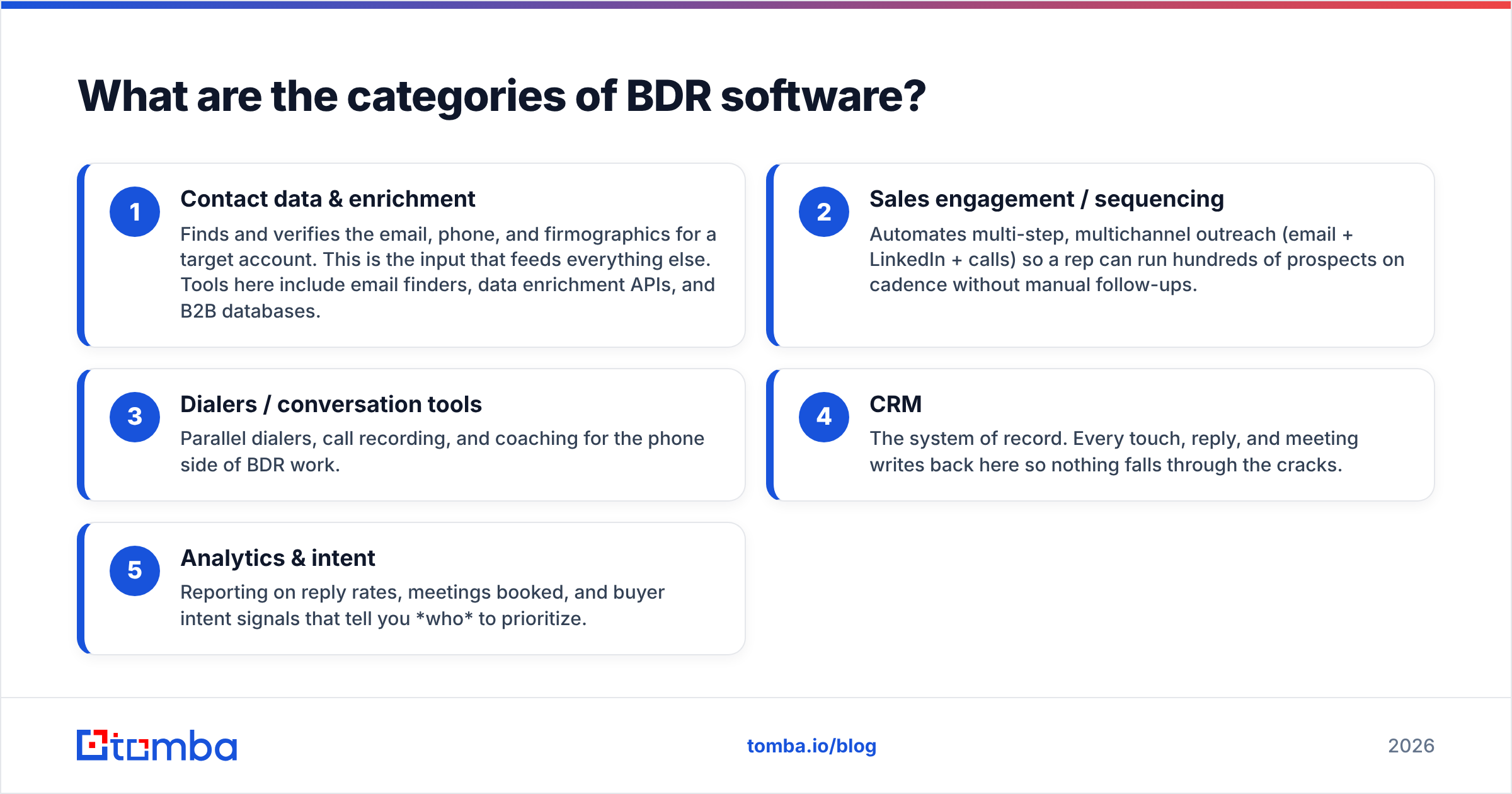
- Contact data & enrichment — Finds and verifies the email, phone, and firmographics for a target account. This is the input that feeds everything else. Tools here include email finders, data enrichment APIs, and B2B databases.
- Sales engagement / sequencing — Automates multi-step, multichannel outreach (email + LinkedIn + calls) so a rep can run hundreds of prospects on cadence without manual follow-ups.
- Dialers / conversation tools — Parallel dialers, call recording, and coaching for the phone side of BDR work.
- CRM — The system of record. Every touch, reply, and meeting writes back here so nothing falls through the cracks.
- Analytics & intent — Reporting on reply rates, meetings booked, and buyer intent signals that tell you who to prioritize.
A BDR can technically work with just categories 1, 2, and 4. The rest are accelerants, not requirements.
What's the best BDR software stack in 2026?#
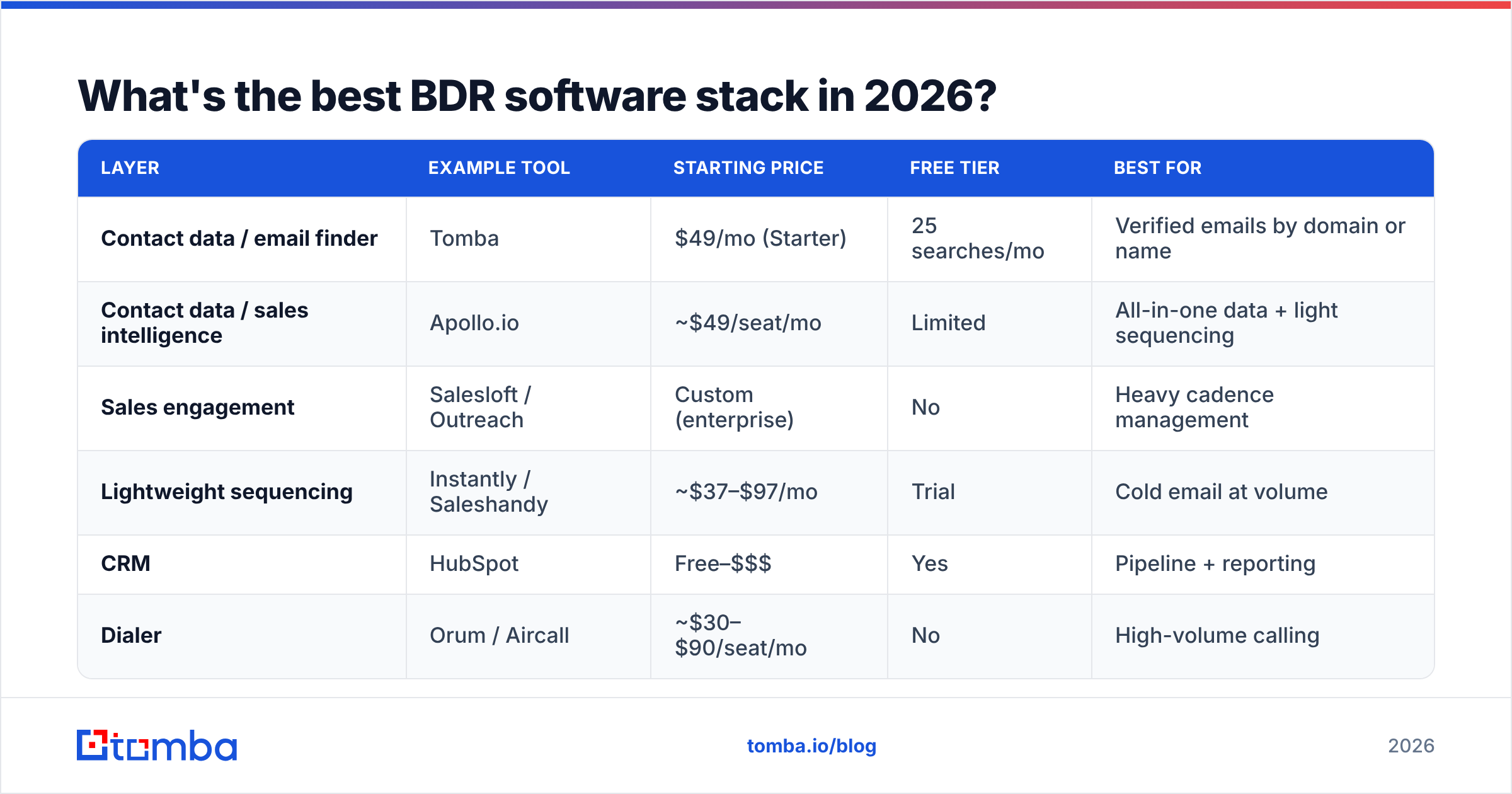
The best stack is the smallest one that keeps reps prospecting instead of doing data entry. Below is a representative comparison across the core layers — prices are list rates and change often, so treat them as ballpark, not gospel.
| Layer | Example tool | Starting price | Free tier | Best for |
|---|---|---|---|---|
| Contact data / email finder | Tomba | $49/mo (Starter) | 25 searches/mo | Verified emails by domain or name |
| Contact data / sales intelligence | Apollo.io | ~$49/seat/mo | Limited | All-in-one data + light sequencing |
| Sales engagement | Salesloft / Outreach | Custom (enterprise) | No | Heavy cadence management |
| Lightweight sequencing | Instantly / Saleshandy | ~$37–$97/mo | Trial | Cold email at volume |
| CRM | HubSpot | Free–$$$ | Yes | Pipeline + reporting |
| Dialer | Orum / Aircall | ~$30–$90/seat/mo | No | High-volume calling |
Notice the pattern: the data layer is the cheapest line item but the highest leverage. If the email is wrong, the sequencer mails a dead address, the CRM logs a ghost, and your sender reputation takes the hit. Get the Tomba pricing details if you want to anchor the data layer first, then layer engagement on top.
For an apples-to-apples view of the broader engagement platforms, the G2 sales engagement category is a reasonable third-party reference for honest user reviews.
How does contact data drive BDR results?#
Contact data is the single biggest multiplier on BDR output, because every downstream tool inherits its quality. Industry studies routinely peg B2B data decay at roughly 30% per year as people change jobs — so a list that was clean last quarter is already rotting.
Here's the chain reaction of bad data:
- Bounces climb. Mailbox providers read high bounce rates as spammer behavior, and your email deliverability drops for every prospect, not just the bad ones.
- Sender reputation erodes. Once your domain reputation tanks, even your good emails land in spam. Recovery takes weeks.
- Reps waste cycles. A BDR dialing wrong numbers or emailing dead addresses is paying full salary for zero pipeline.
That's why the smart move is to find and verify before you send. A workflow that pairs an email finder with an email verifier catches dead addresses before they ever enter a sequence. For territory-based prospecting, domain search pulls every known contact at a target company in one pass, and the bulk email finder handles whole lists at once.
If most of your accounts run on catch-all domains (where the server accepts everything), a dedicated catch-all verifier is the difference between guessing and knowing.
What should a BDR software stack cost?#
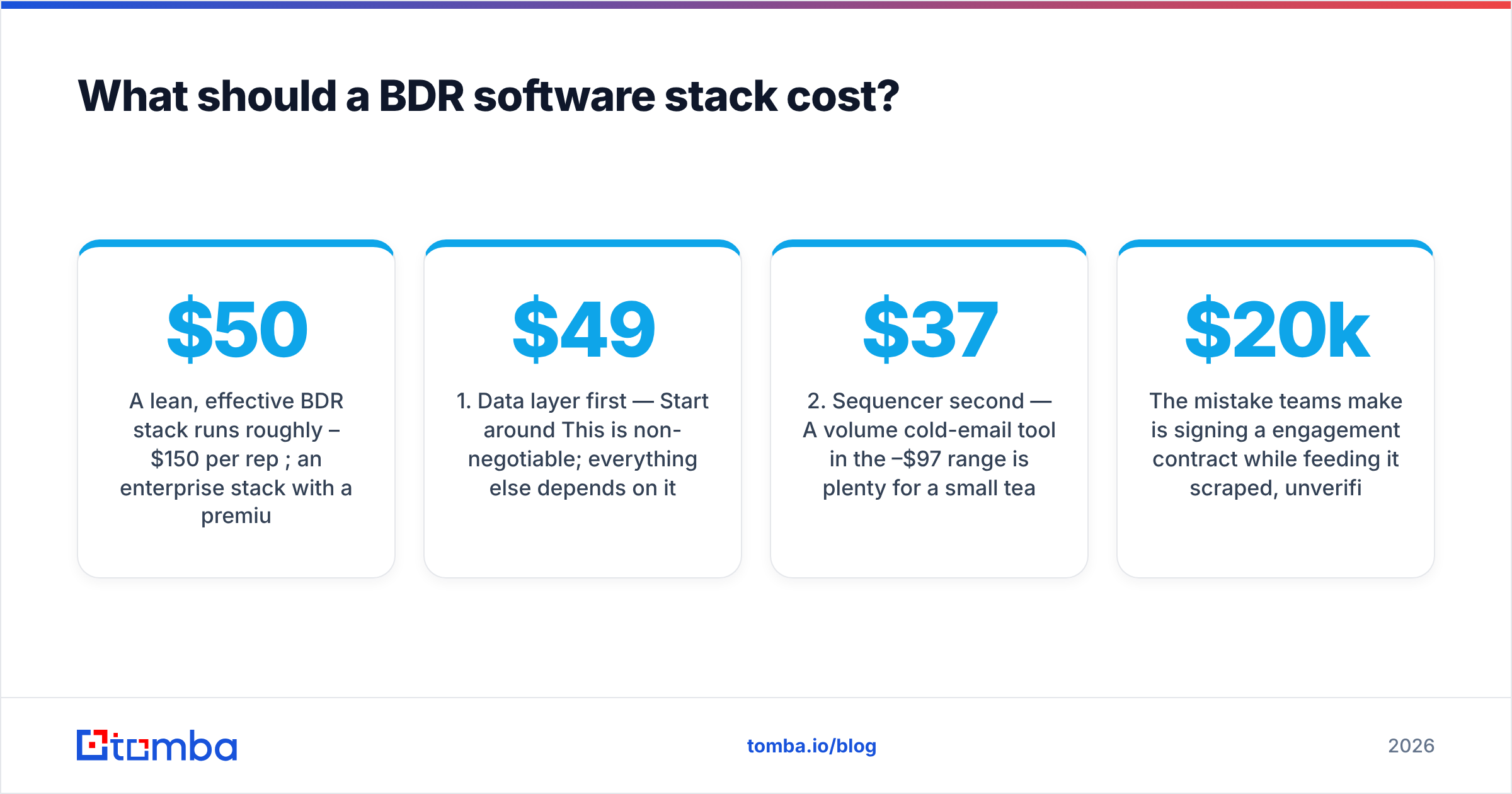
A lean, effective BDR stack runs roughly $50–$150 per rep per month; an enterprise stack with a premium engagement platform and dialer can hit $300+ per seat. The trap is overbuying engagement software before you've proven the motion.
Sensible budgeting order:
- Data layer first — Start around $49/mo. This is non-negotiable; everything else depends on it.
- Sequencer second — A volume cold-email tool in the $37–$97/mo range is plenty for a small team.
- CRM third — HubSpot's free tier or a low Pipedrive plan covers early-stage teams.
- Dialer and intent last — Add these only when call volume or account prioritization becomes the bottleneck.
The mistake teams make is signing a $20k/year engagement contract while feeding it scraped, unverified lists. You'd get more pipeline spending a tenth of that on accurate data and a simple sequencer.
)
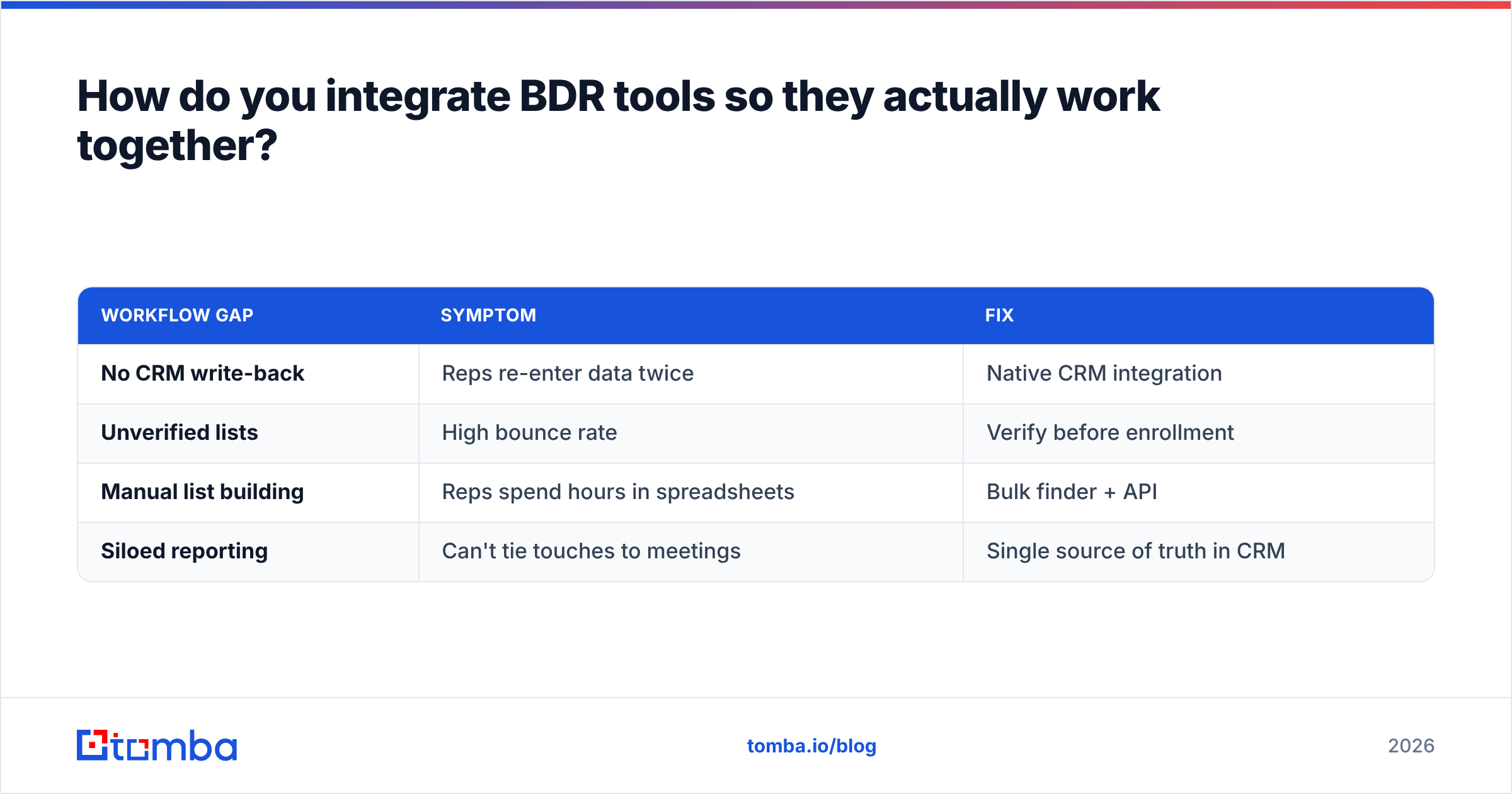
How do you integrate BDR tools so they actually work together?#
The stack only pays off when data flows automatically between tools — otherwise reps become human copy-paste machines, which defeats the point. The integration backbone is your CRM: data discovery writes into it, and your sequencer reads from it.
A clean flow looks like this:
- Find and verify contacts, then push them to the CRM via a Salesforce integration or HubSpot integration.
- The sequencer pulls enrolled contacts from the CRM and runs the cadence.
- Replies and meetings sync back so reporting is accurate.
For teams that build their own glue, the Tomba API lets you enrich and verify inside whatever workflow you already run — whether that's a Zapier automation, a custom script, or a Sheets-based list builder. The less manual hand-off between tools, the more time reps spend actually selling.
| Workflow gap | Symptom | Fix |
|---|---|---|
| No CRM write-back | Reps re-enter data twice | Native CRM integration |
| Unverified lists | High bounce rate | Verify before enrollment |
| Manual list building | Reps spend hours in spreadsheets | Bulk finder + API |
| Siloed reporting | Can't tie touches to meetings | Single source of truth in CRM |
BDR software vs. doing it manually: is it worth it?#
Yes — past a handful of accounts, manual prospecting stops scaling and software pays for itself fast. A BDR working purely by hand might research and contact 15–25 prospects a day. With a data layer plus a sequencer, the same rep can run 100+ contacts on cadence while spending their human hours on personalization and replies.
The honest counterpoint: tools amplify whatever motion you have. If your targeting is wrong or your messaging is weak, software just helps you fail faster and louder. Fix the fundamentals — ideal customer profile, a reason to reach out, a clear ask — then let the stack scale it.
Here's the quick decision test:
- Under 30 outbound contacts/week: A free email finder tier and manual sending may be fine.
- 30–200 contacts/week: Add a paid data plan and a sequencer. This is where most BDR teams live.
- 200+ contacts/week or multiple reps: Full stack with CRM write-back, dialer, and analytics becomes worth the cost and admin overhead.
What features matter most when choosing BDR software?#
Prioritize accuracy, integrations, and verification over feature-count marketing. A long feature list means nothing if the core data is wrong or the tool won't talk to your CRM.
Checklist for evaluating any BDR tool:
- Data accuracy and freshness — Ask how the vendor sources and verifies data. Tomba's approach is documented on its data sources page; demand the same transparency from any vendor.
- Built-in verification — Finding an email is half the job; verifying it before you send is the other half.
- Coverage — Does it find phones and LinkedIn data, not just emails? A phone finder rounds out multichannel outreach.
- Integrations — Native CRM connectors and an API beat manual CSV exports every time.
- Compliance — Confirm the vendor respects GDPR/CCPA and gives you opt-out handling.
- Fair pricing — Credit-based models should be predictable. Watch for tools that burn credits on failed lookups.
For a vendor-neutral starting point on the engagement side, HubSpot's sales tools overview is a useful reference for how the CRM-plus-sequencing pieces are meant to fit.
How do you build a BDR stack from scratch?#
Start with data, prove the motion with one cheap sequencer, then expand. Resist the urge to buy the enterprise platform first.
A 30-day rollout that works:
- Week 1 — Data layer. Stand up an email finder and verifier. Build one clean, verified list of 200 ICP contacts. Track bounce rate as your quality benchmark.
- Week 2 — Sequencing. Connect a simple cold-email tool. Launch one 4-step cadence. Measure reply rate, not open rate (opens are increasingly unreliable).
- Week 3 — CRM. Wire write-back so every touch logs automatically. Now you can see touches-to-meetings.
- Week 4 — Iterate. Double down on the segment with the best reply rate. Add a dialer only if calls are clearly converting.
This sequence keeps your spend tied to proven results and stops you from buying tools that solve problems you don't have yet.
The bottom line#
BDR software is a system, not a single purchase, and the system is only as good as the data flowing through it. Buy the data layer first, prove the motion with a lean sequencer, and let your CRM be the single source of truth. Everything else is an accelerant you add when the bottleneck is obvious.
If you want to anchor that foundation, start with the Tomba Email Finder. It finds professional emails by name, domain, or company, verifies them before they hit your sequence, and plugs into your CRM and the Tomba API so your reps stay focused on booking meetings — not cleaning lists. Spin up the free tier (25 searches a month) and build your first verified list today.
// get started
Find, verify and enrich your first contacts today
Start on the free plan with 25 searches a month, then scale when your team is ready.
Free plan · No credit card required · GDPR & CCPA
// about the author