Behavior Scoring in 2026: A Practical B2B Lead Guide
Behavior scoring ranks leads by what they actually do, not who they are. Here's how to build a model that fills your pipeline with ready buyers in 2026.
TL;DR
- Behavior scoring ranks leads by the actions they take — page visits, email clicks, demo requests, pricing views — instead of static traits like job title or company size.
- It catches buying intent that demographic scoring misses, so reps spend time on people who are actually moving toward a purchase.
- A working model needs three things: tracked events, point values tied to revenue outcomes, and score decay so old activity stops inflating rankings.
- Combine behavior scoring with firmographic data (a hybrid model) for the sharpest prioritization — neither signal is enough alone.
- Garbage contact data poisons any scoring model. Clean, verified records from tools like the Tomba Email Finder are the foundation, not an afterthought.
What is behavior scoring?#
Behavior scoring is a method of ranking leads based on what they do rather than who they are. Every tracked action — opening an email, visiting your pricing page, downloading a whitepaper, replying to a sequence — earns or loses points. The running total tells you how engaged and how close to buying a contact is.
Think of it like a fitness tracker for your pipeline. A static profile says "35-year-old, runs sometimes." A behavior tracker says "ran 10k this morning, three days in a row." The second one tells you what's actually happening right now. Demographic data describes the person; behavioral data describes the momentum.
In B2B, that distinction is the difference between a VP of Engineering who downloaded one ebook two years ago and a junior analyst who visited your pricing page four times this week and booked a demo. The title says the VP is the better lead. The behavior says the analyst's company is in an active buying cycle. Behavior scoring surfaces the second one.
How is behavior scoring different from demographic scoring?#
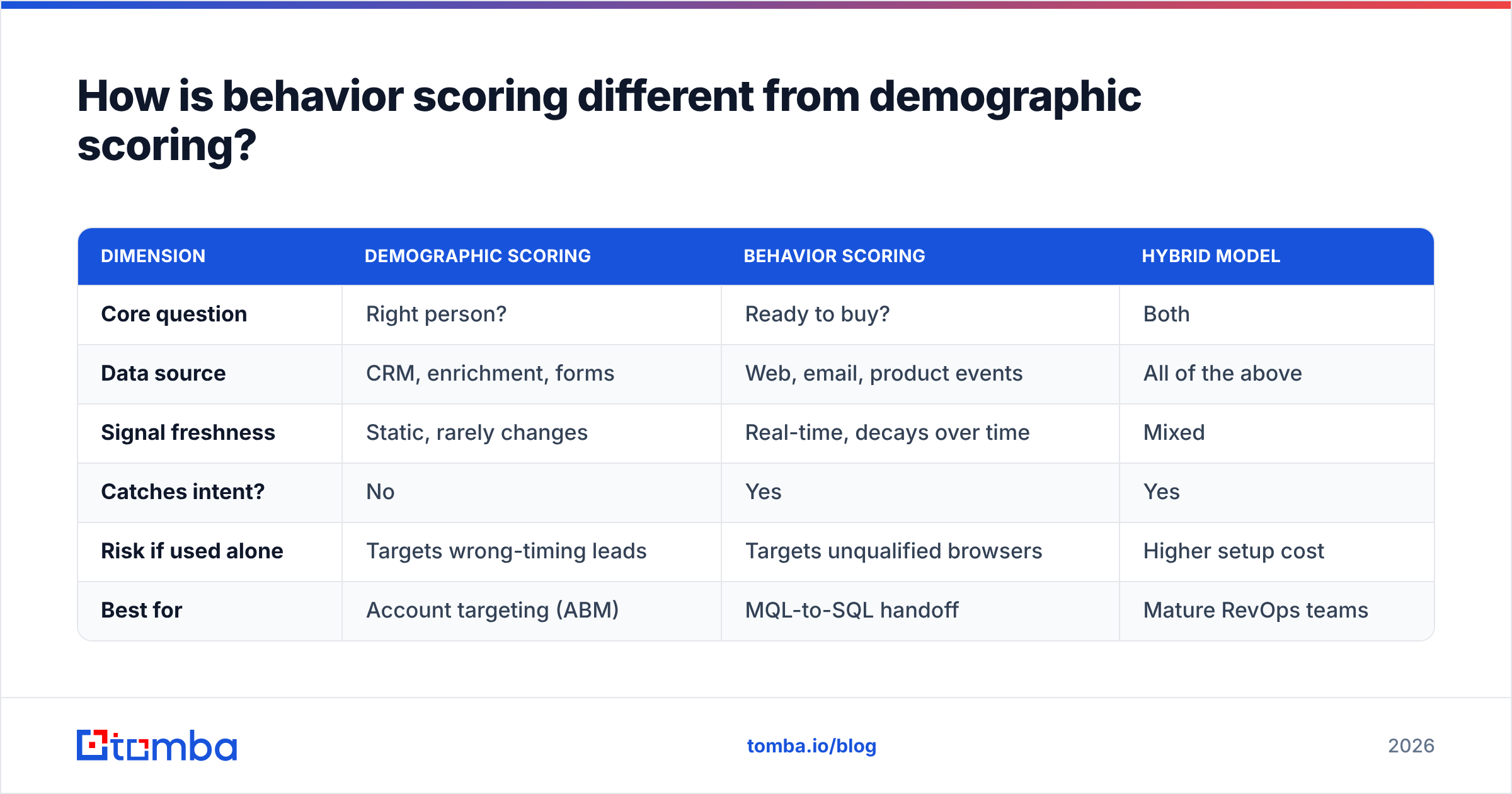
Most teams confuse the two or use them interchangeably. They answer different questions. Demographic (or firmographic) scoring asks "Is this the right kind of person at the right kind of company?" Behavior scoring asks "Is this person showing signs they want to buy right now?"
The strongest lead scoring programs use both axes. A common framework plots fit (demographic) against engagement (behavioral) on a grid, so you can tell a high-fit/low-engagement lead (worth nurturing) apart from a low-fit/high-engagement one (worth a polite hold).
| Dimension | Demographic scoring | Behavior scoring | Hybrid model |
|---|---|---|---|
| Core question | Right person? | Ready to buy? | Both |
| Data source | CRM, enrichment, forms | Web, email, product events | All of the above |
| Signal freshness | Static, rarely changes | Real-time, decays over time | Mixed |
| Catches intent? | No | Yes | Yes |
| Risk if used alone | Targets wrong-timing leads | Targets unqualified browsers | Higher setup cost |
| Best for | Account targeting (ABM) | MQL-to-SQL handoff | Mature RevOps teams |
The takeaway: demographic scoring keeps you targeting the right market; behavior scoring tells you when to strike. Used together they form the basis of a defensible lead management and scoring process.
Which behaviors are worth scoring?#
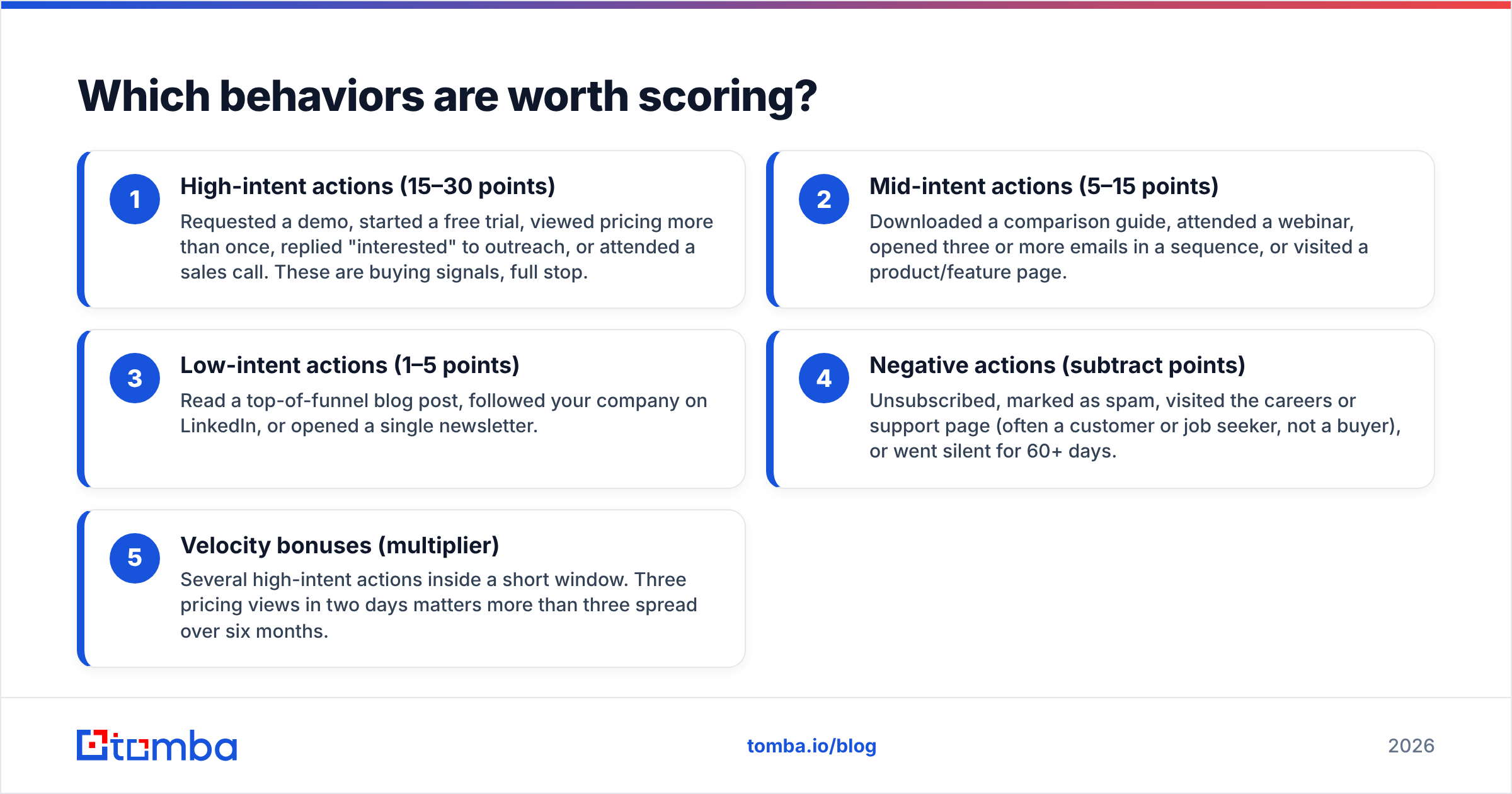
Not all actions carry equal weight. A pricing-page visit signals far more intent than a blog read. The art of behavior scoring is assigning point values that reflect how close each action sits to a purchase decision. Here's a starting framework you can adapt:
- High-intent actions (15–30 points) — Requested a demo, started a free trial, viewed pricing more than once, replied "interested" to outreach, or attended a sales call. These are buying signals, full stop.
- Mid-intent actions (5–15 points) — Downloaded a comparison guide, attended a webinar, opened three or more emails in a sequence, or visited a product/feature page.
- Low-intent actions (1–5 points) — Read a top-of-funnel blog post, followed your company on LinkedIn, or opened a single newsletter.
- Negative actions (subtract points) — Unsubscribed, marked as spam, visited the careers or support page (often a customer or job seeker, not a buyer), or went silent for 60+ days.
- Velocity bonuses (multiplier) — Several high-intent actions inside a short window. Three pricing views in two days matters more than three spread over six months.
The negative scores matter as much as the positive ones. A lead who unsubscribes after a demo request isn't hot anymore, and your model should reflect that drop immediately.
How do you build a behavior scoring model?#
Conclusion first: start small, tie every point to a revenue outcome, and add complexity only when the data justifies it. A model nobody understands is a model nobody trusts.
Step 1 — Define your conversion event. Usually a closed-won deal or a sales-accepted opportunity. Everything you score should correlate with this outcome.
Step 2 — Pull historical data. Look at your last 100–200 won deals. Which actions did those buyers take before purchasing? Which actions did lost leads take? This is where your point values come from — not from gut feel.
Step 3 — Assign weights. Give the actions most common in won deals the highest scores. If 80% of customers viewed pricing twice before buying, that action earns serious points.
Step 4 — Set a threshold. Decide the score at which a lead becomes a Marketing Qualified Lead (MQL) and gets handed to sales. Too low and you flood reps with browsers; too high and you starve them.
Step 5 — Add decay. A 50-point action from last March shouldn't count the same as one from yesterday. Decay rules (e.g., scores halve after 30 days of inactivity) keep your rankings honest.
Step 6 — Test and recalibrate. Review monthly. If high-scoring leads aren't converting, your weights are wrong. Adjust.
According to HubSpot's research on lead scoring, companies that act on behavioral triggers within an hour are dramatically more likely to qualify a lead than those who wait a day. Speed only works if your model is accurate enough to trust.

What data and tools do you need?#
Behavior scoring runs on three layers of infrastructure: a place to capture events, a place to store and score them, and clean contact data underneath it all.
- Event capture — Your website analytics, marketing automation platform, and product analytics tool record the actions. Marketing automation (HubSpot, Marketo) and CRMs (Salesforce, Pipedrive) all ship with native scoring engines.
- The scoring engine — Where points get assigned and totaled. Most teams use their CRM or marketing automation platform; advanced teams pipe events into a dedicated revenue operations data layer.
- Clean contact data — This is the layer everyone underrates. If your CRM is full of bounced addresses, duplicate records, and unverified contacts, your behavior scores attach to ghosts. You can't score the email engagement of an address that doesn't exist.
That last point is where data quality tooling earns its keep. Before you score behavior, you need accurate, deliverable contacts to score in the first place. Running new leads through an email verifier and enriching thin records with data enrichment means your model scores real humans, not noise. Garbage in, garbage scored.
Here's how the common scoring approaches stack up on cost and capability:
| Approach | Setup effort | Real-time scoring | Needs clean data | Typical cost |
|---|---|---|---|---|
| CRM native rules | Low | Partial | Yes | Included in CRM |
| Marketing automation | Medium | Yes | Yes | $$ per platform |
| Dedicated RevOps stack | High | Yes | Critical | $$$ |
| Spreadsheet (manual) | Low | No | Yes | Free, doesn't scale |
The free spreadsheet route works for a team scoring 50 leads a month. Past that, the manual upkeep eats more hours than it saves.
What are the most common behavior scoring mistakes?#
Most failed scoring models fail for predictable reasons. Avoid these:
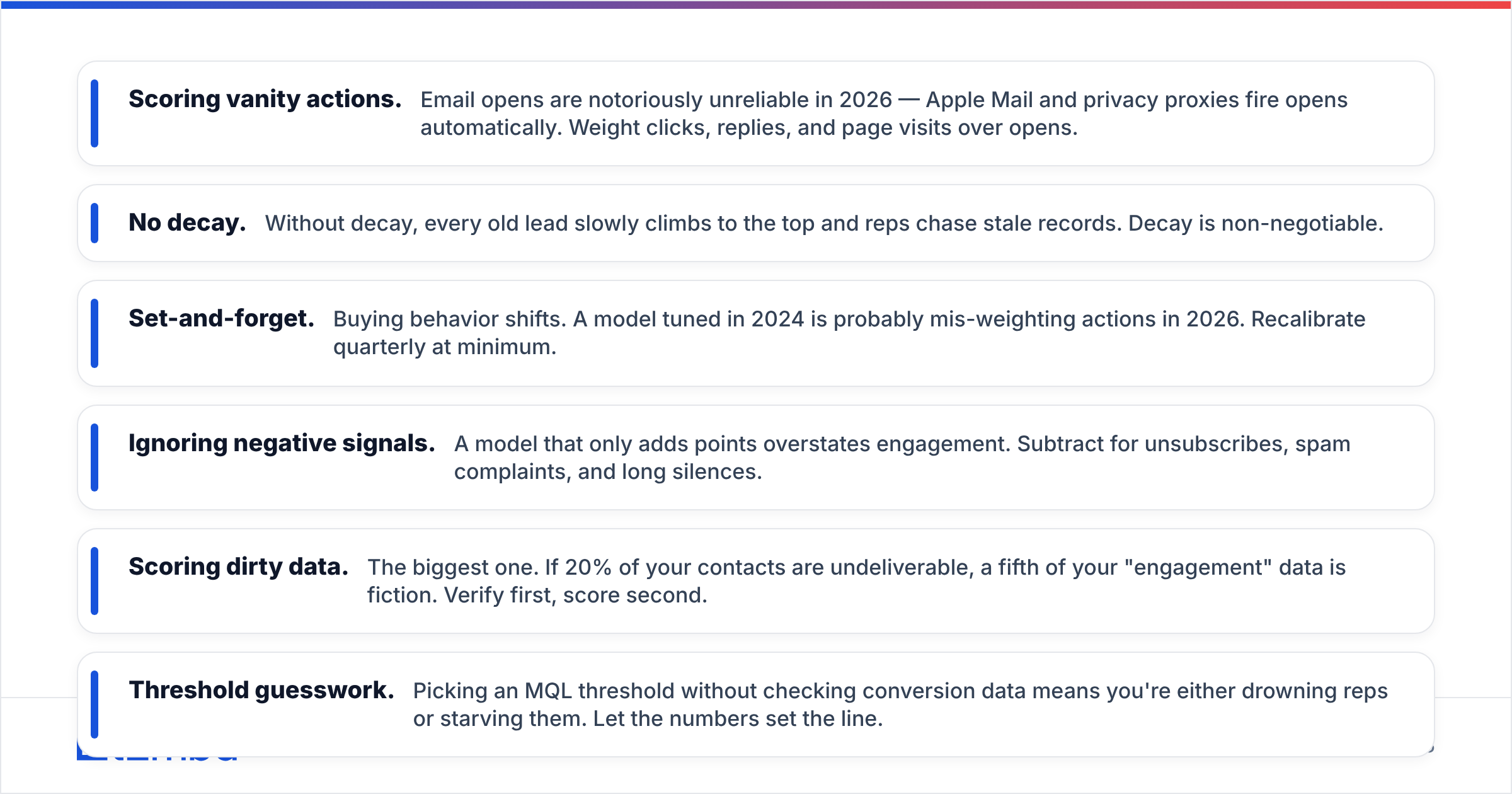
- Scoring vanity actions. Email opens are notoriously unreliable in 2026 — Apple Mail and privacy proxies fire opens automatically. Weight clicks, replies, and page visits over opens.
- No decay. Without decay, every old lead slowly climbs to the top and reps chase stale records. Decay is non-negotiable.
- Set-and-forget. Buying behavior shifts. A model tuned in 2024 is probably mis-weighting actions in 2026. Recalibrate quarterly at minimum.
- Ignoring negative signals. A model that only adds points overstates engagement. Subtract for unsubscribes, spam complaints, and long silences.
- Scoring dirty data. The biggest one. If 20% of your contacts are undeliverable, a fifth of your "engagement" data is fiction. Verify first, score second.
- Threshold guesswork. Picking an MQL threshold without checking conversion data means you're either drowning reps or starving them. Let the numbers set the line.
Avoiding these is mostly discipline, not technology. The model is only as good as the maintenance behind it.
How do you connect scoring to outreach?#
A high score is worthless if nobody acts on it. The point of behavior scoring is to trigger the right outreach at the right moment — and that means your scoring engine has to talk to your sales workflow.
The practical pattern: when a lead crosses your MQL threshold, automatically route them to a rep with the context of why they scored high. "Viewed pricing twice and booked a demo" is a far better opening than a cold "just checking in." That context turns a generic touch into a relevant one, which is exactly what lifts your response rate.
For this to work end to end, your enriched, verified contact needs a real email and ideally a direct phone line. A hot behavioral signal with no way to reach the person is a dead end. Pairing your scoring model with a reliable email finder and phone finder closes that gap — the score tells you who and when, the contact data gives you how. Tools like Tomba's integrations push verified contacts straight into HubSpot, Salesforce, and Pipedrive so scored leads land where reps already work.
If you want to see how mature teams structure this handoff, Salesforce's documentation on lead scoring and grading and the vendor breakdowns on G2 are solid neutral references for comparing platform capabilities.
Is behavior scoring worth it for small teams?#
Yes — and arguably more so. A 100-person sales org can absorb the cost of chasing bad leads. A three-person team cannot. When every rep hour is scarce, knowing which 10 of your 200 leads are actually warming up is the difference between hitting quota and missing it.
You don't need an expensive RevOps stack to start. A simple model in your existing CRM — five high-intent actions, three negative ones, and a 30-day decay rule — will outperform no scoring at all by a wide margin. Start there, watch which scored leads convert, and refine. The sophistication can come later; the discipline of scoring behavior should come now.
The one thing small teams cannot skip is data quality. With a thin pipeline, every contact counts, and a model built on unverified emails will mislead you fast. Verify and enrich before you score.
Getting started#
Behavior scoring rewards teams who treat it as an ongoing practice, not a one-time setup. Define your conversion event, score actions by how close they sit to a purchase, decay old activity, subtract for negative signals, and recalibrate every quarter. Pair it with firmographic fit for the sharpest possible prioritization.
But none of it works on a dirty database. Before you score a single behavior, make sure the contacts behind those behaviors are real and reachable. The Tomba Email Finder gives you accurate, verified professional emails to feed your scoring model — so every point you assign maps to a person your reps can actually reach. Start free with 25 searches a month, then scale up on the Starter plan at $49/mo when your pipeline grows. Score the right behaviors, reach the right people, and let your reps spend their hours where the intent actually is.
// get started
Find, verify and enrich your first contacts today
Start on the free plan with 25 searches a month, then scale when your team is ready.
Free plan · No credit card required · GDPR & CCPA
// about the author