Behavioral Segmentation in 2026: The Complete B2B Guide
Behavioral segmentation groups buyers by what they do, not who they are. Here's how B2B teams build behavior-based segments that lift conversion and shorten the sales cycle in 2026.
Behavioral segmentation is the practice of grouping prospects and customers by what they do — pages they visit, emails they open, features they use, deals they stall on — instead of who they are on paper. For B2B teams in 2026, it's the difference between blasting one message at a list and sending the right message to a buyer who just signaled intent.
This guide breaks down the types of behavioral segmentation, shows real B2B examples, and gives you a step-by-step framework to build it without a six-figure data stack.
TL;DR#
- Behavioral segmentation sorts buyers by actions and signals (intent, usage, engagement, purchase history) rather than firmographics like industry or headcount.
- It consistently beats demographic-only targeting because behavior predicts the next purchase far better than static attributes.
- The five core types: purchase behavior, usage/engagement, intent signals, customer journey stage, and benefit sought.
- You need three things to start: clean contact data, an event source (site, product, email), and a place to score and route segments.
- Start small — one high-intent segment (e.g. "viewed pricing twice in 7 days") usually pays for the whole project.
What is behavioral segmentation?#
Behavioral segmentation divides your audience into groups based on observed behavior toward your product, content, or brand. Think of it like a coffee shop that stops asking "how old are you?" and starts noticing "you order a flat white every Tuesday at 8am" — the second pattern tells you exactly what to offer and when.
In B2B terms, you stop targeting "VP of Marketing at a 200-person SaaS company" and start targeting "a contact who downloaded the ROI calculator, opened three nurture emails, and visited the integrations page." The first is a guess. The second is a buying signal.
Traditional market segmentation leans on four buckets: demographic, geographic, psychographic, and behavioral. The first three describe the buyer at rest. Behavioral segmentation describes the buyer in motion — and motion is what closes deals.
How is behavioral segmentation different from demographic segmentation?#
Demographic and firmographic data tell you whether someone could buy. Behavioral data tells you whether they're about to. You need both, but they answer different questions and belong at different points in the funnel.
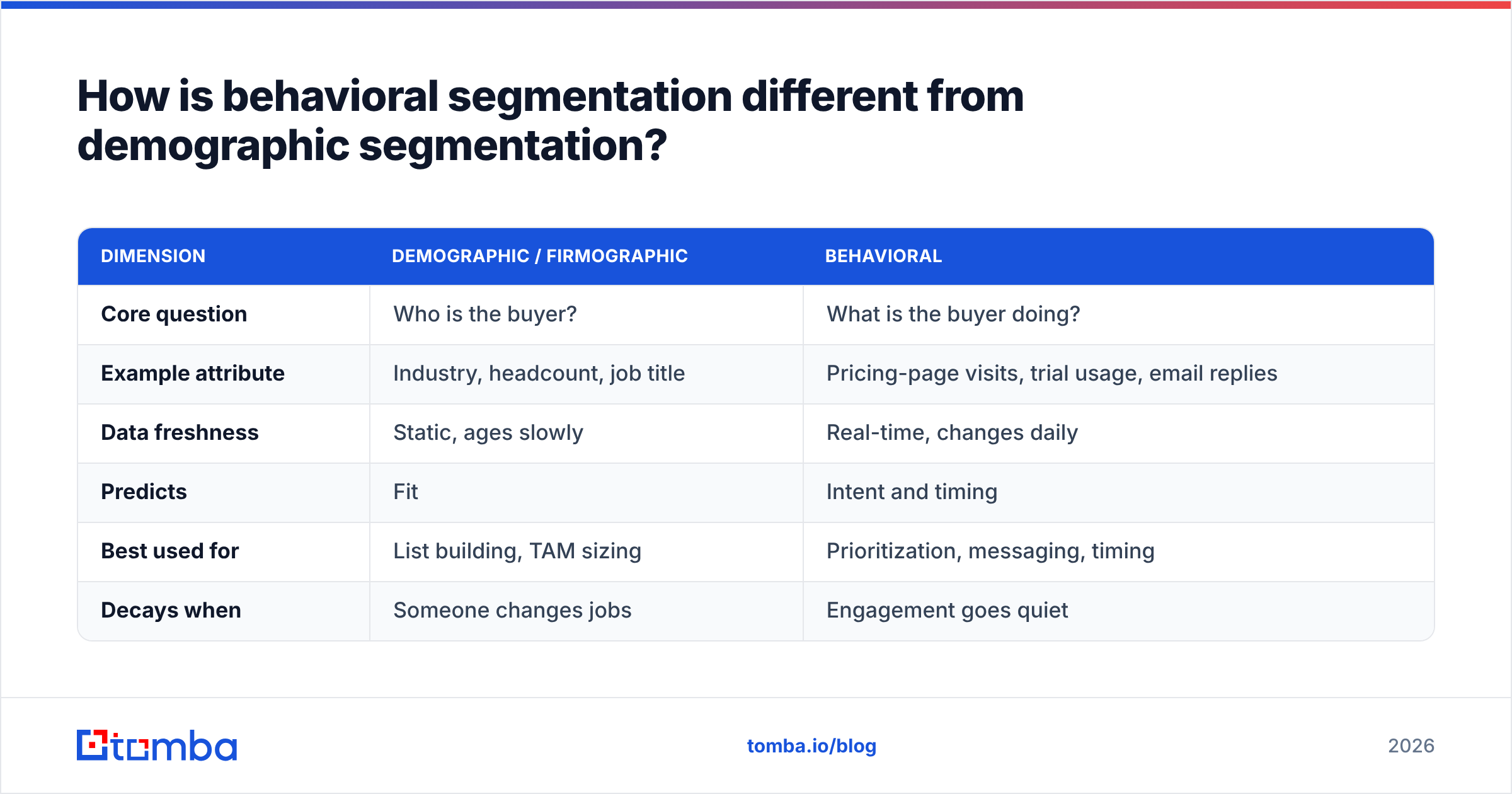
| Dimension | Demographic / Firmographic | Behavioral |
|---|---|---|
| Core question | Who is the buyer? | What is the buyer doing? |
| Example attribute | Industry, headcount, job title | Pricing-page visits, trial usage, email replies |
| Data freshness | Static, ages slowly | Real-time, changes daily |
| Predicts | Fit | Intent and timing |
| Best used for | List building, TAM sizing | Prioritization, messaging, timing |
| Decays when | Someone changes jobs | Engagement goes quiet |
The practical takeaway: use firmographics to decide who gets into the database, and behavior to decide who gets a call today. A perfect-fit account that has gone silent for 90 days should rank below an imperfect-fit account that just requested a demo.
What are the types of behavioral segmentation?#
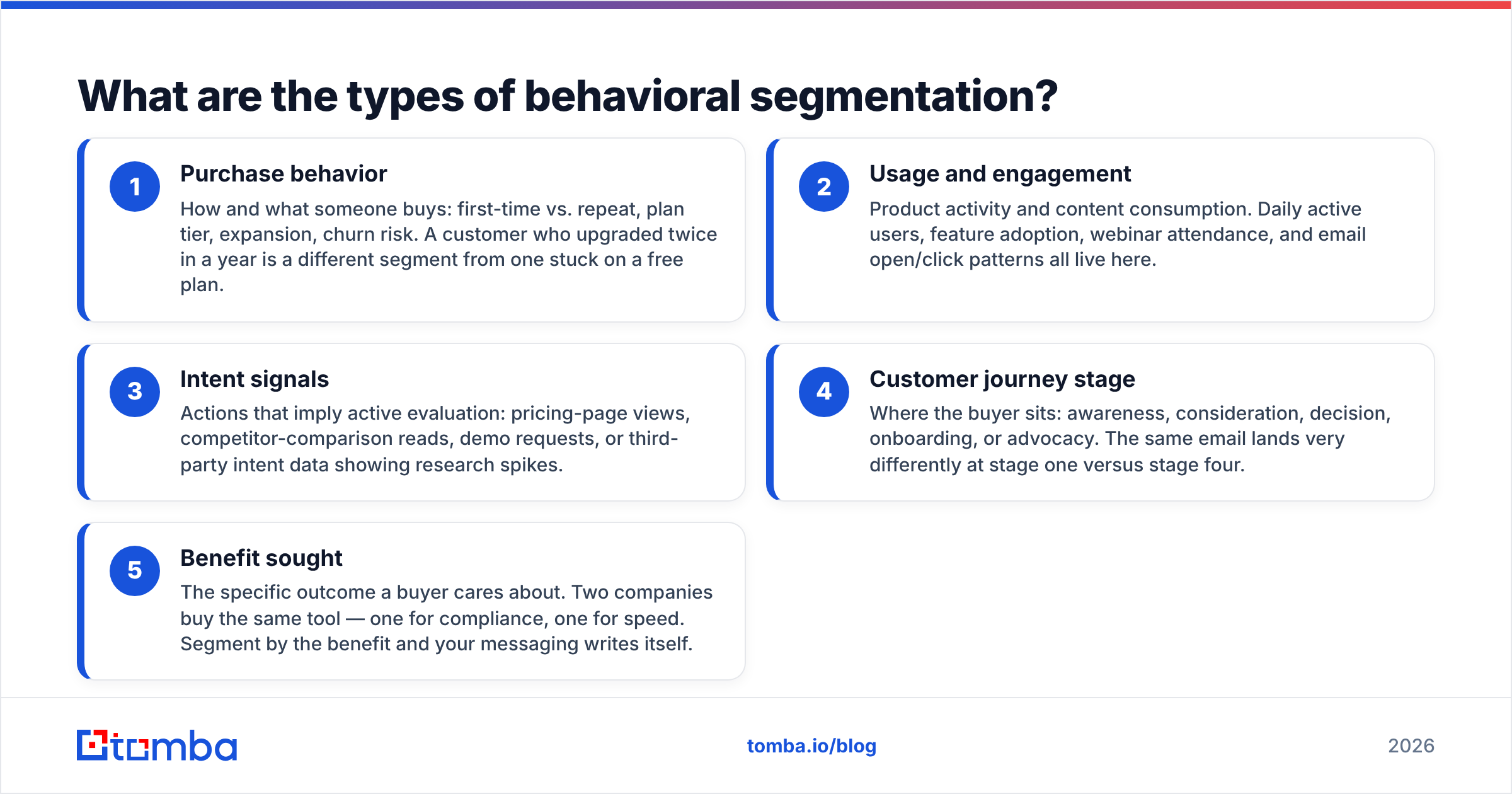
There are five behavior types that cover almost every B2B use case. Most teams start with one and layer in the rest.
- Purchase behavior — How and what someone buys: first-time vs. repeat, plan tier, expansion, churn risk. A customer who upgraded twice in a year is a different segment from one stuck on a free plan.
- Usage and engagement — Product activity and content consumption. Daily active users, feature adoption, webinar attendance, and email open/click patterns all live here.
- Intent signals — Actions that imply active evaluation: pricing-page views, competitor-comparison reads, demo requests, or third-party intent data showing research spikes.
- Customer journey stage — Where the buyer sits: awareness, consideration, decision, onboarding, or advocacy. The same email lands very differently at stage one versus stage four.
- Benefit sought — The specific outcome a buyer cares about. Two companies buy the same tool — one for compliance, one for speed. Segment by the benefit and your messaging writes itself.
You can combine these. "Trial users (journey stage) who used the export feature three times (usage) and viewed pricing (intent)" is a single, highly actionable segment.
Why does behavioral segmentation matter for B2B revenue?#
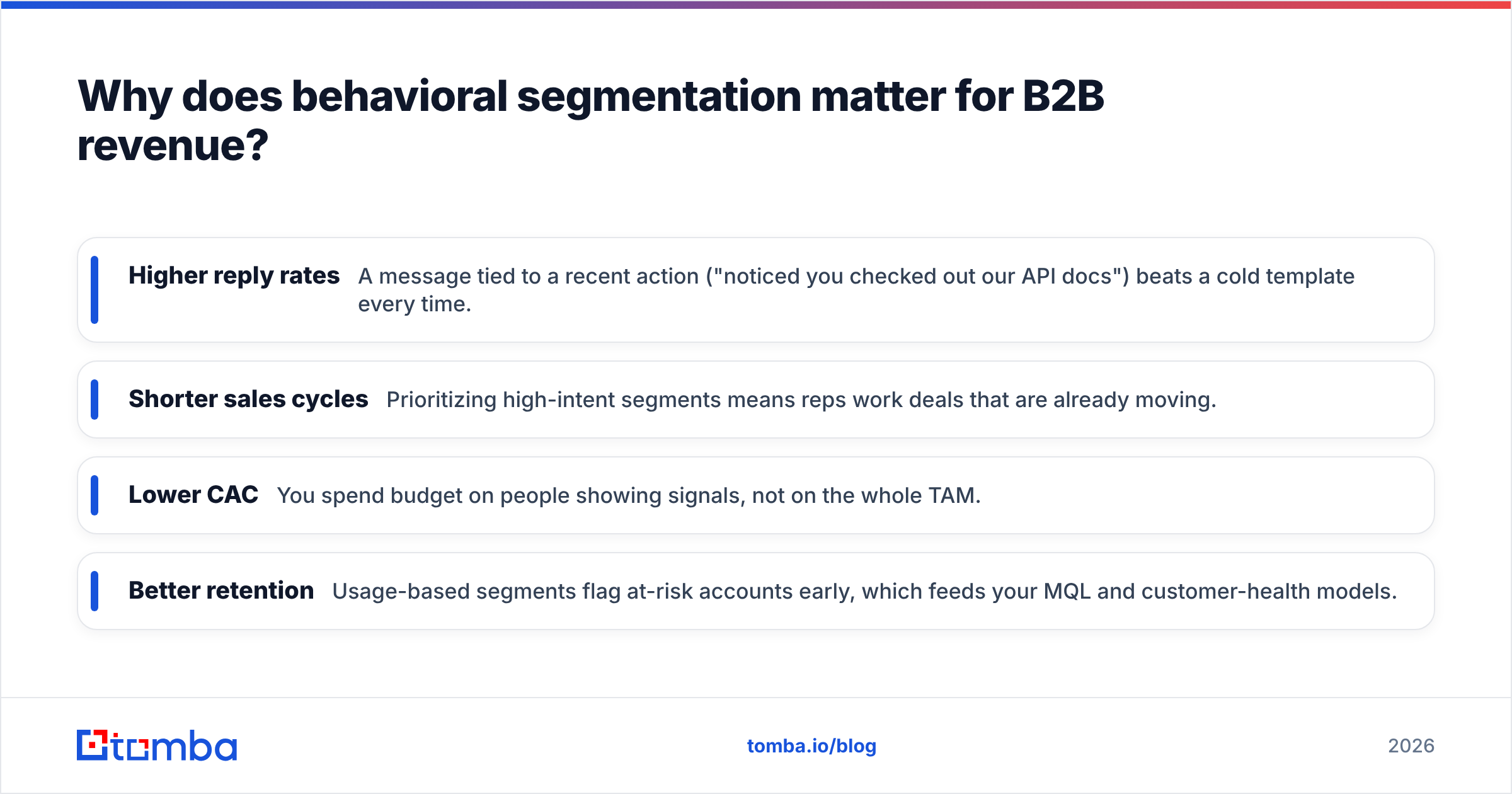
Conclusion first: behavior predicts revenue, so segmenting on it makes every downstream play more efficient. When you route by behavior, sales spends time on warm accounts, marketing sends fewer but better emails, and customer success intervenes before churn instead of after.
HubSpot's research on personalization repeatedly shows that targeted, behavior-driven messaging outperforms generic sends on open, click, and conversion. Analyst firms like Gartner make the same point about intent-driven go-to-market: the teams that win in tight markets are the ones reacting to signals fastest.
A few concrete payoffs:
- Higher reply rates — A message tied to a recent action ("noticed you checked out our API docs") beats a cold template every time.
- Shorter sales cycles — Prioritizing high-intent segments means reps work deals that are already moving.
- Lower CAC — You spend budget on people showing signals, not on the whole TAM.
- Better retention — Usage-based segments flag at-risk accounts early, which feeds your MQL and customer-health models.
How do you build behavioral segmentation step by step?#
Here's a framework that works whether you're a two-person team or a full RevOps department.
Step 1 — Define the behaviors that matter. Don't track everything. List the 5–10 actions that historically precede a closed deal or a churn event. Pricing visits, demo requests, and feature activation are usually top of the list.
Step 2 — Get clean, complete contact data. Behavior is useless if you can't tie it to a real person and reach them. This is where most B2B segmentation breaks: a website visitor fires events but you have no email, no company, no role. Tools like website visitor reveal and data enrichment turn anonymous activity into contactable, segmentable records.
Step 3 — Choose an event source. Your website (analytics + reveal), your product (in-app events), and your email platform (opens, clicks, replies) are the three richest streams. Start with whichever you already instrument.
Step 4 — Score and rank. Assign points to each behavior, decay them over time, and set thresholds that trigger a segment. "Pricing view = 10 points, demo request = 30, no activity for 14 days = −15" is a perfectly good v1.
Step 5 — Route and act. Each segment needs an owner and an action. High-intent → SDR call within an hour. Re-engaging churn risk → CS playbook. Early-stage → nurture sequence. A segment with no action attached is just a report.
Step 6 — Measure and refine. Track conversion by segment, kill the segments that don't move revenue, and split the ones that do.
What are real B2B examples of behavioral segmentation?#
Abstract frameworks are easy to nod at and hard to use. Here's what behavioral segments look like in practice.
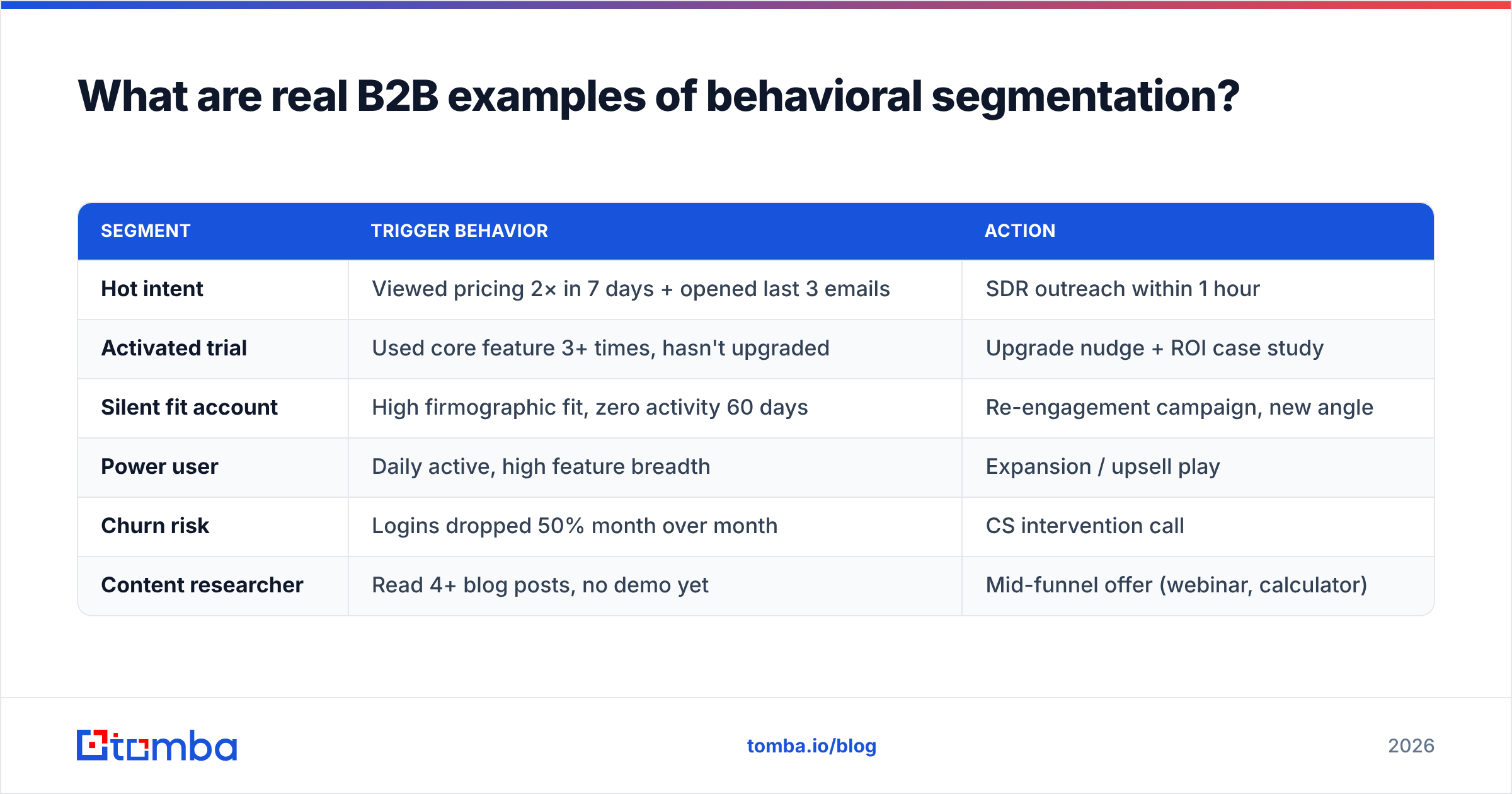
| Segment | Trigger behavior | Action |
|---|---|---|
| Hot intent | Viewed pricing 2× in 7 days + opened last 3 emails | SDR outreach within 1 hour |
| Activated trial | Used core feature 3+ times, hasn't upgraded | Upgrade nudge + ROI case study |
| Silent fit account | High firmographic fit, zero activity 60 days | Re-engagement campaign, new angle |
| Power user | Daily active, high feature breadth | Expansion / upsell play |
| Churn risk | Logins dropped 50% month over month | CS intervention call |
| Content researcher | Read 4+ blog posts, no demo yet | Mid-funnel offer (webinar, calculator) |
Notice every row pairs a measurable behavior with a specific next step. That pairing is the whole discipline. The "silent fit account" row is also why you keep firmographics around — fit plus behavior together is stronger than either alone.
What data and tools do you need?#
You need three layers, and you can assemble them without enterprise pricing.
- Identity layer — Who is this person? You need verified emails, company, and role. An email finder and enrichment API fill the gaps so anonymous events become real contacts.
- Event layer — What did they do? Product analytics, website tracking, and your email/CRM activity feed live here.
- Action layer — A CRM, sequencer, or marketing automation tool where segments trigger plays.
The most common failure point is the identity layer. You can have the best event tracking in the world, but if 60% of your high-intent visitors are anonymous, your behavioral segments are half-empty. Closing that gap — matching behavior to a verified, reachable contact — is usually the highest-leverage fix.
What mistakes should you avoid?#
- Tracking everything, acting on nothing. A dashboard with 40 events and zero routing rules is theater. Pick the behaviors that predict revenue and ignore the rest.
- Letting scores live forever. Behavior decays. A pricing view from six months ago is not intent. Build time decay into every score.
- Ignoring data quality. Segments built on stale or unverified emails route reps to dead ends. Verify before you act.
- One-and-done setup. Behavior shifts with your product and market. Revisit segment definitions quarterly.
- Over-segmenting. Fifty micro-segments no one can maintain is worse than five you actually use. Add complexity only when a segment proves it drives a different action.
How does behavioral segmentation fit with lead scoring?#
They're two halves of the same system. Lead scoring is the math — assigning weighted points to behaviors and attributes. Behavioral segmentation is the grouping — turning those scores into named, actionable buckets. You score to rank individuals; you segment to design plays.
In practice, the same event feeds both. A demo request adds 30 points to a contact's score and drops them into the "hot intent" segment. Score tells your reps the order to work; segment tells them the script to use. Together they let a small team behave like a much larger one — every contact gets a relevant touch without anyone manually sorting a spreadsheet.
Ready to power your behavioral segments with reliable data?#
Behavioral segmentation only works when behavior maps to a real, reachable person — and that starts with accurate contact data. The Tomba Email Finder turns names, domains, and anonymous activity into verified professional emails you can actually segment and act on, so your "hot intent" list isn't full of bounces and blanks.
Start on the free tier (25 searches/month), then scale to Starter at $49/mo or Growth at $99/mo as your segments grow — full Tomba pricing is on the site. Build the segment, fill the identity gap, and let behavior tell you who to call next.
// get started
Find, verify and enrich your first contacts today
Start on the free plan with 25 searches a month, then scale when your team is ready.
Free plan · No credit card required · GDPR & CCPA
// about the author