Ben Franklin Close: The 2026 Guide to Closing With Logic
The Ben Franklin close turns a stalled deal into a calm pros-and-cons decision. Here's how to run it in 2026 without sounding like a 1950s car salesman.
Ben Franklin Close
The Ben Franklin close is one of the oldest closing techniques in sales, and it still works in 2026 for one simple reason: it lets the prospect convince themselves. Instead of pushing, you hand them a structured way to weigh the decision. Done well, it feels like help. Done badly, it feels like a magic trick they can see through.
TL;DR#
- What it is: A closing technique where you walk the prospect through a written list of pros and cons, named after Benjamin Franklin's decision-making method.
- Why it works: It externalizes a messy internal debate, reduces decision anxiety, and lets the buyer reach the conclusion themselves.
- When to use it: Late-stage, analytical buyers who are stalled by indecision — not early-stage or emotional purchases.
- Biggest risk: Sounding manipulative or stacking the list so obviously that you lose trust.
- 2026 reality: It pairs best with clean prospect data, multi-threaded deals, and a CRM that tracks objections — not as a standalone trick.
What is the Ben Franklin close?#
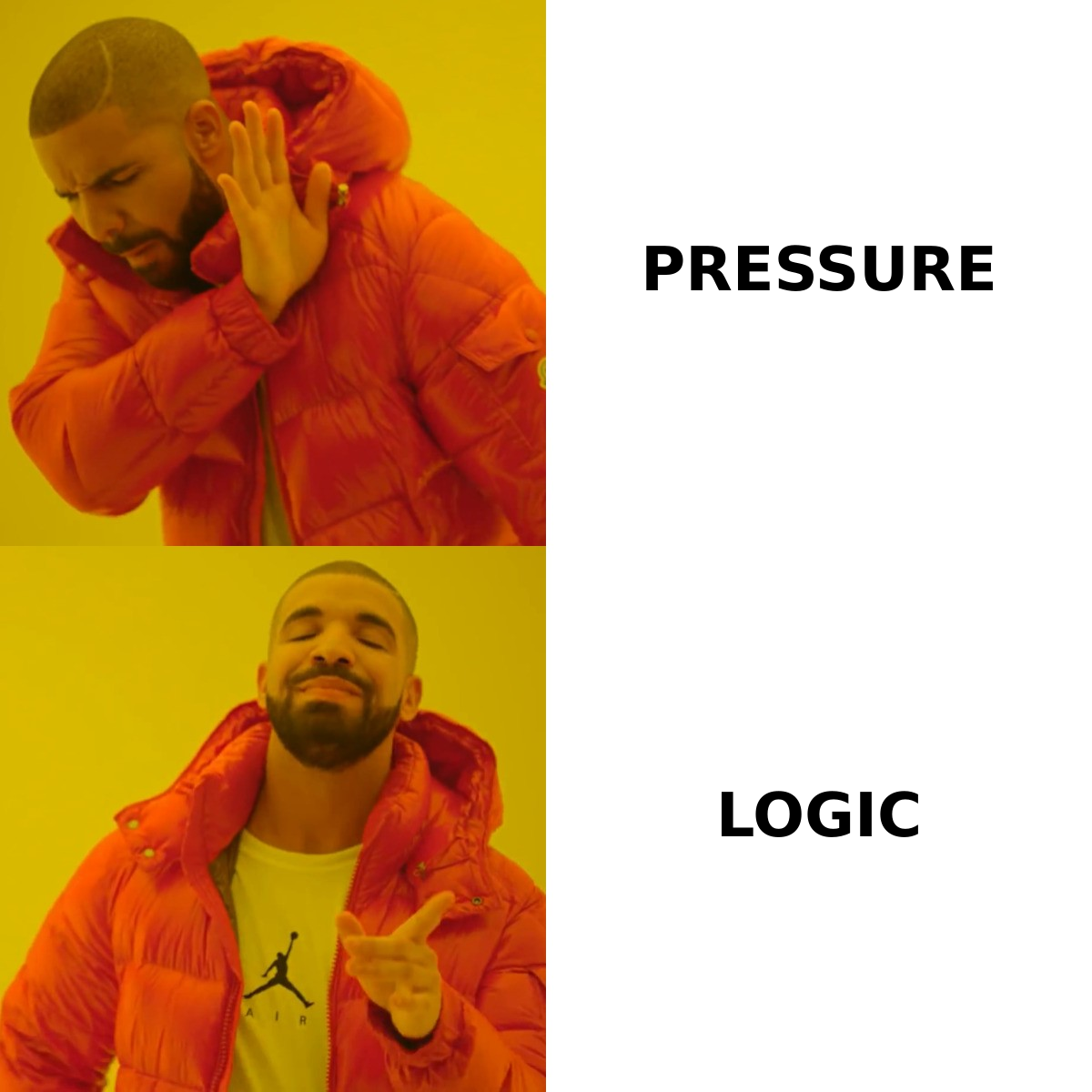
The Ben Franklin close is a sales technique where you ask the prospect to make a literal two-column list — reasons to buy on one side, reasons not to buy on the other — and then talk through it together. The premise is that when the "pro" column visibly outweighs the "con" column, the logical choice becomes obvious to the buyer without you having to argue for it.
The name comes from Benjamin Franklin himself. In a 1772 letter to the scientist Joseph Priestley, Franklin described his "moral algebra" for hard decisions: divide a sheet of paper in half, list the arguments for and against over a few days, then strike out items of roughly equal weight until one side clearly wins. You can read the original method on Franklin's Wikipedia entry — it predates modern sales by two centuries, which is part of why the technique carries an air of plain common sense rather than pressure.
In a sales context, the reframe is subtle but important. You are not arguing. You are facilitating a decision the buyer is already trying to make. That shift in posture is the entire value of the technique.
How does the Ben Franklin close work, step by step?#
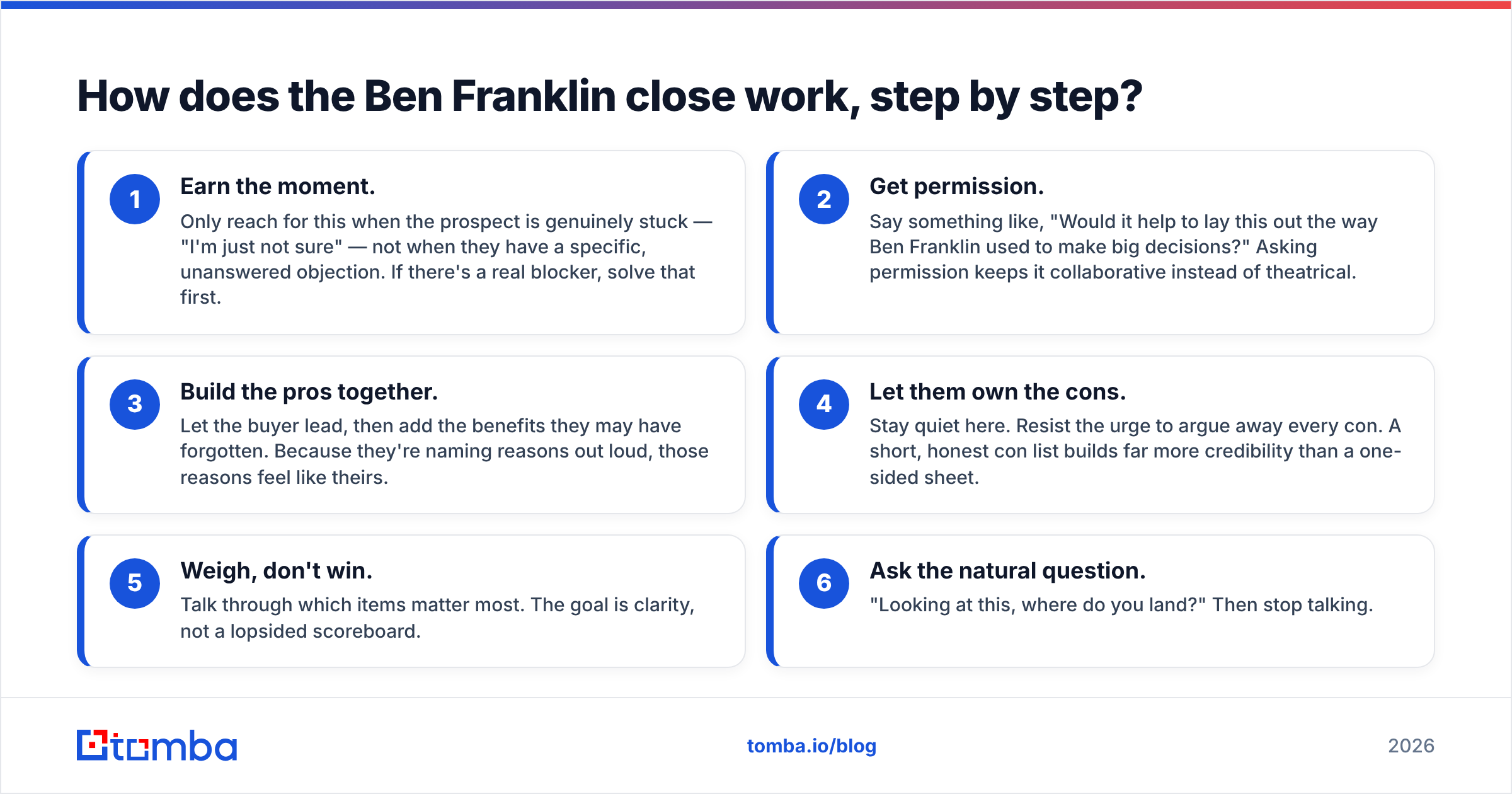
The mechanics are simple, but the sequence matters. Here is the core flow:
- Earn the moment. Only reach for this when the prospect is genuinely stuck — "I'm just not sure" — not when they have a specific, unanswered objection. If there's a real blocker, solve that first.
- Get permission. Say something like, "Would it help to lay this out the way Ben Franklin used to make big decisions?" Asking permission keeps it collaborative instead of theatrical.
- Build the pros together. Let the buyer lead, then add the benefits they may have forgotten. Because they're naming reasons out loud, those reasons feel like theirs.
- Let them own the cons. Stay quiet here. Resist the urge to argue away every con. A short, honest con list builds far more credibility than a one-sided sheet.
- Weigh, don't win. Talk through which items matter most. The goal is clarity, not a lopsided scoreboard.
- Ask the natural question. "Looking at this, where do you land?" Then stop talking.
The discipline in step 4 is what separates a real consultant from a closer running a script. If your con column is empty, the prospect knows the game.
Why does the Ben Franklin close still work in 2026?#
Three forces make this technique durable, even as buying has moved to committees, Slack threads, and procurement portals.
- Decision fatigue is real. B2B buyers evaluate more vendors than ever. A structured list reduces the cognitive load of comparing options, which is exactly what an overwhelmed buyer wants.
- People trust their own conclusions. When a buyer writes "saves 6 hours a week" in their own handwriting, it lands harder than the same line in your deck. Self-generated reasons beat seller-generated claims.
- It surfaces hidden objections. The con column is free market research. Whatever the buyer writes there is the real blocker — the thing your follow-up needs to address. That intelligence is worth the close even when the deal doesn't sign on the spot.
That last point connects directly to pipeline health. Every con you capture is a data point that should land in your CRM so the next touch is sharper. A close is never just a yes/no event; it's a source of signal.

When should you use it — and when should you not?#
The Ben Franklin close is a scalpel, not a hammer. Matching it to the right situation is most of the skill.
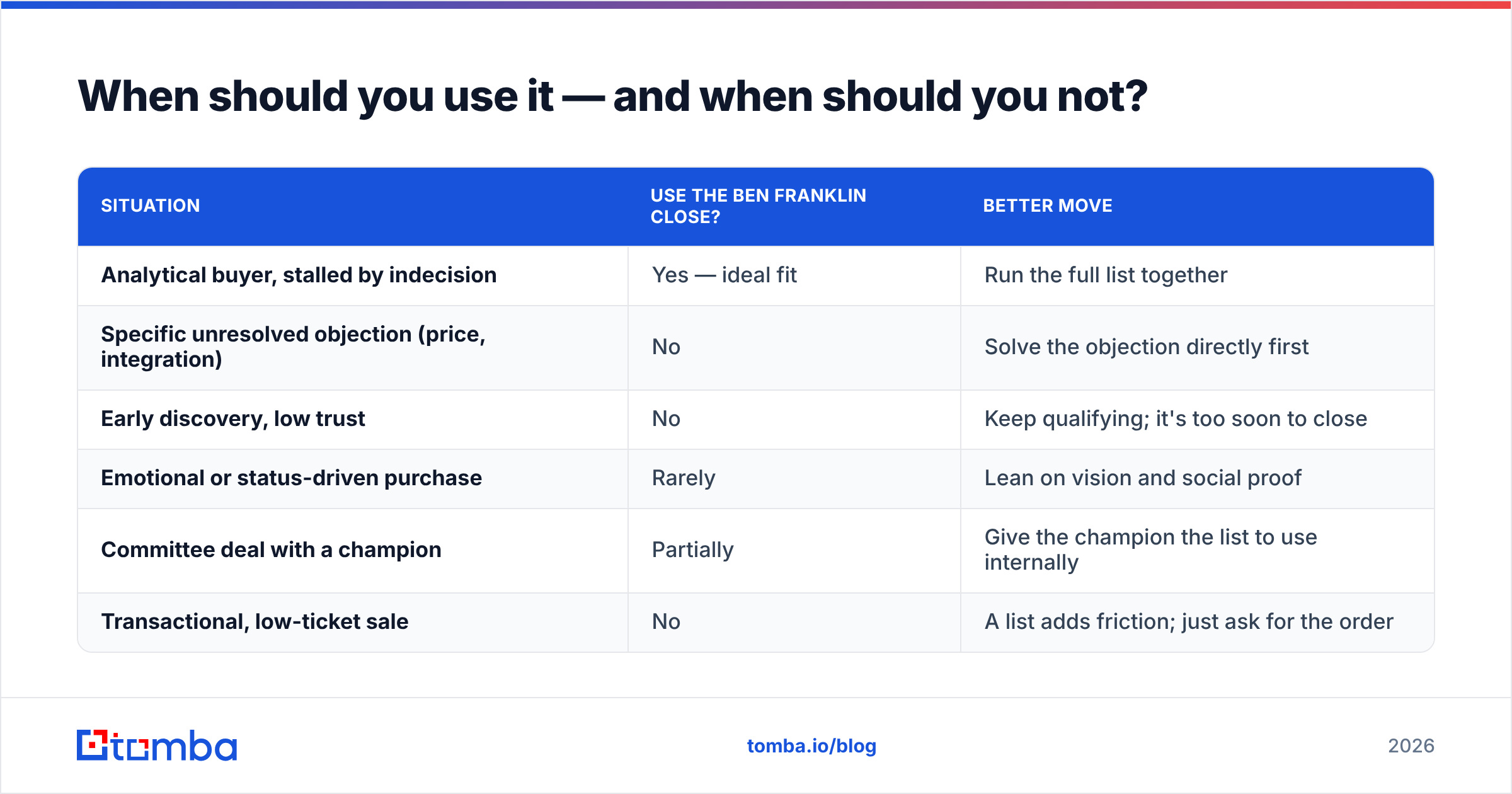
| Situation | Use the Ben Franklin close? | Better move |
|---|---|---|
| Analytical buyer, stalled by indecision | Yes — ideal fit | Run the full list together |
| Specific unresolved objection (price, integration) | No | Solve the objection directly first |
| Early discovery, low trust | No | Keep qualifying; it's too soon to close |
| Emotional or status-driven purchase | Rarely | Lean on vision and social proof |
| Committee deal with a champion | Partially | Give the champion the list to use internally |
| Transactional, low-ticket sale | No | A list adds friction; just ask for the order |
The pattern: this technique shines when the obstacle is indecision, not disagreement. If the buyer disagrees with a specific point, no amount of column-balancing fixes that — you have to address the point.
How does it compare to other closing techniques?#
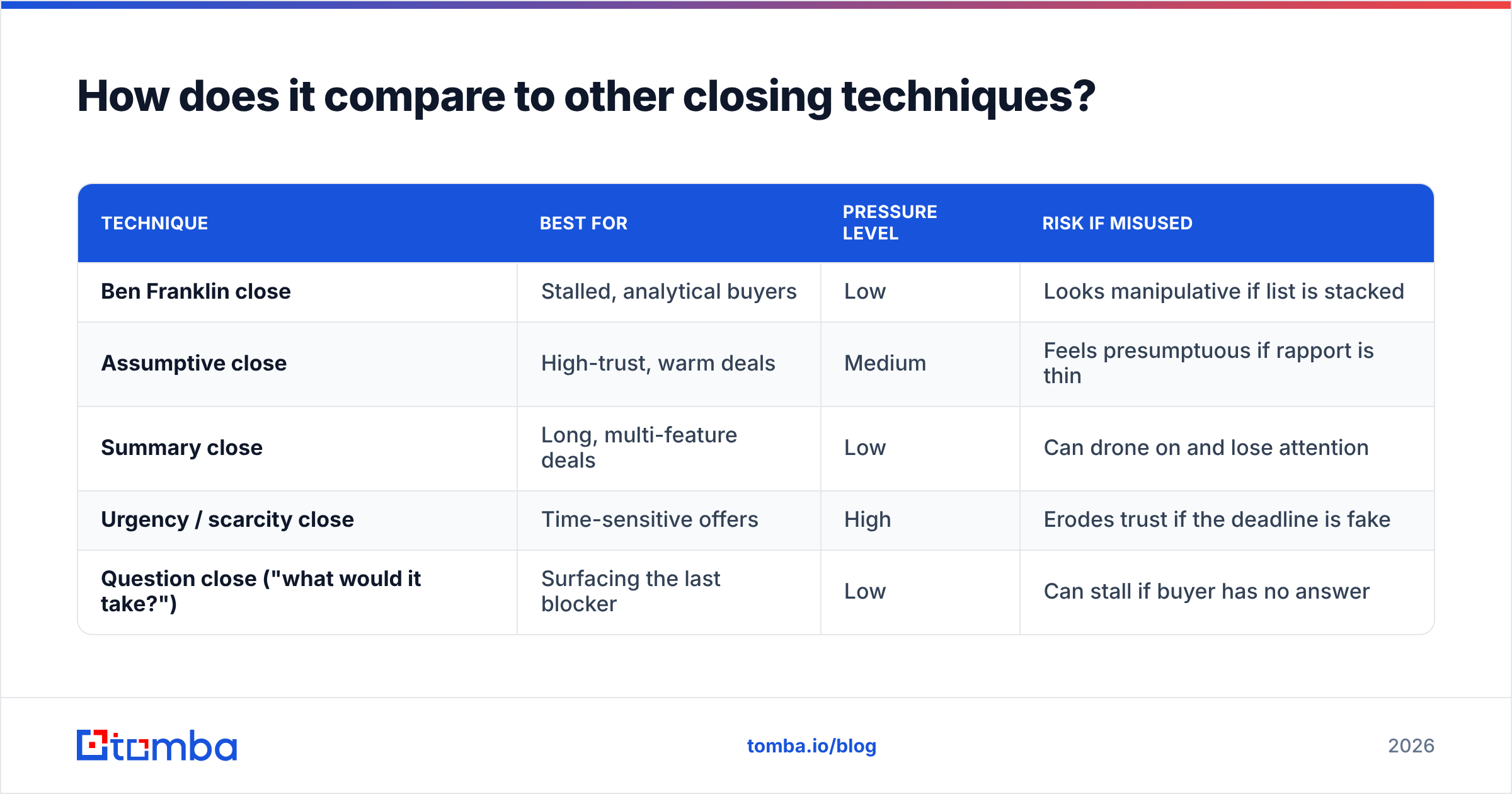
The Ben Franklin close is one of a family of late-stage closes. Knowing the trade-offs keeps you from defaulting to the same move every time.
| Technique | Best for | Pressure level | Risk if misused |
|---|---|---|---|
| Ben Franklin close | Stalled, analytical buyers | Low | Looks manipulative if list is stacked |
| Assumptive close | High-trust, warm deals | Medium | Feels presumptuous if rapport is thin |
| Summary close | Long, multi-feature deals | Low | Can drone on and lose attention |
| Urgency / scarcity close | Time-sensitive offers | High | Erodes trust if the deadline is fake |
| Question close ("what would it take?") | Surfacing the last blocker | Low | Can stall if buyer has no answer |
In practice, top reps blend these. A common sequence is to use a question close to surface the real concern, a summary close to recap value, and the Ben Franklin close only if the buyer is still weighing it internally. HubSpot's overview of closing techniques is a solid reference if you want to map the full menu, and Salesforce's sales fundamentals resources cover how these fit into a modern pipeline.
What does a Ben Franklin close script sound like?#
Scripts are scaffolding, not lines to recite. Here's a natural-sounding version:
Rep: "Sounds like you can see the value but you're still on the fence. Want to do something Ben Franklin used to do for tough calls — just lay out the reasons for and against on paper?"
Buyer: "Sure."
Rep: "Great. On the 'reasons to move forward' side, what stands out to you?" (Let them list. Add the ones they miss.)
Rep: "Now the other column — what's giving you pause?" (Stay silent. Write down exactly what they say.)
Rep: "Looking at this together — the time savings, the integration, the support — against the budget timing concern. Which of these carries the most weight for you right now?"
Notice what's missing: no "so as you can see, it's obvious." The buyer connects the dots. If they say the budget timing matters most, you've just learned the real blocker and can pivot to solving it instead of pretending the close worked.
What are the most common mistakes?#
Most failed Ben Franklin closes fail for the same handful of reasons:
- Stacking the deck. A pro column with twelve items and a con column with one insults the buyer's intelligence. Aim for an honest list; let the weight, not the count, carry it.
- Arguing the cons away. The moment you debate every con, you've turned a collaboration into a sales pitch. Acknowledge cons. Don't litigate them.
- Using it too early. Running this in discovery, before trust exists, feels like a parlor trick. Earn the right first.
- Talking after the question. The close ends with a question. If you keep talking, you rob the buyer of the silence they need to decide.
- Ignoring the con data. The single most common waste: capturing real objections in the con column and then never acting on them. That list is your follow-up roadmap.
Avoiding these is less about charisma and more about restraint. The technique works because of what you don't say.
How does prospect data make or break the close?#
Here's the part most "closing techniques" articles skip: the Ben Franklin close only matters if you're closing the right person. The most logically balanced pros-and-cons sheet in the world is worthless if you're talking to someone who can't sign, or if your outreach never reached the decision-maker in the first place.
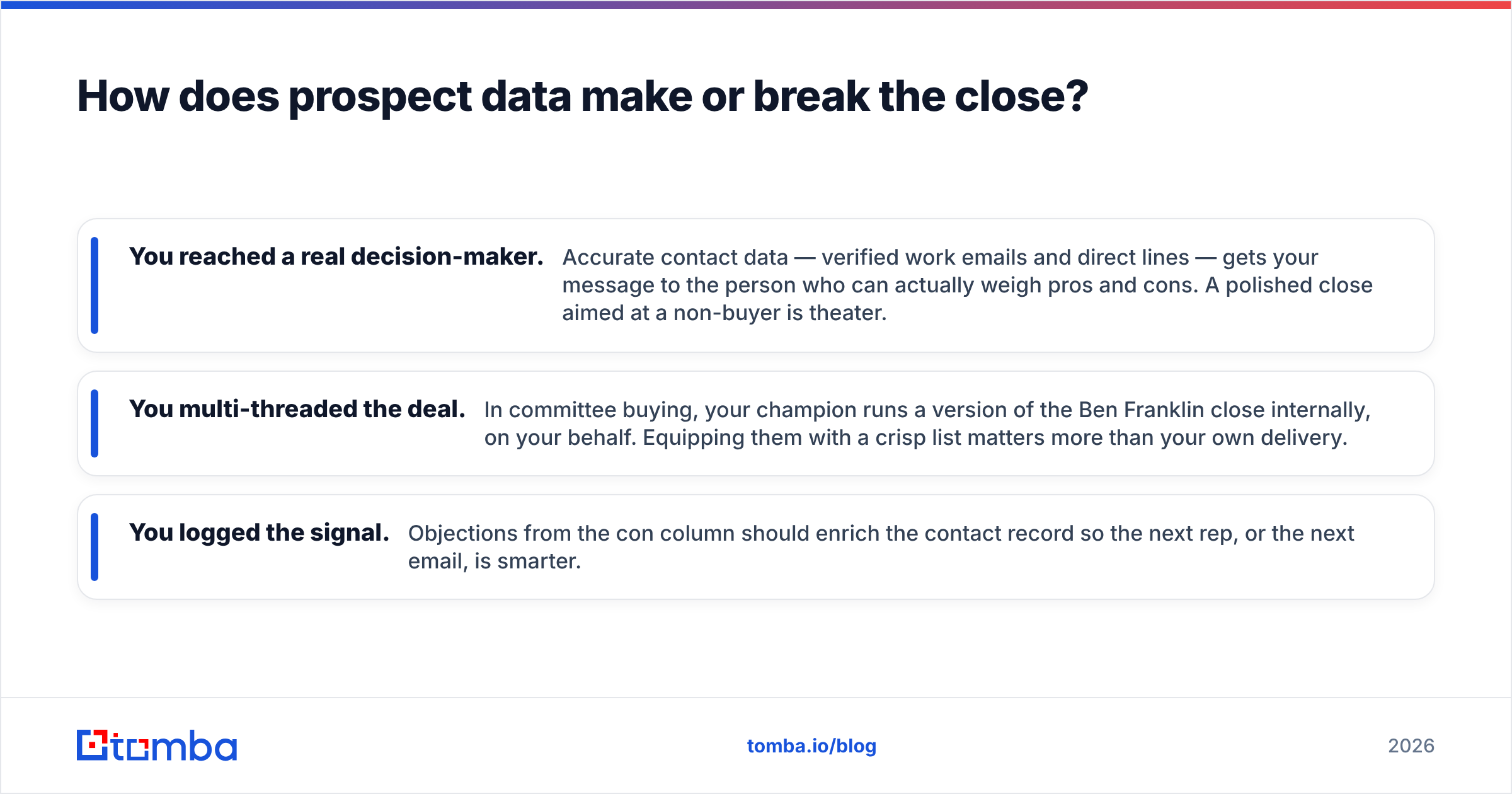
That's where the unglamorous front end of the funnel decides your win rate. Before you ever get to a close, three things have to be true:
- You reached a real decision-maker. Accurate contact data — verified work emails and direct lines — gets your message to the person who can actually weigh pros and cons. A polished close aimed at a non-buyer is theater.
- You multi-threaded the deal. In committee buying, your champion runs a version of the Ben Franklin close internally, on your behalf. Equipping them with a crisp list matters more than your own delivery.
- You logged the signal. Objections from the con column should enrich the contact record so the next rep, or the next email, is smarter.
Modern teams use tools like the Tomba Email Finder to reach verified decision-makers and data enrichment to know who actually holds budget before a single demo is booked. The close is the last 5% of the work; the data quality decides whether that 5% ever gets a chance.
Does the Ben Franklin close still belong in a 2026 sales stack?#
Yes — but as a tool, not a tactic you lean on. Buyers in 2026 are more informed and more skeptical of "techniques" than ever. The version that survives is the consultative one: a genuine, collaborative way to help an analytical buyer organize a decision they're already trying to make. The manipulative, deck-stacked version dies on contact with a savvy buyer.
Think of it like a calculator for a decision. A calculator doesn't tell you what to buy; it just makes the math visible so you can trust the answer. Used that way, the Ben Franklin close isn't a trick at all. It's a service.
The reps who win with it treat the con column as the most valuable part — free, honest intelligence about what's really blocking the deal. They pair it with clean data on the front end so the close lands in front of someone who can say yes. And they know when to put it away: for an emotional buyer or a one-call transaction, a list is just friction.
Where do you go from here?#
Master the close, but start earlier in the funnel — because the best script can't fix a conversation with the wrong person. If your reps are running clean closing techniques but still missing quota, the leak is usually upstream: bad contact data, untargeted outreach, and decision-makers who never got the message.
Fix that first. Use the Tomba Email Finder to reach verified decision-makers by name, domain, or company, so every Ben Franklin close you run is aimed at someone who can actually sign. Start free with 25 searches a month, then scale on the Starter plan at $49/mo as your pipeline grows — see Tomba pricing for the full breakdown. The close is the easy part once you're talking to the right buyer.
Ready to find emails that actually work?
Join 150,000+ professionals who stopped guessing and started sending. Free credits on signup — no credit card required.
Get the Tomba newsletter
Practical outbound tactics and product updates — once every two weeks.
About the author