7 Benefits of Account Based Marketing in 2026 (With Data)
Account based marketing concentrates spend on the accounts most likely to buy. Here are the seven benefits that make ABM worth it in 2026 — and how to start.
Account based marketing flips the traditional funnel: instead of casting a wide net and hoping a few good-fit buyers fall in, you pick the accounts you actually want and aim everything — content, ads, sales outreach, events — straight at them. In 2026, with ad costs up and inbox attention scarcer than ever, that focus is the difference between a pipeline you can forecast and one you cross your fingers over.
TL;DR — The Core Benefits of Account Based Marketing#
- Higher ROI. ABM concentrates budget on a short list of high-value accounts, so almost every dollar touches a buyer who can actually close. Most teams running ABM report it as their highest-ROI program.
- Sales and marketing finally align. Both teams work the same named-account list with shared definitions, which kills the "these leads are junk" argument.
- Bigger deals, shorter cycles. Targeting whole buying committees — not single leads — pulls larger contracts through the pipeline faster.
- Less waste. You stop paying to reach 10,000 strangers so you can talk to 50 companies that fit.
- Cleaner measurement. Account-level reporting tells you exactly which target accounts moved, instead of vanity lead counts.
What Is Account Based Marketing, Really?#
Account based marketing (ABM) is a B2B strategy where marketing and sales treat individual accounts — specific companies — as markets of one. Think of it as fishing with a spear instead of a net. The net catches volume but most of it is bycatch you throw back. The spear takes patience and aim, but everything you bring home is exactly what you wanted.
Technically, ABM means you define a set of target accounts (often your Ideal Customer Profile made concrete), map the buying committee inside each one, and then coordinate personalized campaigns across every channel to engage those specific people. It is the operational backbone of modern revenue operations, because it forces marketing, sales, and customer success to agree on who matters before anyone spends a cent.
The strategy isn't new — ITSMA coined the term in 2004 — but the tooling that makes it practical at scale only matured recently. Intent data, contact enrichment, and programmatic ads now let a two-person team run plays that used to require an enterprise budget.
ABM vs Traditional Demand Generation#
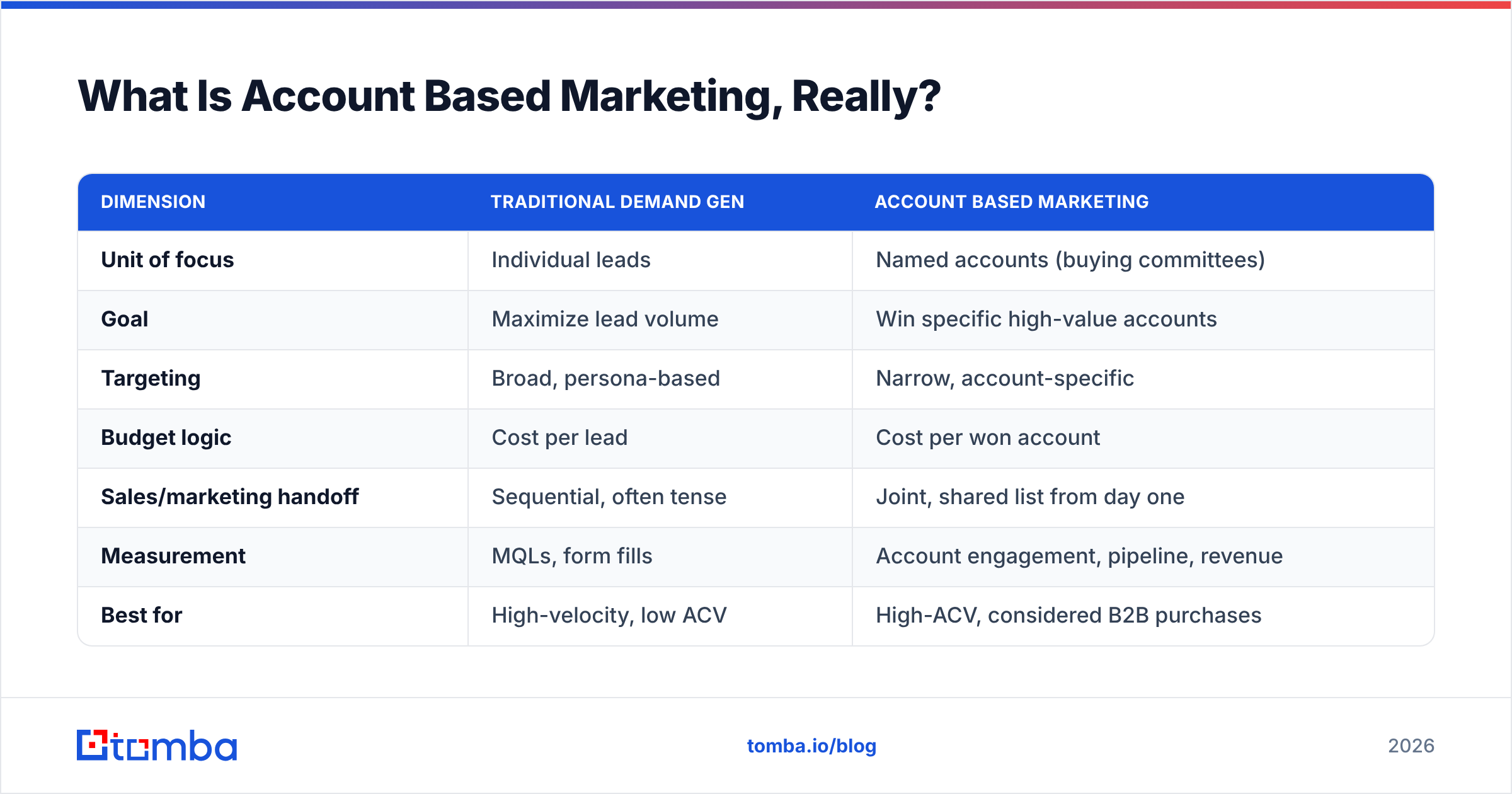
Before the benefits, it helps to see the contrast cleanly. The two approaches optimize for opposite things.
| Dimension | Traditional Demand Gen | Account Based Marketing |
|---|---|---|
| Unit of focus | Individual leads | Named accounts (buying committees) |
| Goal | Maximize lead volume | Win specific high-value accounts |
| Targeting | Broad, persona-based | Narrow, account-specific |
| Budget logic | Cost per lead | Cost per won account |
| Sales/marketing handoff | Sequential, often tense | Joint, shared list from day one |
| Measurement | MQLs, form fills | Account engagement, pipeline, revenue |
| Best for | High-velocity, low ACV | High-ACV, considered B2B purchases |
Neither is universally "better." If you sell a $20/month product to millions of SMBs, volume wins. If you sell a $80,000 platform to 300 enterprises, ABM wins almost every time.
Why Is Account Based Marketing Worth It in 2026?#
Here are the seven benefits that keep ABM at the top of B2B marketing priorities — laid out in the order most teams feel them.
1. Dramatically Higher Marketing ROI#
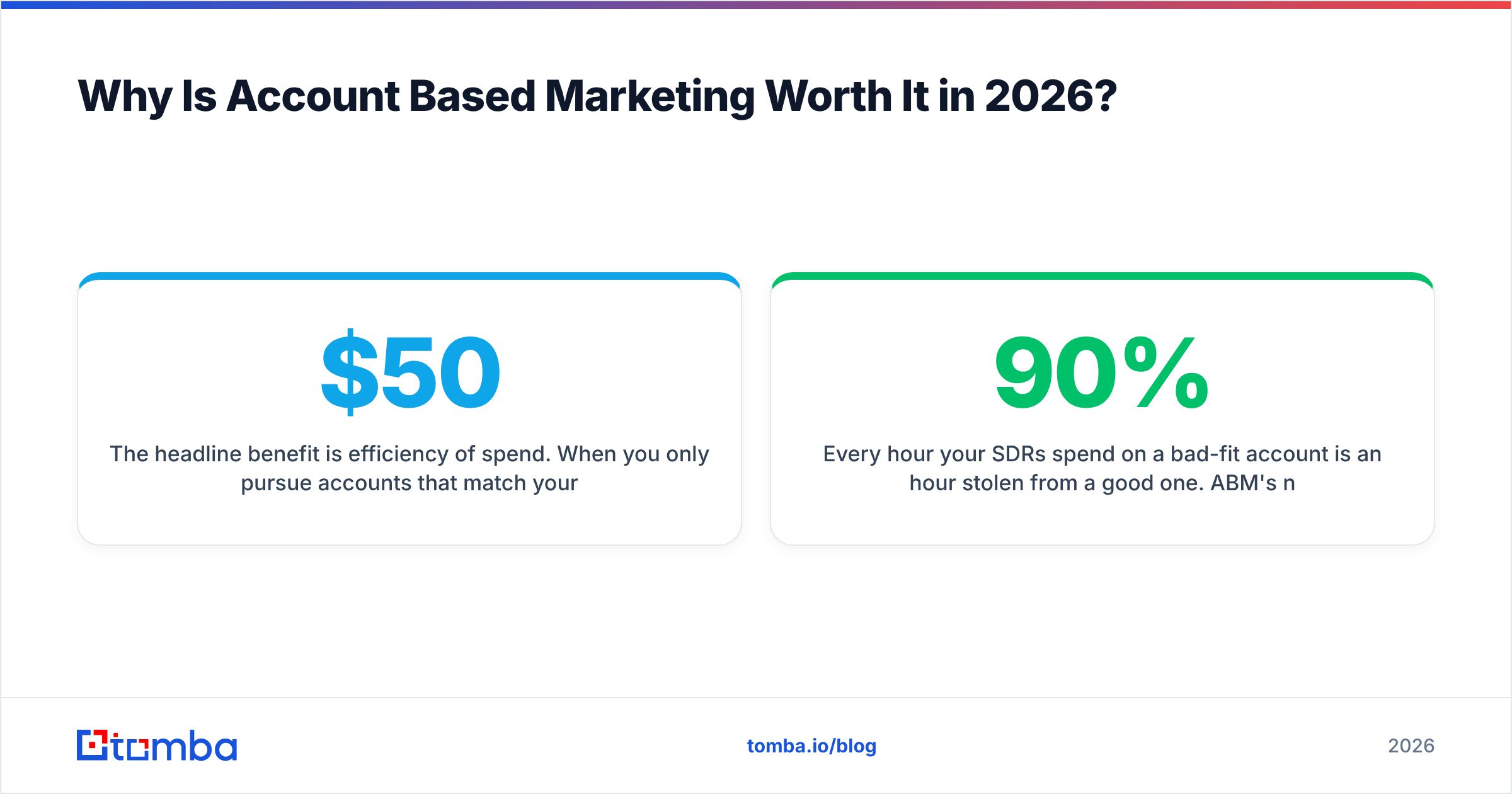
The headline benefit is efficiency of spend. When you only pursue accounts that match your ICP, you stop subsidizing clicks and downloads from people who will never buy. Year after year, ABM practitioners surveyed by ITSMA and others report it delivers their highest return of any go-to-market program. The math is intuitive: a $50,000 campaign aimed at 100 perfect-fit accounts that yields three $90,000 deals beats the same budget sprayed across 50,000 cold contacts that yields a pile of unqualified form fills.
2. Real Sales and Marketing Alignment#
ABM only works if both teams agree on the target list — which means they have to talk. That shared accountability is, quietly, one of the biggest organizational wins. Marketing stops being judged on raw lead counts and starts being judged on whether named accounts advance. Sales stops complaining about lead quality because they helped pick the accounts. The friction that defines most B2B orgs simply has less room to grow.
3. Bigger Deal Sizes#
Because ABM engages the entire buying committee — the champion, the economic buyer, the technical evaluator, the skeptic in finance — deals tend to land bigger and stick longer. You're not selling one person on one feature; you're building consensus across a group, which naturally pushes toward larger, multi-product, longer-term contracts.
4. Shorter, More Predictable Sales Cycles#
Counterintuitively, engaging more people speeds things up. When marketing has already warmed the CFO and the head of IT before sales even calls, the deal doesn't stall waiting for an internal champion to evangelize alone. Multi-threaded accounts move through stages with fewer surprise blockers, which tightens your win rate and makes forecasting far less of a guessing game.
5. Less Wasted Budget and Effort#
Every hour your SDRs spend on a bad-fit account is an hour stolen from a good one. ABM's narrow focus means your team's energy compounds on the accounts that matter. No more building 5,000-line prospecting lists where 90% bounce or ghost — you build a tight list of validated contacts and work it deeply.
6. Sharper, Account-Level Measurement#
Lead-based reporting flatters you with big numbers that don't pay salaries. ABM reporting asks a harder, more useful question: did this account engage, enter pipeline, and close? Account-level attribution gives you a clean line from spend to revenue, which is exactly what your CFO wants to see and exactly what a healthy marketing qualified lead model struggles to deliver.
7. Better Customer Experience and Retention#
Personalization isn't a gimmick — buyers genuinely respond to outreach that reflects their actual situation. An ABM approach treats each account as a relationship, not a transaction, which carries naturally into onboarding and expansion. The same account intelligence that won the deal helps customer success keep and grow it.
How Do the ABM Benefits Compare to the Costs?#
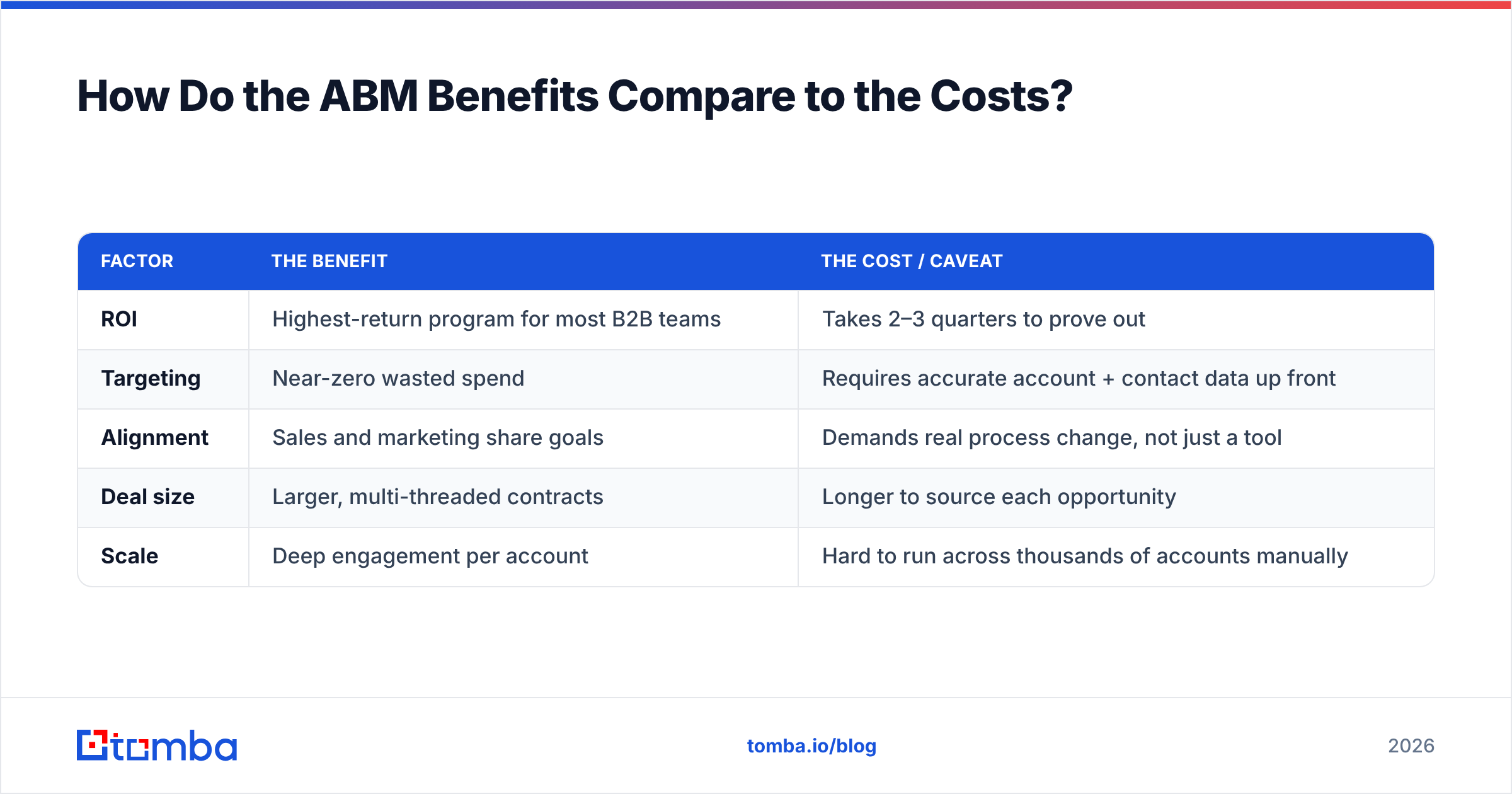
ABM is not free, and pretending otherwise sets teams up to quit too early. Be honest about the trade-offs.
| Factor | The Benefit | The Cost / Caveat |
|---|---|---|
| ROI | Highest-return program for most B2B teams | Takes 2–3 quarters to prove out |
| Targeting | Near-zero wasted spend | Requires accurate account + contact data up front |
| Alignment | Sales and marketing share goals | Demands real process change, not just a tool |
| Deal size | Larger, multi-threaded contracts | Longer to source each opportunity |
| Scale | Deep engagement per account | Hard to run across thousands of accounts manually |
The recurring theme in that right-hand column is data. ABM lives or dies on the quality of your target-account list and the contacts inside it. Aim at the wrong companies, or chase email addresses that bounce, and every downstream benefit evaporates. This is where most ABM programs actually fail — not strategy, but the unglamorous work of building a clean, deliverable contact base for each account.
How to Start Account Based Marketing Without an Enterprise Budget#
You don't need a six-figure platform to capture most of these benefits. A lean ABM motion fits in five steps.
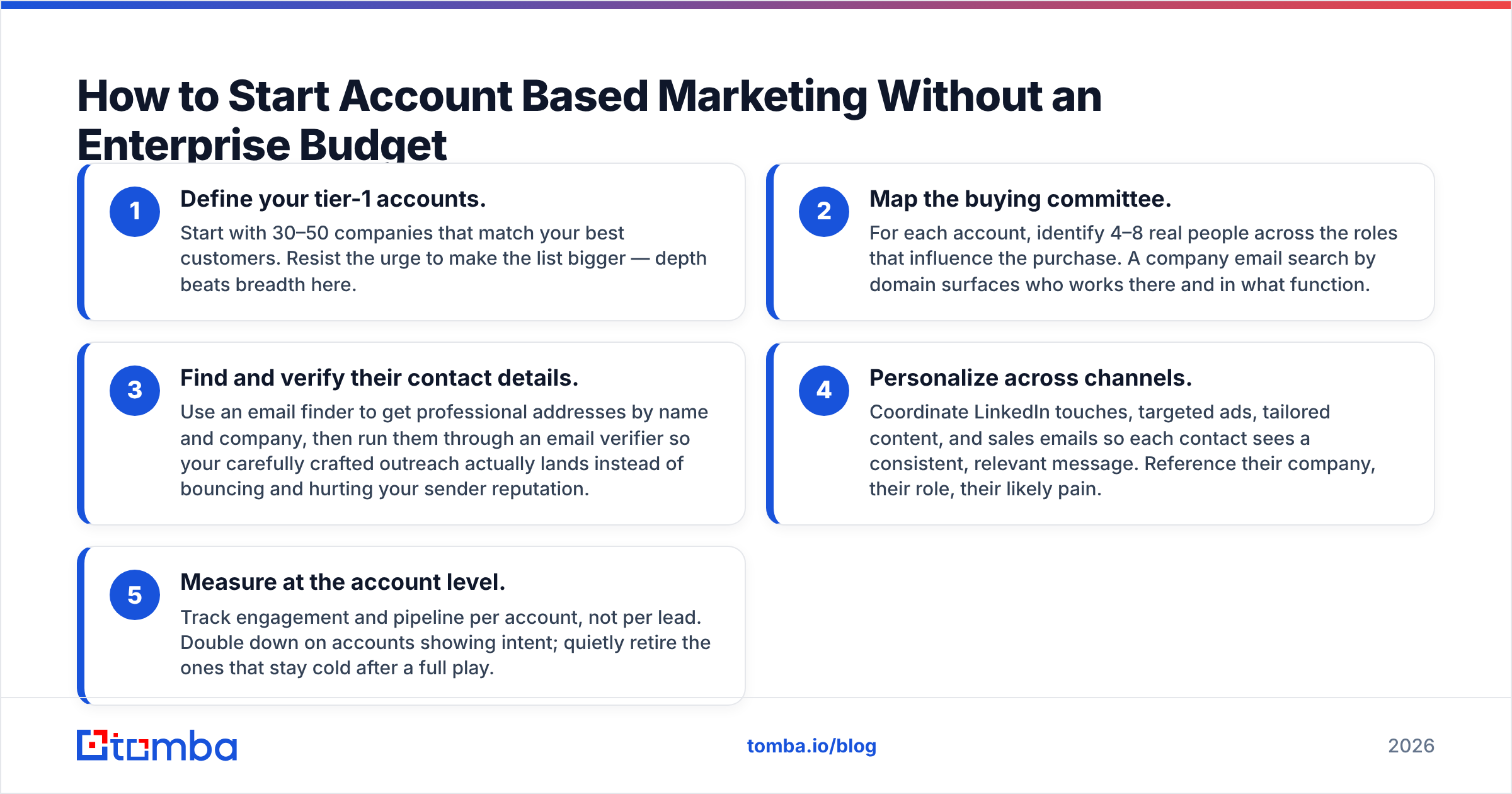
- Define your tier-1 accounts. Start with 30–50 companies that match your best customers. Resist the urge to make the list bigger — depth beats breadth here.
- Map the buying committee. For each account, identify 4–8 real people across the roles that influence the purchase. A company email search by domain surfaces who works there and in what function.
- Find and verify their contact details. Use an email finder to get professional addresses by name and company, then run them through an email verifier so your carefully crafted outreach actually lands instead of bouncing and hurting your sender reputation.
- Personalize across channels. Coordinate LinkedIn touches, targeted ads, tailored content, and sales emails so each contact sees a consistent, relevant message. Reference their company, their role, their likely pain.
- Measure at the account level. Track engagement and pipeline per account, not per lead. Double down on accounts showing intent; quietly retire the ones that stay cold after a full play.
The first three steps are entirely a data problem, and they're the cheapest place to get ABM right. If your list is built on guessed or stale email addresses, even brilliant creative falls flat. Tools that pull verified, role-specific contacts straight from a company domain turn a week of manual research into an afternoon — and keep your bulk lead generation clean enough that your campaigns measure what they're supposed to.
Is ABM Right for Your Business?#
ABM pays off when three things are true: your average contract value is high enough to justify per-account effort (generally $15,000+ annually), your buying process involves multiple stakeholders, and your total addressable market is countable rather than infinite. If you sell considered B2B products to a defined set of companies, the benefits above are very real and very achievable.
If you sell a low-cost, self-serve product to a massive undifferentiated market, stay with high-velocity demand gen — ABM's per-account economics won't work in your favor. And many teams run a hybrid: broad demand gen to fill the top, ABM plays reserved for the tier-1 logos worth real attention.
The honest takeaway: account based marketing isn't a trend to chase, it's a discipline to commit to. The teams that win with it aren't the ones with the fanciest platform — they're the ones who pick the right accounts and reach the right people with data they can trust.
Build Your ABM Target List With Verified Contacts#
Every benefit of account based marketing traces back to one foundation: knowing exactly who to reach inside each account, and reaching them without bounces. That's the part Tomba Email Finder was built for — search any company by domain, name, or role, get professional email addresses, and verify them before they enter your sequences. Start free with 25 searches a month, then scale on the Starter plan at $49/mo as your account list grows. Spend your ABM budget on the accounts that convert, not on guessing at addresses that bounce.
// get started
Find, verify and enrich your first contacts today
Start on the free plan with 25 searches a month, then scale when your team is ready.
Free plan · No credit card required · GDPR & CCPA
// about the author