Benefits Of Consultative Selling: The 2026 Playbook
Consultative selling trades the pitch for a diagnosis. Here are the real benefits of consultative selling in 2026 — bigger deals, higher win rates, and fewer churned customers.
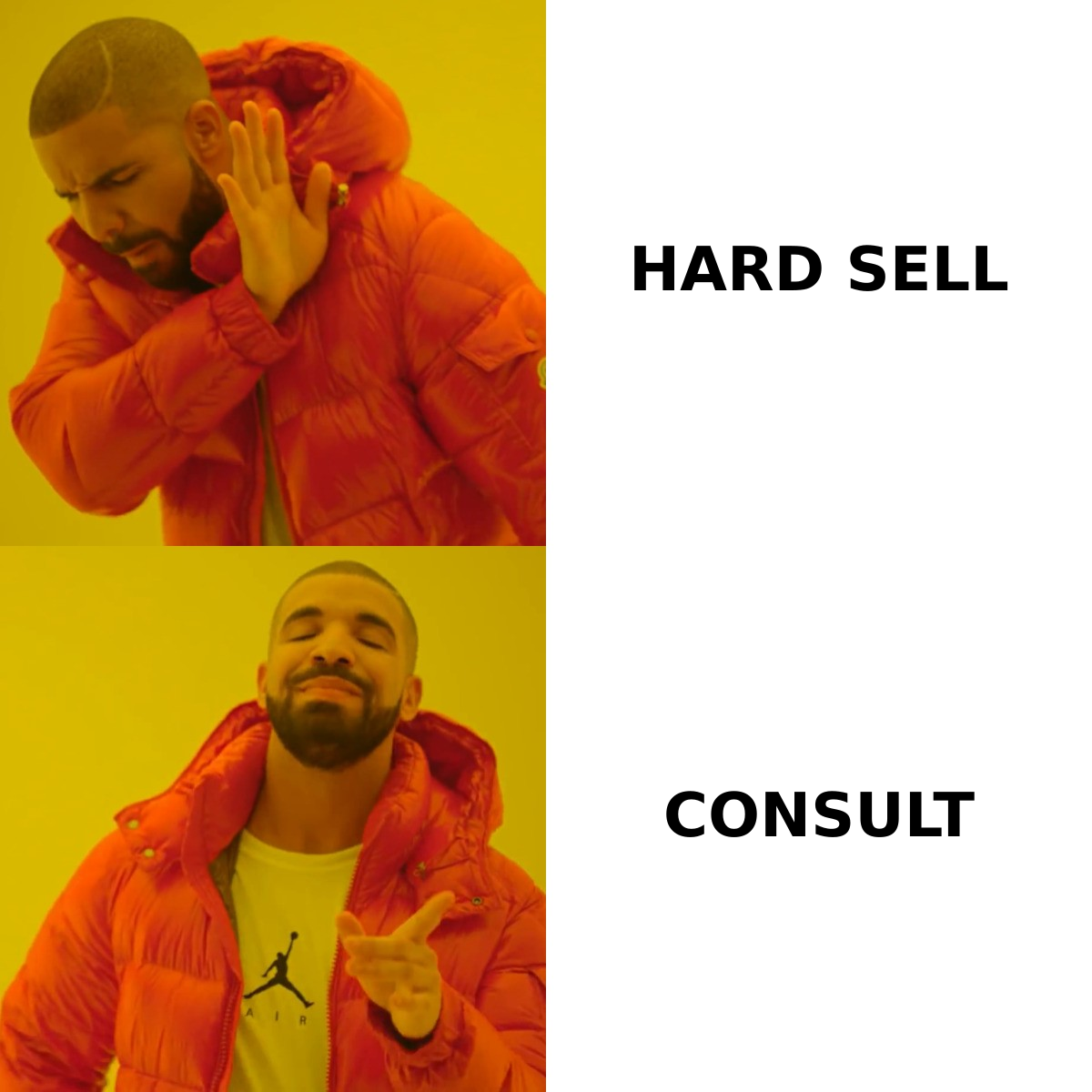
Consultative selling is the difference between a doctor who prescribes before examining and one who diagnoses first. The second one keeps patients. In B2B sales, the second one keeps customers — and closes bigger deals doing it.
This guide breaks down the concrete benefits of consultative selling, how it stacks up against the old transactional model, and how to actually run it in 2026 when buyers research more than ever and tolerate pitches less than ever.
TL;DR#
- Consultative selling means diagnosing the buyer's problem before recommending a solution — you act as an advisor, not a vendor pushing a catalog.
- The measurable benefits: higher win rates, larger average deal size, shorter sales cycles on qualified deals, lower churn, and stronger referrals.
- It works because modern B2B buyers complete most of their research alone — they don't need a brochure, they need someone to make sense of their situation.
- The approach demands better research and data up front; you can't ask sharp questions about a prospect you know nothing about.
- Tools that enrich contact and company data (like an email finder plus data enrichment) make consultative outreach scalable instead of artisanal.
What is consultative selling?#
Consultative selling is a sales approach where the rep leads with questions and diagnosis instead of product features. You spend the early conversation understanding the prospect's goals, constraints, and pain — then you connect your solution to what you actually heard. If your product doesn't fit, a true consultative seller says so.
Think of it like a good architect. A bad one shows you the same house they build for everyone. A good one asks how you live, who's in the family, and how the light hits the lot — then designs around your answers. The house costs more and the client never regrets it.
The methodology isn't new — Mack Hanan coined the term in the 1970s — but it has become the default expectation. According to Gartner research, B2B buyers spend only a small fraction of their journey with any sales rep, and the rest is independent research. When they finally talk to you, a feature dump insults the homework they already did.
How is consultative selling different from transactional selling?#
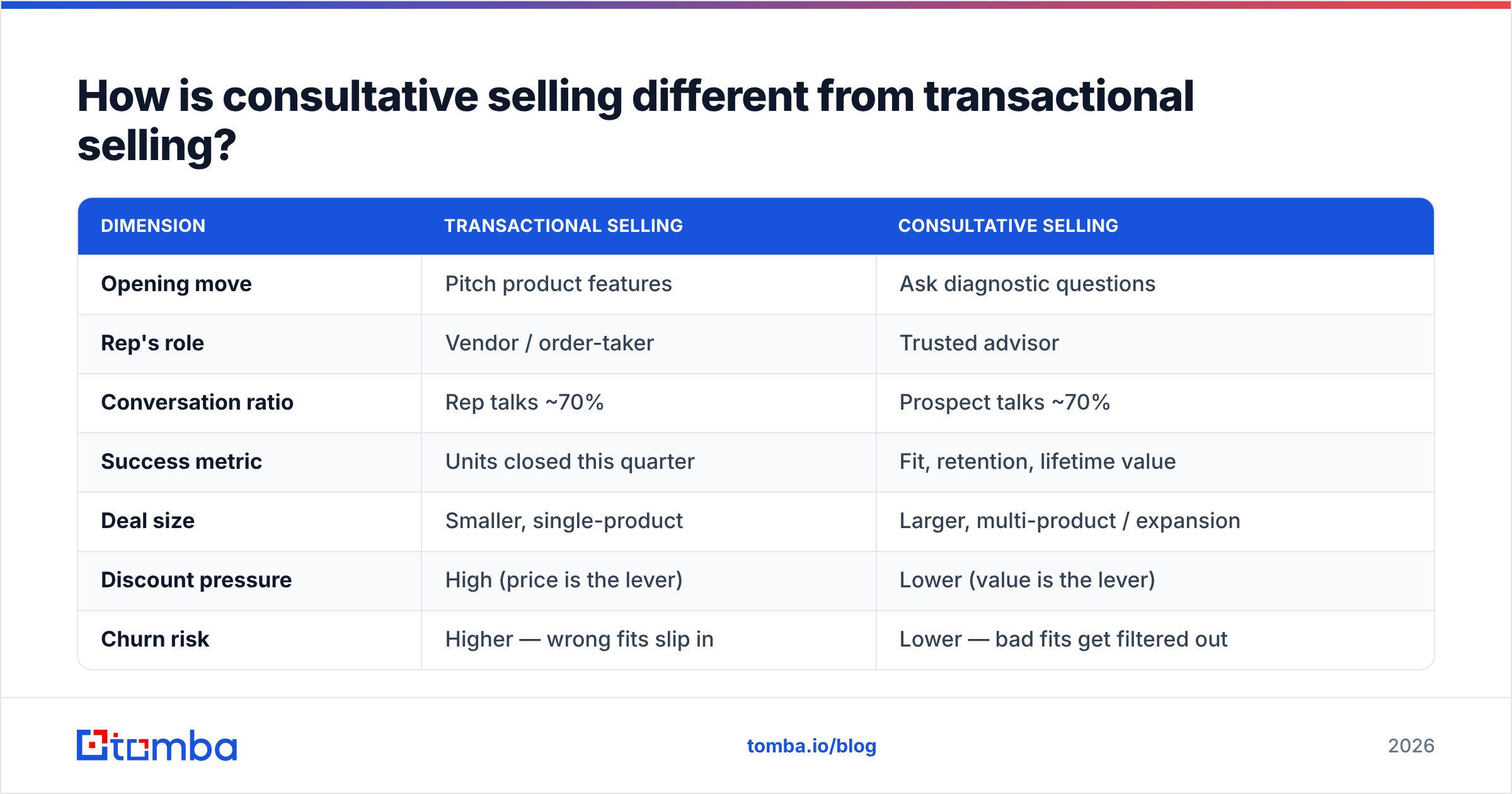
Transactional selling optimizes for the close. Consultative selling optimizes for the fit, and the close follows. The two approaches produce different behaviors at every stage of the deal.
| Dimension | Transactional Selling | Consultative Selling |
|---|---|---|
| Opening move | Pitch product features | Ask diagnostic questions |
| Rep's role | Vendor / order-taker | Trusted advisor |
| Conversation ratio | Rep talks ~70% | Prospect talks ~70% |
| Success metric | Units closed this quarter | Fit, retention, lifetime value |
| Deal size | Smaller, single-product | Larger, multi-product / expansion |
| Discount pressure | High (price is the lever) | Lower (value is the lever) |
| Churn risk | Higher — wrong fits slip in | Lower — bad fits get filtered out |
| Best for | Low-cost, commodity products | Complex, high-consideration B2B |
The honest caveat: transactional selling is not wrong everywhere. If you sell a $9 commodity with no configuration, a 40-minute discovery call is malpractice in the other direction. Consultative selling earns its keep when the purchase is complex, expensive, or risky — which describes most B2B software, services, and capital goods.
What are the core benefits of consultative selling?#
Here are the benefits that show up in pipeline reports, not just in sales-training slides.
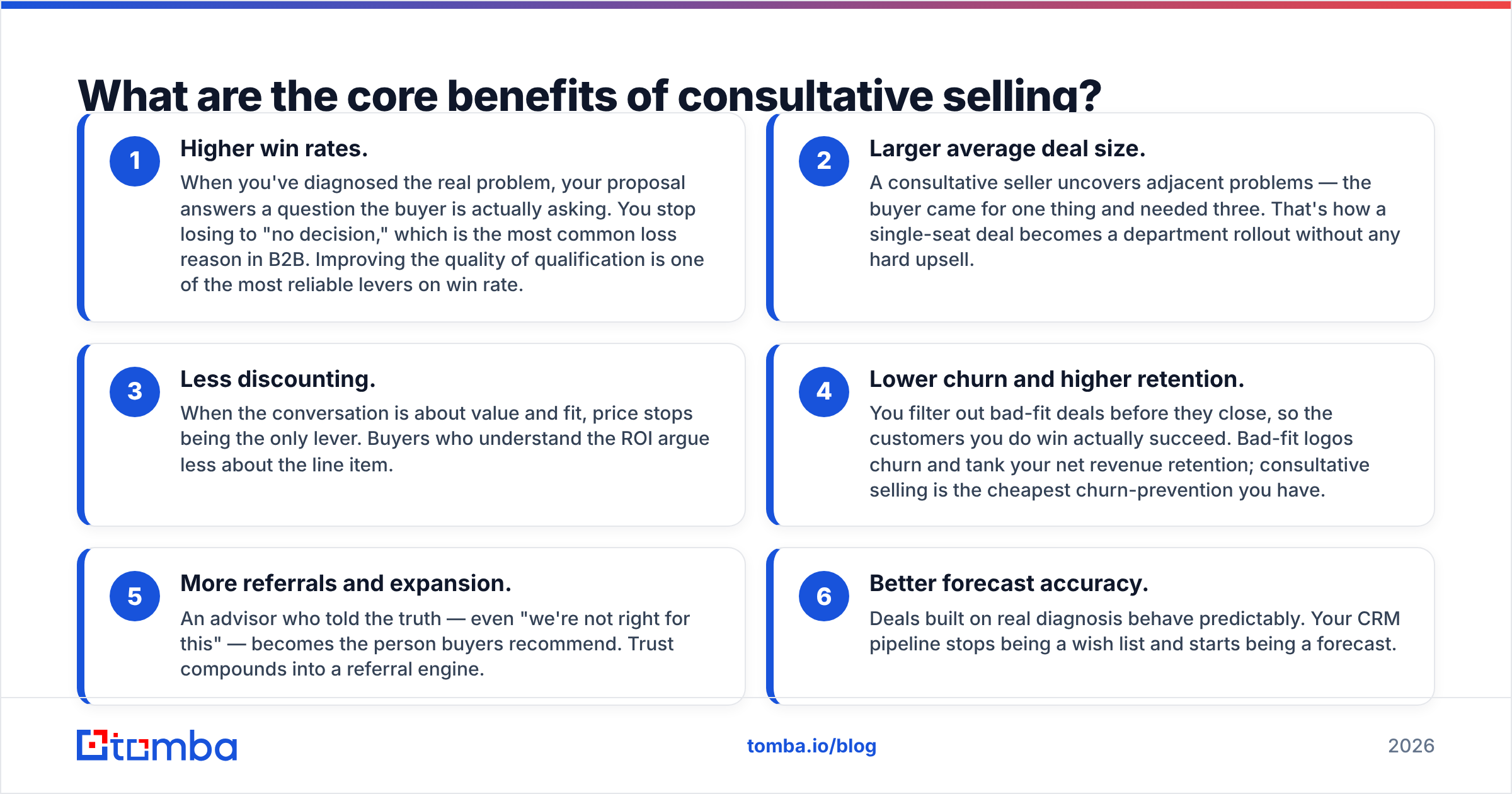
- Higher win rates. When you've diagnosed the real problem, your proposal answers a question the buyer is actually asking. You stop losing to "no decision," which is the most common loss reason in B2B. Improving the quality of qualification is one of the most reliable levers on win rate.
- Larger average deal size. A consultative seller uncovers adjacent problems — the buyer came for one thing and needed three. That's how a single-seat deal becomes a department rollout without any hard upsell.
- Less discounting. When the conversation is about value and fit, price stops being the only lever. Buyers who understand the ROI argue less about the line item.
- Lower churn and higher retention. You filter out bad-fit deals before they close, so the customers you do win actually succeed. Bad-fit logos churn and tank your net revenue retention; consultative selling is the cheapest churn-prevention you have.
- More referrals and expansion. An advisor who told the truth — even "we're not right for this" — becomes the person buyers recommend. Trust compounds into a referral engine.
- Better forecast accuracy. Deals built on real diagnosis behave predictably. Your CRM pipeline stops being a wish list and starts being a forecast.
HubSpot's sales research consistently finds that trust and relevance — not persistence — separate top performers. Consultative selling is the operational version of "be relevant."
Why does consultative selling work better in 2026?#
It works because the buyer changed, and the old script didn't keep up.
Three forces make the consultative approach the rational choice right now:
- Information symmetry. Buyers can read your pricing, your reviews on G2, and your competitors' docs before you say hello. The one thing they can't Google is how it all applies to their messy situation. That's the only value a rep can still add.
- Pitch fatigue. Inboxes are saturated with templated, AI-generated outreach. A genuinely researched, specific message is now a pattern interrupt. Relevance is rare, and rare is valuable.
- Buying committees. The average B2B deal now involves many stakeholders. You cannot one-pitch a committee — you have to diagnose each stakeholder's distinct fear and stitch a consensus. That's consultative work by definition.
How do you actually run a consultative sale?#
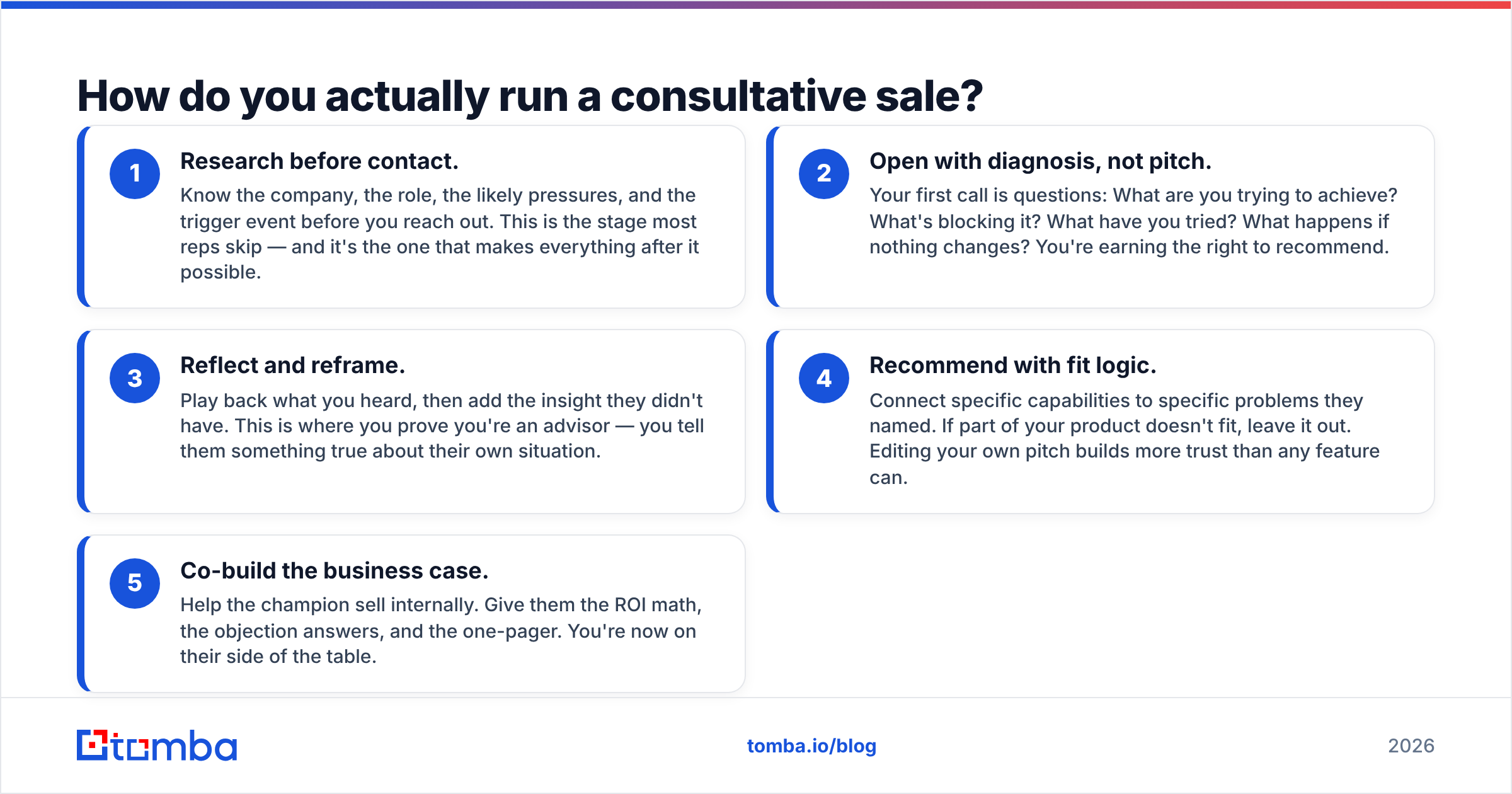
The method is simple to describe and hard to do. Five stages, in order.
- Research before contact. Know the company, the role, the likely pressures, and the trigger event before you reach out. This is the stage most reps skip — and it's the one that makes everything after it possible.
- Open with diagnosis, not pitch. Your first call is questions: What are you trying to achieve? What's blocking it? What have you tried? What happens if nothing changes? You're earning the right to recommend.
- Reflect and reframe. Play back what you heard, then add the insight they didn't have. This is where you prove you're an advisor — you tell them something true about their own situation.
- Recommend with fit logic. Connect specific capabilities to specific problems they named. If part of your product doesn't fit, leave it out. Editing your own pitch builds more trust than any feature can.
- Co-build the business case. Help the champion sell internally. Give them the ROI math, the objection answers, and the one-pager. You're now on their side of the table.
The data layer that makes it scale#
Consultative selling falls apart at scale for one reason: research is expensive. You can be deeply consultative with five accounts a week by hand. To do it across a real territory, you need the research half automated so your human attention goes to the conversation, not the data hunt.
That's the practical bottleneck where tooling earns its place:
- Find the right contact — reach the actual decision-maker, not a generic inbox, with a reliable email finder.
- Enrich the account — pull role, company size, tech stack, and signals so your diagnostic questions are sharp, using data enrichment.
- Verify before you send — protect your sender reputation so the consultative message actually lands instead of bouncing.
Get the data layer right and consultative selling stops being a boutique technique for your top three reps. It becomes the standard motion for the whole team.
What are the downsides and how do you handle them?#
Conclusion first: the costs of consultative selling are real but manageable, and they're mostly front-loaded.
- It's slower per touch. Diagnosis takes time. The fix is ruthless qualification — spend the deep work only on accounts that clear a fit bar, and run a lighter motion for the rest.
- It demands skilled reps. You can't script genuine curiosity. The fix is training on questioning frameworks and call review, not memorized rebuttals.
- It requires more research overhead. As covered above, this is where automation and good data tooling pay for themselves.
- It can stall on small deals. Match the effort to the deal. A consultative motion on a $200/year purchase loses money. Reserve it for complex, high-value pursuits.
None of these outweigh the win-rate and retention gains on the deals that matter. They're a reason to be selective about where you go consultative, not whether you do.
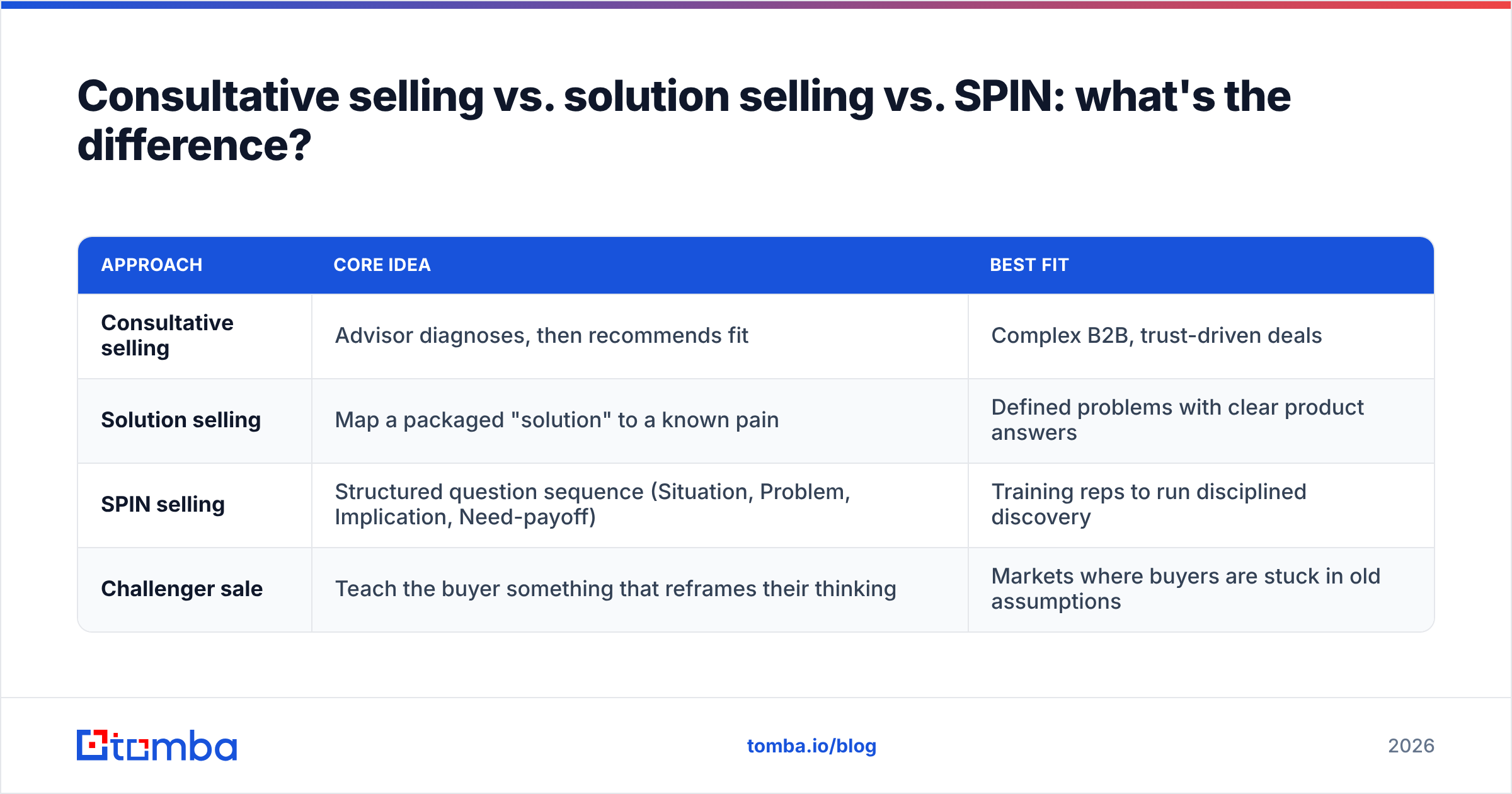
Consultative selling vs. solution selling vs. SPIN: what's the difference?#
These terms overlap, and reps use them interchangeably. The distinctions are worth knowing.
| Approach | Core idea | Best fit |
|---|---|---|
| Consultative selling | Advisor diagnoses, then recommends fit | Complex B2B, trust-driven deals |
| Solution selling | Map a packaged "solution" to a known pain | Defined problems with clear product answers |
| SPIN selling | Structured question sequence (Situation, Problem, Implication, Need-payoff) | Training reps to run disciplined discovery |
| Challenger sale | Teach the buyer something that reframes their thinking | Markets where buyers are stuck in old assumptions |
In practice, strong reps blend them: SPIN gives you the question discipline, Challenger gives you the reframe, and consultative selling is the umbrella philosophy that ties diagnosis to recommendation. You don't have to pick one religion.
How do you measure if consultative selling is working?#
Track leading and lagging indicators together, or you'll quit too early.
- Leading: talk-to-listen ratio on calls, number of discovery questions per first meeting, percentage of deals with a documented "why change" before a demo.
- Lagging: win rate on qualified opportunities, average deal size, sales cycle length on closed-won, net revenue retention, and referral volume.
The trap is judging consultative selling on raw activity metrics — calls dialed, emails sent. Those go down when you do this right, because each touch is more deliberate. Judge it on conversion and retention, where the gains actually live. If your win rate and deal size climb while your churn drops, the slower top-of-funnel is paying for itself many times over.
Where does the data come from?#
Everything above rests on one assumption: that you can reach the right person with enough context to ask a good question. That's the part most teams under-resource.
Start with reliable contact data. Tomba's Email Finder locates professional email addresses by name, company, or domain, so your consultative outreach goes to the decision-maker instead of a contact form. Pair it with enrichment to walk into every conversation already knowing the account — and you've turned consultative selling from a heroic individual effort into a repeatable team motion. Check the Tomba pricing (a free tier with 25 searches/month, Starter at $49/mo, Growth at $99/mo) to see where your volume fits, then point your reps' attention where it belongs: the conversation, not the data hunt.
Diagnose first. Pitch later. Let the data do the legwork so you can do the thinking.
Ready to find emails that actually work?
Join 150,000+ professionals who stopped guessing and started sending. Free credits on signup — no credit card required.
Get the Tomba newsletter
Practical outbound tactics and product updates — once every two weeks.
About the author