Benefits of Data Enrichment in 2026: A B2B Growth Guide
Dirty CRM data quietly drains revenue. Here are the concrete benefits of data enrichment in 2026 — and how to capture them without blowing your budget.
Data you collected six months ago is already wrong. People changed jobs, companies rebranded, phone numbers got disconnected, and the "decision maker" you logged got promoted out of the buying committee. Data enrichment is how you fight that decay — and the payoff shows up in nearly every metric your revenue team cares about.
TL;DR#
- Data enrichment fills gaps and corrects errors in your contact and company records by appending verified third-party data (job titles, emails, phone numbers, firmographics, tech stack).
- The biggest benefits of data enrichment are higher conversion rates, sharper targeting, shorter sales cycles, cleaner CRM data, and lower wasted spend.
- B2B data decays ~30% per year, so enrichment is a maintenance habit, not a one-time project.
- Enrichment pays for itself when it removes manual research, reduces bounce rates, and routes leads faster.
- Start small: enrich your highest-value segment first, verify before you sync, and measure lift against a control group.
What is data enrichment?#
Data enrichment is the process of enhancing your existing records with additional, accurate information pulled from external sources. Think of it like a real-estate appraisal: you already own the house (a lead's name and email), but an appraiser adds the context that makes it usable — square footage, neighborhood, recent comparable sales. Enrichment does the same for a thin contact record, attaching the firmographic, demographic, and behavioral context that turns a name into a qualified opportunity.
Technically, enrichment matches a known key (an email, a domain, a LinkedIn URL) against a provider's database and appends or corrects fields. There are three common flavors:
- Contact enrichment — append job title, seniority, department, verified email, and direct dial to a person record.
- Company (firmographic) enrichment — append industry, employee count, revenue, location, and funding to an account.
- Technographic enrichment — append the tools and platforms a company runs, useful for tech-fit targeting.
If you want the textbook definition and where the data comes from, Tomba documents its data sources and offers data enrichment as a standalone product alongside the email finder.

Why does data quality matter so much in B2B?#
Bad data is expensive in ways that don't show up on an invoice. Gartner has repeatedly estimated that poor data quality costs organizations an average of $12.9 million per year, and the damage compounds: reps waste hours on dead numbers, marketing burns budget on mistargeted ads, and leaders make forecasts on a foundation of guesses. (Gartner)
The decay problem is structural. Roughly 70% of B2B data goes stale within a year as people switch roles and companies reorganize. So even a pristine list degrades fast without ongoing enrichment. This is the core argument for treating enrichment as a recurring process rather than a quarterly cleanup.
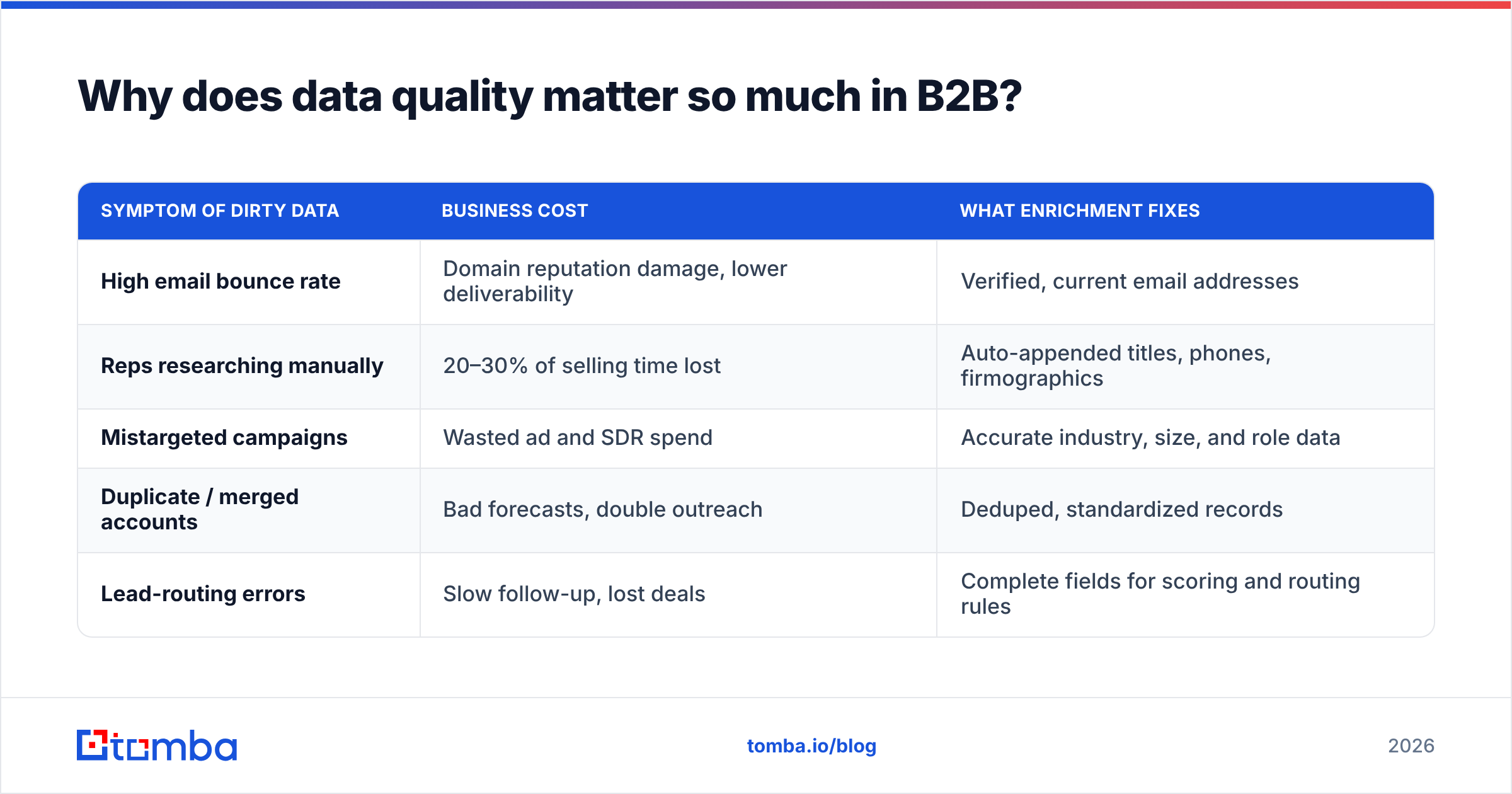
| Symptom of dirty data | Business cost | What enrichment fixes |
|---|---|---|
| High email bounce rate | Domain reputation damage, lower deliverability | Verified, current email addresses |
| Reps researching manually | 20–30% of selling time lost | Auto-appended titles, phones, firmographics |
| Mistargeted campaigns | Wasted ad and SDR spend | Accurate industry, size, and role data |
| Duplicate / merged accounts | Bad forecasts, double outreach | Deduped, standardized records |
| Lead-routing errors | Slow follow-up, lost deals | Complete fields for scoring and routing rules |
What are the core benefits of data enrichment?#
Here are the benefits that consistently move the needle for B2B teams, ranked by how directly they tie to revenue.
- Higher conversion rates. When you know a prospect's exact role, seniority, and company context, your messaging lands. Personalized, well-segmented outreach converts measurably better than spray-and-pray.
- Sharper targeting and segmentation. Firmographic and technographic data let you build ICP-tight segments — "Series B SaaS companies, 50–200 employees, running HubSpot" — instead of broad guesses.
- Shorter sales cycles. Reps stop spending the first 20 minutes of every account hunting for a phone number or org chart. The data is already there.
- Cleaner CRM and better forecasting. Standardized, deduped, complete records make your CRM a source of truth instead of a liability, which makes pipeline forecasts believable.
- Lower acquisition cost. Less wasted spend on bad leads and bounced emails means a lower effective cost per opportunity.
- Faster, smarter lead scoring and routing. Scoring models need complete inputs. Enrichment fills the fields your scoring rules depend on, so hot leads reach the right rep in minutes.
The throughline: enrichment doesn't just clean data, it makes every downstream system — scoring, routing, sequencing, reporting — work the way it was designed to.
How does data enrichment improve deliverability and outreach?#
Deliverability is where enrichment quietly earns its keep. Every email you send to a dead or mistyped address chips away at your sender reputation, and once your domain is flagged, even your good emails land in spam. Enrichment paired with verification breaks that cycle by confirming an address is real and mailbox-active before you ever hit send.
In practice, the workflow looks like this: enrich the record to get the most current email, then run it through an email verifier to confirm it's deliverable, and use a catch-all verifier for domains that accept everything. Teams running cold outreach at scale typically push lists through the bulk email finder so enrichment and verification happen in one pass instead of one record at a time.
The result is fewer bounces, a healthier sender reputation, and more replies from the same volume of sends. That is the difference between an outreach program that scales and one that gets throttled by mailbox providers.
In-house enrichment vs. a dedicated tool: which is better?#
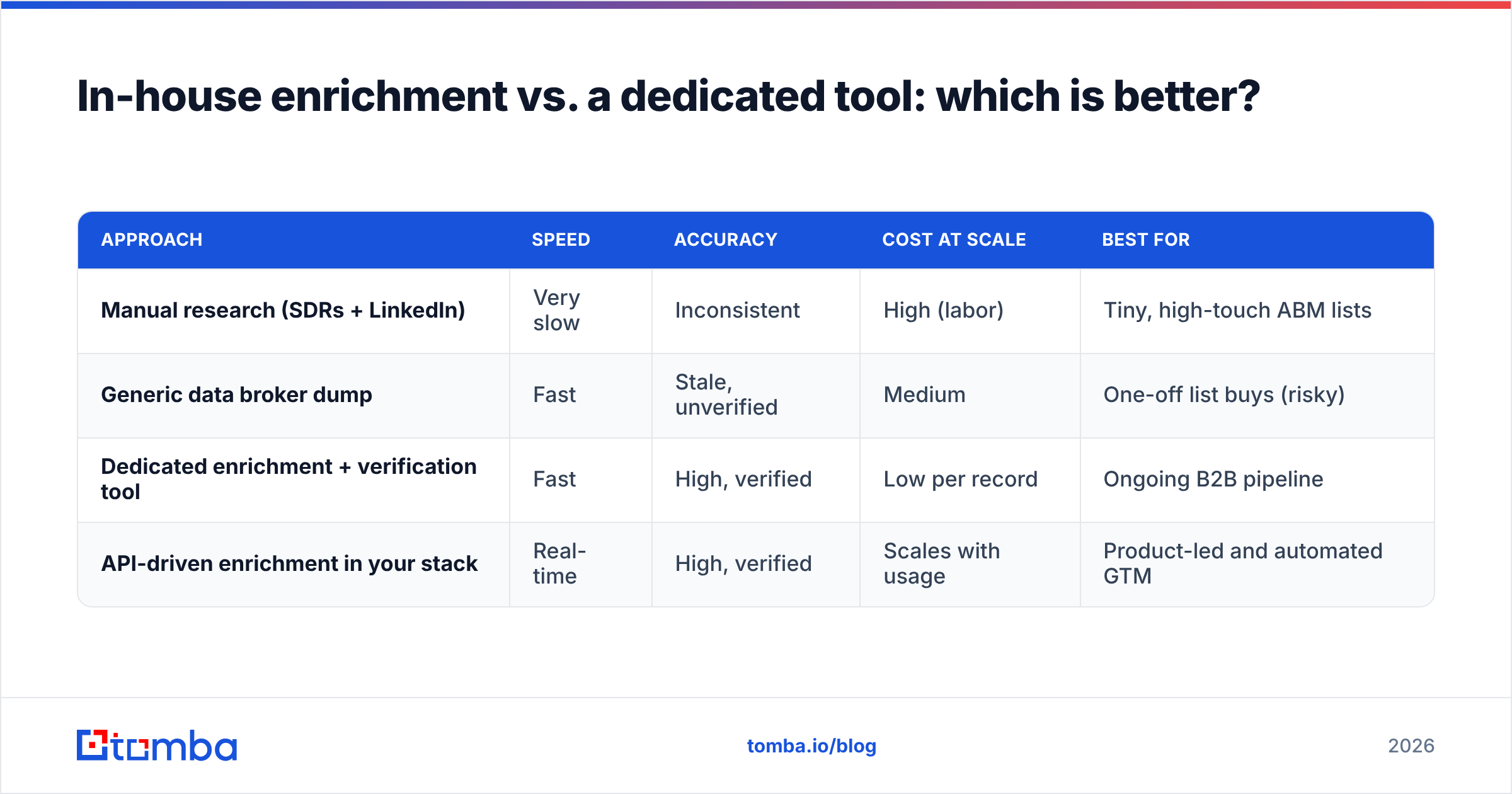
You can technically enrich data manually — assign an SDR to LinkedIn and a spreadsheet — but the math rarely works once you're past a few hundred records. Here's an honest comparison of the three common approaches.
| Approach | Speed | Accuracy | Cost at scale | Best for |
|---|---|---|---|---|
| Manual research (SDRs + LinkedIn) | Very slow | Inconsistent | High (labor) | Tiny, high-touch ABM lists |
| Generic data broker dump | Fast | Stale, unverified | Medium | One-off list buys (risky) |
| Dedicated enrichment + verification tool | Fast | High, verified | Low per record | Ongoing B2B pipeline |
| API-driven enrichment in your stack | Real-time | High, verified | Scales with usage | Product-led and automated GTM |
Manual enrichment burns your most expensive people on work software does better. A raw broker dump is cheap but unverified, so you inherit the decay problem on day one. A dedicated tool with built-in verification — or an email finder API wired directly into your CRM — gives you accuracy and automation together, which is why most scaling teams land there.
What does data enrichment cost?#
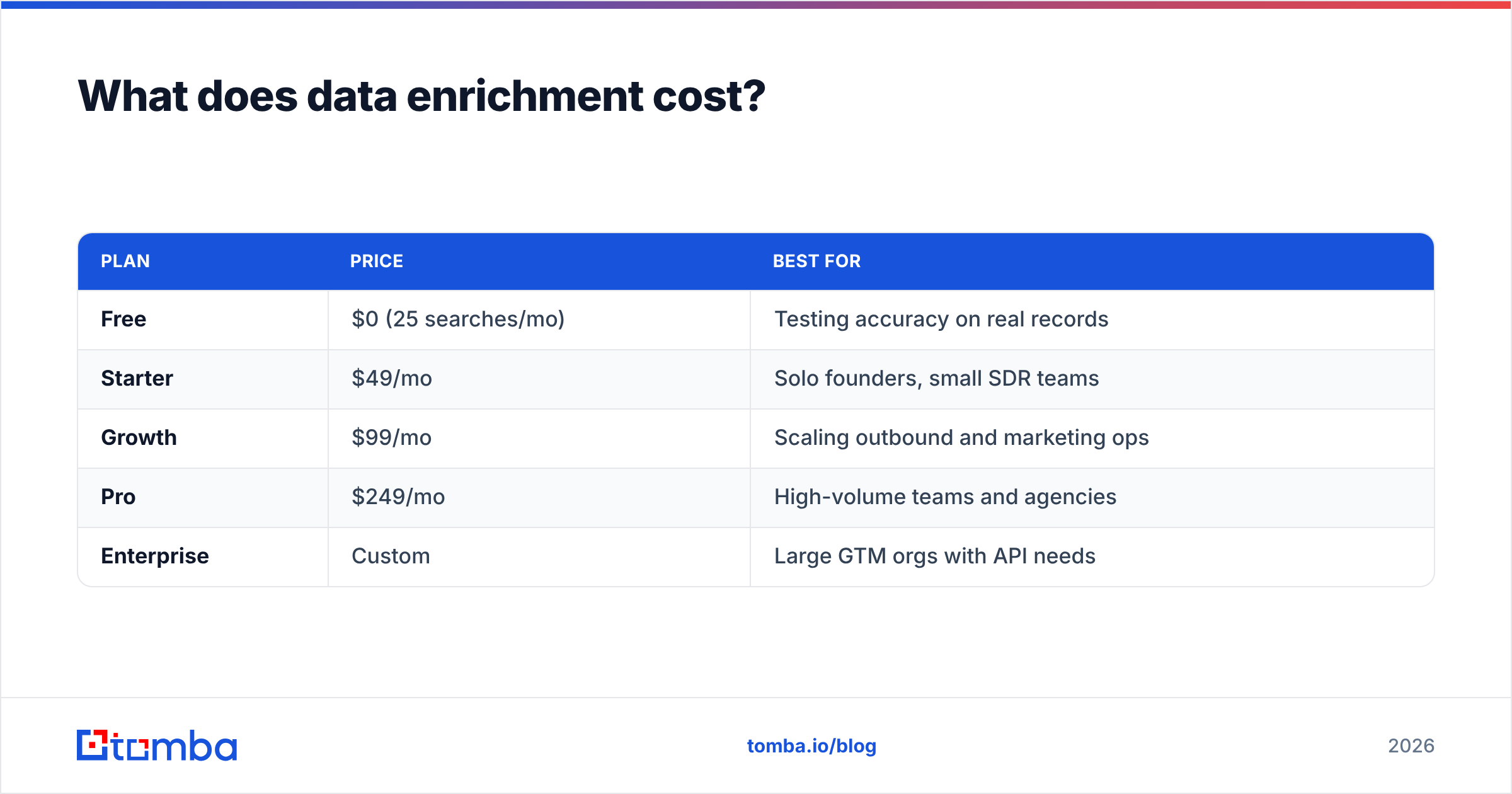
Pricing for enrichment usually follows a credit model: you pay per record found or verified, with monthly tiers that lower the per-credit cost as volume rises. The trap to avoid is paying premium per-record rates for data you never verify — you end up funding the decay problem.
For reference, here's how Tomba structures access, which is representative of the category:
| Plan | Price | Best for |
|---|---|---|
| Free | $0 (25 searches/mo) | Testing accuracy on real records |
| Starter | $49/mo | Solo founders, small SDR teams |
| Growth | $99/mo | Scaling outbound and marketing ops |
| Pro | $249/mo | High-volume teams and agencies |
| Enterprise | Custom | Large GTM orgs with API needs |
Full Tomba pricing is public, including credit allowances per tier. When you compare vendors, normalize on cost per verified record, not cost per lookup — a cheap tool that returns 40% stale data is more expensive than it looks.
How do you measure the ROI of data enrichment?#
Don't take ROI on faith. Run enrichment like an experiment.
- Set a baseline. Record current bounce rate, reply rate, conversion rate, and average research time per rep before you start.
- Use a control group. Enrich one segment, leave a comparable segment untouched, and compare outcomes over a fixed window.
- Track leading indicators. Bounce rate and reply rate move first; conversion and cycle length follow.
- Attribute the savings. Hours of manual research eliminated × loaded labor cost is real, recoverable budget.
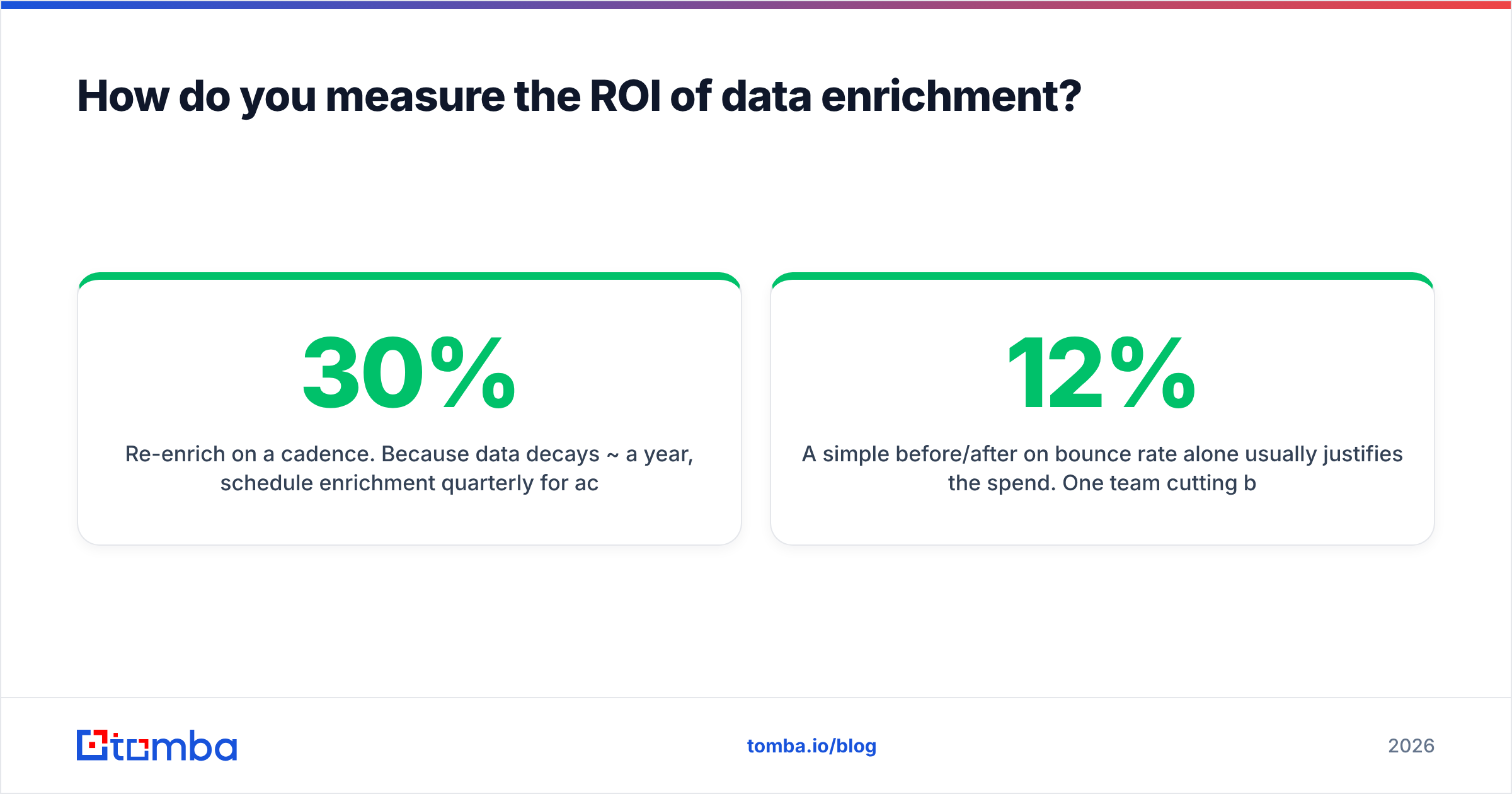
- Re-enrich on a cadence. Because data decays ~30% a year, schedule enrichment quarterly for active segments and before any major campaign.
A simple before/after on bounce rate alone usually justifies the spend. One team cutting bounces from 12% to 2% protects its domain reputation, which lifts deliverability across every campaign — a benefit that's hard to overstate and easy to miss if you only look at a single send.
What data should you enrich first?#
Prioritize by leverage, not by volume. Enriching 50,000 cold records you'll never contact is busywork. Enriching the 500 accounts in active pipeline is revenue.
- Open opportunities — make sure every contact on a live deal is current and complete.
- High-fit inbound leads — enrich on capture so scoring and routing fire instantly.
- Target-account lists (ABM) — append org charts and direct dials before outreach.
- Lapsed CRM records — re-verify before you re-engage to protect deliverability.
For ongoing capture, wiring enrichment into the point of entry — a web form, your Tomba Chrome extension, or a CRM integration — beats periodic batch cleanups because records never get a chance to go stale in the first place.
Common mistakes to avoid#
- Enriching without verifying. Appended data is only useful if it's deliverable. Always verify emails before they hit a sequence.
- Over-enriching. You don't need 40 fields. Append the handful your scoring, routing, and messaging actually use.
- Ignoring compliance. Respect GDPR/CCPA — enrich for legitimate business purposes and honor opt-outs. (HubSpot's guidance on data privacy is a solid primer.)
- One-and-done thinking. Decay is constant. Build a re-enrichment cadence or you're back to dirty data within a year.
- No measurement. If you can't show lift against a control, you can't defend the budget.
The bottom line#
The benefits of data enrichment are not abstract. Cleaner records mean higher conversion, sharper targeting, shorter cycles, better forecasts, and lower wasted spend — and the effects compound because every downstream system runs on the data underneath it. The teams that win in 2026 treat enrichment as ongoing hygiene, pair it with verification, and measure the lift instead of assuming it.
If you're ready to stop losing deals to stale records, start where the impact is highest. Use the Tomba Email Finder to find and verify current contacts by name, domain, or company, then enrich your active pipeline first and let verification protect your sender reputation. The free tier gives you 25 searches a month — enough to test accuracy on your own records before you commit a dollar.
// get started
Find, verify and enrich your first contacts today
Start on the free plan with 25 searches a month, then scale when your team is ready.
Free plan · No credit card required · GDPR & CCPA
// about the author