Benefits of Go to Market Strategy: 9 GTM Wins for 2026
A go-to-market strategy aligns product, sales, and marketing around one plan. Here are the concrete benefits of a go-to-market strategy and how to capture them in 2026.
Benefits of Go to Market Strategy: 9 GTM Wins for 2026
A go-to-market (GTM) strategy is the difference between launching a product and launching it on purpose. Most teams that miss revenue targets don't have a bad product. They have a bad plan, or no plan, for how that product reaches a buyer. This post breaks down the real, measurable benefits of go to market strategy. Then it shows you how to turn each one into pipeline.
TL;DR#
- A go-to-market strategy aligns product, marketing, and sales around one ideal customer, one message, and one motion — killing the silos that quietly burn budget.
- The biggest benefits of a go-to-market strategy are lower CAC, faster launches, and a repeatable revenue engine you can forecast against.
- Clean, enriched contact data is the fuel — even the best GTM plan stalls without accurate emails, phone numbers, and firmographics.
- GTM is not a one-time launch document. The teams that win in 2026 treat it as a living system they revisit every quarter.
- You can start small: define your ICP, pick one channel, instrument it, and only then scale.
What Is a Go-to-Market Strategy?#
A go-to-market strategy is your plan for taking a product to a specific market and turning strangers into paying customers. Think of it like a flight plan. A pilot doesn't just point the plane the right way and hope. They file a route, plan for weather and fuel, and adjust mid-flight. GTM is that flight plan for revenue. It covers who you sell to, what you say, where you reach them, and how you know you're on course.
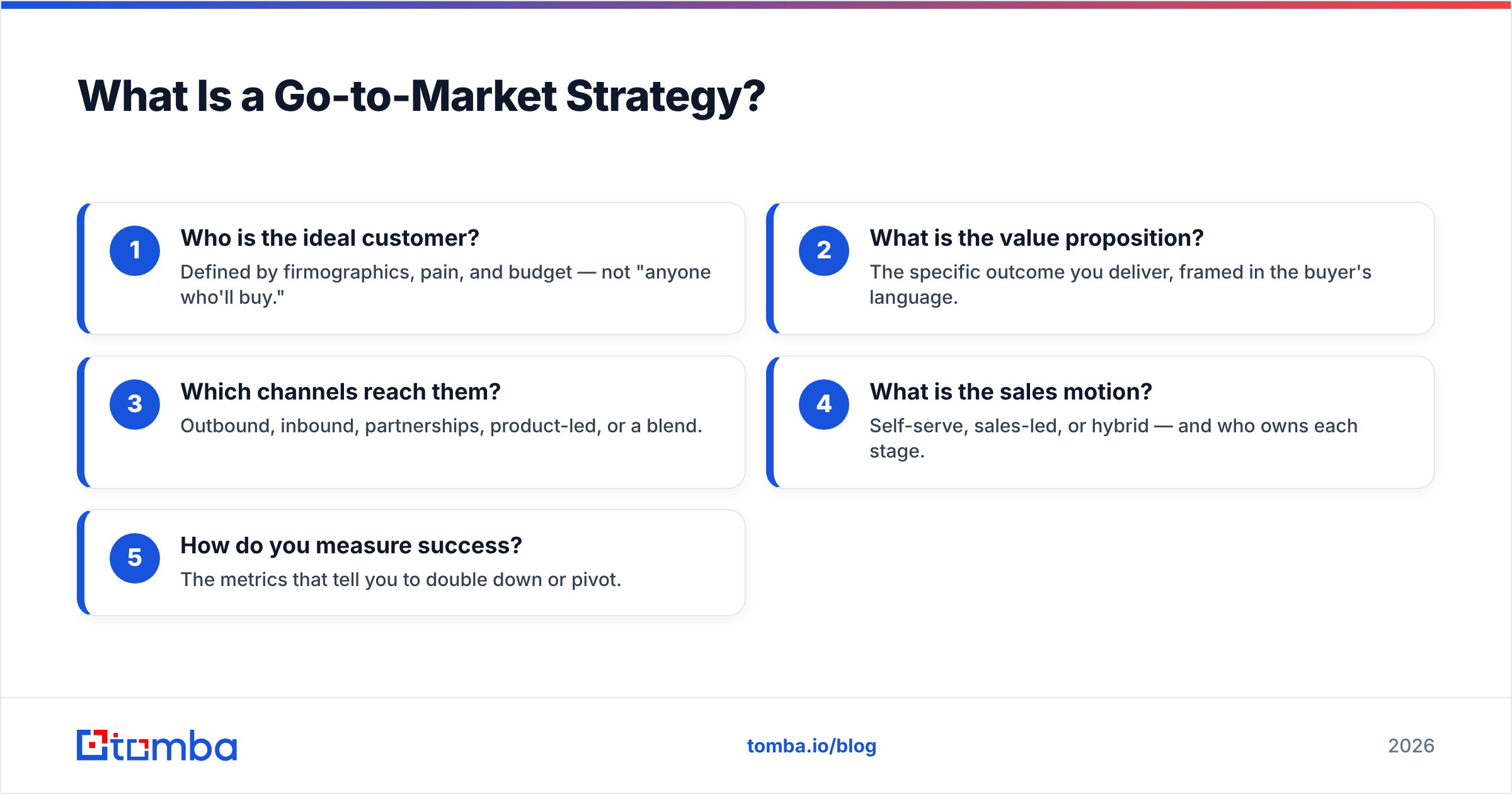
Technically, a strong GTM plan answers five questions before a single dollar is spent on acquisition:
- Who is the ideal customer? Defined by firmographics, pain, and budget — not "anyone who'll buy."
- What is the value proposition? The specific outcome you deliver, framed in the buyer's language.
- Which channels reach them? Outbound, inbound, partnerships, product-led, or a blend.
- What is the sales motion? Self-serve, sales-led, or hybrid — and who owns each stage.
- How do you measure success? The metrics that tell you to double down or pivot.
This is closely tied to revenue operations, the discipline of unifying the data and processes behind those five answers. A GTM strategy is the what; RevOps is the how it runs.
Why Do So Many Launches Fail Without One?#
Because effort without direction looks like progress but isn't. Without a GTM strategy, marketing generates leads sales won't touch, sales chases accounts that never close, and product ships features nobody asked for. Each team is busy. None of them are aligned.
Gartner research consistently finds that B2B buying has become more complex, with larger buying committees and longer cycles. When your internal teams aren't synced, that complexity compounds: you're sending mixed messages to a committee that's already struggling to make a decision.

A documented strategy forces the uncomfortable conversations early — who is this really for, and why would they switch — instead of after you've spent a quarter's budget finding out the hard way.
What Are the Core Benefits of Go to Market Strategy?#
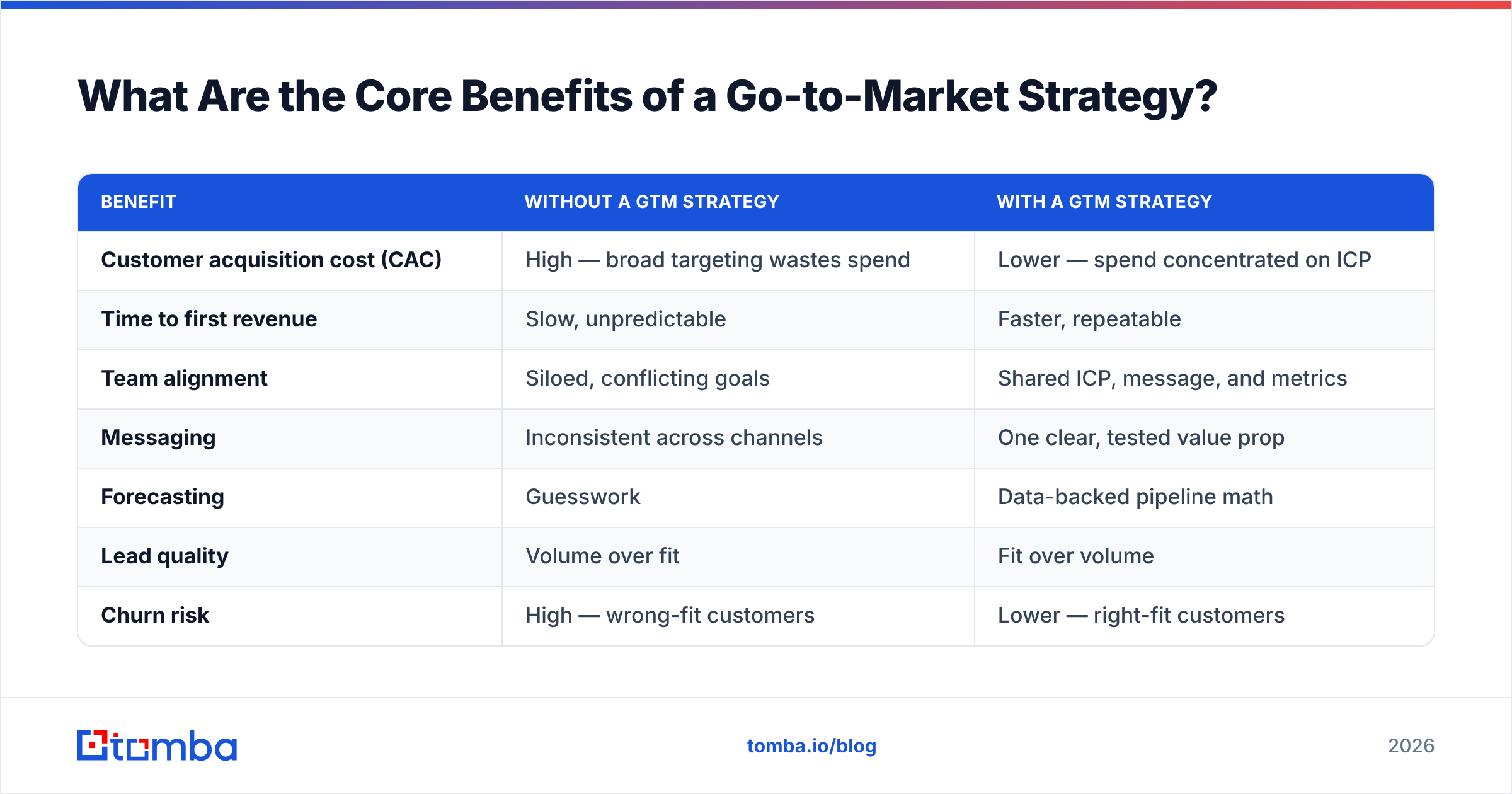
Here are the nine benefits that show up directly in your numbers.
| Benefit | Without a GTM Strategy | With a GTM Strategy |
|---|---|---|
| Customer acquisition cost (CAC) | High — broad targeting wastes spend | Lower — spend concentrated on ICP |
| Time to first revenue | Slow, unpredictable | Faster, repeatable |
| Team alignment | Siloed, conflicting goals | Shared ICP, message, and metrics |
| Messaging | Inconsistent across channels | One clear, tested value prop |
| Forecasting | Guesswork | Data-backed pipeline math |
| Lead quality | Volume over fit | Fit over volume |
| Churn risk | High — wrong-fit customers | Lower — right-fit customers |
| Scaling | Chaotic, breaks under growth | Systematic, documented playbook |
1. Lower customer acquisition cost#
When you know exactly who your buyer is, you stop paying to reach people who will never convert. Targeting your ideal customer profile (ICP) instead of "everyone in the industry" means every ad impression, email, and SDR hour goes toward accounts with real buying intent. The math is simple: fewer wasted touches, lower cost per closed deal.
2. Faster, more predictable launches#
A GTM plan turns a launch from an event into a process. You already know the channels, the message, and the handoffs, so you're executing instead of improvising. The second and third product lines launch faster because the playbook already exists.
3. Genuine team alignment#
This is the benefit teams underrate most. When product, marketing, and sales share one ICP and one definition of a qualified lead, the friction at every handoff drops. Marketing stops counting MQLs that sales ignores. Sales stops complaining about "bad leads." Everyone is graded on the same outcome.
4. A repeatable, forecastable revenue engine#
Once your motion is documented and instrumented, you can forecast. You know that X targeted contacts produce Y meetings and Z deals. That ratio is the foundation of every reliable revenue forecast — and it's impossible to build without a strategy defining what you're measuring.
How Does GTM Strategy Connect to Data Quality?#
Your GTM strategy is only as good as the data it runs on. This is the gap that quietly kills otherwise solid plans: you define a beautiful ICP, then hand your SDRs a list of bounced emails and disconnected phone numbers.
Consider the chain. Your strategy says "target VPs of Engineering at Series B SaaS companies in North America." To act on that, you need to actually find those people — their work emails, their direct dials, their company's tech stack. If 30% of your contact data is wrong, 30% of your perfectly-targeted outreach lands nowhere.
This is where tooling does the heavy lifting. A platform like Tomba sits underneath the GTM motion, turning your ICP definition into a real, reachable list:
- Email finder — locate verified professional emails by name and domain so outreach actually arrives.
- Domain search — pull every reachable contact at a target account in one query.
- Data enrichment — fill in firmographics and role data so your segmentation matches your ICP.

Without clean data, the benefits of a go-to-market strategy stay theoretical. With it, the strategy compiles into action.
Is a GTM Strategy Worth It for Small Teams?#
Yes — arguably more so. Big companies can absorb the cost of misalignment; a five-person startup cannot. When you have one SDR and a limited ad budget, you literally cannot afford to spray and pray. A focused GTM strategy is what lets a small team punch above its weight by concentrating limited resources on the highest-probability accounts.
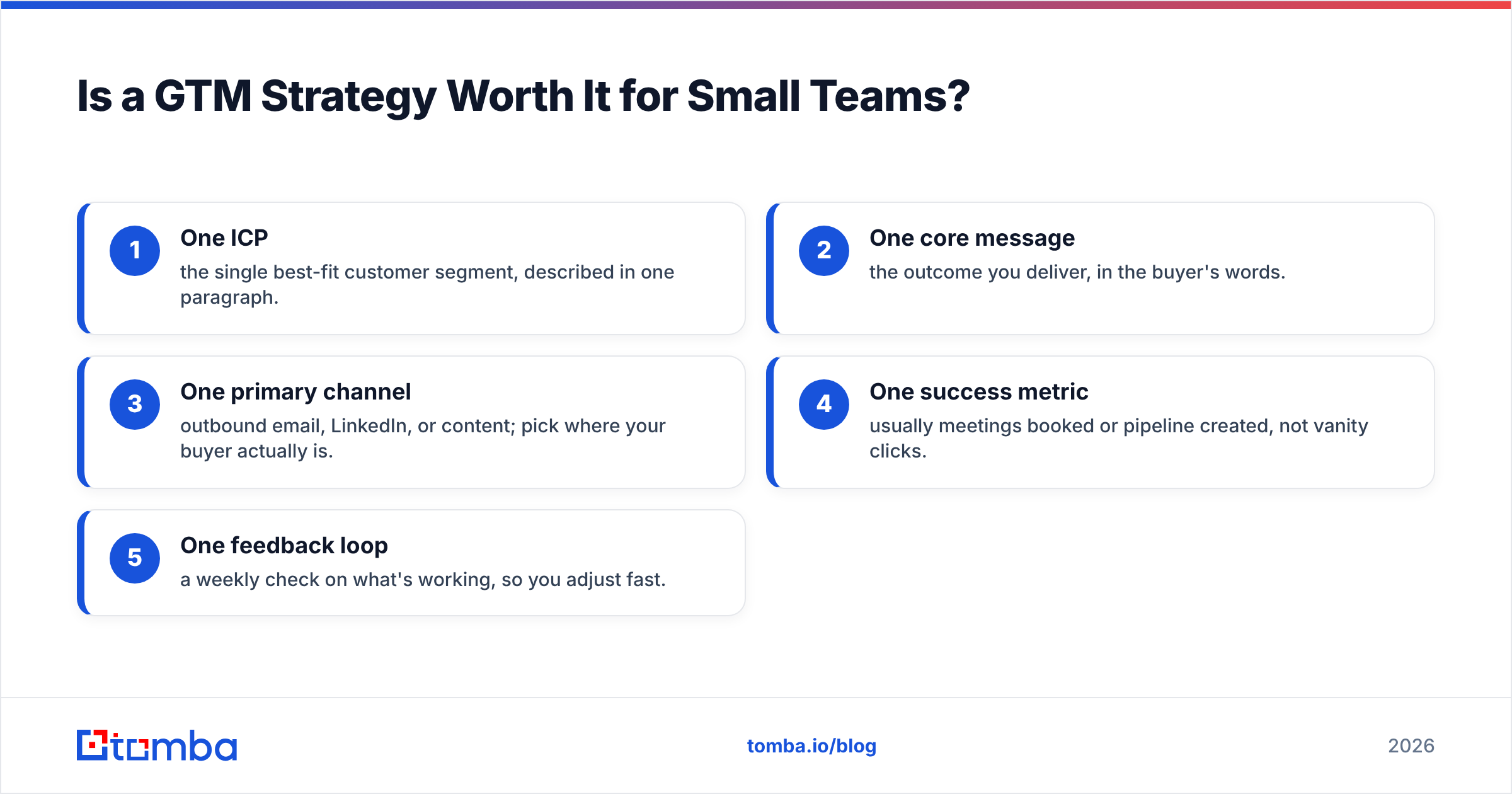
The myth is that GTM strategy means a 40-page document and a consultant. It doesn't. For a small team, a usable GTM strategy can fit on one page:
- One ICP — the single best-fit customer segment, described in one paragraph.
- One core message — the outcome you deliver, in the buyer's words.
- One primary channel — outbound email, LinkedIn, or content; pick where your buyer actually is.
- One success metric — usually meetings booked or pipeline created, not vanity clicks.
- One feedback loop — a weekly check on what's working, so you adjust fast.
Start there. Expand only once that one motion is producing predictable results.
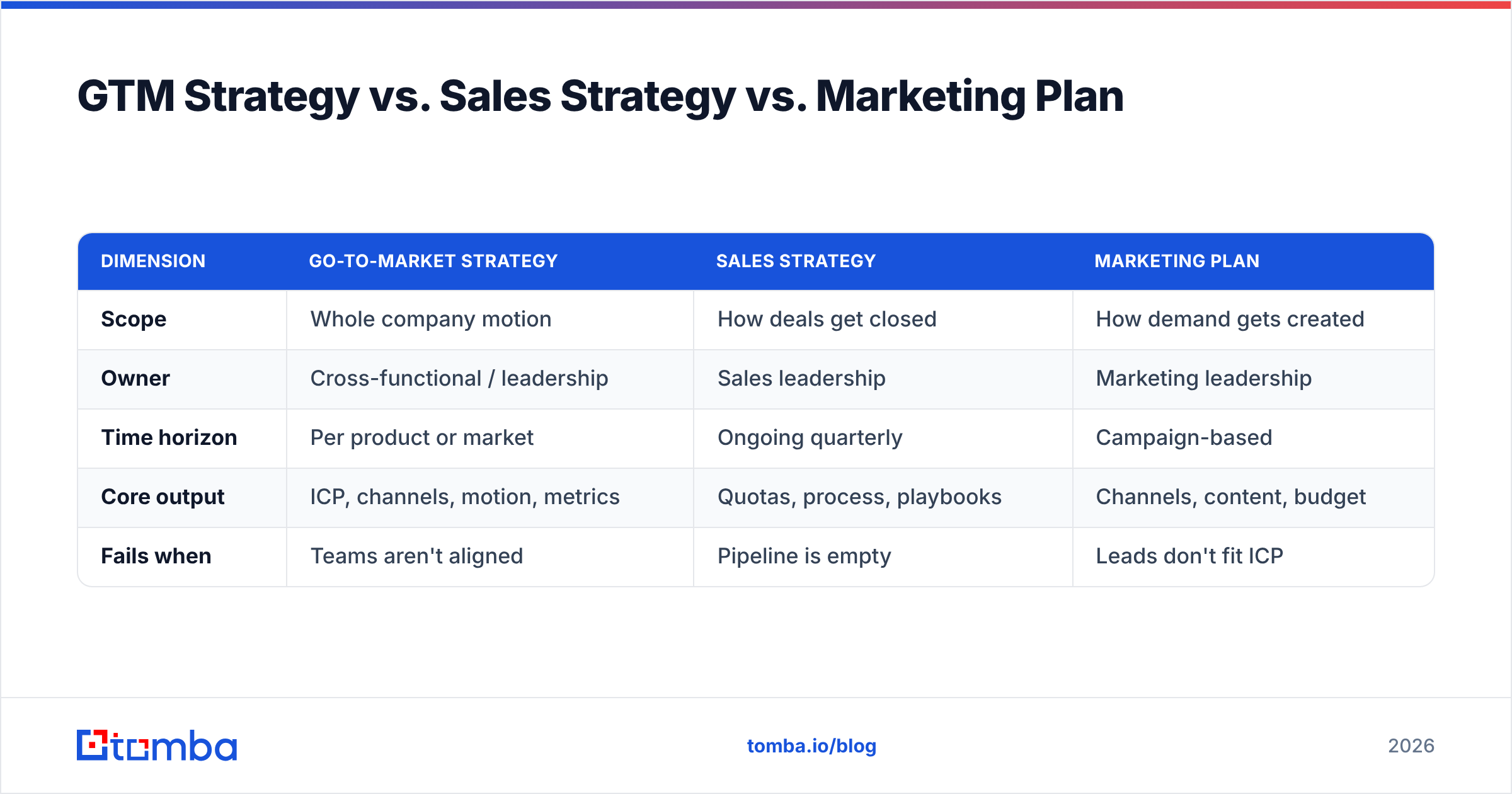
GTM Strategy vs. Sales Strategy vs. Marketing Plan#
These three get used interchangeably, which causes real confusion. Here's how they differ.
| Dimension | Go-to-Market Strategy | Sales Strategy | Marketing Plan |
|---|---|---|---|
| Scope | Whole company motion | How deals get closed | How demand gets created |
| Owner | Cross-functional / leadership | Sales leadership | Marketing leadership |
| Time horizon | Per product or market | Ongoing quarterly | Campaign-based |
| Core output | ICP, channels, motion, metrics | Quotas, process, playbooks | Channels, content, budget |
| Fails when | Teams aren't aligned | Pipeline is empty | Leads don't fit ICP |
The GTM strategy is the umbrella. Your sales strategy and marketing plan are executions of it. When a marketing plan and a sales strategy disagree, it's almost always because there's no GTM strategy above them resolving the conflict.
What Metrics Prove Your GTM Strategy Is Working?#
A strategy you can't measure is just an opinion. Track these signals to know whether the benefits are landing:
- CAC and CAC payback period — falling CAC is the clearest sign your targeting is tightening.
- Win rate by segment — if your ICP segment wins more than others, your strategy is correct; if not, your ICP is wrong.
- Sales cycle length — better-fit prospects move faster.
- Lead-to-opportunity conversion — measures whether marketing and sales actually agree on quality.
- Net revenue retention — right-fit customers stay and expand; wrong-fit customers churn.
G2's category data and your own CRM are the two sources to triangulate here. The CRM tells you what's happening; external benchmarks tell you whether it's good. Tools like HubSpot make instrumenting these metrics straightforward once your GTM definitions are clear.
How Do You Build a GTM Strategy in 2026?#
Build it in layers, validating each before adding the next.
Layer 1 — Define the ICP. Use real customer data, not aspiration. Look at your best existing customers: what do they have in common? That pattern is your ICP.
Layer 2 — Sharpen the message. Interview five customers. Use their exact words for the problem and the outcome. Your value proposition is hiding in those transcripts.
Layer 3 — Pick and instrument one channel. Don't open five fronts. Choose the one channel where your ICP already spends time, and set up tracking before you launch — not after.
Layer 4 — Fuel it with clean data. Turn your ICP into a reachable contact list with verified emails and direct phone numbers. This is the operational layer most strategies skip, and it's why most strategies underdeliver. Pricing for the data layer is modest relative to the wasted spend it prevents — see Tomba pricing for where a small team can start.
Layer 5 — Review and adjust quarterly. GTM is a living system. The market in Q4 2026 will not be the market in Q1. Revisit your ICP, message, and channel mix every quarter.
What's the Single Biggest Mistake Teams Make?#
Treating GTM as a launch document instead of an operating system. Teams write a beautiful strategy deck, present it once, and never look at it again. Six months later, the ICP has drifted, the message is stale, and nobody noticed because the document was never a living thing.
The fix is to tie your GTM strategy to a recurring review tied to your metrics. If win rate by segment drops, that's a signal to revisit the ICP — not to push harder on a broken motion. The strategy earns its keep by being the thing you update, not the thing you filed.
Conclusion: Turn Strategy Into Pipeline#
The benefits of go to market strategy — lower CAC, faster launches, real alignment, and a forecastable revenue engine — only materialize when the strategy meets execution. And execution lives or dies on whether you can actually reach the right people.
That's the bridge worth building first. Define your ICP, then make it reachable. Tomba's Email Finder turns your target list into verified, deliverable contacts, so the strategy you spent weeks building doesn't bounce on the first send. Start on the free tier (25 searches a month), prove the motion on a single segment, and scale the plan that's already working. A go-to-market strategy is a promise about where revenue will come from — clean data is how you keep it.
// get started
Find, verify and enrich your first contacts today
Start on the free plan with 25 searches a month, then scale when your team is ready.
Free plan · No credit card required · GDPR & CCPA
// about the author