9 Benefits of Lead Generation That Drive B2B Growth in 2026
Lead generation is more than filling a pipeline. Here are the nine measurable benefits of lead generation that compound into predictable B2B revenue in 2026.
TL;DR
- Lead generation turns random outreach into a predictable, measurable revenue system — its biggest benefit is forecastability, not just volume.
- Done well, it lowers customer acquisition cost (CAC), shortens sales cycles, and improves win rates because reps spend time on people who actually fit.
- The benefits compound: better data feeds better targeting, which feeds better conversion, which feeds better data.
- The weak link is almost always contact data quality, not tactics — a 70%-accurate list quietly burns half your effort.
- You capture these benefits faster with verified contact data from tools like a email finder and an email verifier.
What is lead generation, really?#
Lead generation is the process of attracting strangers and turning them into identified, contactable prospects who have shown some fit or interest in what you sell. Think of it like fishing with a chart instead of a blindfold: you still cast a line, but you know which water holds the fish, what bait they take, and roughly how many you can land this month.
Technically, it spans inbound (content, SEO, ads that capture interest) and outbound (targeted prospecting, cold email, social selling) motions. Both feed the same goal — a list of real humans, at real companies, with a real reason to talk to you. Everything downstream in sales depends on the quality of that list.
The reason "benefits of lead generation" is worth unpacking is that most teams treat it as a volume game. It isn't. The real payoff is a system — one that produces revenue you can predict, defend in a board meeting, and improve quarter over quarter.
What are the core benefits of lead generation?#
Here are the nine benefits that actually move the number, ordered from most strategic to most tactical.
- Predictable pipeline. When you know your conversion rates and your lead volume, you can forecast revenue. This single benefit is why CFOs fund marketing at all — predictability beats a lucky quarter every time.
- Lower customer acquisition cost. Targeted lead gen wastes less spend on people who will never buy, pulling your blended CAC down.
- Shorter sales cycles. Pre-qualified leads arrive warmer, so reps skip the "are you even a fit?" dance.
- Higher win rates. Better targeting means a larger share of your pipeline is genuinely winnable. (See how win rate ties directly to lead quality.)
- Better product-market feedback. A steady flow of conversations tells you which segments, pains, and messages resonate — fast.
- Scalable growth. A documented lead engine can be staffed up, automated, and handed off without depending on one heroic rep.
- Improved marketing-sales alignment. Shared lead definitions force both teams to agree on what "good" looks like.
- Higher customer lifetime value. Better-fit leads churn less and expand more.
- Competitive moat. A compounding data and conversion advantage is hard for competitors to copy.
)
Why does predictable pipeline matter more than raw volume?#
Predictability is the headline benefit because it changes how the whole business plans. A team that generates 200 random leads a month is gambling. A team that generates 120 qualified leads with known conversion rates is running a forecast.
Here's the everyday version: volume without predictability is like a restaurant that sometimes serves 10 customers and sometimes 500 with no way to know which night is which — you over-staff, over-buy, and panic. Predictable lead gen is reservations on the books. You prep exactly what you need.
This is also where revenue operations earns its keep. RevOps takes the raw output of lead gen and turns it into the dashboards that let leadership commit to a number. Without consistent lead generation feeding it, RevOps is just reporting on noise.
How does lead generation lower customer acquisition cost?#
Targeting is the lever. Every dollar you spend reaching someone who will never buy inflates your CAC; every dollar spent on a genuine fit lowers it.
There are three concrete ways good lead generation drops acquisition cost:
- Tighter ideal customer profile (ICP) filtering removes obvious non-buyers before a rep ever touches them.
- Verified contact data means fewer bounced emails, fewer dead phone numbers, and less wasted rep time — a bounce isn't free, it damages your sender reputation too.
- Channel efficiency — knowing which source produces buyers lets you cut the channels that only produce tire-kickers.
That second point is where most teams quietly bleed money. If your list is 70% accurate, three out of ten touches are wasted before anyone reads your message. Running prospects through an email verifier and confirming tricky domains with a catch-all verifier recovers that lost effort directly. According to HubSpot's research on sales productivity, reps already spend only a fraction of their week actually selling — bad data eats the rest.
What's the difference between good and bad lead generation?#
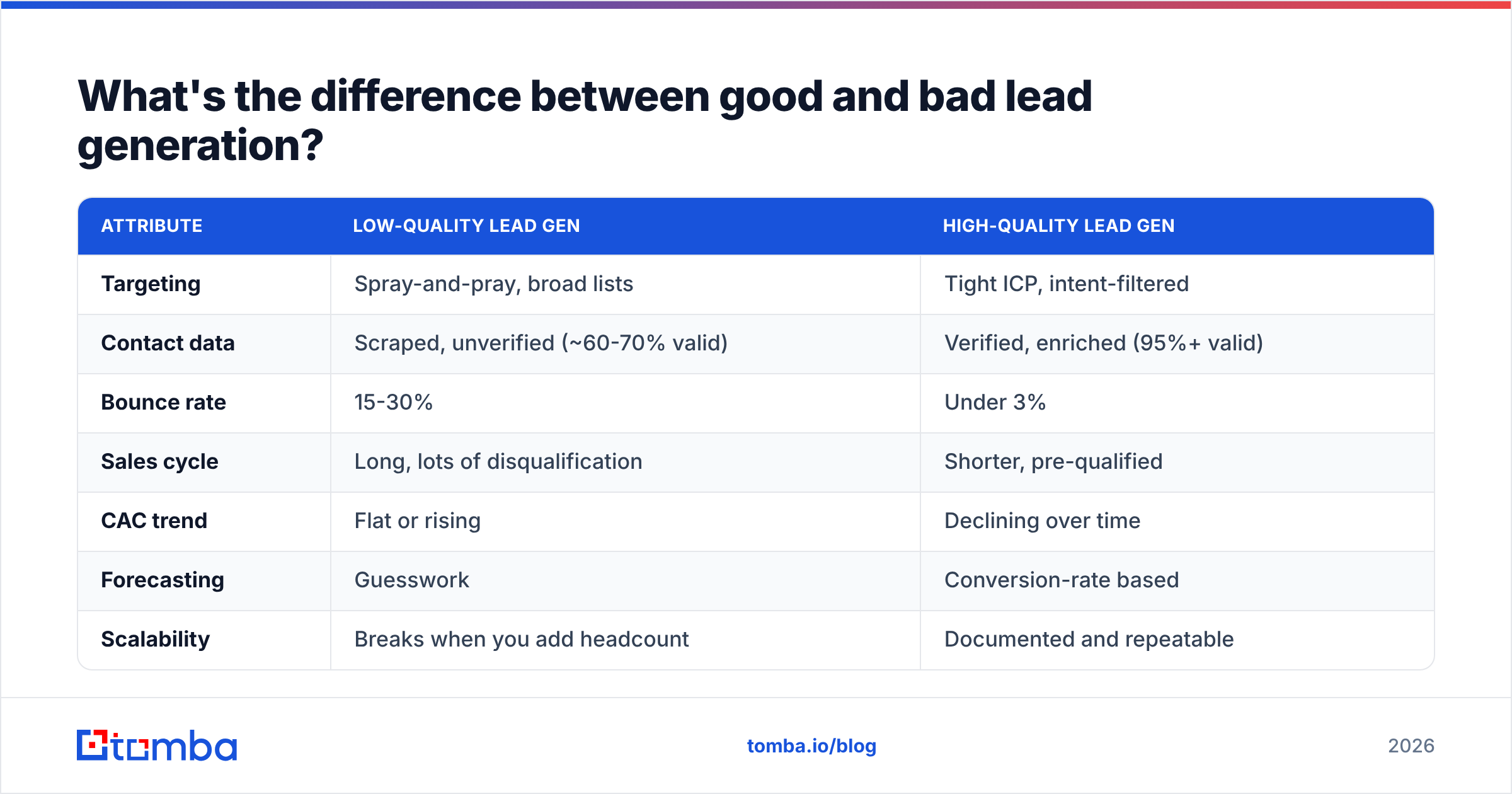
Not all lead generation produces these benefits. The gap between a system that compounds and one that burns budget usually comes down to a handful of attributes. Here's the honest comparison.
| Attribute | Low-quality lead gen | High-quality lead gen |
|---|---|---|
| Targeting | Spray-and-pray, broad lists | Tight ICP, intent-filtered |
| Contact data | Scraped, unverified (~60-70% valid) | Verified, enriched (95%+ valid) |
| Bounce rate | 15-30% | Under 3% |
| Sales cycle | Long, lots of disqualification | Shorter, pre-qualified |
| CAC trend | Flat or rising | Declining over time |
| Forecasting | Guesswork | Conversion-rate based |
| Scalability | Breaks when you add headcount | Documented and repeatable |
The pattern is clear: the benefits of lead generation are gated behind data quality and targeting. You can have a brilliant cold-email sequence, but if 25% of the addresses bounce, you've capped your results before the first send. That's also why deliverability matters — high bounce rates wreck your email deliverability and quietly throttle every future campaign.
How do you measure the benefits of lead generation?#
Conclusion first: if you can't tie lead gen to revenue and cost, you can't prove the benefits — so instrument it from day one.
Track these core metrics:
- Lead-to-opportunity rate — what share of leads become real deals. The single best signal of lead quality.
- Cost per qualified lead (CPQL) — total spend divided by qualified leads, not raw leads.
- Sales cycle length — measured from first touch to close; should shrink as targeting improves.
- Customer acquisition cost (CAC) — the bottom-line efficiency number.
- Response rate — an early indicator that your targeting and messaging match.
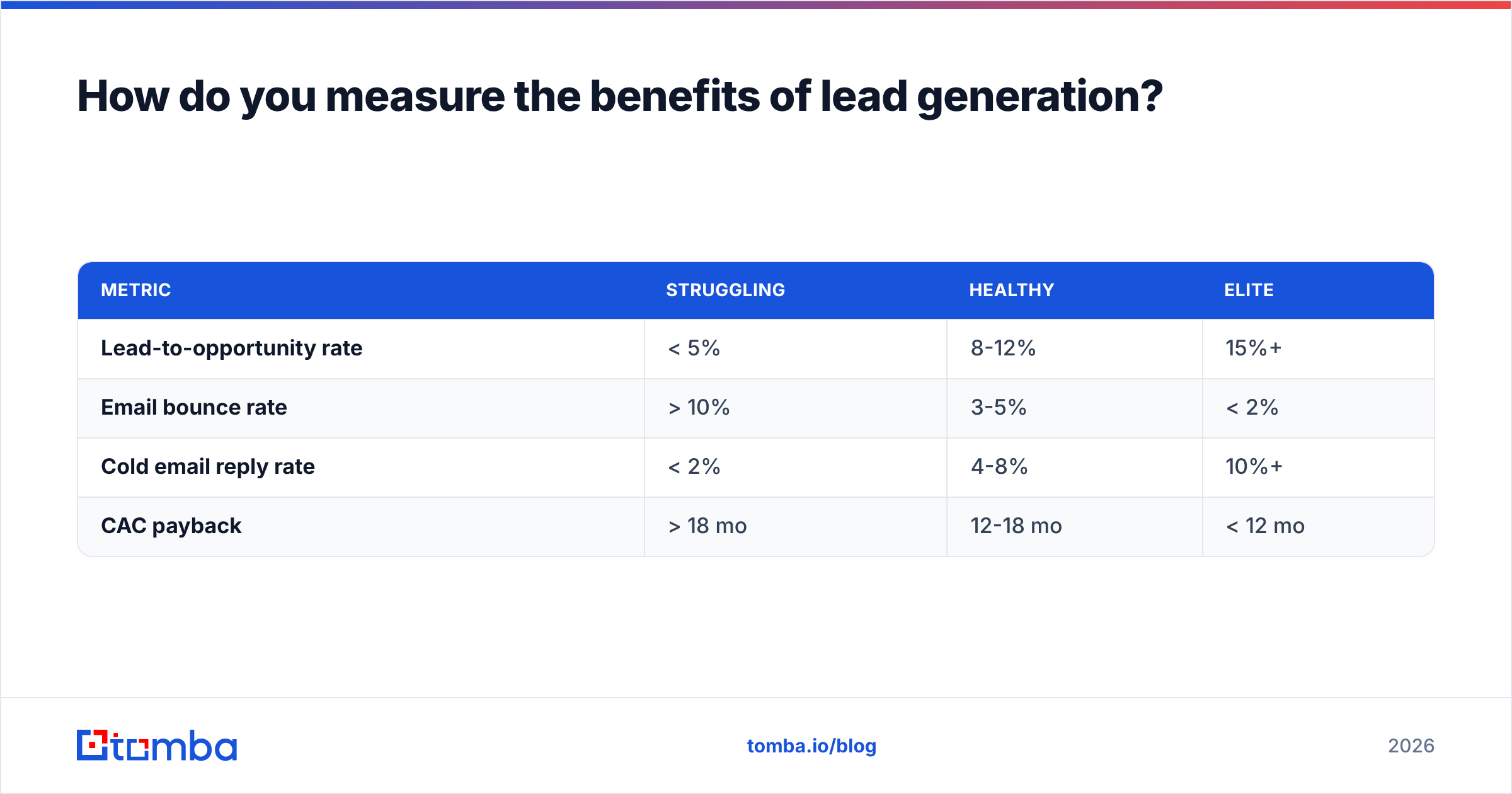
A practical benchmark hierarchy looks like this:
| Metric | Struggling | Healthy | Elite |
|---|---|---|---|
| Lead-to-opportunity rate | < 5% | 8-12% | 15%+ |
| Email bounce rate | > 10% | 3-5% | < 2% |
| Cold email reply rate | < 2% | 4-8% | 10%+ |
| CAC payback | > 18 mo | 12-18 mo | < 12 mo |
Use these as direction, not gospel — they vary by deal size and market. The point is to watch the trend. Healthy lead generation makes every row improve together over time, because the benefits reinforce each other.
)
Which lead generation tactics deliver the benefits fastest?#
You don't capture all nine benefits with one channel. The fastest path is a small stack of complementary motions, each fed by clean data.
- Targeted outbound email. The highest-leverage motion for B2B, if your list is verified. Start with a domain search to map every contact at a target company, then verify before you send.
- Content and SEO. Slow to start, but it produces inbound leads that convert at a higher rate because they arrive with intent. Pairs well with social selling on LinkedIn.
- Data enrichment. Turning a thin lead (just a name and company) into a complete, routable record. Contact enrichment fills the gaps so reps don't waste time researching.
- Bulk prospecting for new segments. When testing a new vertical, a bulk email finder lets you validate a whole segment quickly before committing rep time.
A simple rule: pick one outbound and one inbound motion, instrument both, and only add a third once the first two are predictable. Adding channels before you've made the existing ones measurable just multiplies the noise.
For teams comparing platforms, independent review sites like G2's lead generation category are a useful sanity check on what each tool actually does versus what its homepage claims.
What are the risks and limits of lead generation?#
Being honest: lead generation isn't free upside. Three failure modes are worth naming.
- Volume obsession. Chasing raw lead counts inflates vanity metrics and CAC. More leads of the wrong type make sales slower, not faster.
- Data decay. B2B contact data goes stale at roughly 22-30% per year as people change jobs. A list you bought 18 months ago is mostly fiction now. This is why verification has to be ongoing, not a one-time step.
- Compliance. GDPR, CAN-SPAM, and similar rules govern how you collect and contact leads. Skipping consent and suppression handling turns a benefit into a liability.
The good news is that all three are solvable with process: define qualified before you scale volume, re-verify data on a schedule, and bake compliance into your workflow rather than bolting it on.
How does data quality multiply every other benefit?#
This is the multiplier nobody puts on the slide. Every benefit above — lower CAC, shorter cycles, higher win rates, predictability — is bounded by the accuracy of your contact data.
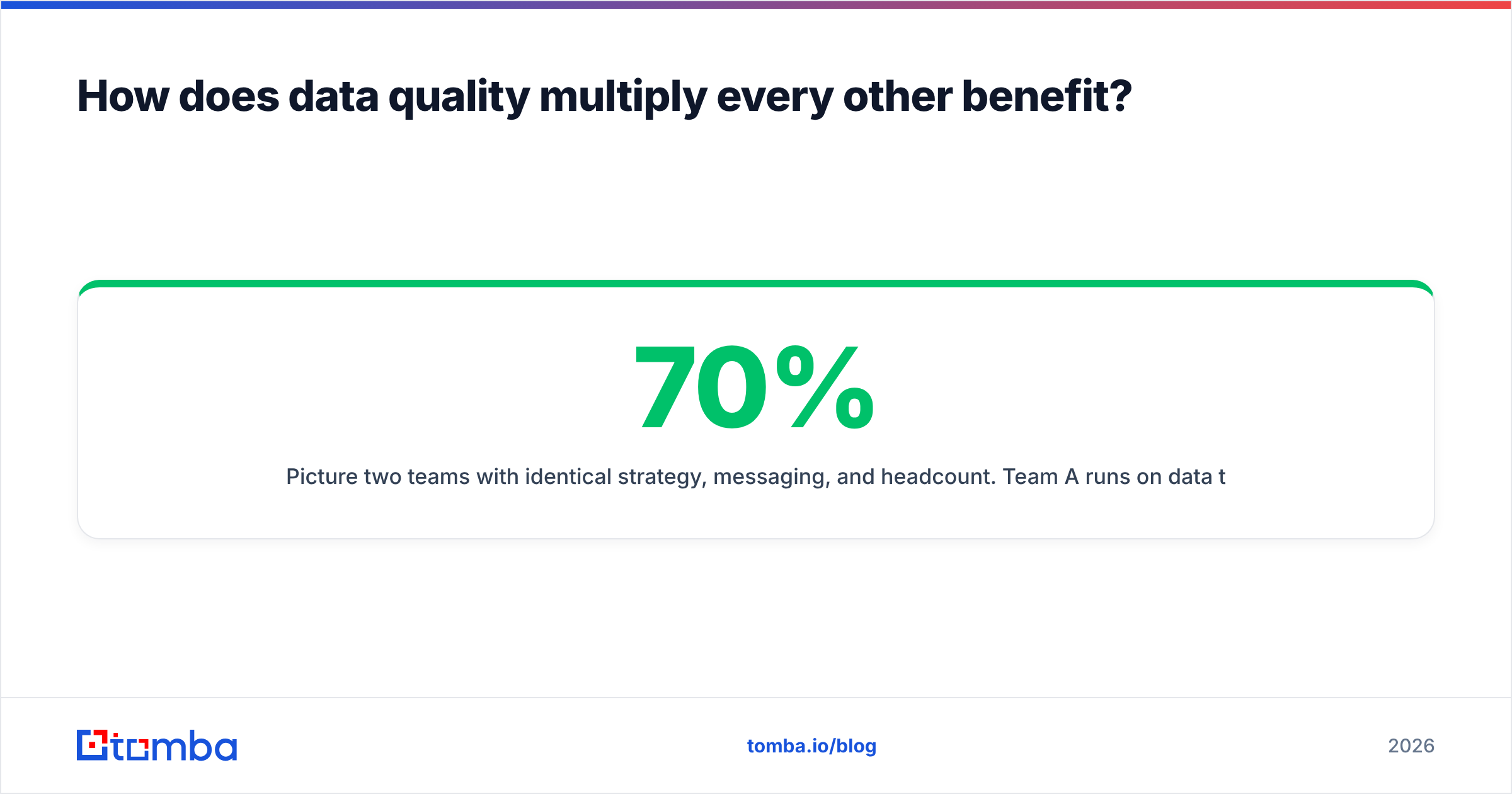
Picture two teams with identical strategy, messaging, and headcount. Team A runs on data that's 70% accurate. Team B runs on data that's 96% accurate. Team B reaches roughly 37% more real humans per campaign with zero extra effort or spend. Over a year, that compounding gap shows up as a materially lower CAC and a fuller pipeline — purely from data hygiene.
That's why the smartest move when you're trying to unlock the benefits of lead generation isn't a new tactic. It's tightening the data layer: find the right contacts, verify them before outreach, enrich them so reps can personalize, and re-check them on a cadence. The tactics you already have will start performing the way they were supposed to.
How do you build a lead generation system that compounds?#
Here's the minimal, repeatable loop:
- Define your ICP precisely — industry, size, role, and a trigger that signals timing.
- Source contacts at target accounts using a find email addresses workflow tied to your ICP.
- Verify and enrich every record before it enters a sequence.
- Run one outbound and one inbound motion, instrumented end to end.
- Measure lead-to-opportunity and CPQL, not raw volume.
- Feed wins back into the ICP so targeting sharpens each cycle.
Each loop makes the next one better — that's the compounding moat. Want to see plan options for scaling this? Compare Tomba pricing: a free tier with 25 searches/month, Starter at $49/mo, Growth at $99/mo, and Pro at $249/mo, so you can match cost to volume as the system grows.
Get the data layer right first#
The benefits of lead generation are real and they compound — but they're gated behind contact data quality. Before you tweak another subject line or buy another channel, fix the foundation: find verified, enriched contacts at the accounts that match your ICP. The Tomba Email Finder does exactly that — search by domain, name, or company, get verified professional emails, and feed your sequences a list that doesn't bounce. Start on the free tier, prove the lift on your own pipeline, and scale the motion that's already working. Clean data in, predictable pipeline out.
// get started
Find, verify and enrich your first contacts today
Start on the free plan with 25 searches a month, then scale when your team is ready.
Free plan · No credit card required · GDPR & CCPA
// about the author