Benefits of Market Segmentation: Your 2026 Growth Guide
Market segmentation isn't a slide in a strategy deck — it's the difference between a 2% reply rate and a 12% one. Here are the concrete benefits, the trade-offs, and how to act on them in 2026.
Most teams treat "market segmentation" as a workshop exercise — a few personas drawn on a whiteboard, then forgotten the moment campaigns go live. That's a mistake. Segmentation is the lever that decides whether your next outbound batch lands at a 2% reply rate or a 12% one, and whether your ad budget reaches buyers or burns on people who will never purchase.
This guide breaks down the real benefits of market segmentation, where it costs you, and how to put it to work without drowning in spreadsheets.
TL;DR#
- Segmentation lifts conversion by matching message to buyer — relevance is the single biggest driver of reply and click rates.
- It lowers customer acquisition cost (CAC) because you stop spending on audiences that never convert.
- It sharpens product and pricing decisions, surfacing which segments actually pay more and churn less.
- The catch: segmentation is only as good as your data. Stale or thin records produce confident targeting of the wrong people.
- Start small — two or three high-contrast segments beat fifteen overlapping ones you can't act on.
What is market segmentation?#
Market segmentation is the practice of splitting a broad market into smaller groups of buyers who share traits — industry, company size, behavior, geography, or need — so you can serve each group with a tailored message, offer, and channel.
Think of it like a tailor versus a bulk T-shirt printer. The printer makes one size and hopes it fits most people; the tailor measures each customer and cuts to fit. The printer is cheaper per unit, but the tailor sells more suits because each one actually fits. Segmentation is how you act like the tailor at scale — using data instead of a measuring tape.
According to HubSpot's research on marketing personalization, messages aligned to a specific audience consistently outperform generic broadcasts. The mechanism is simple: relevance. A CFO at a 5,000-person enterprise and a founder at a 4-person startup have nothing in common except that your generic email annoyed them both.

What are the main types of market segmentation?#
Before you can reap the benefits, you need to know which axis to cut on. Most B2B teams blend several of these:
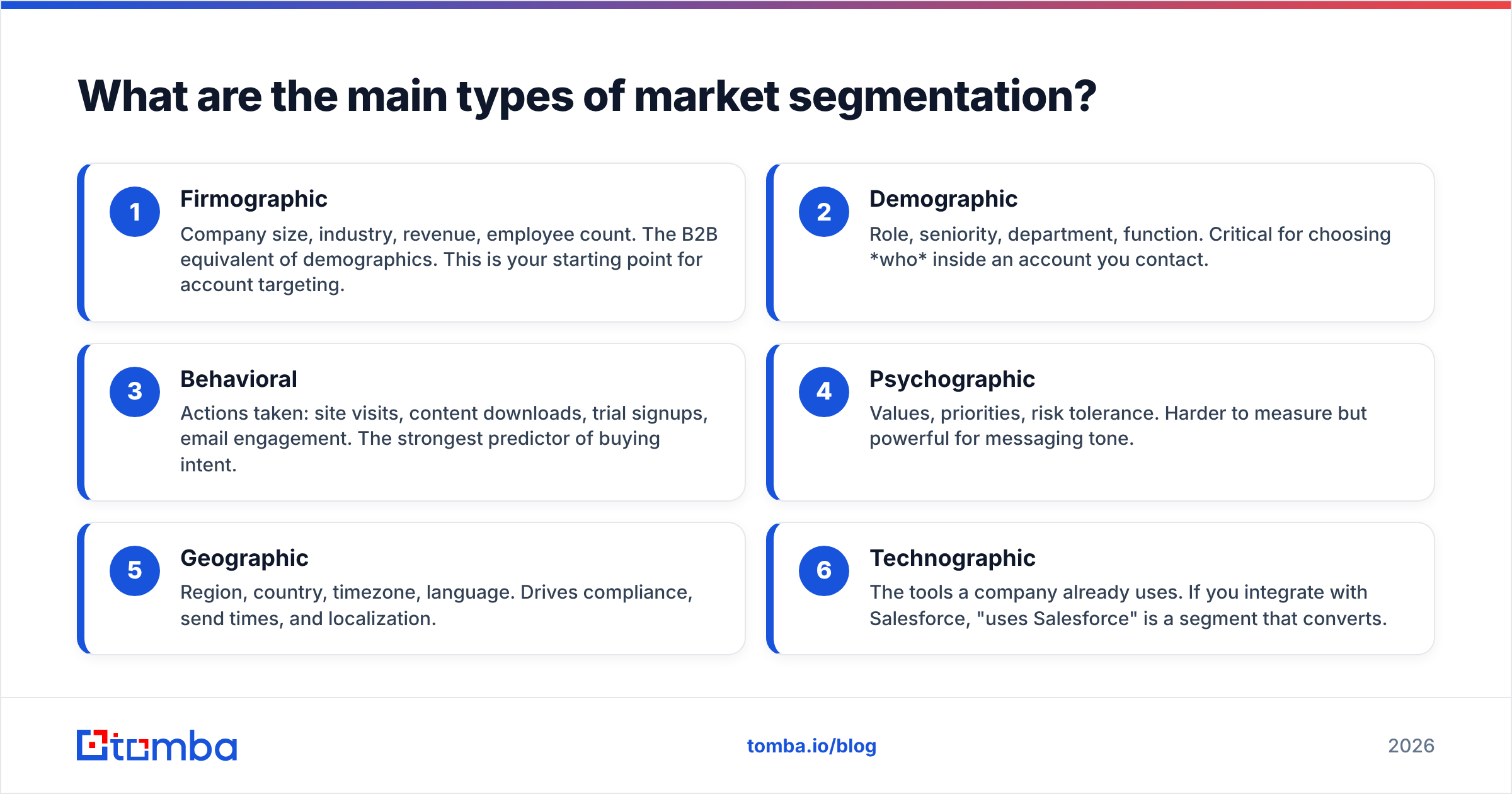
- Firmographic — Company size, industry, revenue, employee count. The B2B equivalent of demographics. This is your starting point for account targeting.
- Demographic — Role, seniority, department, function. Critical for choosing who inside an account you contact.
- Behavioral — Actions taken: site visits, content downloads, trial signups, email engagement. The strongest predictor of buying intent.
- Psychographic — Values, priorities, risk tolerance. Harder to measure but powerful for messaging tone.
- Geographic — Region, country, timezone, language. Drives compliance, send times, and localization.
- Technographic — The tools a company already uses. If you integrate with Salesforce, "uses Salesforce" is a segment that converts.
For a deeper taxonomy, Wikipedia's market segmentation overview is a solid neutral reference. The point is not to use all six — it's to pick the two or three that predict purchase in your market.
What are the benefits of market segmentation?#
Here's where segmentation earns its keep. Each benefit below is something you can measure, not a vibe.
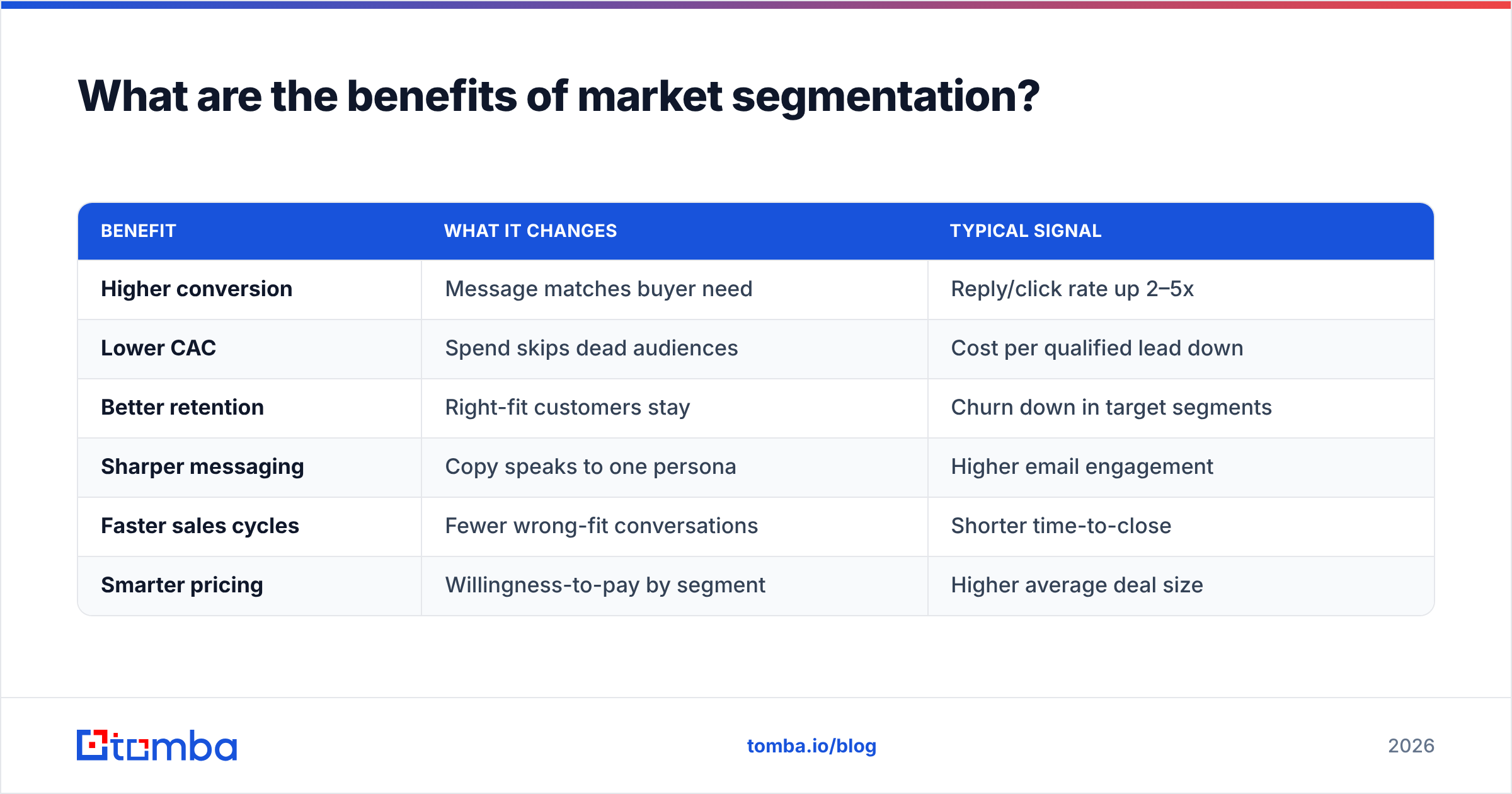
| Benefit | What it changes | Typical signal |
|---|---|---|
| Higher conversion | Message matches buyer need | Reply/click rate up 2–5x |
| Lower CAC | Spend skips dead audiences | Cost per qualified lead down |
| Better retention | Right-fit customers stay | Churn down in target segments |
| Sharper messaging | Copy speaks to one persona | Higher email engagement |
| Faster sales cycles | Fewer wrong-fit conversations | Shorter time-to-close |
| Smarter pricing | Willingness-to-pay by segment | Higher average deal size |
1. Higher conversion rates#
When your message reflects the reader's exact situation, response rates climb. A segmented cold email that names the prospect's industry pain outperforms a generic "I'd love to connect" by a wide margin. This is the most immediate, visible benefit — and it shows up within a single campaign.
2. Lower customer acquisition cost#
Every dollar you spend reaching someone who will never buy is waste. Segmentation lets you exclude poor-fit accounts before you pay to reach them. Narrowing your B2B database to companies that match your ideal profile means a smaller list — but a far higher hit rate, which is what actually lowers CAC.
3. Better customer retention#
Segments don't just help you acquire; they help you keep. When you target buyers who genuinely fit your product, they get value faster and churn less. Segmenting by use case also tells your success team which onboarding playbook to run for each cohort.
4. Sharper, faster messaging#
Writing for "everyone" produces bland copy. Writing for "VP of Engineering at a 200-person SaaS company" produces sentences that land. Segmentation makes your copywriters' jobs easier because they're writing to one person, not a committee of imagined averages.
5. Smarter product and pricing decisions#
When you track outcomes by segment, you learn which buyers pay more, expand faster, and complain less. That intelligence feeds revenue operations and product roadmaps. You might discover a small segment quietly drives 40% of expansion revenue — and reallocate accordingly.
Is market segmentation worth the cost?#
Short answer: yes, but it's not free. Segmentation has real trade-offs, and pretending otherwise sets teams up for disappointment.
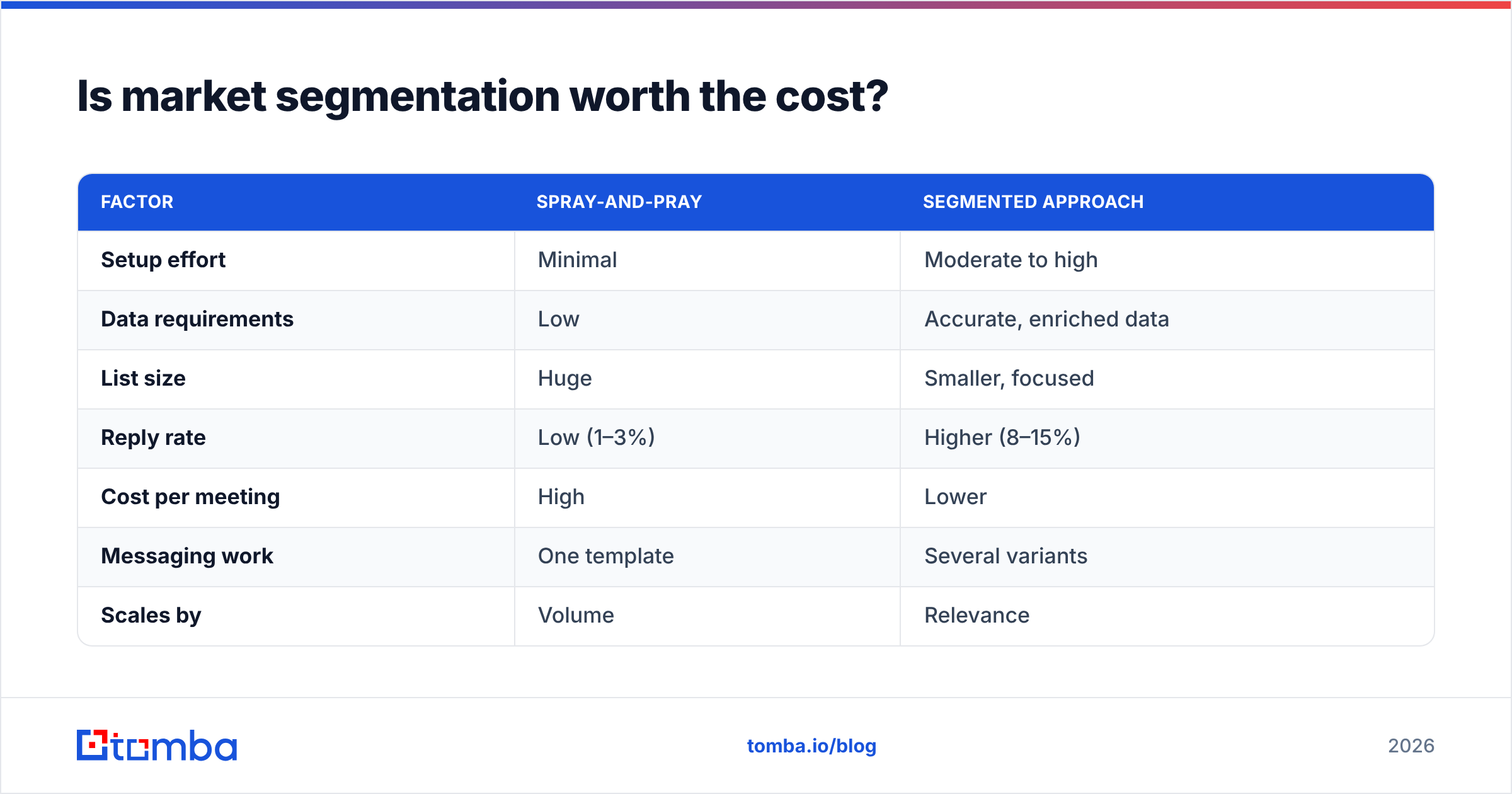
| Factor | Spray-and-pray | Segmented approach |
|---|---|---|
| Setup effort | Minimal | Moderate to high |
| Data requirements | Low | Accurate, enriched data |
| List size | Huge | Smaller, focused |
| Reply rate | Low (1–3%) | Higher (8–15%) |
| Cost per meeting | High | Lower |
| Messaging work | One template | Several variants |
| Scales by | Volume | Relevance |
The honest catch: segmentation multiplies your messaging workload, and it depends entirely on data quality. Segment on stale job titles or guessed company sizes and you'll confidently target the wrong people — worse than not segmenting, because you'll trust the output. This is why enrichment matters more than the segmentation framework itself.

How do you actually build segments that work?#
A model is useless if you can't populate it with real contacts. Here's a practical sequence.
Step 1 — Define the axes that predict purchase. Look at your last 50 closed-won deals. What did they share? Industry? Headcount band? A specific trigger event? Those shared traits are your segments. Don't invent segments theoretically; reverse-engineer them from wins.
Step 2 — Get the data to populate them. This is where most segmentation strategies stall. You can define "Series B fintech companies with 50–200 employees," but you still need the actual companies and the right contacts inside them. Tools like Tomba's domain search let you pull verified contacts at target companies, while data enrichment fills in the firmographic and role fields your segments depend on.
Step 3 — Validate before you act. Segmenting on a bad email address wastes the whole effort. Verify contacts so your segmented campaigns actually reach inboxes rather than bouncing and hurting your sender reputation.
Step 4 — Tailor one variable at a time. Start by changing only the opening line and the pain point per segment. You don't need fully bespoke campaigns on day one; you need relevance where it counts.
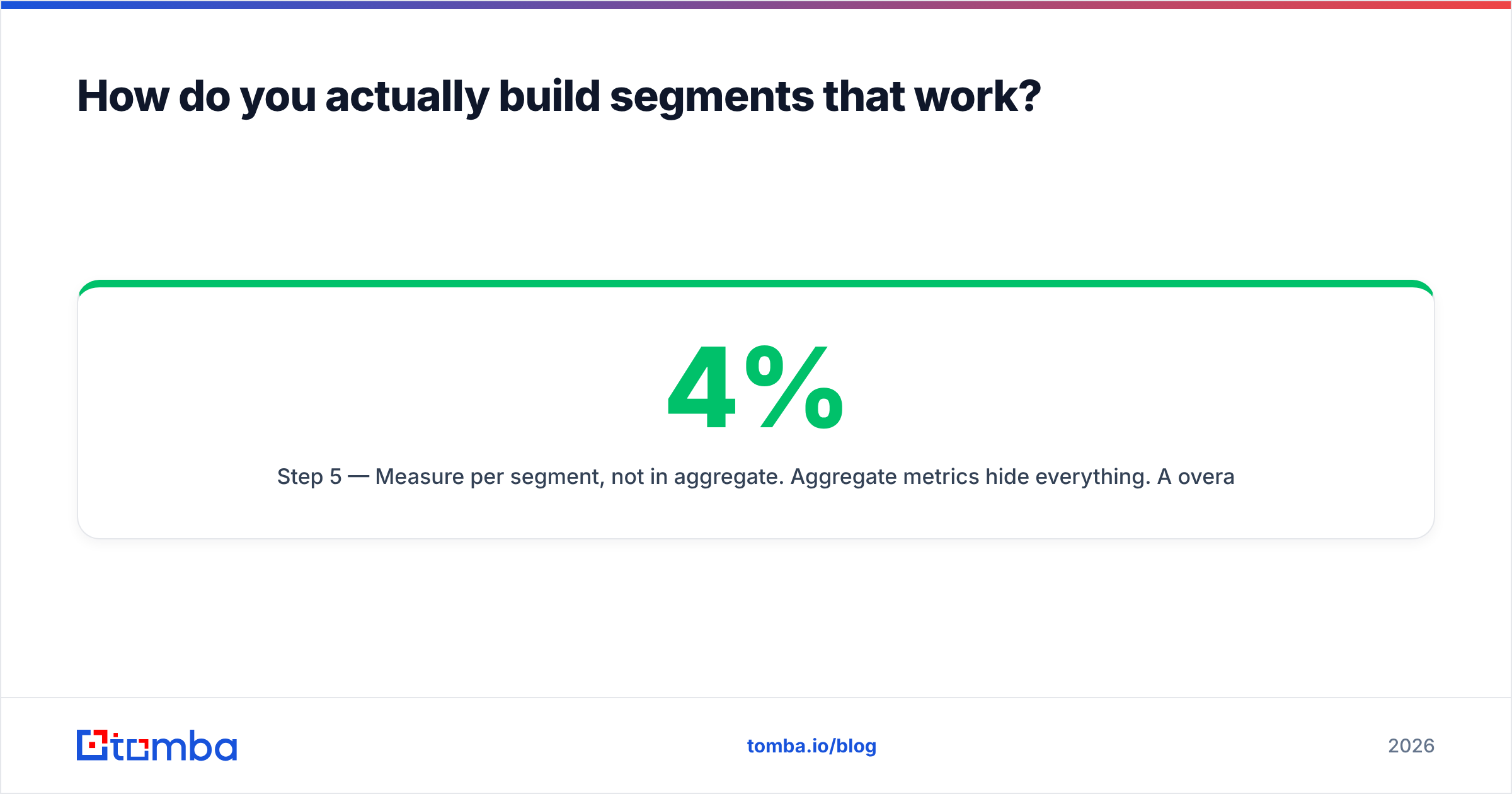
Step 5 — Measure per segment, not in aggregate. Aggregate metrics hide everything. A 4% overall reply rate might be 11% in one segment and 0.5% in another. Only segment-level reporting tells you where to double down.
Which segmentation type should you start with?#
For most B2B teams, start with firmographic plus behavioral. Firmographics get you the right accounts; behavior tells you which ones are ready now. Layer in role-based (demographic) targeting to pick the right person inside the account.
Avoid the common trap of building fifteen micro-segments you can't staff. According to analyst guidance from firms like Gartner, the value of segmentation comes from acting differently per segment — if you treat all your segments the same in execution, you've gained nothing but a more complicated spreadsheet. Three segments you genuinely tailor for beat fifteen you don't.
Once you have your accounts, identifying a marketing qualified lead within each segment becomes far cleaner, because you're scoring within a defined cohort rather than against a noisy global average.
How does segmentation connect to outbound execution?#
Segmentation and outbound are two halves of the same motion. The segment defines who and what to say; outbound is how you reach them. The handoff between them is contact data — and it's the most common point of failure.
A perfectly designed segment of "RevOps leaders at mid-market SaaS" is worthless if you can't find their email addresses. That's the gap an email finder closes: you take the company list your segmentation produced and turn it into reachable, verified contacts ready for sequencing.
This is also where segmentation pays compounding dividends. Because your list is already filtered to fit, your verified contacts convert at a higher rate, your sender reputation stays healthy, and your reps spend time on conversations that can actually close — instead of working a giant undifferentiated list.
Common mistakes that kill segmentation ROI#
- Segmenting on data you can't trust. Garbage firmographics produce confident targeting of the wrong accounts. Enrich and verify first.
- Too many segments. If you can't write a distinct message for each, merge them.
- Set-and-forget. Markets shift; segments decay. Revisit quarterly using fresh closed-won data.
- Ignoring behavioral signals. A perfect-fit account that's never engaged is colder than an imperfect-fit account that just visited your pricing page twice.
- No per-segment measurement. If you only look at blended numbers, you're flying blind.
The bottom line#
The benefits of market segmentation — higher conversion, lower CAC, better retention, sharper messaging, smarter pricing — are real and measurable. But they're downstream of one thing: accurate, well-enriched contact data. Segmentation is a multiplier, and a multiplier applied to bad data just produces confident waste.
Get the segments right, then get the contacts right. If your strategy is sound but your lists are thin or stale, start by turning your target-account list into verified, reachable contacts with the Tomba Email Finder — find professional emails by domain, name, or company, so every segment you defined actually becomes a campaign you can run. Pair it with Tomba's data enrichment to keep your firmographic fields fresh, and check Tomba pricing to match a plan to your volume. Segmentation is the plan; clean data is what makes it ship.
// get started
Find, verify and enrich your first contacts today
Start on the free plan with 25 searches a month, then scale when your team is ready.
Free plan · No credit card required · GDPR & CCPA
// about the author