9 Benefits of Personal Selling That Drive B2B Revenue in 2026
Personal selling still closes the deals automation can't. Here are the real benefits of personal selling in 2026 — and how to scale it without losing the human touch.
TL;DR
- Personal selling is the one-to-one, human-led sale — a rep talking with a buyer, reading the room, and adapting in real time. Automation can't fully replace it.
- The biggest benefits of personal selling are higher conversion on complex deals, immediate two-way feedback, stronger trust, easier objection handling, and natural upsell/cross-sell moments.
- It costs more per touch than email or ads, so you reserve it for high-value, high-consideration deals — and feed it with accurate contact data.
- The 2026 winners blend both: automated prospecting and enrichment to fill the pipeline, then personal selling to close.
- Clean contact data is the multiplier. A great rep wastes hours on bad numbers and dead inboxes — fix the input and personal selling pays off.
What is personal selling?#
Personal selling is a direct, person-to-person sales method where a rep communicates with a prospect to inform, persuade, and close — usually for considered purchases. Think a discovery call, a product demo, an in-person meeting, or a back-and-forth over the phone. The defining trait is two-way, real-time human interaction, not a one-way broadcast.
It helps to compare it to buying a coffee versus buying a house. The coffee is transactional: you don't need a salesperson, just a menu. The house needs an agent who answers your questions, reads your hesitation, and walks you through the scary parts. B2B deals — software platforms, equipment, services — sit closer to the house end of that spectrum, which is exactly why personal selling still matters in 2026.
Technically, personal selling spans a process: prospecting, qualifying, the approach, presentation, handling objections, closing, and follow-up. Marketing automation can support every stage, but the human owns the conversation where the decision actually happens.
What are the main benefits of personal selling?#
Here are the nine benefits that make personal selling worth its higher cost per contact:
- Higher conversion on complex deals — When a buyer can ask "but what about our setup?" and get a precise answer in the same breath, deals move. Personal selling shortens the gap between doubt and decision.
- Immediate, two-way feedback — A rep hears tone, hesitation, and the questions a form never captures. That live signal is market research you can't buy.
- Trust and relationship building — People buy from people. A consistent human contact builds the credibility that turns a first sale into a multi-year account.
- Tailored messaging — The pitch flexes to the buyer in front of you. No segment is too small when the segment is one person.
- Effective objection handling — Objections get resolved on the spot instead of silently killing a deal in an inbox.
- Upsell and cross-sell openings — A live conversation surfaces adjacent needs ("we also struggle with X") that automation rarely catches.
- Stronger close rates on high-ticket items — The more money and risk involved, the more buyers want a human to stand behind the promise.
- Customer retention and advocacy — A relationship built in the sale carries into renewal, expansion, and referrals.
- Competitive differentiation — When your competitors automate everything, a real, knowledgeable human becomes the differentiator.
Is personal selling better than automated outreach?#
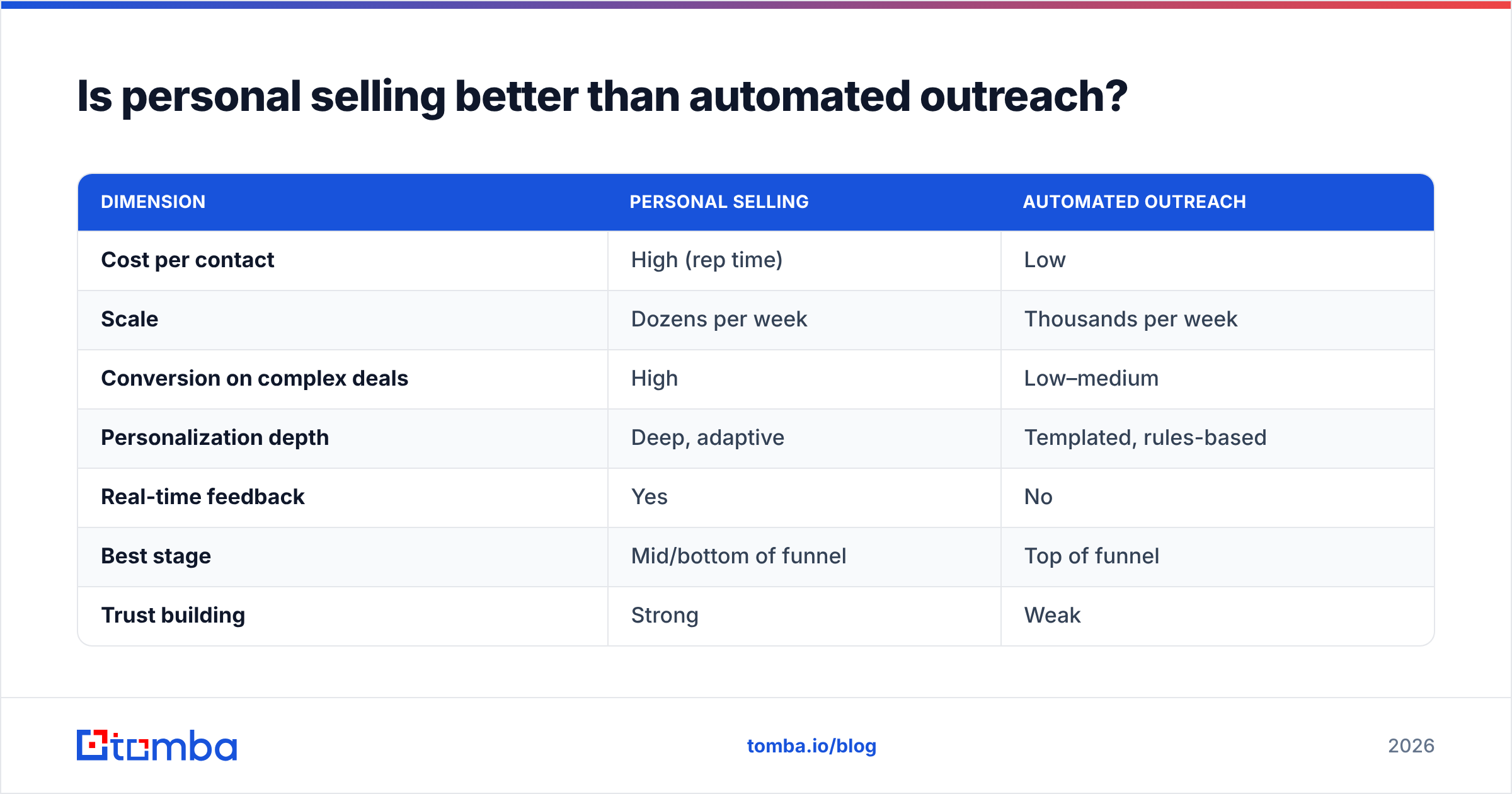
Neither one wins outright — they win together. Automated outreach is unbeatable at the top of the funnel: it puts your message in front of thousands of contacts cheaply and consistently. Personal selling is unbeatable at the bottom: it converts the qualified few into signed customers. The mistake teams make is forcing one to do the other's job.
Treat automation as the engine that fills the pipeline and personal selling as the closer that finishes the job. Strong outbound sales strategy in 2026 sequences the two deliberately: automated, data-driven prospecting identifies and warms the right accounts, then a human steps in the moment a deal shows real intent.
| Dimension | Personal selling | Automated outreach |
|---|---|---|
| Cost per contact | High (rep time) | Low |
| Scale | Dozens per week | Thousands per week |
| Conversion on complex deals | High | Low–medium |
| Personalization depth | Deep, adaptive | Templated, rules-based |
| Real-time feedback | Yes | No |
| Best stage | Mid/bottom of funnel | Top of funnel |
| Trust building | Strong | Weak |
| Ideal deal size | High-ticket | Low–mid ticket |
The takeaway: don't ask which is "better." Ask which job you're trying to do. According to HubSpot's sales research, buyers increasingly expect both efficient digital touchpoints and a knowledgeable human when stakes are high — so the blended motion outperforms either extreme.
When should you use personal selling?#
Use personal selling when the deal is complex, expensive, or relationship-driven — and skip it when the product sells itself at low cost. The economics are simple: a rep's hour is expensive, so spend it where a human meaningfully lifts the close rate.
Lean into personal selling when:
- The deal is high-value. Enterprise software, capital equipment, and multi-year contracts justify the cost of human attention.
- The sales cycle is long and multi-stakeholder. When five people must say yes, a rep who navigates the politics is worth more than any email sequence.
- The product is technical or customizable. Buyers need a guide, not a brochure.
- Trust is the deciding factor. In services and consulting, the relationship is the product.
Lean on automation instead when the price point is low, the buyer self-educates, and volume matters more than depth. Most B2B teams live in the middle, which is why the sales process and pipeline you design should route each lead to the right motion based on deal size and intent.
How do you scale personal selling without losing the human touch?#
You scale personal selling by automating everything except the conversation. The rep's time should go entirely to talking with qualified buyers — not hunting for emails, validating phone numbers, or copy-pasting data between tabs. Strip away the busywork and one rep can have far more high-quality conversations per week.
Here's where the human-touch motion quietly breaks: bad data. A rep working from a stale list burns the first ten minutes of every block on bounced emails and dead-end numbers. Fix the input and the whole motion gets faster. That's the unglamorous multiplier behind every benefit listed above.
Practical ways to scale without going cold:
- Enrich before you dial. Walk into each conversation knowing the contact's role, company, and context. Data enrichment turns a name into a briefed conversation.
- Verify contacts first. Reps should never test deliverability by sending. Use an email verifier so every outreach lands and your response rate reflects your pitch, not your list quality.
- Find direct lines for the deals that matter. For high-ticket accounts, a phone finder gets you a real conversation faster than a fourth follow-up email.
- Automate the admin. Log calls, sync to CRM, and queue follow-ups so the rep stays in selling mode.
What are the drawbacks of personal selling — and how do you offset them?#
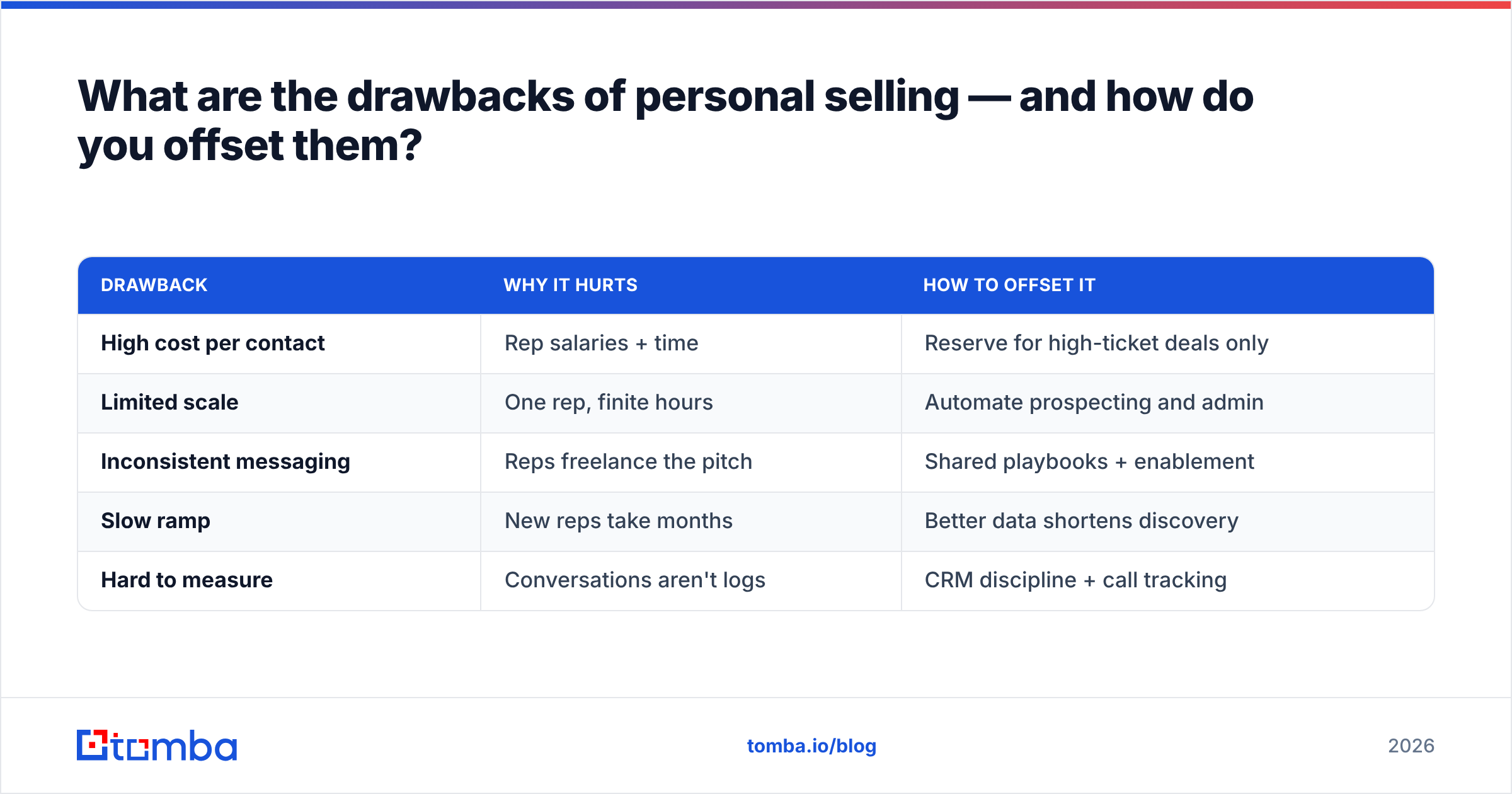
Personal selling's weaknesses are real: it's expensive, it's slow, and it doesn't scale linearly. Hiring your way to more revenue gets costly fast, and a single rep can only hold so many conversations. Ignoring these trade-offs is how teams overspend on motions that should have been automated.
| Drawback | Why it hurts | How to offset it |
|---|---|---|
| High cost per contact | Rep salaries + time | Reserve for high-ticket deals only |
| Limited scale | One rep, finite hours | Automate prospecting and admin |
| Inconsistent messaging | Reps freelance the pitch | Shared playbooks + enablement |
| Slow ramp | New reps take months | Better data shortens discovery |
| Hard to measure | Conversations aren't logs | CRM discipline + call tracking |
The fix is not to abandon personal selling — it's to protect it. Spend it where it pays, and remove every non-selling task from the rep's day. According to Gartner's research on B2B buying, buyers spend only a small fraction of their journey with any one supplier's reps, so every minute of human contact has to count. The teams that win make those minutes count by arming reps with accurate, current data instead of letting them dig for it.
How does data quality change the ROI of personal selling?#
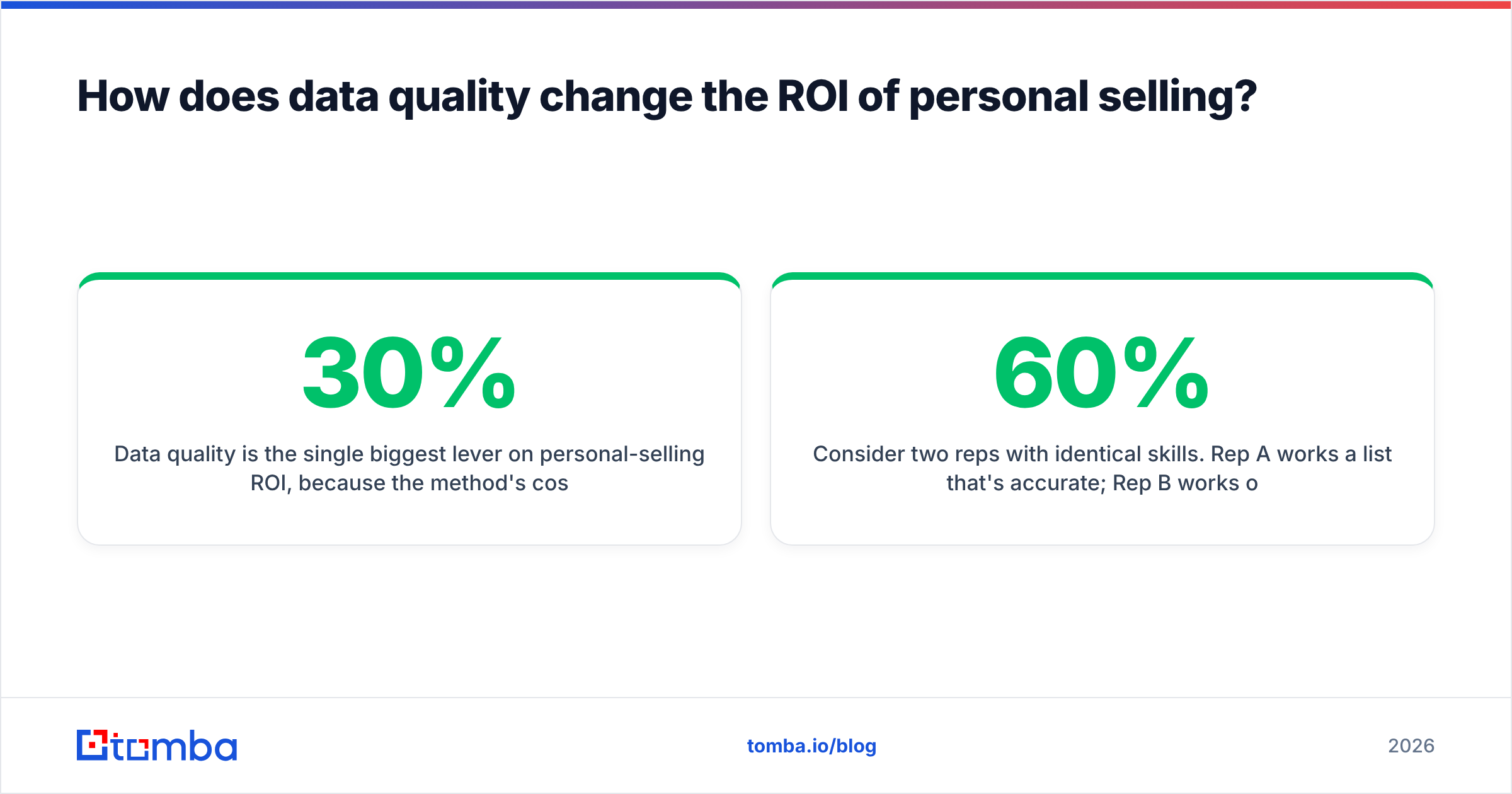
Data quality is the single biggest lever on personal-selling ROI, because the method's cost lives in rep time. Every benefit — trust, feedback, tailored messaging, objection handling — only happens after the rep reaches a real person. If 30% of your contacts are wrong, you've effectively cut your selling capacity by a third before anyone says hello.
Consider two reps with identical skills. Rep A works a list that's 60% accurate; Rep B works one that's 95% accurate. Same hours, same script. Rep B simply has more conversations — and conversations are where personal selling earns its premium. The skill gap you obsess over matters far less than the data gap you ignore.
This is why pipeline-stage tooling and prospecting feed directly into closing performance:
- Find the right contact with an email finder so reps target decision-makers, not generic inboxes.
- Confirm it's reachable before outreach to keep deliverability and rep momentum high.
- Enrich the record so the first conversation starts informed.
- Keep the CRM clean so no rep ever re-qualifies a lead someone already worked.
Personal selling and good data aren't separate disciplines. The data decides how many at-bats your closer gets, and the closer decides how many of those at-bats become revenue.
The bottom line: personal selling in 2026#
Personal selling endures because some decisions are too big, too complex, or too human to hand to a sequence. Its benefits — conversion on hard deals, live feedback, trust, tailored messaging, objection handling, upsell, retention, and differentiation — are exactly the things automation struggles to fake. The catch is cost, and the answer to cost is focus plus clean data.
The 2026 playbook is clear: automate the top of the funnel, personalize the bottom, and never let a skilled rep waste an hour on a bad list. Blend the two motions and you get the scale of automation with the close rate of a human.
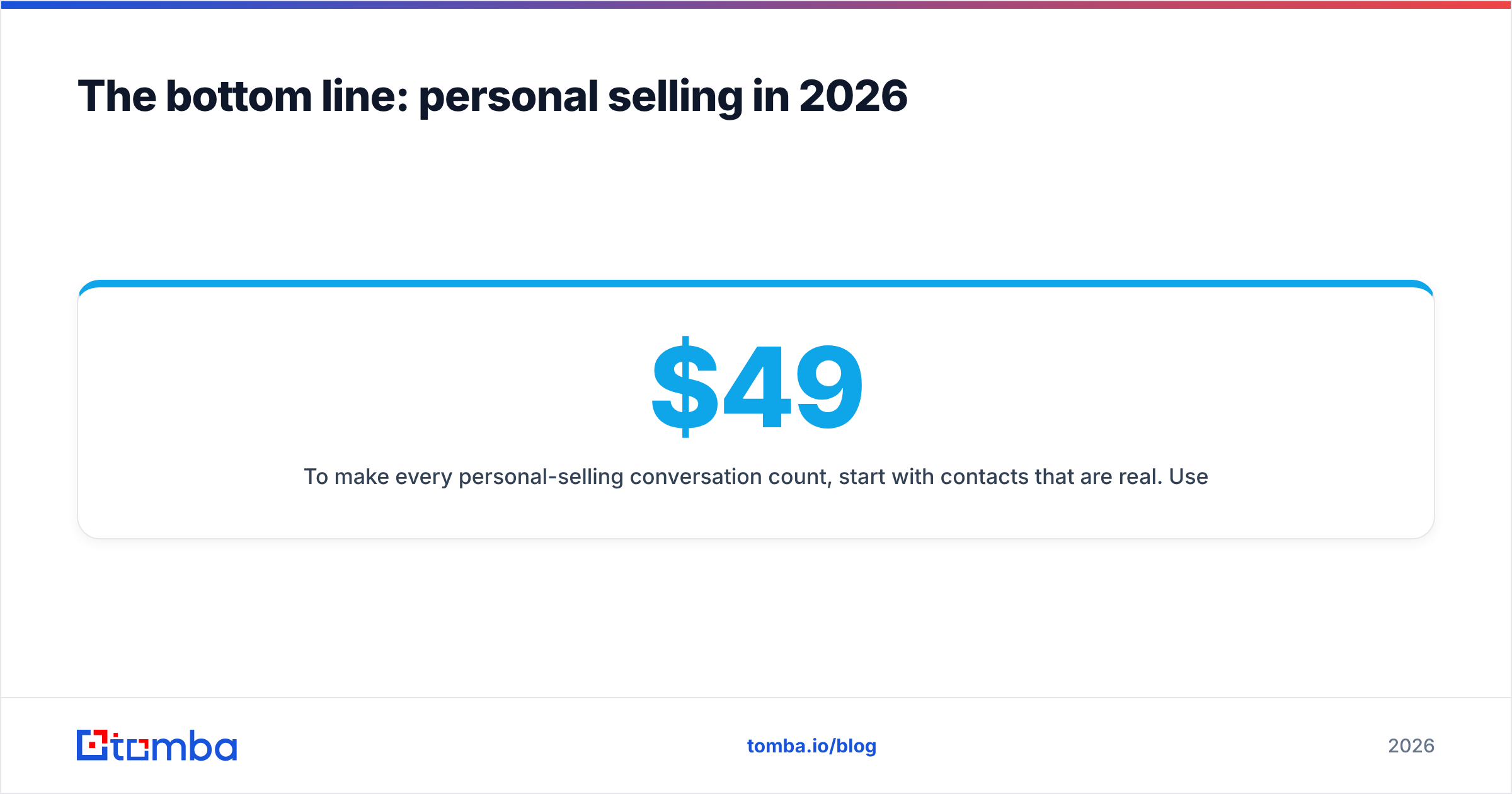
To make every personal-selling conversation count, start with contacts that are real. Use the Tomba Email Finder to source verified, decision-maker emails by name, company, or domain — then hand your reps a list worth their time. Check Tomba pricing to find the plan that fits your team: a free tier with 25 searches a month to test it, Starter at $49/mo, Growth at $99/mo, and Pro at $249/mo as you scale. Feed your closers clean data, and let personal selling do what only it can.
Ready to find emails that actually work?
Join 150,000+ professionals who stopped guessing and started sending. Free credits on signup — no credit card required.
Get the Tomba newsletter
Practical outbound tactics and product updates — once every two weeks.
About the author