The Benefits of RevOps in 2026: A B2B Revenue Playbook
Siloed sales, marketing, and success teams leak revenue at every handoff. Here are the concrete benefits of RevOps in 2026 — and how to capture them without a 12-month reorg.
Revenue Operations stopped being a buzzword somewhere around the third quarter where your forecast missed by 20% and nobody could agree on why. If marketing, sales, and customer success each run their own tools, their own definitions, and their own version of "the number," you are not managing one revenue engine — you are refereeing three.
This post breaks down the concrete benefits of RevOps: what you actually get when you unify the operations behind your go-to-market motion, what it costs, and how to start without blowing up your org chart.
TL;DR#
- RevOps aligns marketing, sales, and customer success under one operating model — shared data, shared metrics, shared accountability for revenue.
- The biggest benefits of RevOps are tighter forecasts, faster sales cycles, cleaner data, less tool sprawl, and a smoother customer handoff between teams.
- Companies with strong alignment grow faster: research from Forrester and others ties RevOps maturity to measurable revenue lift and efficiency gains.
- You do not need a 12-month reorg. Start with one shared data layer, one set of definitions, and one source of clean contact data.
- The fastest ROI usually comes from fixing the data foundation — because every downstream metric inherits the quality of the records feeding it.
What is RevOps, in plain terms?#
RevOps is the pit crew for your revenue car. The drivers — your reps, marketers, and CS managers — get the glory, but the pit crew owns the tooling, the data, the process, and the timing that decide whether the car finishes the race. Technically, revenue operations is the function that unifies the people, process, data, and technology across the entire customer lifecycle, from first touch to renewal.
Before RevOps, each team optimized its own slice. Marketing chased MQL volume, sales chased closed-won, and CS chased retention — three scoreboards, zero shared truth. RevOps replaces those parallel tracks with a single funnel that everyone is measured against.
The four pillars RevOps typically owns:
- Operations alignment — one process spanning marketing ops, sales ops, and CS ops instead of three disconnected ones.
- Data and analytics — a single source of truth for pipeline, conversion, and revenue, so nobody argues about whose number is right.
- Technology and tooling — a rationalized stack where systems talk to each other instead of duplicating data.
- Enablement — shared playbooks, definitions, and training so a lead means the same thing to everyone.

What are the core benefits of RevOps?#
The benefits of RevOps compound because they all draw from the same well: a unified view of the customer. Fix the foundation once, and forecasting, routing, reporting, and handoffs all improve at the same time. Here are the benefits that show up first.
| Benefit | What it fixes | Typical impact |
|---|---|---|
| Accurate forecasting | Conflicting numbers across teams | Forecasts within a tighter, defensible range |
| Faster sales cycles | Slow, manual lead handoffs | Less time wasted between stages |
| Clean, unified data | Duplicate and stale records | Higher rep trust in the CRM |
| Lower tool cost | Overlapping point solutions | Consolidated, cheaper stack |
| Smoother handoffs | Dropped context at every stage | Better retention and expansion |
| Shared accountability | Finger-pointing on misses | One funnel, one scoreboard |
1. More accurate revenue forecasting#
When marketing, sales, and finance pull from different systems, your forecast is a negotiation, not a calculation. RevOps centralizes pipeline data so the forecast is built once, from one dataset, with definitions everyone signed off on. The result is a number you can actually defend in a board meeting — and adjust with confidence when conditions change.
2. Shorter sales cycles#
Every handoff is a chance to stall. A lead that sits in a queue for two days because routing rules are ambiguous is a lead cooling off. RevOps owns the routing logic, the SLAs between teams, and the automation that moves a record from "marketing qualified" to "rep is calling" in minutes instead of days. Less friction at the seams means deals move faster end to end.
3. A single source of truth for data#
This is the quiet giant. Most "RevOps problems" are actually data problems wearing a trench coat. Duplicate accounts, three spellings of the same company, contacts who left 18 months ago — every one of those poisons a downstream metric. RevOps establishes ownership of the data layer: what gets captured, how it is normalized, when it is enriched, and who is allowed to change it.
This is also where tooling earns its keep. Keeping records current with reliable data enrichment and accurate contact details means your reps trust the CRM instead of keeping a private spreadsheet on the side.
4. Less tool sprawl and lower cost#
Ask a 50-person revenue org to list its tools and you will hit 30 before lunch. Many overlap. RevOps audits the stack, kills redundant point solutions, and consolidates around systems that integrate. The benefit is twofold: a smaller bill, and fewer places for data to fork and rot.
5. A cleaner customer handoff#
The moment a deal closes is the moment context usually evaporates. Sales knows why the customer bought; CS finds out the hard way. RevOps designs the handoff so intent, promises, and account history travel with the customer. That continuity is what turns a one-year contract into a three-year one.
Is RevOps better than separate sales and marketing ops?#
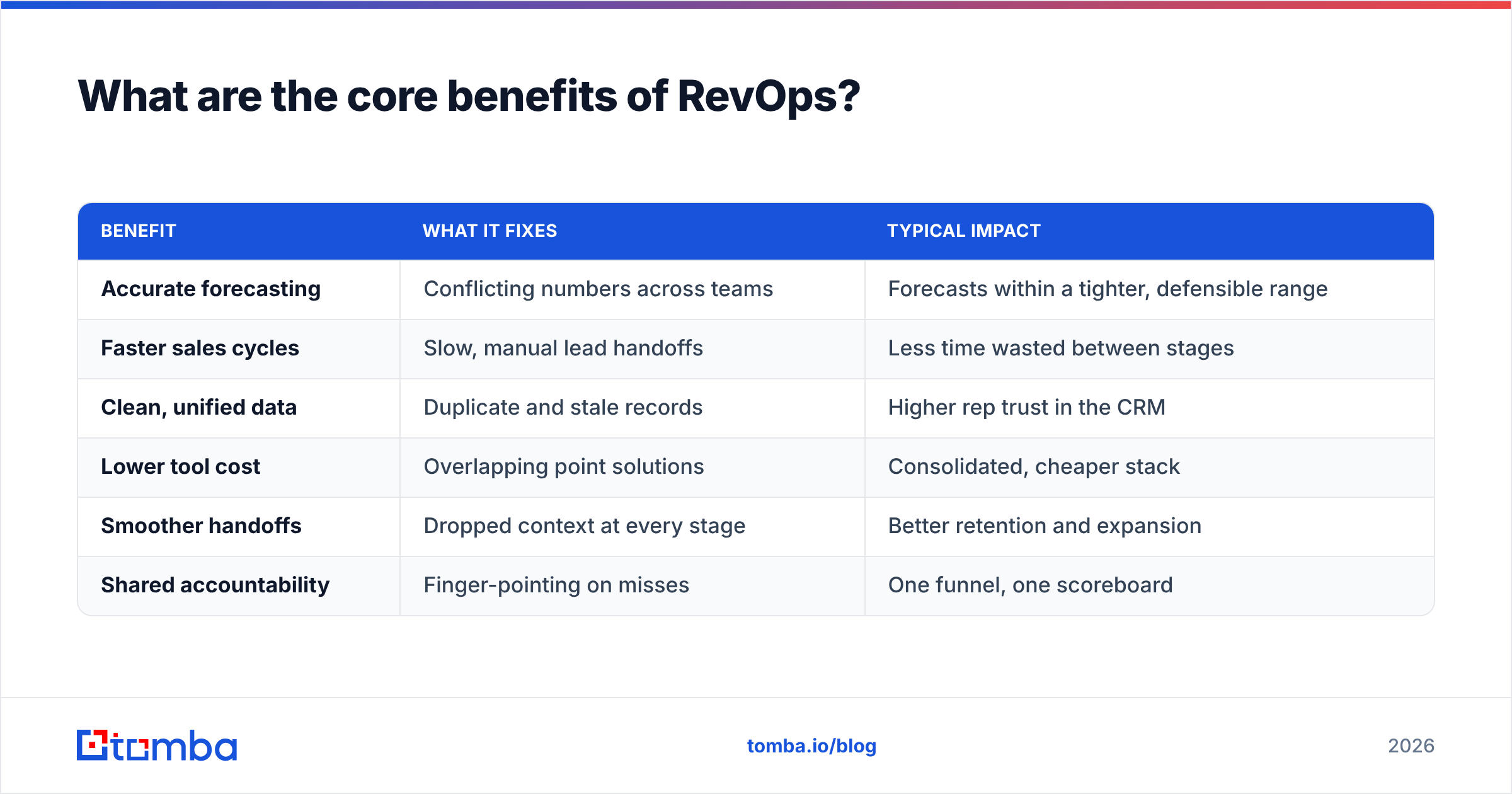
Yes — for most growing B2B companies, a unified RevOps model beats three independent ops functions. The separate-ops approach optimizes each team locally while the revenue engine suffers globally. Here is the honest comparison.
| Dimension | Siloed Ops (Sales / Mktg / CS separate) | Unified RevOps |
|---|---|---|
| Source of truth | Three systems, three numbers | One shared dataset |
| Forecast accuracy | Reconciled manually, often late | Built once, defensible |
| Lead handoff | Manual, lossy, slow | Automated with SLAs |
| Tooling | Overlapping, duplicated | Rationalized, integrated |
| Accountability | Per-team scoreboards | One revenue funnel |
| Cost to run | Higher (redundancy) | Lower over time |
The caveat: RevOps is not free to stand up. Early-stage teams with a handful of reps may not need a dedicated function yet — a single ops-minded operator can carry it. The model pays off once you have enough volume and enough teams that the handoffs themselves become the bottleneck. If your misses keep tracing back to "the data was wrong" or "we didn't know who owned that lead," you are past the threshold.

How does RevOps improve data quality specifically?#
RevOps improves data quality by assigning ownership to it — the same way a restaurant assigns a head chef to the kitchen instead of letting every server cook their own dish. Without an owner, data quality is everyone's job, which means it is no one's. With RevOps, there is a clear answer to "who decides how a company name is formatted" and "when do we re-verify a contact."
Concretely, a healthy RevOps data practice runs on a few habits:
- Standardized capture — forms, integrations, and imports all write data in the same shape, so you never get "Inc." in one field and "Incorporated" in another.
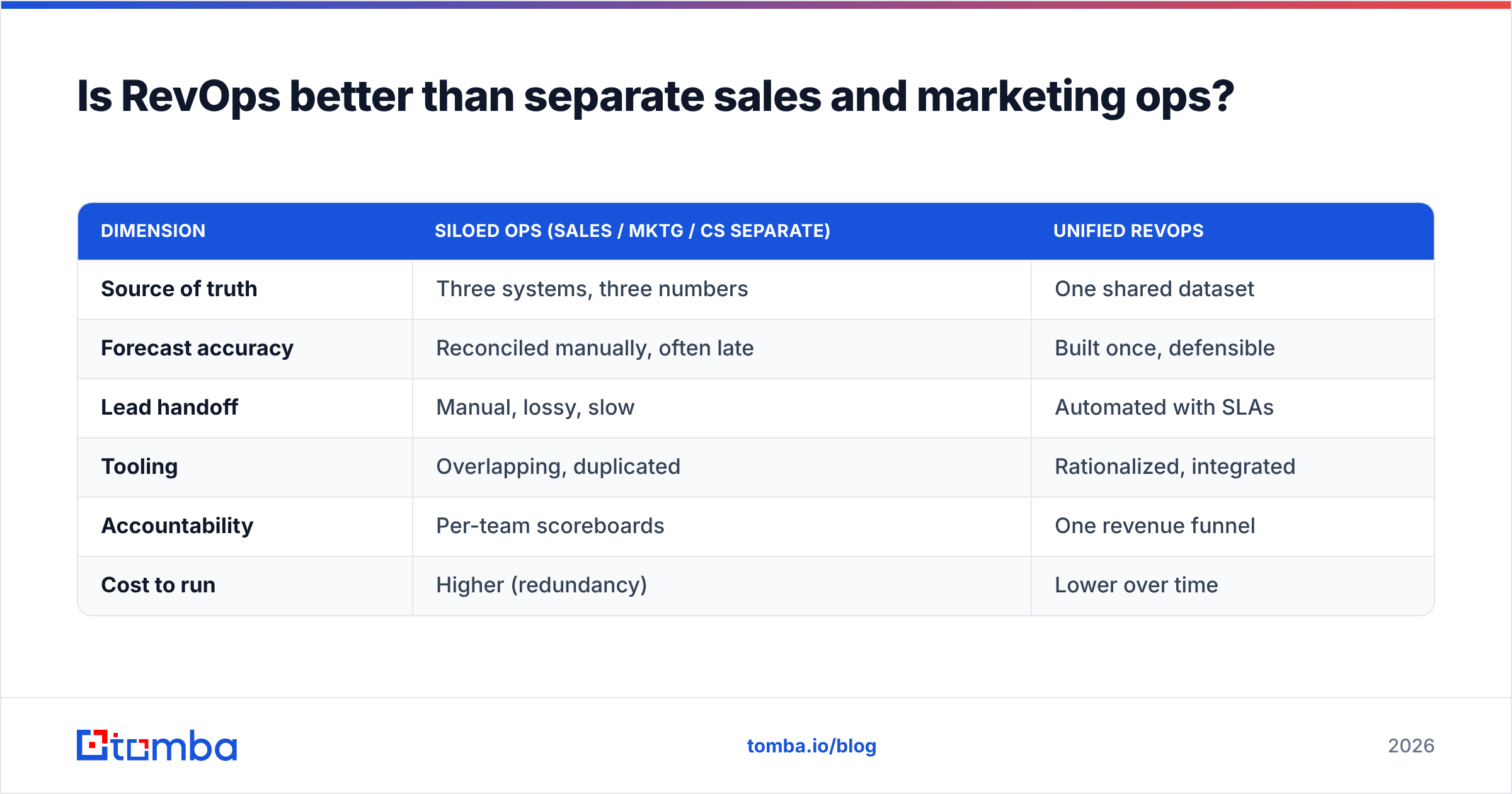
- Routine verification — email addresses decay roughly 25–30% per year as people change jobs. Catching dead addresses with an email verifier before a campaign protects your sender reputation.
- Enrichment on entry — when a lead arrives with just an email, automated enrichment fills in company, role, and firmographics so routing and scoring have something to work with.
- Deduplication discipline — one account, one record. Merge rules run continuously, not in a panicked quarterly cleanup.
- Closed-loop feedback — when a rep flags a bad record, the fix flows back to the source so the same error does not reappear.
The reason this matters so much: every metric you celebrate or panic over inherits the quality of the records underneath it. A "30% reply rate" on a list that is 40% stale is a fiction. Clean data is not a nice-to-have inside RevOps — it is the precondition for every other benefit on this list. Industry analysts at Gartner have long flagged poor data quality as a multi-million-dollar annual drag on the average enterprise, and RevOps is the discipline that puts a name on the problem.
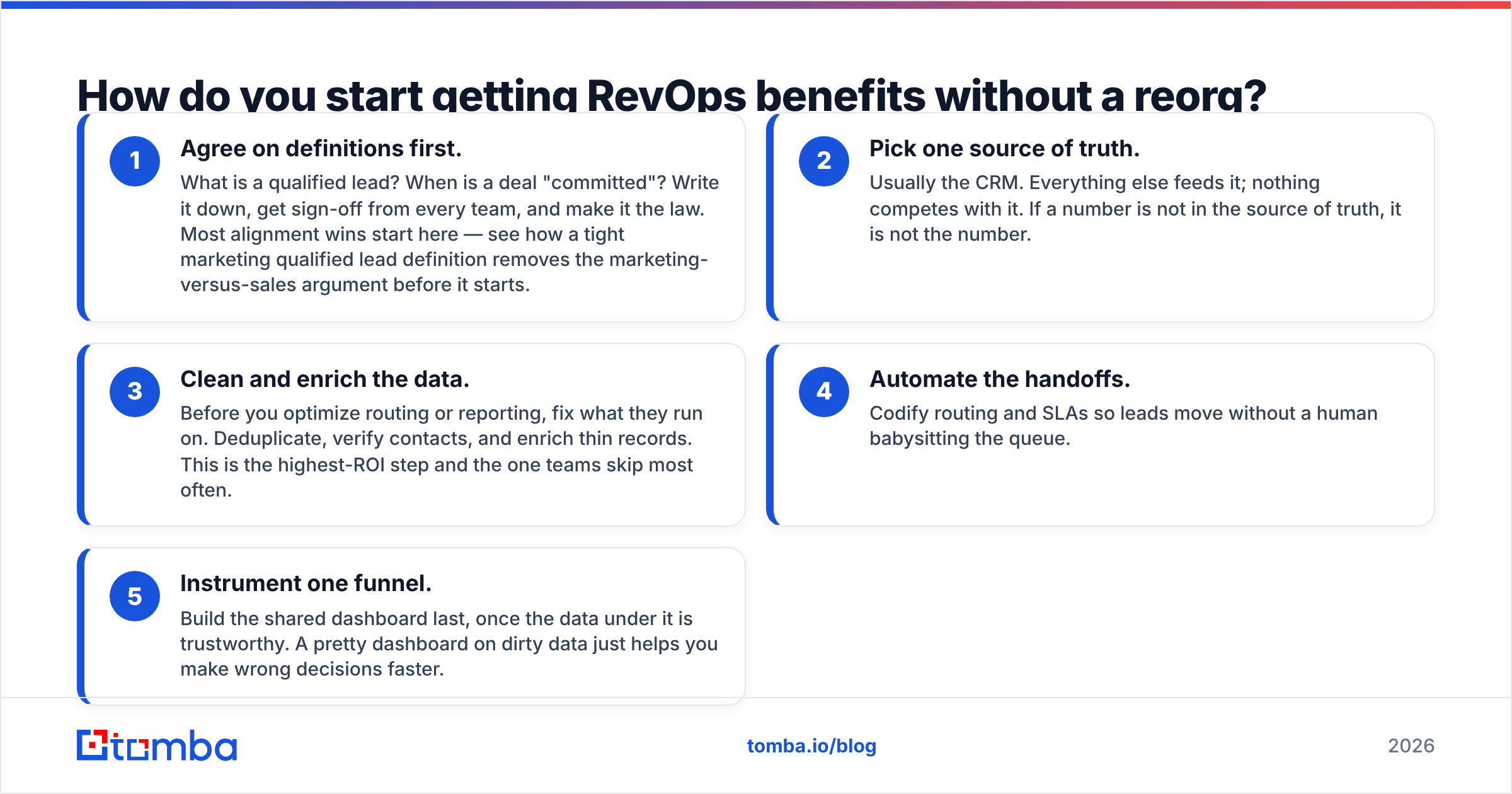
How do you start getting RevOps benefits without a reorg?#
You do not flip a switch labeled "RevOps." You sequence it. The fastest path to value is to fix the foundation before you redraw the org chart.
- Agree on definitions first. What is a qualified lead? When is a deal "committed"? Write it down, get sign-off from every team, and make it the law. Most alignment wins start here — see how a tight marketing qualified lead definition removes the marketing-versus-sales argument before it starts.
- Pick one source of truth. Usually the CRM. Everything else feeds it; nothing competes with it. If a number is not in the source of truth, it is not the number.
- Clean and enrich the data. Before you optimize routing or reporting, fix what they run on. Deduplicate, verify contacts, and enrich thin records. This is the highest-ROI step and the one teams skip most often.
- Automate the handoffs. Codify routing and SLAs so leads move without a human babysitting the queue.
- Instrument one funnel. Build the shared dashboard last, once the data under it is trustworthy. A pretty dashboard on dirty data just helps you make wrong decisions faster.
Notice that steps 1 through 3 require zero headcount changes. You can capture most of the early benefits of RevOps with the team you already have — you are changing how they operate, not who reports to whom. The reorg, if you even need one, comes after the operating model proves itself.
A note on tooling at step 3: this is where a reliable data layer pays for itself. Whether you are filling gaps with a bulk email finder ahead of a campaign or wiring verification into your CRM through an API, the goal is the same — records your whole revenue team can trust without keeping private side-spreadsheets.
What does RevOps NOT fix?#
Honest expectation-setting, because RevOps gets oversold. It will not fix a bad product, a weak value proposition, or a market that does not want what you sell. It is an operational multiplier, not a strategy. If your win rate is low because the product loses on features, no amount of clean data routing will save the quarter.
RevOps also will not survive without executive backing. Because it spans three teams, it needs a sponsor who can settle turf disputes. Stand it up as a powerless coordinating committee and it will be ignored by exactly the teams it is meant to align. Give it real ownership of the data and process, and the benefits follow.
The bottom line#
The benefits of RevOps are real and they compound: tighter forecasts, faster cycles, cleaner data, a leaner stack, and handoffs that retain customers instead of dropping them. But almost every one of those benefits traces back to a single root — the quality and unity of your underlying data. Get that right and the rest gets easier. Get it wrong and you are just building dashboards on sand.
That is also the cheapest place to start. You can begin aligning definitions and cleaning your contact data this week, with the team you have, long before you draw a new org chart.
Your RevOps engine runs on accurate contact data — so start there. Tomba's email finder helps your revenue teams build and maintain a clean, verified contact foundation by domain, name, or company, with a verifier, domain search, and enrichment sitting right alongside it. Plans start with a free tier of 25 searches per month, then scale from $49/mo as your motion grows; see full Tomba pricing to match a tier to your team. Give every downstream RevOps metric data it can actually trust.
// get started
Find, verify and enrich your first contacts today
Start on the free plan with 25 searches a month, then scale when your team is ready.
Free plan · No credit card required · GDPR & CCPA
// about the author