Benefits of Sales and Marketing Alignment: 2026 Playbook
Sales and marketing alignment is not a culture slogan — it is revenue math. Here are the measurable benefits, the data foundation behind them, and how to make "smarketing" actually stick in 2026.
Sales and marketing alignment gets talked about like a personality fix — get everyone in a room, agree to be nicer, ship a shared Slack channel. It is not that. Alignment is a revenue operating decision: one definition of a good lead, one set of data, one pipeline number both teams are measured against. When that exists, the benefits show up in the metrics you already report on. When it doesn't, you leak deals at every handoff.
This post breaks down the concrete benefits of sales and marketing alignment, why most "alignment" initiatives fail at the data layer, and the practical steps and tooling that make it real in 2026.
TL;DR#
- Alignment is a revenue lever, not a vibe. Aligned orgs consistently report shorter sales cycles, higher win rates, and better retention than siloed ones.
- The benefits cluster in five areas: faster pipeline velocity, higher conversion, lower CAC, better forecasting, and stronger customer retention.
- Most alignment fails at the data layer — not the relationship layer. If sales and marketing work from different contact records, no amount of meetings fixes it.
- A shared lead definition (SQL/MQL) plus clean, enriched contact data is the foundation everything else sits on.
- You can start small: one SLA, one shared dashboard, one verified data source. Tools like a data enrichment layer and a reliable email finder remove the most common friction point — bad contact data.
What is sales and marketing alignment, really?#
Sales and marketing alignment ("smarketing") means both teams operate against shared goals, shared definitions, and shared data — instead of optimizing their own metrics in isolation.
Think of it like a relay race. Marketing runs the first leg and hands off the baton; sales runs the anchor leg. If the handoff zone is sloppy — the baton (the lead) is dropped, passed too early, or passed to someone not ready to run — the team's split time is terrible no matter how fast each runner is individually. Alignment is the practice of designing a clean handoff zone.
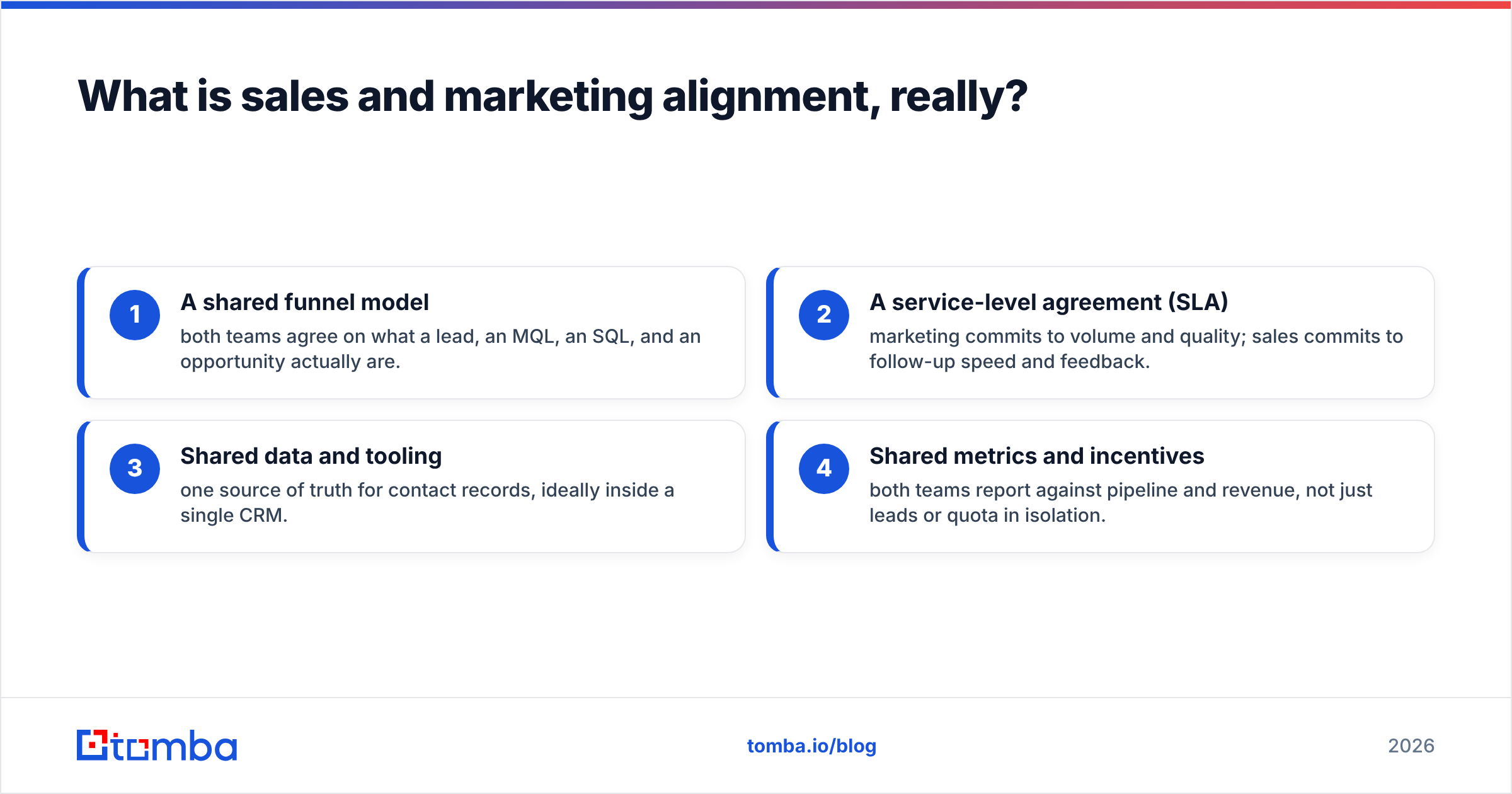
Technically, alignment shows up as four agreements:
- A shared funnel model — both teams agree on what a lead, an MQL, an SQL, and an opportunity actually are.
- A service-level agreement (SLA) — marketing commits to volume and quality; sales commits to follow-up speed and feedback.
- Shared data and tooling — one source of truth for contact records, ideally inside a single CRM.
- Shared metrics and incentives — both teams report against pipeline and revenue, not just leads or quota in isolation.
Miss any one of these and you have cooperation, not alignment.
)
Why does misalignment cost so much?#
Misalignment is expensive because the damage compounds at every stage. A marketing team optimizing for raw lead volume floods sales with unqualified contacts. Sales, burned by junk, ignores the next batch — including the good ones. Marketing sees low follow-up, concludes sales is lazy, and stops sharing intent signals. The flywheel spins backwards.
The classic industry stat — frequently cited from HubSpot and analyst research at Forrester — is that misalignment between sales and marketing wastes a large share of marketing-generated leads and drags down annual revenue. The exact percentages vary by study, but the direction is never in dispute: siloed go-to-market motions underperform aligned ones on nearly every metric that matters.
The hidden cost is data decay. B2B contact data goes stale fast — people change jobs, companies rebrand, domains shift. When marketing's list and sales' CRM diverge, reps waste hours chasing dead emails and wrong titles. That is why a clean, verified data foundation is not a "nice to have" for alignment — it is the precondition.
What are the core benefits of sales and marketing alignment?#
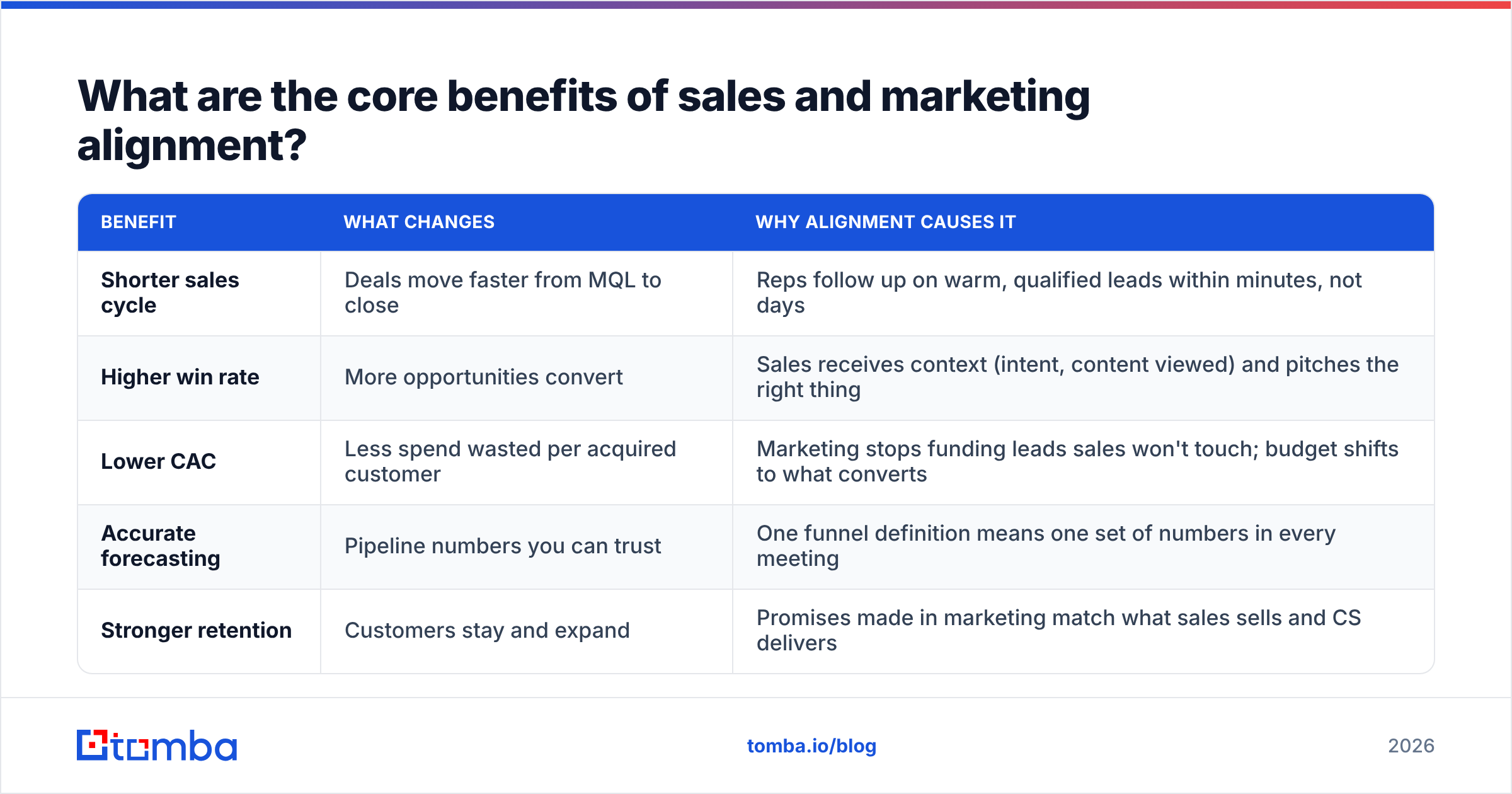
Here are the five benefit categories that aligned organizations consistently report, with the mechanism behind each.
| Benefit | What changes | Why alignment causes it |
|---|---|---|
| Shorter sales cycle | Deals move faster from MQL to close | Reps follow up on warm, qualified leads within minutes, not days |
| Higher win rate | More opportunities convert | Sales receives context (intent, content viewed) and pitches the right thing |
| Lower CAC | Less spend wasted per acquired customer | Marketing stops funding leads sales won't touch; budget shifts to what converts |
| Accurate forecasting | Pipeline numbers you can trust | One funnel definition means one set of numbers in every meeting |
| Stronger retention | Customers stay and expand | Promises made in marketing match what sales sells and CS delivers |
The five benefits in plain terms#
- Faster pipeline velocity. When the handoff is instant and lead data is complete, the time between "raised hand" and "first meeting" collapses. Speed-to-lead is one of the most reliable predictors of conversion — and it is purely an alignment-plus-data problem.
- Higher conversion and win rates. Reps who know why a lead is hot — which page they read, which webinar they attended, what their tech stack looks like — open with relevance instead of a cold script. Context closes deals.
- Lower customer acquisition cost. Alignment kills the single biggest source of waste: paying to generate leads that sales never works. Budget re-routes toward the channels and segments that actually produce revenue.
- Trustworthy forecasting and reporting. A shared funnel definition means marketing's "pipeline contribution" and sales' "pipeline" are the same number. Board meetings stop being a debate about whose spreadsheet is right.
- Better retention and expansion. When the story marketing tells, the deal sales closes, and the value customer success delivers all line up, churn drops. Misalignment that starts at the top of the funnel leaks out the bottom as cancellations.
How is an aligned GTM motion different from a siloed one?#
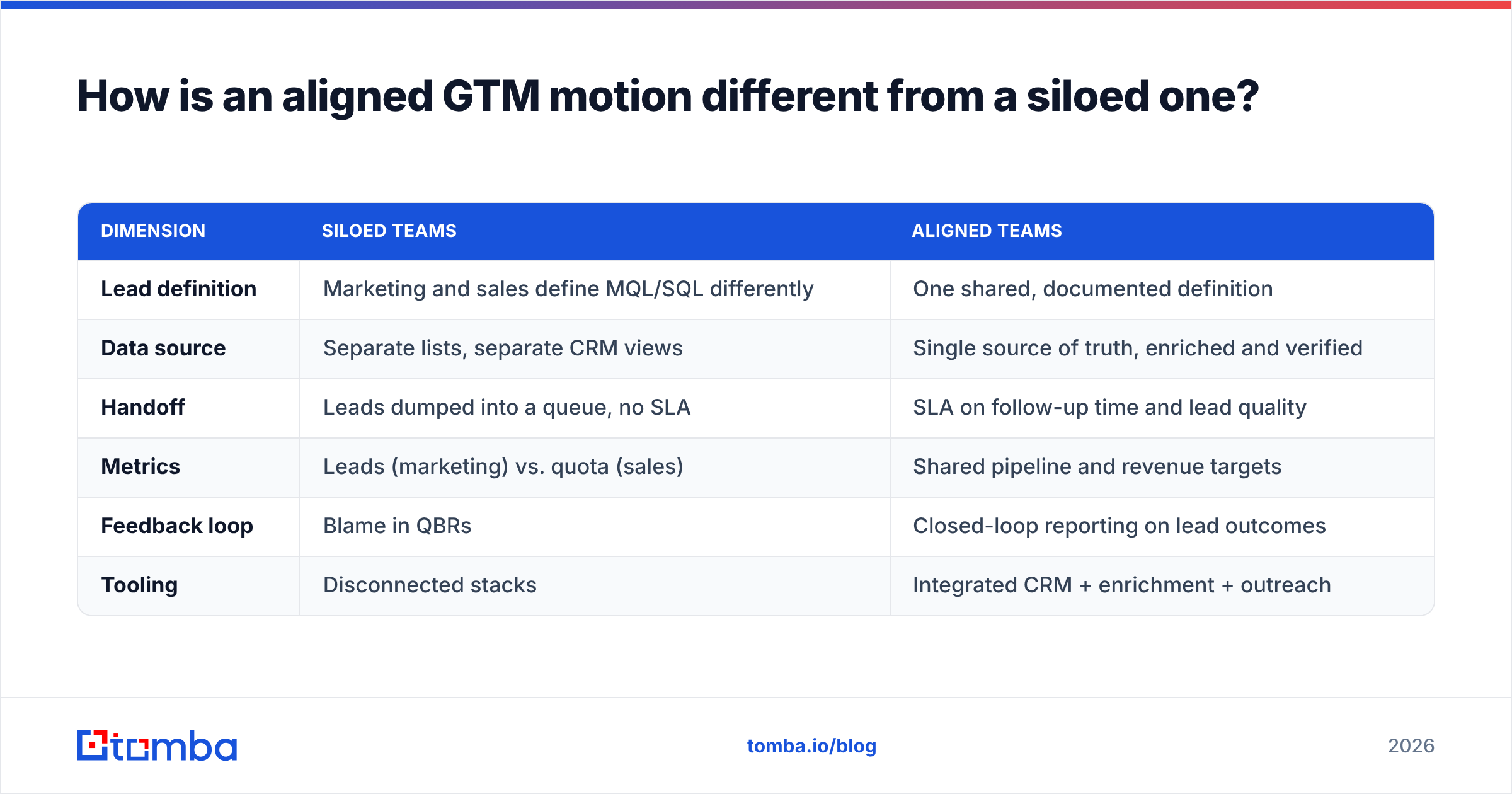
The difference is structural, not attitudinal. Here is the side-by-side.
| Dimension | Siloed teams | Aligned teams |
|---|---|---|
| Lead definition | Marketing and sales define MQL/SQL differently | One shared, documented definition |
| Data source | Separate lists, separate CRM views | Single source of truth, enriched and verified |
| Handoff | Leads dumped into a queue, no SLA | SLA on follow-up time and lead quality |
| Metrics | Leads (marketing) vs. quota (sales) | Shared pipeline and revenue targets |
| Feedback loop | Blame in QBRs | Closed-loop reporting on lead outcomes |
| Tooling | Disconnected stacks | Integrated CRM + enrichment + outreach |
Notice how many rows trace back to data. You cannot share a lead definition if you cannot agree on what's in the record. You cannot enforce an SLA if reps spend the SLA window cleaning bad emails. This is the part most "alignment workshops" skip — and it is why they fail.
Why does alignment usually fail at the data layer?#
Most alignment efforts die not because people won't cooperate, but because the contact data underneath them is a mess.
Picture a marketing team handing off 500 MQLs. If 18% of those emails bounce, 12% have the wrong job title, and a chunk are catch-all domains no one verified, sales experiences the handoff as noise. They learn to distrust marketing leads as a category. No SLA survives contact with bad data.
Fixing this is unglamorous but decisive:
- Verify before handoff. Run lists through an email verifier so reps never burn a touch on a dead address. Handle ambiguous domains with a dedicated catch-all verifier.
- Enrich to complete the record. Use contact enrichment to fill in title, company, seniority, and firmographics so routing rules and personalization actually work.
- Standardize the source. Pull net-new contacts from one place — a B2B database and domain-level search — instead of three reps buying three different lists.
- Sync to the CRM automatically. Connect your data layer to the CRM via native integrations (HubSpot, Salesforce, Pipedrive) so marketing and sales literally see the same record.
Get the data right and the soft stuff — trust, SLAs, shared dashboards — suddenly holds, because both teams are finally arguing about strategy instead of about whose numbers are real.
)
How do you actually implement sales and marketing alignment?#
You don't need a six-month transformation program. Run this sequence and you'll see movement in a quarter.
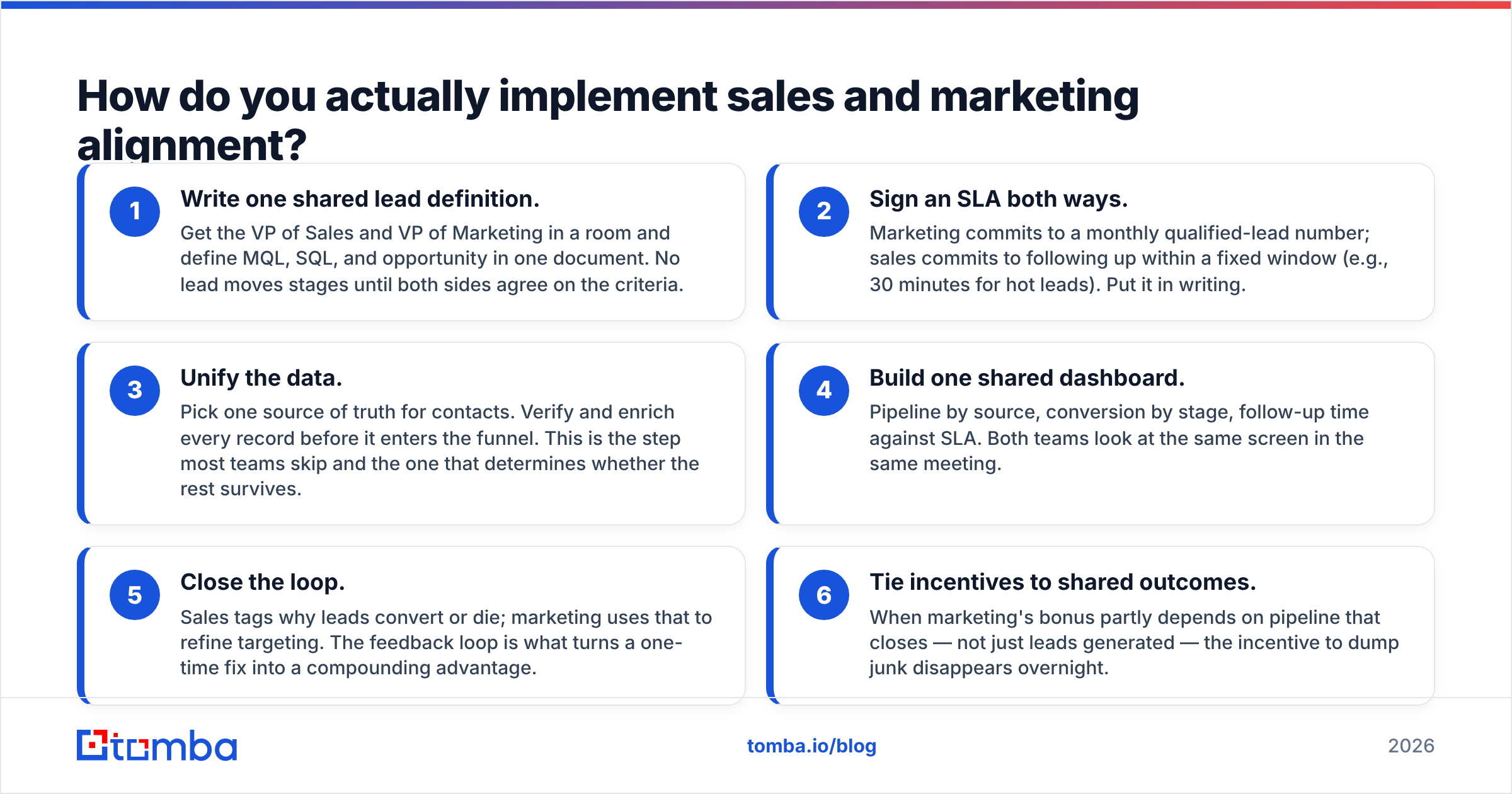
- Write one shared lead definition. Get the VP of Sales and VP of Marketing in a room and define MQL, SQL, and opportunity in one document. No lead moves stages until both sides agree on the criteria.
- Sign an SLA both ways. Marketing commits to a monthly qualified-lead number; sales commits to following up within a fixed window (e.g., 30 minutes for hot leads). Put it in writing.
- Unify the data. Pick one source of truth for contacts. Verify and enrich every record before it enters the funnel. This is the step most teams skip and the one that determines whether the rest survives.
- Build one shared dashboard. Pipeline by source, conversion by stage, follow-up time against SLA. Both teams look at the same screen in the same meeting.
- Close the loop. Sales tags why leads convert or die; marketing uses that to refine targeting. The feedback loop is what turns a one-time fix into a compounding advantage.
- Tie incentives to shared outcomes. When marketing's bonus partly depends on pipeline that closes — not just leads generated — the incentive to dump junk disappears overnight.
A useful gut check: review your own funnel against peer benchmarks on a site like G2 or analyst frameworks from Gartner. If your MQL-to-SQL conversion is far below your category median, the problem is almost always definition and data, not effort.
How do you measure whether alignment is working?#
Track a small set of shared metrics and watch them over two to three quarters:
- Speed-to-lead — median time from MQL creation to first sales touch. Should drop sharply.
- MQL-to-SQL conversion — the cleanest signal that lead quality and the shared definition are working.
- Win rate on marketing-sourced pipeline — proves the handoff produces real revenue.
- Sales cycle length — aligned context shortens it.
- Pipeline forecast accuracy — variance between forecast and actual should narrow as definitions converge.
- Data health — bounce rate, % of records enriched, % verified. This is the leading indicator; the others are lagging.
If data health improves but conversion doesn't, your problem is process or messaging. If data health is poor, fix that first — everything downstream is noise until you do.
Frequently asked questions#
Is sales and marketing alignment the same as RevOps? No, but they're related. Revenue operations is the function (people, systems, process) that enables alignment across the full revenue org. Alignment is the outcome RevOps is designed to produce.
Whose job is alignment — sales or marketing? Both, owned by whoever runs revenue (CRO or RevOps lead). Treating it as one team's project guarantees the other team treats it as someone else's problem.
What's the single highest-leverage first step? Unify and clean the contact data. A shared lead definition is worthless if the records behind it can't be trusted. Verification and enrichment are the cheapest, fastest wins.
How long until alignment shows results? Data and SLA fixes show up in speed-to-lead within weeks. Win-rate and retention benefits take one to two full sales cycles to materialize.
The bottom line#
The benefits of sales and marketing alignment — shorter cycles, higher win rates, lower CAC, trustworthy forecasts, better retention — are real and measurable. But they all sit on one foundation: both teams working from the same complete, verified contact data. Fix the data layer and the rest of alignment stops being a slogan and starts being a number on your dashboard.
If your alignment effort keeps stalling on bad lead data, start there. Tomba's Email Finder gives sales and marketing one reliable source for accurate, verified contact data — find professional emails by domain, name, or company, verify before you hand off, and sync clean records straight into your CRM. Start free with 25 searches a month, then scale on a plan that fits your pipeline ($49/mo Starter, $99/mo Growth). Give both teams the same trustworthy data, and let alignment finally stick.
// get started
Find, verify and enrich your first contacts today
Start on the free plan with 25 searches a month, then scale when your team is ready.
Free plan · No credit card required · GDPR & CCPA
// about the author