Best ABM Platform in 2026: Top 7 Tools Ranked & Compared
Choosing the best ABM platform in 2026 comes down to intent data, account coverage, and price. Here's how 6sense, Demandbase, HubSpot, and four others actually compare — and where the data underneath them comes from.
Account-based marketing stopped being a buzzword years ago. Today it's the default motion for most B2B teams selling deals above $20k, and the platform you pick decides whether your "targeted" campaigns actually reach the right accounts or just burn budget on lookalike noise.
This guide ranks the best ABM platform options for 2026, compares them on the things that matter (intent data quality, account coverage, integrations, and price), and is honest about where each one falls short.
TL;DR#
- The best ABM platform overall is 6sense for enterprises that need predictive intent and have budget to match; Demandbase is the closest rival and stronger on advertising.
- HubSpot's ABM tooling is the best value if you already run HubSpot — you avoid a second contract entirely.
- RollWorks and Terminus win on price-to-value for mid-market teams that want ABM advertising without six-figure commitments.
- Every ABM platform is only as good as the contact and account data feeding it — clean enrichment from a tool like Tomba's data enrichment often matters more than the platform brand.
- Don't pay enterprise pricing for features you won't use. Most teams under 50 reps get more from a mid-market platform plus solid data enrichment.
What is an ABM platform?#
An ABM platform is software that helps you market and sell to a specific list of target accounts instead of broadcasting to everyone. Think of it like a sniper scope bolted onto your go-to-market engine: instead of spraying ads and emails at a whole market, you aim spend, content, and sales effort at the 200 or 2,000 companies most likely to buy.
Technically, a modern ABM platform bundles four jobs:
- Account identification — figuring out which companies match your ideal customer profile and which are currently in-market.
- Intent data — signals (third-party content consumption, web visits, search behavior) that suggest an account is researching a problem you solve.
- Orchestration — coordinating ads, email, and sales outreach across the buying committee at one account.
- Measurement — pipeline and revenue attribution by account, not by lead.
The category overlaps heavily with revenue operations tooling, because ABM only works when marketing and sales share one definition of a target account and one source of truth for contact data.
What makes the best ABM platform in 2026?#
The market matured, so the table stakes moved. A platform that just shows you "anonymous account X visited your pricing page" is no longer special. In 2026, the best ABM platform earns its price on three axes:
- Predictive accuracy — does the intent model actually predict deals, or just correlate with traffic? 6sense and Demandbase invest the most here.
- Data coverage and freshness — how many of your target accounts have accurate contacts, firmographics, and technographics attached? This is where many "AI-powered" platforms quietly fail, because their underlying database is stale.
- Activation surface — can you act on a signal without exporting to five other tools? Native advertising, sequences, and CRM sync separate the leaders from the dashboards.
A platform can ace dashboards and still lose deals if the contacts it hands your reps bounce. That's why teams pair their ABM platform with a dedicated email verifier and bulk enrichment layer — the platform finds the account, but verified emails are what let you reach the buying committee.
Which ABM platforms should you compare?#
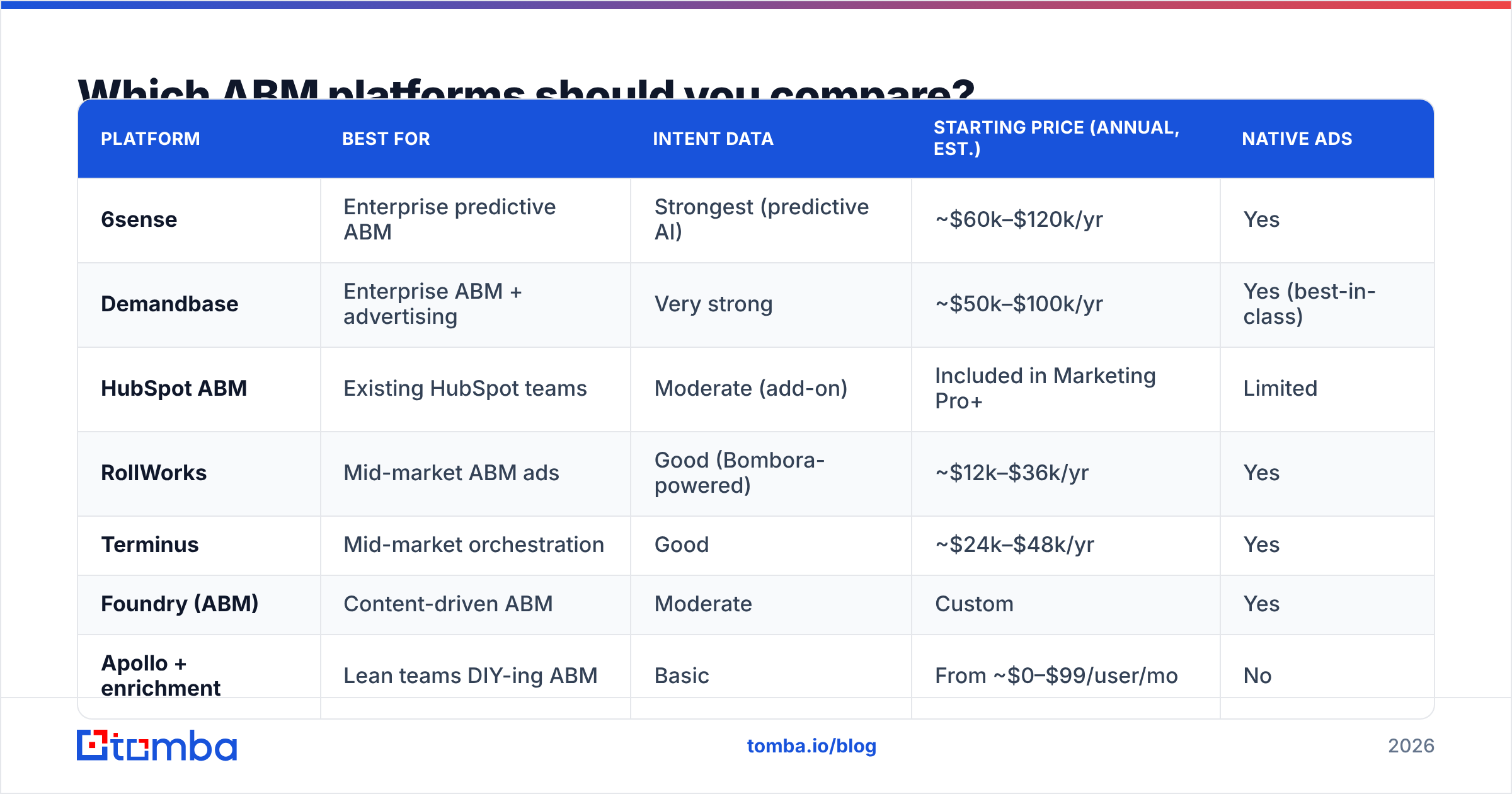
Here are the seven platforms worth shortlisting in 2026, with the pricing tier each one realistically starts at and the team size it fits best.
| Platform | Best for | Intent data | Starting price (annual, est.) | Native ads |
|---|---|---|---|---|
| 6sense | Enterprise predictive ABM | Strongest (predictive AI) | ~$60k–$120k/yr | Yes |
| Demandbase | Enterprise ABM + advertising | Very strong | ~$50k–$100k/yr | Yes (best-in-class) |
| HubSpot ABM | Existing HubSpot teams | Moderate (add-on) | Included in Marketing Pro+ | Limited |
| RollWorks | Mid-market ABM ads | Good (Bombora-powered) | ~$12k–$36k/yr | Yes |
| Terminus | Mid-market orchestration | Good | ~$24k–$48k/yr | Yes |
| Foundry (ABM) | Content-driven ABM | Moderate | Custom | Yes |
| Apollo + enrichment | Lean teams DIY-ing ABM | Basic | From ~$0–$99/user/mo | No |
Pricing is directional — every ABM vendor negotiates and bundles, and most hide list prices behind a sales call. Always validate against G2 reviews and a live quote.
6sense#
The benchmark for enterprise ABM. Its predictive model ingests a huge volume of anonymous web and search signals and maps them to accounts, then scores how close each account is to buying. If you have a large addressable market and a data science-friendly team, 6sense usually produces the best in-market account list. The trade-offs: real cost, a steep learning curve, and a platform you'll under-use unless you have dedicated ops headcount. If you're evaluating it against lighter options, see this 6sense alternative breakdown.
Demandbase#
The other enterprise heavyweight, and arguably stronger on the advertising side. Demandbase combines intent, account identification, and a robust DSP for account-targeted ads. Teams that run heavy paid programs often prefer it to 6sense. It's still an enterprise commitment — expect a similar price band and implementation effort. A side-by-side Demandbase alternative comparison helps if budget is tight.
HubSpot ABM#
If your company already lives in HubSpot, its built-in ABM tools (target account workflows, ICP scoring, account-based dashboards) are the highest-ROI choice simply because there's no new contract, no new login, and no data sync to maintain. The intent data is weaker than the specialists, but for many mid-market teams "good enough intent inside the CRM we already use" beats "great intent in a tool nobody opens." HubSpot also documents its ABM setup clearly.
RollWorks and Terminus#
Both target the mid-market sweet spot: ABM advertising and orchestration without enterprise pricing. RollWorks leans on Bombora intent and is the cheaper entry point; Terminus is stronger on multi-channel orchestration (including its chat and email signature channels). Either is a reasonable first ABM platform for a team scaling from 10 to 50 reps.
Is the best ABM platform actually about the data?#
Yes — and this is the part vendors gloss over. Here's the uncomfortable truth most ABM buyers learn six months in.
Your ABM platform identifies that Acme Corp is in-market. Great. Now what? Your reps need the right five people at Acme — the VP of Engineering, the CISO, the procurement lead — with verified, deliverable contact details. If your platform's database returns a generic info@ address or an email that bounces, the entire predictive model just produced a dead end.
This is why mature RevOps teams treat the ABM platform and the contact-data layer as two separate purchases:
- The ABM platform handles signals, scoring, ads, and attribution.
- The data layer handles accurate, verified contacts for the people inside those accounts.
A focused tool like the Tomba Email Finder or a domain search across a target account often returns fresher, more accurate contacts than the bundled data inside a $90k ABM suite, because data accuracy is its only job. Run the platform for intent, run a dedicated finder-plus-verifier for the contacts, and your reach rates climb without renegotiating your ABM contract.
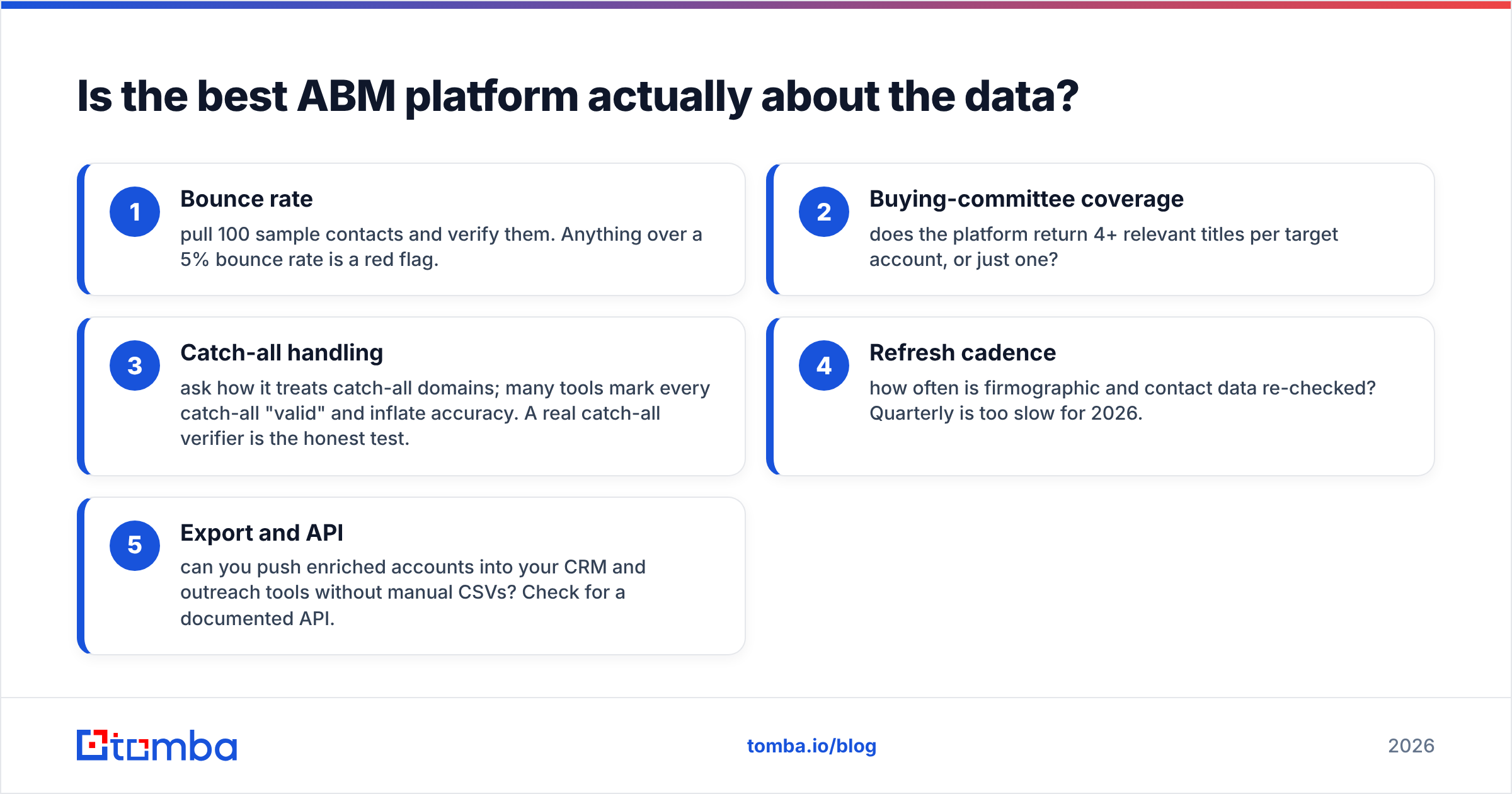
A simple data-quality checklist before you buy#
Before signing any ABM platform, pressure-test the contact data with these five checks:
- Bounce rate — pull 100 sample contacts and verify them. Anything over a 5% bounce rate is a red flag.
- Buying-committee coverage — does the platform return 4+ relevant titles per target account, or just one?
- Catch-all handling — ask how it treats catch-all domains; many tools mark every catch-all "valid" and inflate accuracy. A real catch-all verifier is the honest test.
- Refresh cadence — how often is firmographic and contact data re-checked? Quarterly is too slow for 2026.
- Export and API — can you push enriched accounts into your CRM and outreach tools without manual CSVs? Check for a documented API.
How much should you pay for an ABM platform?#
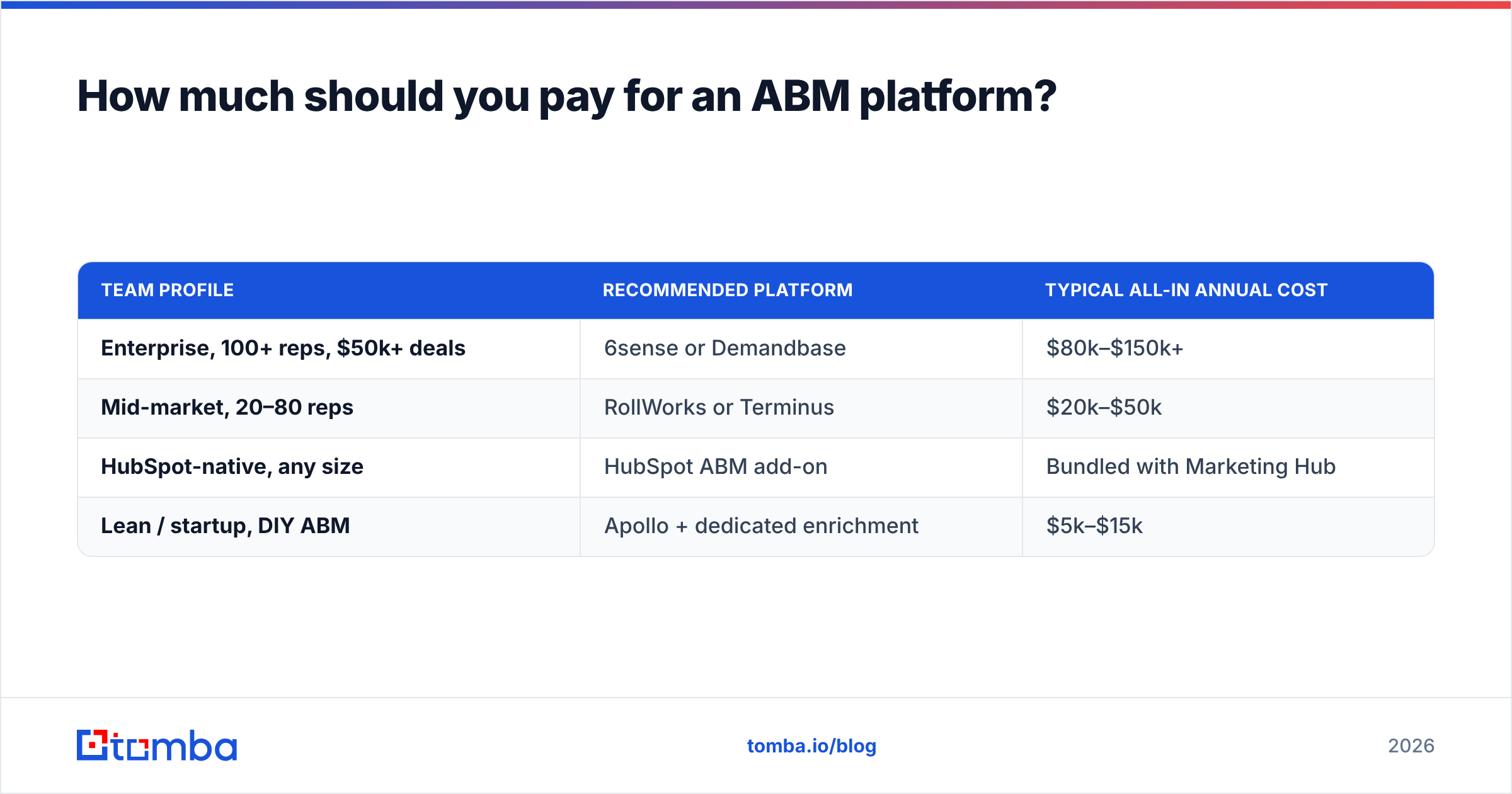
Match the spend to your deal size and team, not to the vendor's ambition.
| Team profile | Recommended platform | Typical all-in annual cost |
|---|---|---|
| Enterprise, 100+ reps, $50k+ deals | 6sense or Demandbase | $80k–$150k+ |
| Mid-market, 20–80 reps | RollWorks or Terminus | $20k–$50k |
| HubSpot-native, any size | HubSpot ABM add-on | Bundled with Marketing Hub |
| Lean / startup, DIY ABM | Apollo + dedicated enrichment | $5k–$15k |
The pattern that wins for budget-conscious teams: buy a mid-tier or HubSpot-native ABM platform for signals and orchestration, then spend a small fraction of the savings on accurate contact data. Tomba's plans run from a free tier (25 searches/month) through Starter at $49/mo, Growth at $99/mo, and Pro at $249/mo — see full Tomba pricing. That's a rounding error next to an enterprise ABM contract, and it fixes the single most common ABM failure: unreachable contacts.
ABM platform pros and cons at a glance#
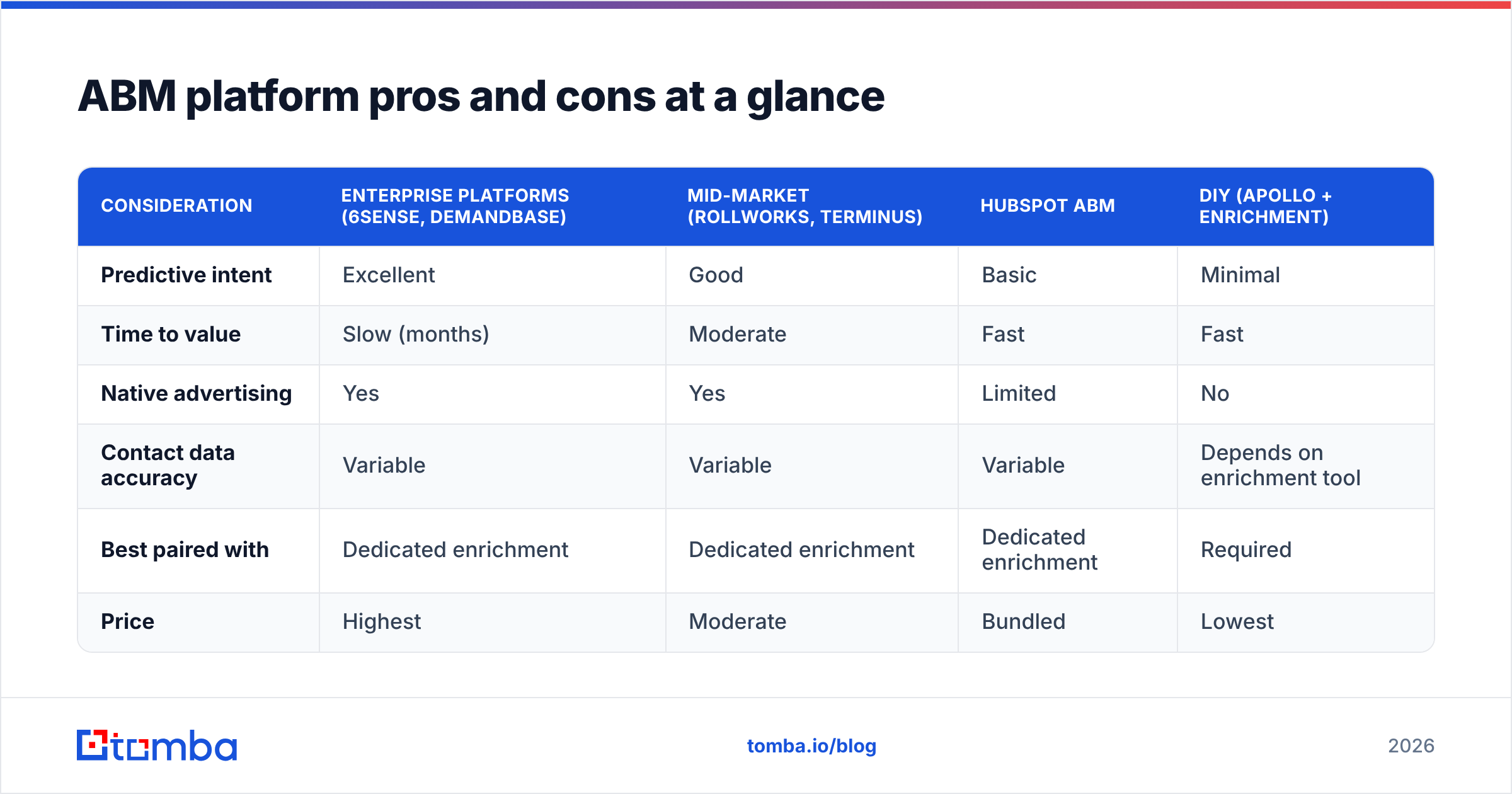
| Consideration | Enterprise platforms (6sense, Demandbase) | Mid-market (RollWorks, Terminus) | HubSpot ABM | DIY (Apollo + enrichment) |
|---|---|---|---|---|
| Predictive intent | Excellent | Good | Basic | Minimal |
| Time to value | Slow (months) | Moderate | Fast | Fast |
| Native advertising | Yes | Yes | Limited | No |
| Contact data accuracy | Variable | Variable | Variable | Depends on enrichment tool |
| Best paired with | Dedicated enrichment | Dedicated enrichment | Dedicated enrichment | Required |
| Price | Highest | Moderate | Bundled | Lowest |
Notice the constant in the "best paired with" row. No matter which tier you choose, the platform supplies signals and the data enrichment layer supplies reachable people. Skipping the second half is the most expensive mistake in ABM.
How do you choose the right ABM platform?#
Work top-down, in this order:
- Start with deal economics. If your average contract value can't support a $50k+ tool, don't shortlist 6sense or Demandbase. Discipline here saves more money than any negotiation.
- Audit your current stack. Already on HubSpot? Start with its native ABM tools before adding a contract. The integration tax of a second platform is real.
- Demand a data sample. Make every vendor prove contact accuracy on your actual target accounts, using the five-point checklist above. Verify the sample yourself with an independent email verifier.
- Separate signals from contacts. Budget explicitly for a contact-data layer. The best ABM platform with bad emails underperforms a modest platform with verified ones.
- Pilot before you commit. Run one quarter against a defined account list and measure pipeline by account. If the platform can't show account-level pipeline lift, it's a dashboard, not a revenue tool.
The bottom line#
The best ABM platform in 2026 depends entirely on your size and budget: 6sense for enterprise predictive ABM, Demandbase for ad-heavy enterprises, HubSpot for teams already invested there, and RollWorks or Terminus for the mid-market. But the decision that quietly determines your ROI isn't the platform logo — it's whether the contacts inside your target accounts are accurate and reachable.
That's the layer you control regardless of which platform you sign. Feed your ABM motion with verified, fresh contacts using the Tomba Email Finder — start free with 25 searches a month, scale to bulk enrichment when your account list grows, and stop letting bounced emails undercut a six-figure platform. Find the right people at every account you target, and your ABM platform finally earns its price.
// get started
Find, verify and enrich your first contacts today
Start on the free plan with 25 searches a month, then scale when your team is ready.
Free plan · No credit card required · GDPR & CCPA
// about the author