Best AI Lead Generation Tools in 2026: Tested & Compared
A no-hype breakdown of the best AI lead generation tools in 2026 — what each one actually does, where it wins, and how to stop overpaying for data you can't use.
Best AI Lead Generation Tools in 2026
TL;DR
- The "best AI lead generation tools" are not the ones with the flashiest AI labels — they're the ones whose underlying data is accurate enough to act on. AI scoring on bad data just helps you email the wrong people faster.
- Most platforms cluster into three jobs: finding contacts, enriching them, and scoring/sequencing them. Few do all three well; you'll usually pair two tools.
- For sourcing verified B2B emails at a sane price, an email-finder-first stack (like Tomba) beats paying enterprise seat fees for an all-in-one you'll half-use.
- Budget realistically: expect $49–$249/mo for a focused tool, and $1,000+/mo once you add an all-in-one sales engagement suite.
- Test on your ICC (ideal customer companies) before committing. Vendor-reported accuracy means nothing until it survives your own bounce rate.
What counts as an "AI lead generation tool" in 2026?#
The short answer: any tool that uses machine learning to find, qualify, or prioritize potential buyers — and most of them stretch the word "AI" hard.
Think of lead generation like fishing. Some tools are the net (they pull in a wide haul of contacts). Some are the sorting table (they enrich and clean the catch). And some are the experienced deckhand who tells you which fish are worth keeping (scoring and intent). "AI" shows up in all three, but it does very different work in each. A model that predicts buying intent is a different beast from one that guesses an email pattern from a name and domain.
That distinction matters because buyers conflate them. You see "AI-powered lead generation" on a landing page and assume one product does everything. In practice, the category splits into clear lanes:
- Email & contact finders — turn a name + company into a verified email or phone number. Tools like Tomba, Hunter, and RocketReach live here.
- Data & enrichment platforms — append firmographics, technographics, and intent signals to records you already have. Clearbit (now Breeze), ZoomInfo, and Apollo lean this way.
- Engagement & scoring suites — sequence outreach, score replies, and route leads. Outreach, Salesloft, and HubSpot sit here.
- Intent & ABM platforms — surface accounts showing buying signals. 6sense and Demandbase dominate this lane.
The best AI lead generation tools for you depend entirely on which of those jobs is your actual bottleneck.

How do the best AI lead generation tools compare?#
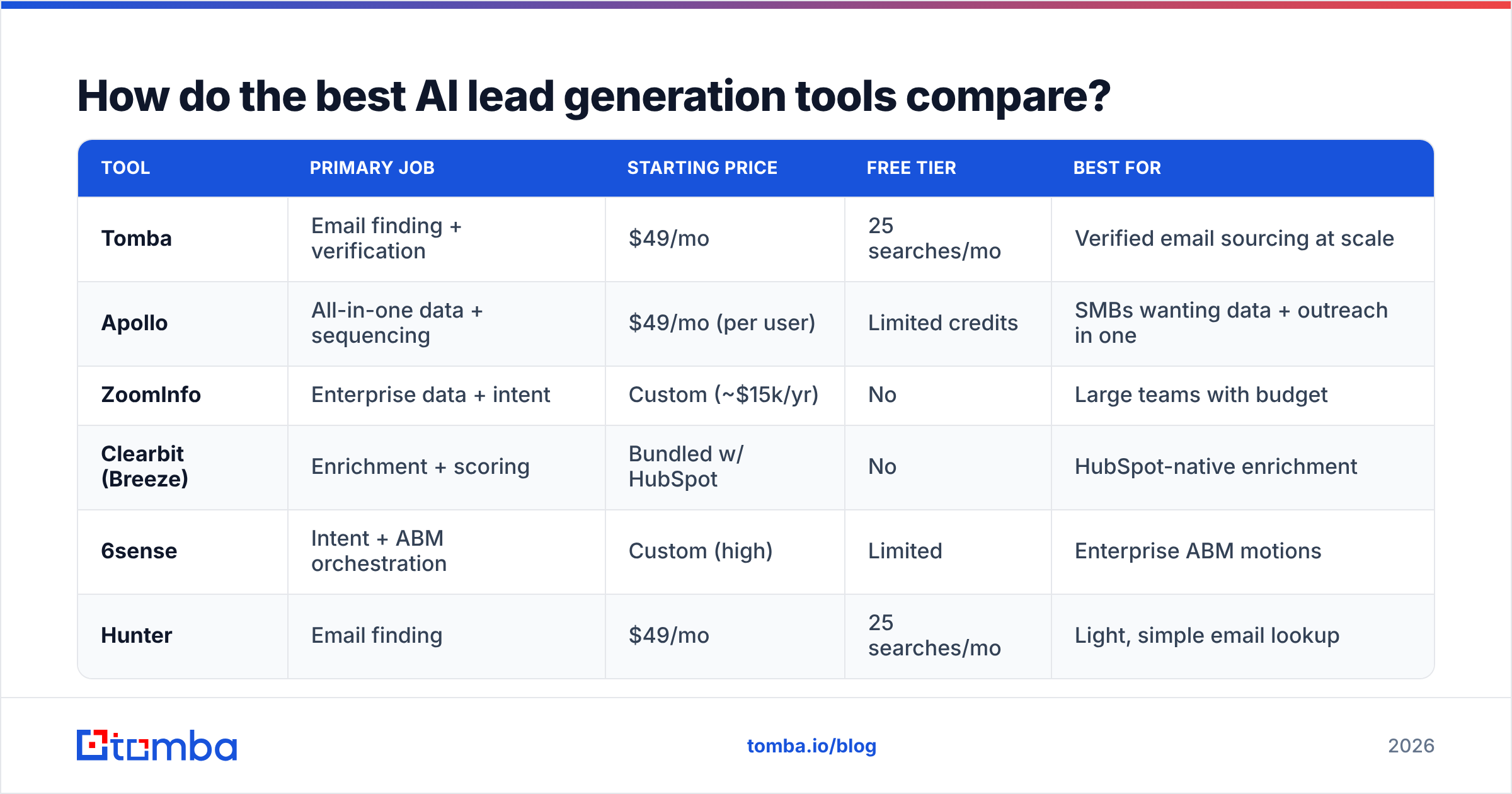
Here's the honest part nobody puts in their comparison page: AI features are a tiebreaker, not a foundation. The foundation is data accuracy and how cleanly the tool drops into your workflow. A 95%-accurate finder at $49/mo will out-earn a "predictive AI" suite at $1,500/mo if the suite's emails bounce.
Below is a side-by-side of the main contenders across the attributes that actually change your pipeline.
| Tool | Primary job | Starting price | Free tier | Best for |
|---|---|---|---|---|
| Tomba | Email finding + verification | $49/mo | 25 searches/mo | Verified email sourcing at scale |
| Apollo | All-in-one data + sequencing | $49/mo (per user) | Limited credits | SMBs wanting data + outreach in one |
| ZoomInfo | Enterprise data + intent | Custom (~$15k/yr) | No | Large teams with budget |
| Clearbit (Breeze) | Enrichment + scoring | Bundled w/ HubSpot | No | HubSpot-native enrichment |
| 6sense | Intent + ABM orchestration | Custom (high) | Limited | Enterprise ABM motions |
| Hunter | Email finding | $49/mo | 25 searches/mo | Light, simple email lookup |
A few things jump out. First, the price gap between a focused finder and an enterprise intent platform is 20–100x. Second, "free tier" is mostly a trial, not a workflow — only the finder-class tools give you a genuinely usable monthly allowance. Third, almost nobody is best at more than one column. ZoomInfo's data depth is real but you pay enterprise rates and sign annual contracts. Apollo bundles everything but its email accuracy is inconsistent across regions. You can read more on how the data itself is sourced and validated on Tomba's data sources page, which is more transparency than most vendors offer.
If your bottleneck is sourcing accurate contact data — the most common one — a dedicated email finder plus a verifier will outperform a bloated suite, because that's the one job it's built around.
Why does data accuracy beat AI features?#
Because every downstream AI is only as good as the record it scores. This is the single most expensive lesson in outbound, and it's worth stating plainly: garbage in, confidently-scored garbage out.
Picture your CRM as a kitchen. Intent data, lead scoring, and AI sequencing are the chefs. Contact data is the ingredients. You can hire a three-star chef (a $50k/yr intent platform), but if the produce is rotten — stale emails, wrong titles, dead domains — the dish fails. No amount of AI plating fixes spoiled inputs.
Concretely, here's how poor data quietly drains a campaign:
- Bounce rate climbs. Each invalid email chips at your sender reputation, and once mailbox providers distrust your domain, even your good emails land in spam.
- Rep time evaporates. SDRs spend hours chasing contacts who left the company two reorgs ago.
- Scoring lies to you. An AI model that flags an "engaged" lead based on a duplicate or merged record sends you down a dead end.
- Attribution breaks. You can't tell what worked because half your sends never arrived.
This is why the verification step is non-negotiable. Running every find through an email verifier before it hits a sequence is the cheapest insurance in your whole stack. Catch-all domains — where the server accepts everything and confirms nothing — are the trap that wrecks "verified" lists; a dedicated catch-all verifier is what separates a list that performs from one that looks fine and bounces.
Which AI lead generation tool fits which team?#
Match the tool to your motion, not the other way around. Here's the decision tree most teams should follow.
If you're a founder or small team doing targeted outbound: Start with a finder-first stack. You need verified emails and maybe phone numbers, not a $1,500/mo platform. Pair Tomba's domain search to map out a target company's contacts, the finder to pull specific people, and the bulk email finder when you're working from a list. Total cost: well under $100/mo on the Growth plan.
If you're an SMB sales team wanting data and outreach together: Apollo is the obvious all-in-one, but cross-check its email accuracy in your region before scaling — many teams supplement Apollo's data with a dedicated finder precisely because of accuracy gaps. (Tomba publishes an Apollo alternative breakdown if you want the head-to-head.)
If you're a mid-market team running account-based plays: You'll want enrichment plus some intent signal. Clearbit/Breeze makes sense if you're already deep in HubSpot; otherwise a standalone data enrichment layer keeps you flexible and avoids lock-in.
If you're an enterprise with budget and a RevOps team: ZoomInfo or 6sense earn their keep here — but only if you have the headcount to operationalize intent data. These platforms punish teams that buy them as a status symbol and never wire up the workflows.
The pattern across all four: the tool is a means, not the strategy. A platform doesn't generate leads; a well-targeted message to a verified contact does.
What features actually matter when you evaluate?#
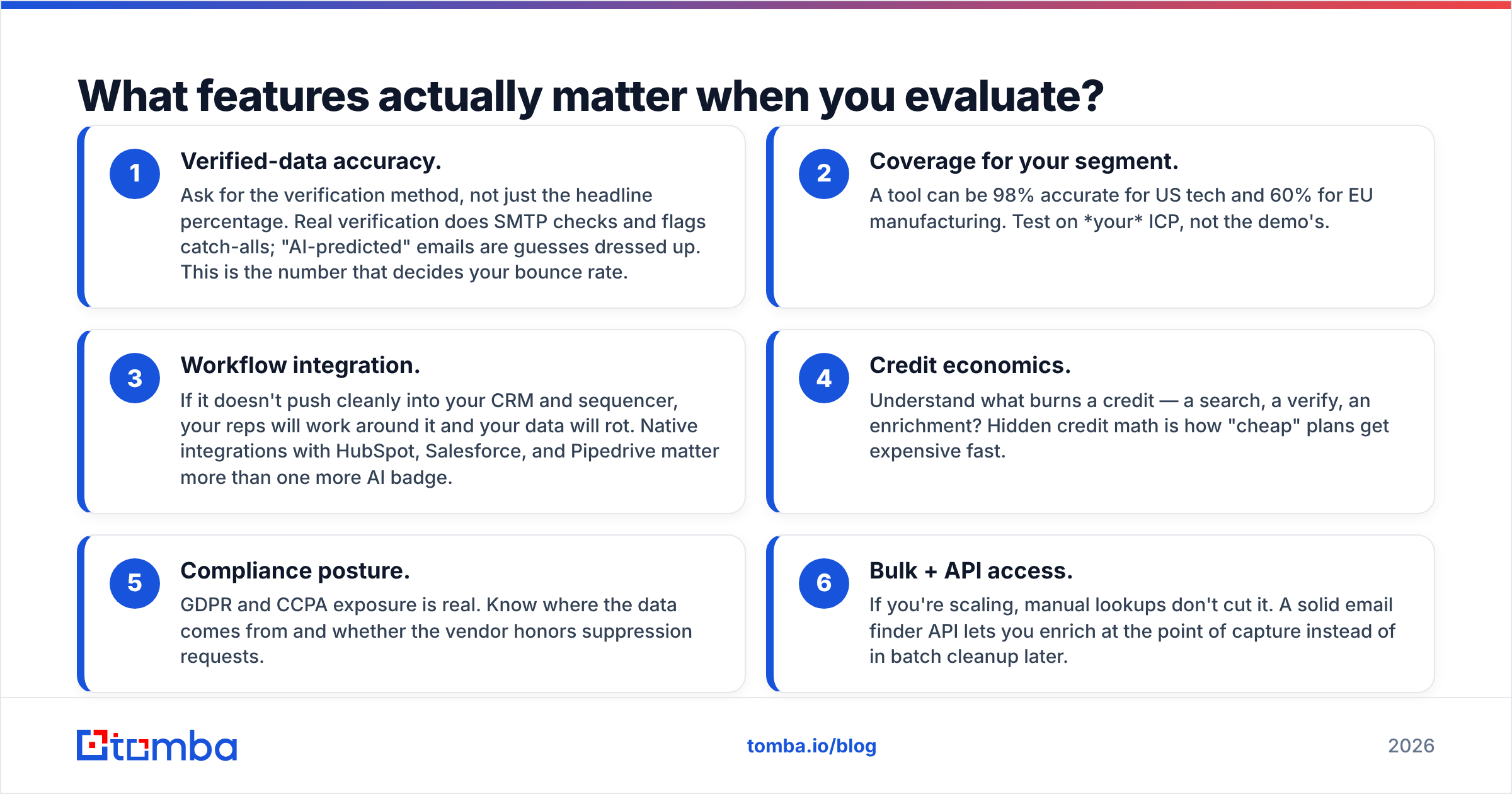
Skip the feature-checklist arms race. These are the attributes that correlate with pipeline, ranked by how much they'll affect your results.
- Verified-data accuracy. Ask for the verification method, not just the headline percentage. Real verification does SMTP checks and flags catch-alls; "AI-predicted" emails are guesses dressed up. This is the number that decides your bounce rate.
- Coverage for your segment. A tool can be 98% accurate for US tech and 60% for EU manufacturing. Test on your ICP, not the demo's.
- Workflow integration. If it doesn't push cleanly into your CRM and sequencer, your reps will work around it and your data will rot. Native integrations with HubSpot, Salesforce, and Pipedrive matter more than one more AI badge.
- Credit economics. Understand what burns a credit — a search, a verify, an enrichment? Hidden credit math is how "cheap" plans get expensive fast.
- Compliance posture. GDPR and CCPA exposure is real. Know where the data comes from and whether the vendor honors suppression requests.
- Bulk + API access. If you're scaling, manual lookups don't cut it. A solid email finder API lets you enrich at the point of capture instead of in batch cleanup later.
Notice "AI" isn't its own line item. That's deliberate. AI is how a good tool delivers items 1–6 faster — it isn't a benefit on its own. When a vendor leads with "AI" and goes quiet on data sourcing, treat it as a yellow flag.
How do you build a lead-gen stack instead of buying one tool?#
The best teams compose a stack; they don't bet everything on a single platform. Think of it like a relay race — each tool runs its leg and hands off cleanly.
A lean, high-performing 2026 stack looks like this:
- Source layer: an email/contact finder (Tomba) for verified emails and phone numbers.
- Verify layer: a verifier + catch-all check before anything enters a sequence.
- Enrich layer: firmographic/technographic enrichment to prioritize.
- Engage layer: a sequencer (Instantly, Salesloft, or HubSpot) to run the cadence.
- Score layer: intent or reply-scoring to route the warm ones to reps fast.
The beauty of composing is leverage. You can swap any single leg without ripping out the whole system — outgrow your sequencer and you replace one tool, not your entire data foundation. All-in-one suites trade that flexibility for convenience, which is fine until the one thing they're mediocre at (usually data accuracy) becomes your ceiling.
For independent benchmarks while you evaluate, G2 and Capterra carry real user reviews segmented by company size — far more useful than vendor case studies. And for the engagement and scoring layer, HubSpot's research on response rates is a solid sanity check on what "good" looks like before you blame your tools.
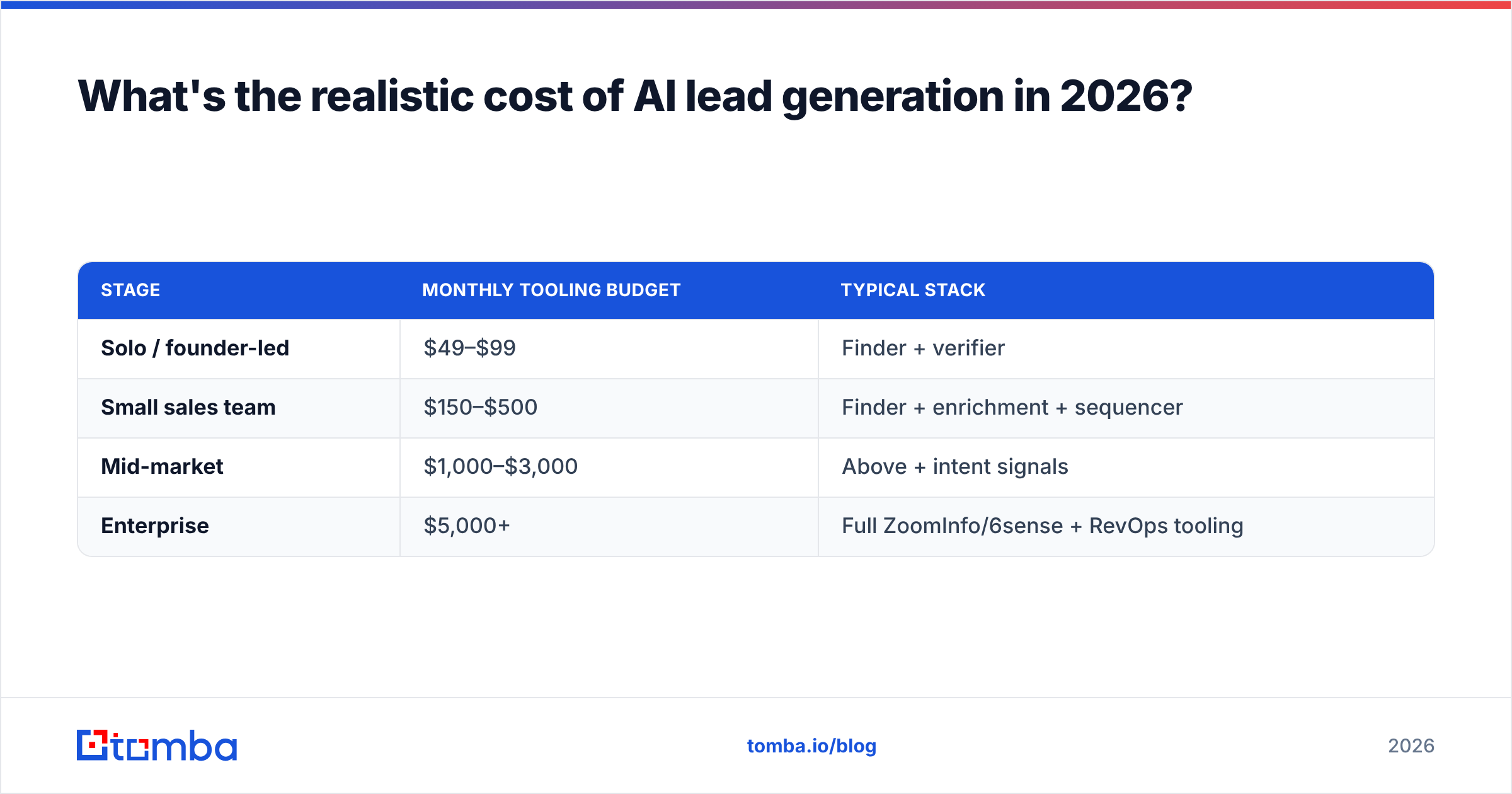
What's the realistic cost of AI lead generation in 2026?#
Budget in tiers, and match the tier to your stage — don't buy enterprise software to do startup-volume outbound.
| Stage | Monthly tooling budget | Typical stack |
|---|---|---|
| Solo / founder-led | $49–$99 | Finder + verifier |
| Small sales team | $150–$500 | Finder + enrichment + sequencer |
| Mid-market | $1,000–$3,000 | Above + intent signals |
| Enterprise | $5,000+ | Full ZoomInfo/6sense + RevOps tooling |
Two cost traps to avoid. First, seat-based pricing on all-in-one suites scales painfully — a 10-rep team on a $99/seat tool is $990/mo before you've sourced a single lead. Tools priced on usage (searches, credits) tend to be friendlier to growing teams. Second, annual lock-in on enterprise platforms means you're committed before you've validated fit; negotiate a pilot or short term first.
For most teams reading this, the math favors starting focused. A Tomba plan at $49–$99/mo covers verified sourcing for a serious outbound effort, and you add layers only when a real bottleneck appears — not because a sales rep upsold you a module you'll never configure.
So which is the best AI lead generation tool?#
There's no single winner, and any list that crowns one is selling you something. The right question is "best at which job, for my stage?"
- Best for verified email sourcing on a budget: a finder-first stack like Tomba.
- Best all-in-one for SMBs: Apollo, with a verifier bolted on.
- Best enterprise data depth: ZoomInfo.
- Best ABM/intent orchestration: 6sense or Demandbase.
- Best HubSpot-native enrichment: Clearbit/Breeze.
What's consistent across every category: the teams that win treat data accuracy as the foundation and AI as the accelerant — never the reverse. Buy the tool that nails your bottleneck, verify everything before you send, and resist the urge to pay for AI features that sit on top of data you haven't validated.
Ready to fix the data layer first?#
If your real bottleneck is finding contacts you can actually reach — and for most teams it is — start where the leverage is highest. The Tomba Email Finder turns a name and company domain into a verified professional email, with built-in verification and catch-all detection so your list performs instead of just looking full. The free tier gives you 25 searches a month to test it against your own ICP before you spend a cent, and paid plans start at $49/mo when you're ready to scale. Build the data foundation right, and every AI tool you add on top of it suddenly starts earning its price.
// get started
Find, verify and enrich your first contacts today
Start on the free plan with 25 searches a month, then scale when your team is ready.
Free plan · No credit card required · GDPR & CCPA
// about the author