Best AI Outreach Tools in 2026: Ranked, Tested & Compared
AI outreach tools promise more replies with less manual work — but most fail without clean data. Here are the best AI outreach tools in 2026, what they cost, and where each one fits.
You can buy the smartest AI outreach platform on the market and still get zero replies. The reason is boring and predictable: the tool writes a great email and sends it to an address that bounces. AI sequencing, personalization, and reply detection only matter once the contact data underneath them is correct.
This guide ranks the best AI outreach tools in 2026 by what they actually do well — and shows where each one breaks. We'll compare features, pricing, and ideal use cases, then explain why the data layer (finding and verifying the contact) is the part most teams underinvest in.
TL;DR#
- The best AI outreach tools in 2026 are Instantly, Apollo, Smartlead, Lemlist, Reply.io, and Salesloft — each strong for a different team size and motion.
- AI features are converging. Most platforms now offer AI copy, multivariate testing, and reply classification. The differentiator is deliverability infrastructure and CRM depth, not the AI gimmicks.
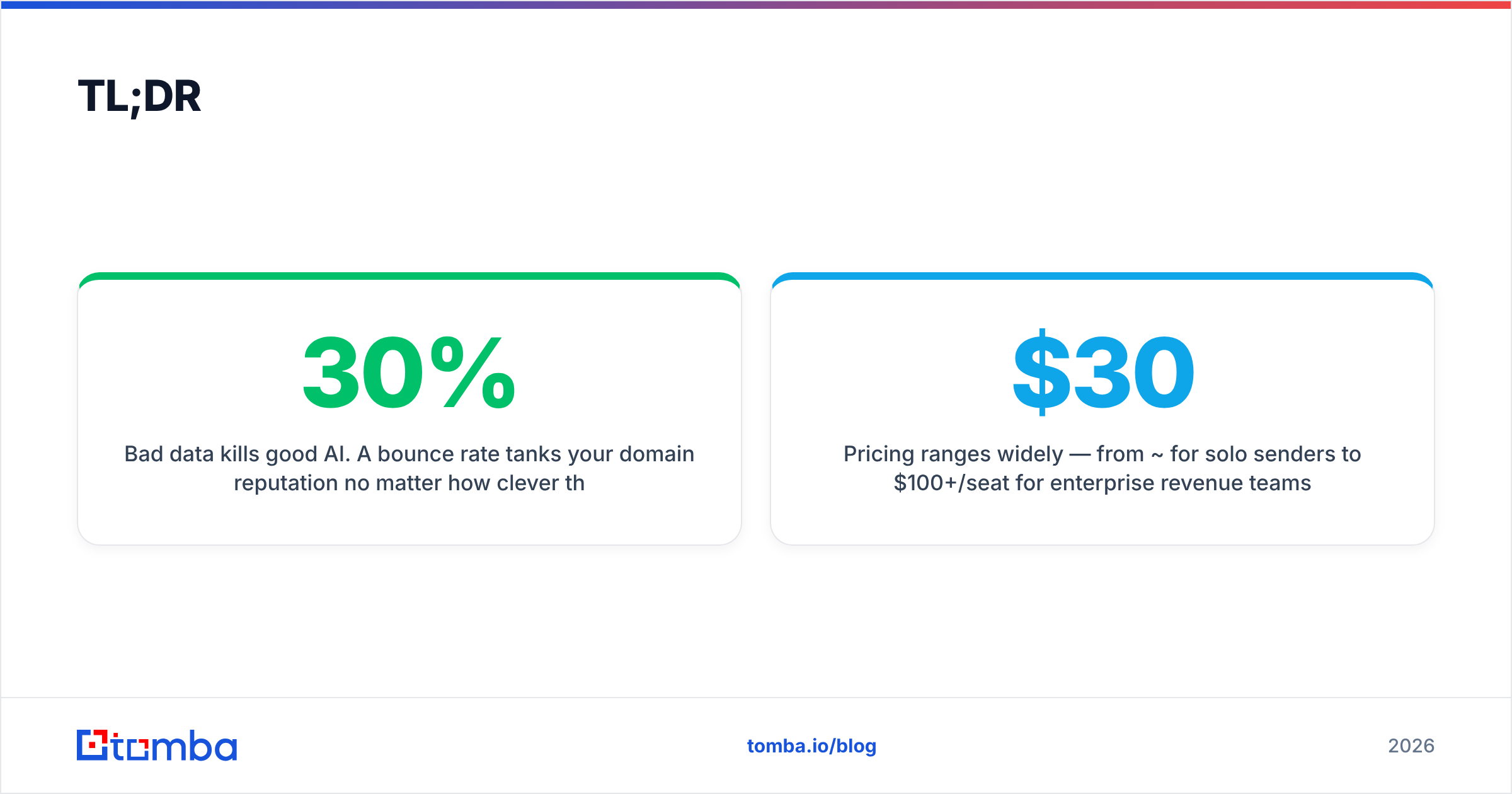
- Bad data kills good AI. A 30% bounce rate tanks your domain reputation no matter how clever the sequence is. Verify before you send.
- Pair your sender with a data source. Tools like the Tomba Email Finder feed clean, verified contacts into whichever outreach platform you pick.
- Pricing ranges widely — from ~$30/mo for solo senders to $100+/seat/mo for enterprise revenue teams.
What are AI outreach tools?#
AI outreach tools are platforms that automate and optimize sales and marketing communication — cold email, LinkedIn, and sometimes calls — using machine learning to write copy, decide send timing, personalize at scale, and detect replies.
Think of an AI outreach tool like a power-assisted bicycle. You still steer and pedal (strategy, offer, list), but the motor (AI) makes each rotation go further. The motor doesn't decide where you're going, and it can't move you forward if the chain is broken — that "chain" is your contact data.
Modern platforms generally bundle four capabilities:
- Sequencing — multi-step, multi-channel campaigns that fire automatically based on opens, clicks, and replies.
- AI personalization — generating opening lines, value props, and follow-ups tailored to each prospect's role, company, or recent activity.
- Deliverability tooling — inbox warmup, sending-rotation, spam-word checks, and reputation monitoring to keep you out of the spam folder.
- Analytics and reply handling — classifying responses (interested, not now, unsubscribe) and surfacing the metrics that predict pipeline.
The category overlaps with sales automation and CRM-native sequencers, but pure-play outreach tools tend to lead on deliverability and AI copy.
How do you choose the best AI outreach tool?#
Choose based on team size, channel mix, and how much you care about deliverability versus CRM depth — not the length of the AI feature list.
Use these six criteria, with bold leads for what to actually check:
- Deliverability infrastructure — Does it offer warmup, inbox rotation, and reputation monitoring? This is the single biggest predictor of cold-email success.
- Data integration — Can it pull verified contacts, or do you bring your own list? Most senders need a separate data source.
- AI copy quality — Are the generated lines usable, or do they read like a robot? Test with your own ICP before committing.
- Channel coverage — Email only, or email + LinkedIn + calls? Multi-channel lifts reply rates but adds complexity.
- CRM and stack fit — Native HubSpot or Salesforce sync, or one-way push?
- Price per outcome — Cost per seat or per inbox versus the volume you actually send.
What are the best AI outreach tools in 2026?#
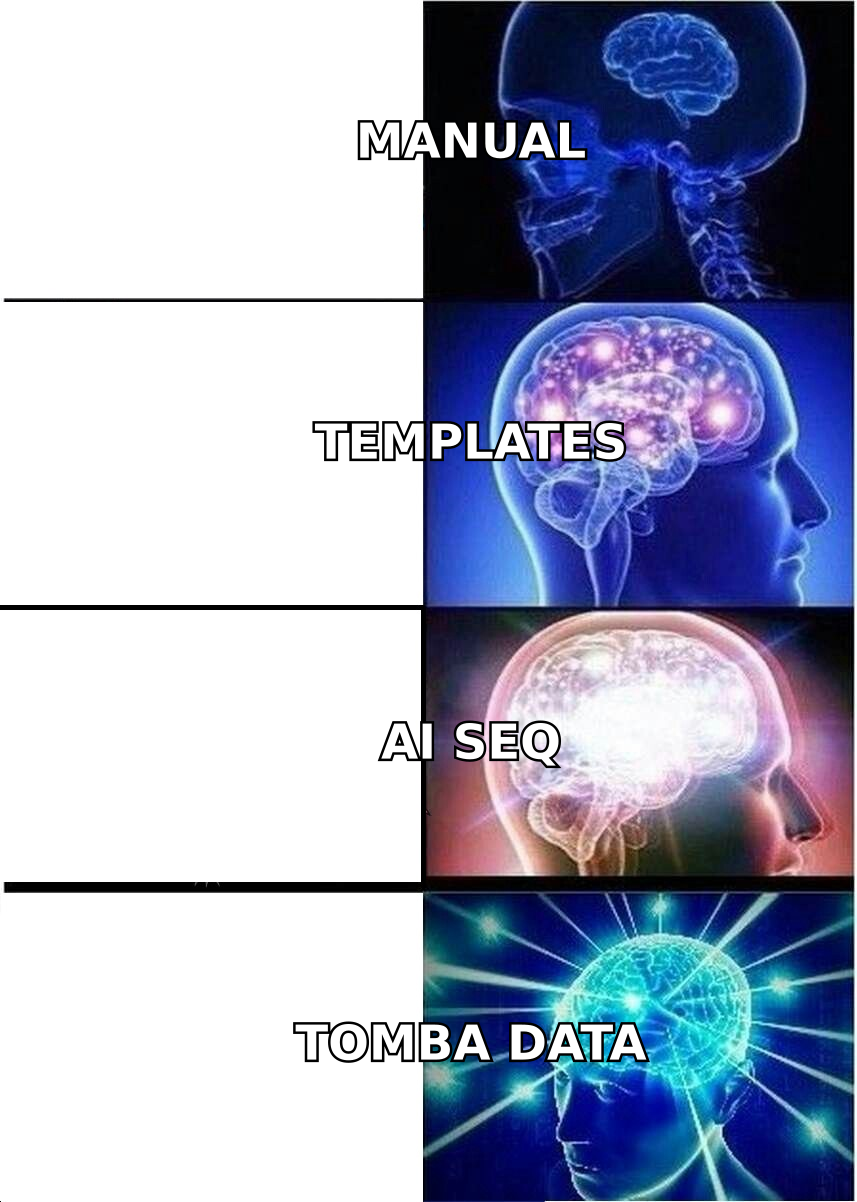
Here's the head-to-head. Pricing is approximate and reflects published entry tiers as of 2026 — always confirm on the vendor's own site.
| Tool | Best for | Core AI feature | Channels | Entry price |
|---|---|---|---|---|
| Instantly | High-volume cold email | AI copy + unlimited warmup | ~$37/mo | |
| Apollo | All-in-one data + send | AI writing + 275M contact DB | Email, calls | ~$49/mo |
| Smartlead | Agencies, deliverability | AI inbox rotation | ~$39/mo | |
| Lemlist | Multichannel SMBs | AI personalization + images | Email, LinkedIn | ~$55/mo |
| Reply.io | SDR teams | AI SDR + reply intent | Email, LinkedIn, calls | ~$59/mo |
| Salesloft | Enterprise revenue orgs | Rhythm AI + forecasting | Email, calls, LinkedIn | Custom |
Instantly#
Instantly built its reputation on unlimited email accounts and aggressive warmup, making it the default for teams sending serious cold-email volume. Its AI now drafts and rewrites copy, and the deliverability network is among the strongest in the category. The catch: it's email-only, and you must supply your own verified list.
Apollo#
Apollo is the closest thing to an all-in-one — a large built-in contact database plus a sequencer plus AI copy. That convenience is its selling point and its weakness: bundled data accuracy varies by region and seniority, and heavy users often layer a dedicated finder on top. If Apollo's data coverage frustrates you, an Apollo alternative focused on verification can fill the gaps.
Smartlead#
Smartlead is the agency favorite — unlimited inboxes, master-inbox reply management, and a deliverability-first design. The AI handles rotation and warmup intelligently. It assumes you already know cold email; the UI rewards operators, not beginners.
Lemlist#
Lemlist leans into personalization — dynamic images, custom landing pages, and AI-generated intros — across email and LinkedIn. It's a strong pick for SMB teams that want creative, multichannel touches without enterprise pricing.
Reply.io#
Reply.io packages an "AI SDR" that drafts, sends, and triages responses by intent across email, LinkedIn, and calls. It suits SDR teams that want automation with a human in the loop. Compare it against a Reply.io alternative if you want lighter pricing.
Salesloft#
Salesloft is enterprise-grade: cadence orchestration, conversation intelligence, and forecasting under one roof. It's overkill for a two-person startup but indispensable for a 50-rep revenue org. Teams priced out often evaluate a Salesloft alternative.
Is AI outreach better than manual outreach?#
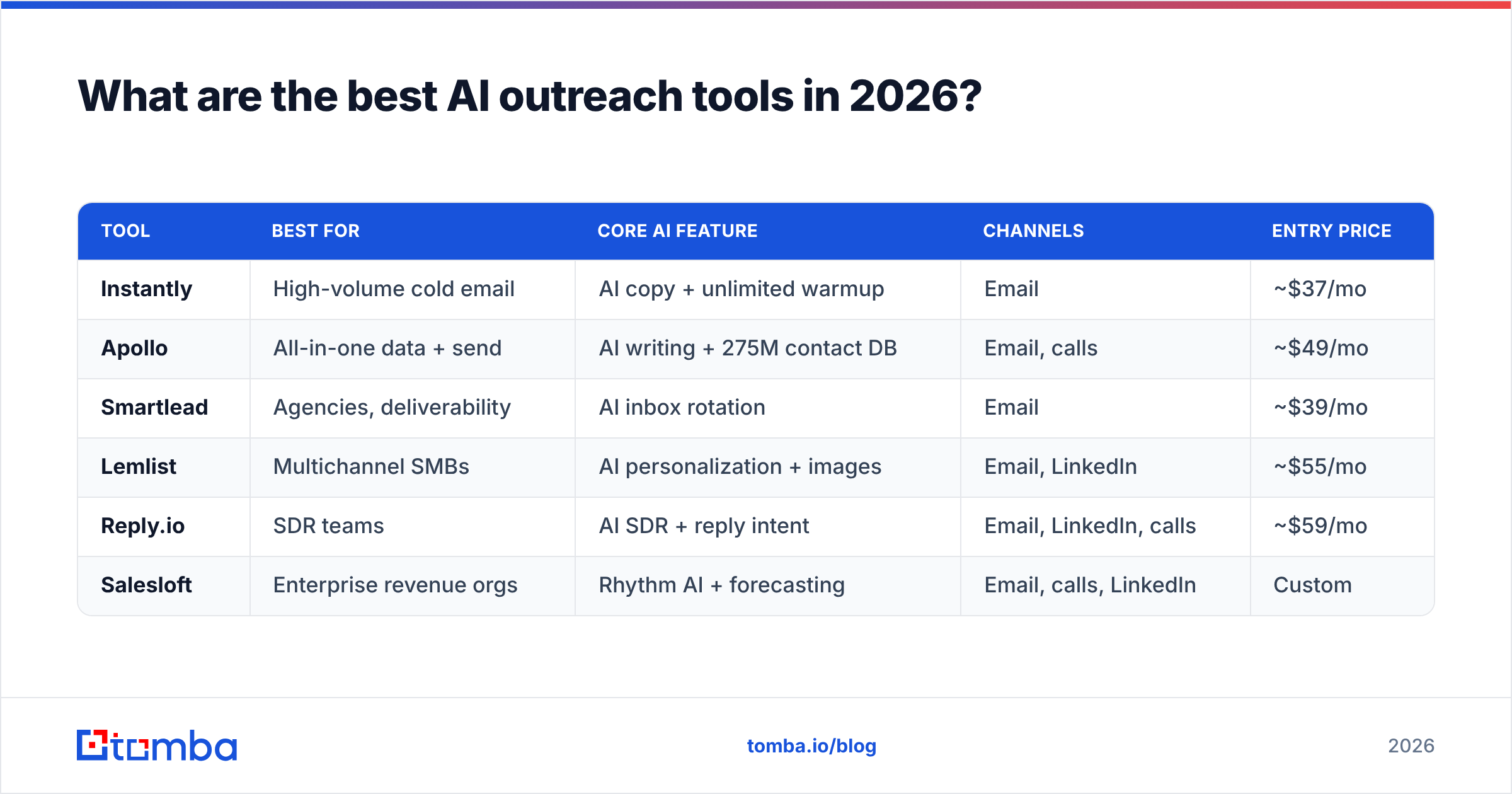
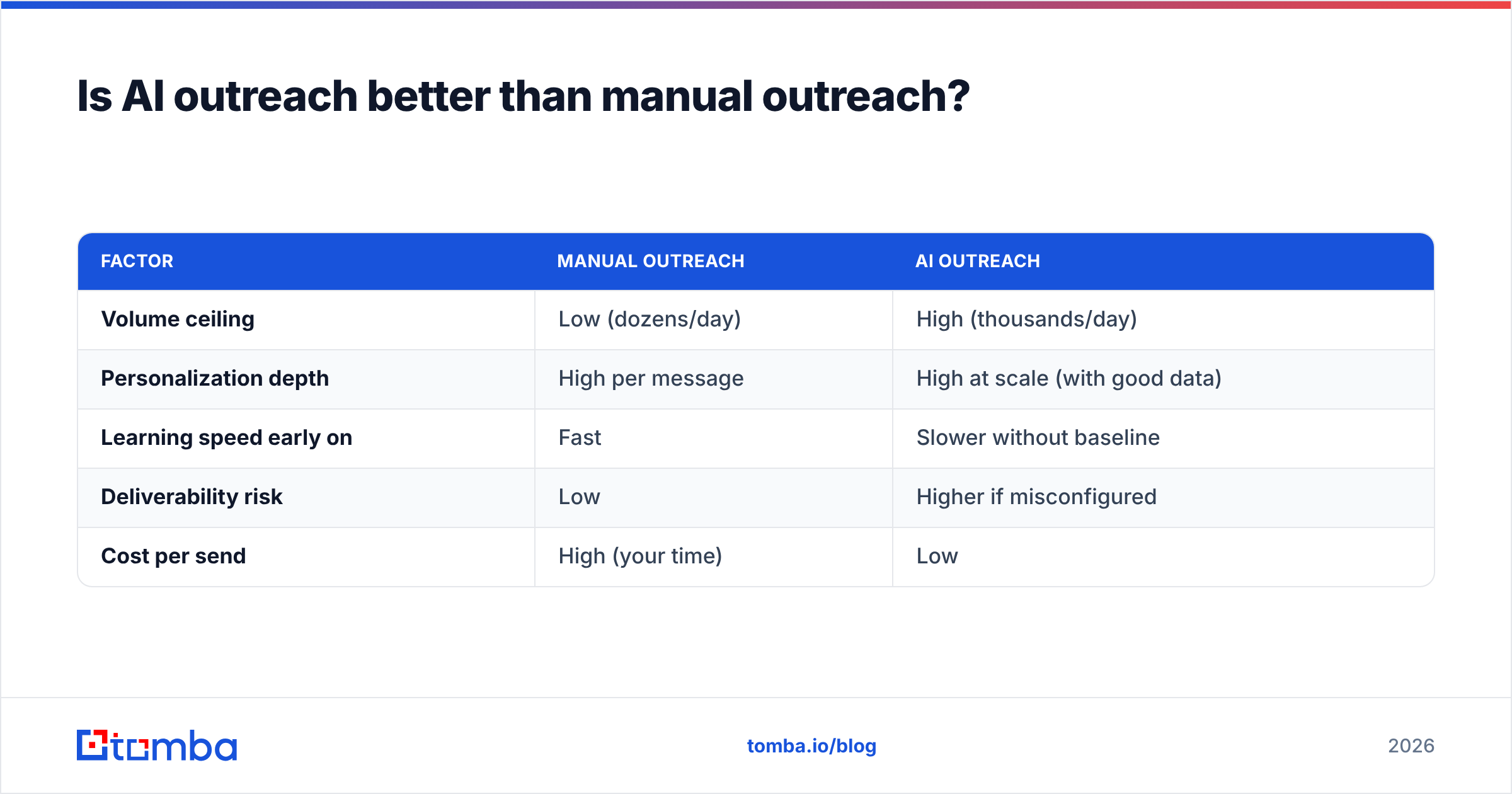
Yes for scale, no for the first 50 emails of a brand-new motion. AI outreach wins decisively once you've validated your message and want to multiply volume. Before that, manual sending teaches you what actually resonates — and no AI can learn your offer faster than you can.
The honest tradeoff:
| Factor | Manual outreach | AI outreach |
|---|---|---|
| Volume ceiling | Low (dozens/day) | High (thousands/day) |
| Personalization depth | High per message | High at scale (with good data) |
| Learning speed early on | Fast | Slower without baseline |
| Deliverability risk | Low | Higher if misconfigured |
| Cost per send | High (your time) | Low |
The pattern that works: prove the message manually, then hand the proven sequence to an AI tool to scale it. Skipping step one means you scale a message that doesn't convert — faster failure, not faster success.
Why does data quality decide whether AI outreach works?#
Because every AI feature sits downstream of the contact record, and a wrong record poisons everything above it. The most sophisticated personalization in the world is worthless if the email address bounces or belongs to someone who left the company 18 months ago.
Here's the chain reaction most teams miss:
- Invalid email → hard bounce → domain reputation drop. A few percent of bounces is tolerable; 20–30% gets your domain flagged. Once flagged, even your valid emails land in spam. Protect this with email deliverability hygiene.
- Stale data → wrong personalization. "I saw you're leading growth at Acme" lands badly when they left Acme last year.
- Catch-all domains → silent failures. Catch-all servers accept everything, so a naive verifier marks them valid when they may not be. A catch-all verifier resolves the ambiguity.
- Duplicate or mismatched records → wasted credits. You pay to send the same prospect three near-identical sequences.
This is why the smartest stacks separate the finding and verifying layer from the sending layer. Your outreach platform sends; a dedicated data tool ensures what it sends to is real. Run new lists through an email verifier before they ever touch a sequence, and use domain search to pull the right contacts at a target company in the first place.
Industry research backs this up. HubSpot's reporting on email engagement and analyst coverage from G2 consistently shows that list quality and deliverability — not subject-line cleverness — separate top and bottom quartile senders.
How much do AI outreach tools cost in 2026?#
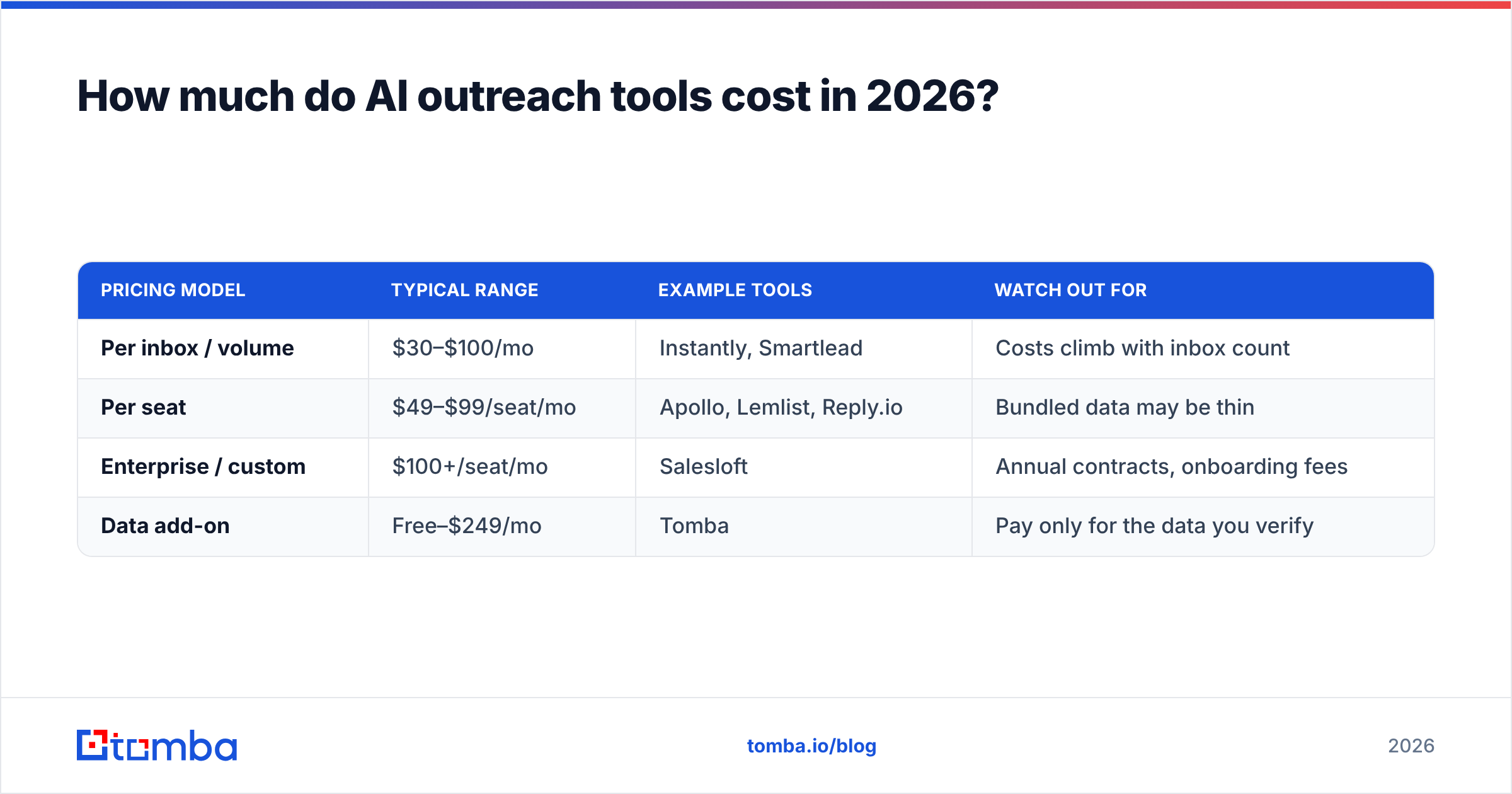
Expect roughly $30–$60/month for self-serve cold-email tools and custom enterprise pricing for full revenue platforms. Most price by inbox, contact volume, or seat — so your real cost depends on how you send, not the sticker number.
| Pricing model | Typical range | Example tools | Watch out for |
|---|---|---|---|
| Per inbox / volume | $30–$100/mo | Instantly, Smartlead | Costs climb with inbox count |
| Per seat | $49–$99/seat/mo | Apollo, Lemlist, Reply.io | Bundled data may be thin |
| Enterprise / custom | $100+/seat/mo | Salesloft | Annual contracts, onboarding fees |
| Data add-on | Free–$249/mo | Tomba | Pay only for the data you verify |
On the data side, Tomba pricing starts with a free tier (25 searches/mo), then Starter at $49/mo, Growth at $99/mo, and Pro at $249/mo. The point isn't to replace your sender — it's to make sure the sender isn't firing into the void. Budgeting for a verification layer alongside your outreach tool is cheaper than rebuilding a burned sending domain.
What's the best AI outreach stack for most teams?#
For most B2B teams in 2026, the winning stack is a deliverability-first sender plus a dedicated, verified data source — not one tool trying to do both.
A practical blueprint:
- Find contacts with a dedicated finder by company domain or name. Pull decision-makers, not generic info@ addresses.
- Verify everything before import. Filter invalids and resolve catch-alls so your bounce rate stays under 3%.
- Send and sequence with Instantly, Smartlead, or Apollo depending on volume and channel needs.
- Sync to CRM so replies and bookings flow into HubSpot or Pipedrive automatically.
- Monitor and refresh — re-verify lists quarterly, since B2B data decays roughly 2–3% per month.
This separation of concerns is why teams that bolt a data layer onto a strong sender outperform teams that trust one bundled platform to do everything passably.
Frequently asked questions#
Do AI outreach tools guarantee more replies? No. They scale whatever message and list you give them. Garbage in, garbage out — at higher volume.
Can one tool replace both my data source and my sender? Some try (Apollo, Reply.io). In practice, bundled data accuracy lags dedicated finders, so most serious senders keep a separate verification step.
What bounce rate is safe? Keep hard bounces under 3%. Above that, mailbox providers start throttling and flagging your domain.
Is cold email still effective in 2026? Yes, when it's verified, personalized, and warmed up. The teams complaining it's "dead" are usually the ones skipping verification.
The bottom line#
The best AI outreach tools in 2026 — Instantly, Apollo, Smartlead, Lemlist, Reply.io, and Salesloft — are all genuinely capable. Pick by team size, channel mix, and how much deliverability infrastructure you need. But remember the order of operations: the AI is only as good as the contact it's emailing.
Before you scale any sequence, lock down your data. Use the Tomba Email Finder to source decision-maker emails by domain or name, then verify them so your chosen outreach platform sends into real inboxes instead of bouncing into spam folders. Start free with 25 searches, and let your AI tools do what they're good at — on a foundation that actually delivers.
// get started
Find, verify and enrich your first contacts today
Start on the free plan with 25 searches a month, then scale when your team is ready.
Free plan · No credit card required · GDPR & CCPA
// about the author