Best B2B Contact Database in 2026: 9 Tools Compared
Most B2B contact databases sell you on record counts, then hand you stale emails. Here's how the top providers actually compare on accuracy, coverage, pricing, and GDPR compliance in 2026 — and which one fits your budget.
TL;DR
- The "best B2B contact database" is not the one with the most records — it's the one with the freshest, verified records for your target market and a price that survives finance review.
- Enterprise teams lean ZoomInfo or Cognism for depth and intent data; SMB and lean GTM teams get more value from Apollo, Lusha, RocketReach, or a verified email-first tool like Tomba.
- Decay is the silent killer: B2B contact data goes stale at roughly 22–30% per year, so verification matters more than the headline record count.
- Compliance is now a buying criterion, not a footnote — GDPR and CCPA exposure differs widely between US-scraped and consent-based EU databases.
- Budget-conscious teams can combine a smaller core database with on-demand verification and enrichment instead of paying five figures for seats they won't use.
What is a B2B contact database?#
A B2B contact database is a searchable store of business people and the companies they work for — names, job titles, work emails, phone numbers, LinkedIn profiles, and firmographics like headcount, revenue, and tech stack. Think of it as the difference between a phone book and a living address book: a static list goes out of date the moment it's printed, while a good database is continuously re-checked against reality.
The catch is that "database" covers wildly different products. Some vendors maintain a fixed warehouse of pre-collected records you query by filter. Others build records on demand — you ask for emails at stripe.com, and the engine finds and verifies them in real time. Many of the B2B data and intelligence tools you'll evaluate blend both models, which is why two providers quoting "275M contacts" can deliver completely different results on your actual list.
For a working definition and how this fits the wider stack, the Gartner market guide for B2B data providers is a useful neutral reference before you talk to any sales rep.
What makes the best B2B contact database?#
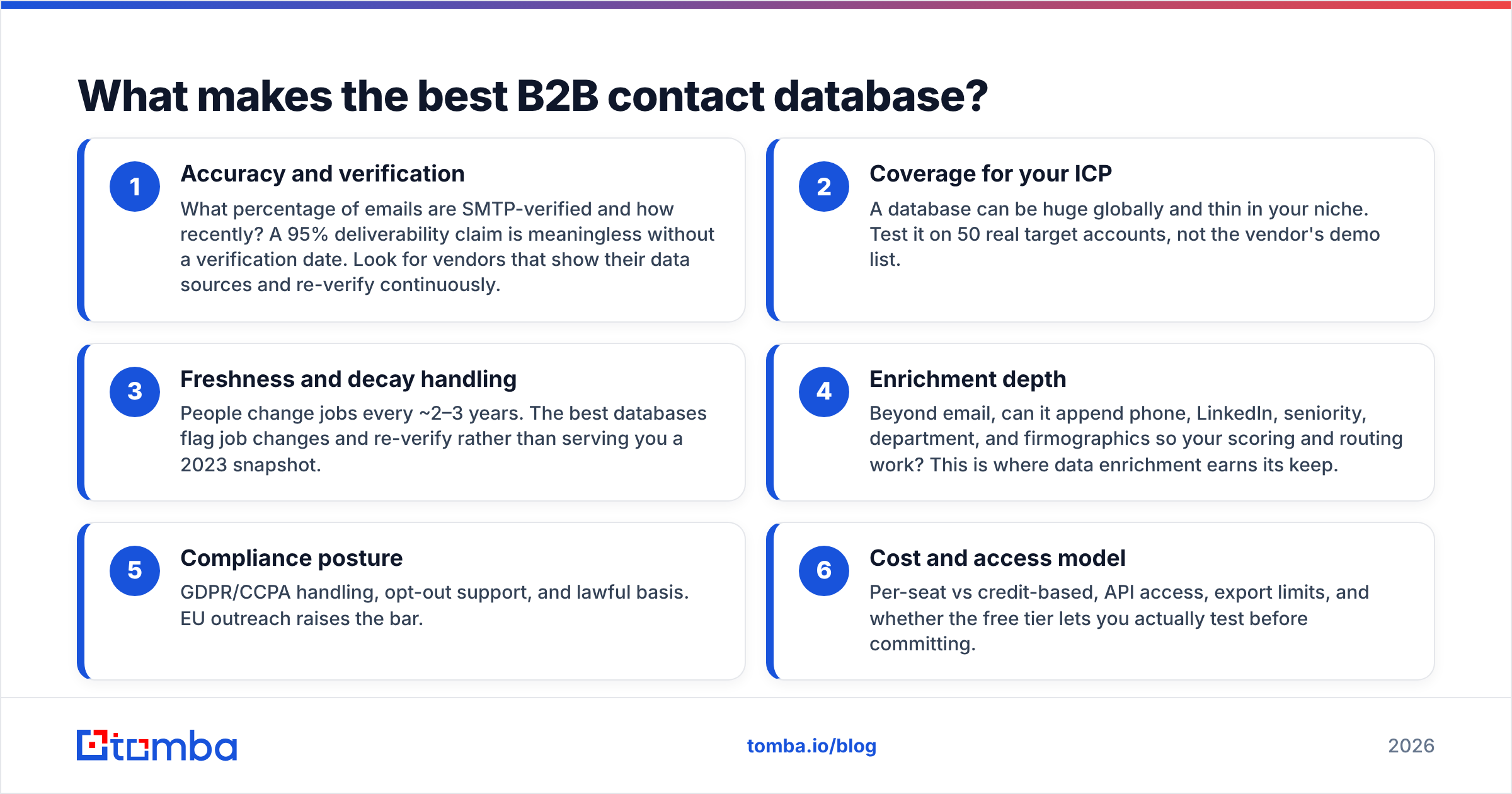
The best B2B contact database wins on data quality and usability, not on the size of the number in its marketing headline. Score every vendor against these six dimensions:
- Accuracy and verification — What percentage of emails are SMTP-verified and how recently? A 95% deliverability claim is meaningless without a verification date. Look for vendors that show their data sources and re-verify continuously.
- Coverage for your ICP — A database can be huge globally and thin in your niche. Test it on 50 real target accounts, not the vendor's demo list.
- Freshness and decay handling — People change jobs every ~2–3 years. The best databases flag job changes and re-verify rather than serving you a 2023 snapshot.
- Enrichment depth — Beyond email, can it append phone, LinkedIn, seniority, department, and firmographics so your scoring and routing work? This is where data enrichment earns its keep.
- Compliance posture — GDPR/CCPA handling, opt-out support, and lawful basis. EU outreach raises the bar.
- Cost and access model — Per-seat vs credit-based, API access, export limits, and whether the free tier lets you actually test before committing.
)
How do the top B2B contact databases compare in 2026?#
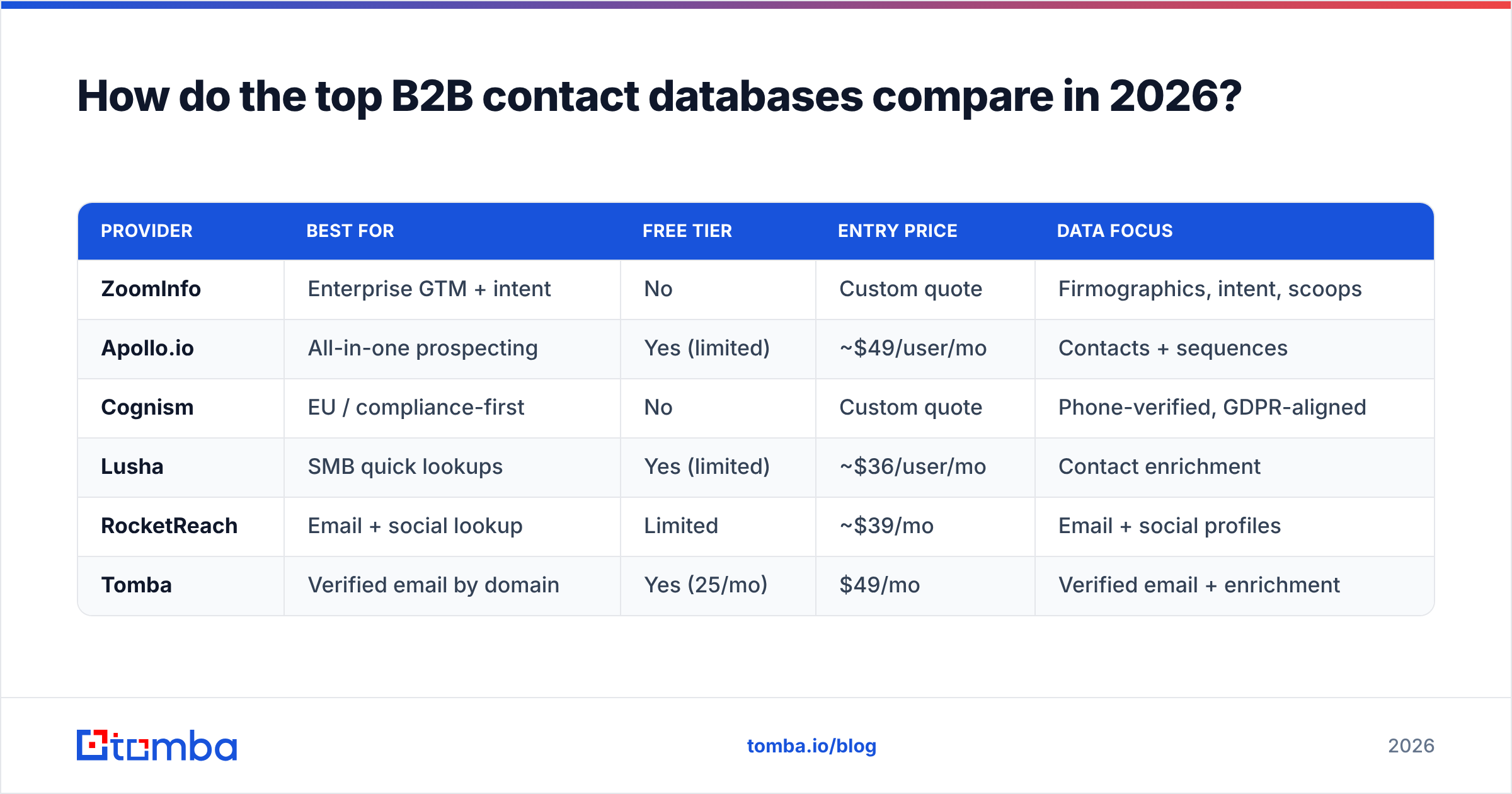
Here's how the most common providers stack up. Prices are entry points published by each vendor or commonly reported; enterprise tiers are quote-based and vary by seat count and data volume.
| Provider | Best for | Free tier | Entry price | Data focus |
|---|---|---|---|---|
| ZoomInfo | Enterprise GTM + intent | No | Custom quote | Firmographics, intent, scoops |
| Apollo.io | All-in-one prospecting | Yes (limited) | ~$49/user/mo | Contacts + sequences |
| Cognism | EU / compliance-first | No | Custom quote | Phone-verified, GDPR-aligned |
| Lusha | SMB quick lookups | Yes (limited) | ~$36/user/mo | Contact enrichment |
| RocketReach | Email + social lookup | Limited | ~$39/mo | Email + social profiles |
| Tomba | Verified email by domain | Yes (25/mo) | $49/mo | Verified email + enrichment |

A few honest takeaways from the table:
- ZoomInfo and Cognism are premium for a reason — deep firmographics and intent signals — but they're priced for funded teams and lock you into annual contracts. Browse the verified reviews on G2's sales intelligence category before signing.
- Apollo is the value leader for all-in-one — database plus sequencing in one seat — though data depth in EMEA can be thinner than its US coverage.
- Tomba, RocketReach, and Lusha shine when you need targeted, verified contacts on demand rather than a giant static warehouse you pay to rent. If Apollo is overkill, an Apollo alternative built around verified email may cost a fraction.
How accurate is the data, really?#
Accuracy is where most "biggest database" claims fall apart. A record count tells you nothing about how many of those emails will actually deliver today.

Two numbers matter far more than total records:
- Verified rate — the share of contacts confirmed deliverable, ideally via SMTP checks rather than pattern guessing. Always confirm whether catch-all domains are flagged; a "valid" address on a catch-all server is a coin flip without a dedicated catch-all verifier.
- Recency — when each record was last re-checked. Data decays at roughly a quarter of your list per year, so a database refreshed quarterly beats one refreshed annually even if the annual one started larger.
The practical defense is to verify before you send, regardless of provider. Running new contacts through an email verifier catches the decay between the database's last refresh and your campaign. It's the cheapest insurance against burning your sender reputation, and it protects your email deliverability when you scale outreach.
)
ZoomInfo vs Apollo vs Cognism vs Tomba: which fits your use case?#
There's no single winner — there's a best fit per situation:
- You're an enterprise running ABM with intent data and need scoops on org changes → ZoomInfo. You'll pay enterprise rates, but the firmographic and intent depth is hard to match. Check ZoomInfo's own product pages and budget for an annual contract.
- You sell into the EU and compliance owns your roadmap → Cognism. Its phone-verified data and GDPR-aligned sourcing reduce legal risk for European outreach.
- You want database plus outreach sequencing in one tool on an SMB budget → Apollo. Strong US coverage, generous-ish free tier, and built-in sending.
- You mostly need accurate, verified work emails by domain or name without renting a giant warehouse → Tomba. Use domain search to pull every reachable contact at a target company, verify on the spot, and enrich. It pairs well with a smaller core CRM rather than replacing it.
- You live in LinkedIn and need a quick reveal tool → Lusha or RocketReach for fast one-off lookups; consider a RocketReach alternative if per-credit costs climb.
The mistake teams make is buying the biggest platform "to be safe" and using 10% of it. Match the tool to how you actually prospect.
How much should a B2B contact database cost?#
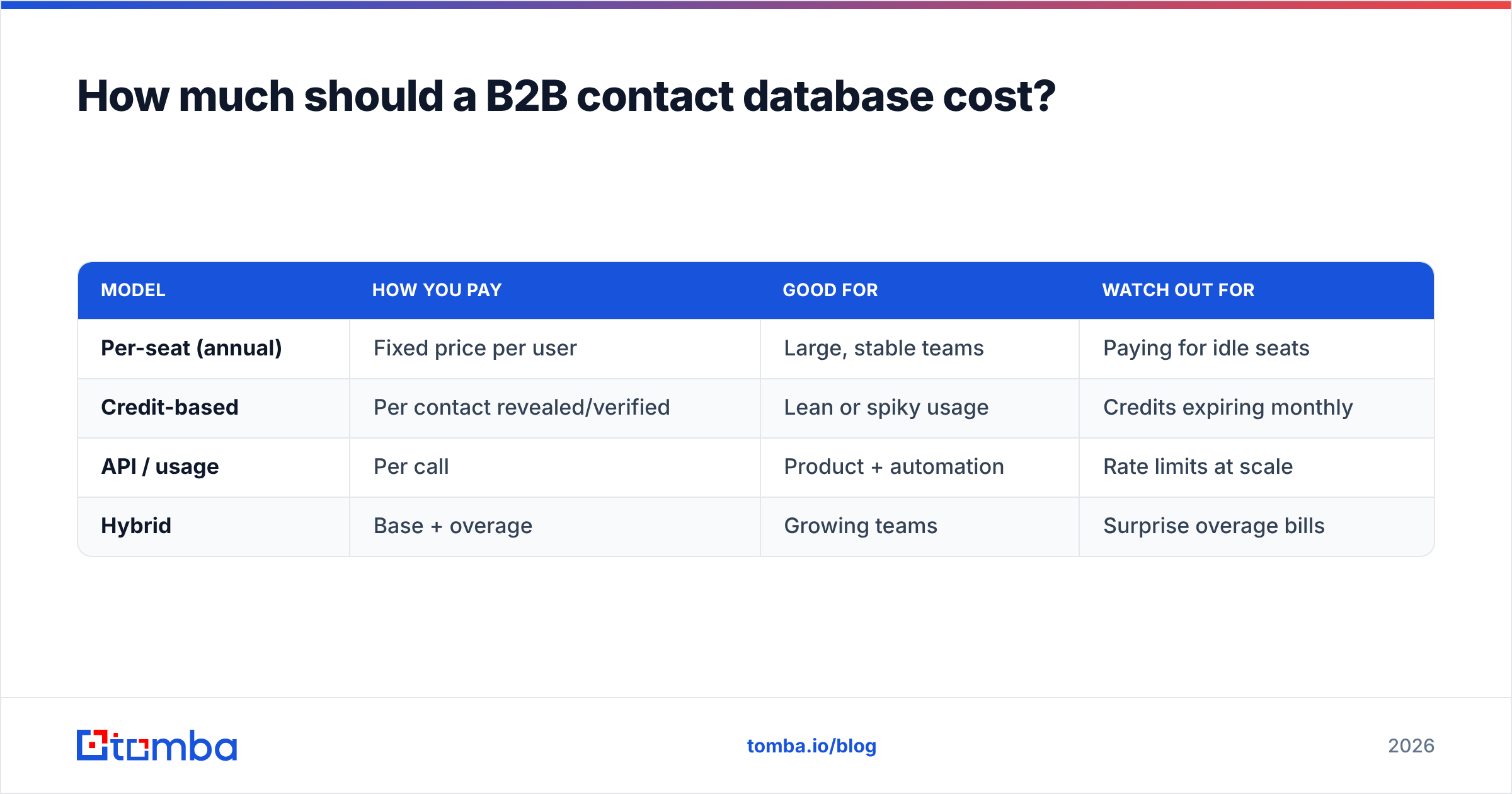
Pricing models matter as much as the sticker price, because they decide whether the cost scales with your team or with your usage.
| Model | How you pay | Good for | Watch out for |
|---|---|---|---|
| Per-seat (annual) | Fixed price per user | Large, stable teams | Paying for idle seats |
| Credit-based | Per contact revealed/verified | Lean or spiky usage | Credits expiring monthly |
| API / usage | Per call | Product + automation | Rate limits at scale |
| Hybrid | Base + overage | Growing teams | Surprise overage bills |
For most SMB and mid-market teams, a credit or usage model beats per-seat. Tomba's transparent pricing runs Free (25 searches/mo), Starter at $49/mo, Growth at $99/mo, Pro at $249/mo, and custom Enterprise — so you can start verifying real contacts before committing budget, then scale through the Tomba API when you automate. Compare that to enterprise platforms where the entry quote often starts in the four figures per month and you see why usage-based pricing is the budget-friendly default.
If you run large lists, factor in a bulk email finder workflow rather than paying per-seat for occasional heavy months.
Is a B2B contact database GDPR and CCPA compliant?#
Compliance depends on the vendor's sourcing and your use case, not on a checkbox in their marketing. Two databases with identical contact counts can carry very different legal exposure.
- Lawful basis — EU-focused vendors like Cognism lean on legitimate-interest processing and maintain do-not-contact suppression. US-scraped databases may not, which raises risk for EU outreach.
- Opt-out handling — The best providers honor suppression lists and propagate deletions. Ask how fast a removal request is reflected.
- Data minimization — Pulling only the fields you need (and verifying rather than hoarding) reduces your liability surface. On-demand verification tools fit this principle well.
Get your DPA in place, document your legitimate-interest assessment for EU contacts, and treat compliance as a recurring process. HubSpot's GDPR resources are a solid plain-English starting point before you ask a vendor pointed questions.
How do you choose the best B2B contact database for your team?#
Run this short evaluation instead of trusting demos:
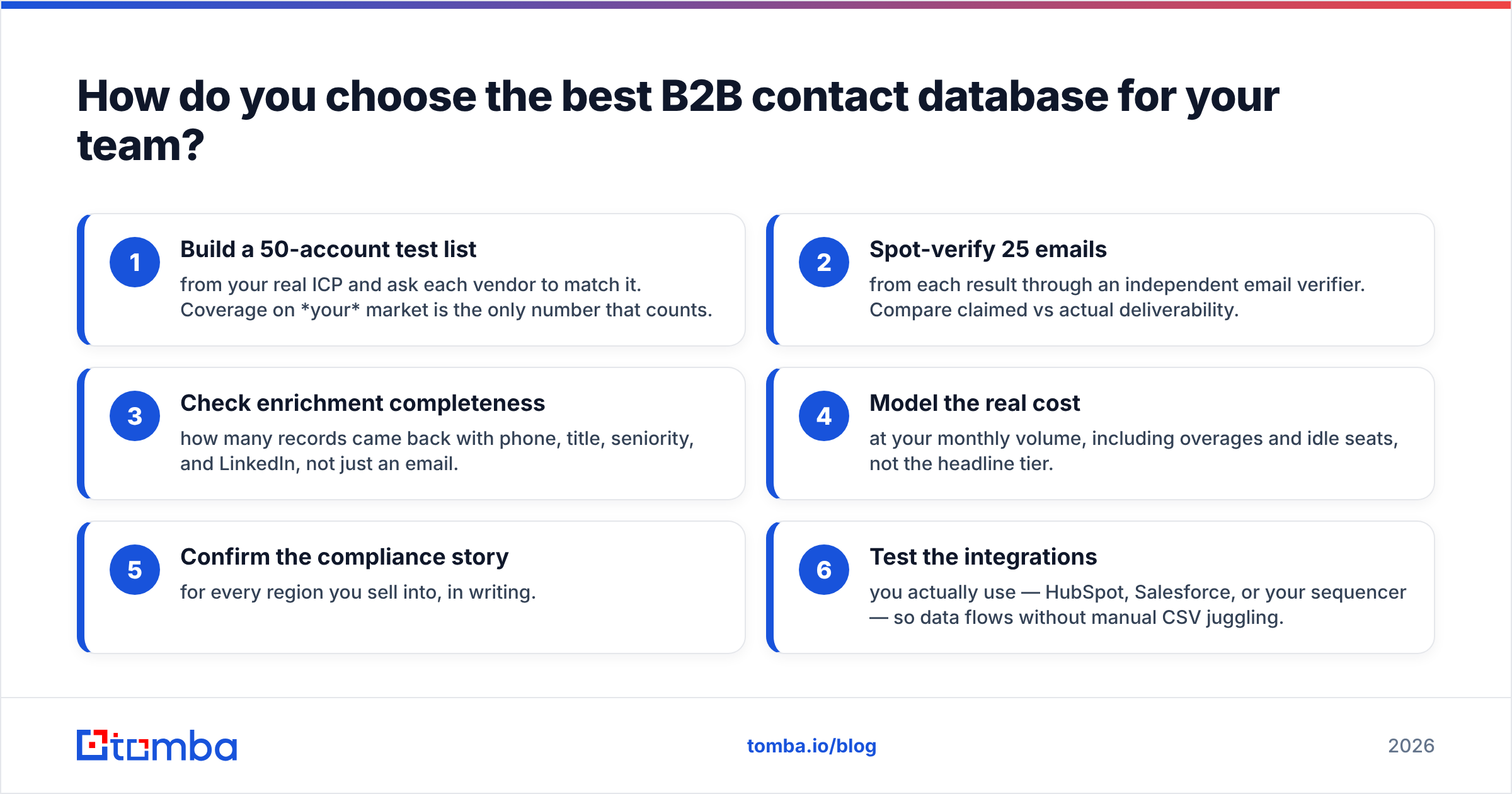
- Build a 50-account test list from your real ICP and ask each vendor to match it. Coverage on your market is the only number that counts.
- Spot-verify 25 emails from each result through an independent email verifier. Compare claimed vs actual deliverability.
- Check enrichment completeness — how many records came back with phone, title, seniority, and LinkedIn, not just an email.
- Model the real cost at your monthly volume, including overages and idle seats, not the headline tier.
- Confirm the compliance story for every region you sell into, in writing.
- Test the integrations you actually use — HubSpot, Salesforce, or your sequencer — so data flows without manual CSV juggling.
Whoever wins on accuracy-per-dollar across your real list is your best B2B contact database, regardless of brand recognition.
Frequently asked questions#
What is the most accurate B2B contact database? Accuracy varies by region and refresh cadence, so "most accurate" is ICP-dependent. The reliable approach is to verify any database's output before sending — even a strong provider has decayed records, and independent verification closes that gap.
Is a free B2B contact database any good? Free tiers (Apollo, Lusha, Tomba's 25 searches/mo) are excellent for testing data quality on your real accounts. They're limited for volume, but they let you compare deliverability before paying — which is exactly how you should buy.
Can I build my own B2B contact database? Yes — combine a domain search to find contacts, an email verifier to confirm them, and data enrichment to fill in firmographics. This usage-based approach often costs less than renting a large static warehouse you only partly use.
How often does B2B contact data go stale? Plan for roughly 22–30% annual decay as people change roles. Re-verify before each major campaign rather than trusting a record's original capture date.
The bottom line#
The best B2B contact database is the one that delivers verified, on-target contacts at a price your usage justifies — not the one with the largest record count on a billboard. Pick depth and intent (ZoomInfo, Cognism) when you're funded and enterprise; pick value and flexibility (Apollo, Lusha, RocketReach, Tomba) when you want accuracy per dollar.
If your priority is verified work emails you can trust on send day — built by domain, name, or company and verified in real time — start with the Tomba Email Finder. Test it free with 25 searches, verify the results against your own list, and scale through the API only when the data proves itself. That's how you buy a contact database that actually performs.
// get started
Find, verify and enrich your first contacts today
Start on the free plan with 25 searches a month, then scale when your team is ready.
Free plan · No credit card required · GDPR & CCPA
// about the author