Best B2B Contact Databases in 2026: A Buyer's Guide
Coverage, accuracy, compliance, and price rarely live in the same tool. Here is how the best B2B contact databases of 2026 actually compare — and how to pick one without overpaying.
TL;DR
- The "best" B2B contact database depends on your motion: coverage-heavy enterprise teams, accuracy-first outbound teams, and budget-conscious startups each have different winners.
- No vendor leads on every axis. ZoomInfo wins raw coverage, Cognism wins EU compliance, Apollo wins all-in-one value, and Tomba wins verified email accuracy per dollar.
- Decayed data is the silent killer: B2B contact records rot at roughly 22–30% per year, so verification freshness matters more than database size.
- Always pair a database with a real-time email verifier — a big list of unverified contacts is just an expensive bounce machine.
- For a verification-first, API-friendly stack, Tomba starts at $49/mo and undercuts the enterprise incumbents while keeping accuracy high.
What is a B2B contact database?#
A B2B contact database is a searchable store of business people and the companies they work for — names, job titles, work emails, phone numbers, LinkedIn URLs, and firmographics like industry, headcount, and revenue. Think of it as the difference between a phone book and a CRM: the phone book just lists everyone, while a good contact database lets you filter to "VP of Marketing at 50–200 person SaaS companies in Germany" and hand you their verified work email in seconds.
The best B2B contact databases combine three things that are surprisingly hard to do at once: broad coverage (how many real contacts exist in the index), high accuracy (how many of those records are correct today), and compliance (where the data came from and whether you can legally email or call the person). Most tools are strong on one or two of these and quietly weak on the third.
Here is the trap buyers fall into: vendors sell on coverage because "300 million contacts" is an easy headline. But coverage is the least useful number. A database with 300M contacts at 60% accuracy is worse for your campaigns than one with 100M contacts at 95% accuracy, because every bounce damages your sender reputation and shrinks your deliverable audience.

How do you judge a B2B contact database?#
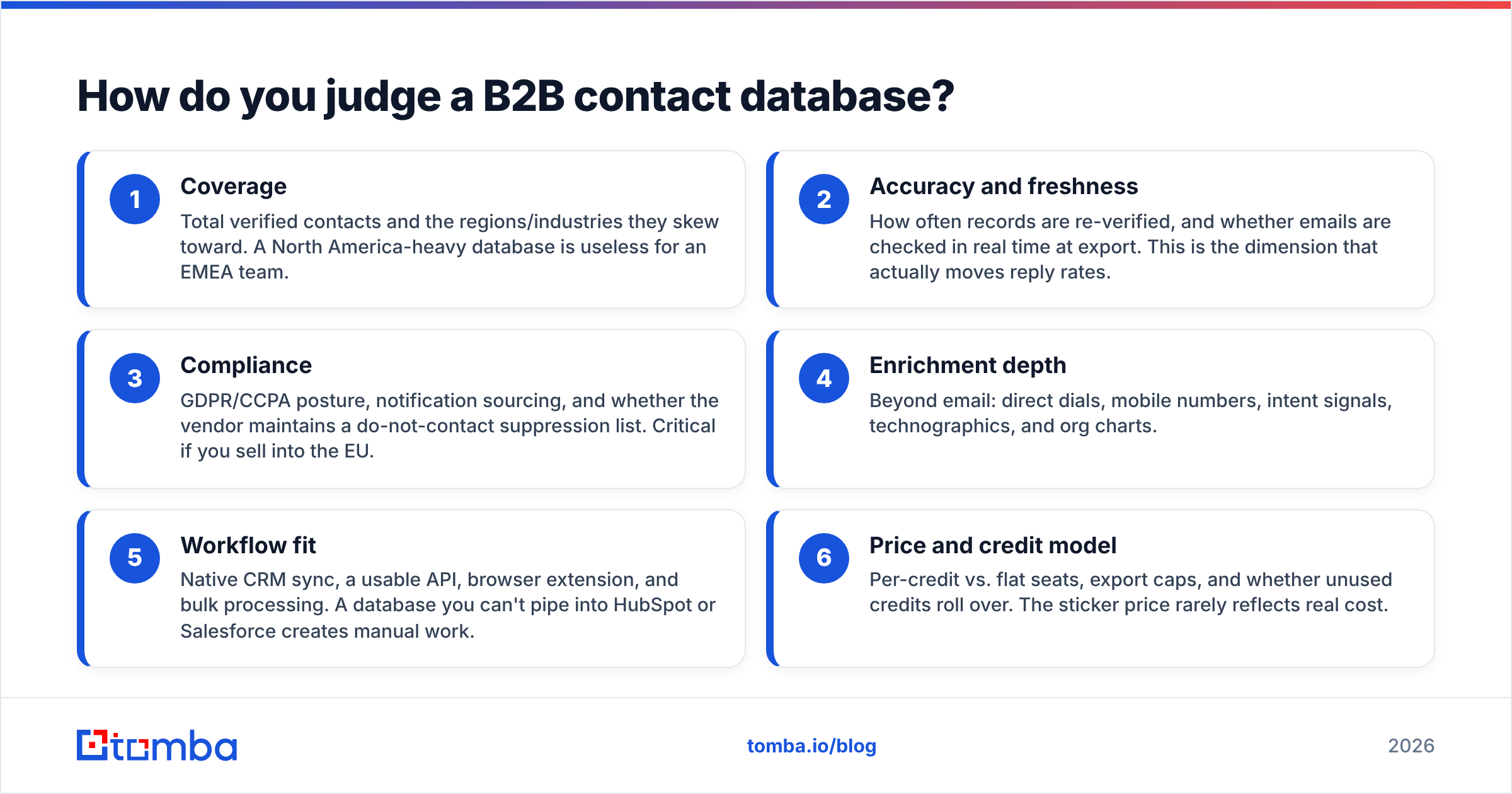
Score every vendor on these six dimensions before you look at price. Use this as your buyer's checklist:
- Coverage — Total verified contacts and the regions/industries they skew toward. A North America-heavy database is useless for an EMEA team.
- Accuracy and freshness — How often records are re-verified, and whether emails are checked in real time at export. This is the dimension that actually moves reply rates.
- Compliance — GDPR/CCPA posture, notification sourcing, and whether the vendor maintains a do-not-contact suppression list. Critical if you sell into the EU.
- Enrichment depth — Beyond email: direct dials, mobile numbers, intent signals, technographics, and org charts.
- Workflow fit — Native CRM sync, a usable API, browser extension, and bulk processing. A database you can't pipe into HubSpot or Salesforce creates manual work.
- Price and credit model — Per-credit vs. flat seats, export caps, and whether unused credits roll over. The sticker price rarely reflects real cost.
The reason this list matters: most "best B2B contact databases" roundups rank by brand recognition, not by the metric that predicts your campaign ROI. Accuracy and freshness are the two that separate a database that books meetings from one that burns your domain.
Which are the best B2B contact databases in 2026?#
Here is the honest landscape. Five tools cover the vast majority of real buying decisions, and each owns a different corner of the market.
ZoomInfo is the enterprise default. Its coverage and intent data are unmatched, and large sales orgs standardize on it because of org charts, scoops, and deep integrations. The catch is price — annual contracts routinely start in the five figures — and aggressive credit limits.
Apollo.io is the all-in-one favorite for SMB and mid-market. You get a large database, sequencing, and a dialer in one seat. Coverage is good and pricing is friendly, but email accuracy is inconsistent on smaller or international companies, so verification on export is essential. See how it compares as an Apollo alternative.
Cognism is the compliance and EU coverage leader. Phone-verified mobile numbers ("Diamond Data") and a strong GDPR posture make it the pick for teams selling into Europe. It is premium-priced and quote-gated.
Lusha is the fast, self-serve option for individual reps who want quick contact lookups via a browser extension. It is easy to start with but thinner on coverage and enrichment depth for full-team deployments.
Tomba is the verification-first, developer-friendly choice. Instead of selling a static list, it finds and verifies emails in real time by domain, name, or company, with a clean email finder API, bulk processing, and a transparent price ladder. It wins on accuracy per dollar for outbound teams that care more about clean, deliverable emails than about a giant pre-baked index.

The accuracy gap above is the whole reason verification-first tools exist. A static database is a snapshot the moment it was scraped; the moment someone changes jobs — and roughly a quarter of professionals do every year — that record is wrong. Real-time verification re-checks the email at the moment you export it, which is why a smaller, fresher index often beats a massive stale one.
How do the best B2B contact databases compare on price and features?#
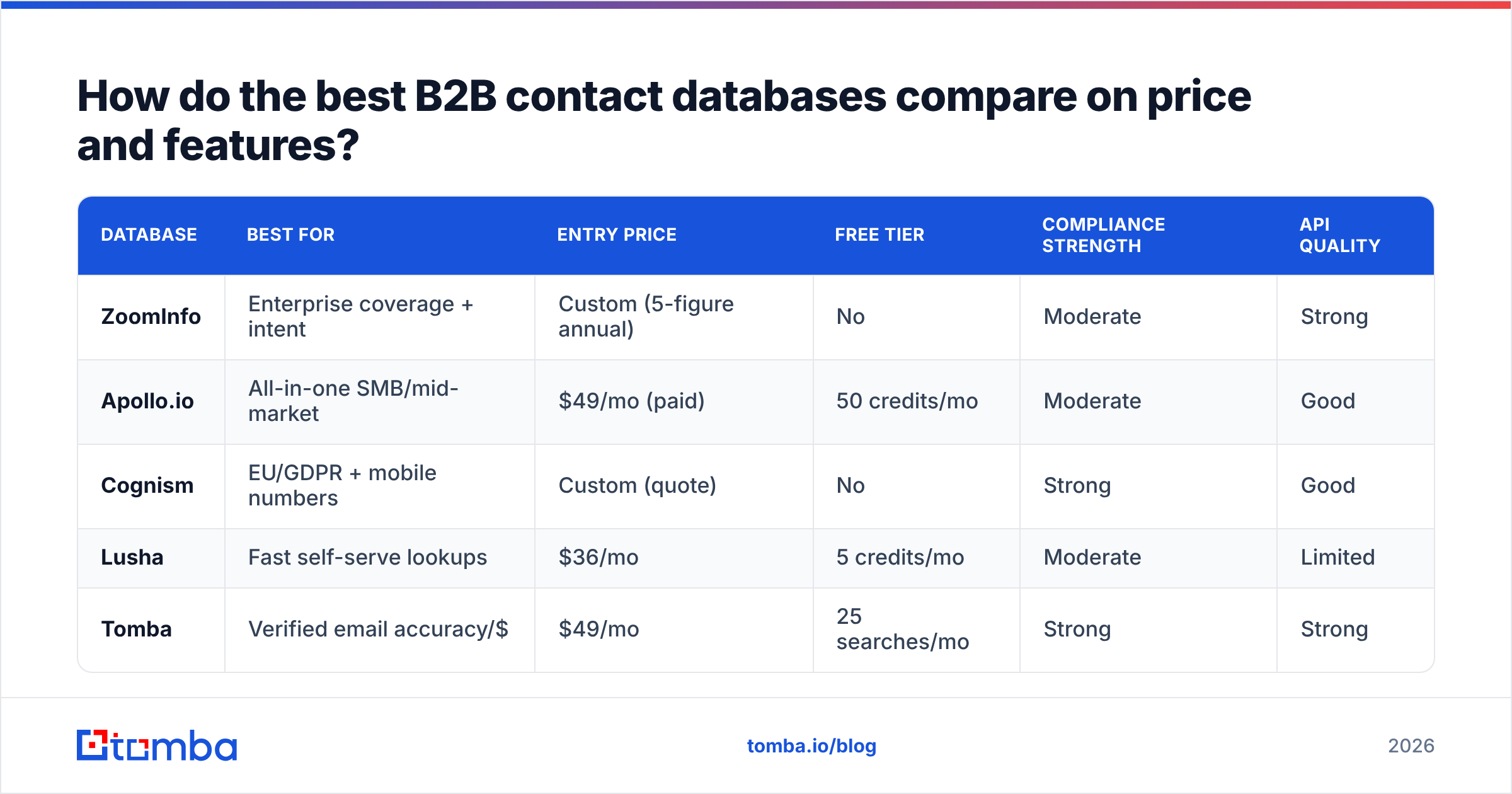
This is the comparison that matters. Below are the practical trade-offs across the five leading B2B contact databases in 2026. Prices are entry points; enterprise tiers are custom.

| Database | Best for | Entry price | Free tier | Compliance strength | API quality |
|---|---|---|---|---|---|
| ZoomInfo | Enterprise coverage + intent | Custom (5-figure annual) | No | Moderate | Strong |
| Apollo.io | All-in-one SMB/mid-market | $49/mo (paid) | 50 credits/mo | Moderate | Good |
| Cognism | EU/GDPR + mobile numbers | Custom (quote) | No | Strong | Good |
| Lusha | Fast self-serve lookups | $36/mo | 5 credits/mo | Moderate | Limited |
| Tomba | Verified email accuracy/$ | $49/mo | 25 searches/mo | Strong | Strong |
A few things jump out of that table. First, the two tools you can actually try without a sales call — Apollo and Tomba — are also the most budget-friendly entry points. Second, the enterprise incumbents hide their pricing behind quotes precisely because it is high and variable. Third, "free tier" is not a gimmick: it lets you test accuracy on your own target accounts before committing, which is the single best way to avoid buyer's remorse.
For teams that need both breadth and verified emails, the smart pattern in 2026 is a hybrid: use a coverage database for discovery, then run every exported contact through a dedicated email verifier and a catch-all verifier before it ever touches a sequence. That single step routinely cuts bounce rates from double digits down to 1–2%.
Why does data accuracy beat database size?#
Because you email people, not databases. The size of an index tells you nothing about whether the specific 500 contacts you export today will actually receive your message.
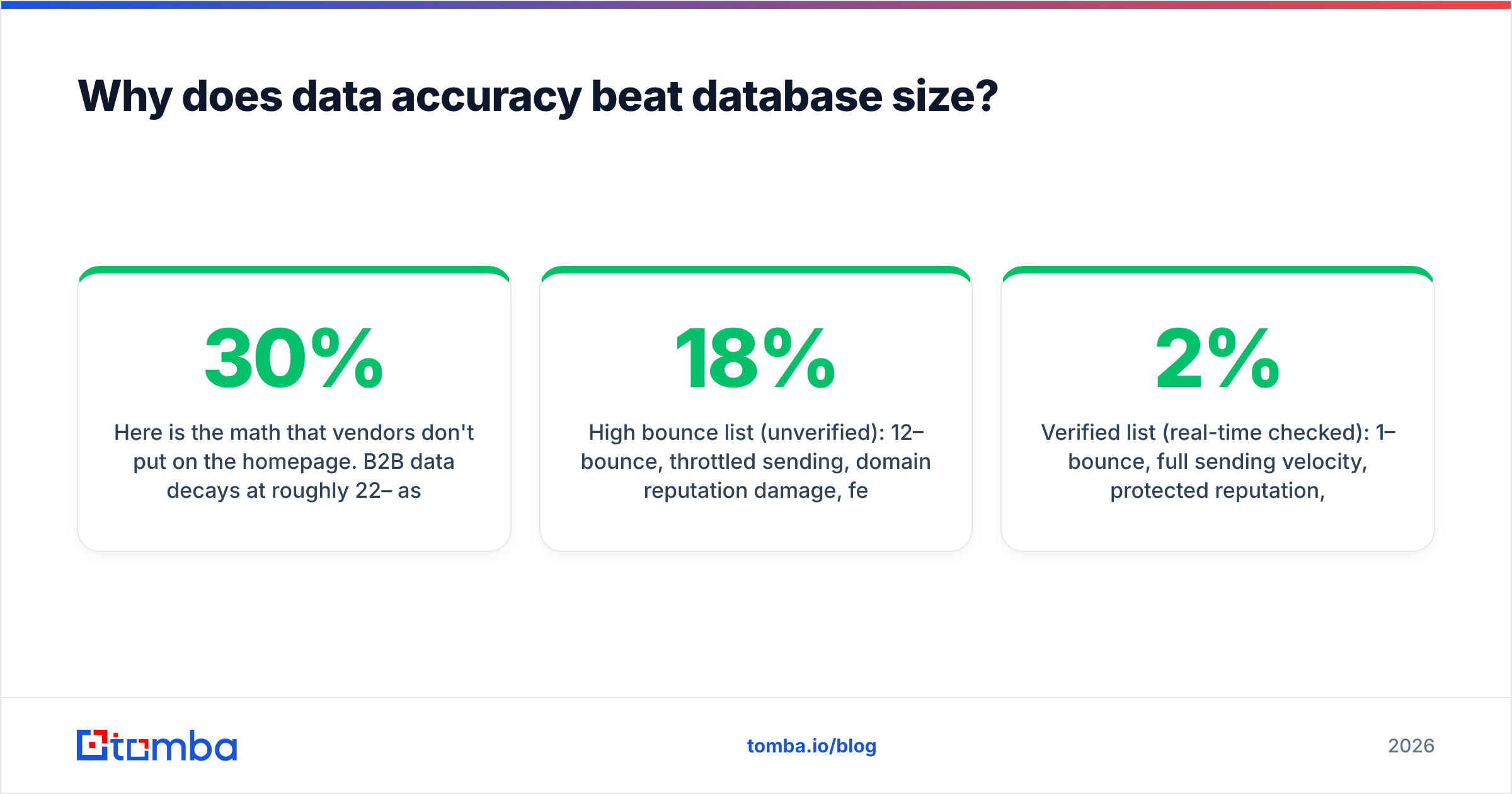
Here is the math that vendors don't put on the homepage. B2B data decays at roughly 22–30% per year as people switch jobs, companies rebrand, and email formats change. So a database advertised at "95% accuracy" on the day it was built is closer to 70% accurate twelve months later if it isn't continuously re-verified. The industry research backs this up — analyst firms like Gartner have long flagged poor data quality as a multi-million-dollar drag on revenue operations.
This is why verification-first tools structure the problem differently. Rather than handing you a year-old snapshot, they verify at the moment of export. The practical effect on a cold campaign:
- High bounce list (unverified): 12–18% bounce, throttled sending, domain reputation damage, fewer inboxes reached.
- Verified list (real-time checked): 1–2% bounce, full sending velocity, protected reputation, more replies per send.
The reputation angle compounds. Mailbox providers watch your bounce and complaint rates; a few bad sends from a stale list can tank your email deliverability for weeks, which means even your clean contacts stop landing in the inbox. Buying a bigger database to "find more people" while ignoring verification is like buying a faster car with no brakes.
If you want to pressure-test any vendor's accuracy claim, do this: pull 100 contacts from a domain you know well — your own company or a customer — and check how many emails are real, current, and correctly formatted. Tools like Tomba's domain search make this a two-minute test, and it tells you more than any G2 badge.
Which B2B contact database should you choose?#
Match the tool to your motion, not to the brand with the biggest logo. Here is the decision shortcut:
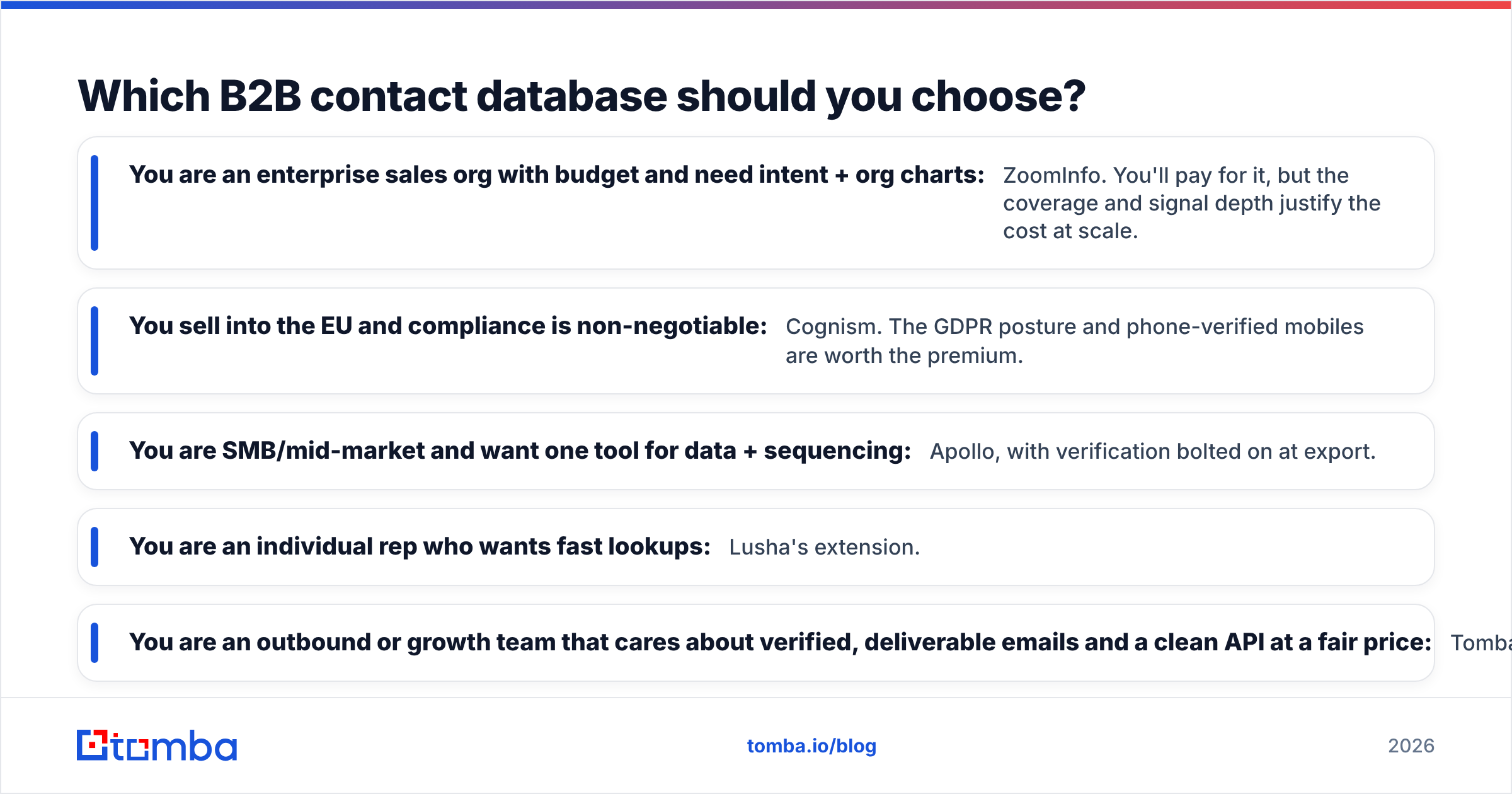
- You are an enterprise sales org with budget and need intent + org charts: ZoomInfo. You'll pay for it, but the coverage and signal depth justify the cost at scale.
- You sell into the EU and compliance is non-negotiable: Cognism. The GDPR posture and phone-verified mobiles are worth the premium.
- You are SMB/mid-market and want one tool for data + sequencing: Apollo, with verification bolted on at export.
- You are an individual rep who wants fast lookups: Lusha's extension.
- You are an outbound or growth team that cares about verified, deliverable emails and a clean API at a fair price: Tomba.
Most teams over-buy. They purchase an enterprise database for its coverage, then use 10% of it and email stale records that bounce. A leaner stack — a focused finder plus rigorous verification — often books more meetings for a fraction of the spend. You can also start free on most modern tools and only scale credits once accuracy is proven on your accounts.
One more practical tip: whatever you choose, build verification into your workflow, not as an afterthought. Connect your database to your CRM via native integrations, enrich incoming leads with data enrichment, and verify in real time. A database is only as valuable as the percentage of it that reaches a real inbox.
The bottom line#
There is no single "best" B2B contact database — there is the best one for your region, your motion, and your budget. ZoomInfo, Cognism, Apollo, and Lusha each own a defensible corner. But the dimension that quietly determines your campaign results is not coverage; it is verified accuracy at the moment you export.
If your goal is to find professional emails that actually land — by domain, by name, or by company — and pipe them straight into your stack via API, start with the Tomba Email Finder. The free tier gives you 25 searches a month to test accuracy on your own target accounts, and paid plans start at $49/mo with built-in verification, bulk processing, and transparent pricing that won't require a sales call. Try it on a domain you know well, count the verified hits, and let the accuracy decide.
Ready to find emails that actually work?
Join 150,000+ professionals who stopped guessing and started sending. Free credits on signup — no credit card required.
Get the Tomba newsletter
Practical outbound tactics and product updates — once every two weeks.
About the author